9 Best AI Support Software for Growing Teams in 2026
Growing teams struggling to scale customer support without ballooning headcount will find this guide to the 9 best AI support software for growing teams invaluable. It evaluates purpose-built platforms on automation depth, setup ease, integrations, analytics, and pricing scalability, helping teams from 10-person startups to 200-person companies handle increasing ticket volume efficiently while maintaining support quality.
 Matt PattoliFounder13 min read
Growing teams face a painful paradox: as your customer base expands, support quality tends to slip unless you scale headcount at the same pace, which crushes margins. AI support software solves this by automating ticket resolution, surfacing insights, and letting lean teams punch above their weight.
The market is crowded, though, and not every tool is built with scaling teams in mind. Some are enterprise behemoths that overwhelm small ops. Others are basic chatbots that break down once complexity increases. This guide focuses on AI support software purpose-built for teams in growth mode, tools that handle increasing volume today and evolve with you tomorrow.
We evaluated each platform on automation depth, ease of setup, integration flexibility, analytics capabilities, and pricing scalability. Whether you're a 10-person startup or a 200-person company hitting an inflection point, these tools deserve a close look.
1. Halo AI
Best for: Growing B2B teams that want an AI-first support architecture with deep product context
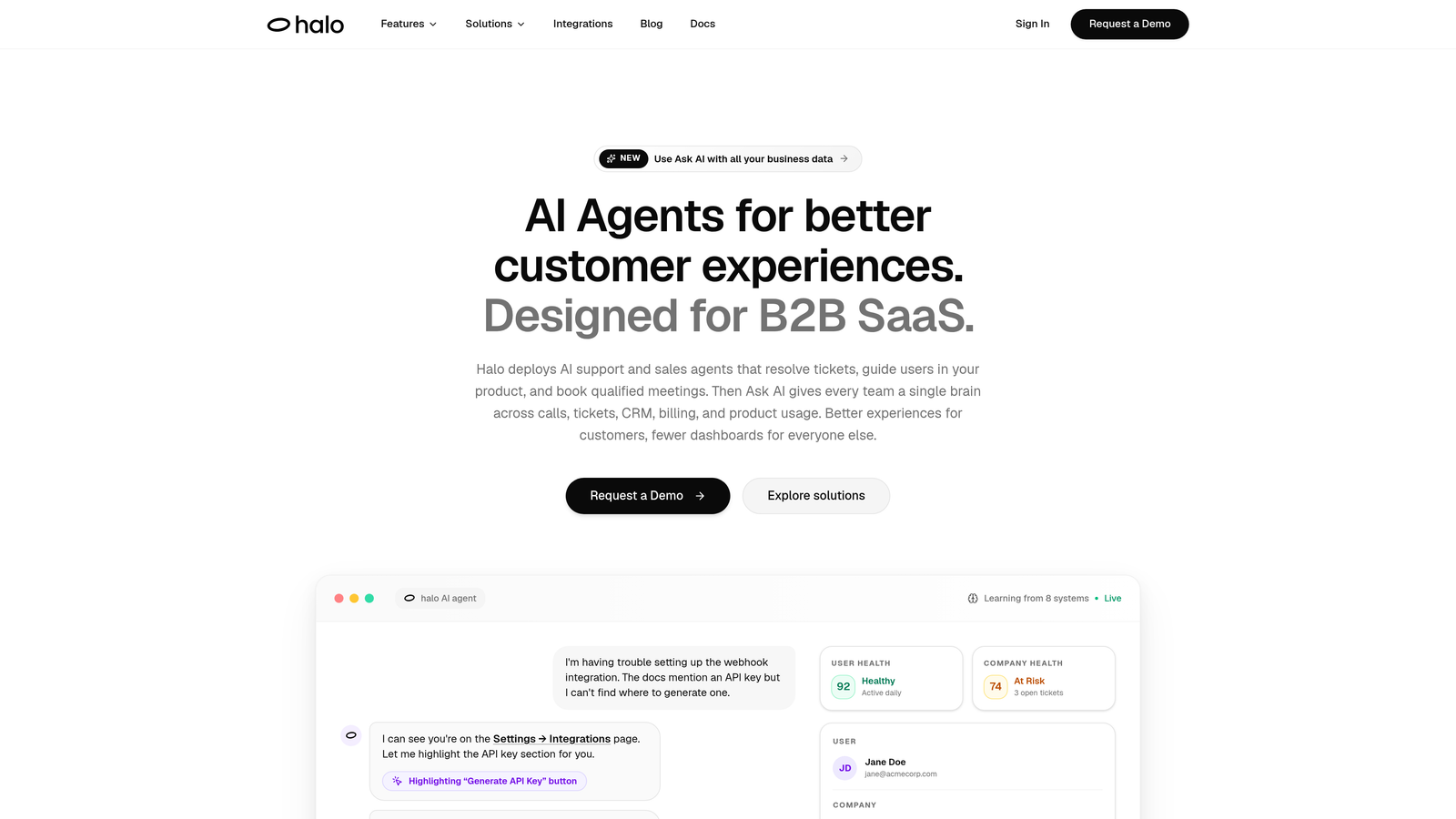
Halo AI is an AI-first customer support platform that deploys intelligent agents to resolve tickets, guide users with page-aware context, and generate business intelligence while learning from every interaction.
Where This Tool Shines
What sets Halo apart from retrofitted AI tools is its architecture. Rather than layering AI onto a traditional ticketing system, Halo is built around AI agents as the primary resolution layer. That distinction matters enormously for growing teams because the system improves continuously, learning from every resolved ticket rather than staying static.
The page-aware chat widget is particularly compelling. It sees what your user sees in-product, which means guidance is contextual rather than generic. Instead of pointing someone to a knowledge base article, Halo can walk them through the exact screen they're on. For SaaS teams with complex products, this dramatically reduces the gap between "user is confused" and "issue resolved."
Key Features
Page-Aware Chat Widget: Understands the user's current product context to deliver precise, in-the-moment guidance rather than generic responses.
Continuous Learning AI Agents: Resolution accuracy improves over time as the system learns from every interaction, reducing the need for manual rule updates.
Smart Inbox with Business Intelligence: Surfaces customer health signals, anomaly detection, and revenue intelligence beyond standard CSAT metrics.
Auto Bug Ticket Creation: Automatically generates and routes bug reports to Linear and Slack, eliminating a manual handoff that often falls through the cracks.
Live Agent Handoff: Escalates complex issues to human agents with full conversation context preserved, so nothing gets repeated.
Best For
Halo is an excellent fit for B2B SaaS companies that want AI to be the primary resolution layer, not a supplementary feature. Teams already using Intercom, Zendesk, or Freshdesk who feel like they're managing a tool rather than benefiting from one will find Halo's AI-first approach refreshing. It connects to Linear, Slack, HubSpot, Stripe, Zoom, PandaDoc, and Fathom, making it especially valuable for product-led growth teams.
Pricing
Contact for pricing. Halo is designed to scale with growing teams without per-agent penalties, which makes it structurally different from seat-based incumbents that get expensive as your team grows.
2. Intercom
Best for: Teams wanting a unified messaging platform with a capable out-of-the-box AI agent
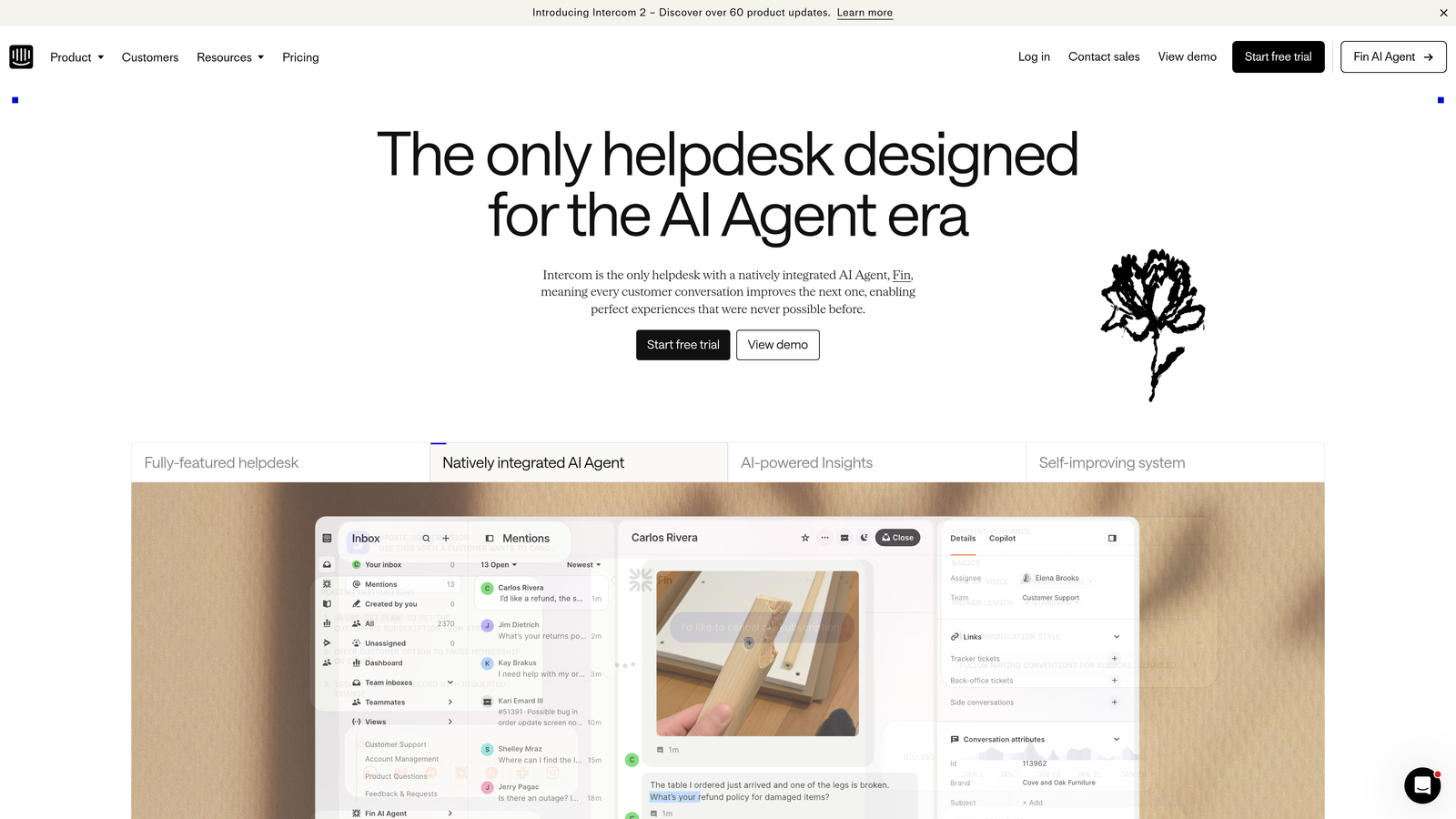
Intercom is a unified customer messaging platform featuring its Fin AI agent, which resolves support conversations using your knowledge base and conversation history.
Where This Tool Shines
Intercom's Fin AI agent is one of the more mature AI resolution products on the market. It draws from your existing knowledge base to handle common questions conversationally, and its integration into Intercom's broader platform means you're not managing a separate AI layer on top of your support stack.
The platform also excels at proactive support. Product tours, in-app messages, and triggered outreach let teams address confusion before it becomes a ticket, which is a meaningful lever for growing SaaS products.
Key Features
Fin AI Agent: Handles automated conversational resolution by drawing on your knowledge base and prior conversation history.
Unified Inbox: Consolidates chat, email, and social channels into a single workspace for agents.
Product Tours and In-App Messaging: Enables proactive support flows that reduce inbound ticket volume.
Custom Bots and Workflow Automation: Visual builder for creating routing logic and automated response flows.
Customer Data Platform: Rich user data and segmentation that informs both support and product decisions.
Best For
Intercom works well for growth-stage SaaS companies that want AI resolution, proactive messaging, and product engagement tools in a single platform. Teams already invested in the Intercom ecosystem will find Fin a natural upgrade. Be aware that Fin is charged per resolution, so costs can climb as volume scales.
Pricing
Starts at $39/seat/month. Fin AI is charged per resolution, which can make cost forecasting unpredictable at higher ticket volumes.
3. Zendesk AI
Best for: Teams that need enterprise-grade ticketing infrastructure with AI layered on top
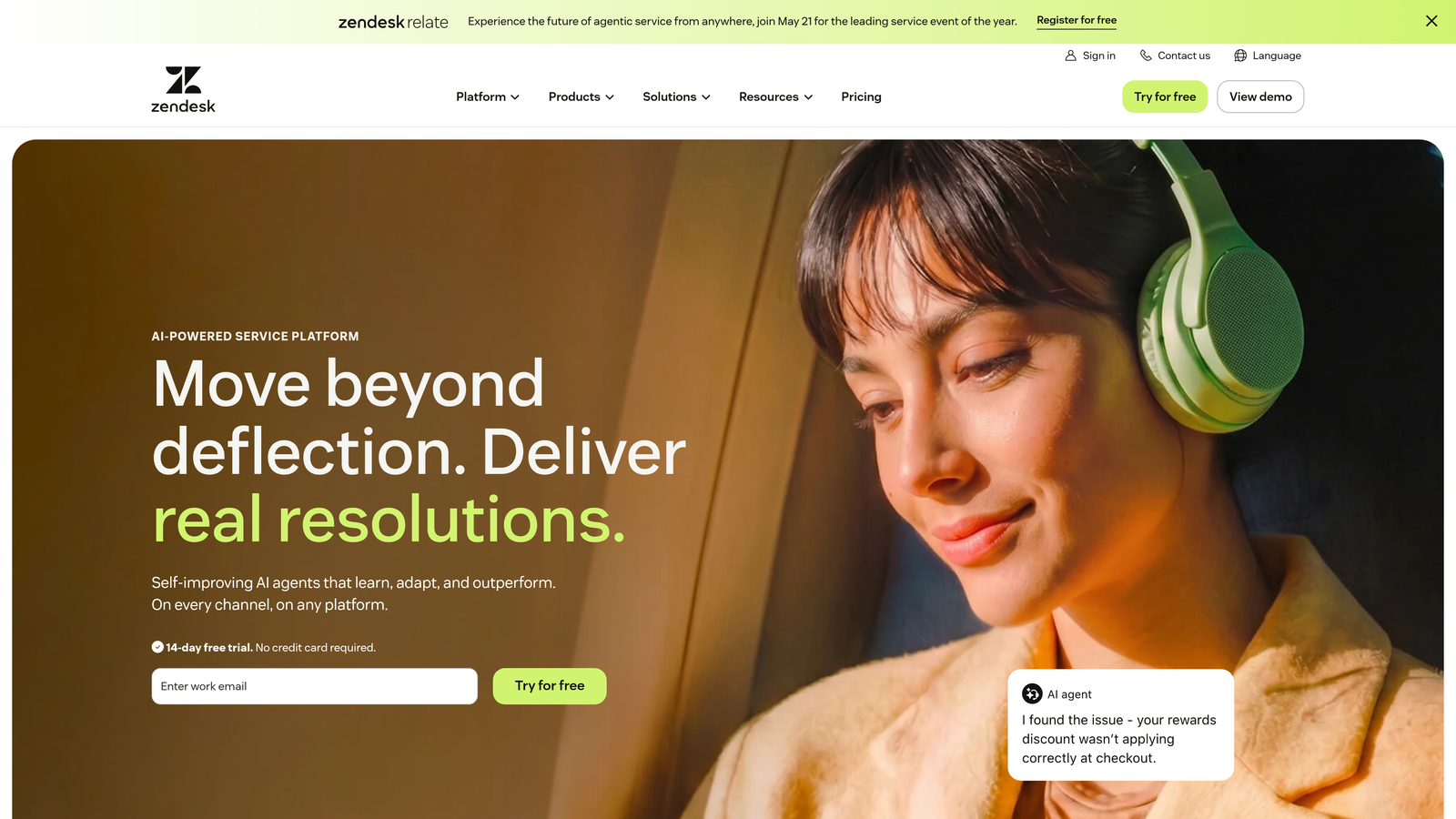
Zendesk is the industry-standard helpdesk platform with AI-powered ticket routing, agent assistance, and automated resolution capabilities built onto its mature ticketing system.
Where This Tool Shines
Zendesk's primary strength is its depth and breadth. The platform has been refined over many years, and its omnichannel support, reporting capabilities, and integration marketplace are genuinely best-in-class. For teams that need to handle email, chat, phone, and social from a single platform, Zendesk delivers.
The AI capabilities, while not native from the ground up, are increasingly capable. Intelligent routing and agent assist features reduce handle time meaningfully, and the platform's scale means it can support teams from startup to enterprise without requiring a migration.
Key Features
AI-Powered Ticket Classification and Routing: Automatically categorizes and routes incoming tickets to the right team or agent.
Agent Assist: Surfaces suggested replies and relevant knowledge base articles in real time during conversations.
1,500+ Pre-Built Integrations: One of the largest integration marketplaces in the support category.
Omnichannel Support: Manages email, chat, phone, and social from a unified platform.
Advanced Analytics and Custom Dashboards: Deep reporting capabilities for teams that need granular performance data.
Best For
Zendesk suits teams that prioritize stability, integration breadth, and a proven ticketing foundation. It's particularly strong for companies with complex support workflows and multiple channels. Growing teams should note that the AI features often require higher-tier plans, and the platform's complexity can slow initial setup.
Pricing
Starts at $19/agent/month for basic plans. AI capabilities are available as add-ons or on higher-tier plans, which can increase total cost significantly as teams scale.
4. Freshdesk (Freddy AI)
Best for: Budget-conscious teams that want solid helpdesk functionality with AI at accessible price points
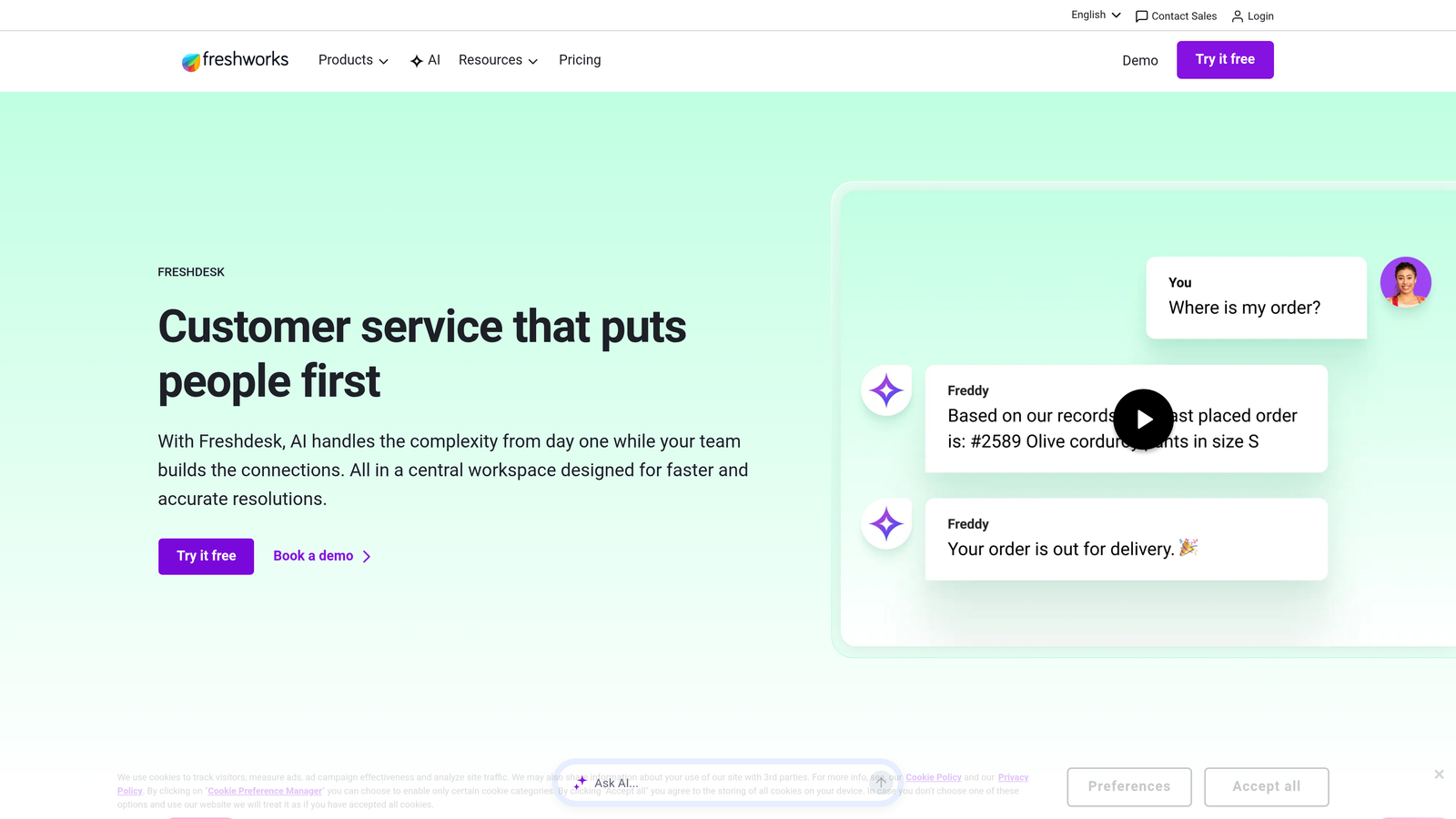
Freshdesk is a full-featured helpdesk with Freddy AI capabilities for ticket auto-triage, suggested responses, and chatbot automation at competitive price points.
Where This Tool Shines
Freshdesk's value proposition is clear: you get a capable helpdesk with AI features at a price that doesn't require a lengthy procurement conversation. The free tier for up to two agents makes it genuinely accessible for early-stage teams, and the Freddy AI features on paid plans handle the most common automation needs without significant configuration overhead.
The built-in collaboration tools, including team huddles and shared ownership, are a nice touch for growing teams where support is still a shared responsibility rather than a dedicated function.
Key Features
Freddy AI Auto-Triage: Automatically categorizes and prioritizes incoming tickets based on content and context.
Canned Response Suggestions: Surfaces relevant pre-written responses to speed up agent reply times.
Free Tier: Supports up to two agents with basic ticketing, making it accessible for very early-stage teams.
Built-In Collaboration Tools: Team huddles and shared ticket ownership reduce coordination friction.
Multi-Channel Support: Handles email, phone, chat, and social from a single platform.
Best For
Freshdesk is a strong choice for teams that are price-sensitive and need a reliable helpdesk with growing AI capabilities. It's particularly well-suited to teams in the 5-50 agent range who want to avoid the complexity and cost of Zendesk while still getting meaningful automation. Freddy AI is available on Pro plans and above, so budget accordingly.
Pricing
Free tier available for up to two agents. Paid plans start at $15/agent/month. Freddy AI is included on Pro plans and above.
5. Tidio
Best for: E-commerce and SMB teams that want fast chatbot deployment with minimal technical lift
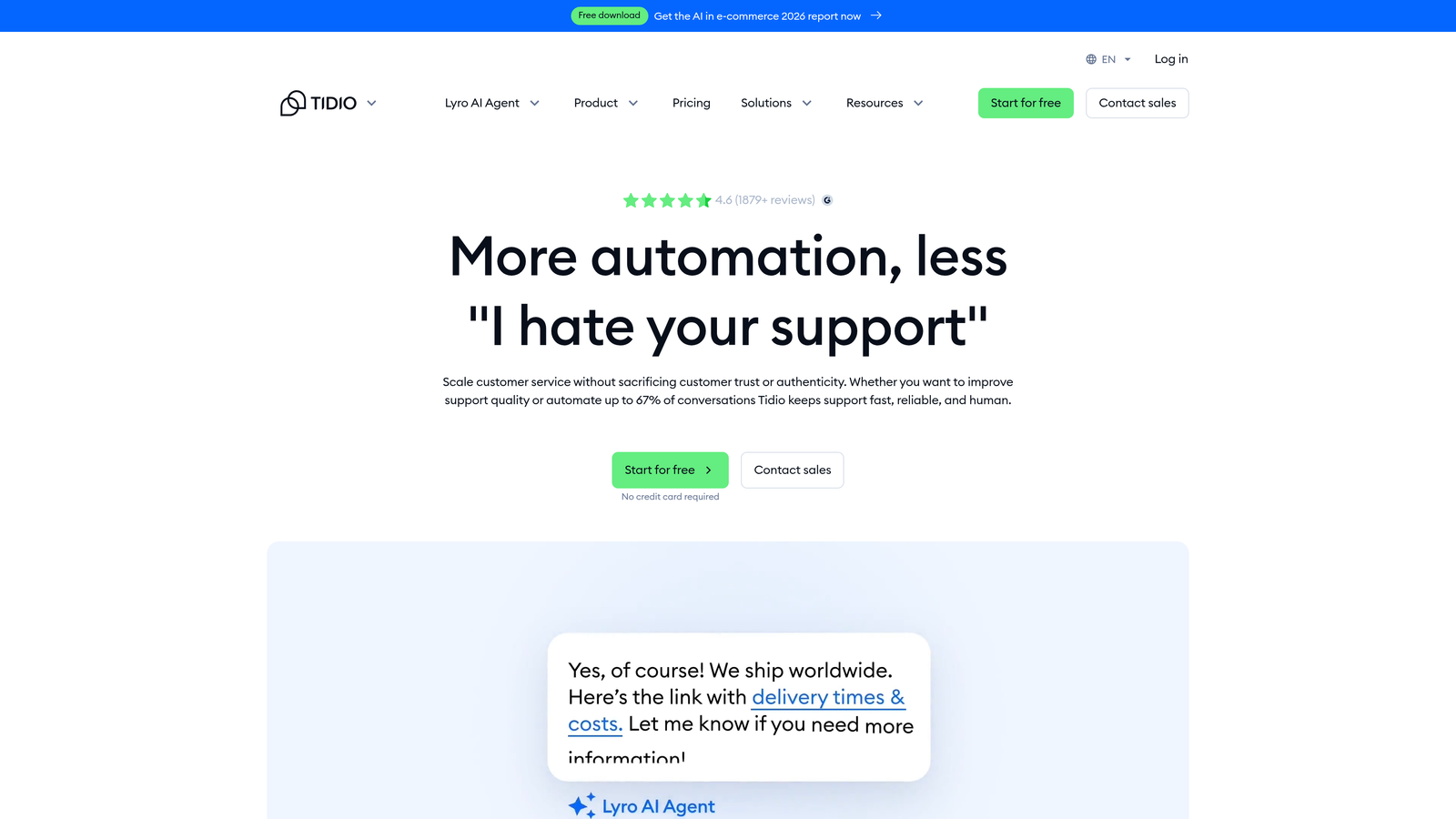
Tidio is a conversational support platform featuring the Lyro AI chatbot for automated responses and a visual flow builder designed for quick deployment.
Where This Tool Shines
Tidio's biggest advantage is speed to value. The visual drag-and-drop flow builder lets non-technical team members build and deploy chatbot flows without writing a line of code. For teams that need something working in days rather than weeks, Tidio removes most of the friction.
Lyro AI, Tidio's AI chatbot, is trained on your FAQ and knowledge base content, which means it can handle a reasonable range of common questions without extensive manual configuration. The platform's native integrations with Shopify and WordPress make it especially practical for e-commerce teams.
Key Features
Lyro AI Chatbot: Trained on your existing FAQ and knowledge base content for automated question resolution.
Visual Flow Builder: Drag-and-drop interface for building chatbot flows without coding.
Live Chat with Visitor Monitoring: Real-time visibility into active visitors for proactive engagement.
E-Commerce Integrations: Native connections to Shopify, WordPress, and other e-commerce platforms.
Conversation Analytics: Performance tracking for chatbot and live chat interactions.
Best For
Tidio is best suited for e-commerce brands and SMBs that want a chatbot and live chat solution with a low barrier to entry. It's less suited to complex B2B SaaS support scenarios but excels where the primary need is answering product and order questions quickly.
Pricing
Free plan available. Paid plans from $29/month. Lyro AI is an add-on starting at $39/month, priced separately from the base platform.
6. Ada
Best for: Mid-market and enterprise teams that need scalable, no-code AI agent deployment
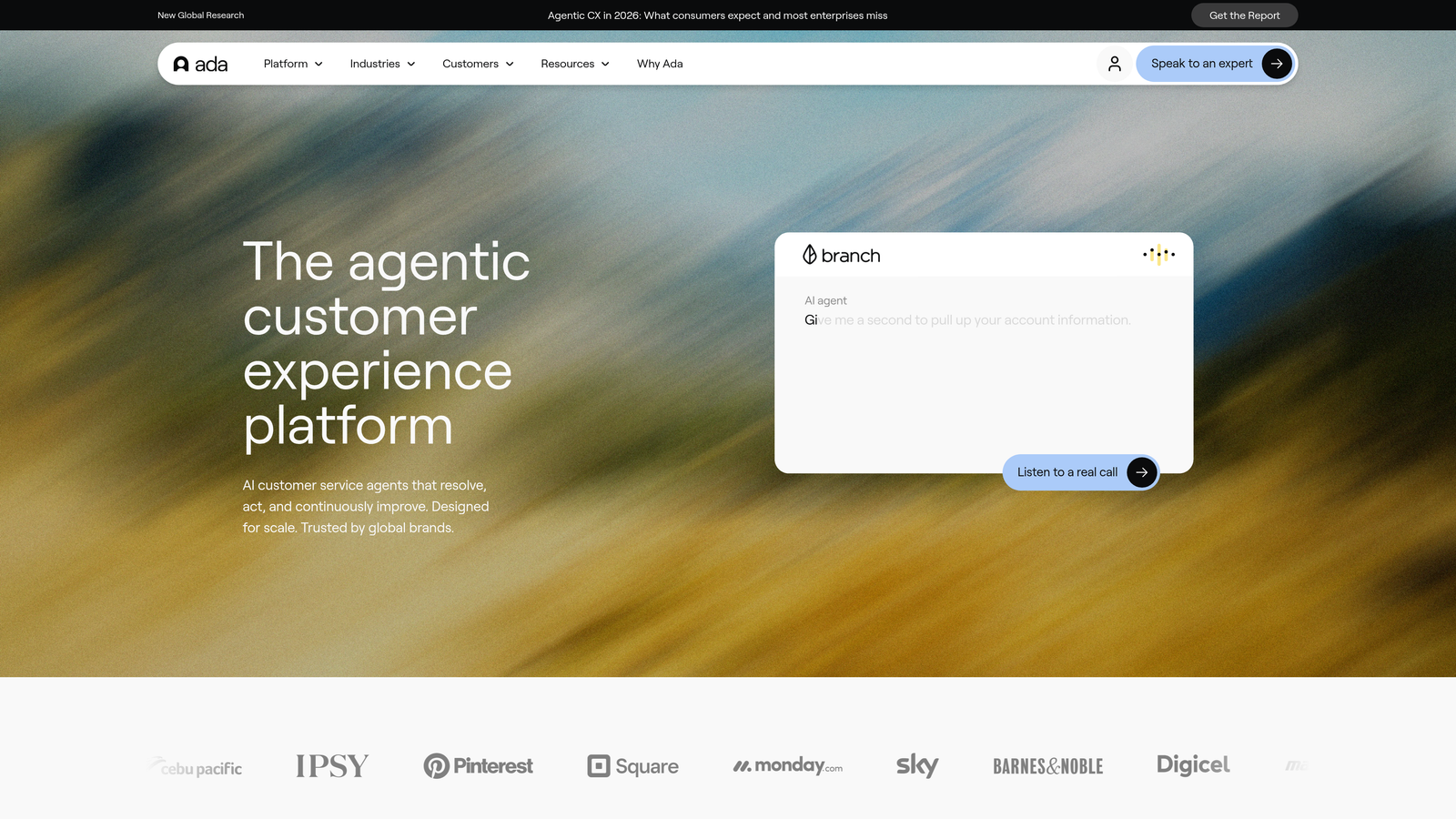
Ada is an enterprise-focused AI automation platform that enables teams to build and deploy AI agents without coding, designed for high-volume support environments.
Where This Tool Shines
Ada's no-code agent builder is genuinely powerful. Teams can configure AI agents that don't just answer questions but actually execute tasks, which puts it in a different category from simple FAQ bots. The reasoning engine behind Ada's agents allows for more nuanced handling of complex queries than most rule-based chatbot builders.
The platform's multilingual support across 50+ languages and enterprise security certifications make it one of the few AI support tools that can operate at global scale without significant custom development.
Key Features
No-Code AI Agent Builder: Visual interface for creating and configuring AI agents without engineering resources.
Action-Oriented AI: Agents can execute tasks and complete workflows, not just answer questions.
Multi-Channel Deployment: Web, mobile, social, and voice channels from a single platform.
Multilingual Support: Handles conversations in 50+ languages for global support operations.
Enterprise Security and Compliance: Certifications and controls suited to regulated industries and large organizations.
Best For
Ada is best suited for mid-market and enterprise teams with significant ticket volumes, global audiences, and the budget to match. Early-stage teams may find the pricing and implementation scope more than they need, but for companies with complex, high-volume support operations, Ada's capabilities justify the investment.
Pricing
Custom pricing. Ada is positioned for mid-market and enterprise budgets, so expect a more involved procurement process than lower-tier alternatives.
7. Help Scout
Best for: Teams that want AI to enhance human agents rather than replace them
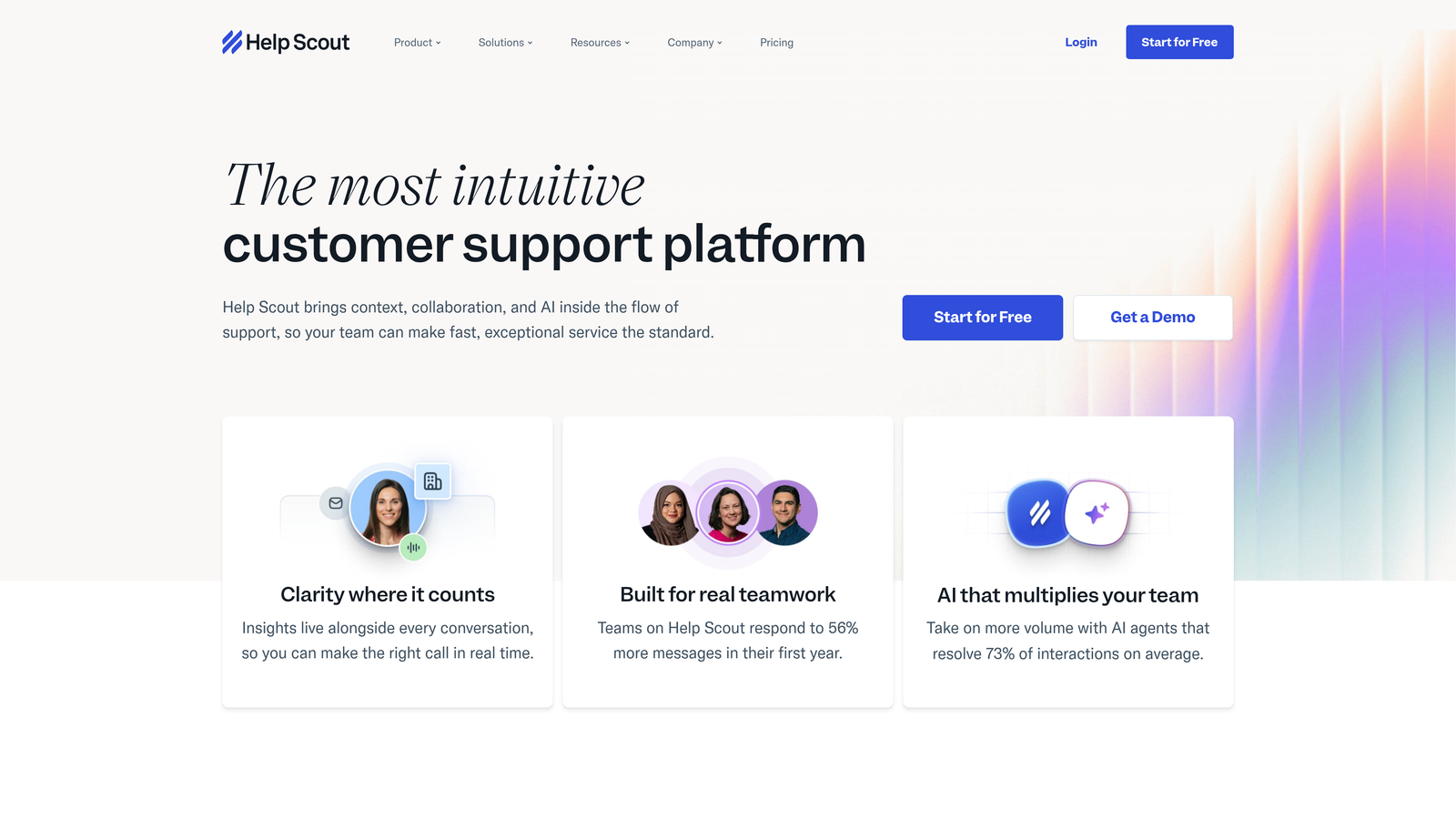
Help Scout is a shared inbox platform with AI-powered drafting, summarization, and recommendations designed for teams that prioritize human-led support augmented by AI.
Where This Tool Shines
Help Scout's philosophy is distinct from most AI-first tools: it treats AI as a productivity layer for human agents rather than an autonomous resolution engine. AI Drafts generate reply suggestions based on conversation context, and AI Summarize gives agents quick overviews during handoffs. The result is faster human responses, not fewer human responses.
For teams where the quality and tone of human communication is central to the brand experience, this approach is genuinely valuable. The clean, intuitive interface also means onboarding new agents is straightforward, which matters when teams are growing quickly.
Key Features
AI Drafts: Generates contextually relevant reply suggestions for agents to review, edit, and send.
AI Summarize: Creates quick conversation summaries to speed up agent handoffs and context-switching.
Shared Inbox with Collision Detection: Prevents two agents from responding to the same ticket simultaneously.
Beacon Widget: Embeds help content and live chat directly in your product.
Docs Knowledge Base: Built-in knowledge base with AI-powered search for self-service support.
Best For
Help Scout is an excellent fit for teams where human connection is core to the support experience, such as professional services firms, high-touch SaaS companies, and brands with strong customer relationships. It's less suited to teams seeking high-volume autonomous resolution.
Pricing
Starts at $25/user/month. AI features are included on the Plus plan at $50/user/month. Pricing is transparent and predictable, which growing teams tend to appreciate.
8. Drift (Salesloft)
Best for: B2B teams that want to convert support interactions into pipeline and revenue
Drift is a conversational AI platform that bridges support and sales, using AI chatbots and real-time engagement to turn support interactions into revenue opportunities.
Where This Tool Shines
Drift occupies a unique position in this list: it's as much a revenue tool as a support tool. The AI chatbots use intent detection to distinguish between support queries and buying signals, routing conversations accordingly. For B2B teams where support and sales overlap frequently, this blending of functions can be genuinely powerful.
The real-time visitor intelligence and engagement scoring give sales and support teams shared visibility into who is on the site, what they're doing, and how to engage them most effectively. This makes Drift particularly compelling for product-led growth companies where the line between support and expansion is fluid.
Key Features
AI Chatbots with Intent Detection: Identifies whether a visitor needs support or has buying intent, routing accordingly.
Real-Time Visitor Intelligence: Live engagement scoring and visitor tracking for proactive outreach.
Meeting Scheduling: Enables direct meeting booking from support conversations to accelerate pipeline.
CRM Integration: Deep connections with Salesforce and HubSpot for revenue attribution.
Conversational Analytics: Performance reporting that ties support interactions to revenue outcomes.
Best For
Drift is best suited for mid-market B2B teams where support and sales are closely connected. If your support team regularly surfaces expansion opportunities or your sales team relies on chat engagement, Drift's combined approach creates real efficiency. Pure support teams may find the sales-forward orientation more than they need.
Pricing
Custom pricing, positioned for mid-market B2B teams. Expect pricing conversations to involve both support and sales stakeholders given the platform's dual nature.
9. Kustomer
Best for: Teams that need a CRM-native support platform with full customer context at every interaction
Kustomer is a CRM-powered support platform with AI classification, routing, and a unified customer timeline that gives agents complete context across every interaction.
Where This Tool Shines
Kustomer's defining feature is its CRM-native architecture. Rather than treating support as an isolated function, Kustomer aggregates every customer interaction, purchase history, and data point into a unified timeline. Agents walk into every conversation with full context, which reduces handle time and improves resolution quality without requiring agents to toggle between systems.
The AI classification and sentiment analysis capabilities add meaningful automation on top of this data-rich foundation. Routing decisions become smarter because they're informed by the full customer relationship, not just the current ticket.
Key Features
Unified Customer Timeline: Aggregates all interactions, purchases, and data points into a single chronological view per customer.
AI Classification and Sentiment Analysis: Automatically categorizes tickets and detects customer sentiment for smarter routing.
Omnichannel Support: Seamless channel switching without losing conversation context.
Custom Workflow Automation: Business process automation builder for complex routing and escalation logic.
CRM-Native Data Integration: Deep customer data architecture that goes beyond standard helpdesk records.
Best For
Kustomer is well-suited for teams in retail, e-commerce, and high-touch B2C environments where customer history is central to support quality. The CRM-native approach is also compelling for B2B teams with complex accounts. The pricing reflects the platform's depth, so it's best evaluated by teams with sufficient ticket volume to justify the investment.
Pricing
Starts at $89/user/month. Enterprise plans with full AI features are available at higher tiers. Kustomer is among the pricier options on this list, but the CRM depth can justify the cost for the right team.
Which Tool Is Right for Your Team?
The best AI support software for your team depends on where you are in your growth trajectory, what your budget looks like, and how much of your support you want AI to own versus assist.
Here's a quick-reference breakdown to help narrow it down:
For AI-first resolution with product context and business intelligence: Halo AI is purpose-built for this. Its page-aware agents, continuous learning architecture, and smart inbox make it the strongest fit for B2B SaaS teams that want AI to be the primary resolution layer, not a bolt-on feature.
For unified messaging with a capable AI agent: Intercom is a mature, well-integrated choice, especially if you also need in-app messaging and product tours.
For enterprise-grade ticketing infrastructure: Zendesk remains the default for teams that need deep omnichannel capabilities and a vast integration marketplace.
For budget-conscious teams getting started: Freshdesk offers the best combination of accessible pricing and solid AI features for teams watching their spend.
For human-led support with AI productivity tools: Help Scout takes the right approach for teams where tone and human connection define the experience.
For B2B teams blending support and sales: Drift's intent-detection and revenue attribution capabilities are hard to match if pipeline generation is part of your support mandate.
Your support team shouldn't scale linearly with your customer base. Let AI agents handle routine tickets, guide users through your product, and surface business intelligence while your team focuses on complex issues that need a human touch. See Halo in action and discover how continuous learning transforms every interaction into smarter, faster support.