9 Best AI Support Software Tools for Growth Teams in 2026
Discover the 9 best AI support software for growth teams in 2026, evaluated on autonomous ticket resolution, integration depth, and scalability. This guide helps fast-growing B2B teams handle expanding support volume without proportional headcount increases, comparing top platforms across key criteria like time-to-value and how effectively each tool scales alongside your business.
 Grant CooperFounder13 min read
Growth teams face a unique support challenge: your user base is expanding faster than your headcount can keep up. Every new customer segment, every new feature launch, every new market entry compounds your support volume — and traditional helpdesks weren't built for that kind of velocity.
AI support software changes the equation. Instead of hiring your way through growth, the right platform lets you resolve tickets autonomously, surface product insights from support conversations, and scale without breaking your team.
But not all AI support tools are built with growth teams in mind. Some are retrofitted chatbots bolted onto legacy helpdesks. Others are powerful but require months of setup. This list focuses on tools that actually move the needle for scaling B2B teams, evaluated on autonomous resolution capability, integration depth, time-to-value, and how well they grow alongside you.
Whether you're running on Zendesk, Intercom, or building your own stack, here are the top tools worth your attention in 2026.
1. Halo AI
Best for: B2B SaaS teams that want AI-first autonomous support with built-in business intelligence.
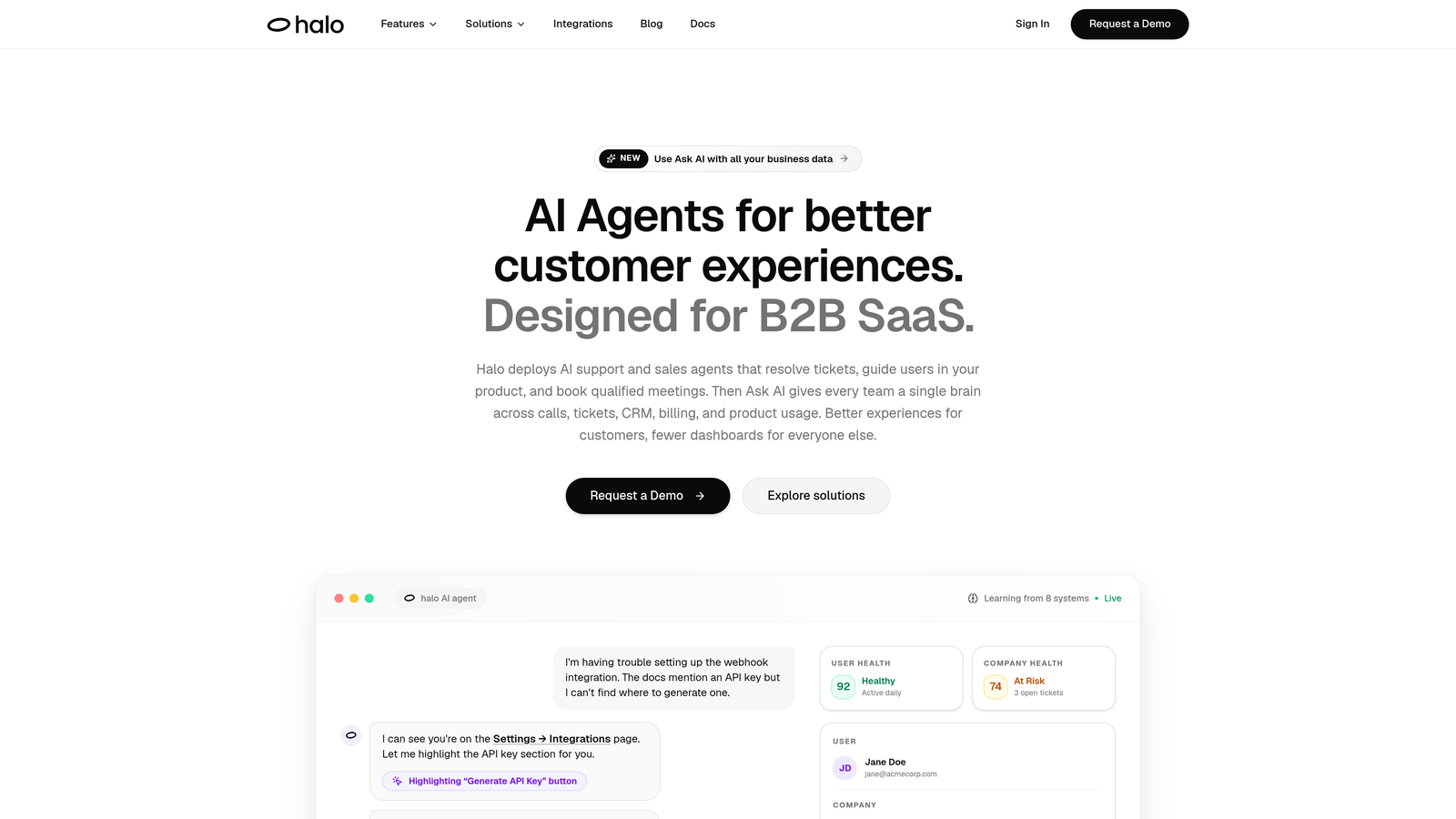
Halo AI is an AI-first customer support platform that deploys autonomous agents to resolve tickets, guide users, and surface business intelligence across your entire stack.
Where This Tool Shines
Most AI support tools know what a user types. Halo AI knows what they're looking at. Its page-aware chat widget understands the user's context inside your product, which means it can deliver guidance that's actually relevant to where someone is stuck, not just a generic FAQ response.
Beyond ticket resolution, Halo AI's smart inbox layers business intelligence on top of support conversations. Customer health signals, anomaly detection, and revenue intelligence turn your support queue into a strategic data source. For growth teams, this is the difference between a cost center and a competitive advantage.
Key Features
Page-Aware Chat Widget: Understands what the user sees in your product at the moment they ask for help, enabling contextually accurate guidance.
Autonomous Ticket Resolution: AI agents handle the full ticket lifecycle independently, learning from every resolved interaction to improve over time.
Smart Inbox with Business Intelligence: Surfaces customer health signals, revenue intelligence, and anomaly detection directly from support conversations.
Auto Bug Ticket Creation: Automatically generates bug reports in Linear and other engineering tools when issues are detected, closing the loop between support and product.
Live Agent Handoff: Escalates to human agents with full conversation context preserved, so customers never have to repeat themselves.
Deep Integrations: Connects natively to Linear, Slack, HubSpot, Intercom, Stripe, Zoom, PandaDoc, and Fathom, linking support to your entire business stack.
Best For
B2B SaaS product teams that want support AI to do more than deflect tickets. If you need your support layer to feed product signals back to engineering, flag at-risk accounts, and scale autonomously alongside rapid user growth, Halo AI is purpose-built for exactly that.
Pricing
Visit haloagents.ai for current pricing details. Plans are designed for growing B2B SaaS teams.
2. Intercom
Best for: Teams already using Intercom as their primary customer messaging platform.
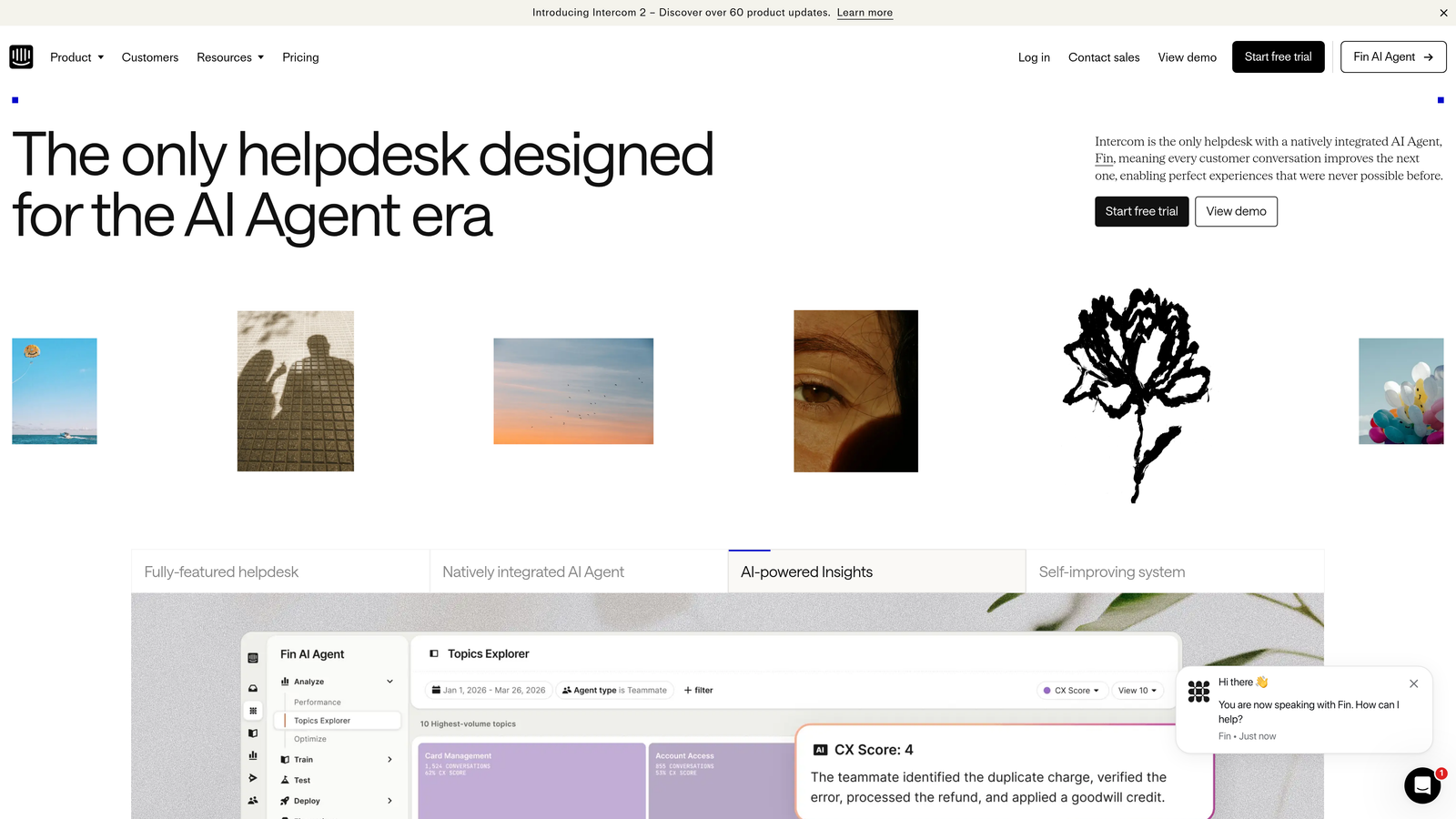
Intercom is a widely-used customer messaging platform with Fin, its AI agent for autonomous ticket resolution, plus AI Copilot tools for human agents.
Where This Tool Shines
Intercom's Fin AI agent is one of the more polished autonomous resolution products on the market. It draws on Intercom's deep customer data and conversation history to handle tickets conversationally, and the messenger experience is genuinely well-designed from an end-user perspective.
The AI Copilot layer extends value to human agents, surfacing suggested replies and relevant knowledge during live conversations. If your team is already living in Intercom, the integration overhead is essentially zero.
Key Features
Fin AI Agent: Handles autonomous conversational resolution using your existing help content and customer data.
AI Copilot: Surfaces suggested replies and knowledge base content for human agents during live conversations.
Customer Data Access: Fin draws on Intercom's full customer conversation history and profile data for more contextual responses.
Conversational UX: One of the more polished messenger experiences available, with smooth escalation flows.
Usage-Based Fin Pricing: Fin charges per resolution, which keeps costs aligned with actual value delivered.
Best For
Teams already standardized on Intercom that want to activate autonomous resolution without migrating their stack. Less ideal for teams that need deep integrations outside the Intercom ecosystem or want AI to surface product-level intelligence.
Pricing
Starts at approximately $39/month for base plans; Fin AI is charged per resolution. Check intercom.com for current rates, as pricing changes frequently.
3. Zendesk AI
Best for: Enterprise teams already standardized on Zendesk that need AI layered into existing workflows.
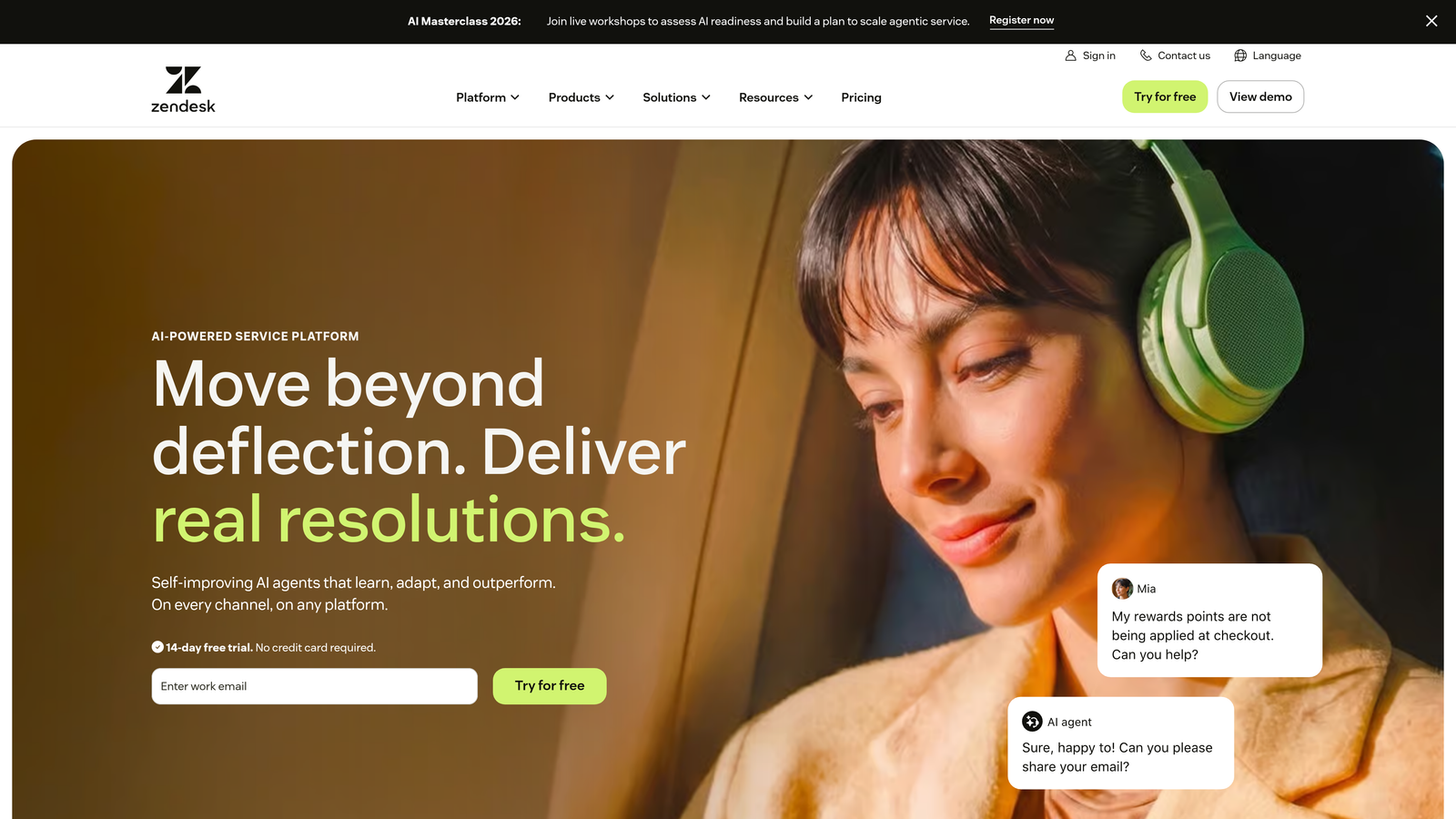
Zendesk AI brings autonomous resolution and intelligent agent assist capabilities to the world's most widely deployed helpdesk platform.
Where This Tool Shines
Zendesk's AI Agents have come a long way from the original Answer Bot. They now handle autonomous resolution across email, chat, and messaging channels, with intelligent triage and routing based on intent and sentiment analysis. For organizations with complex ticket taxonomies and compliance requirements, Zendesk's governance tooling is a genuine differentiator.
The breadth of Zendesk's integration marketplace also means you can connect AI workflows to almost any tool in your stack. The caveat is that this breadth comes with configuration complexity, and the AI features are gated behind higher-tier plans.
Key Features
AI Agents: Autonomous ticket resolution across email, chat, and messaging channels with multi-step conversation handling.
Intelligent Triage and Routing: Classifies and routes tickets based on intent, urgency, and sentiment without manual rules.
AI-Generated Replies: Surfaces suggested responses and knowledge base content for human agents in real time.
Enterprise Governance: Audit trails, compliance tooling, and role-based access controls for regulated industries.
Integration Ecosystem: Hundreds of marketplace apps and native integrations across CRM, billing, and engineering tools.
Best For
Large organizations already invested in Zendesk where migration costs make switching impractical. Growth-stage teams building fresh stacks will likely find Zendesk's complexity and pricing structure better suited to a later stage.
Pricing
AI features are available on Suite Growth plans and above. Check zendesk.com for current plan pricing, as tiers are updated regularly.
4. Freshdesk (Freddy AI)
Best for: SMB and mid-market teams on the Freshworks suite looking for affordable AI across support and sales.
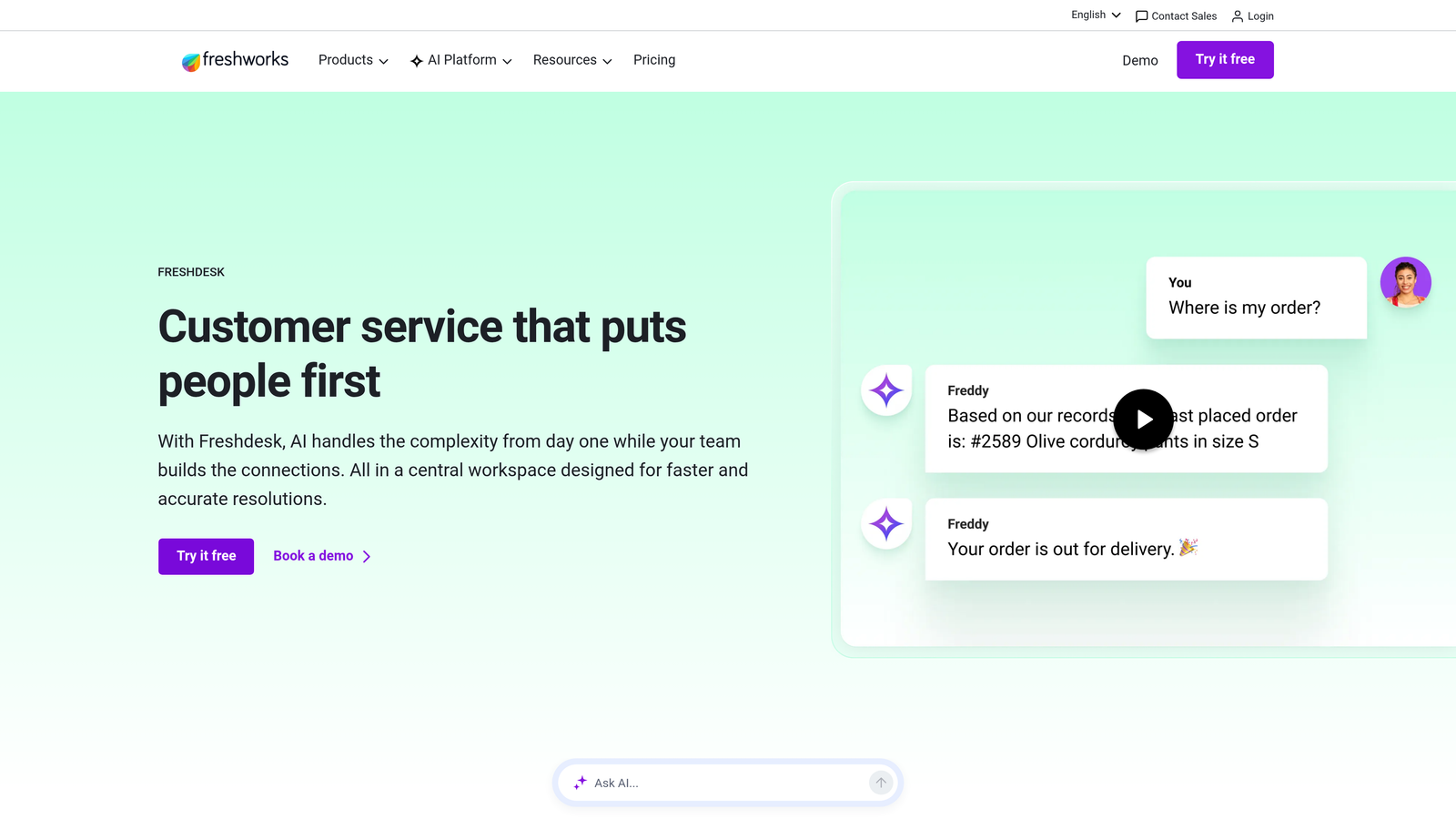
Freshdesk's Freddy AI spans self-service deflection, agent copilot, and analytics, with cross-suite benefits for teams using other Freshworks products.
Where This Tool Shines
Freddy AI's real strength is breadth within the Freshworks ecosystem. If your team uses Freshsales or Freshservice alongside Freshdesk, the AI layer works across all three, giving you a unified intelligence layer without stitching together separate tools. Freddy Insights also surfaces trend detection and anomaly alerts that help support leads spot patterns before they become problems.
Compared to Zendesk at similar feature tiers, Freshdesk tends to come in at a lower price point, which matters for growth teams watching burn rate closely.
Key Features
Freddy Self Service: Autonomous deflection via chat and email using your existing knowledge base content.
Freddy Copilot: AI-assisted response drafting, ticket summarization, and suggested next actions for human agents.
Freddy Insights: Support analytics with trend detection and anomaly flagging across your ticket volume.
Cross-Suite AI: Unified AI layer across Freshdesk, Freshsales, and Freshservice for teams on the full Freshworks stack.
Competitive Pricing: Generally more accessible than Zendesk at comparable feature tiers.
Best For
Mid-market teams already using Freshworks products, or SMBs that want solid AI capabilities without enterprise-level pricing. Less compelling if you're not on the Freshworks ecosystem.
Pricing
Freddy AI is available as an add-on on Growth plans and above. Check freshdesk.com for current pricing and plan details.
5. Tidio
Best for: Early-stage teams and e-commerce businesses that need fast deployment with minimal configuration.
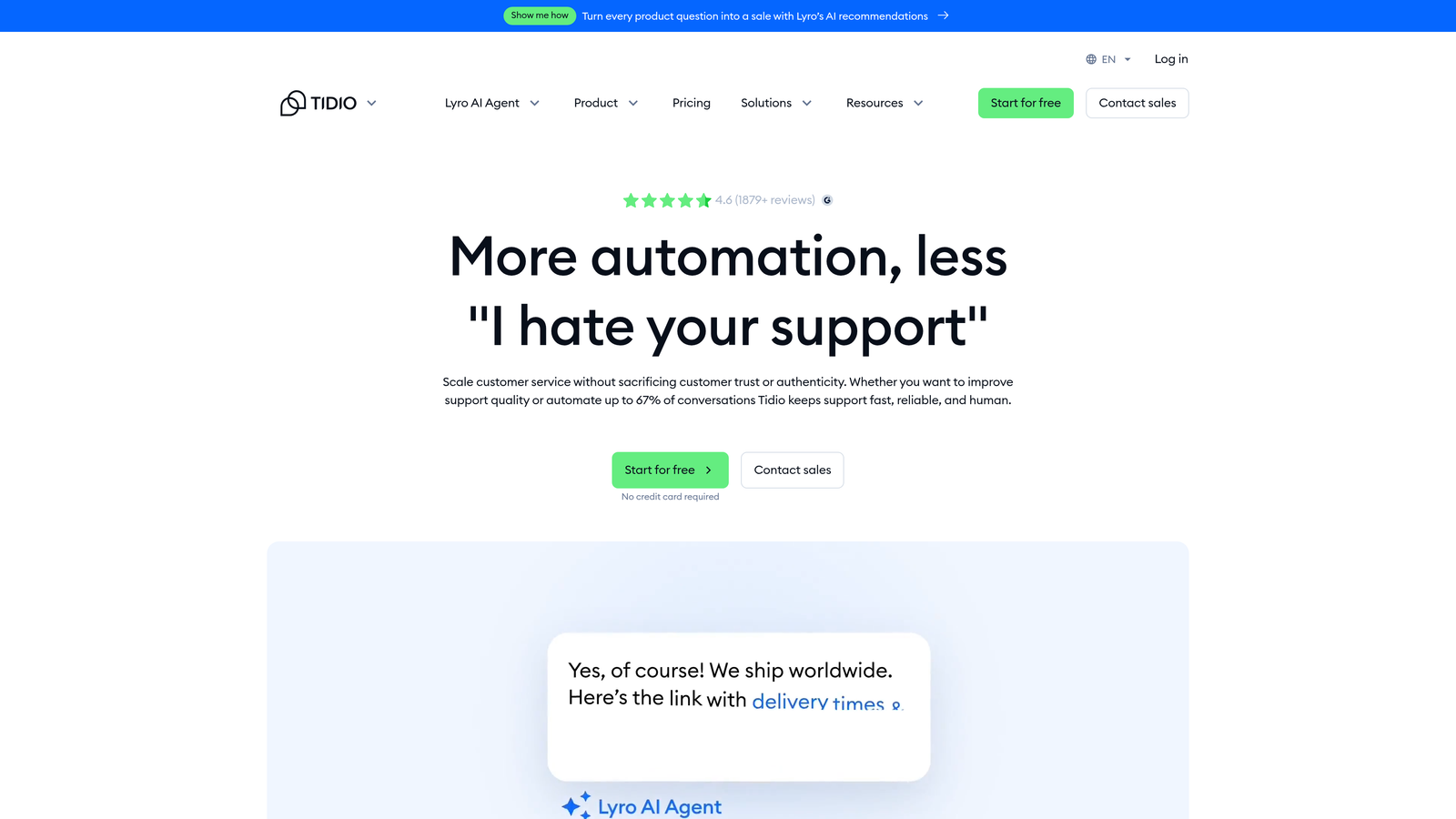
Tidio is a live chat and AI support platform with Lyro, its conversational AI agent, designed for fast deployment with low configuration overhead.
Where This Tool Shines
Tidio's biggest advantage is time-to-value. Lyro can be up and running in hours rather than weeks, making it one of the fastest paths to autonomous conversational support on this list. For teams that need to ship something now and refine later, that matters.
The live chat fallback to human agents is smooth and well-designed, which means customers don't feel the seam when Lyro escalates. Tidio's Shopify and WooCommerce integrations also make it a natural fit for e-commerce teams, though early-stage SaaS teams use it too.
Key Features
Lyro AI Agent: Conversational AI that handles support autonomously using your help content, with smooth escalation to live chat.
Fast Setup: Low configuration requirements mean most teams can deploy in a single day.
Live Chat Fallback: Seamless handoff to human agents with conversation context intact.
E-Commerce Integrations: Native connections to Shopify and WooCommerce for order and product context.
Accessible Pricing: Free plan available with paid tiers starting at an accessible price point for smaller teams.
Best For
Early-stage startups and e-commerce teams that need autonomous support fast. Less suited for complex B2B SaaS workflows that require deep product integrations, business intelligence, or multi-system automation.
Pricing
Free plan available; Lyro AI starts at approximately $29/month. Check tidio.com for current rates.
6. Forethought
Best for: Teams that want AI capabilities on top of their existing helpdesk without replacing it.
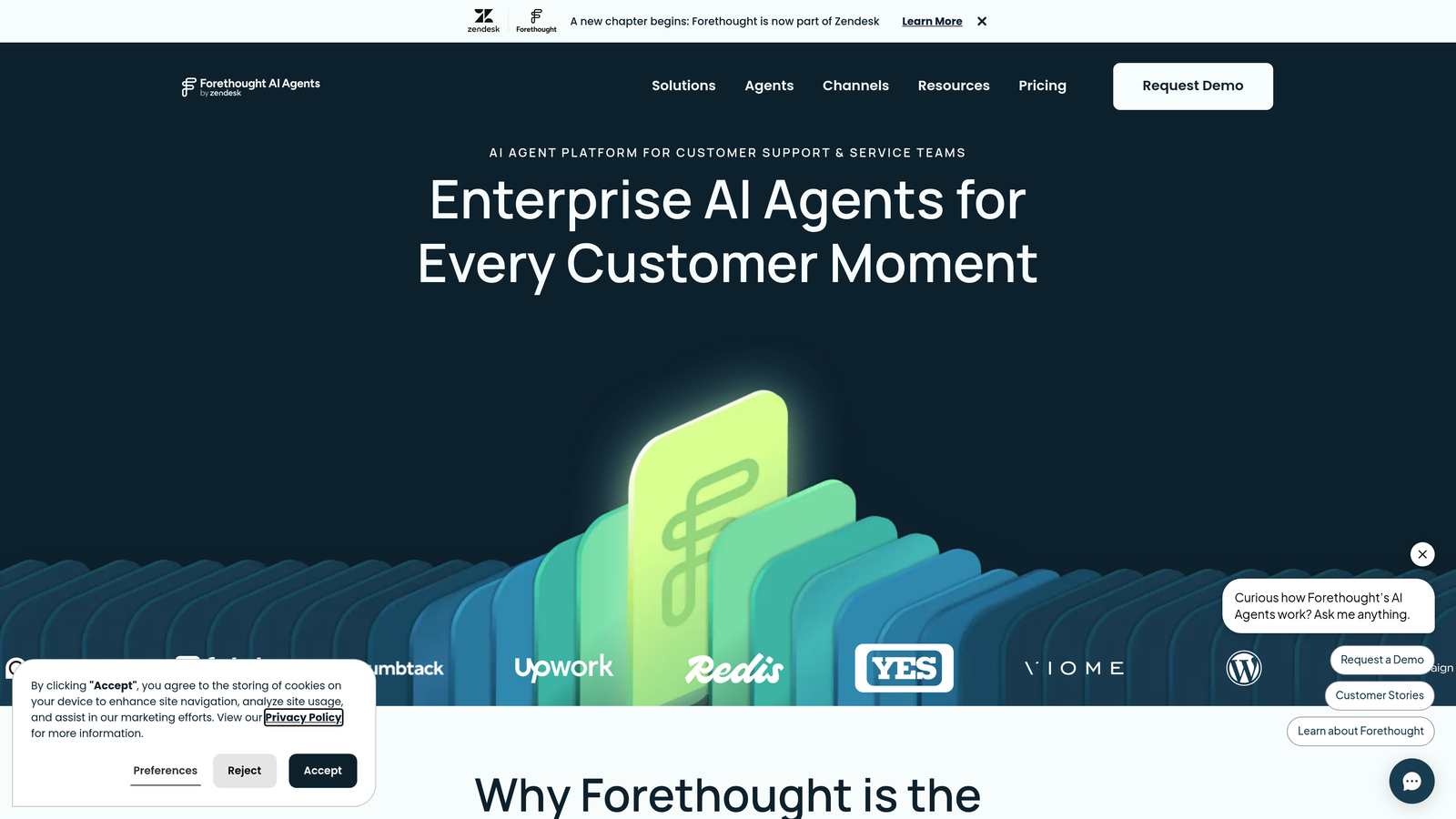
Forethought is an AI support platform that layers autonomous resolution, smart triage, and agent assist on top of existing helpdesks like Zendesk, Salesforce, ServiceNow, and Freshdesk.
Where This Tool Shines
Forethought's core value proposition is additive, not replacement. If your team has years of configuration, workflows, and institutional knowledge built into Zendesk or Salesforce Service Cloud, Forethought lets you activate AI on top of that investment rather than starting over. This dramatically reduces migration risk for teams that can't afford disruption.
Its Triage product is particularly strong, using predictive routing to direct tickets based on intent, urgency, and topic before a human ever touches them. The Discover layer also surfaces support analytics and insight extraction that help teams understand what's driving volume.
Key Features
Solve: Autonomous AI resolution layer that handles tickets without requiring you to replace your existing helpdesk.
Triage: Predictive routing based on intent, urgency, and topic classification.
Assist: AI-generated reply suggestions and knowledge surfacing for human agents during ticket handling.
Discover: Support analytics and insight extraction to identify volume drivers and emerging issues.
Helpdesk Compatibility: Works across Zendesk, Salesforce Service Cloud, ServiceNow, and Freshdesk.
Best For
Growth teams locked into enterprise helpdesks that want AI capabilities without a platform migration. Also strong for ops-heavy teams that want predictive routing and analytics alongside autonomous resolution.
Pricing
Custom pricing based on volume and use case. Contact forethought.ai directly for a quote.
7. Kustomer
Best for: High-volume consumer support teams that want a CRM-first approach to customer service.
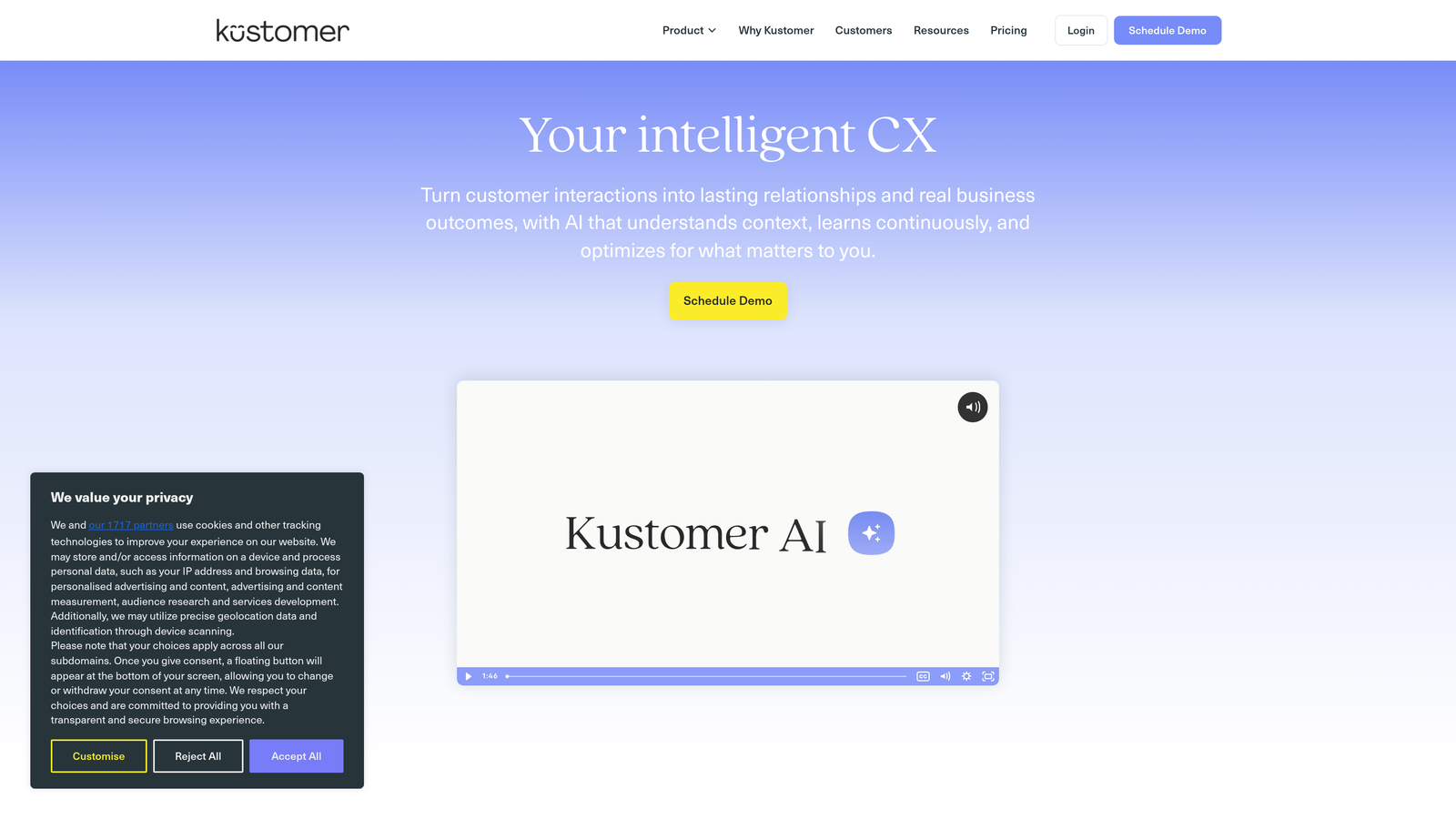
Kustomer is a CRM-first customer service platform that organizes support around full customer timelines, with KustomerIQ providing AI automation, routing, and deflection.
Where This Tool Shines
Kustomer's defining characteristic is its data model. Rather than organizing around tickets, it builds a complete customer timeline, every interaction, purchase, and conversation in one view, and then applies AI to that rich context. For high-volume consumer support where history matters, this approach produces meaningfully better routing and deflection outcomes.
The built-in CRM also eliminates the need for a separate customer data platform, which simplifies the stack for teams that would otherwise be syncing data between their helpdesk and CRM constantly.
Key Features
Customer Timeline: All interactions, purchases, and conversations organized around the individual customer rather than individual tickets.
KustomerIQ: AI-powered routing, deflection, and workflow automation built on top of the full customer data model.
Omnichannel Support: Email, chat, SMS, social, and voice channels unified in a single agent workspace.
Built-In CRM: Eliminates the need for a separate customer data platform for support workflows.
High-Volume Workflows: Designed for teams handling large ticket volumes with complex customer histories.
Best For
B2C companies and high-volume consumer support teams where rich customer history improves resolution quality. Less optimized for B2B SaaS growth teams that need deep product integrations and engineering workflow connections.
Pricing
Starts at approximately $89/user/month. Check kustomer.com for current pricing and enterprise options.
8. Gladly
Best for: Premium brands where support quality is a core differentiator and customer experience is a strategic priority.
Gladly is a people-based customer service platform that organizes conversations around customers rather than ticket numbers, with Sidekick AI for autonomous resolution and Hero for agent workflows.
Where This Tool Shines
Gladly's people-based model is genuinely different from most platforms on this list. There are no ticket numbers. Every conversation a customer has ever had with your team is visible in a single continuous thread, regardless of channel. This creates a support experience that feels personal at scale, which is why premium consumer brands tend to gravitate toward it.
Sidekick AI handles autonomous self-service resolution, while the Hero agent workspace gives human agents AI-assisted response tools when escalation is needed. The platform's philosophy is human-first with AI augmentation, rather than AI-first with human fallback.
Key Features
People-Based Model: No ticket numbers; full conversation history per customer across every channel in a single continuous view.
Sidekick AI Agent: Autonomous self-service resolution for common support scenarios without human involvement.
Hero Agent Workspace: AI-assisted response tools and full customer context for human agents handling escalations.
Omnichannel Continuity: Seamless conversation continuity across chat, email, voice, and SMS.
Brand-Quality Experience: Designed for companies where the support interaction itself is part of the brand promise.
Best For
Premium consumer brands and companies where support quality is a strategic differentiator. Less suited for growth teams optimizing purely for deflection rate or teams that need deep SaaS product integrations.
Pricing
Custom pricing based on team size and use case. Contact gladly.com for a quote.
9. Drift (via Salesloft)
Best for: Growth teams where support conversations are tightly coupled with revenue and expansion motions.
Drift, now part of Salesloft, is a conversational AI platform spanning marketing, sales, and support touchpoints, with AI playbooks for routing conversations to the right team or resource.
Where This Tool Shines
Drift's original strength was conversational marketing and sales, and that DNA carries through in how it handles support-adjacent conversations. When an inbound support question has expansion potential, Drift's playbooks can route it to the right revenue team rather than closing the loop in a support queue. For growth teams where support and sales overlap, this is a meaningful capability.
Post-acquisition into Salesloft, Drift's support-specific features are evolving within a broader revenue platform context. Teams evaluating it should assess current feature availability directly, as the product roadmap continues to develop.
Key Features
Conversational AI Playbooks: Routes conversations to the right team, resource, or automated flow based on intent and context.
Revenue-Aware Routing: Identifies expansion opportunities within support conversations and connects them to sales workflows.
Multi-Touchpoint Coverage: Spans marketing, sales, and support conversations in a unified platform.
AI Qualification: Qualifies and segments inbound conversations before routing to humans.
Salesloft Integration: Native connection to Salesloft's broader revenue intelligence and engagement platform.
Best For
Growth teams where support and revenue motions are tightly coupled, particularly those already using Salesloft for sales engagement. Less suited for teams that need dedicated, deep-feature support infrastructure as their primary use case.
Pricing
Check salesloft.com for current Drift pricing and packaging, as plans have evolved post-acquisition.
Which Tool Is Right for Your Growth Stage
The tools on this list cover a wide range of philosophies, from AI layered on top of legacy helpdesks to purpose-built platforms that treat support as a source of business intelligence. The right choice depends on where you are now and what you need AI to actually do.
For early-stage teams moving fast, Tidio offers the fastest path to autonomous resolution with minimal configuration. If speed to deploy matters more than depth of integration, it's a solid starting point.
For teams already embedded in Intercom or Zendesk, Fin and Zendesk AI reduce migration friction significantly. You get meaningful AI capabilities without rebuilding your stack. Forethought fills a similar role for teams on Salesforce or ServiceNow.
For growth teams that want AI to do more than deflect tickets, surfacing product signals, flagging at-risk accounts, auto-creating bug reports, and connecting support to your entire business stack, Halo AI is the strongest fit. Its AI-first architecture, page-aware context, and business intelligence layer are built specifically for the problems B2B SaaS teams face as they scale.
Start with the tool that fits where you are now, not where you hope to be in two years. A tool you can deploy and learn from today will outperform a theoretically perfect tool that takes six months to configure.
Your support team shouldn't scale linearly with your customer base. Let AI agents handle routine tickets, guide users through your product, and surface business intelligence while your team focuses on complex issues that need a human touch. See Halo in action and discover how continuous learning transforms every interaction into smarter, faster support.