9 Best AI Support Software for Product Teams in 2026
Product teams managing bug reports, feature confusion, and churn signals simultaneously need more than generic helpdesk tools. This guide evaluates the 9 best AI support software for product teams in 2026, comparing top solutions on AI capabilities, engineering integrations like Linear, GitHub, and Jira, and their ability to surface user insights that directly inform product roadmap decisions.
 Grant CooperFounder13 min read
Product teams live at a crossroads that most helpdesk tools weren't designed for. You're fielding bug reports, onboarding questions, feature confusion, and churn signals all at once — and the way you handle each one affects not just customer satisfaction, but what gets prioritized in your next sprint. Generic support software routes tickets. AI support software built for product teams does something more: it understands context, connects to your dev stack, surfaces patterns, and helps you close the loop between what users experience and what engineers build.
This guide covers the top AI support tools for product teams in 2026, evaluated on AI depth, engineering integrations (Linear, GitHub, Jira), in-app support quality, and business intelligence beyond basic ticket counts. Whether you're a startup scaling support without adding headcount or a mature product org trying to connect support data to your roadmap, there's an option here worth your attention.
1. Halo AI
Best for: B2B SaaS product teams that need AI-first support with deep engineering integrations
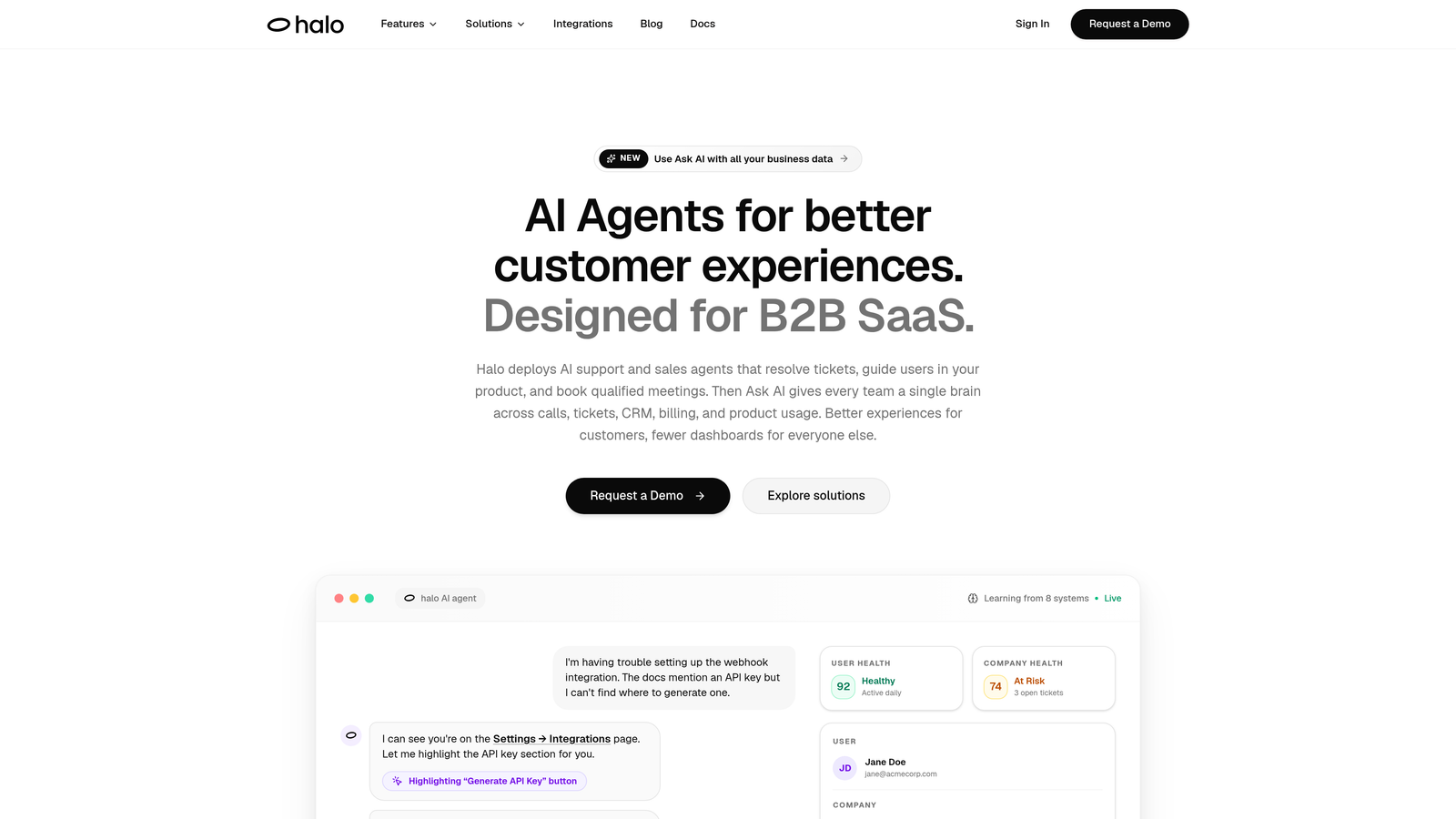
Halo AI is an AI-first customer support platform built specifically for B2B SaaS product teams, not a traditional helpdesk with AI bolted on afterward.
Where This Tool Shines
Halo's standout capability is its page-aware context. The chat widget understands what page a user is on and can provide visual UI guidance — meaning users get help that's relevant to exactly where they are in your product, not a generic FAQ response. This is the kind of in-context support that actually reduces churn and confusion at the moment it matters most.
Beyond the chat experience, Halo connects support to your engineering workflow in a way few tools attempt. Auto bug ticket creation routes issues directly into Linear, GitHub, or Jira without manual triaging. The smart inbox goes further, surfacing business intelligence signals — customer health, revenue anomalies, churn risk — derived from support interactions. It's support data feeding product decisions, which is exactly what product teams need.
Key Features
Page-Aware Chat Widget: Understands the user's current location in your product and delivers contextual UI guidance, not generic answers.
Auto Bug Ticket Creation: Automatically creates bug tickets in Linear, GitHub, or Jira directly from support conversations, eliminating manual triaging.
Smart Inbox with Business Intelligence: Surfaces customer health signals, revenue anomalies, and churn risk indicators extracted from support patterns.
Live Agent Handoff: Escalates to human agents with full conversation context preserved, so nothing gets repeated.
Broad Integration Stack: Connects to Slack, HubSpot, Intercom, Stripe, Zoom, PandaDoc, and Fathom for a unified view across your business stack.
Continuous Learning: Improves from every resolved interaction, becoming more effective over time without manual retraining.
Best For
Halo is purpose-built for B2B SaaS product teams that want support intelligence to feed directly into engineering and customer success workflows. It's particularly strong for teams already using Linear or GitHub who want to eliminate the gap between "user reported a bug" and "engineer sees a ticket."
Pricing
Contact for pricing at haloagents.ai. Given the depth of integrations and AI-first architecture, pricing is tailored to team size and use case.
2. Intercom
Best for: Product teams wanting in-app messaging, onboarding flows, and AI-powered autonomous resolution
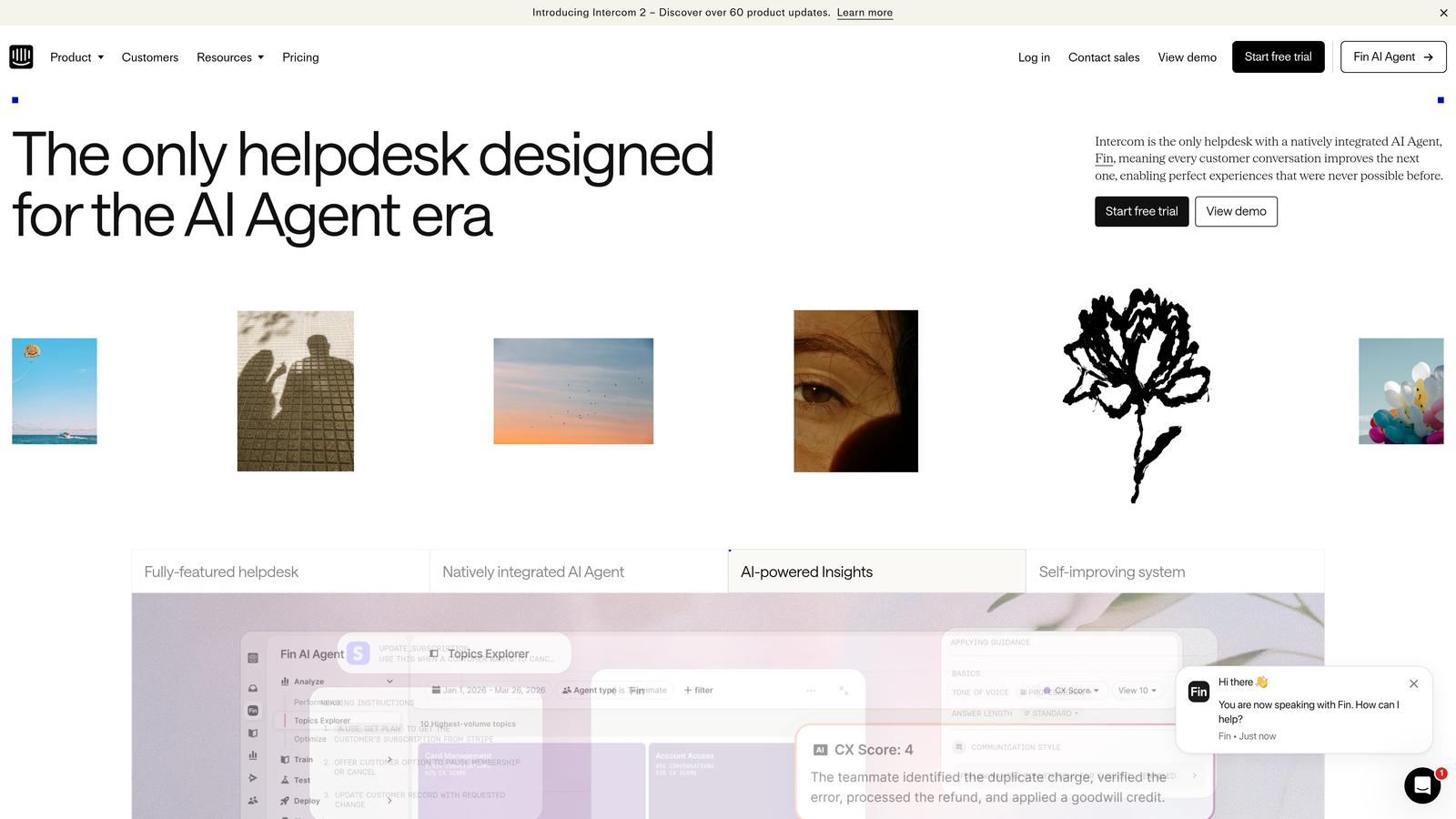
Intercom is one of the most established customer messaging platforms, featuring Fin — an AI agent designed to handle a substantial share of support conversations autonomously.
Where This Tool Shines
Intercom's strength is the combination of in-app messaging, product tours, and AI resolution in a single platform. Fin handles a meaningful portion of conversations without human involvement, and the workflow automation tools let product teams build sophisticated onboarding and support sequences. For teams that want to blend customer support with product engagement, Intercom covers a lot of ground.
The integration ecosystem is extensive, and the conversation analytics provide solid visibility into support volume and customer satisfaction. The main consideration is cost: pricing can escalate quickly as conversation volume grows, especially with per-resolution billing for Fin.
Key Features
Fin AI Agent: Handles autonomous conversation resolution across a range of common support queries.
In-App Messaging and Product Tours: Supports onboarding flows and feature announcements directly inside your product.
Shared Inbox with AI Assist: Gives human agents suggested replies and context during live conversations.
Extensive Integration Marketplace: Connects to a wide range of third-party tools across CRM, analytics, and engineering.
CSAT and Conversation Analytics: Tracks satisfaction scores and conversation trends over time.
Best For
Product teams that want a mature, full-featured platform combining AI support with in-app engagement. Particularly well-suited for teams already invested in the Intercom ecosystem or those who prioritize product tours and onboarding flows alongside support.
Pricing
Starts at $39/seat/month; Fin AI usage is billed per resolution. Verify current pricing at intercom.com as tiers evolve frequently.
3. Zendesk AI
Best for: Enterprise product orgs with established Zendesk infrastructure and complex compliance needs
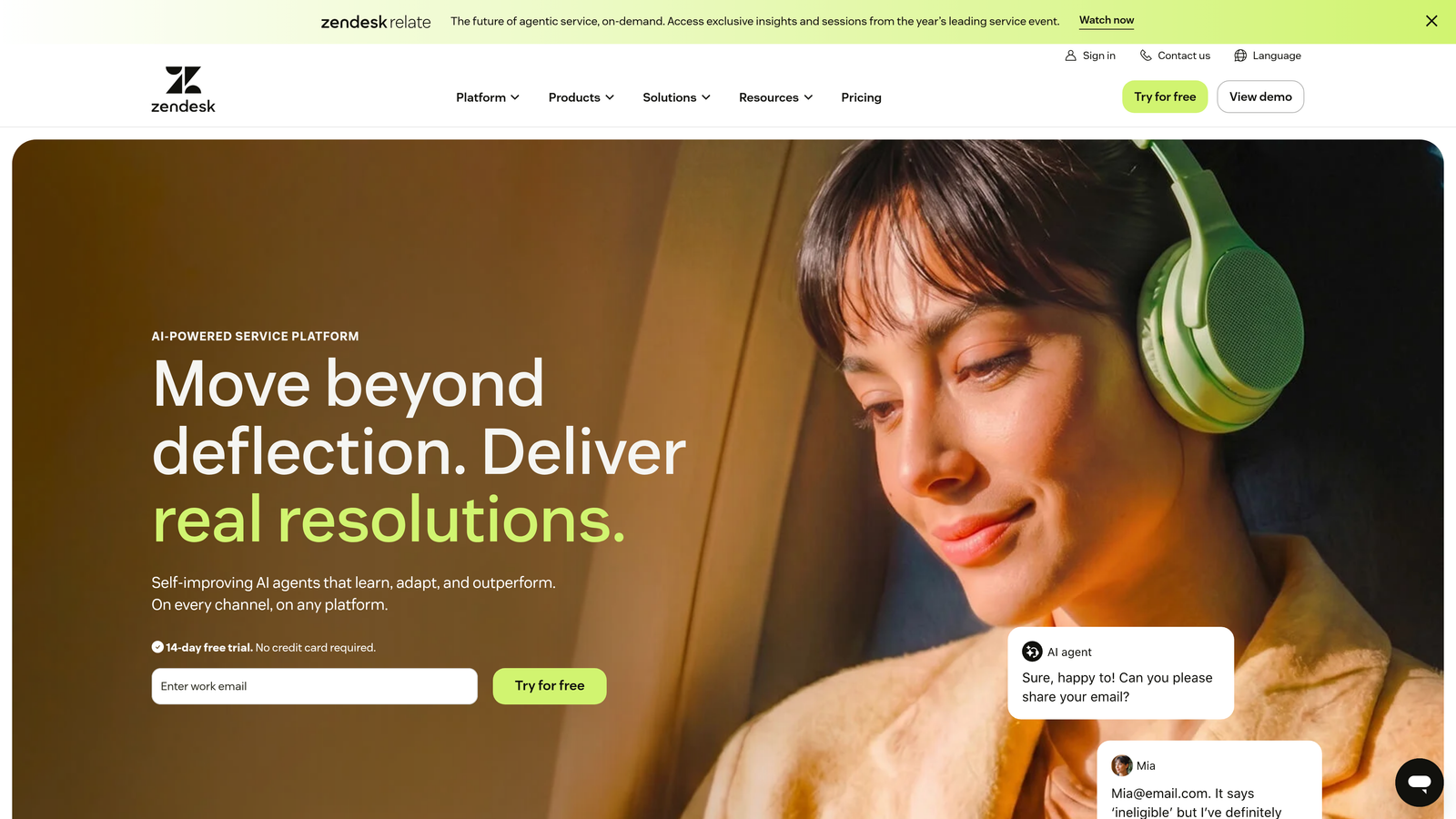
Zendesk AI is an enterprise-grade helpdesk platform with AI capabilities including intelligent triage, an agent copilot, and automated ticket resolution built on decades of accumulated support data.
Where This Tool Shines
Zendesk's AI capabilities have matured considerably. Intelligent routing ensures tickets reach the right team or agent without manual intervention, and the Agent Copilot provides suggested replies and next-best-action guidance that genuinely speeds up resolution. For organizations with complex support operations, Zendesk's reporting and compliance infrastructure is hard to match.
The honest trade-off is complexity. For smaller product teams or startups, the platform can feel like significant overhead. It's built for scale, and that architecture comes with a learning curve and a price point to match.
Key Features
AI-Powered Triage and Routing: Automatically classifies and routes incoming tickets based on intent and priority.
Agent Copilot: Provides suggested replies, knowledge base surfacing, and next-best-action guidance in real time.
Advanced Reporting Suite: Deep analytics covering ticket volume, resolution time, agent performance, and customer satisfaction.
Enterprise Security and Compliance: Robust controls for regulated industries and large organizations.
Large Integration Ecosystem: Hundreds of marketplace apps covering CRM, engineering, and analytics tools.
Best For
Larger product organizations with established Zendesk infrastructure, compliance requirements, or support teams at significant scale. Less ideal for small product teams who don't need enterprise complexity.
Pricing
Suite plans start at $55/agent/month. Verify current pricing at zendesk.com.
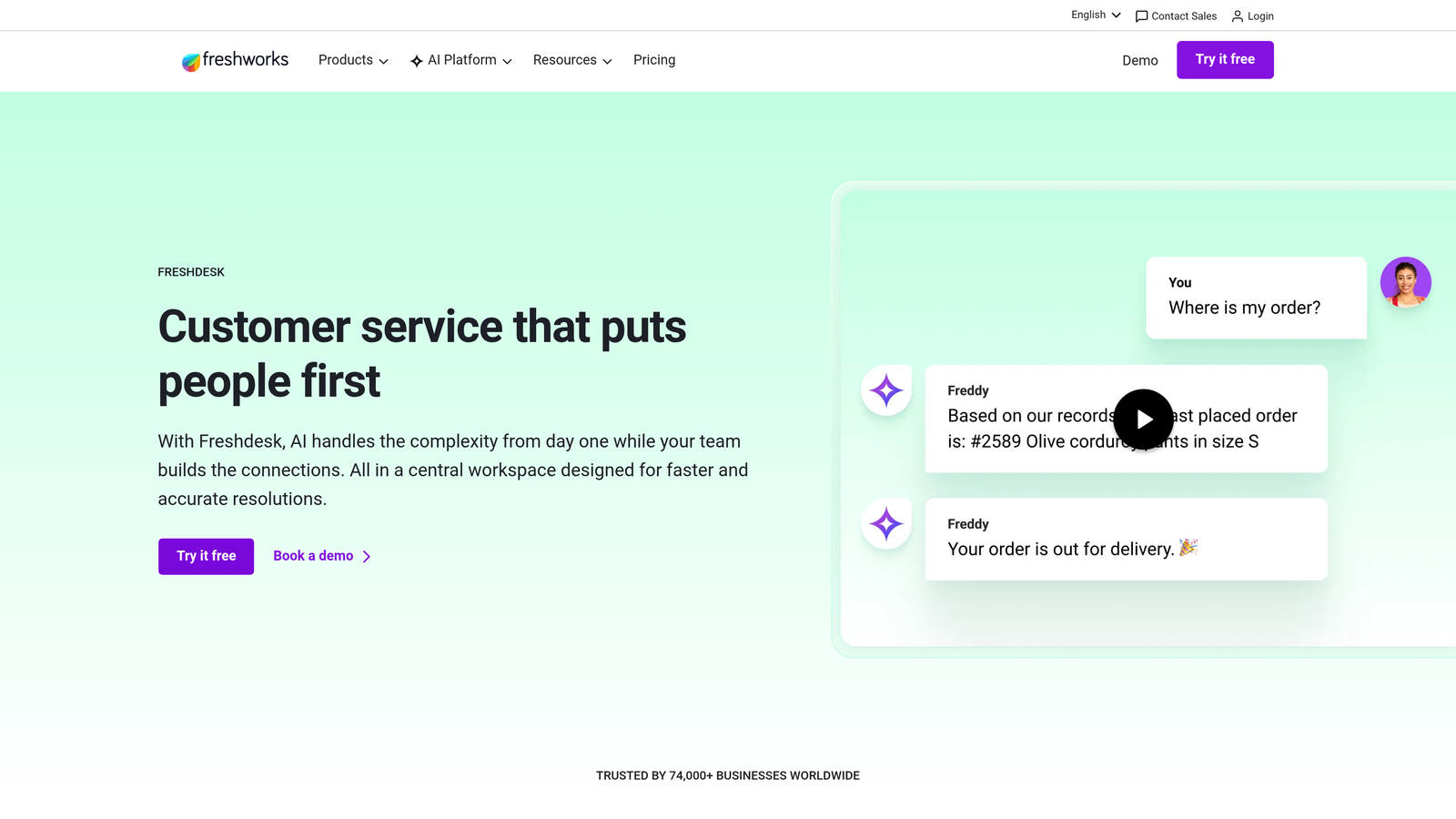
4. Freshdesk Freddy AI
Best for: SMB to mid-market product teams wanting full-stack AI support without enterprise pricing
Freshdesk's AI layer — Freddy — spans self-service deflection, agent assistance, and analytics, making it a capable full-stack option at a more accessible price point than Zendesk or Intercom.
Where This Tool Shines
Freddy AI covers three distinct areas: Freddy Self Service handles deflection and chatbot flows before a ticket is ever created; Freddy Copilot assists agents with drafts, summaries, and suggestions mid-conversation; and Freddy Insights surfaces trend detection and anomaly alerts from support data. Getting all three in a single platform at Freshdesk's price point is genuinely competitive.
The omnichannel coverage is solid, spanning email, chat, phone, and social. For product teams that support users across multiple channels without wanting to manage multiple tools, this is a practical advantage.
Key Features
Freddy Self Service: AI-powered deflection bot that handles common queries before they become tickets.
Freddy Copilot: Assists agents with reply drafts, conversation summaries, and contextual suggestions.
Freddy Insights: Detects support trends and anomalies, surfacing patterns that might otherwise go unnoticed.
Omnichannel Support: Unified inbox across email, chat, phone, and social media channels.
Competitive Pricing: Accessible tiers that make full-stack AI support viable for smaller teams.
Best For
SMB to mid-market product teams that want comprehensive AI support capabilities without the enterprise price tag. A strong choice for teams graduating from basic helpdesk tools who want AI assistance across the full support lifecycle.
Pricing
Free tier available; paid plans start at $15/agent/month. Verify current pricing at freshworks.com.
5. Plain
Best for: Developer-first product teams and API-first companies that want support to feel like a dev tool
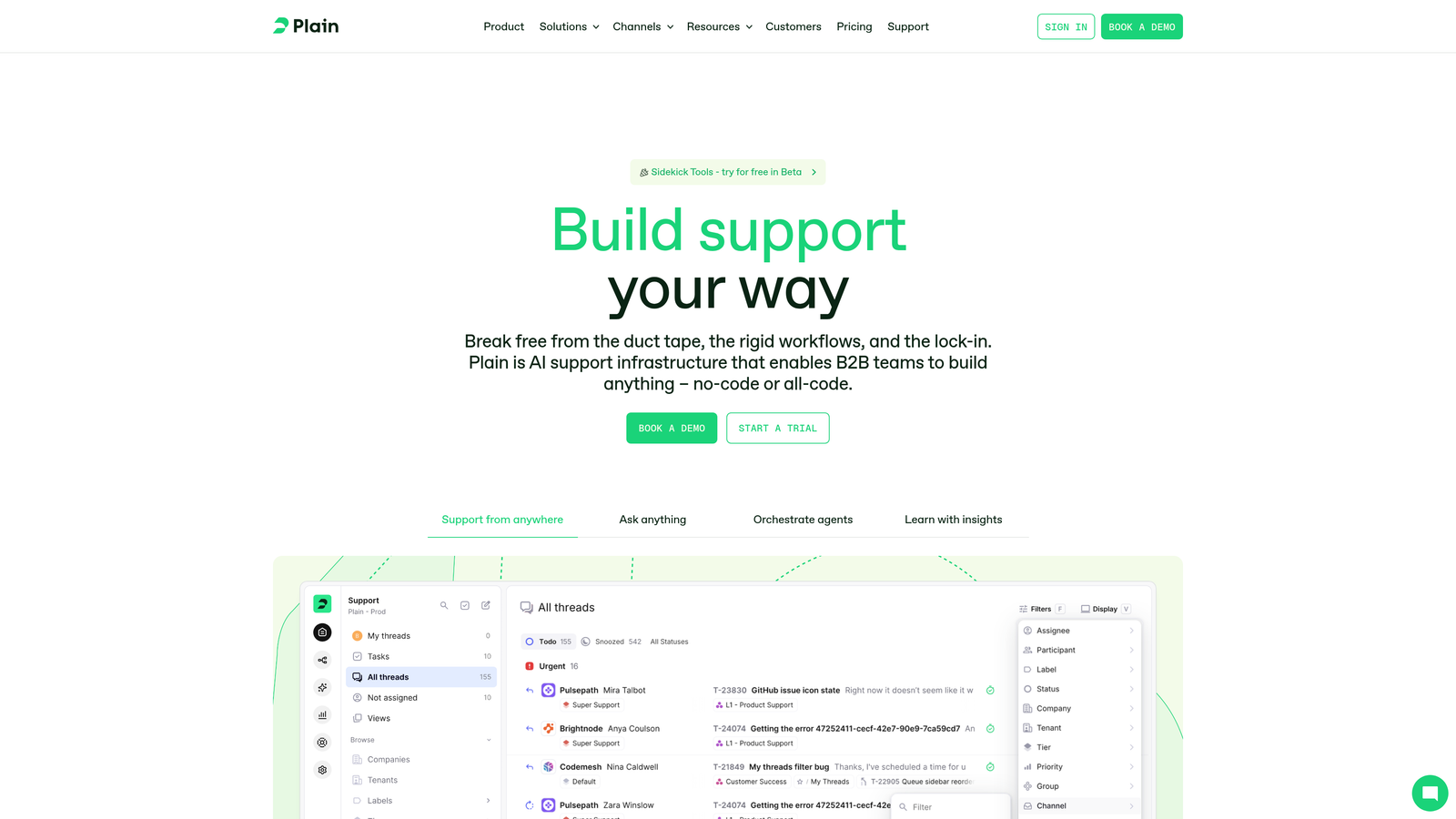
Plain is a developer-first support platform built specifically for technical product companies, with an API-first architecture and native integrations with engineering tools.
Where This Tool Shines
Plain is deliberately not a traditional helpdesk. It's designed to feel familiar to engineering teams: thread-based conversations, API-first architecture, native Slack and GitHub integrations, and custom UI components that let you embed support directly in your product. If your team thinks in terms of APIs and developer workflows, Plain fits that mental model in a way most support tools don't.
The lightweight architecture is also a genuine advantage. There's no legacy helpdesk overhead to work around, and the speed of the platform reflects that. For dev tools startups or API-first companies where the support team is the engineering team, Plain removes a lot of friction.
Key Features
API-First Design: Fully programmable support workflows that integrate cleanly with existing engineering infrastructure.
Native Slack and GitHub Integrations: Brings support into the tools engineering teams already live in.
Custom UI Components: Allows teams to embed contextual support directly inside their product interface.
Thread-Based Conversation Model: Familiar structure for engineering teams accustomed to GitHub issues and Slack threads.
Lightweight and Fast: No legacy helpdesk complexity — built for speed and developer ergonomics.
Best For
API-first companies, developer tools startups, and technical product teams where engineering and support overlap significantly. Less suited for teams that need traditional helpdesk features like phone support or complex agent workflows.
Pricing
Contact for pricing at plain.com. Designed specifically for technical product teams.
6. Forethought
Best for: Teams that want smarter AI on top of an existing Zendesk or Salesforce helpdesk without migrating
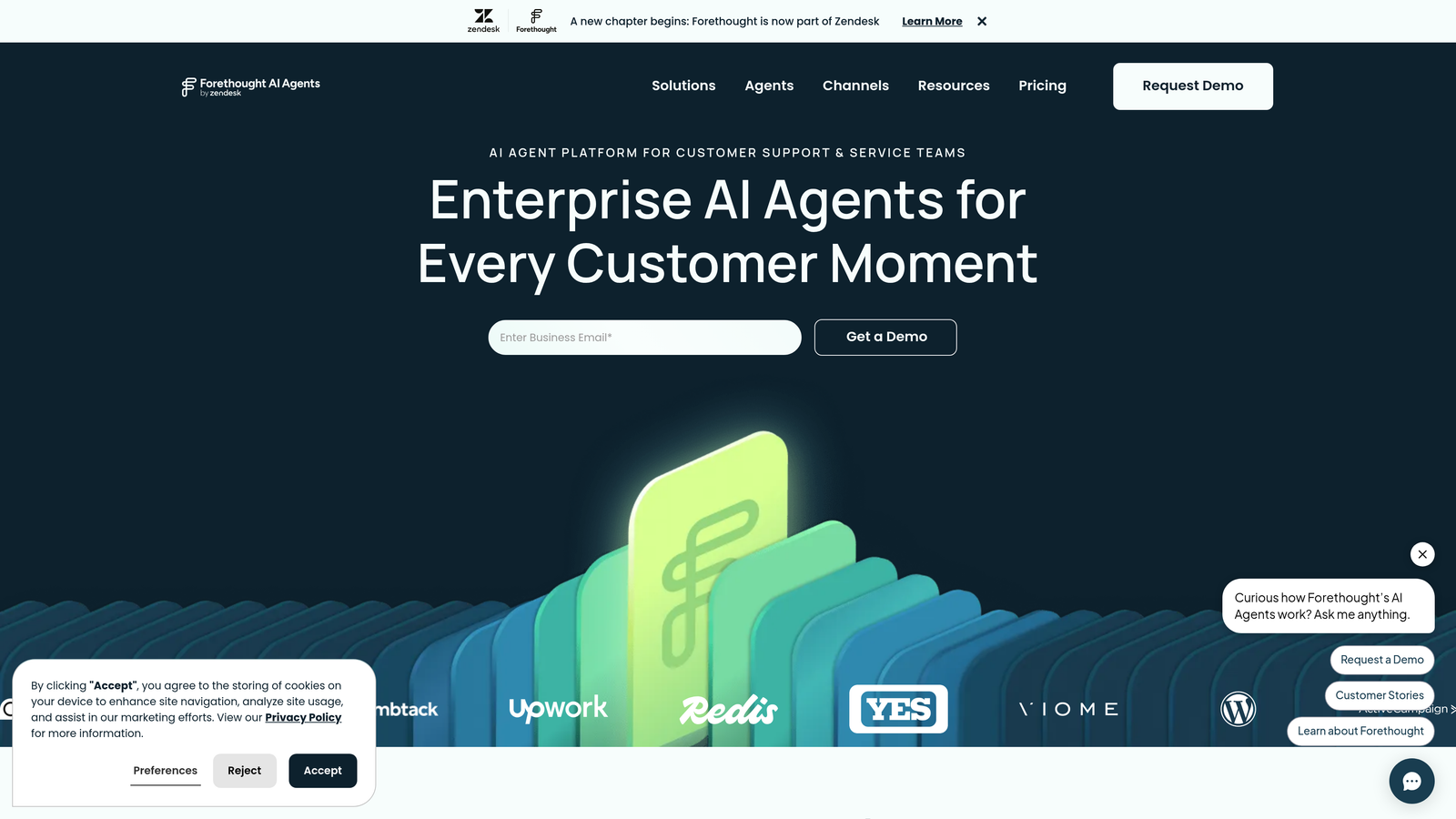
Forethought is an AI layer that sits on top of existing helpdesks, adding intelligent triage, routing, and autonomous resolution without requiring teams to abandon their current platform.
Where This Tool Shines
Forethought's core value proposition is additive: if your team is already embedded in Zendesk or Salesforce Service Cloud, Forethought makes that investment smarter without a rip-and-replace migration. Solve, their AI agent, handles deflection and autonomous resolution. Triage handles intelligent classification, tagging, and routing. Together, they can meaningfully reduce the volume of tickets that reach human agents.
This approach suits organizations where changing the core helpdesk isn't politically or practically feasible, but where leadership wants measurable AI efficiency gains on the existing stack. The analytics dashboard tracks AI resolution rates and agent efficiency, giving teams clear visibility into ROI.
Key Features
Solve AI Agent: Handles autonomous ticket deflection and resolution for common support queries.
Triage AI: Intelligently classifies, tags, and routes incoming tickets based on content and intent.
Helpdesk Compatibility: Works alongside Zendesk, Salesforce Service Cloud, and other established platforms.
Workflow Automation: Automates repetitive support processes without requiring manual configuration at scale.
Analytics Dashboard: Tracks AI resolution rates, deflection performance, and agent efficiency metrics.
Best For
Product teams at mid-market or enterprise companies that are already committed to Zendesk or Salesforce and want AI efficiency gains without platform migration. Less compelling for teams starting fresh or willing to consider a full platform switch.
Pricing
Contact for pricing at forethought.ai.
7. Kustomer
Best for: Product-led growth companies where support and customer success overlap significantly
Kustomer is a CRM-native support platform that unifies customer support history, product usage data, and CRM context in a single timeline, with AI features built throughout the workflow.
Where This Tool Shines
The unified customer timeline is Kustomer's defining feature. Rather than treating support as isolated tickets, Kustomer gives agents a complete picture: support history, product usage signals, CRM data, and purchase history all in one view. For product teams where support and customer success blur together, this context dramatically changes the quality of every interaction.
AI-powered automated responses and intelligent routing reduce manual work, and the omnichannel inbox covers email, chat, social, SMS, and voice. The workflow automation and business rules engine add flexibility for teams with complex support logic.
Key Features
Unified Customer Timeline: Combines support history, CRM data, and product usage in a single agent view.
AI-Powered Automated Responses: Handles routine queries autonomously with intelligent routing for complex issues.
Omnichannel Inbox: Unified view across email, chat, social, SMS, and voice channels.
Deep CRM Capabilities: Built-in customer relationship data that blends support and customer success workflows.
Workflow Automation: Business rules engine for building complex, conditional support logic.
Best For
Product-led growth companies and teams where customer success and support share ownership of the customer relationship. Particularly useful when product usage data needs to be visible during every support interaction.
Pricing
Starts at $89/agent/month. Verify current pricing at kustomer.com.
8. Help Scout
Best for: Lean product teams that want AI assistance without making support feel automated or impersonal
Help Scout is a clean, human-feeling support platform with AI assist features that reduce agent effort without making the support experience feel robotic.
Where This Tool Shines
Help Scout occupies a distinct position: it's not trying to be the most AI-heavy platform on this list. Instead, its AI features — Drafts, Summarize, and Answers — are designed to make human agents faster and better without replacing the human element that many product teams value. AI Drafts suggest replies that maintain the agent's voice. AI Summarize gives agents instant context on long threads. AI Answers handles self-service via the integrated Docs knowledge base.
The pricing model is refreshingly simple. No per-resolution fees, no usage-based billing surprises. For lean product teams managing support on a tight budget, that predictability matters.
Key Features
AI Drafts: Suggests replies that maintain the agent's natural voice rather than producing generic AI responses.
AI Summarize: Instantly surfaces key context from long conversation threads for faster agent onboarding.
AI Answers: Handles self-service resolution by drawing on your integrated Docs knowledge base.
Unified Platform: Shared inbox, live chat, and knowledge base in a single, clean interface.
Transparent Pricing: Flat-rate plans with no per-resolution or usage-based fees.
Best For
Smaller, lean product teams that prioritize a human-feeling support experience and want AI assistance that enhances agents rather than replacing them. A strong fit for teams where brand voice and personal touch matter.
Pricing
Starts at $50/month for up to 3 users. Verify current pricing at helpscout.com.
9. Tidio
Best for: Consumer-facing products and SMB SaaS teams needing accessible AI chat without complexity
Tidio is an accessible AI chat platform featuring Lyro, a conversational AI agent that handles common customer queries quickly and with minimal setup overhead.
Where This Tool Shines
Tidio's primary advantage is accessibility. Lyro AI gets up and running without extensive technical configuration, making it practical for smaller product teams that don't have dedicated support ops resources. The automation flows cover common support scenarios effectively, and the unified inbox brings live chat, email, and Messenger together in one place.
It's worth being clear about where Tidio fits: this is a strong SMB and consumer product tool, not an enterprise platform. If your team needs deep engineering integrations, complex business intelligence, or sophisticated AI autonomy, you'll likely outgrow it. But for teams that need fast, affordable AI chat without the overhead, Tidio delivers.
Key Features
Lyro AI: Conversational AI agent that handles common support queries autonomously with quick setup.
Automation Flows: Pre-built and customizable flows for frequent support scenarios.
Unified Inbox: Brings live chat, email, and Messenger into a single view for smaller teams.
Minimal Technical Setup: Accessible configuration without requiring engineering resources to deploy.
Affordable Pricing: Entry-level plans accessible to smaller product teams and startups.
Best For
Consumer-facing product teams, early-stage startups, and SMB SaaS companies that need AI-powered chat support without enterprise complexity or pricing. Not the right fit for teams needing deep dev tool integrations or advanced business intelligence.
Pricing
Free tier available; Lyro AI plans start at $29/month. Verify current pricing at tidio.com.
Which Tool Is Right for Your Team?
The right AI support tool for your product team depends on three things: your current stack, your team size, and how deeply you want support data to feed into your product development process.
If you're a B2B SaaS product team that wants support, engineering, and business intelligence connected in one AI-first platform, Halo AI is the strongest fit. The page-aware context, auto bug ticket creation, and smart inbox business intelligence are purpose-built for exactly this use case.
If you're already invested in Intercom or Zendesk and don't want to migrate, Intercom Fin and Zendesk AI both offer meaningful AI capability on top of established infrastructure. Forethought is worth considering if you want AI intelligence layered on Zendesk without changing your core workflow.
If you're a developer-first team where engineering and support overlap, Plain's API-first architecture and native GitHub and Slack integrations make it feel like a natural extension of your existing toolchain rather than another vendor tool.
If budget is the primary constraint, Freshdesk Freddy AI offers the most comprehensive AI feature set at accessible price points. Tidio is the right starting point for consumer-facing products or early-stage teams that need AI chat without complexity.
If human-feeling support matters to your brand and you have a lean team, Help Scout's AI assist approach enhances agents without making interactions feel automated.
Your support team shouldn't scale linearly with your customer base. Let AI agents handle routine tickets, guide users through your product, and surface business intelligence while your team focuses on complex issues that need a human touch. See Halo in action and discover how continuous learning transforms every interaction into smarter, faster support.