9 Best AI Support Software for SaaS Companies in 2026
Discover the 9 best AI support software for SaaS companies in 2026, evaluated for AI depth, automation quality, and SaaS-specific integrations to help support teams resolve tickets autonomously, guide users in real time, and scale efficiently without sacrificing accuracy or customer experience.
 Matt PattoliFounder13 min read
SaaS support teams face a challenge that most helpdesk software wasn't designed to solve. Your users expect instant, accurate answers about complex software at 2 AM, on a Sunday, during a product launch. They're not asking simple questions, and they don't have patience for generic chatbot responses that miss the point entirely.
AI support software changes this equation. The best tools in this category resolve tickets autonomously, guide users through your product in real time, and surface intelligence that helps your team get ahead of problems before they escalate. The difference between a good tool and a great one often comes down to architecture: is AI genuinely at the core, or is it a layer bolted onto legacy infrastructure?
This list covers the top AI support tools purpose-built (or well-suited) for SaaS companies in 2026. Each was evaluated on AI depth, SaaS-specific integrations, automation quality, and scalability. We start with the tool we believe offers the most complete AI-first approach for SaaS teams, then cover strong alternatives across different use cases and budgets.
1. Halo AI
Best for: SaaS teams wanting a fully AI-first support platform with business intelligence built in.
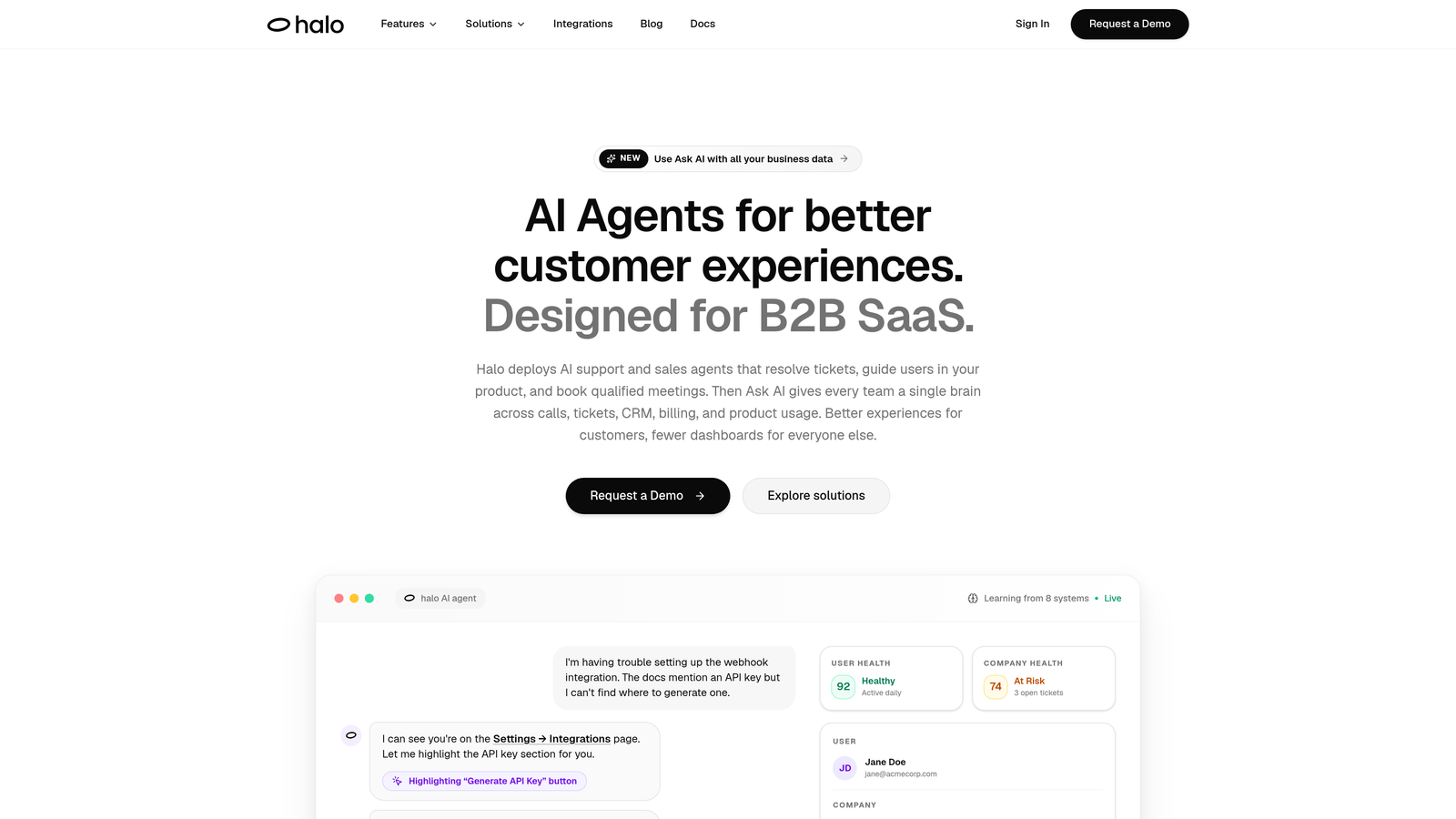
Halo AI is an AI-first customer support platform built specifically for SaaS companies, deploying autonomous agents that resolve tickets, guide users, and surface actionable business intelligence.
Where This Tool Shines
What separates Halo AI from most tools on this list is its architecture. Rather than adding AI features on top of an existing helpdesk, Halo was built AI-first from the ground up. That distinction matters more than it sounds: when AI is the foundation rather than a feature, every part of the system, from ticket routing to user guidance to analytics, is designed to work intelligently rather than just efficiently.
The page-aware chat widget is a standout capability. Halo's AI agent can see the exact page and UI state a user is on, which means it provides contextual guidance rather than generic documentation links. For SaaS companies where onboarding friction and feature confusion drive a significant share of support volume, this is a meaningful differentiator.
Key Features
Page-Aware AI Agents: The AI sees exactly what users see and delivers contextual UI guidance based on their current page or workflow state.
Autonomous Ticket Resolution: AI agents resolve tickets independently and escalate intelligently to human agents only when complexity warrants it.
Auto Bug Ticket Creation: Automatically detects and routes bug reports to Linear or your existing issue tracker, saving product and engineering teams significant triage time.
Smart Inbox with Business Intelligence: Goes beyond standard CSAT metrics to surface customer health signals, revenue intelligence, and anomaly detection directly from support conversations.
Broad Integration Ecosystem: Native integrations with Linear, Slack, HubSpot, Intercom, Stripe, Zoom, PandaDoc, and Fathom connect support data to your entire business stack.
Continuous Learning: The system learns from every resolved interaction, improving resolution accuracy over time without manual retraining.
Best For
SaaS startups and scaling B2B platforms that want AI to be the core of their support operation, not a supplement to it. Particularly well-suited for product teams that want support data feeding directly into bug tracking and customer health workflows.
Pricing
Contact for pricing. Visit haloagents.ai for current plans and to book a demo.
2. Intercom
Best for: SaaS teams wanting a mature, all-in-one messaging platform with strong onboarding and a large integration ecosystem.
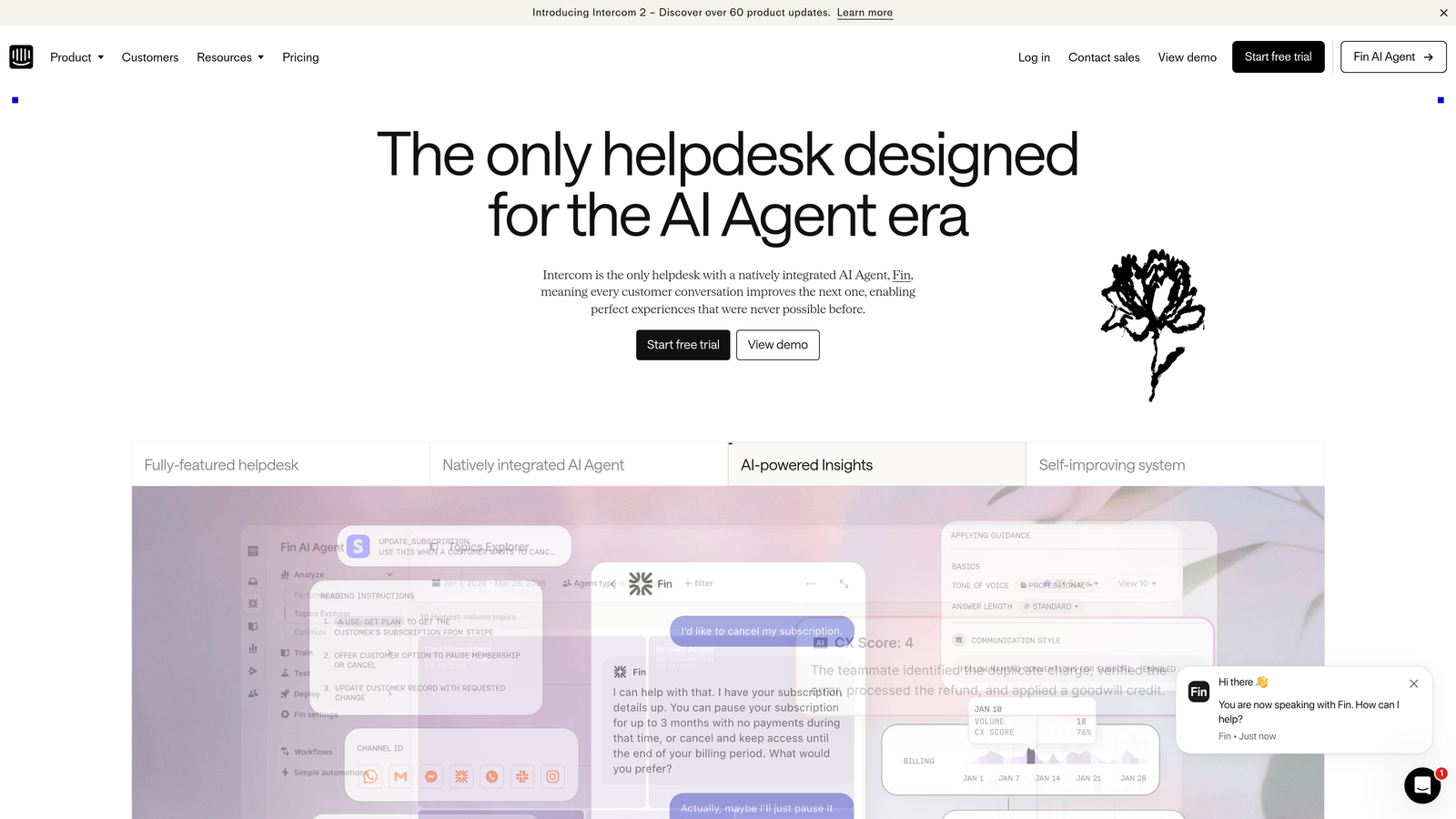
Intercom is a well-established customer messaging platform combining AI-powered ticket resolution with product tours, onboarding flows, and omnichannel communication.
Where This Tool Shines
Intercom's Fin AI agent, built on GPT-4, handles a meaningful share of inbound support volume autonomously. For SaaS teams that have invested in a solid knowledge base, Fin can draw on that content to resolve common queries without agent involvement. The platform also excels at onboarding: product tours and in-app messaging are native capabilities, not integrations.
The trade-off worth knowing is that Intercom's AI is layered onto a messaging-first platform rather than built AI-first. This means the experience is polished and reliable, but teams looking for deeper AI autonomy or business intelligence from support data may find the ceiling lower than expected.
Key Features
Fin AI Agent: GPT-4 based automated resolution that draws on your knowledge base to handle common support queries.
Product Tours and Onboarding Flows: Built-in tools for user onboarding and feature adoption, without needing a separate tool.
Omnichannel Inbox: Handles chat, email, and social channels in a single unified workspace.
Extensive App Marketplace: Hundreds of integrations covering CRM, analytics, and product tools.
Best For
Scaling SaaS companies that want a single platform for support, onboarding, and customer messaging. Strong choice if product tours and in-app engagement are as important as ticket resolution.
Pricing
Starts at approximately $39/month for small teams; scales significantly with seat count and AI usage volume. Review current pricing at intercom.com.
3. Zendesk AI
Best for: Enterprise SaaS teams needing a proven, compliance-ready helpdesk with AI triage and agent assistance layered in.
Zendesk AI is the AI layer built into the Zendesk Suite, adding intelligent triage, intent detection, an agent copilot, and generative self-service to an enterprise-grade ticketing foundation.
Where This Tool Shines
Zendesk's strength is scale and reliability. For enterprise SaaS companies with complex compliance requirements, large support teams, and high ticket volumes, Zendesk provides a proven infrastructure that many organizations have built workflows around for years. The AI additions, including intelligent triage, intent detection, and agent copilot with suggested replies, genuinely improve agent efficiency rather than just adding a chatbot layer.
The honest caveat is that Zendesk can feel heavyweight for smaller or faster-moving SaaS teams. The AI capabilities are additions to an existing platform rather than native to it, which sometimes shows in how they integrate with core workflows.
Key Features
Intelligent Triage and Intent Detection: Automatically routes tickets to the right team based on detected intent and topic classification.
Agent Copilot: Surfaces suggested replies and macro recommendations to help agents respond faster and more consistently.
AI-Powered Self-Service: Help Center and bot capabilities that allow customers to resolve issues without agent involvement.
Enterprise Security and Compliance: Robust controls for data residency, access management, and regulatory compliance.
Best For
Enterprise SaaS companies with established Zendesk infrastructure, large support organizations, and compliance requirements that rule out newer platforms.
Pricing
Suite plans start at approximately $55/agent/month; AI add-ons are priced separately. Check zendesk.com for current tier details.
4. Freshdesk Freddy AI
Best for: Mid-market SaaS teams in the Freshworks ecosystem looking for accessible AI-assisted support at a lower price point than enterprise alternatives.
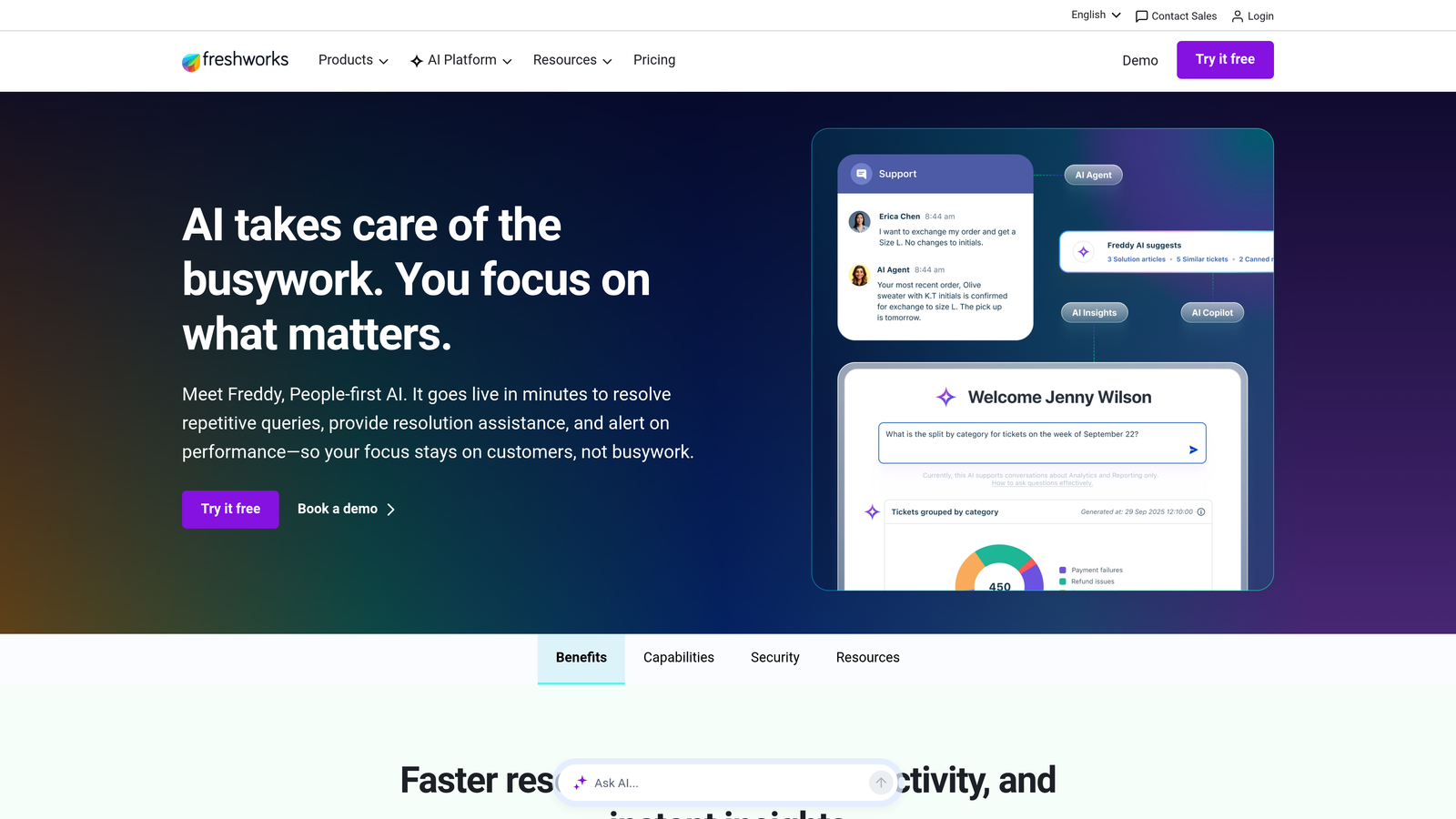
Freshdesk's Freddy AI is an AI layer spanning ticket categorization, agent assistance, and self-service automation across the Freshworks support suite.
Where This Tool Shines
Freddy AI's modular structure is genuinely useful for teams that want to adopt AI incrementally. Freddy Copilot handles agent-side assistance with reply suggestions and ticket summarization, while Freddy Self Service addresses customer-facing automation. Teams can adopt one capability without committing to the full stack immediately.
For SaaS companies already using other Freshworks products (CRM, ITSM), Freddy's native integration across the ecosystem adds real value. Data flows across products without custom configuration, which reduces operational overhead for smaller teams.
Key Features
Freddy Copilot: Provides agents with reply suggestions, ticket summaries, and contextual recommendations to speed up resolution.
Freddy Self Service: Customer-facing automated resolution that handles common queries without agent involvement.
Freddy Insights: Support analytics and trend detection that surfaces patterns in ticket volume and customer issues.
Freshworks Ecosystem Integration: Native connectivity across Freshdesk, Freshsales CRM, and Freshservice ITSM.
Best For
Mid-market SaaS teams on a budget, particularly those already using Freshworks products who want AI capabilities without switching platforms.
Pricing
Freshdesk plans start at approximately $15/agent/month; Freddy AI features are available on higher tiers. Visit freshworks.com for current plan details.
5. Tidio
Best for: Early-stage SaaS companies wanting fast AI chat deployment with a low technical barrier to entry.
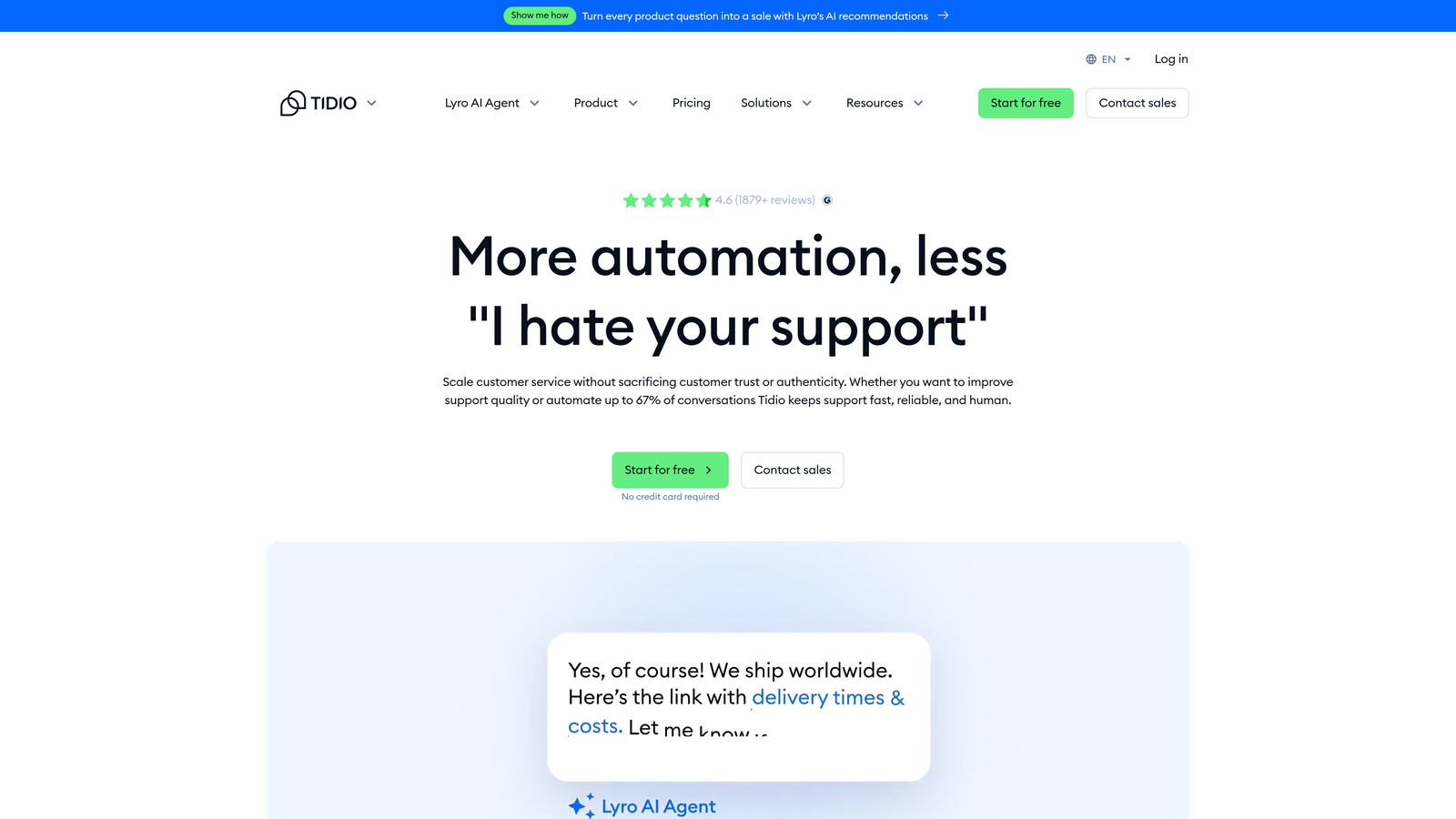
Tidio is an accessible AI chat platform featuring the Lyro AI chatbot, designed for quick deployment with strong live agent fallback capabilities.
Where This Tool Shines
Tidio's biggest advantage is how fast you can get up and running. For early-stage SaaS teams that need AI-assisted chat without a lengthy implementation, Tidio delivers a working setup in a short timeframe. Lyro handles conversational support queries and hands off smoothly to a live agent when needed.
The trade-off is depth. Tidio works well for common, predictable support questions, but it lacks the SaaS-specific integrations and business intelligence capabilities that more mature platforms offer. Think of it as a strong starting point rather than a long-term enterprise solution.
Key Features
Lyro AI Chatbot: Conversational AI that handles common support queries automatically using your knowledge base content.
Easy Setup: Minimal technical configuration required, making it accessible for small teams without dedicated engineering support.
Live Chat with Human Handoff: Smooth escalation from AI to live agent when conversations exceed automated capabilities.
Basic Analytics: Conversation history and performance metrics for monitoring chatbot effectiveness.
Best For
Early-stage SaaS startups and SMBs that need a fast, affordable AI chat solution and aren't yet ready for a full-featured enterprise platform.
Pricing
Free plan available; paid plans from approximately $29/month. Lyro AI conversations are priced separately based on volume.
6. Drift (Salesloft)
Best for: PLG and sales-led SaaS companies where inbound support conversations carry pipeline value alongside support intent.
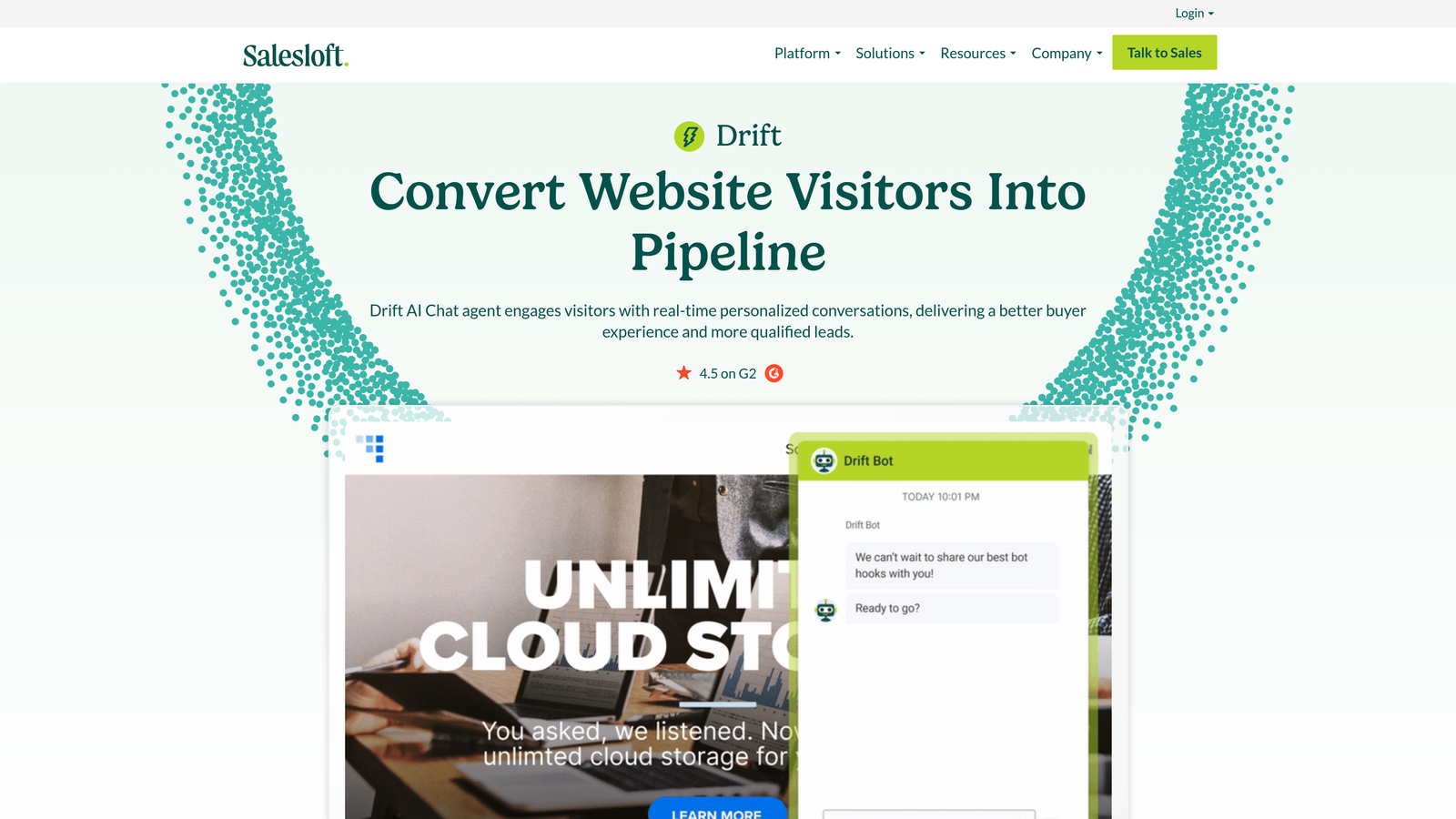
Drift, now part of Salesloft, is a conversational platform that bridges support and sales, making it particularly useful where the line between a support question and a sales opportunity is thin.
Where This Tool Shines
Drift is the right tool when your support conversations aren't purely support conversations. In PLG SaaS environments, a user asking "how do I do X?" is often also a signal of expansion intent or upgrade readiness. Drift's AI handles qualification and routing alongside support, and its integration with Salesloft creates a revenue-aware workflow that pure support tools don't offer.
If your team is purely focused on support resolution without a sales motion, Drift may feel over-engineered. Its strength is specifically in the overlap between support and revenue.
Key Features
AI-Powered Conversational Chat: Handles both support queries and sales qualification within the same conversation flow.
Playbooks: Routes conversations based on intent signals, ensuring the right team receives the right conversation at the right time.
Salesloft Integration: Connects support conversations directly into revenue workflows for seamless handoff to sales.
Account-Based Targeting: Personalizes conversation routing based on account attributes and visitor identity.
Best For
PLG SaaS companies and sales-led B2B platforms where support conversations frequently intersect with pipeline and expansion opportunities.
Pricing
Premium pricing model; contact Drift or Salesloft directly for current rates and package details.
7. Kustomer
Best for: Relationship-heavy SaaS support teams that need a complete customer timeline view alongside AI automation.
Kustomer is a CRM-native customer service platform with AI automation built around a full customer history, suited for high-touch B2B SaaS support operations.
Where This Tool Shines
Kustomer's differentiator is context. Every support interaction surfaces within a complete customer timeline, giving agents immediate visibility into past conversations, account history, and relationship data before they type a single word. The AI automation layer, covering routing, triage, and suggested responses, operates on top of this rich context rather than treating each ticket in isolation.
Enterprise buyers should note that Kustomer is now owned by Meta, which raises data and privacy considerations worth evaluating depending on your compliance requirements and customer data sensitivity.
Key Features
Full Customer Timeline: Aggregates every touchpoint, conversation, and account action into a single unified view for agents.
AI-Powered Routing and Triage: Automatically categorizes and routes tickets based on intent, urgency, and customer attributes.
Omnichannel Support: Manages chat, email, SMS, and social channels from a single workspace.
Deep CRM Integration: Connects support data with customer relationship data for context-rich agent workflows.
Best For
High-touch B2B SaaS companies and teams managing complex customer relationships where full account context is critical to quality support.
Pricing
Enterprise pricing starting around $89/user/month; contact Kustomer for current rates and package options.
8. Help Scout
Best for: SaaS teams with a human-first support culture that want AI to make agents faster without removing the personal touch.
Help Scout is a clean, human-first support platform with AI assistance features designed to enhance agent productivity while preserving the quality of personal customer interactions.
Where This Tool Shines
Help Scout occupies a specific and valuable niche: teams that believe support quality and human connection are competitive advantages, not costs to be automated away. The AI features, including AI Drafts, Summarize, and Assist, are designed to help agents work faster rather than replace them. The interface is consistently praised for its simplicity and low learning curve.
The trade-off is automation depth. Help Scout won't autonomously resolve a large share of your ticket volume the way an AI-first platform will. If your support philosophy prioritizes quality and relationship over speed and scale, that's a feature rather than a limitation.
Key Features
AI Drafts: Generates suggested reply drafts that agents can review, edit, and send, reducing time spent on routine responses.
AI Summarize: Condenses long conversation threads into quick summaries so agents get context at a glance.
Docs Knowledge Base: Built-in knowledge base with AI-assisted search to help customers self-serve before contacting support.
Clean Shared Inbox: Minimal, well-designed interface that teams can adopt quickly with almost no training overhead.
Best For
SaaS teams with a relationship-driven support culture, particularly those where agent quality and brand voice matter as much as resolution speed.
Pricing
Plans from approximately $22/user/month; AI features included on Standard and Plus tiers. See helpscout.com for current pricing.
9. Forethought
Best for: Enterprise SaaS teams that want to add generative AI capabilities on top of an existing helpdesk without replacing it.
Forethought is a generative AI support layer that integrates with existing helpdesks to add intelligent triage, routing, and autonomous resolution without requiring a platform migration.
Where This Tool Shines
Forethought solves a real problem for enterprise teams: you've invested heavily in Zendesk, Salesforce Service Cloud, or Freshdesk, your team is trained on it, your workflows are built around it, and a full platform switch isn't realistic. Forethought adds meaningful AI capabilities on top of what you already have, specifically triage, routing, and generative resolution, without disrupting existing infrastructure.
The natural limitation is that Forethought is an additive layer, not a foundation. Teams looking to build a truly AI-first support operation will eventually outgrow the bolt-on model. But for enterprises that need AI capabilities now without a migration project, it's a pragmatic solution.
Key Features
AI Triage and Routing: Intelligently classifies and routes incoming tickets within your existing helpdesk environment.
Generative AI Resolution (Solve): Autonomous ticket resolution using generative AI trained on your support content and history.
Triage and Assist Products: Separate product modules covering different layers of the support workflow from self-service to agent assistance.
Deep Helpdesk Integrations: Native integration with Zendesk, Salesforce Service Cloud, and Freshdesk for seamless deployment.
Best For
Enterprise SaaS companies committed to their existing helpdesk infrastructure that want to add AI capabilities incrementally without a platform replacement.
Pricing
Enterprise pricing; contact Forethought directly for current rates and implementation details.
Which Tool Is Right for Your SaaS Team?
The right answer depends less on feature checklists and more on where your team is, where you're headed, and how you think about the role of AI in your support operation.
Here's a quick way to think through the decision:
Early-stage SaaS: Start with Tidio if you need something running fast with minimal setup, or go straight to Halo AI if you want an AI-first foundation that scales with you rather than one you'll outgrow.
Scaling B2B SaaS: Halo AI or Intercom are the strongest options. Halo AI leads on AI depth and business intelligence; Intercom leads on onboarding and messaging breadth.
Enterprise on existing helpdesk: Zendesk AI if you're already invested in the Zendesk ecosystem; Forethought if you want generative AI on top of Zendesk, Salesforce, or Freshdesk without switching platforms.
PLG or sales-led SaaS: Drift is purpose-built for the support-sales overlap that defines product-led growth motions.
Human-first support culture: Help Scout gives your agents AI assistance without removing the personal touch that defines your brand.
One principle worth holding onto as you evaluate: AI that's bolted onto a legacy platform will always be constrained by that platform's architecture. If you're building a support operation that needs to scale without scaling headcount, an AI-first foundation isn't a nice-to-have. It's the difference between a system that gets smarter over time and one that just gets busier.
Your support team shouldn't scale linearly with your customer base. Let AI agents handle routine tickets, guide users through your product, and surface business intelligence while your team focuses on complex issues that need a human touch. See Halo in action and discover how continuous learning transforms every interaction into smarter, faster support.