9 Best AI Support Software for Scale in 2026
Discover the 9 best AI support software for scale in 2026, evaluated specifically for B2B SaaS companies managing high ticket volumes. This guide compares top platforms on automation depth, integration breadth, and long-term AI performance to help growing teams find tools that handle support complexity without requiring proportional headcount increases.
 Grant CooperFounder13 min read
As B2B SaaS companies grow, support volume scales faster than headcount can keep up. A ticket backlog that was manageable at 50 customers becomes a genuine crisis at 500. That's where AI support software earns its place, not as a chatbot novelty, but as a core piece of your support infrastructure.
This list focuses specifically on tools built for scale: platforms that handle high ticket volumes autonomously, integrate with your existing stack, and get smarter over time rather than plateauing. Whether you're running a lean support team at a Series A startup or managing enterprise-level complexity, there's a meaningful difference between tools that help at scale and tools that just help.
We evaluated each platform on automation depth, integration breadth, AI quality, and how well it grows with your team, not just how it performs on day one.
1. Halo AI
Best for: B2B SaaS teams that want AI-first support automation with deep product context
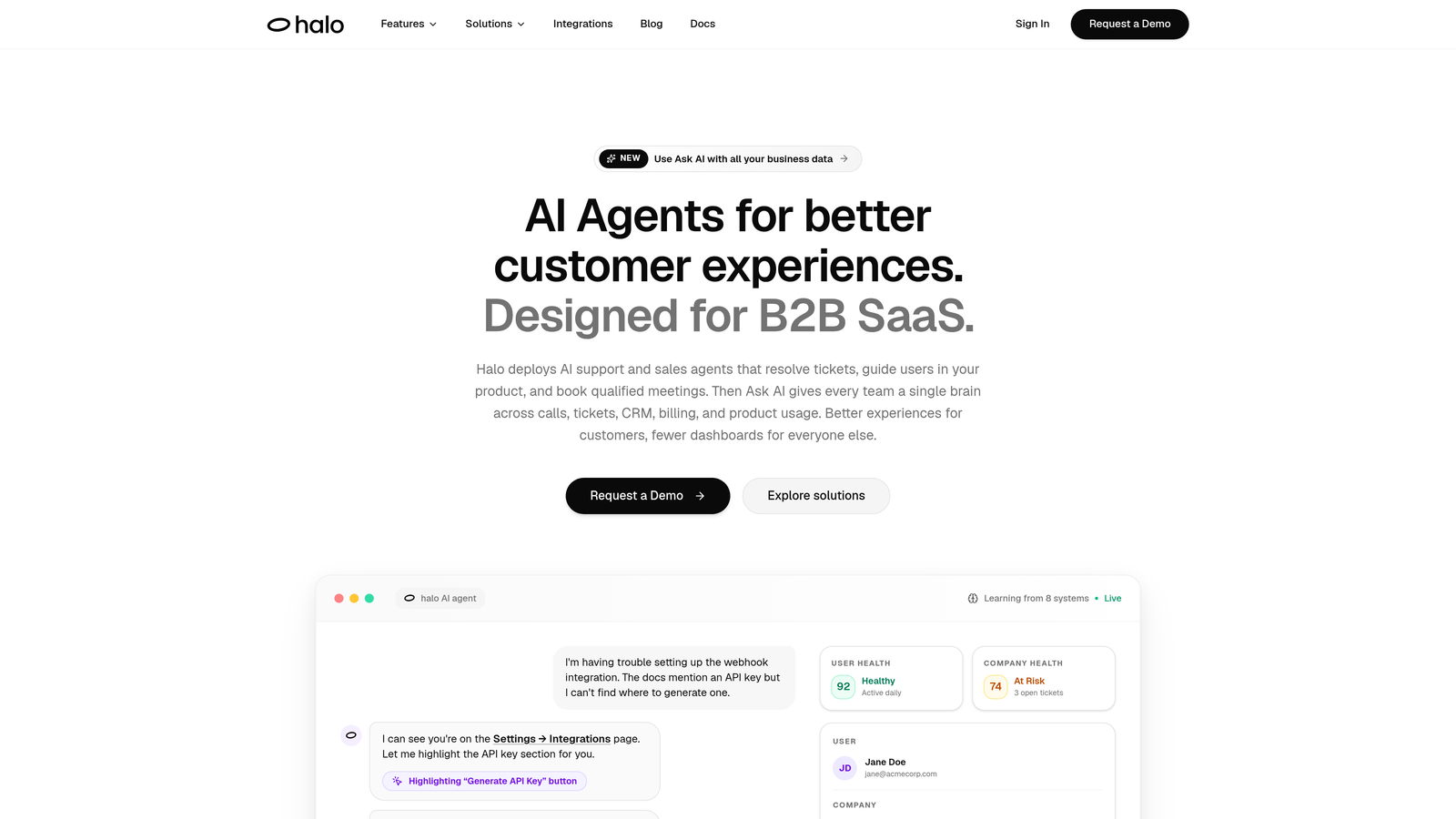
Halo AI is an AI-first customer support platform built specifically for B2B SaaS product teams who need autonomous ticket resolution that actually understands their product.
Where This Tool Shines
What separates Halo from most platforms on this list is its architecture. It wasn't built as a helpdesk with AI bolted on later. Every layer, from ticket resolution to user guidance to bug reporting, was designed around AI as the core. That matters because AI-first systems learn differently. Each resolved ticket makes the next resolution smarter, rather than just executing the same static workflows.
The page-aware chat widget is a standout capability. Halo can see what the user sees in your product, which means it can provide contextually accurate visual guidance rather than generic help center links. For SaaS products with complex UIs, this is a meaningful difference in support quality.
Key Features
Page-Aware Chat Widget: Understands the user's current context in your product and provides relevant visual UI guidance, not just generic answers.
Autonomous AI Agents: Resolve support tickets end-to-end, learning from every interaction to improve resolution quality over time.
Auto Bug Ticket Creation: Converts support issues into Linear or Jira tickets automatically, closing the loop between support and engineering without manual handoffs.
Smart Inbox with Business Intelligence: Surfaces customer health signals, revenue anomaly detection, and other intelligence signals beyond basic support metrics.
Live Agent Handoff: Escalates complex issues to human agents with full conversation context preserved, so customers never have to repeat themselves.
Integrations: Connects with Linear, Slack, HubSpot, Intercom, Stripe, Zoom, PandaDoc, and Fathom for a genuinely unified support stack.
Best For
Product-led SaaS companies scaling from startup to mid-market who want AI that understands their product deeply. Particularly strong for teams where support insights need to flow into product, engineering, and revenue workflows, not just stay inside a helpdesk.
Pricing
Visit haloagents.ai for current pricing details. Plans are designed for growing SaaS teams.
2. Intercom
Best for: Teams that want mature omnichannel messaging with a capable AI agent layer
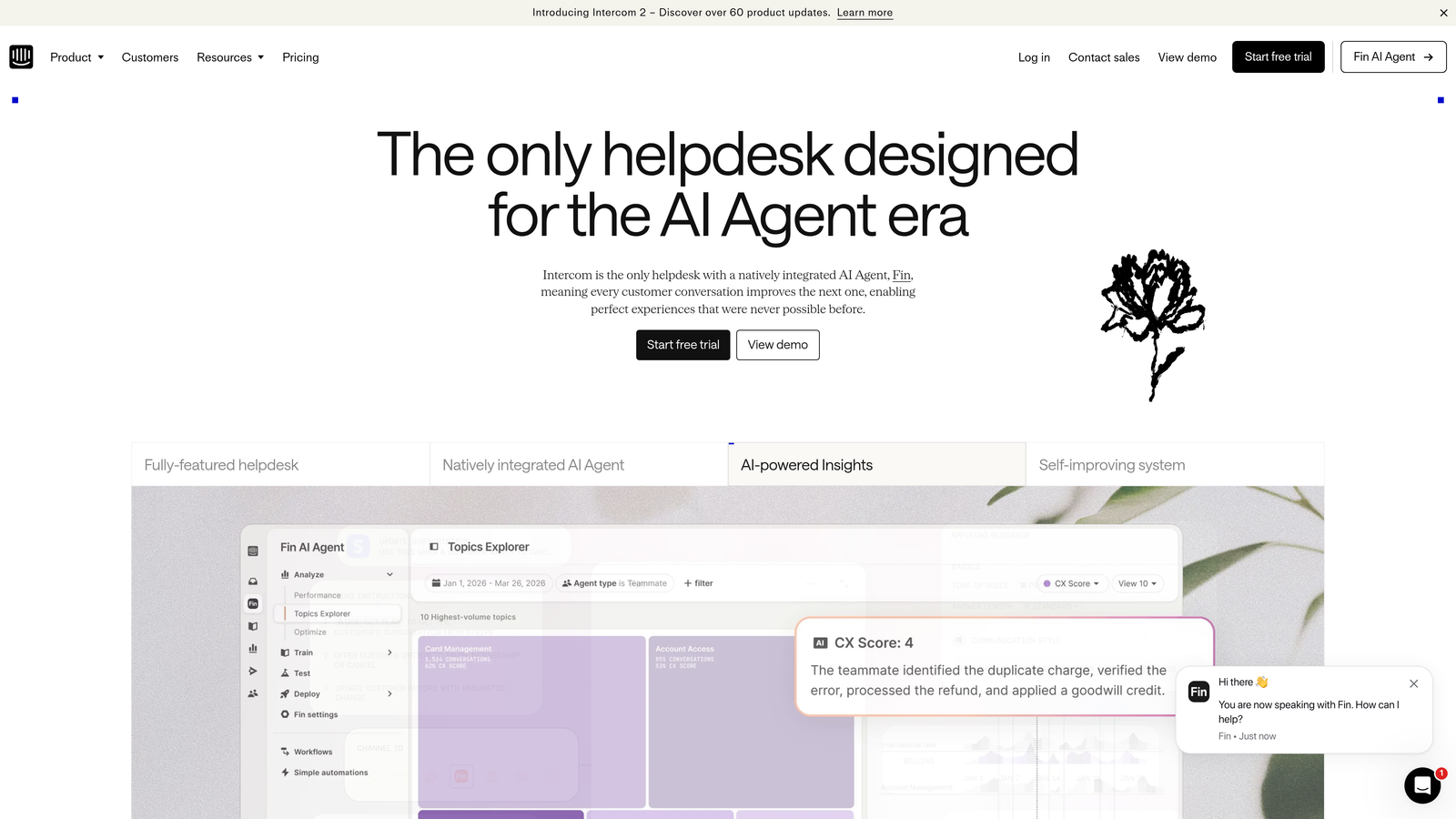
Intercom is one of the most established customer messaging platforms, featuring Fin, an AI agent built on large language models that resolves support queries using your help center content and conversation history.
Where This Tool Shines
Intercom's strength is its maturity. The platform has been refined over many years, and it shows in the polish of its omnichannel capabilities, its large app marketplace, and the depth of its reporting. Fin, Intercom's AI agent, is genuinely capable at handling common support queries using your existing documentation, making it a relatively low-friction AI addition for teams already on the platform.
The ecosystem is also worth noting. If your team relies on a wide variety of third-party tools, Intercom's integration marketplace covers a lot of ground. The tradeoff is that pricing scales significantly at higher usage tiers, which can become a consideration as you grow.
Key Features
Fin AI Agent: Resolves support queries autonomously using help center content and conversation history, with LLM-powered understanding.
Omnichannel Messaging: Handles chat, email, and social channels from a unified inbox.
App Marketplace: Extensive integrations with third-party tools across CRM, analytics, and product categories.
AI-Powered Routing: Intelligently routes conversations to the right team or agent based on context and rules.
Reporting and CSAT: Built-in analytics for tracking resolution rates, customer satisfaction, and team performance.
Best For
Growth-stage to enterprise companies that want a proven messaging platform with AI capabilities and a broad integration ecosystem. Works well for teams that have already invested in building out a help center and want AI to leverage that existing content.
Pricing
Tiered plans with pricing that scales based on usage and seats. Check intercom.com for current rates, as pricing at higher tiers can be significant.
3. Zendesk AI
Best for: Large support organizations that need enterprise-grade infrastructure with AI layered in
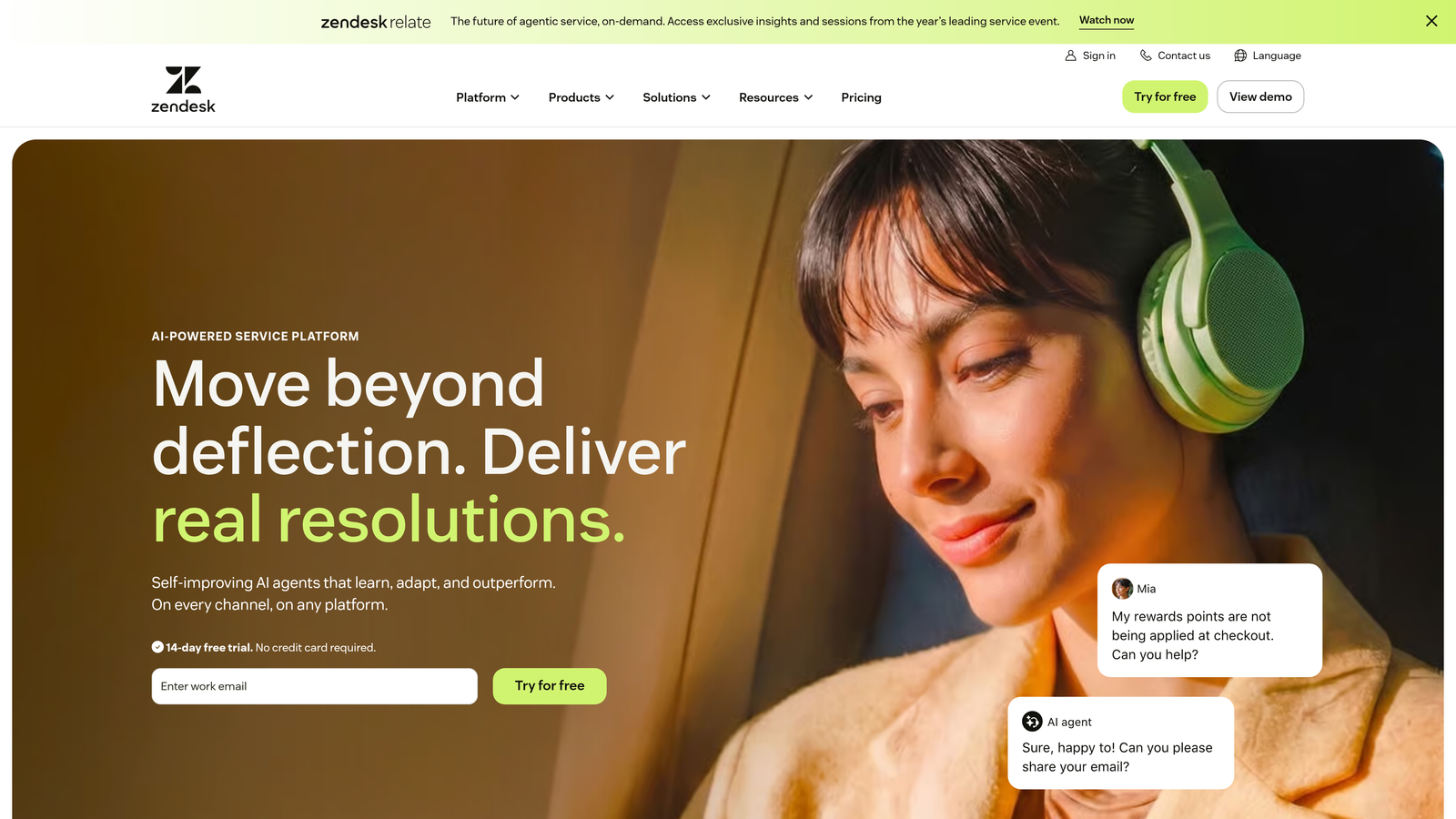
Zendesk is the enterprise-standard helpdesk platform, with AI triage, intelligent routing, and agent copilot capabilities built into a deeply customizable support infrastructure.
Where This Tool Shines
Zendesk's value proposition at scale is its infrastructure depth. For large support organizations managing complex SLA requirements, compliance needs, and multi-team workflows, Zendesk provides the configurability to handle it. The AI layer, including intelligent triage, agent copilot for reply suggestions, and AI-powered self-service, sits on top of that proven foundation.
The tradeoff is complexity. Zendesk rewards teams that have dedicated support operations resources to configure and maintain it. For smaller teams without that bandwidth, the overhead can outweigh the benefits.
Key Features
AI Triage and Routing: Automatically classifies, prioritizes, and routes incoming tickets based on content and intent.
Agent Copilot: Provides reply suggestions, conversation summarization, and next-step recommendations to speed up agent responses.
Workflow Automation: Advanced automation rules and SLA management for complex support operations.
Compliance and Security: Enterprise-grade security features, data residency options, and compliance certifications.
Integration Marketplace: Hundreds of integrations covering virtually every business tool category.
Best For
Enterprise support teams or well-resourced mid-market companies with dedicated support ops. Best suited for organizations that need deep customization, strong compliance controls, and the ability to handle high ticket volumes across multiple teams and channels.
Pricing
Suite plans available with enterprise pricing on request. Verify current rates at zendesk.com before budgeting, as enterprise configurations vary significantly.
4. Freshdesk (Freddy AI)
Best for: Growing teams that want solid AI-augmented support without enterprise price tags
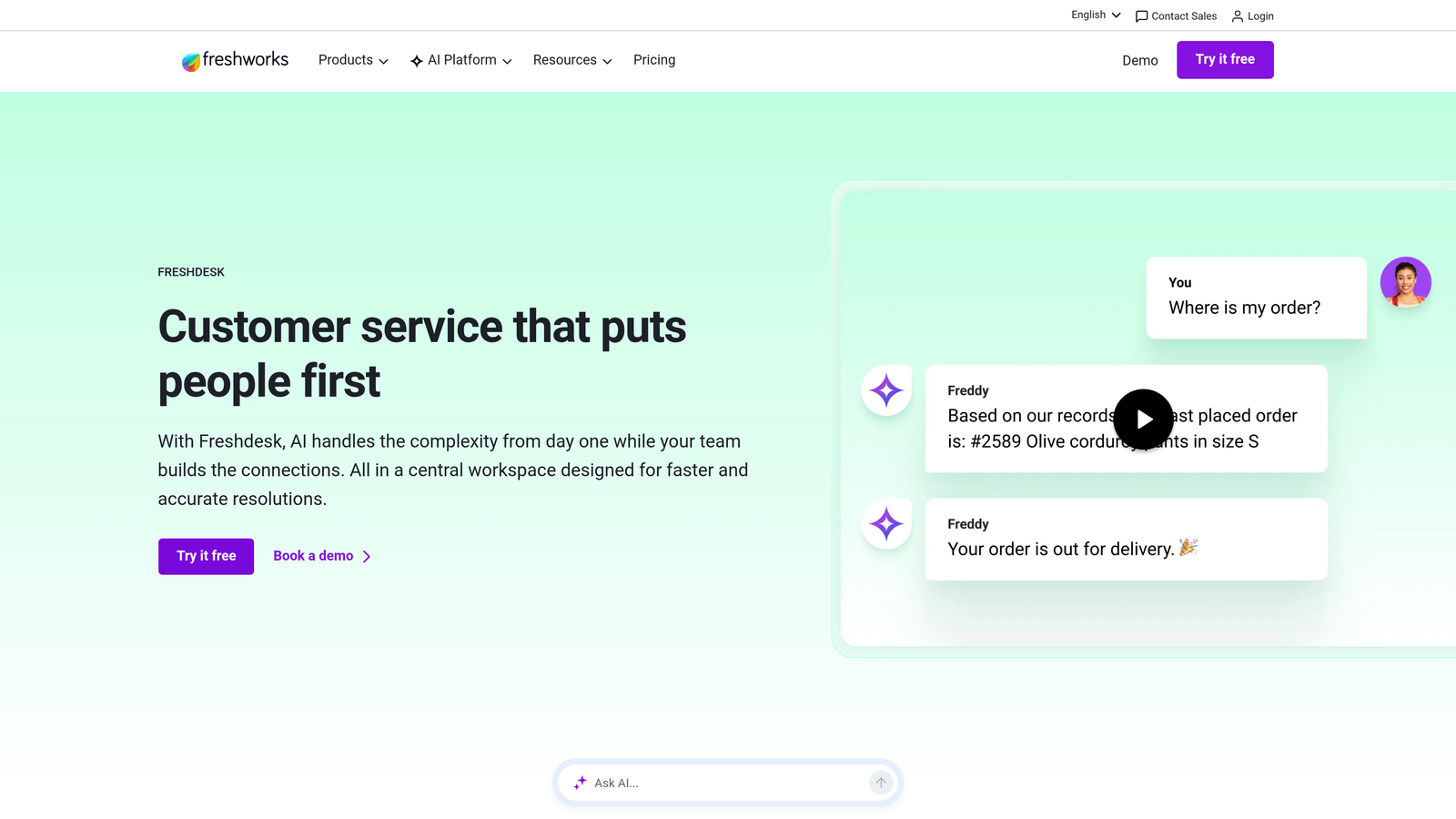
Freshdesk is Freshworks' helpdesk platform, with Freddy AI providing agent copilot, self-service automation, and analytics at a price point that makes it accessible for teams in growth mode.
Where This Tool Shines
Freshdesk's appeal is the combination of genuine AI capability with more accessible pricing compared to enterprise alternatives. Freddy AI covers three meaningful areas: helping agents draft replies faster, handling customer-facing self-service, and surfacing analytics insights including anomaly alerts. That's a reasonably complete AI story for a mid-market platform.
The free tier also makes Freshdesk a practical starting point for early-stage teams. You can get real value before committing to a paid plan, which is a meaningful advantage when budgets are tight and you're still figuring out your support stack.
Key Features
Freddy AI Copilot: Assists agents with reply drafting, suggested responses, and conversation context to reduce handle time.
Freddy Self Service: Automates customer-facing resolution through AI-powered bots and knowledge base deflection.
Freddy Insights: Analytics layer that surfaces support trends, team performance data, and anomaly alerts.
Omnichannel Support: Handles email, chat, phone, and social channels from a unified interface.
Free Tier: Available for small teams, making it a low-risk entry point for companies early in their support tooling journey.
Best For
Mid-market SaaS companies and growing teams that want a capable, AI-augmented helpdesk without the overhead or cost of enterprise platforms. Also a strong choice for teams migrating off spreadsheets or basic email support for the first time.
Pricing
Free tier available for small teams; paid plans start at competitive rates. Check freshdesk.com for current pricing across tiers.
5. Salesforce Agentforce
Best for: Enterprises already running Salesforce that want AI agents operating across their full CRM and service data
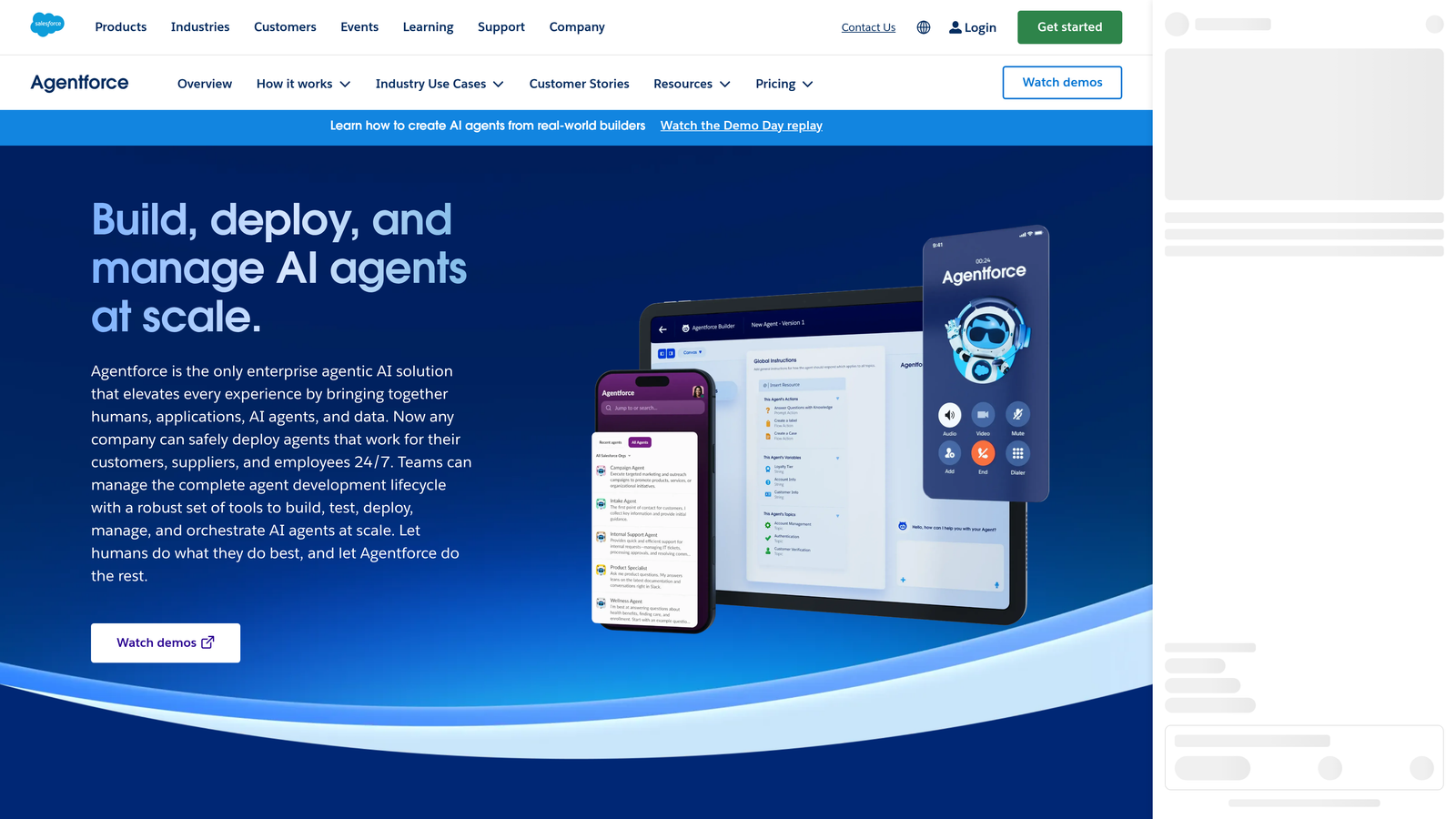
Salesforce Agentforce is Salesforce's autonomous AI agent platform, operating across Service Cloud, CRM data, and the full Salesforce ecosystem to handle complex support workflows at enterprise scale.
Where This Tool Shines
The core advantage of Agentforce is data depth. When your AI agents can access the full Salesforce customer record, including purchase history, CRM notes, open cases, and account data, the quality of autonomous resolution improves significantly. For enterprises where Salesforce is already the system of record, Agentforce removes the integration gap that limits other AI tools.
The low-code agent builder also makes it more accessible than you might expect from a Salesforce product. Teams can configure agents using pre-built templates without deep technical resources, though enterprise deployments typically still involve a Salesforce partner or internal admin.
Key Features
Autonomous AI Agents: Take actions across Salesforce data to resolve cases, update records, and complete multi-step workflows without human intervention.
Service Cloud Integration: Deep native connection to case management, knowledge base, and customer records.
Multi-Channel Deployment: Operates across chat, email, voice, and messaging channels.
Low-Code Agent Builder: Pre-built templates and a visual builder for configuring agent behavior without heavy development work.
Einstein Analytics: Built-in reporting and AI-powered insights across service performance and customer data.
Best For
Enterprise companies with Salesforce as their CRM backbone. If you're not already a Salesforce customer, the onboarding complexity and cost make this a harder sell. If you are, it's one of the most powerful options for AI-driven service automation at scale.
Pricing
Enterprise pricing, typically bundled with existing Salesforce contracts. Contact Salesforce directly for current Agentforce rates and packaging.
6. Ada
Best for: High-volume teams that need reasoning-based AI for complex, multi-turn conversations
Ada is a dedicated AI agent platform that uses reasoning-based AI to handle complex, multi-turn support conversations without rigid decision trees or scripted flows.
Where This Tool Shines
Ada's differentiator is its approach to conversation. Most AI support tools work well for simple, single-turn queries: "What's your return policy?" or "How do I reset my password?" Ada is designed for the messier, multi-step conversations that typically require human agents, using reasoning to navigate complexity rather than falling back on scripted paths.
Because Ada is a standalone AI agent platform rather than a helpdesk, it integrates with your existing tools rather than replacing them. That's a meaningful positioning choice: teams that have already invested in Zendesk or Salesforce can add Ada's AI capabilities on top without a platform migration.
Key Features
Reasoning-Based AI: Handles complex, multi-step conversations by reasoning through context rather than following rigid decision trees.
No-Code Agent Builder: Configurable by non-technical teams without developer resources.
Multi-Language Support: Handles global deployments across multiple languages from a single configuration.
Helpdesk Integrations: Connects with Zendesk, Salesforce, Freshdesk, and other major platforms.
Deflection and Resolution Analytics: Detailed reporting on what Ada resolves autonomously versus what escalates to human agents.
Best For
Large B2B or B2C companies with high support volumes that need sophisticated AI conversation handling. Particularly strong for global teams that need multi-language support and for organizations that want AI overlaid on their existing helpdesk investment.
Pricing
Custom enterprise pricing. Contact Ada directly at ada.cx for rates based on your volume and use case.
7. Forethought
Best for: Teams that want to add AI capabilities to an existing helpdesk without migrating platforms
Forethought is an AI layer that sits on top of your existing helpdesk, particularly Zendesk and Salesforce, adding autonomous resolution, intelligent triage, and agent assist without requiring a platform migration.
Where This Tool Shines
The appeal of Forethought is pragmatic: your team already knows your helpdesk, your workflows are already configured, and migrating platforms carries real risk and cost. Forethought's bet is that you shouldn't have to migrate to get meaningfully better AI. Its three products, Solve for auto-resolution, Triage for intelligent routing, and Assist for agent copilot, can each be deployed independently or together.
This modular approach also makes it easier to justify the investment incrementally. You can start with Triage to improve routing accuracy, add Assist to speed up agent replies, and layer in Solve for autonomous resolution as confidence builds.
Key Features
Solve: Autonomous AI resolution for incoming tickets, handling common queries without agent involvement.
Triage: AI-powered routing and priority classification to ensure tickets reach the right team immediately.
Assist: Agent copilot that surfaces relevant knowledge and drafts replies to reduce handle time.
Helpdesk Compatibility: Works alongside Zendesk, Salesforce Service Cloud, and other major platforms.
Workflow Automation: Adds intelligent automation without requiring you to rebuild existing helpdesk workflows.
Best For
Support teams with established helpdesk configurations who want to add AI capabilities without the disruption of a full platform change. Strong fit for Zendesk and Salesforce shops looking to increase automation depth.
Pricing
Custom pricing based on usage and deployment scope. Contact Forethought at forethought.ai for rates.
8. Kustomer
Best for: Teams that need deep customer context woven into every support interaction
Kustomer is a CRM-native customer service platform that provides a unified customer timeline alongside AI automation, making it strong for teams where customer history is central to every support conversation.
Where This Tool Shines
Kustomer's unified customer timeline is its defining feature. Rather than treating each support ticket as an isolated event, Kustomer surfaces the full customer record: every past interaction, purchase, status change, and conversation, all in one view. For support teams where context matters as much as speed, this changes the quality of every interaction.
The CRM-native architecture also means you're not paying for and maintaining a separate CRM. For teams that don't already have a deeply embedded CRM, Kustomer can consolidate two tools into one, which has real operational value.
Key Features
Unified Customer Timeline: Combines all customer interactions, purchases, and data into a single chronological view for every agent.
AI-Powered Routing: Automatically routes conversations based on customer attributes, intent, and team availability.
CRM-Native Architecture: Built-in customer data management without requiring a separate CRM integration.
Omnichannel Threading: Maintains conversation continuity across email, chat, social, and phone.
Business Rules Engine: Flexible workflow automation based on customer data and conversation attributes.
Best For
B2B SaaS and DTC companies where customer history and account context are critical to support quality. Particularly strong for teams that currently maintain a separate CRM and helpdesk and want to consolidate.
Pricing
Per-agent pricing at mid-market to enterprise rates. Check kustomer.com for current pricing and plan details.
9. Help Scout
Best for: Smaller SaaS teams that want clean, human-centered support with AI assistance built in
Help Scout is a clean, human-centered support platform that has added AI drafting, summarization, and self-service features without sacrificing its signature simplicity.
Where This Tool Shines
Help Scout's reputation has always been built on getting out of your team's way. The interface is clean, the learning curve is minimal, and the focus is on helping agents have good conversations rather than managing complex workflows. The AI additions, particularly AI Drafts and AI Summarize, fit that philosophy: they speed up agents without adding operational overhead.
It's worth being honest about the positioning here. Help Scout is not the right tool for a support team handling thousands of tickets per day that needs deep autonomous resolution. But for smaller teams or early-stage companies that want genuine AI assistance without the complexity of enterprise platforms, it punches well above its price point.
Key Features
AI Drafts: Generates AI-assisted reply drafts for agents to review, edit, and send, reducing time-to-response without removing the human touch.
AI Summarize: Condenses long conversation threads into quick summaries so agents get up to speed instantly.
Beacon Self-Service Widget: Embeddable widget with AI-powered answers that deflects common questions before they become tickets.
Shared Inbox: Clean shared inbox with collision detection to prevent two agents from replying to the same conversation.
Simple Interface: Minimal learning curve with an interface that agents can use effectively from day one.
Best For
Early-stage and small-to-mid SaaS teams that prioritize simplicity and want AI assistance without the configuration overhead of enterprise platforms. A strong starting point for teams outgrowing email-based support for the first time.
Pricing
Affordable per-user pricing with a free trial available. Check helpscout.com for current plan rates.
Which Tool Is Right for Your Team?
The right AI support platform depends less on which tool has the longest feature list and more on where your team is today and where you're headed.
If you're a B2B SaaS team that wants AI at the core of your support stack, not layered on top of legacy infrastructure, Halo AI is built specifically for that. The page-aware context, continuous learning, and business intelligence signals make it a strong fit for product-led companies where support and product feedback loops need to stay connected.
For teams already deep in the Salesforce or Zendesk ecosystem, Agentforce and Zendesk AI respectively give you the most native AI experience without disrupting existing workflows. Intercom sits in a similar category for teams that have built their customer messaging around that platform.
If budget is a primary constraint, Freshdesk offers a genuinely capable AI-augmented helpdesk at a more accessible price point, with a free tier to start. Help Scout covers similar ground for teams that prioritize simplicity over feature depth.
Ada and Forethought are the right call when you want to add sophisticated AI capabilities on top of an existing helpdesk rather than replace it. Ada handles complex, reasoning-based conversations; Forethought adds modular AI across triage, resolution, and agent assist. Kustomer rounds out the list for teams where unified customer context is the primary driver.
Your support team shouldn't scale linearly with your customer base. Let AI agents handle routine tickets, guide users through your product, and surface business intelligence while your team focuses on complex issues that need a human touch. See Halo in action and discover how continuous learning transforms every interaction into smarter, faster support.