9 Best AI Support Software for Small Business in 2026
Small businesses can deliver fast, 24/7 customer support without a large team by choosing the right AI support software for small business needs. This guide evaluates nine top platforms—including Halo AI and others—based on ease of setup, pricing transparency, AI response quality, and scalability, helping lean teams automate ticket resolution and live chat while staying within budget.
 Matt PattoliFounder14 min read
Small businesses face a unique support challenge: customers expect fast, personalized responses around the clock, but hiring a full support team isn't always in the budget. AI support software bridges that gap by automating ticket resolution, powering live chat, and surfacing insights without requiring a dedicated ops team to manage it.
But with dozens of AI support tools now on the market, finding the right fit for a lean team can be overwhelming. We evaluated these platforms based on criteria that matter most to small businesses: ease of setup, pricing transparency, quality of AI responses, integration flexibility, and how well they scale as your team grows.
Whether you're a five-person startup drowning in support emails or a 50-person company looking to reduce response times, here are the best AI support software options available right now.
1. Halo AI
Best for: B2B teams that want autonomous AI agents resolving tickets end-to-end without scaling headcount
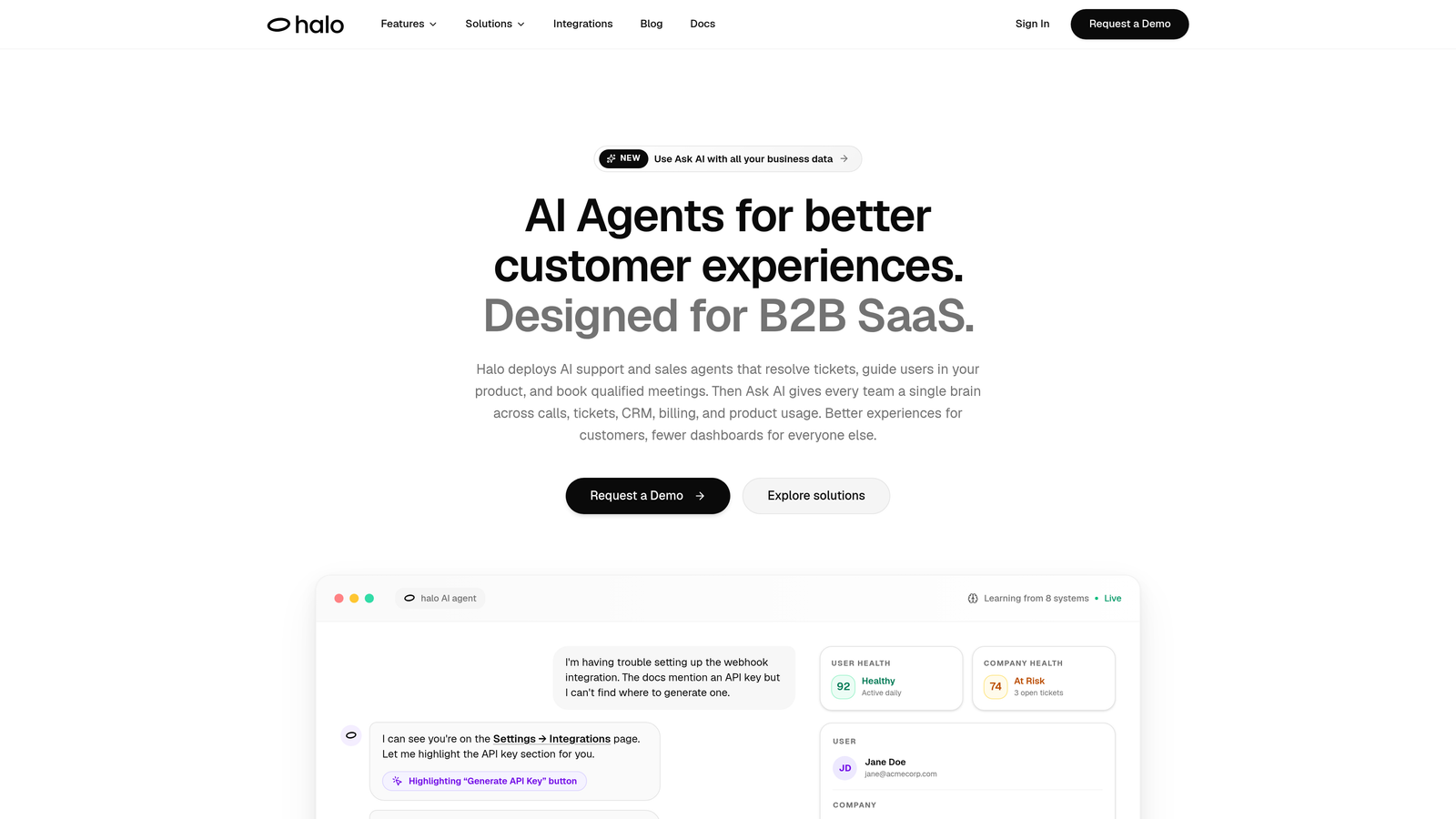
Halo AI is an AI-first customer support platform built around autonomous agents that resolve tickets, guide users through your product, and generate business intelligence from every interaction.
Where This Tool Shines
Most support tools treat AI as a layer on top of existing helpdesk workflows. Halo is different: AI is the default handler, and human agents are the escalation path. That architecture means tickets get resolved faster, without a human needing to touch every conversation.
What really sets Halo apart for B2B teams is its page-aware context. The chat widget can see what a user is looking at in real time, allowing the AI to provide visual UI guidance rather than generic answers. Combined with integrations across Linear, Slack, HubSpot, Intercom, Stripe, and more, Halo connects your support layer to your entire business stack.
Key Features
Autonomous Ticket Resolution: AI agents handle support tickets end-to-end, from intake to resolution, without requiring human review on routine issues.
Page-Aware Chat Widget: The widget sees what users see in your product, enabling specific, contextual UI guidance rather than generic help content.
Smart Inbox with Business Intelligence: Goes beyond support metrics to surface customer health signals, revenue intelligence, and anomaly detection.
Auto Bug Ticket Creation: Automatically creates bug reports in Linear and other dev tools when users report issues, closing the loop between support and engineering.
Live Agent Handoff: Complex issues escalate to human agents with full conversation context preserved, so nothing gets lost in the handoff.
Best For
Halo is purpose-built for B2B SaaS companies and product teams that want AI to operate as the primary support layer, not just a suggestion engine. It's especially well-suited for teams already using tools like Linear, HubSpot, or Intercom who want those systems to talk to each other through a single intelligent support hub.
Pricing
Contact for pricing. Halo is designed to scale with small and growing teams, so pricing is tailored to your usage and team size rather than one-size-fits-all per-seat billing.
2. Intercom
Best for: Teams that want AI-powered messaging plus proactive in-app communication in one platform
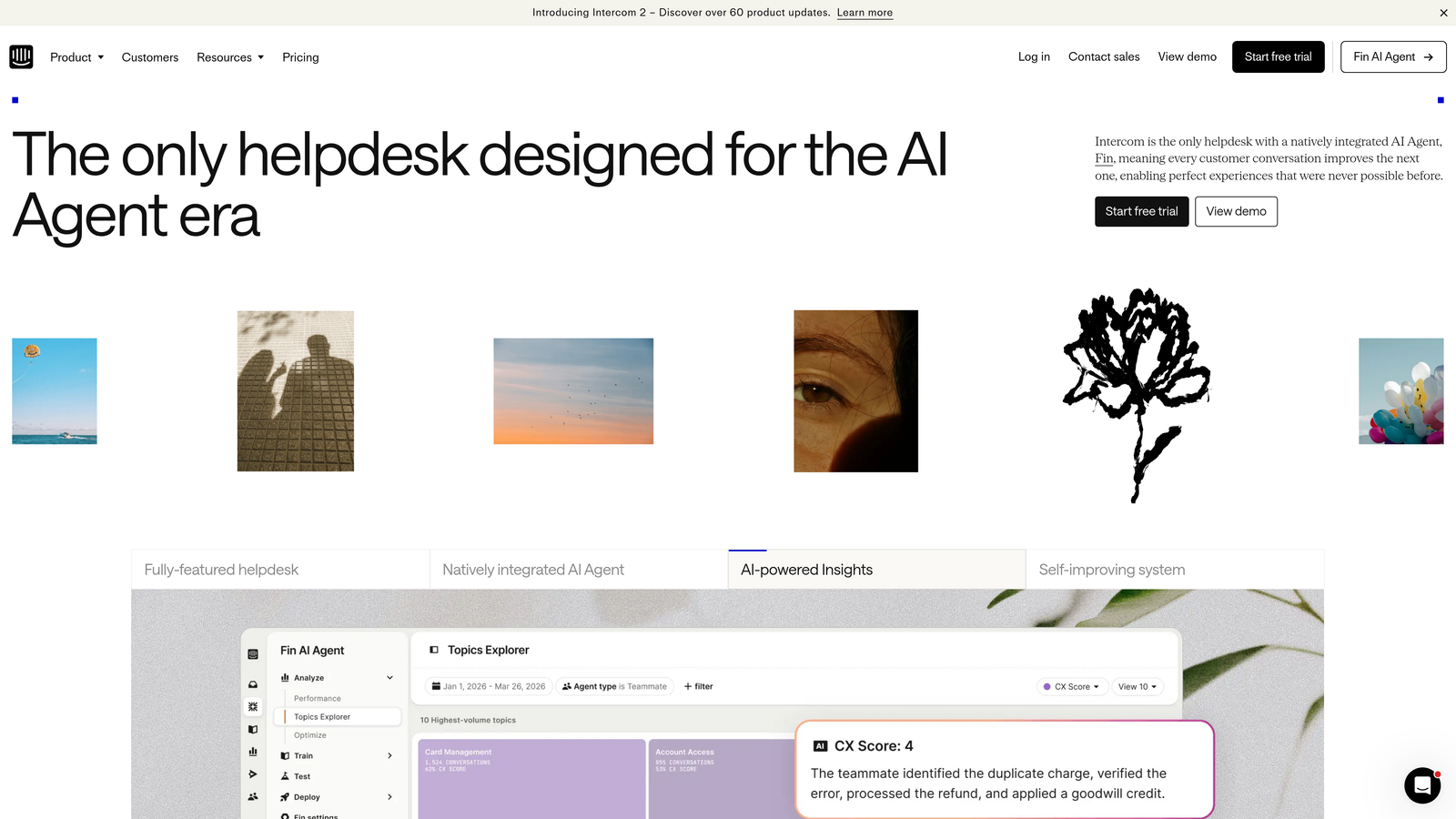
Intercom is a unified customer messaging platform with Fin, its AI agent built to resolve common support queries and assist human agents with contextual suggestions.
Where This Tool Shines
Intercom's Fin AI agent is one of the more capable automated resolution tools on the market, trained to handle queries across chat, email, and in-app channels. The AI copilot feature, which surfaces suggested replies and conversation summaries for human agents, makes it a strong choice for blended teams where humans and AI work side by side.
Intercom also excels at proactive support: product tours, triggered messages, and in-app announcements let you get ahead of common questions before they become tickets.
Key Features
Fin AI Agent: Handles automated conversation resolution across channels using your existing help content as its knowledge base.
AI Copilot: Provides human agents with real-time suggested replies, ticket summaries, and contextual recommendations.
Multi-Channel Support: Covers in-app messaging, email, and social channels from a single inbox.
Product Tours: Proactive in-app guidance that reduces support volume by educating users before they reach out.
Integration Marketplace: Extensive third-party integrations covering CRM, e-commerce, and developer tools.
Best For
Small businesses that want a single platform for both reactive support and proactive customer engagement. Particularly well-suited for SaaS products where in-app messaging and onboarding flows are as important as ticket resolution.
Pricing
Starts at $39/seat/month on the Essential plan. Fin AI is charged per resolution, which can add up quickly at higher volumes, so model your expected usage before committing.
3. Freshdesk (Freddy AI)
Best for: Small businesses transitioning from shared inboxes who need affordable, structured ticketing with AI assistance
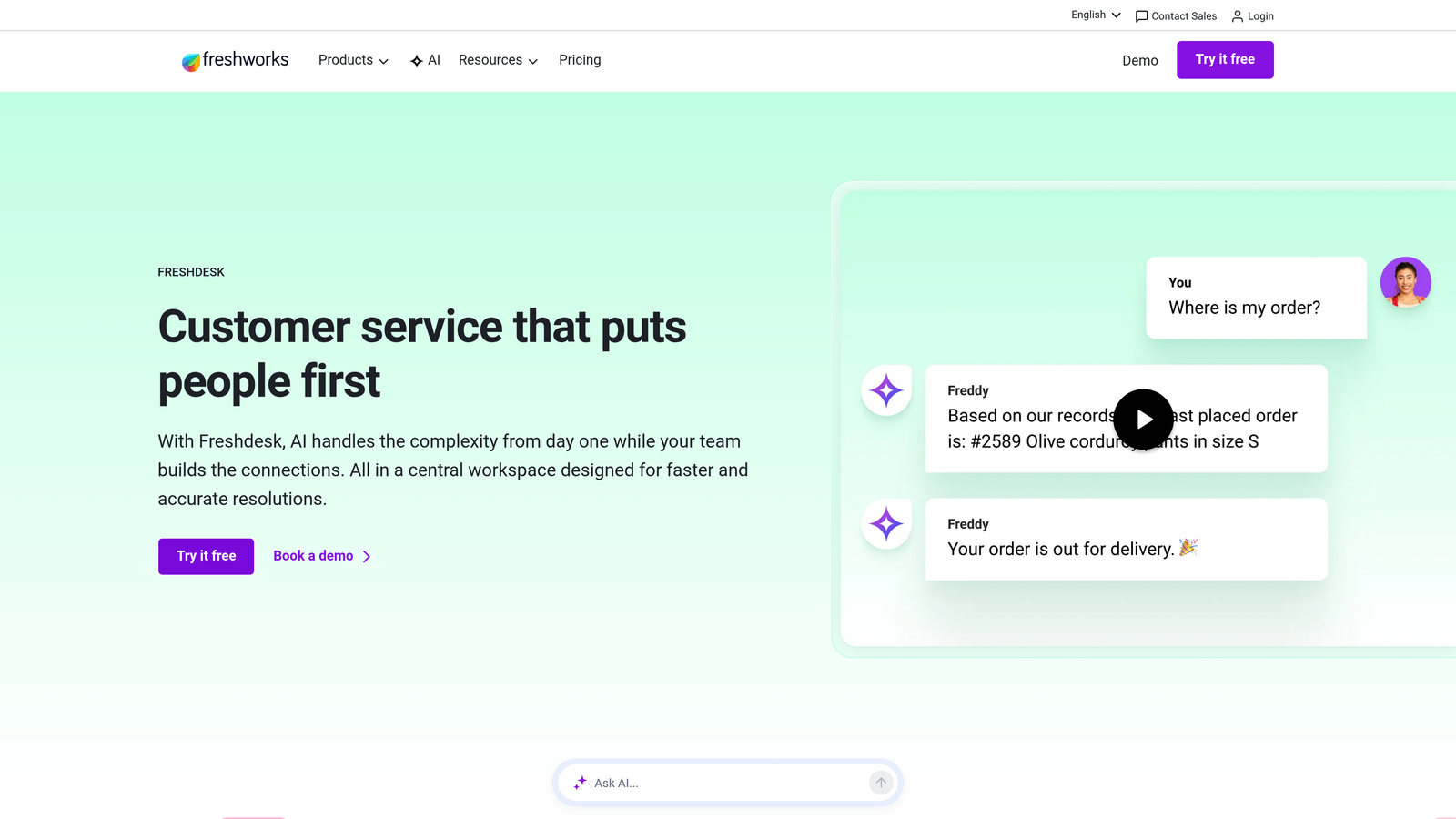
Freshdesk is a well-established helpdesk platform with Freddy AI layered in for auto-triage, response suggestions, and ticket categorization.
Where This Tool Shines
Freshdesk's biggest advantage for small businesses is its free tier: up to two agents can use the platform at no cost, making it a low-risk starting point. The upgrade path is also gradual and predictable, which matters when you're watching every line item.
Freddy AI handles the repetitive cognitive load of support work: categorizing incoming tickets, suggesting canned responses, and routing tickets to the right team. It's not the most autonomous AI on this list, but it meaningfully reduces manual effort for teams that are new to structured support tooling.
Key Features
Free Tier: Full ticketing functionality for up to two agents at no cost, with no credit card required.
Freddy AI: Auto-categorizes tickets, suggests responses, and flags anomalies to reduce manual triage work.
Multi-Channel Support: Handles email, live chat, phone, and social media tickets from one unified inbox.
Knowledge Base: Built-in self-service portal that integrates with Freddy AI for article suggestions.
SLA Management: Automated ticket routing and escalation rules to keep response times on track.
Best For
Small teams coming from shared Gmail or Outlook inboxes who need to formalize their support process without a steep learning curve or upfront investment. Also a good fit for businesses with diverse support channels that need everything in one place.
Pricing
Free plan available for up to two agents. Paid plans start at $15/agent/month, making it one of the more affordable structured helpdesk options on this list.
4. Zendesk (with AI Add-On)
Best for: Small businesses with aggressive growth plans that need enterprise-grade infrastructure from day one
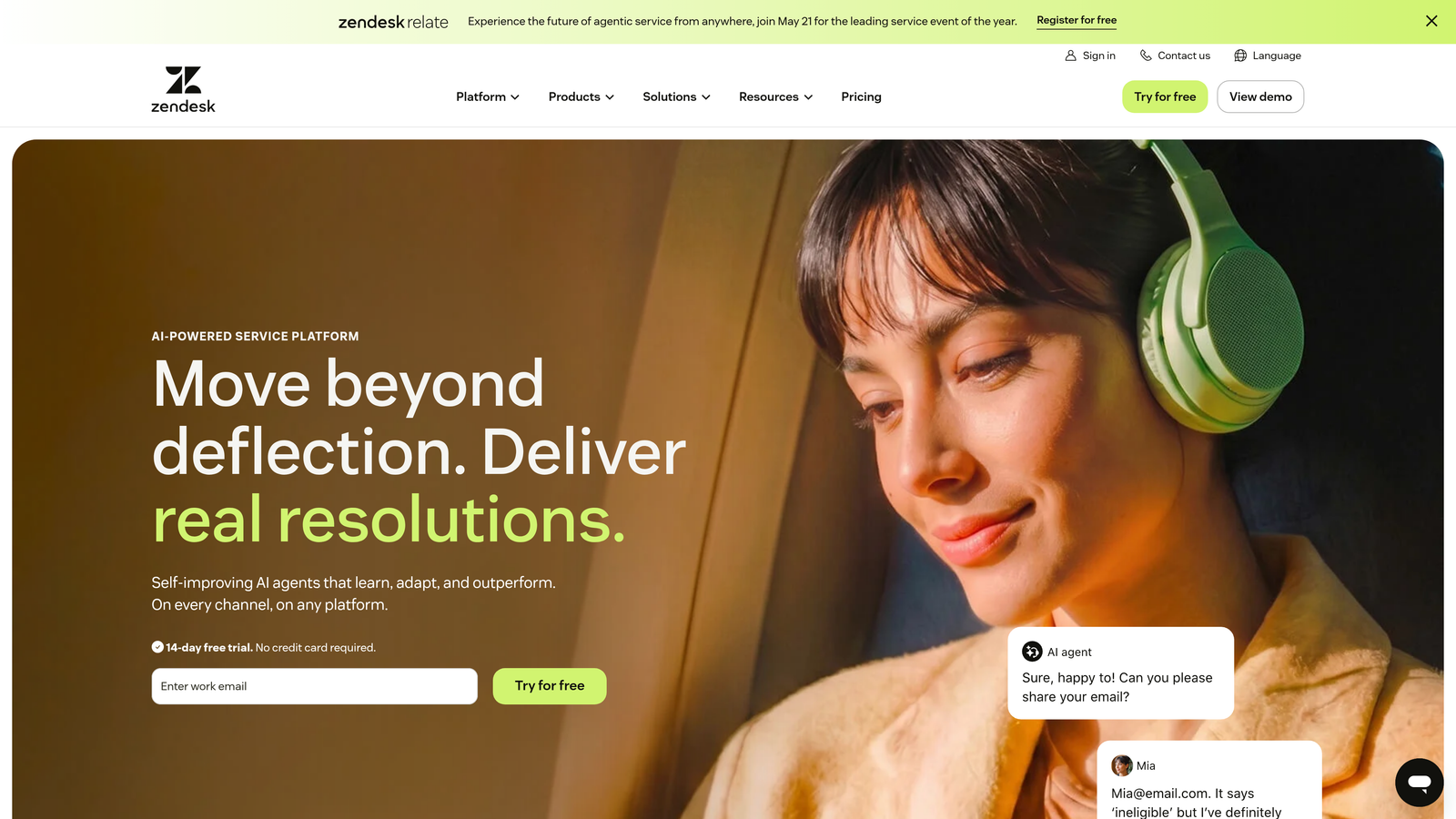
Zendesk is the industry-standard helpdesk platform, now with AI-powered triage, generative reply drafting, and one of the largest integration marketplaces in the category.
Where This Tool Shines
Zendesk's strength is its depth. The platform handles virtually any support workflow at any scale, and its AI features for intelligent triage, intent detection, and generative reply drafting are genuinely useful for reducing agent handle time. The 1,500-plus pre-built integrations mean it connects to nearly any tool your business already uses.
The tradeoff is complexity. Zendesk can take meaningful time to configure properly, and the AI features are an additional cost on top of base seat pricing. For a small team that wants to be up and running quickly, that overhead is worth acknowledging upfront.
Key Features
Intelligent Triage: Automatically detects intent, sentiment, and language to route tickets to the right queue without manual intervention.
Generative AI: Drafts replies and summarizes long ticket threads to reduce time spent on routine responses.
1,500+ Integrations: Connects to virtually any tool in your stack via the Zendesk Marketplace.
Omnichannel Support: Unified inbox across email, live chat, voice, and social media.
Advanced Analytics: Custom dashboards and reporting to track performance across every channel and team.
Best For
Small businesses that know they'll scale quickly and want to avoid migrating platforms later. Also a strong choice for teams with complex routing requirements or those that need deep reporting capabilities from the start.
Pricing
Starts at $19/agent/month on the Support Team plan. Advanced AI capabilities are a paid add-on, so factor that into your total cost estimate before comparing against other platforms on this list.
5. Tidio
Best for: E-commerce businesses on Shopify or WooCommerce that need AI chat with native store integrations
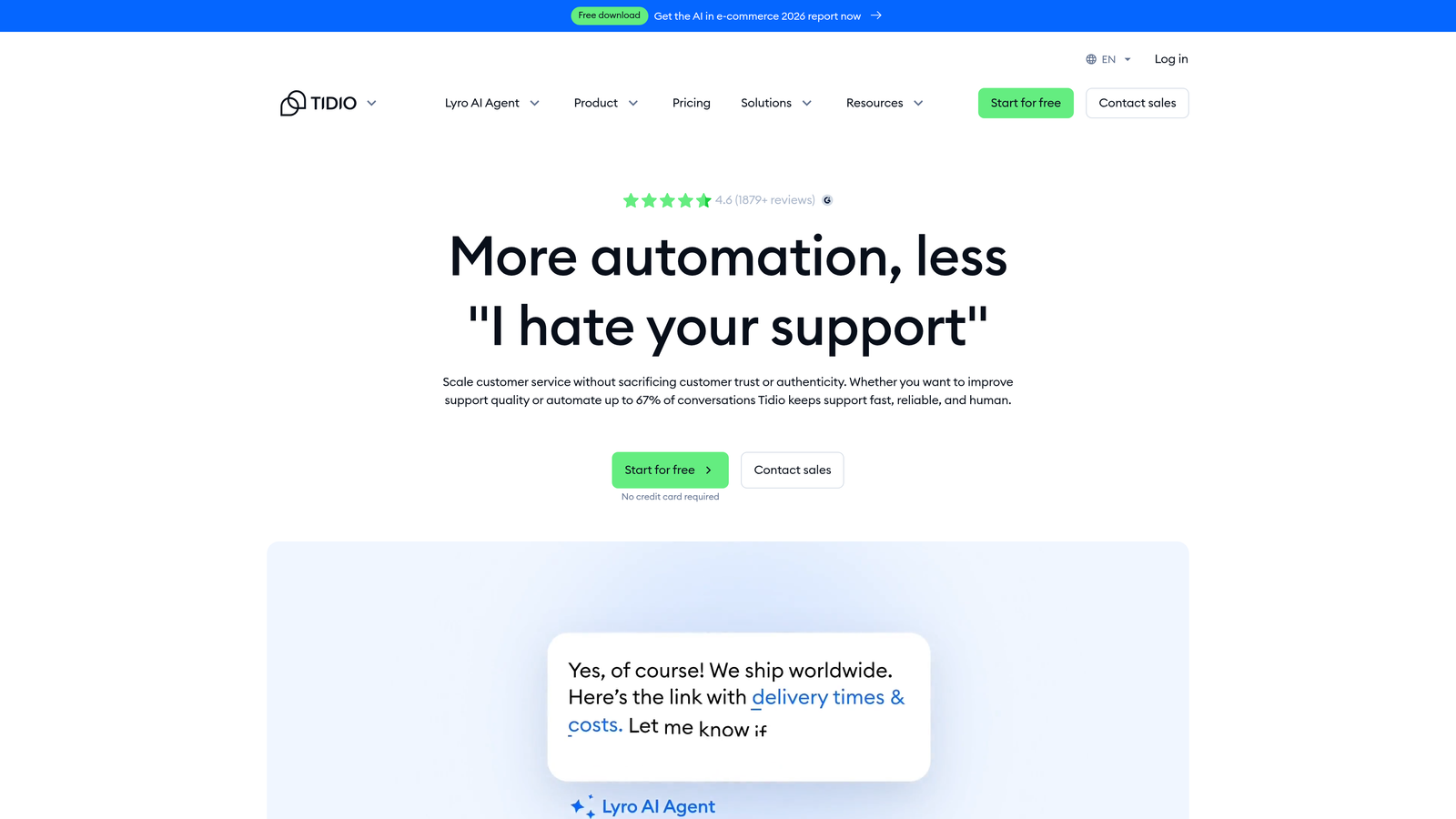
Tidio is an AI-powered live chat and chatbot platform built with e-commerce in mind, featuring Lyro AI as its core automated resolution engine.
Where This Tool Shines
Tidio's Lyro AI is trained directly on your FAQ and help content, which means it can answer product-specific questions without extensive configuration. For Shopify merchants in particular, the native integration enables Lyro to handle order status queries, product questions, and return requests automatically.
The visual chatbot flow builder is a standout for non-technical teams. You can build and modify conversation flows without writing a single line of code, which keeps setup time short and iteration fast.
Key Features
Lyro AI Chatbot: Trained on your own help content to answer customer questions autonomously without manual scripting.
No-Code Flow Builder: Visual drag-and-drop interface for building chatbot conversation paths without technical skills.
Native E-Commerce Integrations: Deep connections to Shopify, WooCommerce, and WordPress out of the box.
Live Chat with Visitor Monitoring: Real-time view of active visitors with the ability to initiate proactive conversations.
Order Management: Handles order lookups and product recommendations directly within the chat interface.
Best For
Small e-commerce businesses, particularly those on Shopify or WooCommerce, that want AI to handle a high volume of repetitive order and product questions without human involvement. Less suited for B2B SaaS teams or businesses with complex, multi-step support workflows.
Pricing
Free plan available. Paid plans start at $29/month, with Lyro AI available as an add-on from $39/month. Pricing is workspace-based rather than per-seat, which can be more cost-effective for small teams.
6. Help Scout
Best for: Teams that prioritize warm, personal customer relationships and want AI to assist without replacing the human voice
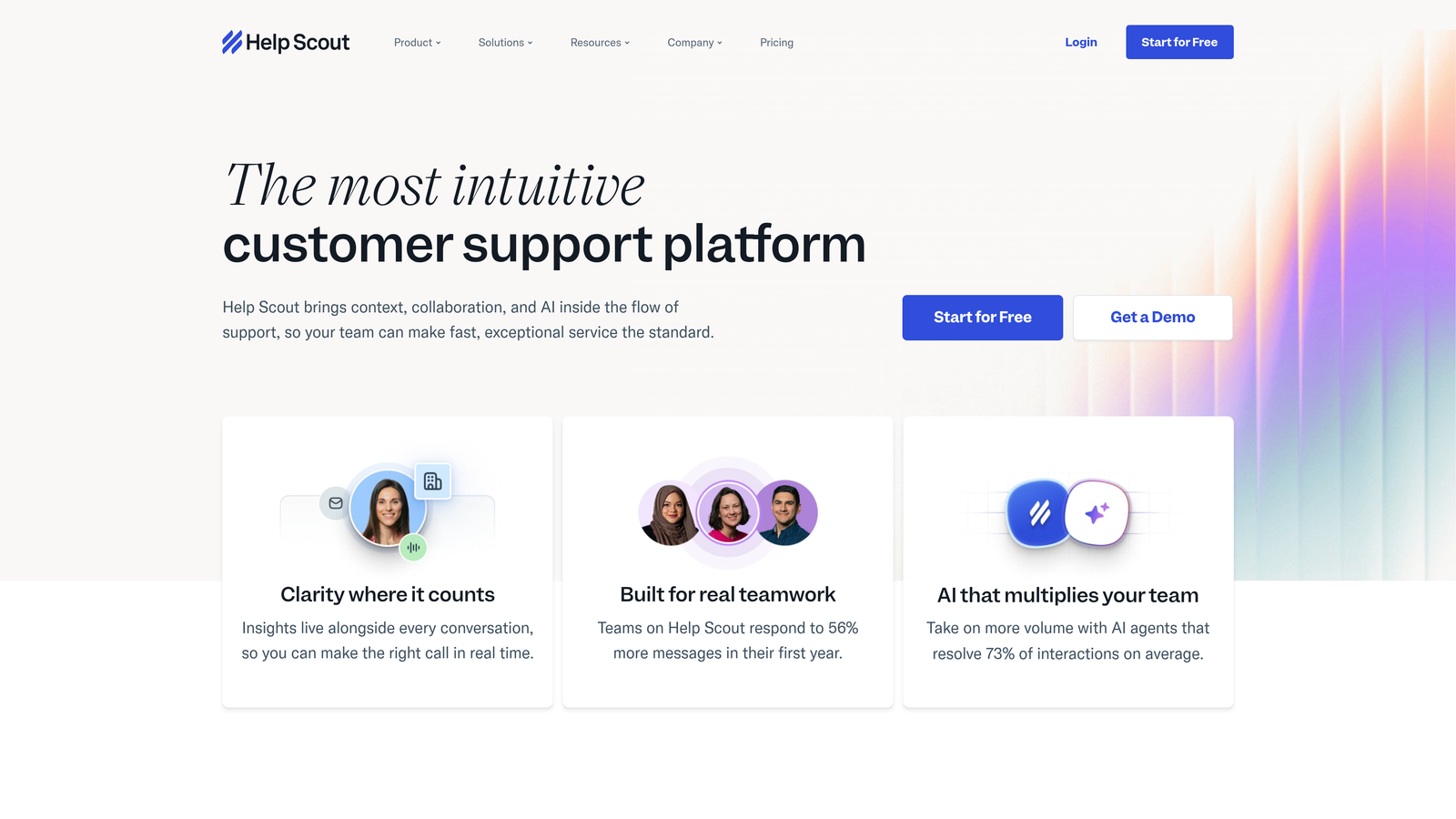
Help Scout is a clean, human-centric shared inbox platform with AI features focused on speeding up agents rather than replacing them.
Where This Tool Shines
Help Scout's design philosophy is intentionally different from AI-first platforms. Rather than automating resolution, it uses AI to make human agents faster: drafting replies, summarizing long threads, and surfacing relevant help articles mid-conversation. The result is support that still feels personal, just delivered more efficiently.
The Beacon widget embeds seamlessly into your product or website, giving users access to your knowledge base and live chat without leaving the page. Collision detection in the shared inbox prevents two agents from responding to the same ticket simultaneously, which is a small but genuinely useful feature for small teams.
Key Features
AI Draft Replies: Generates reply drafts based on conversation context that agents can review, edit, and send.
Conversation Summaries: Condenses long ticket threads so agents can get up to speed instantly without reading every message.
Beacon Widget: Embedded help widget with knowledge base search, chat, and proactive messaging.
Docs Knowledge Base: Built-in help center with AI-powered article suggestions for both agents and customers.
Collision Detection: Prevents duplicate responses by showing when another agent is already viewing or replying to a ticket.
Best For
Small businesses and service teams where personal, relationship-driven support is a core brand value. Particularly well-suited for teams that handle complex, nuanced conversations where full AI autonomy would feel impersonal or risky.
Pricing
Starts at $25/user/month on the Standard plan. Pricing is straightforward with no surprise add-ons for core AI features, which makes budgeting predictable for small teams.
7. Crisp
Best for: Early-stage startups consolidating live chat, CRM, and AI chatbot into a single affordable workspace
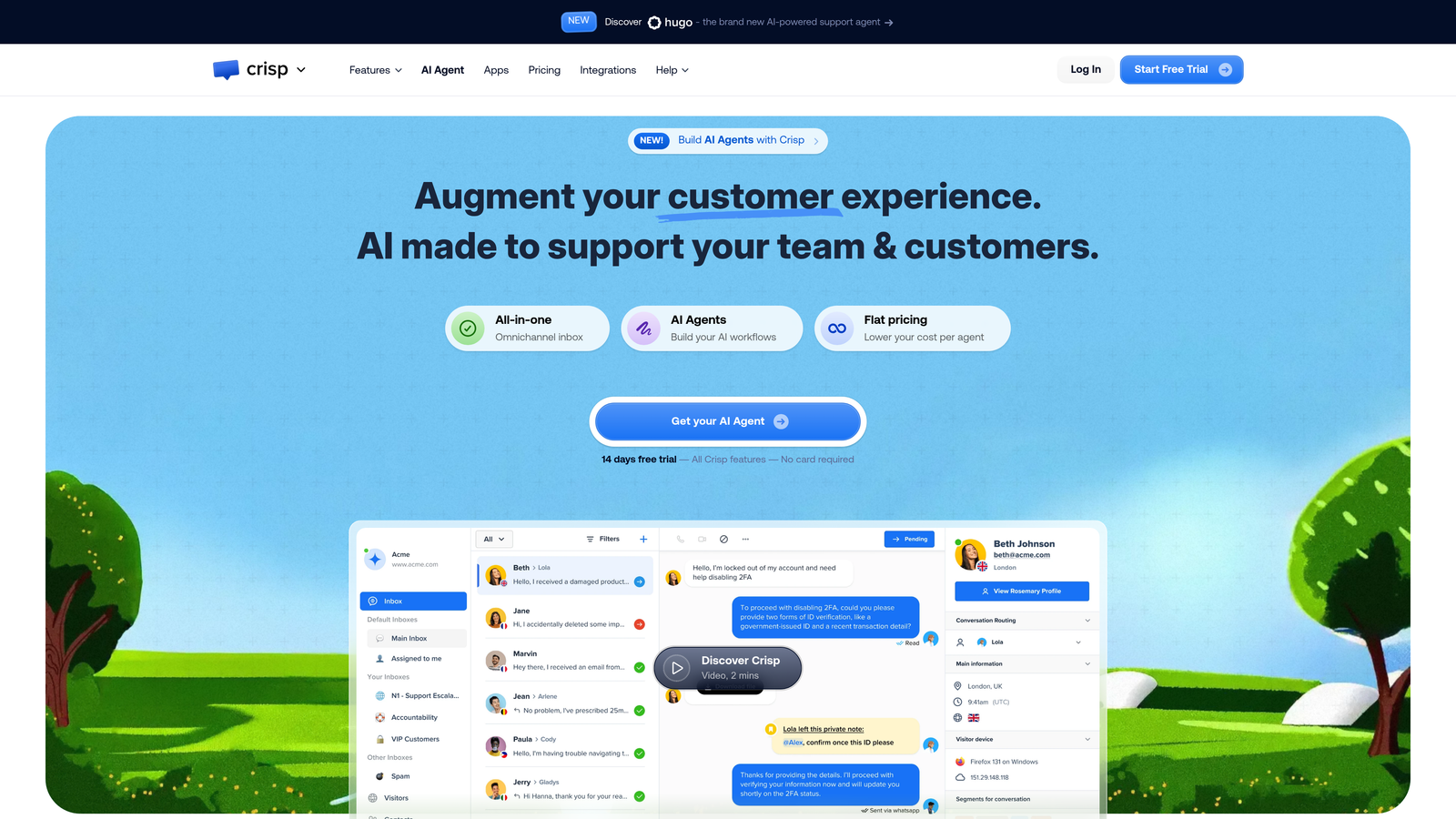
Crisp is an all-in-one messaging platform that bundles live chat, AI chatbot, a lightweight CRM, and a knowledge base into a single tool at a price point that's genuinely accessible for bootstrapped teams.
Where This Tool Shines
Crisp's appeal is consolidation. Instead of paying separately for a helpdesk, a CRM, and a chatbot platform, you get a functional version of all three in one workspace. For startups that haven't yet committed to a full support stack, that simplicity has real value.
The co-browsing and video chat features are unusual at this price point and can be particularly useful for hands-on onboarding or technical support scenarios where seeing the user's screen makes all the difference.
Key Features
AI Chatbot: Trained on your knowledge base to answer common questions automatically before routing to a human agent.
Shared Inbox: Unified view of live chat, email, and social channel conversations for the whole team.
Lightweight CRM: Contact management and conversation history built directly into the platform without a separate tool.
Co-Browsing and Video Chat: Real-time screen sharing and video support for complex or hands-on customer interactions.
Free Plan: Full access for up to two seats at no cost, making it a genuine zero-risk starting point.
Best For
Early-stage startups and very small teams that want a single tool for customer communication rather than a patchwork of separate platforms. The free tier makes it especially appealing for pre-revenue or early-traction businesses watching costs closely.
Pricing
Free for two seats. Pro plan at $25/month per workspace; Unlimited at $95/month per workspace. Workspace-based pricing is a significant advantage for growing teams compared to per-seat models.
8. Zoho Desk (Zia AI)
Best for: Small businesses already in the Zoho ecosystem that want AI-enhanced support tightly connected to their CRM and finance tools
Zoho Desk is a full-featured helpdesk with Zia AI providing sentiment analysis, auto-tagging, anomaly detection, and response suggestions across every ticket.
Where This Tool Shines
If your business already uses Zoho CRM, Zoho Books, or other apps in the Zoho suite, Desk integrates with them natively in ways that third-party tools simply can't replicate. Support agents can see a customer's full purchase history, open invoices, and sales activity without switching tabs.
Zia's sentiment analysis is a practical differentiator: it flags tickets from frustrated or at-risk customers so agents can prioritize them before a bad experience escalates. The anomaly detection feature similarly surfaces unusual spikes in ticket volume, which can be an early warning signal for product issues.
Key Features
Zia AI: Provides sentiment analysis, auto-tagging, response suggestions, and anomaly detection across all incoming tickets.
Zoho Ecosystem Integration: Native, deep connections to Zoho CRM, Books, Analytics, and other Zoho products.
Multi-Channel Ticketing: Handles email, live chat, phone, and social media from a unified agent interface.
Workflow Automation: Customizable routing rules, SLA policies, and escalation paths without requiring developer involvement.
Self-Service Portal: Knowledge base and community forum for customers to find answers without contacting support.
Best For
Small businesses that are already invested in the Zoho ecosystem and want their support platform to share data seamlessly with their CRM and operations tools. Also a strong option for teams that want AI-assisted prioritization without paying for a fully autonomous AI platform.
Pricing
Free plan available for up to three agents. Paid plans start at $14/agent/month, making it one of the most affordable structured helpdesks on this list with meaningful AI capabilities included.
9. HubSpot Service Hub
Best for: Teams using HubSpot CRM that want support, sales, and marketing data unified in one customer timeline
HubSpot Service Hub is an AI-powered support platform natively connected to HubSpot CRM, giving every support interaction full customer lifecycle context.
Where This Tool Shines
The core advantage of Service Hub is data unification. When your support agent opens a ticket, they can immediately see the customer's marketing touchpoints, sales conversations, and previous support history in a single timeline. That context makes AI-assisted responses significantly more relevant and personalized.
Breeze, HubSpot's AI layer, powers chatbot responses using CRM data rather than generic knowledge base content. That means a customer asking about their account gets an answer informed by their actual account history, not a templated FAQ response.
Key Features
Breeze AI Chatbot: CRM-powered chatbot that uses customer data to provide contextual, personalized automated responses.
Unified Customer Timeline: Single view of every marketing, sales, and support interaction for each customer across the entire HubSpot platform.
Ticket Automation: Rule-based ticket routing, SLA tracking, and escalation workflows.
Knowledge Base: Built-in help center with AI-suggested articles for both agents and end users.
Customer Feedback Tools: NPS, CSAT, and CES surveys with reporting dashboards built directly into the platform.
Best For
Small businesses already using HubSpot for CRM, marketing, or sales who want to bring support into the same ecosystem. The free tools are a useful starting point, but the most powerful AI and automation features require the Professional tier, which is a meaningful jump in cost.
Pricing
Free tools available with limited functionality. Starter plan at $20/seat/month; Professional at $100/seat/month. Costs can scale quickly for growing teams, so map out your expected seat count before committing to Professional.
Finding the Right AI Support Fit for Your Team
The best AI support software for your small business depends on where you are today and where you're headed. There's no single right answer, but there are clear patterns based on what different teams actually need.
If you're a B2B SaaS company that wants AI to operate as the primary support layer with genuine autonomy, page-aware context, and business intelligence built in, Halo AI is the most purpose-built option on this list. It's designed for teams that want to scale support without scaling headcount, and its integrations with Linear, HubSpot, Slack, and Stripe make it a natural fit for product-led companies with complex tooling environments.
For e-commerce businesses on Shopify or WooCommerce, Tidio's Lyro AI handles the high-volume, repetitive queries that dominate retail support. For teams already deep in the Zoho or HubSpot ecosystems, Zoho Desk and HubSpot Service Hub offer the tightest data integration with tools you're already using. And for very early-stage teams watching every dollar, Crisp's free tier or Freshdesk's free plan give you a real starting point without upfront commitment.
Here's a quick selection guide by use case:
AI-first autonomous resolution (B2B SaaS): Halo AI
Proactive in-app messaging + AI: Intercom
Budget-friendly structured helpdesk: Freshdesk or Zoho Desk
E-commerce with Shopify/WooCommerce: Tidio
Human-centric support with AI assist: Help Scout
All-in-one for early-stage startups: Crisp
Full HubSpot ecosystem integration: HubSpot Service Hub
Enterprise-scale infrastructure from day one: Zendesk
Your support team shouldn't scale linearly with your customer base. Let AI agents handle routine tickets, guide users through your product, and surface business intelligence while your team focuses on complex issues that need a human touch. See Halo in action and discover how continuous learning transforms every interaction into smarter, faster support.