9 Best AI Support Software Tools: Pricing Comparison for 2026
Choosing the right AI customer support platform is as much a budget decision as a features one, and pricing models vary wildly across the market. This guide delivers a detailed AI support software pricing comparison of 9 leading tools, breaking down tier structures, what's actually included, and which buyer profile gets the best value in 2026.
 Grant CooperFounder14 min read
Choosing AI support software is no longer just a feature decision. It's a budget decision with serious downstream consequences, and the pricing models across the market vary wildly. Per-seat, per-resolution, per-conversation, flat-rate, usage-based tiers that balloon the moment your ticket volume spikes — the complexity makes apples-to-apples comparison genuinely difficult.
This guide cuts through that noise. We've compared leading AI customer support platforms on pricing structure, what's actually included at each tier, and which buyer profile gets the best value. Whether you're a lean startup trying to avoid per-agent fees or a scaling SaaS team that needs deep integrations and business intelligence baked in, there's a right fit — and a wrong one that will cost you more than you planned.
One important note before diving in: vendor pricing changes frequently. All pricing information here reflects publicly available details as of mid-2026. Always verify current tiers directly on each vendor's website before making a purchasing decision.
1. Halo AI
Best for: B2B SaaS teams replacing legacy helpdesks rather than adding AI on top
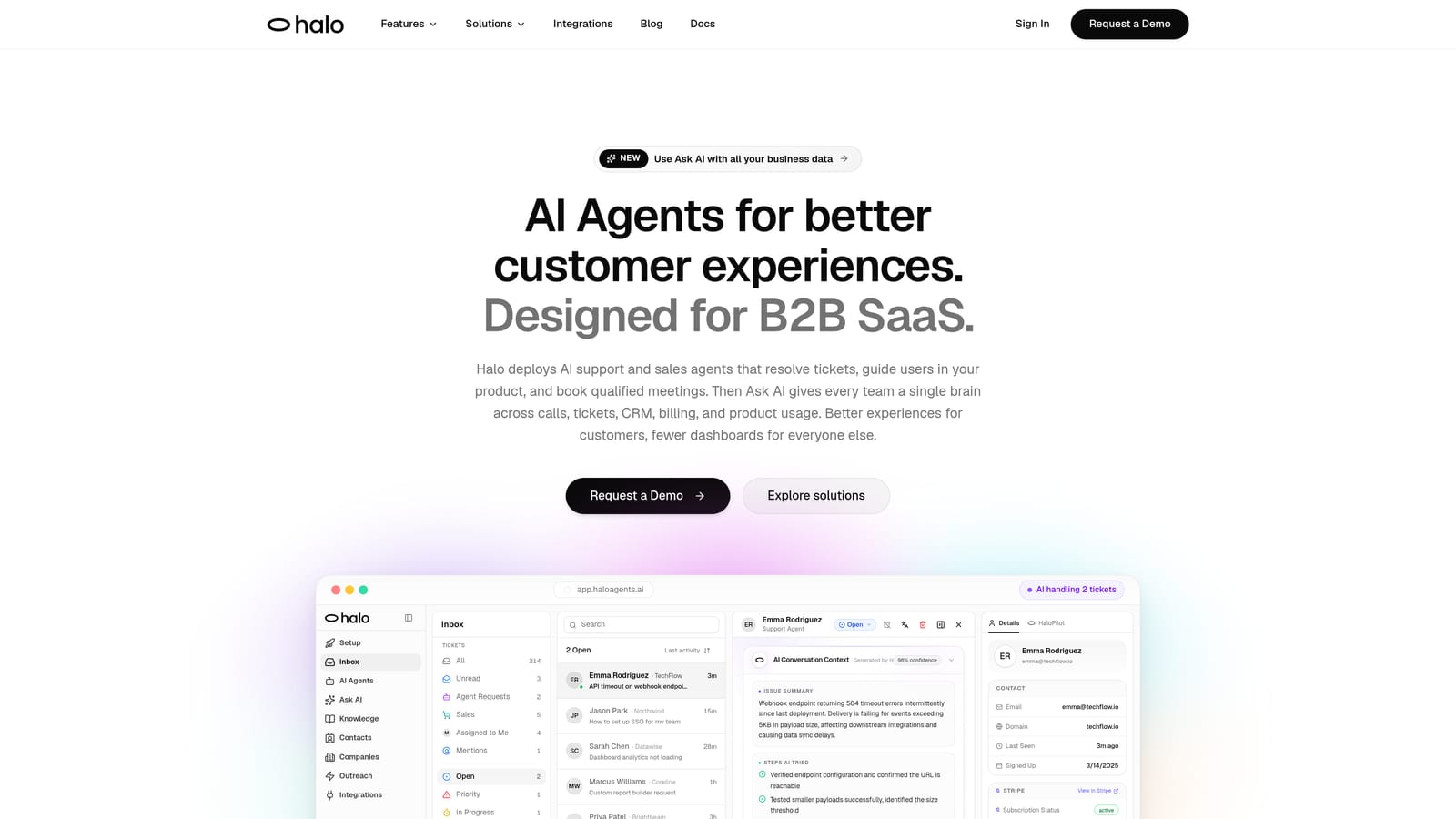
Halo AI is an AI-native customer support platform that deploys intelligent agents to resolve tickets, guide users with page-aware context, and surface business intelligence — built from the ground up as AI-first, not as a bolt-on to an existing helpdesk.
Where This Tool Shines
Most platforms in this list started as traditional helpdesks and added AI features over time. Halo was designed the other way around. That architectural difference shows up in capabilities that legacy tools struggle to replicate, particularly the page-aware context engine: the AI agent actually sees what the user sees, enabling it to provide visual, step-by-step guidance rather than generic responses.
Beyond ticket resolution, Halo's smart inbox surfaces business intelligence that most support tools simply don't offer. Customer health signals, anomaly detection, and revenue intelligence turn your support operation into a strategic data source, not just a cost center. Every interaction feeds continuous learning, so the system gets measurably smarter over time without manual retraining.
Key Features
Intelligent AI Agents: Resolve tickets autonomously and learn from every interaction, improving accuracy without manual configuration updates.
Page-Aware Chat Widget: The AI sees the user's current page context and delivers visual, contextual guidance rather than static knowledge base links.
Smart Inbox with Business Intelligence: Surfaces customer health signals, anomaly detection, and revenue intelligence directly in the support workflow.
Auto Bug Ticket Creation: Automatically identifies and routes bug reports to engineering tools like Linear, closing the loop between support and product teams.
Live Agent Handoff: Escalates complex issues to human agents with full conversation context preserved, so nothing gets repeated.
Broad Integration Stack: Connects with HubSpot, Slack, Intercom, Stripe, Zoom, PandaDoc, and Fathom, linking support to your entire business stack.
Best For
Halo is the strongest fit for B2B SaaS and product teams that want to replace their helpdesk entirely rather than augment it with AI features. If your current support stack involves per-agent seat fees and separately priced AI add-ons, Halo's consolidated approach is worth evaluating seriously. Teams that need business intelligence beyond basic ticket metrics will find particular value here.
Pricing
Contact Halo AI directly for pricing. The platform is positioned for teams moving away from per-seat legacy pricing models, so the structure differs meaningfully from traditional helpdesks. Reach out at haloagents.ai.
2. Intercom
Best for: Teams already embedded in the Intercom ecosystem who want AI-powered resolution layered in
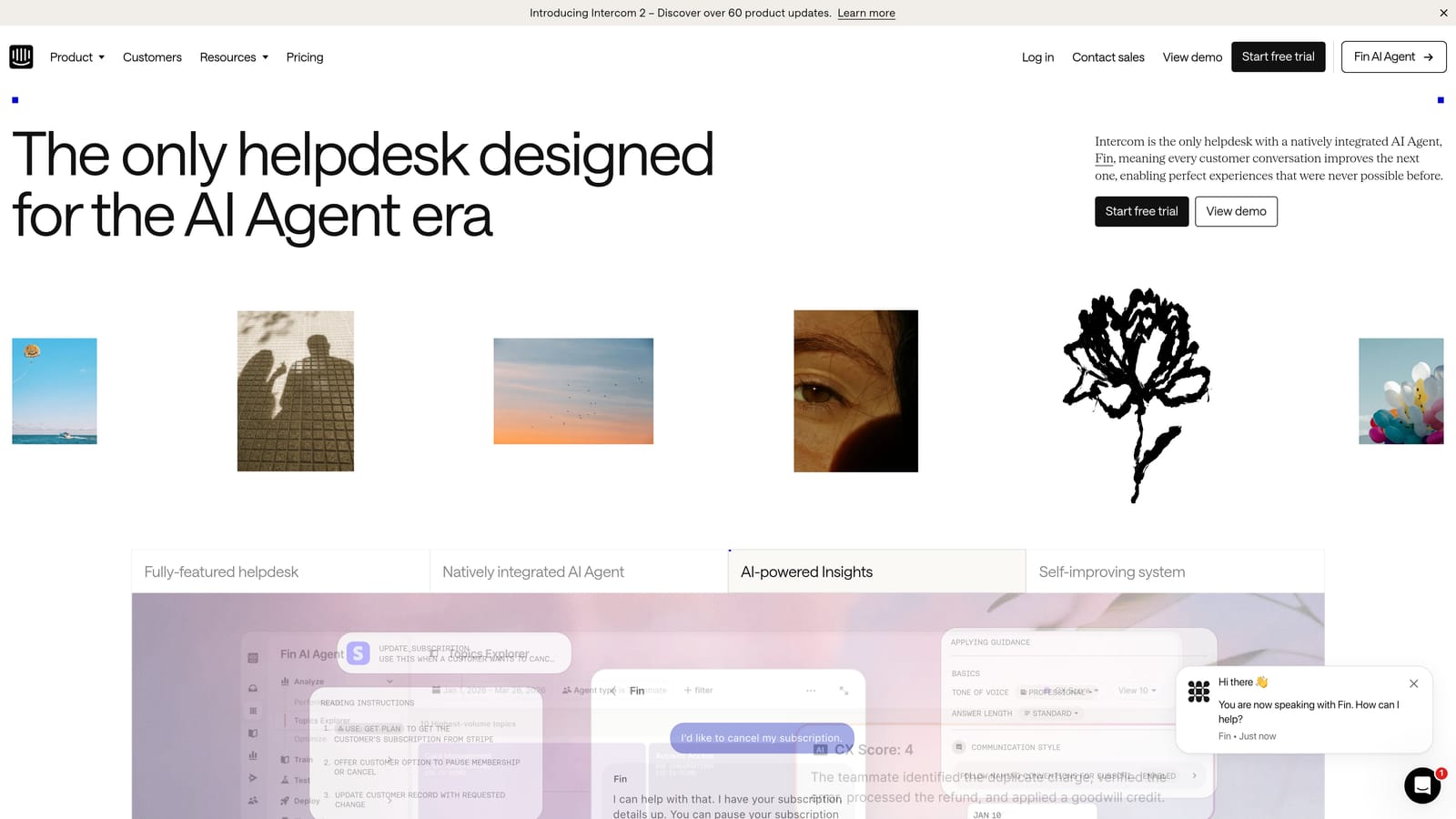
Intercom is a mature customer messaging platform with Fin, its AI agent, built in for automated ticket resolution and conversation handling across channels.
Where This Tool Shines
Intercom's strength is its maturity. The platform has been refined over many years, and Fin AI benefits from that foundation: it handles escalation flows, integrates with the shared inbox, and connects to Intercom's extensive app marketplace without friction. For teams already using Intercom for customer messaging, adding Fin is a natural extension rather than a platform migration.
The omnichannel coverage is solid — chat, email, and in-app messaging all flow into a unified inbox. AI-assisted drafts and conversation summaries help human agents work faster when escalations occur.
Key Features
Fin AI Agent: Handles automated resolution with escalation to human agents when needed, trained on your existing help content.
Omnichannel Messaging: Unified inbox covering chat, email, and in-app conversations across the customer journey.
AI-Assisted Drafts and Summaries: Helps human agents draft replies and get up to speed on conversation history quickly.
Extensive App Marketplace: Hundreds of integrations with CRMs, analytics tools, and product platforms.
Per-Resolution Fin Pricing: Fin charges are tied to successful resolutions, aligning cost with outcomes rather than seat count.
Best For
Teams already using Intercom for customer engagement who want AI resolution without switching platforms. Also a strong choice for product-led growth companies where in-app messaging is central to the support experience. Less ideal for teams sensitive to per-resolution cost spikes at high ticket volumes.
Pricing
Base platform fee plus per-resolution charges for Fin AI. Costs can scale significantly at high ticket volumes, so model your expected resolution volume carefully before committing. Verify current tiers at intercom.com/pricing.
3. Zendesk
Best for: Enterprise teams that need deep configurability, broad marketplace integrations, and established SLA management
Zendesk is the enterprise-grade helpdesk standard, now with AI features available on higher Suite tiers for triage, agent assist, and workflow automation.

Where This Tool Shines
Zendesk's breadth is unmatched. The marketplace alone gives enterprise teams access to hundreds of integrations, and the platform's workflow engine, SLA management, and reporting capabilities are mature and battle-tested. For large organizations with complex support operations, Zendesk's configurability is genuinely valuable.
The AI features — including intelligent triage and agent assist — are solid additions for teams on higher tiers. The tradeoff is that these capabilities are gated behind Suite Professional and Enterprise plans, meaning smaller teams pay for features they may not need just to access AI functionality.
Key Features
Zendesk AI Triage: Intelligently routes and categorizes incoming tickets to reduce manual sorting and improve response times.
Agent Assist: Suggests responses and surfaces relevant knowledge base articles for human agents handling escalated tickets.
Advanced Workflow Engine: Highly configurable automation rules, triggers, and SLA management for complex support operations.
Marketplace Integrations: Hundreds of pre-built integrations across CRM, analytics, ecommerce, and communication tools.
Reporting and Analytics: Robust built-in reporting with options for custom dashboards at enterprise tiers.
Best For
Enterprise organizations with large support teams, complex workflows, and the budget to match. Also suitable for teams where Zendesk is already deeply embedded and migration costs outweigh switching benefits. Less ideal for lean teams or startups where per-agent pricing compounds quickly.
Pricing
Per-agent, per-month across Suite tiers. AI features are available on higher plans, which means the total cost per agent increases significantly when AI capabilities are required. Verify current tiers at zendesk.com/pricing.
4. Freshdesk
Best for: Small to mid-sized teams that want accessible entry pricing with AI features that scale as they grow
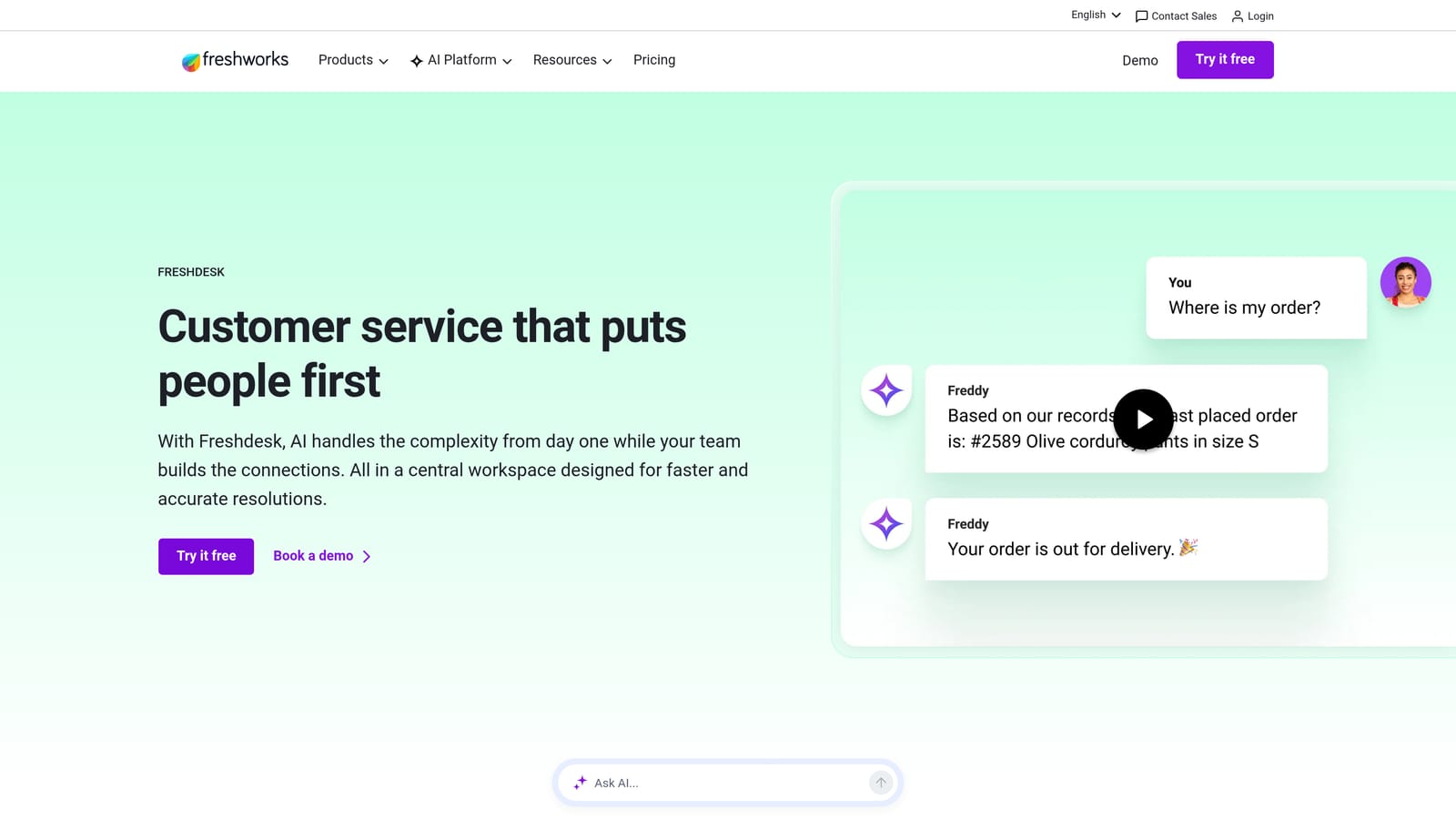
Freshdesk is a helpdesk platform with a generous free tier and Freddy AI layered across paid plans, making it one of the more accessible entry points in the market.
Where This Tool Shines
Freshdesk's free tier for up to 10 agents makes it genuinely useful for early-stage teams that need basic helpdesk functionality without committing budget. As teams grow, the Growth, Pro, and Enterprise tiers progressively unlock Freddy AI features including ticket suggestions, auto-triage, and the Freddy Self Service chatbot for automated resolution.
Compared to Zendesk at similar feature sets, Freshdesk is generally considered more budget-friendly. The omnichannel coverage — email, chat, phone, and social — is solid across paid tiers, and the modular add-on structure gives teams some flexibility in what they pay for.
Key Features
Freddy AI: Provides ticket suggestions, auto-triage, and agent assist across paid tiers, with self-service chatbot capabilities on higher plans.
Free Tier: Supports up to 10 agents with core helpdesk functionality, making it accessible for small teams testing the waters.
Omnichannel Support: Covers email, chat, phone, and social channels within a unified inbox.
Freddy Self Service: Chatbot automation for deflecting common queries, available on higher tiers.
Modular Add-Ons: Teams can add specific capabilities without upgrading the entire plan tier.
Best For
Small teams starting out who need a free entry point, and mid-sized teams that want AI features at a more accessible price point than Zendesk. Not the strongest fit for teams that need deep business intelligence or AI that learns continuously from interactions rather than relying on static knowledge bases.
Pricing
Free tier available for limited agents; paid plans are per-agent per month with Freddy AI features scaling by tier. Verify current plan details at freshdesk.com/pricing.
5. Tidio
Best for: SMBs and e-commerce brands that need fast deployment and conversation-based AI without complex setup
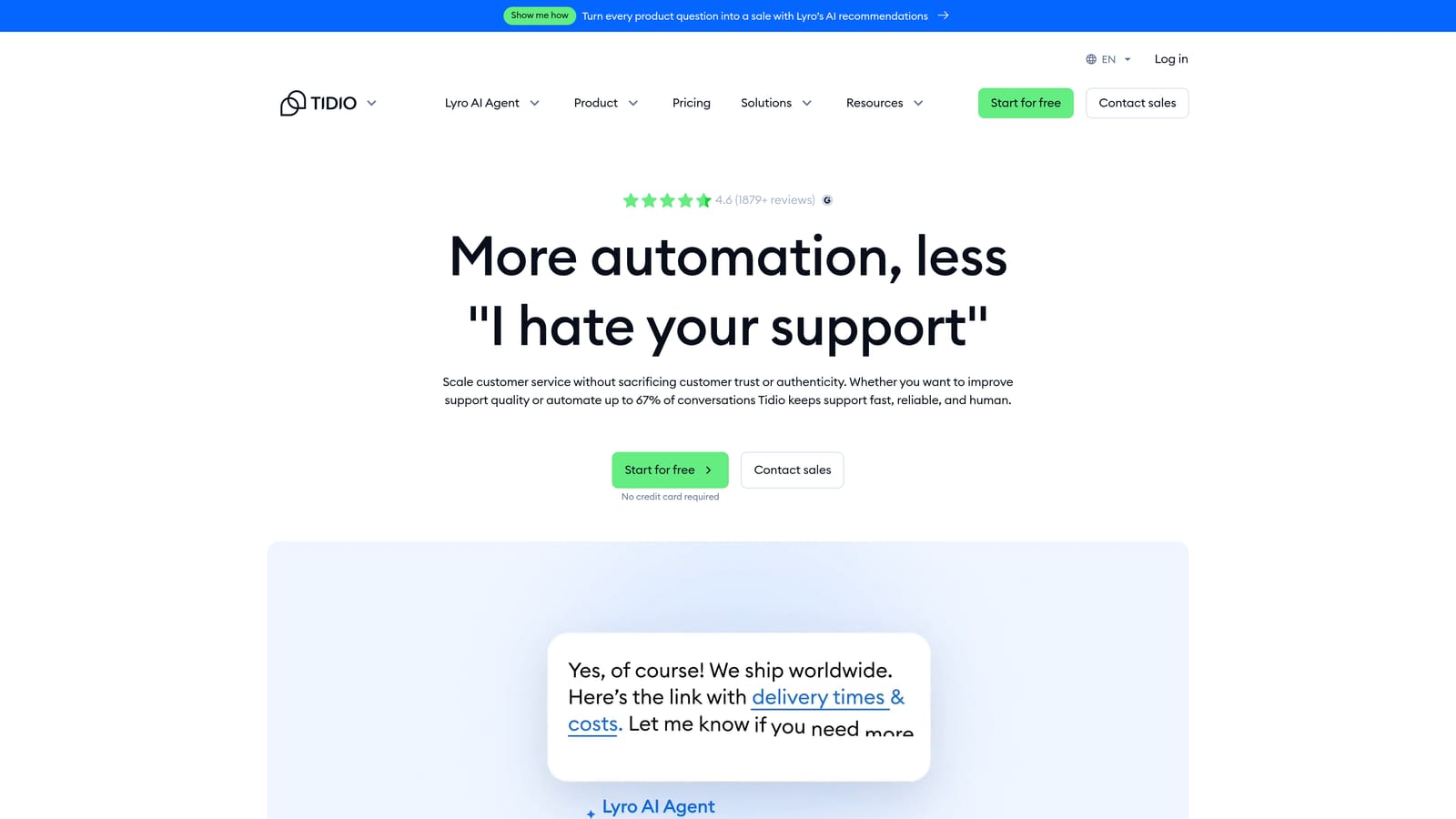
Tidio is a lightweight AI chat and helpdesk tool with Lyro AI, designed for fast deployment and accessible pricing with a strong following among smaller e-commerce businesses.
Where This Tool Shines
Tidio's biggest advantage is speed to value. The setup is straightforward, the interface is approachable, and Lyro AI starts handling conversations without lengthy configuration. For SMBs that need automated chat without a dedicated technical team to implement it, Tidio removes most of the friction.
The conversation-based pricing model for Lyro AI is intuitive: you pay based on conversations handled rather than agent seats. This works well for businesses with moderate, predictable volumes. At high volumes, however, it's worth modeling the cost carefully before assuming it's cheaper than seat-based alternatives.
Key Features
Lyro AI Chatbot: Handles automated conversation resolution with a focus on natural, context-aware responses to common customer questions.
Simple Setup: Deploys without technical configuration, making it accessible for non-technical teams.
Multi-Channel Integration: Covers live chat, email, and Messenger in a unified interface.
Free Entry Tier: A free plan allows small teams to start without upfront cost commitment.
Conversation-Based Lyro Pricing: AI usage is billed per conversation handled, aligning cost with actual usage volume.
Best For
SMBs and e-commerce brands that prioritize ease of deployment and have relatively straightforward support workflows. Not typically the right choice for complex B2B SaaS support scenarios that require deep integrations, business intelligence, or AI that adapts to nuanced product-specific queries.
Pricing
Free plan available; Lyro AI is priced per conversations handled at higher tiers. Verify current plan structure at tidio.com/pricing.
6. Help Scout
Best for: Mid-market teams that want AI-assisted support without fully automating away the human feel
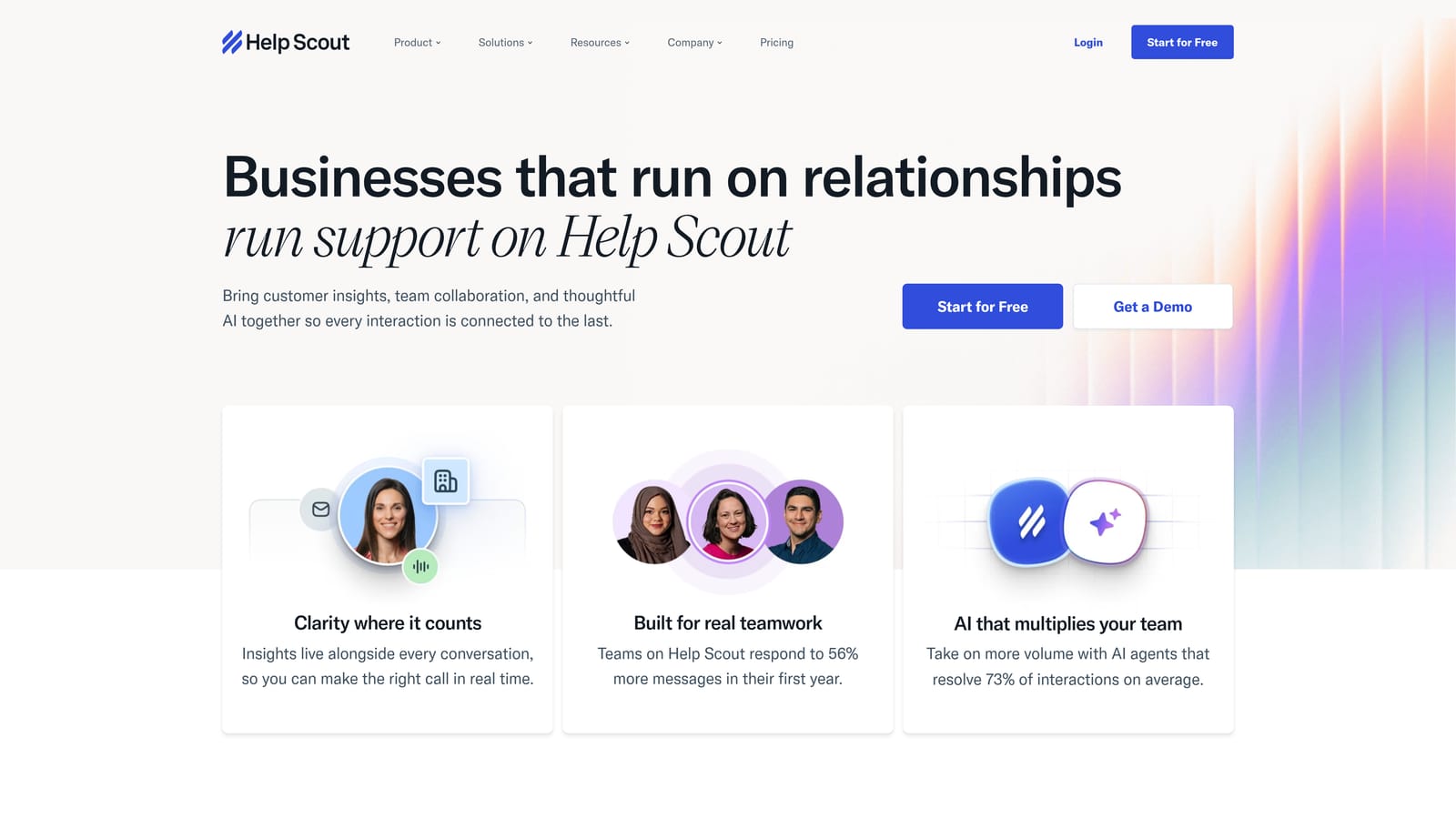
Help Scout is a shared inbox platform with AI drafts and summarization built in, focused on maintaining a human feel in support without complex automation overhead.
Where This Tool Shines
Help Scout occupies a thoughtful middle ground: AI features that make human agents faster and more effective, without pushing toward full autonomous resolution. AI Drafts suggest replies based on conversation history, and AI Summarize gives agents instant context on long threads. These are practical, day-to-day efficiency gains that don't require rethinking your entire support philosophy.
Importantly, these AI features are included in Help Scout's standard pricing rather than gated behind premium add-ons. For teams that want AI assistance without a separate AI surcharge, that's a meaningful structural advantage.
Key Features
AI Drafts: Generates suggested replies based on conversation history, reducing the time agents spend composing responses from scratch.
AI Summarize: Provides quick context summaries for long tickets, helping agents get up to speed without reading entire threads.
Shared Inbox: Includes collision detection and private notes to keep team coordination smooth.
Docs Knowledge Base: Built-in knowledge base with AI-assisted search to help customers self-serve before reaching an agent.
AI Included in Pricing: AI features are not sold as a separate add-on, keeping the total cost more predictable.
Best For
Mid-market teams that value the human element of support and want AI to assist rather than replace agents. Particularly well-suited for teams where customer relationships are high-touch and fully automated resolution would feel impersonal. Less ideal for teams seeking autonomous AI resolution or deep business intelligence from their support stack.
Pricing
Per-user per month across Standard, Plus, and Pro tiers, with AI features included at current pricing. Verify at helpscout.com/pricing.
7. Drift (Salesloft)
Best for: Revenue-focused teams where support conversations and sales pipeline overlap significantly
Drift, now part of Salesloft, is a conversational AI platform designed for teams where support and sales conversations intersect and pipeline acceleration matters alongside ticket resolution.
Where This Tool Shines
Drift's differentiation is its revenue orientation. Where most support tools are built to close tickets, Drift is built to connect conversations to pipeline. Real-time chat qualification, meeting scheduling built directly into chat flows, and deep CRM integration mean that a support conversation can transition into a sales motion without friction.
For teams where the line between customer success, support, and sales is intentionally blurry — common in enterprise SaaS — this crossover capability is genuinely valuable. Revenue intelligence features connect support outcomes to sales data in ways that traditional helpdesks simply don't.
Key Features
Conversational AI: Handles real-time chat for both qualification and support, adapting to the intent of each conversation.
CRM Integration: Deep pipeline-aware integration that surfaces account context during support and sales conversations.
Meeting Scheduling: Built-in routing and scheduling within chat flows, removing friction from the sales handoff process.
Revenue Intelligence: Connects support interaction data to sales outcomes for a more complete view of customer value.
Enterprise Architecture: Built for larger organizations with complex sales and support motion requirements.
Best For
Enterprise and mid-market SaaS teams where support and sales share significant overlap, and where connecting conversation data to revenue outcomes is a priority. Not the right fit for teams that need a pure support tool or those with straightforward ticket resolution needs and limited sales-support crossover.
Pricing
Custom and enterprise pricing. Contact Salesloft directly for current packages at salesloft.com.
8. Kustomer
Best for: Brands with complex customer histories that need a CRM-native support platform with omnichannel coverage
Kustomer is a CRM-native customer support platform with AI automation built into a unified customer timeline, currently operating under Meta's ownership.
Where This Tool Shines
Kustomer's core architectural advantage is the unified customer timeline. Rather than treating each ticket as an isolated event, Kustomer consolidates every interaction across all channels into a single view of the customer. For support teams handling customers with long, complex histories across email, chat, SMS, social, and voice, this context is invaluable.
AI-powered routing, triage, and suggested responses layer on top of that foundation, and the no-code workflow builder gives operations teams flexibility without requiring engineering support. The CRM-native structure means customer data is central rather than bolted on.
Key Features
Unified Customer Timeline: Consolidates all interactions across channels into a single customer view, giving agents complete context instantly.
AI Routing and Triage: Intelligently assigns and categorizes incoming conversations based on content, history, and agent availability.
No-Code Workflow Builder: Enables operations teams to build automation without engineering involvement.
Native Omnichannel: Covers email, chat, SMS, social, and voice within a unified platform.
AI Automation on Enterprise Tier: Full AI automation capabilities are available at the Enterprise plan level.
Best For
Brands where customer history and relationship context are central to every support interaction, particularly those managing high-volume omnichannel operations. The Enterprise tier requirement for full AI automation means the pricing model is better suited to established organizations than early-stage teams.
Pricing
Per-user per month; full AI features available on the Enterprise tier. Verify current plan details at kustomer.com/pricing.
9. Gorgias
Best for: E-commerce brands on Shopify or BigCommerce that want support pricing tied to ticket volume rather than agent headcount
Gorgias is a support platform purpose-built for e-commerce brands, with deep Shopify and BigCommerce integration and a ticket-based pricing model tied directly to support volume.
Where This Tool Shines
Gorgias solves a specific problem exceptionally well: high-volume e-commerce support where order data needs to be visible inside every ticket. The native Shopify, BigCommerce, and Magento integrations pull order history, shipping status, and customer data directly into the support interface, eliminating the tab-switching that slows agents down in generic helpdesks.
The ticket-based pricing model is structurally interesting. Rather than charging per agent seat, Gorgias charges per billable ticket, which means adding agents doesn't directly increase your bill. For e-commerce brands with seasonal volume spikes, this model requires careful planning, but it aligns cost with actual support demand rather than headcount.
Key Features
Native E-Commerce Integrations: Deep Shopify, BigCommerce, and Magento integration surfaces order data directly inside support tickets.
AI Agent: Handles automated resolution of common e-commerce queries like order status, returns, and shipping questions.
Revenue Statistics: Links support interactions to conversion data, helping teams understand the revenue impact of support quality.
Ticket-Based Pricing: Plans scale by monthly ticket volume rather than agent seats, a structural alternative to the per-seat model.
Macros and Templates: High-volume order support is accelerated with pre-built response templates for common query types.
Best For
E-commerce brands running on Shopify or BigCommerce with significant support volume and a preference for volume-based pricing over seat-based pricing. Not designed for B2B SaaS support workflows, and teams outside the e-commerce vertical will find the platform's strengths largely irrelevant to their use case.
Pricing
Ticket-based pricing model; plans scale by monthly billable ticket volume. Verify current tier details at gorgias.com/pricing.
Which Tool Is Right for Your Team?
The right AI support software comes down to three questions: how you're being charged, what AI capabilities are included at your price point, and whether the platform was built for your use case or retrofitted for it.
Here's a quick way to orient your decision by company profile:
B2B SaaS teams replacing a legacy helpdesk: Halo AI is built specifically for this transition. AI-native architecture, page-aware context, business intelligence baked in, and a pricing model that doesn't penalize you for growing your team.
Teams already embedded in Intercom: Fin AI is the natural extension. Understand the per-resolution cost model before committing at scale.
Enterprise organizations with complex workflows: Zendesk's configurability and marketplace depth justify the per-agent cost if you're operating at that level of complexity.
Small teams starting out on a tight budget: Freshdesk's free tier and Tidio's accessible entry pricing give you room to start without upfront commitment.
Mid-market teams that value the human touch: Help Scout's included AI features and shared inbox model strike the right balance between automation and relationship.
Revenue-focused SaaS with sales-support overlap: Drift within Salesloft connects conversations to pipeline in ways other tools don't.
E-commerce brands on Shopify: Gorgias's ticket-based pricing and native integrations are purpose-built for your workflow.
If your team is ready to move beyond per-seat pricing and legacy helpdesk limitations, See Halo in action and discover how continuous learning transforms every support interaction into smarter, faster resolution — without scaling your headcount alongside your customer base.