9 Best AI Support Software to Purchase in 2026
This guide evaluates nine leading ai support software purchase options for 2026, scoring each platform across AI resolution capabilities, integration depth, analytics, pricing transparency, and deployment ease. Whether you're replacing a legacy helpdesk or building an AI-first support stack, this breakdown helps B2B teams identify the right solution for their specific use case and budget.
 Matt PattoliFounder14 min read
The AI customer support software market is crowded, and every vendor promises autonomous resolution, intelligent routing, and game-changing analytics. If you're a B2B team evaluating an AI helpdesk software purchase in 2026, sorting through the noise is genuinely hard work.
This guide cuts straight to what matters. We evaluated nine platforms across five dimensions: AI resolution capabilities, integration depth, analytics and business intelligence, pricing transparency, and ease of deployment. The list covers the full spectrum, from purpose-built AI agents to enterprise suites with AI layered on top.
Whether you're replacing a legacy helpdesk, augmenting an existing Zendesk or Intercom setup, or building an AI-first support stack from scratch, you'll find a clear-eyed breakdown of each platform's real strengths and ideal use cases. For teams also comparing individual tools head-to-head, our chatbot software comparison and chatbot pricing guides go deeper on specific dimensions. Here are the top AI support platforms worth considering this year.
1. Halo AI
Best for: B2B SaaS teams that want an AI-native support stack built around autonomous resolution and business intelligence.
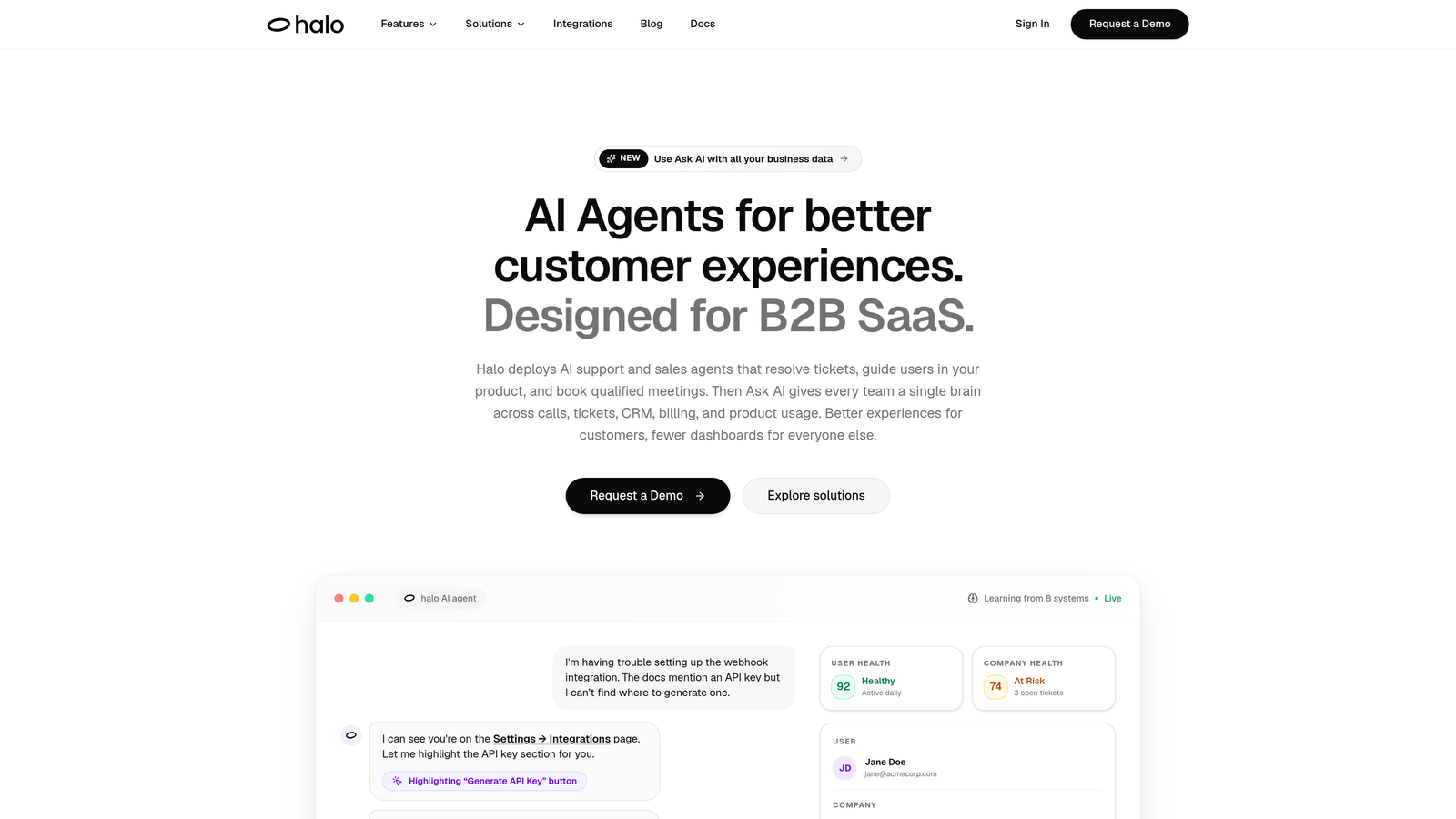
Halo AI is an AI-first customer support platform where autonomous agents resolve tickets, guide users visually through your product, create bug reports, and surface business intelligence from every interaction.
Where This Tool Shines
What separates Halo from legacy helpdesks with AI add-ons is the architecture. The platform was built around AI from day one, which means the intelligence layer isn't bolted on as an afterthought. Every interaction feeds a continuous learning loop, so the system gets measurably smarter over time rather than staying static.
The page-aware chat widget is a genuine differentiator. Halo's AI sees what the user is looking at inside your product and can deliver visual UI guidance in context, cutting down the back-and-forth that plagues traditional support. On top of that, the Smart Inbox goes beyond ticket management to surface customer health signals, revenue intelligence, and anomaly detection, turning your support queue into a source of business insight.
Key Features
Page-Aware Chat Widget: Understands what users are doing inside your product and delivers visual, in-context guidance without requiring them to leave the screen.
Continuous Learning: Every resolved ticket and interaction improves the AI's future performance, building a compounding intelligence advantage over time.
Auto Bug Ticket Creation: Automatically identifies and logs bug reports to your engineering workflow, with live agent handoff for issues that need human attention.
Smart Inbox with Business Intelligence: Surfaces customer health signals, churn risk indicators, revenue signals, and anomaly detection from within your support data.
Deep Integration Stack: Connects natively with Linear, Slack, HubSpot, Intercom, Stripe, Zoom, PandaDoc, and Fathom, so support data flows across your entire business stack.
Best For
Halo is purpose-built for B2B SaaS companies and product teams that want AI agents to handle routine resolution at scale while generating actionable business intelligence in the process. It's particularly well-suited for teams ready to move beyond augmenting an old helpdesk and commit to an AI-native architecture.
Pricing
Contact Halo AI for pricing. The platform is designed for B2B SaaS teams scaling support operations, so pricing is tailored to team size, ticket volume, and integration requirements.
2. Zendesk AI
Best for: Existing Zendesk customers looking to add AI capabilities without migrating to a new platform.
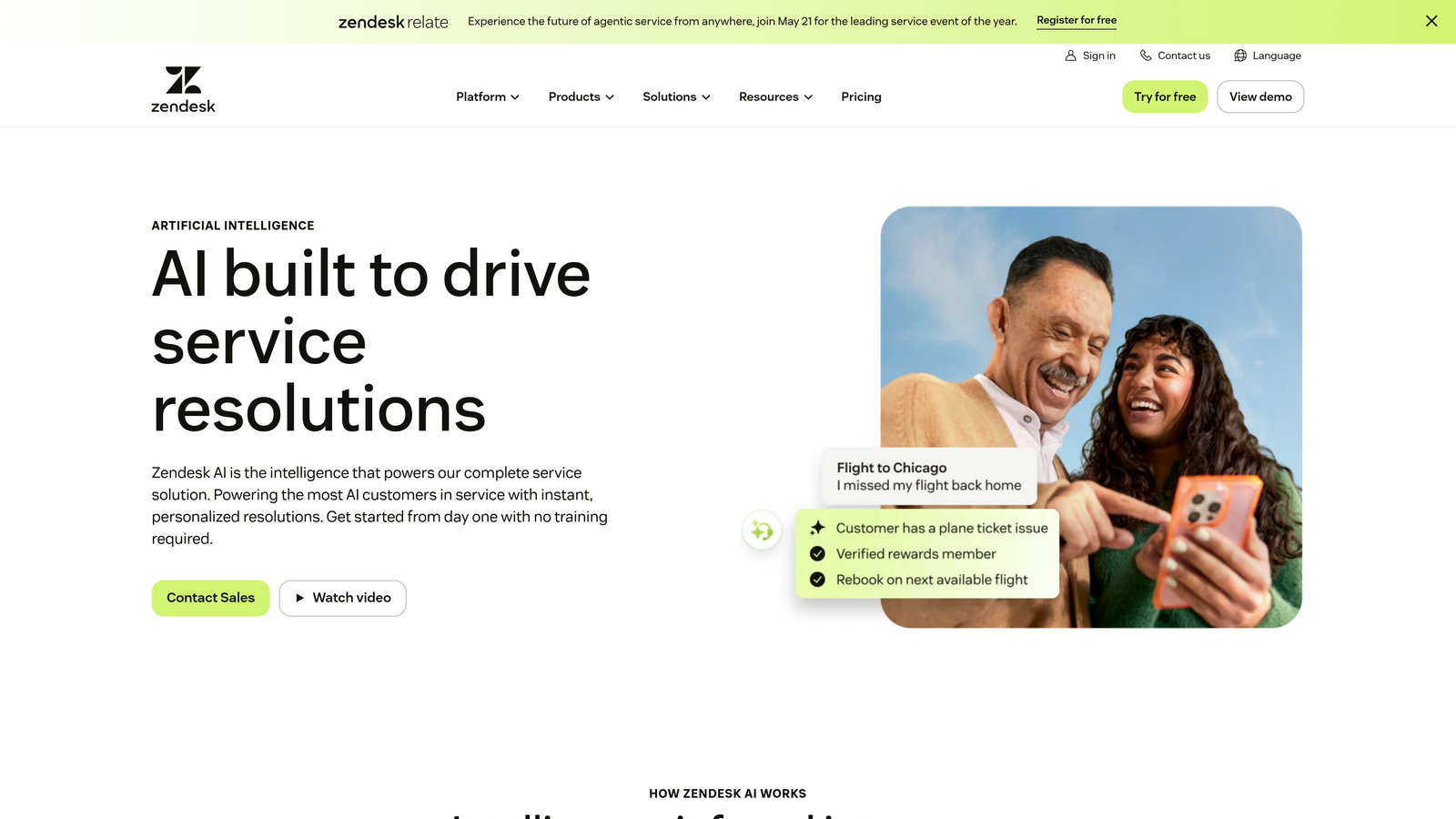
Zendesk AI is a suite of AI capabilities natively embedded across the Zendesk platform, covering self-service agents, intelligent triage, agent assist, and generative AI for knowledge management.
Where This Tool Shines
If your team is already running on Zendesk, the AI layer integrates without disruption. You're not adopting a new system; you're activating intelligence within a workflow your agents already know. That reduces deployment friction significantly and makes adoption faster than switching platforms entirely.
The generative AI capabilities for knowledge base management are particularly useful. Teams can draft, update, and optimize help center articles using AI, which addresses one of the most common bottlenecks in scaling self-service: keeping content current.
Key Features
AI Agents for Self-Service: Handles common customer queries autonomously before escalating to a human agent, reducing ticket volume on straightforward issues.
Intelligent Triage: Detects intent, language, and sentiment to route tickets accurately and prioritize urgent issues without manual sorting.
Generative AI for Agents: Drafts reply suggestions and ticket summaries to help agents respond faster and more consistently.
Knowledge Base AI: Assists with creating and maintaining help center content, flagging gaps and suggesting updates based on ticket trends.
Native Suite Integration: Works across Zendesk Support, Guide, Chat, and Talk without additional connectors or middleware.
Best For
Teams already invested in the Zendesk ecosystem who want to extend their existing setup with AI rather than replace it. Less ideal for teams starting fresh who want an AI-native foundation.
Pricing
AI add-on available on Suite plans; AI agents are priced per automated resolution. Full pricing details are available on Zendesk's website, and costs scale with resolution volume.
3. Intercom Fin
Best for: Product-led SaaS companies that want a conversational AI agent integrated with their existing Intercom messaging setup.
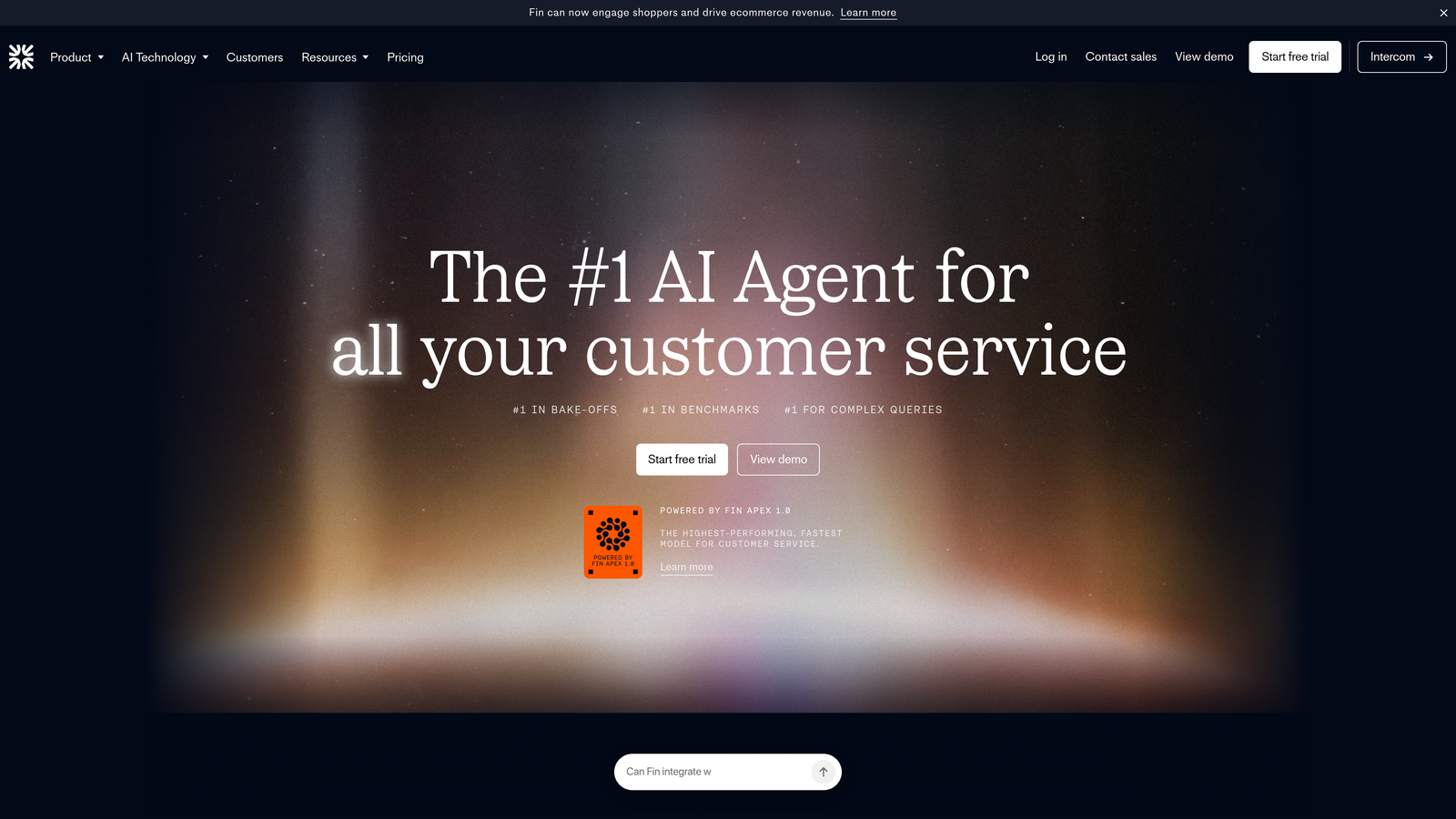
Intercom Fin is a conversational AI agent built natively into the Intercom platform, resolving customer queries using help center content and conversation history with clean human handoff when needed.
Where This Tool Shines
Fin's strength is how naturally it fits into the Intercom product experience. For teams already using Intercom for in-app messaging, onboarding, and product tours, Fin extends the same conversational surface into support resolution without introducing a separate tool or vendor relationship.
The AI copilot for agents is a practical addition. Rather than replacing agents entirely, it assists them with suggestions during live conversations, which helps teams that handle complex queries where full automation isn't appropriate.
Key Features
Fin AI Agent: Trained on your help center content and historical conversations to resolve queries without human intervention on common issues.
Multi-Channel Support: Handles customer interactions across chat, email, and SMS from a single platform.
AI Copilot: Provides real-time suggestions and context to human agents during live conversations, improving response quality and speed.
Custom Answer Workflows: Allows teams to build specific response paths for particular query types or customer segments.
Proactive Messaging Integration: Connects AI support resolution with Intercom's broader product tours and proactive outreach capabilities.
Best For
Product-led SaaS companies and growth teams already on Intercom who want to add AI resolution without switching platforms. Also works well for teams that need both support and proactive engagement from one tool.
Pricing
Fin is priced per resolution. The Intercom platform starts at $39 per seat per month, with Fin costs adding on based on automated resolution volume.
4. Freshdesk Freddy AI
Best for: Budget-conscious teams or small businesses that need AI-assisted support without enterprise price tags.
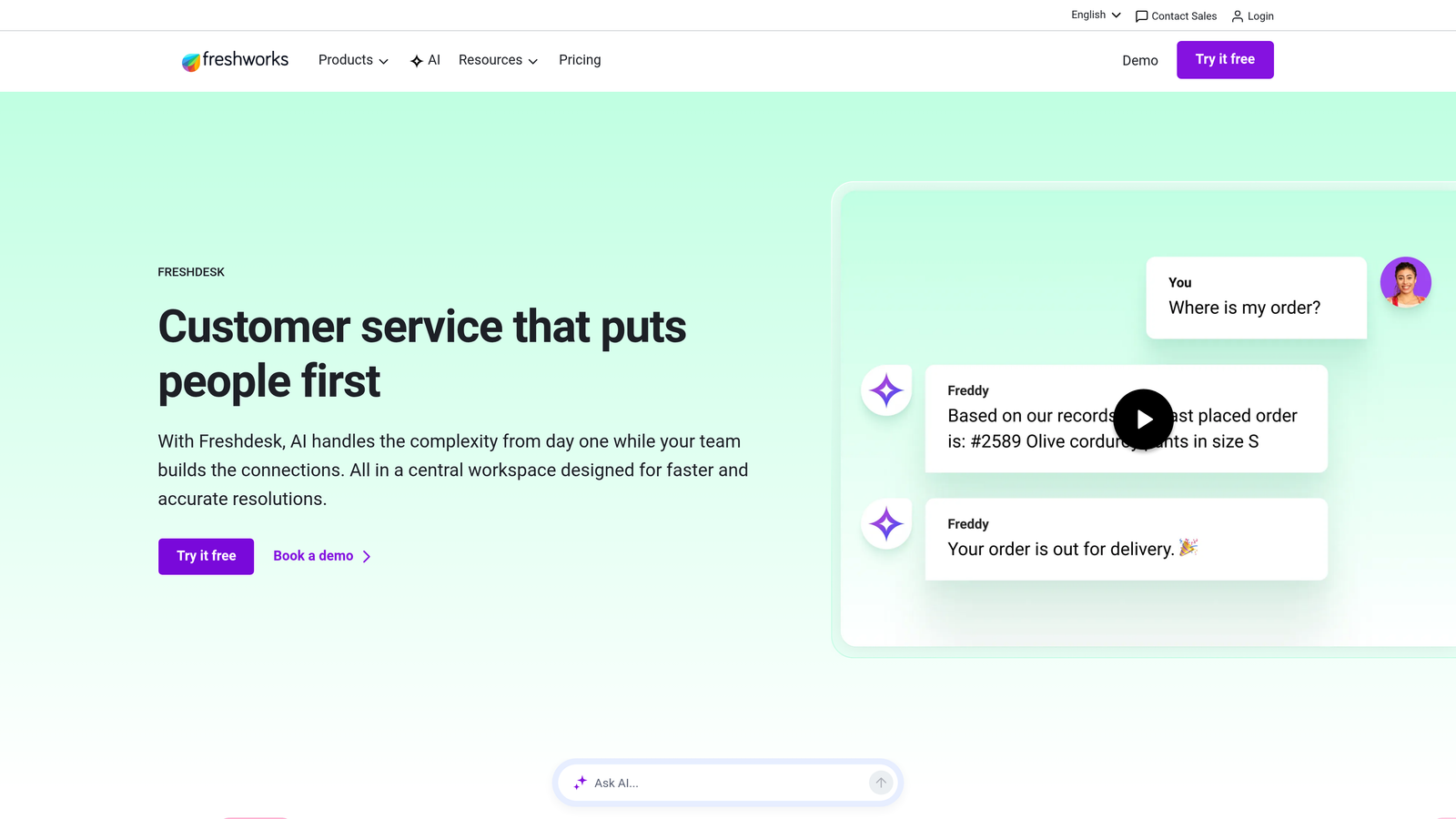
Freshdesk with Freddy AI is Freshworks' helpdesk platform featuring self-service bots, agent assist tools, and analytics at competitive price points, including a free tier for smaller teams.
Where This Tool Shines
Freshdesk's value proposition is accessibility. The free tier gives small teams a real starting point, and the AI features scale up as you move to paid plans. For teams that need solid helpdesk fundamentals with AI assistance rather than full AI autonomy, Freddy strikes a practical balance.
The combination of Freddy AI Agent for self-service and Freddy Copilot for agent assistance covers both sides of the support equation without requiring a large upfront investment or complex deployment.
Key Features
Freddy AI Agent: Handles automated customer self-service, resolving common queries without routing to a human agent.
Freddy Copilot: Provides agents with reply draft suggestions, ticket summaries, and contextual recommendations during live interactions.
AI-Powered Routing: Automatically assigns and prioritizes tickets based on content, urgency, and team availability.
Built-In Analytics: Tracks team performance, ticket trends, and resolution rates with reporting built directly into the platform.
Free Plan: A functional free tier makes it accessible for small teams testing AI-assisted support before committing to paid features.
Best For
Small to mid-sized teams, startups, and budget-conscious operations that want AI-assisted support without enterprise pricing. Also a strong option for teams migrating off basic email-only workflows for the first time.
Pricing
Free tier available. Paid plans start at $15 per agent per month, with AI features unlocking on higher tiers. Pricing is among the most accessible in this category.
5. Ada
Best for: Enterprise teams that need high-volume automated resolution across multiple channels and languages at scale.
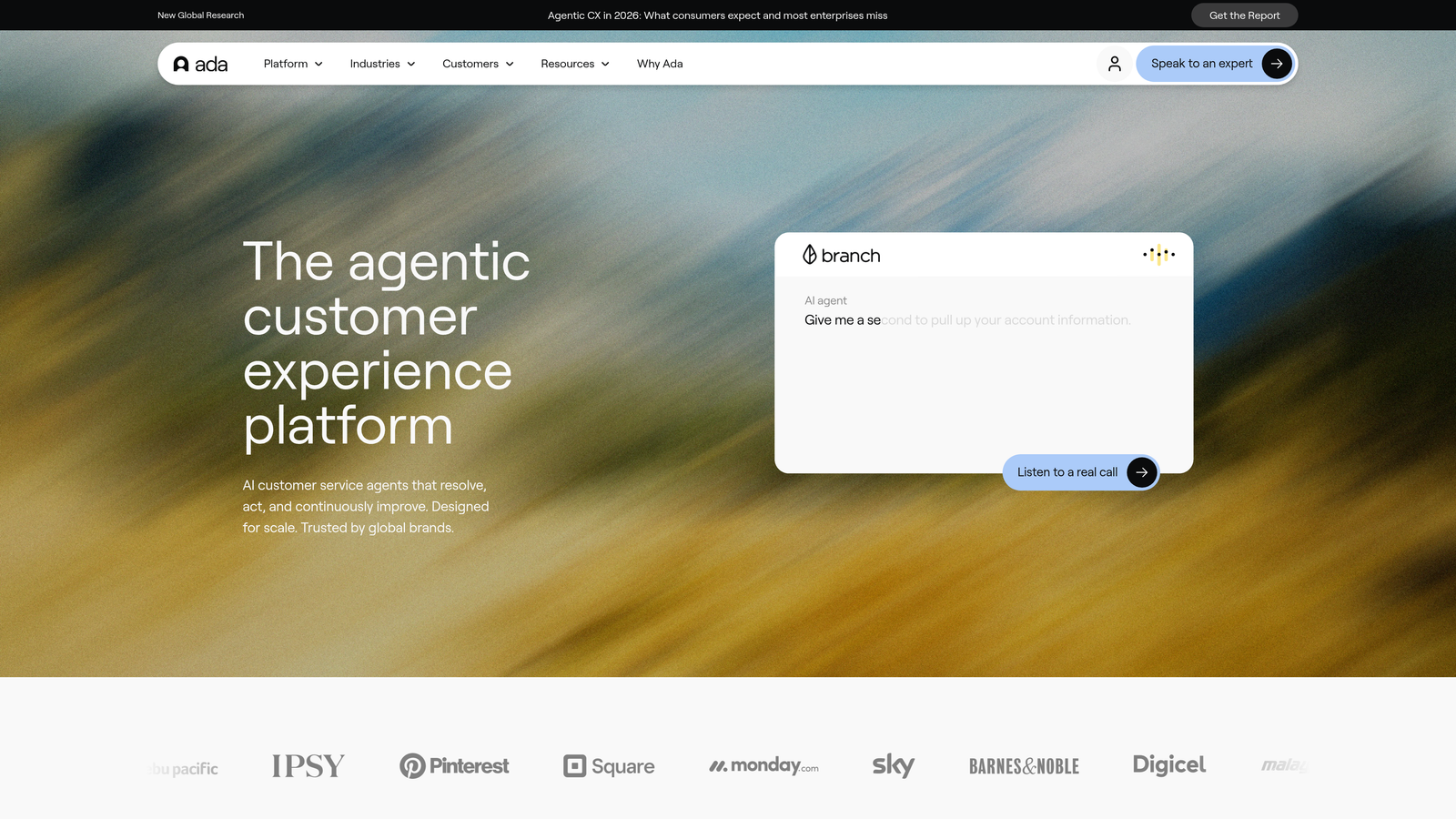
Ada is an enterprise-grade AI agent platform purpose-built for automated customer service, supporting high-volume resolution across web, mobile, social, and phone in more than 50 languages.
Where This Tool Shines
Ada is built for scale in a way that most tools on this list are not. The platform is designed to handle enterprise-level query volumes across complex, multi-channel environments without degrading resolution quality. For global businesses with diverse customer bases, the multilingual support across 50+ languages is a meaningful capability, not a checkbox feature.
The action-oriented AI is another standout. Ada's agents can actually execute tasks, such as processing refunds, updating account information, or triggering downstream workflows, rather than simply answering questions. That moves the platform into genuine automation territory rather than just deflection.
Key Features
No-Code AI Agent Builder: Allows non-technical teams to build and configure AI agents using generative AI without engineering involvement.
Multi-Channel Deployment: Operates across web, mobile, social media, and phone from a single platform configuration.
Multilingual Support: Resolves queries in 50+ languages, making it suitable for global customer bases without separate regional setups.
Action-Oriented AI: Executes tasks like refunds and account updates autonomously, going beyond question-answering into real workflow automation.
Enterprise Security and Compliance: Built with enterprise-grade data security, access controls, and compliance frameworks.
Best For
Large enterprises with high ticket volumes, global customer bases, and complex multi-channel support requirements. Less suited to small or mid-sized teams where the enterprise pricing and feature depth may exceed actual needs.
Pricing
Custom enterprise pricing. Contact Ada directly for a quote based on volume, channels, and feature requirements.
6. Tidio
Best for: Small businesses and e-commerce teams that want an accessible AI chatbot with minimal technical setup.
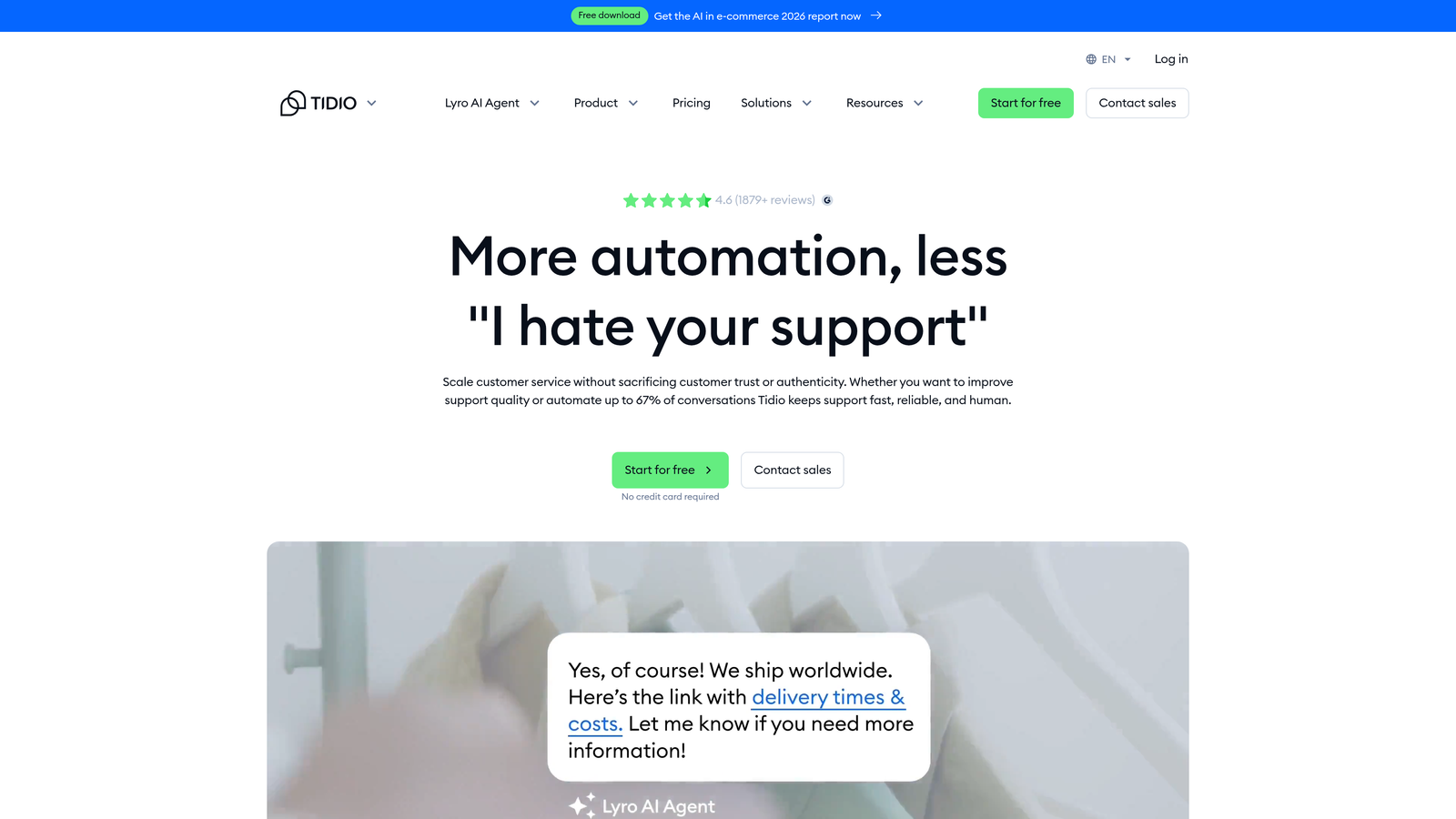
Tidio is an AI chatbot and live chat platform featuring the Lyro AI assistant, trained on your own content and designed to get up and running quickly without technical complexity.
Where This Tool Shines
Tidio's primary strength is approachability. The setup process is genuinely fast, and the Lyro AI chatbot learns from your existing knowledge base and FAQs without requiring a data science team to configure it. For small businesses and e-commerce operators who need AI-assisted support without a dedicated technical team, that matters enormously.
The combination of live chat, chatbot, and email in a single tool also reduces the number of platforms a small team needs to manage, which is a practical operational benefit that often gets overlooked in enterprise-focused comparisons.
Key Features
Lyro AI Chatbot: Trained on your knowledge base and FAQs to handle common customer queries automatically with minimal configuration.
Visual Flow Builder: Lets non-technical users design chatbot conversation paths without writing code.
Unified Inbox: Combines live chat, chatbot, and email into a single interface so agents don't need to switch between tools.
E-Commerce Integrations: Native connections to Shopify and WooCommerce make it easy to provide order-aware support for online stores.
Quick Deployment: Designed for fast setup with minimal technical requirements, making it accessible for teams without dedicated IT resources.
Best For
Small businesses, e-commerce stores, and early-stage teams that need functional AI-assisted support quickly and affordably. Not designed for complex enterprise environments or high-volume B2B support operations.
Pricing
Free plan available. Lyro AI starts at $39 per month. Tidio+ plans start from $749 per month for higher-volume and more advanced use cases.
7. Forethought
Best for: Teams that want to add AI intelligence to an existing helpdesk like Zendesk or Salesforce without replacing it.
Forethought is an AI layer that sits on top of existing helpdesk platforms, providing intelligent triage, agent assist, and automated resolution using its SupportGPT technology.
Where This Tool Shines
Forethought's positioning is clear: if you're committed to your existing helpdesk but want to inject AI capabilities without a full migration, this is a purpose-built solution for that scenario. It works as an intelligent overlay, which means your team's existing workflows, data, and institutional knowledge stay intact.
The SupportGPT technology handles both automated resolution for common queries and agent assist for more complex ones, giving teams a flexible AI layer that scales with ticket complexity rather than applying a one-size-fits-all approach.
Key Features
SupportGPT Resolution: Generative AI that resolves common tickets automatically and assists agents with drafts and suggestions on more complex issues.
Intelligent Triage: Detects intent and routes tickets to the right team or workflow without manual sorting.
Helpdesk Overlay: Integrates directly with Zendesk, Salesforce Service Cloud, and other major helpdesks without requiring platform migration.
Workflow Automations: Builds automated resolution paths for recurring ticket types, reducing repetitive agent work.
AI Performance Analytics: Tracks resolution rates, deflection metrics, and AI performance so teams can measure impact and optimize over time.
Best For
Mid-market and enterprise teams with existing helpdesk investments who want to add AI resolution and triage without switching platforms. Particularly strong for Zendesk and Salesforce users.
Pricing
Custom pricing based on ticket volume. Contact Forethought directly for a quote tailored to your support operation size and helpdesk environment.
8. Drift (Salesloft)
Best for: Revenue-focused teams that need AI chatbots bridging customer support and sales conversations in real time.
Drift, now part of the Salesloft platform, is a conversational AI tool that uses AI chatbots to engage website visitors, qualify leads, and handle support conversations with a strong emphasis on revenue attribution.
Where This Tool Shines
Drift occupies a unique position in this list because it sits at the intersection of support and sales. For teams where the support conversation frequently overlaps with revenue opportunities, such as expansion, upsell, or trial conversion, Drift's ability to route and engage based on buyer intent is genuinely differentiated.
The real-time visitor intelligence is a practical feature for go-to-market teams. Knowing who is on your site, what they're looking at, and routing them to the right conversation or resource in real time is a capability that pure support platforms don't typically offer.
Key Features
AI-Powered Chatbots: Handles support queries and lead qualification simultaneously, bridging the gap between support and sales workflows.
Real-Time Visitor Intelligence: Identifies website visitors and routes them based on intent, company, or account status.
Conversational Landing Pages: Replaces static forms with live chat experiences to engage high-intent visitors more effectively.
CRM and Sales Tool Integration: Connects with CRM platforms and sales engagement tools to keep revenue data synchronized.
Revenue Analytics: Tracks conversation attribution and pipeline impact, making it easier to demonstrate support's contribution to revenue.
Best For
B2B companies where support and sales conversations frequently overlap, particularly teams using Salesloft for revenue engagement who want a unified platform. Less suited to pure support-only use cases.
Pricing
Drift is part of the Salesloft platform with custom pricing based on usage and feature requirements. Contact Salesloft for current packaging and quotes.
9. Help Scout
Best for: Relationship-driven support teams that want AI assistance for agents without removing the human element from customer interactions.
Help Scout is a human-first customer support platform that uses AI to assist agents with drafts, summaries, and suggestions rather than replacing them with autonomous resolution.
Where This Tool Shines
Help Scout takes a deliberately different philosophy from most tools on this list. Rather than optimizing for maximum AI autonomy, it focuses on making human agents faster and more effective. For teams where relationship quality and personal touch are central to the customer experience, that philosophy is a genuine competitive advantage rather than a limitation.
The clean, simple UX is consistently cited as a strength. Agents aren't navigating a complex enterprise platform; they're working in an interface designed around their experience, which tends to improve both adoption and response quality.
Key Features
AI Drafts and Reply Suggestions: Generates draft responses for agents to review and send, speeding up response time without removing human judgment from the loop.
AI Conversation Summaries: Condenses long conversation threads so agents can get up to speed quickly when picking up a ticket mid-thread.
Docs Knowledge Base: Built-in knowledge base with AI-assisted search that surfaces relevant articles for both customers and agents.
Beacon Chat Widget: Embeds a chat widget that proactively recommends relevant help articles before a customer submits a ticket.
Clean Agent UX: Designed with agent experience as a priority, reducing interface complexity and improving day-to-day usability.
Best For
Small to mid-sized teams, professional services companies, and any organization where customer relationships are a core differentiator and full AI autonomy would undermine the experience they want to deliver.
Pricing
Standard plan starts at $50 per month. Plus plan at $75 per month. AI features are included across plans rather than gated behind a separate add-on.
Which Tool Is Right for Your Team?
The right AI support software purchase depends heavily on three things: your existing stack, your resolution goals, and your budget model. Here's a quick way to think through the options.
AI-first autonomous support: If you're building a modern support stack from scratch and want AI agents that learn continuously, surface business intelligence, and integrate across your entire business, Halo AI is the purpose-built choice. It's designed for B2B SaaS teams that want more than ticket deflection.
Layering AI onto an existing helpdesk: If you're committed to Zendesk or Salesforce and want to add AI without migrating, Zendesk AI and Forethought are both strong options. Zendesk AI works best if you're already on the Zendesk Suite. Forethought is better if you want a vendor-agnostic AI overlay.
Product-led SaaS: Intercom Fin is the natural fit for teams already using Intercom for in-app messaging and product engagement.
Budget-friendly entry points: Freshdesk Freddy AI and Tidio both offer free tiers and accessible paid plans. Freshdesk is stronger for traditional helpdesk workflows; Tidio is better for e-commerce and small business use cases.
Enterprise-scale automation: Ada is built for high-volume, multi-channel, multilingual environments where enterprise security and action-oriented AI are requirements, not nice-to-haves.
Revenue-bridging conversations: Drift, now part of Salesloft, is the choice when support and sales conversations overlap and you need real-time visitor intelligence alongside chatbot capabilities.
Human-first with AI assist: Help Scout is for teams where relationship quality comes first and AI should amplify agents rather than replace them.
Before you finalize a purchase, model your costs against expected ticket volume and automation rate. Pricing models vary widely across per-resolution, per-seat, and flat-platform structures, and the cheapest per-seat option can become expensive at scale. For a deeper look at expected returns, our AI support agent and chatbot ROI guides can help you build the business case.
Your support team shouldn't scale linearly with your customer base. Let AI agents handle routine tickets, guide users through your product, and surface business intelligence while your team focuses on complex issues that need a human touch. See Halo in action and discover how continuous learning transforms every interaction into smarter, faster support.