9 Best AI Support Software Vendors in 2026
This guide evaluates nine leading ai support software vendors in 2026, comparing platforms that go beyond basic chatbots to autonomously resolve tickets, deliver real-time product guidance, and generate actionable business intelligence—helping B2B SaaS teams scale support without proportionally growing headcount.
 Grant CooperFounder13 min read
The support ticket backlog is a universal pain point for scaling B2B teams, and the old approach of hiring more agents isn't keeping pace with growth. AI support software vendors have matured significantly, moving well beyond basic chatbots into systems that resolve tickets autonomously, guide users through products in real time, and surface business intelligence from every interaction.
This list covers nine vendors worth evaluating in 2026, selected based on depth of AI capability (not just keyword matching), integration ecosystem, scalability for B2B SaaS teams, and whether the platform learns and improves over time. Whether you're replacing a legacy helpdesk, adding AI on top of Zendesk or Intercom, or building a support stack from scratch, there's a fit here for your team.
1. Halo AI
Best for: B2B SaaS teams wanting AI-first support with business intelligence built in
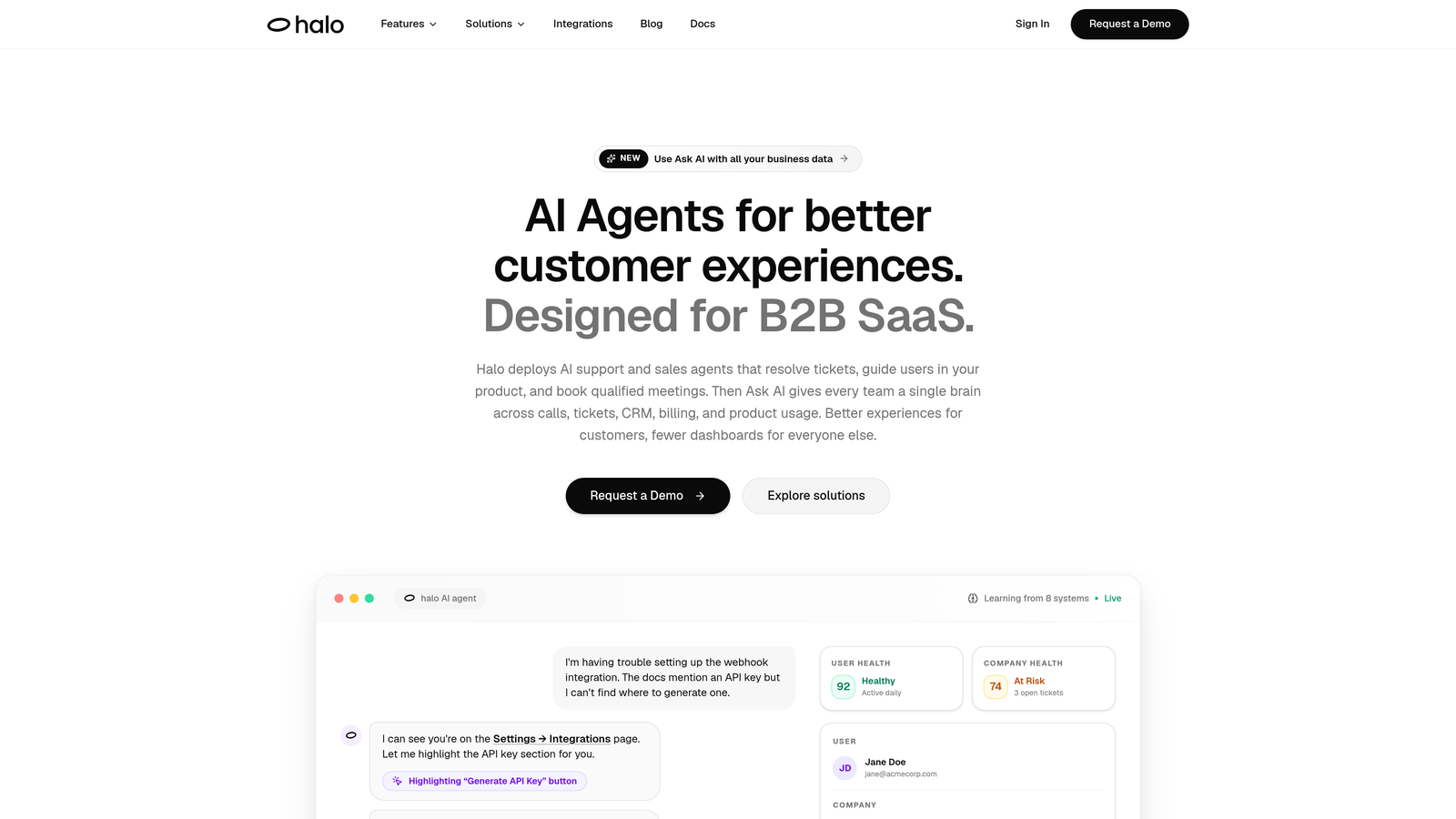
Halo AI is an AI-first customer support platform built specifically for B2B SaaS teams that want to move beyond ticket management into genuinely intelligent, autonomous support.
Where This Tool Shines
What separates Halo from most vendors on this list is its architecture. Rather than bolting AI onto an existing helpdesk, Halo is built ground-up around AI agents that continuously learn from every interaction. That distinction matters: native AI architectures tend to have cleaner data models, which means the AI gets meaningfully smarter over time rather than just getting incremental keyword improvements.
The page-aware context capability is particularly compelling for SaaS product teams. Halo's chat widget sees what a user is looking at in real time and provides in-context visual guidance, essentially letting the AI agent walk users through your product the way a knowledgeable support rep would. Combine that with auto bug ticket creation routed directly to Linear or your engineering tool, and Halo starts functioning less like a support tool and more like a connected layer across your entire product and engineering workflow.
Key Features
Page-Aware AI Agents: The chat widget sees what users see in real time, enabling in-context visual guidance rather than generic help article links.
Autonomous Ticket Resolution: AI agents handle tickets end-to-end with smart escalation to live agents when complexity warrants a human touch.
Auto Bug Ticket Creation: Automatically identifies and routes bug reports to Linear or your engineering tool, closing the loop between support and product.
Smart Inbox with Business Intelligence: Surfaces customer health signals, revenue anomalies, and product feedback trends directly from support interactions, turning your support queue into a strategic data source.
Deep Integrations: Connects to Linear, Slack, HubSpot, Intercom, Stripe, Zoom, PandaDoc, and Fathom, making it a genuine hub across your business stack rather than an isolated support tool.
Best For
B2B SaaS product teams and support leaders who want AI that does more than deflect tickets. Particularly well-suited for teams where support data should be informing product decisions, and where engineering and support workflows need to be tightly connected.
Pricing
Contact for pricing, tailored to team size and usage. Given the depth of integrations and business intelligence capabilities, expect pricing to reflect an enterprise-grade platform.
2. Intercom
Best for: Teams already using Intercom's messaging platform who want AI built into their existing workflow
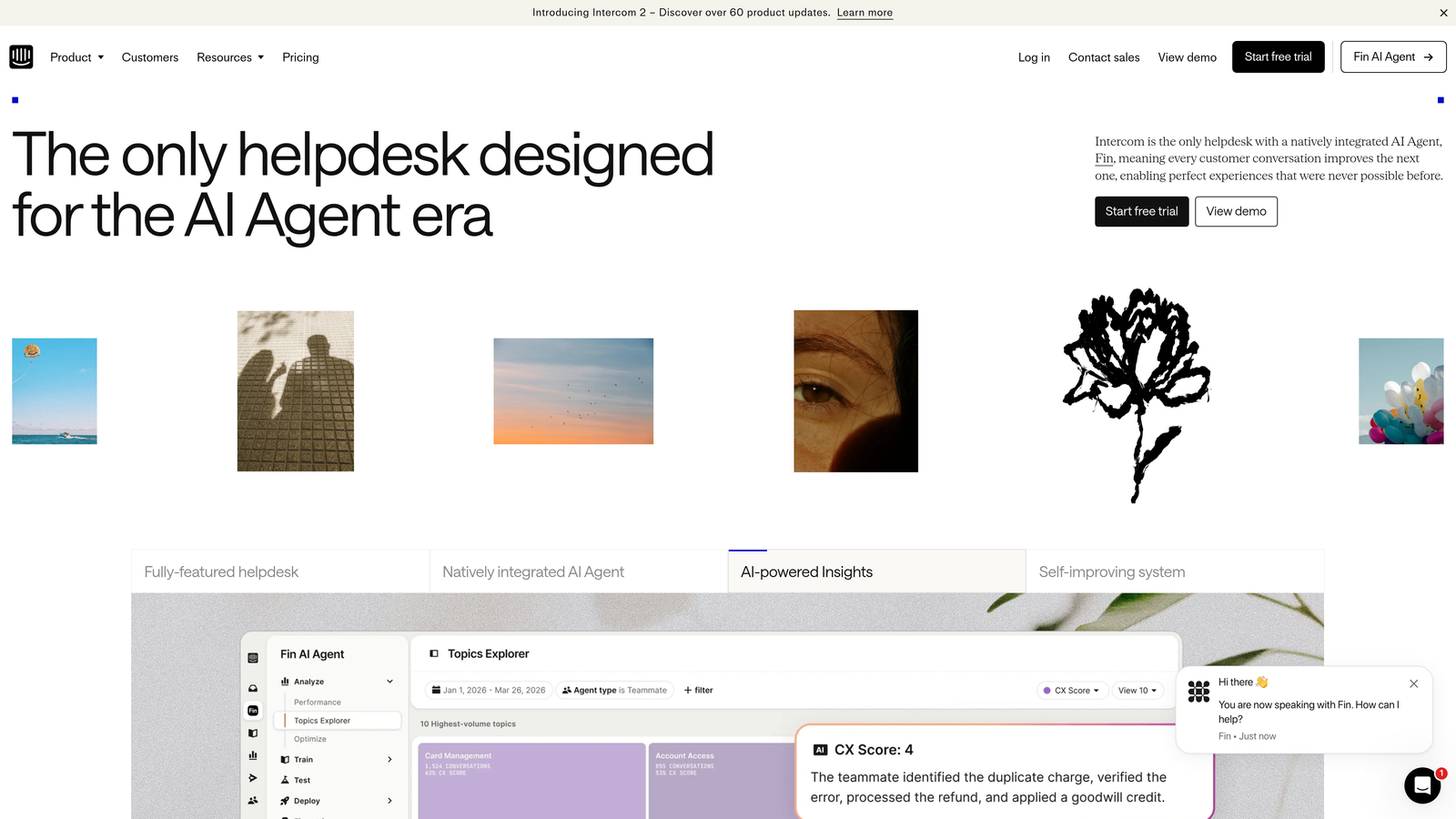
Intercom is an all-in-one customer messaging platform featuring Fin, an AI agent built on large language models that handles support conversations and escalates to human agents within the same inbox.
Where This Tool Shines
Intercom's strength is the seamlessness of the AI-to-human handoff. Fin operates inside the same unified inbox your human agents use, which means escalations feel natural rather than jarring. For teams already living in Intercom, adding Fin doesn't require a workflow overhaul — it layers in on top of what you're already doing.
The platform's breadth is also notable. Beyond Fin, Intercom offers product tours, in-app messaging, and an extensive app marketplace, making it a reasonable choice for teams that want their support and customer engagement tools consolidated in one place.
Key Features
Fin AI Agent: Handles automated ticket resolution using large language model reasoning, not just keyword matching.
Unified Inbox: AI and human agent conversations live in the same interface, making escalation and context handoff smooth.
Workflow Automation: Routing, tagging, and assignment automation to keep tickets moving without manual triage.
Product Tours and In-App Messaging: Goes beyond support into proactive user onboarding and engagement.
App Marketplace and API: Extensive integrations with third-party tools for teams with complex stacks.
Best For
Teams already invested in Intercom's ecosystem, or those who want AI support tightly coupled with in-app messaging and onboarding. Less ideal if you're looking for deep business intelligence from support data or engineering workflow integrations.
Pricing
Starts at approximately $39/month for base plans; Fin AI resolution is priced per resolved conversation, which can escalate meaningfully at higher volumes. Verify current pricing directly with Intercom.
3. Zendesk AI
Best for: Large enterprise support organizations needing AI layered onto a proven helpdesk platform
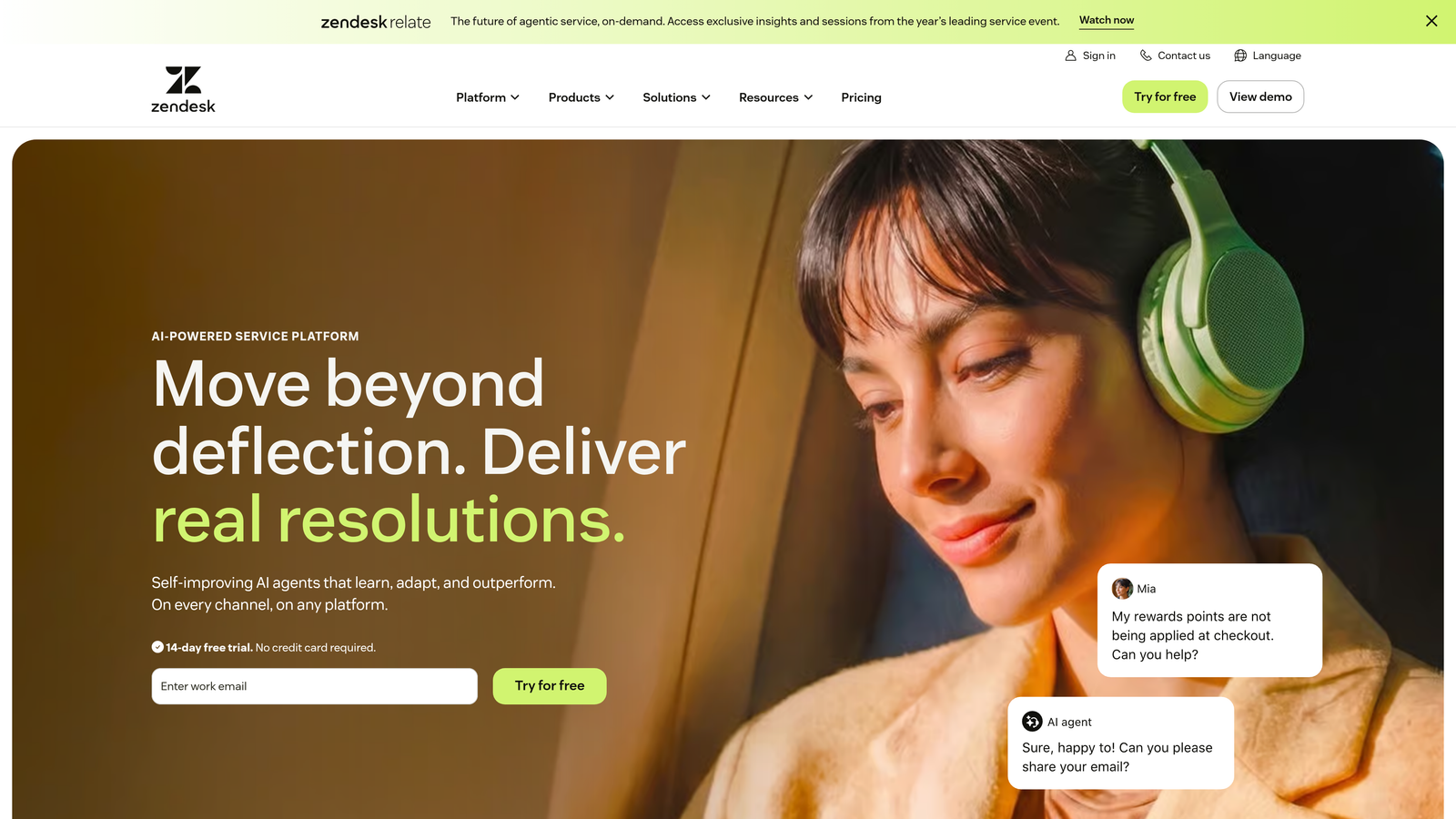
Zendesk AI is an enterprise-grade helpdesk platform with native AI capabilities including intelligent triage, agent copilot, and automated resolution built into the Zendesk Suite.
Where This Tool Shines
Zendesk's scale and compliance credentials are hard to match. For enterprise teams with strict security requirements and complex multi-channel support operations, Zendesk AI provides AI capabilities within a platform that IT and legal teams are already comfortable with. That organizational trust matters more than it might seem when rolling out AI to large support teams.
The Agent Copilot feature is a practical value-add for teams not ready to fully automate: it surfaces real-time response suggestions to human agents, improving consistency and speed without removing the human from the loop entirely.
Key Features
Intelligent Triage and Routing: AI automatically classifies and routes incoming tickets based on intent, sentiment, and content.
Agent Copilot: Provides real-time response suggestions and contextual guidance to human agents during live conversations.
Automated Resolutions: AI agents handle common requests end-to-end without human intervention.
Advanced Analytics and Reporting: Robust reporting suite for tracking support performance, trends, and AI resolution rates.
Enterprise Compliance and Security: Certifications and controls that meet enterprise procurement requirements.
Best For
Large support organizations already on Zendesk, or enterprise buyers who need AI capabilities within a platform with established compliance and security credentials. The AI add-on pricing model means costs can scale quickly for high-volume teams.
Pricing
Suite plans start at approximately $55/agent/month; AI features are priced as add-ons on top of the base Suite. Confirm current pricing with Zendesk directly as add-on structures change.
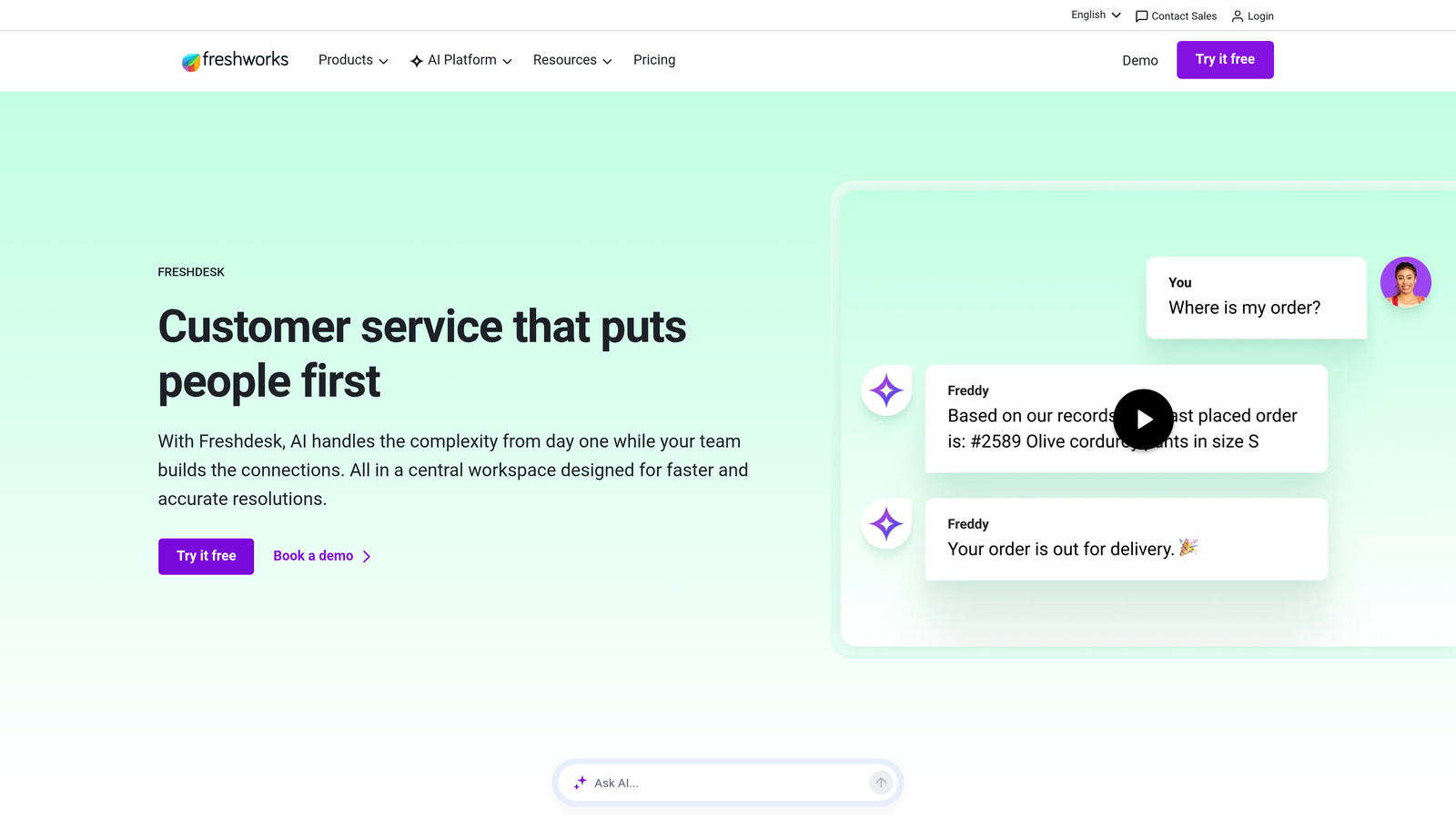
4. Freshdesk (Freddy AI)
Best for: SMB and mid-market teams wanting capable AI support at competitive pricing
Freshdesk is a cloud-based helpdesk platform with Freddy AI spanning self-service deflection, agent assistance, and cross-suite automation across the broader Freshworks product family.
Where This Tool Shines
Freshdesk's value proposition is accessible AI at a price point that doesn't require an enterprise budget. Freddy AI operates across two distinct modes: Freddy Self Service handles deflection before tickets reach agents, and Freddy Copilot assists agents with response drafting and suggestions in real time. That dual-layer approach covers both ends of the support workflow.
For teams using multiple Freshworks products, the cross-suite AI is a genuine differentiator. Freddy spans Freshdesk (support), Freshsales (CRM), and Freshservice (ITSM), which means support agents can pull CRM context without switching platforms.
Key Features
Freddy Self Service: AI-powered deflection that resolves common queries before they become tickets.
Freddy Copilot: Assists agents with response drafting, summaries, and suggested next actions.
Cross-Suite AI: Freddy intelligence spans support, CRM, and ITSM within the Freshworks ecosystem.
Omnichannel Support: Covers email, chat, phone, and social from a single interface.
Competitive Pricing: One of the more affordable options for teams that need AI without enterprise-level spend.
Best For
SMB and mid-market teams, particularly those already using or considering other Freshworks products. Also a good fit for teams that want to start with AI-assisted agents (Copilot) before moving to full automation.
Pricing
Free plan available; paid plans from approximately $15/agent/month; Freddy AI available as an add-on. Pricing varies by plan tier and Freddy capability level.
5. Salesforce Agentforce
Best for: Enterprises already running Salesforce Service Cloud who want AI with full CRM context
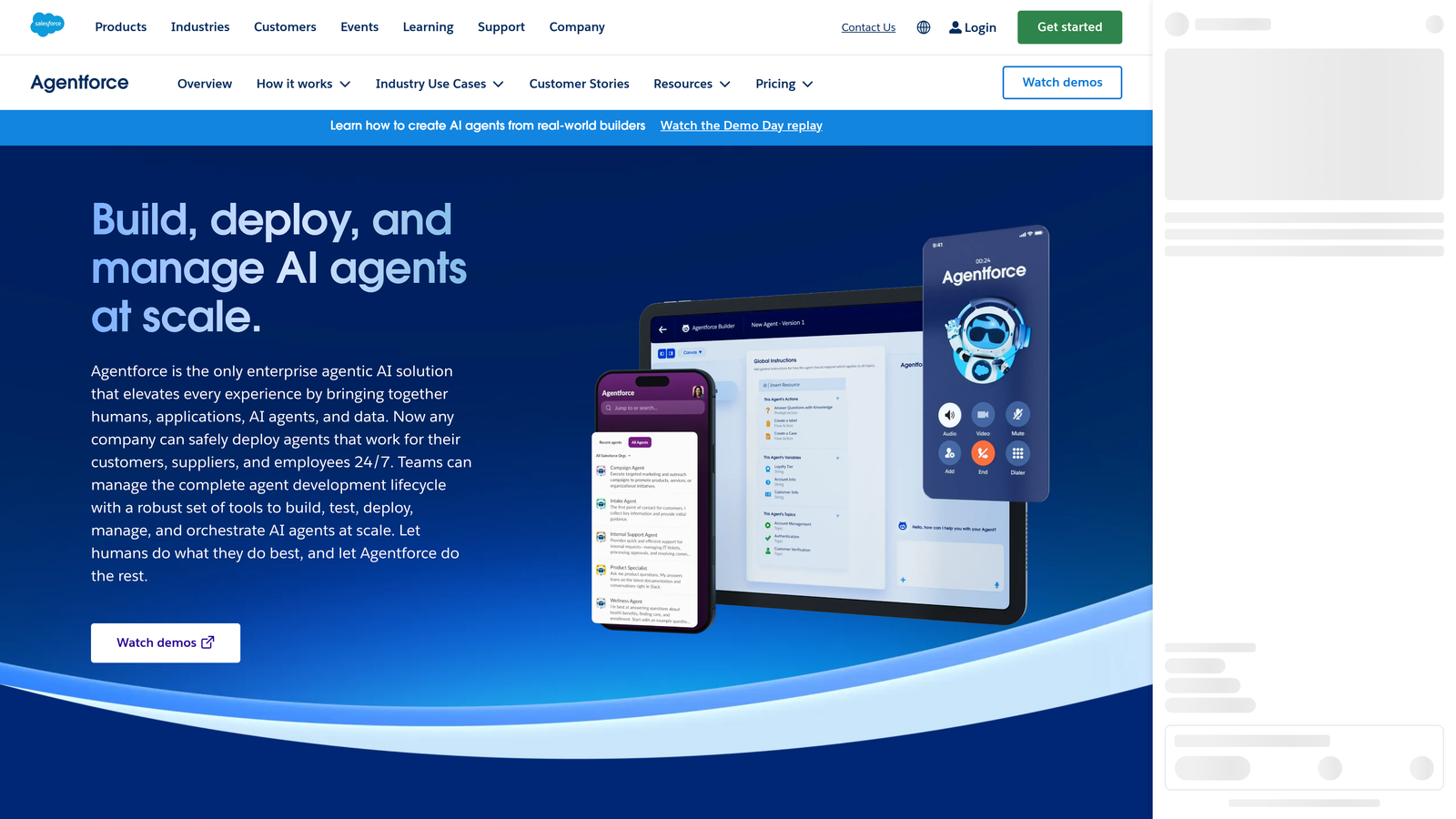
Salesforce Agentforce is Salesforce's autonomous AI agent platform, deeply integrated with Service Cloud and giving AI agents access to full CRM and customer history for context-rich support resolution.
Where This Tool Shines
The core advantage of Agentforce is context. When your AI agent has access to a customer's full Salesforce CRM record, including deal history, account status, open opportunities, and past service interactions, it can handle support conversations with a level of personalization and accuracy that context-free AI agents simply can't match. For enterprise B2B teams, that customer history often determines how a support case should be handled.
Agentforce's low-code Agent Builder also makes it accessible to Salesforce admins without deep AI engineering expertise, which is a practical consideration for large organizations with established Salesforce teams but limited ML resources.
Key Features
Full CRM Data Access: AI agents operate with complete Salesforce customer history, account data, and interaction records.
Multi-Step Reasoning: Handles complex support scenarios that require reasoning across multiple data points before responding.
Native Service Cloud Integration: No integration work required for teams already on Salesforce's service platform.
Low-Code Agent Builder: Salesforce admins can configure and deploy AI agents without engineering support.
Enterprise Security and Compliance: Inherits Salesforce's established security and compliance framework.
Best For
Enterprises already committed to the Salesforce ecosystem. Implementation complexity and cost make it a poor fit for teams without existing Salesforce infrastructure or dedicated Salesforce admin resources.
Pricing
Agentforce pricing is based on conversations; requires an active Salesforce Service Cloud subscription. Total cost of ownership can be significant at scale.
6. Forethought
Best for: Teams wanting AI triage and resolution layered on top of their existing helpdesk
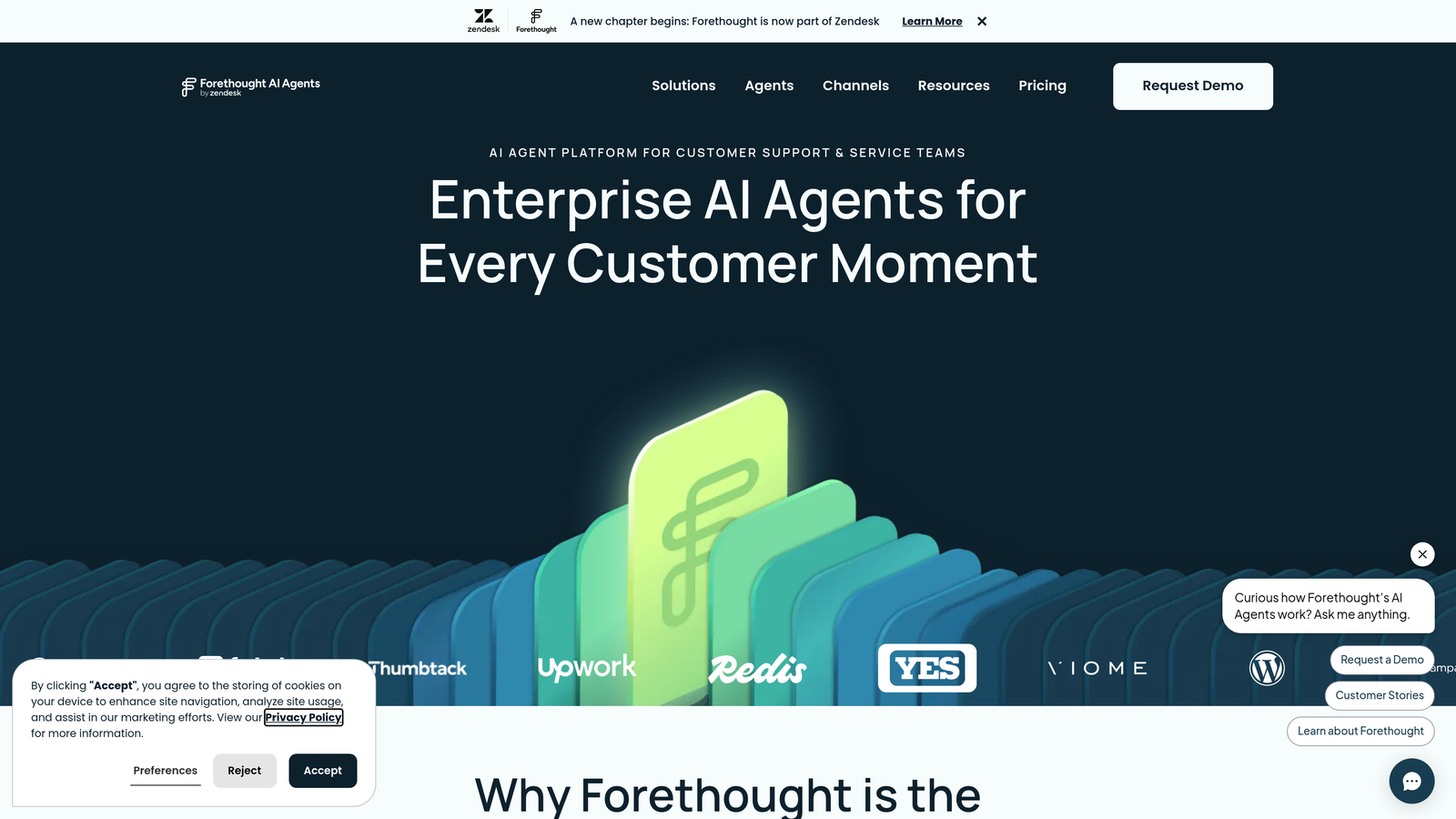
Forethought is a purpose-built AI platform for support teams that works alongside existing helpdesks, specializing in AI triage, intelligent routing, and autonomous ticket resolution without requiring you to replace your current system.
Where This Tool Shines
Forethought's positioning is deliberately additive rather than replacement-oriented. If your team is heavily invested in Zendesk or Salesforce and isn't ready to migrate, Forethought layers AI capabilities on top without disrupting the existing setup. That's a meaningful practical advantage for support leaders who need to show quick AI wins without a multi-month platform migration.
The modular structure is also worth noting. Forethought's Triage, Route, Solve, and Discover modules can be deployed independently, letting teams start with the highest-value use case and expand from there rather than committing to a full platform overhaul upfront.
Key Features
Triage AI: Automatically classifies and prioritizes incoming tickets based on intent and urgency.
Route AI: Assigns tickets to the right agent based on skills, availability, and ticket context.
Solve AI: Handles automated resolution of common, repetitive requests without agent involvement.
Discover AI: Analyzes historical ticket data to identify automation opportunities your team hasn't yet addressed.
Native Helpdesk Integrations: Works directly with Zendesk, Salesforce, Freshdesk, and ServiceNow.
Best For
Support teams that want AI capabilities without switching helpdesks. Particularly valuable for organizations with established Zendesk or Salesforce workflows that want to add AI incrementally rather than all at once.
Pricing
Custom pricing — contact Forethought for a demo and quote. Pricing typically reflects the combination of modules deployed.
7. Ada
Best for: Enterprise CX teams building sophisticated, multilingual AI agents without writing code
Ada is a no-code AI agent platform designed for enterprise CX teams, enabling non-technical teams to build and deploy sophisticated multilingual AI agents across web, mobile, and messaging channels.
Where This Tool Shines
Ada's Reasoning Engine is the standout technical differentiator. It allows the AI agent to handle multi-step, complex resolution flows without requiring engineering resources to build decision trees or maintain conversation scripts. For large CX teams managing diverse customer journeys across multiple channels, that no-code flexibility is genuinely valuable.
The multilingual capability is also production-grade rather than an afterthought, which matters for enterprise teams supporting global customer bases. Ada supports many languages with consistent quality, reducing the need for separate regional agent configurations.
Key Features
No-Code Agent Builder: CX teams can build, test, and deploy AI agents without engineering involvement.
Ada's Reasoning Engine: Handles complex, multi-step resolution scenarios without pre-scripted conversation flows.
Multilingual Support: Production-grade support across many languages for global customer bases.
Omnichannel Deployment: Deploy across web, mobile, SMS, WhatsApp, and additional messaging channels from one platform.
Enterprise Governance: SSO, compliance controls, and data governance features for enterprise procurement requirements.
Best For
Large enterprise CX teams managing high volumes across multiple languages and channels, particularly those who need non-technical team members to own and iterate on AI agent configuration independently.
Pricing
Custom enterprise pricing — contact Ada directly for a quote. Given the enterprise focus, expect pricing to reflect that positioning.
8. Tidio
Best for: Startups and small businesses needing fast, accessible AI chat with minimal setup
Tidio is an accessible AI chat platform for small businesses and early-stage SaaS teams, featuring Lyro AI for automated customer conversations and a simple live chat fallback.
Where This Tool Shines
Tidio's defining strength is speed to value. The setup is minimal, the interface is intuitive, and Lyro AI can start handling conversations within hours of installation rather than weeks of configuration. For small teams that need AI chat capability immediately without a dedicated implementation project, Tidio removes almost all of the typical friction.
The visual chatbot flow builder also gives non-technical team members control over conversation design without needing developer support. It's not as powerful as Ada's Reasoning Engine for complex scenarios, but for the straightforward support conversations that make up most of a small team's queue, it's more than sufficient.
Key Features
Lyro AI Agent: Handles automated support conversations with natural language understanding for common customer queries.
Live Chat with Quick Takeover: Agents can step into any conversation immediately when Lyro needs human backup.
Visual Chatbot Flow Builder: Non-technical teams can design conversation flows without writing code.
E-Commerce Integrations: Native integrations with Shopify and WooCommerce for product and order context.
Simple Setup: Minimal technical requirements — install, configure, and go live quickly.
Best For
Startups, small businesses, and early-stage SaaS teams that need immediate AI chat capability without the budget or implementation overhead of enterprise platforms. Less suited for complex B2B enterprise environments with high ticket volumes and intricate routing requirements.
Pricing
Free plan available; Lyro AI from approximately $29/month. One of the most accessible price points on this list.
9. Kustomer
Best for: High-volume support teams where full customer relationship context drives resolution quality
Kustomer is a CRM-native customer support platform that gives both AI agents and human agents a complete customer timeline, making every interaction informed by the full history of that customer relationship.
Where This Tool Shines
Kustomer's unified customer timeline is the feature that sets it apart from conventional helpdesk platforms. Rather than showing agents a string of disconnected tickets, Kustomer surfaces a chronological view of every interaction, purchase, and communication touchpoint. When AI agents operate with that full context, they can resolve issues more accurately and personalize responses in ways that feel genuinely helpful rather than robotic.
The flexible CRM data model is also a practical advantage for teams with non-standard customer data structures. Kustomer's custom objects and attributes allow teams to model their specific customer relationships rather than forcing data into a rigid schema.
Key Features
Unified Customer Timeline: Complete view of all interactions, purchases, and communication history for every customer.
Context-Rich AI Responses: AI agents generate responses informed by full customer history, not just the current ticket.
Omnichannel Inbox: Handles email, chat, social, voice, and SMS from a single interface.
Intelligent Routing: Routes tickets based on customer attributes and history, not just ticket content.
Flexible CRM Data Model: Custom objects and attributes accommodate non-standard customer data structures.
Best For
High-volume support teams where customer history meaningfully affects how support cases should be handled. Particularly strong for teams where support quality is directly tied to knowing the customer's relationship status, purchase history, or account health.
Pricing
Starts at approximately $89/agent/month. Pricing reflects the CRM-native architecture and enterprise feature depth.
Making the Right Choice for Your Team
The honest answer is that the best AI support vendor depends heavily on where your team is starting from and what you're trying to accomplish beyond ticket deflection.
Here's a quick orientation by use case:
Halo AI is the strongest fit for B2B SaaS teams that want AI going beyond support into business intelligence, product feedback loops, and engineering workflows. The page-aware context and continuous learning architecture make it particularly well-suited for product-led companies where support and product are tightly connected.
Intercom is the natural choice for teams already in the Intercom ecosystem who want to activate Fin without disrupting their existing workflows. Zendesk AI serves the same function for large enterprise teams on Zendesk Suite. Freshdesk with Freddy AI is the value-oriented option for mid-market teams who don't need enterprise pricing.
Salesforce Agentforce belongs at the top of the evaluation list for enterprises running Salesforce Service Cloud — but only for them. Forethought is the right call for teams that want AI triage and resolution layered on their existing helpdesk without a migration. Ada serves enterprise CX teams that need no-code agent building at scale across multiple languages and channels.
Tidio is the clear winner for startups and small teams that need to get AI chat running quickly at an accessible price point. Kustomer is built for teams where CRM context is the primary driver of support quality.
Your support team shouldn't scale linearly with your customer base. Let AI agents handle routine tickets, guide users through your product, and surface business intelligence while your team focuses on complex issues that need a human touch. See Halo in action and discover how continuous learning transforms every interaction into smarter, faster support.