9 Best AI Support Software With Integrations in 2026
Choosing the right AI support software with integrations is critical for B2B teams who need seamless connectivity between their CRM, ticketing systems, and engineering tools. This guide evaluates nine top platforms based on integration depth, AI resolution capabilities, ease of setup, and overall value — helping you find a solution that keeps context flowing across systems and workflows unbroken.
 Matt PattoliFounder13 min read
Integrations are the make-or-break factor for AI support software. A standalone AI chatbot that can't connect to your CRM, ticketing system, or engineering tools doesn't solve problems — it creates another data silo. The real value of AI support platforms comes from how well they plug into your existing stack, so context flows between systems, agents get full customer history, and workflows stay unbroken across teams.
The tools below were evaluated on four criteria: breadth and depth of integrations, AI resolution capabilities, ease of setup, and overall value for B2B teams. Depth matters here as much as breadth — a surface-level connection that just syncs contact names is very different from a bidirectional integration that triggers workflows, surfaces customer health signals, and routes issues to the right system automatically.
Whether you're running a lean support team at a growing SaaS company or managing enterprise-scale operations, the right platform will make your AI a force multiplier across every tool your team already uses. Here are the top AI support platforms worth evaluating in 2026.
1. Halo AI
Best for: B2B product teams wanting AI-first architecture with deep business-stack integrations
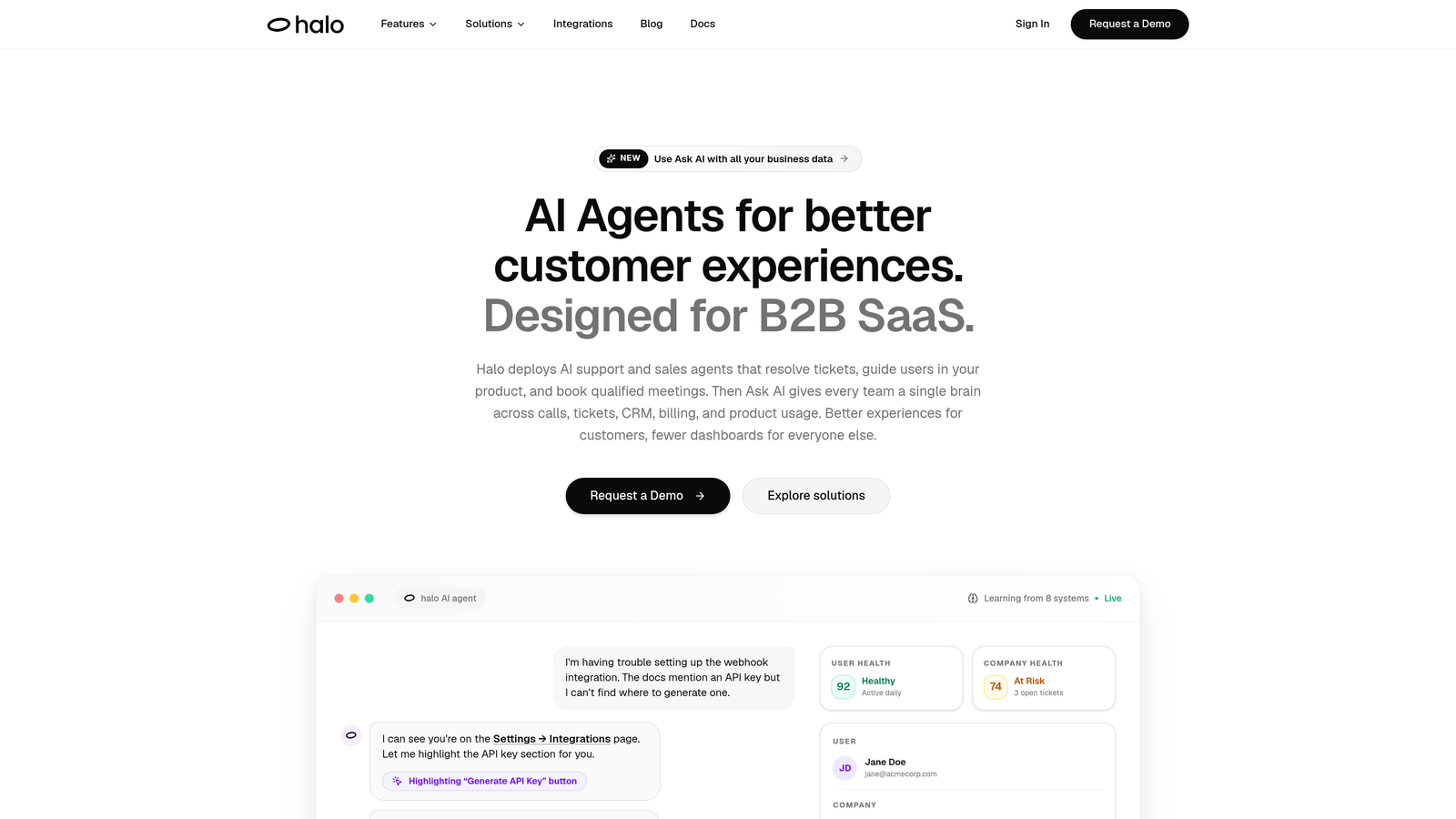
Halo AI is an AI-first customer support platform built natively around intelligent agents, not bolted onto a legacy helpdesk.
Where This Tool Shines
What separates Halo from most support platforms is that it was designed from the ground up as an AI system, not a traditional ticketing tool with AI features added later. That architectural difference shows up in how it handles integrations: rather than connecting to your stack at the surface level, Halo pulls context from engineering tools, revenue platforms, and communication apps to give AI agents a complete picture of every customer interaction.
The page-aware chat widget is a genuinely useful differentiator. It sees what users see in your product, which means it can offer visual UI guidance rather than generic text-based instructions. Combined with auto bug ticket creation routed directly to Linear or your engineering tool of choice, Halo closes the loop between customer-facing support and internal engineering workflows without anyone manually copying information between systems.
Key Features
Native Business-Stack Integrations: Connects to Linear, Slack, HubSpot, Intercom, Stripe, Zoom, PandaDoc, and Fathom, with bidirectional data flow across the stack.
Page-Aware Chat Widget: Understands the user's current page context for visual UI guidance tailored to exactly where they are in your product.
Auto Bug Ticket Creation: Automatically generates and routes bug reports to engineering tools when issues are detected, without requiring agent intervention.
Smart Inbox with Business Intelligence: Goes beyond ticket management to surface customer health signals, revenue intelligence, and anomaly detection directly in the support workflow.
Live Agent Handoff: Escalates complex issues to human agents with full context transfer so nothing gets repeated or lost in translation.
Best For
Halo is best suited for B2B SaaS and product teams that need their support platform to talk to engineering, sales, and finance tools — not just a helpdesk inbox. If your team already uses Linear, HubSpot, or Stripe and wants AI agents that understand the full customer context, this is worth a close look.
Pricing
Contact for pricing. Halo is designed for B2B teams scaling support operations, so pricing is tailored to team size and integration requirements.
2. Intercom
Best for: Mid-market to enterprise teams wanting a unified communication platform with broad integration coverage
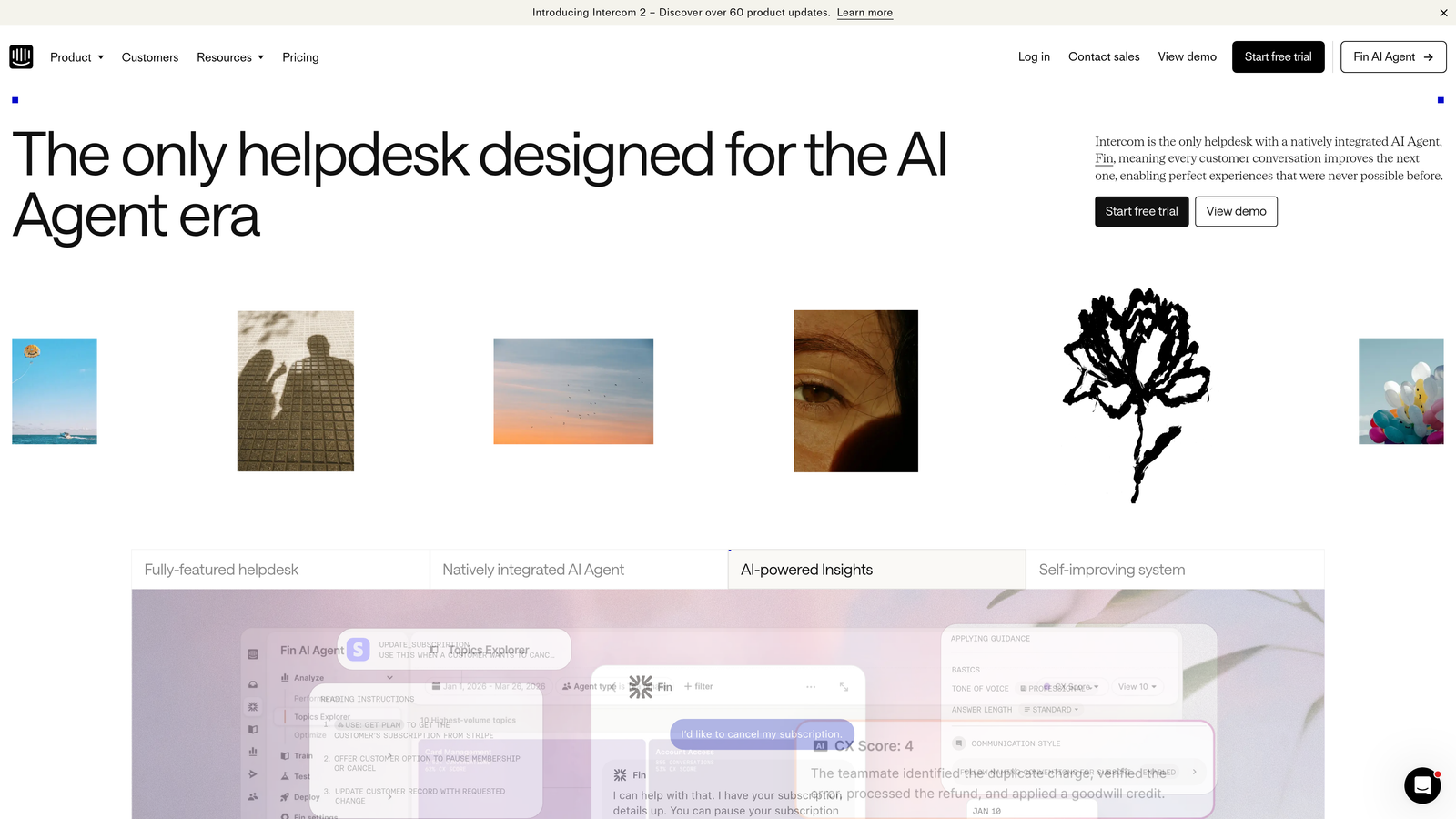
Intercom is a unified customer communication platform with an AI agent called Fin and a marketplace of over 400 integrations.
Where This Tool Shines
Intercom's strength is in combining live chat, AI automation, and customer data into a single platform that feels cohesive. Fin, its AI agent, resolves tickets by pulling answers from your knowledge base, and it handles a meaningful volume of routine questions without needing human involvement.
The platform's built-in CRM and customer data features mean that agents always have context on who they're talking to, what plan they're on, and what their history looks like. The 400+ app marketplace covers most major CRM, e-commerce, and productivity tools, making it a solid choice for teams that want broad integration coverage without heavy custom development.
Key Features
Fin AI Agent: Resolves tickets automatically by drawing from your knowledge base, with escalation to human agents when needed.
400+ App Marketplace: Covers integrations with Salesforce, HubSpot, Slack, Stripe, and many others.
Built-in CRM: Customer data and interaction history available natively without a separate CRM integration.
Omnichannel Messaging: Handles chat, email, and in-app messaging from a unified inbox.
Customizable Workflows: Automation bots and workflow builders for routing, tagging, and escalation logic.
Best For
Mid-market SaaS and tech companies that want a polished all-in-one platform with strong out-of-the-box integrations and an AI agent that doesn't require significant setup to start resolving tickets.
Pricing
Starts at $39 per seat per month. Fin AI usage is billed per resolution, so costs scale with AI activity volume.
3. Zendesk
Best for: Enterprise teams managing complex multi-channel support operations at scale
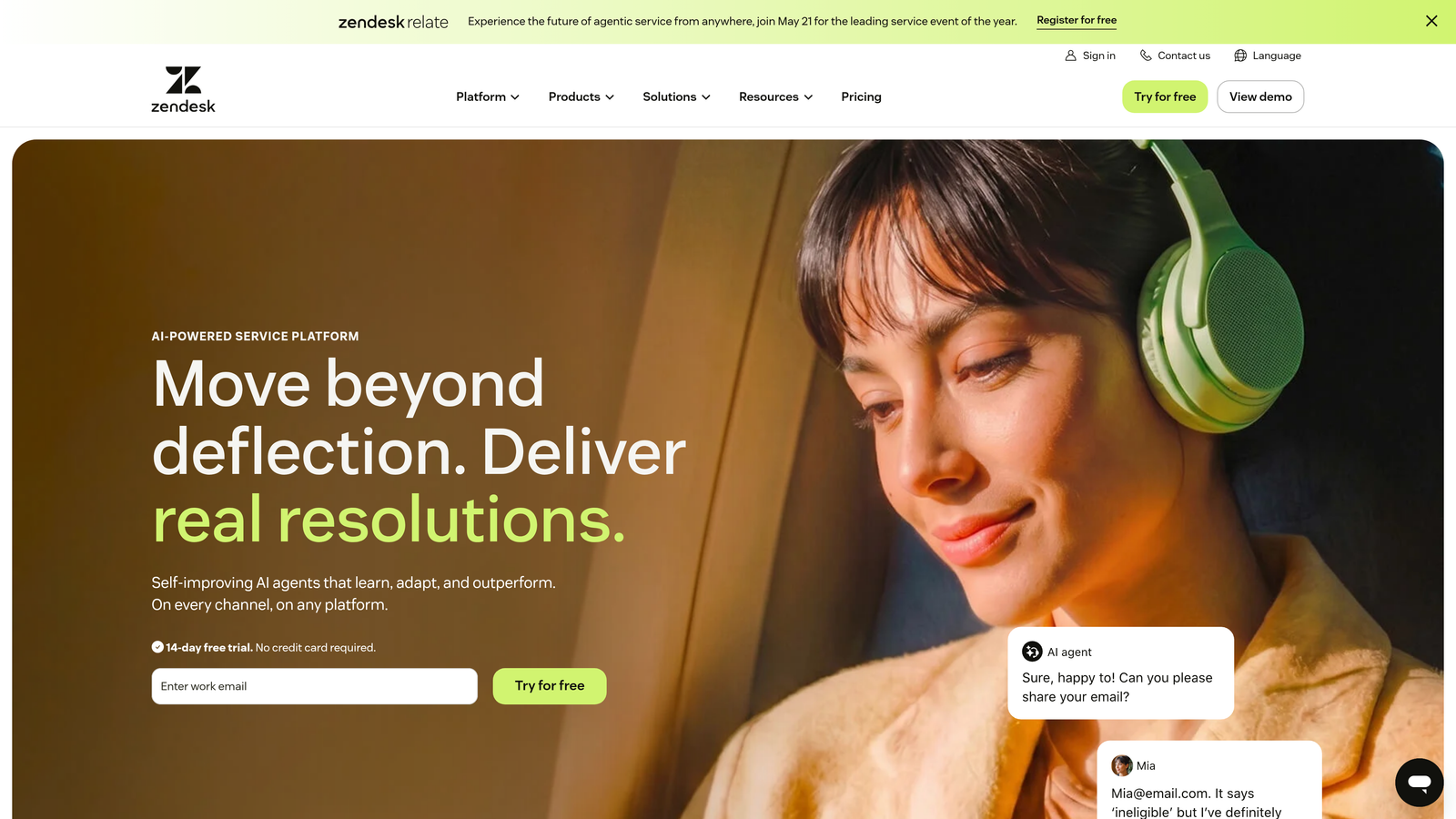
Zendesk is an enterprise-grade support platform with AI agents and one of the largest integration marketplaces in the helpdesk industry.
Where This Tool Shines
Zendesk's integration marketplace is genuinely impressive in terms of breadth: over 1,500 apps covering virtually every category of business software. For large organizations with complex tech stacks, that breadth means you can almost always find a pre-built connector rather than building a custom integration from scratch.
Its AI capabilities have matured significantly, with agents that handle automated resolution and triage across channels. The platform's depth in enterprise features — advanced analytics, SLA management, custom reporting, and compliance tooling — makes it a natural fit for organizations that need governance and visibility alongside automation.
Key Features
Zendesk AI Agents: Automated resolution and intelligent triage across support channels, with escalation routing.
1,500+ Integrations: One of the largest helpdesk app marketplaces, covering CRM, e-commerce, DevOps, and productivity tools.
Deep Native Integrations: Pre-built connectors for Salesforce, Jira, Shopify, and Slack with meaningful data exchange.
Advanced Analytics: Custom reporting and dashboards for ticket volume, agent performance, and resolution trends.
Enterprise Security: SOC 2 compliance, data residency options, and enterprise-grade access controls.
Best For
Large enterprises and scaling companies with multi-channel support operations that need proven infrastructure, extensive integration coverage, and strong compliance capabilities.
Pricing
Starts at $55 per agent per month for Suite Team. AI add-ons are priced separately, which can add meaningfully to the total cost.
4. Freshdesk
Best for: Budget-conscious teams wanting AI-powered helpdesk with native suite connectivity
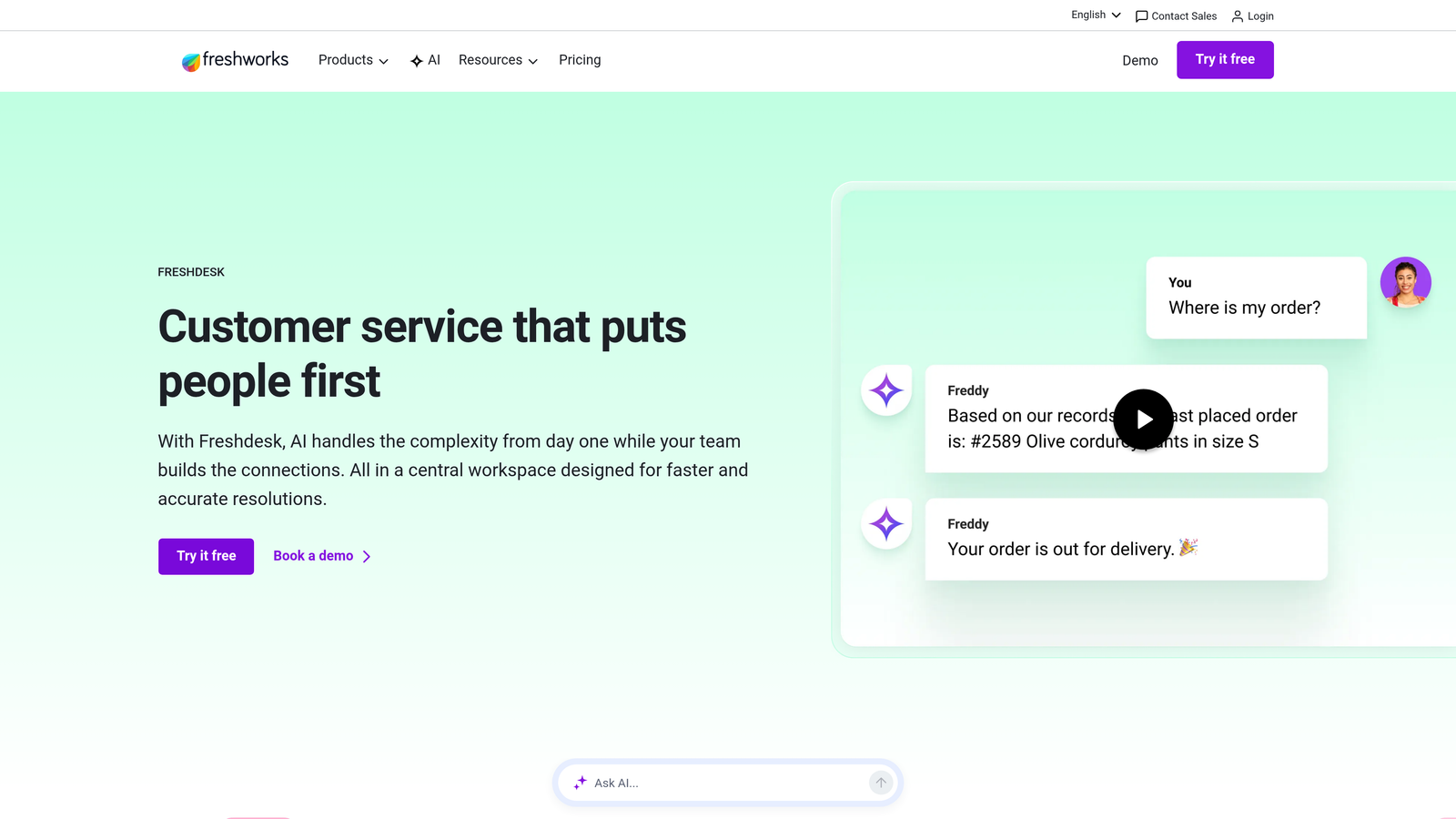
Freshdesk is an AI-powered helpdesk with Freddy AI and native connections across the broader Freshworks product ecosystem.
Where This Tool Shines
Freshdesk's biggest integration advantage is its native connectivity to the rest of the Freshworks suite: Freshsales for CRM, Freshmarketer for marketing automation, and Freshservice for IT support. If your organization uses multiple Freshworks products, the data sharing between them is seamless and doesn't require custom configuration.
Freddy AI handles ticket triage, suggested responses, and resolution for common queries. It's not the most sophisticated AI on this list, but it's effective for standard support workflows and significantly reduces the manual load on agents handling repetitive questions.
Key Features
Freddy AI: Handles ticket triage, suggested responses, and automated resolution for common support queries.
Native Freshworks Suite Integration: Direct data sharing with Freshsales, Freshmarketer, and Freshservice without third-party connectors.
Third-Party App Marketplace: Integrations with popular tools outside the Freshworks ecosystem via the marketplace.
Omnichannel Support: Manages email, live chat, phone, and social media from a unified inbox.
SLA Management: Automated SLA tracking and escalation rules to keep response times on target.
Best For
Small to mid-market teams looking for an affordable, capable helpdesk that integrates well with other Freshworks tools. Also a good fit for teams starting with a free plan and expecting to scale up.
Pricing
Free tier available for up to 10 agents. Paid plans start at $15 per agent per month, making it one of the more accessible options on this list.
5. Ada
Best for: Enterprise brands wanting a purpose-built AI agent platform with flexible API integrations
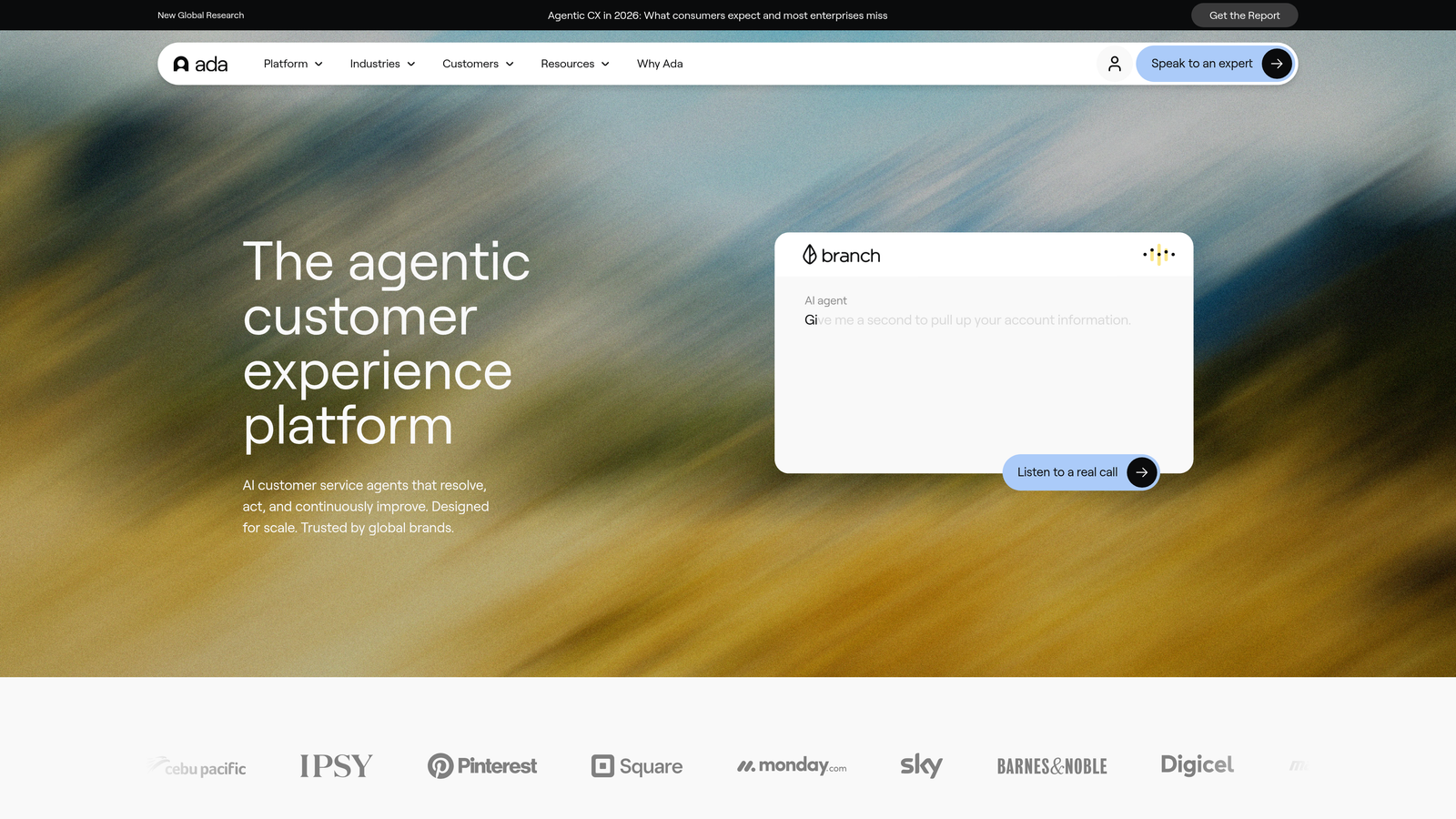
Ada is a purpose-built AI agent platform designed for enterprise customer experience teams that need AI-first resolution without legacy helpdesk constraints.
Where This Tool Shines
Ada was built as an AI-first platform, which means its architecture is designed around automated resolution rather than human-assisted ticketing. This shows up in how it handles complex, multi-step conversations: the AI can take actions, not just answer questions, making it more capable than chatbots that simply surface knowledge base articles.
Its integration flexibility is a strong point for enterprise teams with custom tech stacks. Beyond pre-built connectors for major CX platforms, Ada supports custom REST API connections, which means it can pull data from and push actions to proprietary systems that don't have off-the-shelf integrations.
Key Features
AI-First Agent Architecture: Built for automated resolution from the ground up, not layered onto a legacy ticketing system.
Pre-built and Custom Integrations: Connects to Zendesk, Salesforce, Shopify, and custom REST APIs for flexible stack connectivity.
Multilingual Support: Handles customer conversations in 50+ languages without separate configuration per language.
No-Code Automation Builder: Custom workflow creation for routing, escalation, and action-taking without engineering involvement.
Resolution Analytics: Dashboard tracking AI resolution rates, escalation patterns, and conversation quality.
Best For
Enterprise brands with high support volumes, complex workflows, and a need for AI that can take actions rather than just answer questions. Particularly suited for teams with custom backend systems that need API-level integration.
Pricing
Custom enterprise pricing. Contact Ada's sales team for a quote tailored to your volume and integration requirements.
6. Tidio
Best for: Small businesses and e-commerce teams wanting fast, lightweight AI chat with popular tool integrations
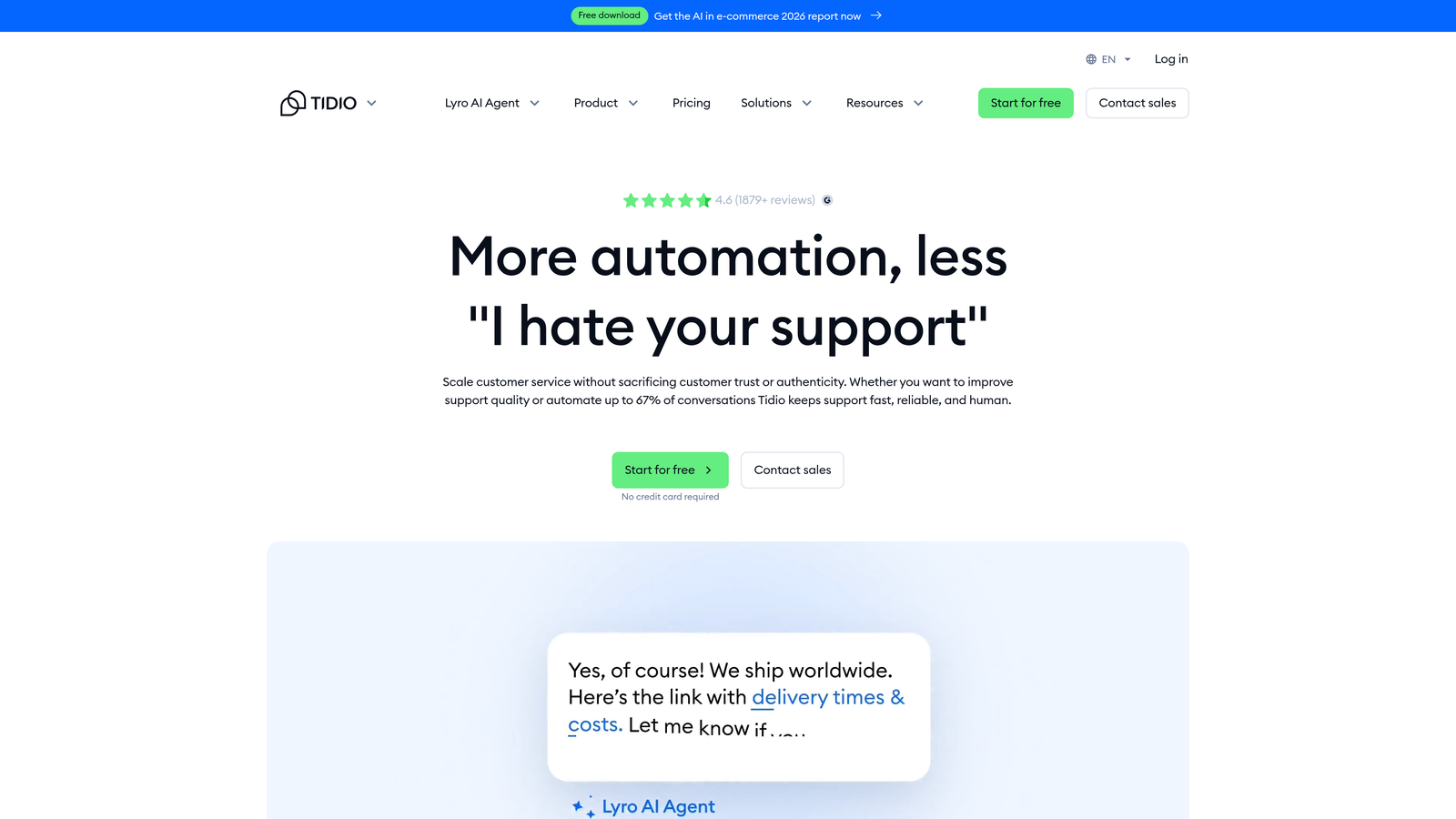
Tidio is a lightweight AI chat platform featuring the Lyro AI chatbot, built for smaller teams that need quick setup and integrations with common e-commerce and marketing tools.
Where This Tool Shines
Tidio's appeal is its simplicity. You can get a functional AI chatbot connected to your Shopify store, WordPress site, or WooCommerce shop in a matter of hours rather than days. For small business owners who don't have a dedicated IT or support operations team, that low barrier to entry is genuinely valuable.
Lyro, its AI chatbot, handles common customer questions using your existing content and FAQs. It's not as sophisticated as enterprise AI agents, but it covers the basics well and frees up human agents for more nuanced conversations. The Zapier connection extends its reach to hundreds of additional tools beyond the native integrations.
Key Features
Lyro AI Chatbot: Automated customer conversations using your existing FAQ and content, with human escalation for complex queries.
E-commerce Integrations: Native connections with Shopify, WordPress, and WooCommerce for order and customer data.
Marketing Tool Connections: Integrates with Mailchimp and HubSpot for customer data continuity across marketing and support.
Zapier Extension: Connects to hundreds of additional apps for teams with broader workflow automation needs.
Visual Chatbot Builder: Drag-and-drop interface for creating conversation flows without writing code.
Best For
Small businesses, e-commerce stores, and early-stage teams that want AI chat up and running quickly without a lengthy implementation process or enterprise-level budget.
Pricing
Free plan available with basic features. Paid plans start at $29 per month, making Tidio one of the most accessible entry points on this list.
7. HubSpot Service Hub
Best for: Teams already in the HubSpot ecosystem wanting support natively tied to CRM and revenue data
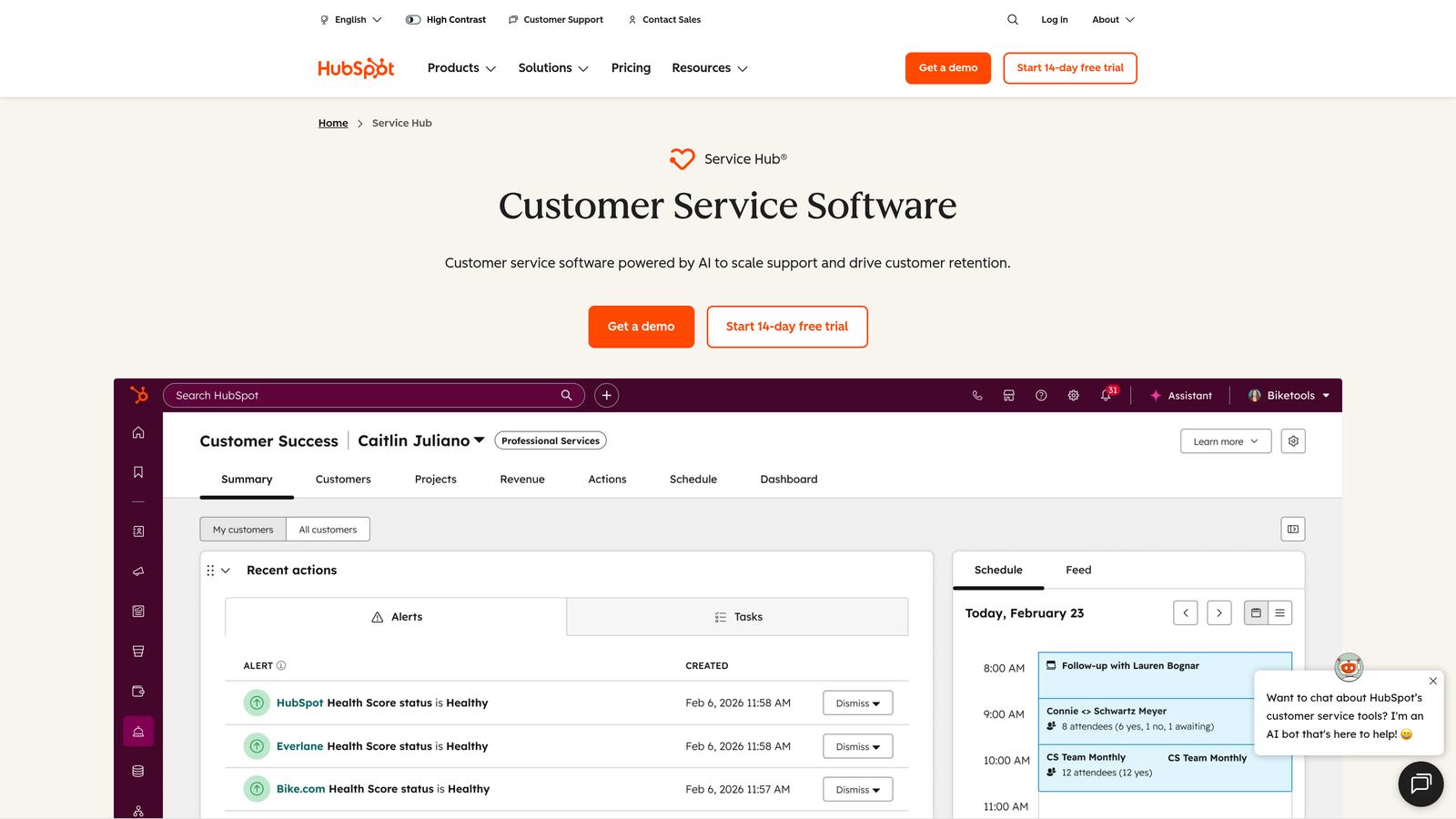
HubSpot Service Hub is an AI-powered service platform natively connected to HubSpot's CRM, marketing, and sales tools, with access to over 1,700 marketplace integrations.
Where This Tool Shines
If your team already runs on HubSpot for CRM and marketing, Service Hub is the most natural support extension. Every ticket is tied to a contact record with full purchase history, marketing engagement, and sales pipeline context. That's a level of built-in customer intelligence that most standalone helpdesks can't match without significant integration work.
The connection between support data and revenue data is particularly useful for B2B teams: you can see which customers are churning, which are expanding, and what support issues correlate with pipeline movement, all in one place. The 1,700+ app marketplace covers most additional tools your team might need beyond the HubSpot suite.
Key Features
AI Chatbot with CRM Context: Ticket automation and AI chat that pulls directly from HubSpot contact and deal records.
Native HubSpot Suite Access: Real-time data sharing with HubSpot CRM, Marketing Hub, and Sales Hub without any connector setup.
1,700+ App Marketplace: Broad third-party integration coverage for tools outside the HubSpot ecosystem.
Customer Feedback Tools: Built-in NPS, CSAT, and CES surveys tied to contact records for longitudinal tracking.
Revenue-Tied Reporting: Custom reports connecting support metrics to pipeline and revenue data for business-level insights.
Best For
Mid-market B2B teams that are already HubSpot customers and want to unify support, sales, and marketing data without stitching together multiple platforms.
Pricing
Free tools available for basic ticketing and chat. Service Hub Starter begins at $20 per seat per month, with more advanced AI and reporting features on higher tiers.
8. Kustomer
Best for: DTC and e-commerce brands needing a unified customer timeline with AI-powered automation
Kustomer is a CRM-powered customer service platform with AI automation and a single unified customer timeline aggregating all interactions and order data.
Where This Tool Shines
Kustomer's defining feature is its customer timeline view: every interaction, order, return, and conversation is aggregated into a single chronological record for each customer. For e-commerce and DTC brands where agents need order history and shipping status alongside support context, this eliminates the constant tab-switching that slows resolution times.
Its AI layer handles intent detection and suggests responses based on the full customer history, not just the current conversation. That historical context makes AI suggestions meaningfully more relevant than platforms that only look at the immediate ticket.
Key Features
AI Intent Detection: Identifies customer intent from message content and history to route and prioritize tickets intelligently.
Unified Customer Timeline: Single view aggregating all interactions, orders, returns, and support history across channels.
E-commerce Integrations: Native connections with Shopify, Magento, and other commerce platforms for order data in the support view.
Omnichannel Support: Manages chat, email, social, SMS, and voice from a single agent workspace.
Custom Business Rules: Flexible automation for routing, tagging, escalation, and SLA management based on customer attributes.
Best For
DTC brands, e-commerce companies, and subscription businesses where customer lifetime value and order history are central to every support interaction.
Pricing
Enterprise pricing model; starts around $89 per user per month. Best suited for teams where the unified timeline ROI justifies the higher per-seat cost.
9. Dixa
Best for: Mid-market brands prioritizing intelligent routing and a unified agent workspace across channels
Dixa is a conversational customer service platform with AI-powered routing and a unified agent workspace designed for teams that care as much about agent experience as customer experience.
Where This Tool Shines
Dixa's AI-powered routing is its standout capability. Rather than simple rule-based assignment, it uses conversation signals to prioritize and route tickets intelligently, matching customers with the right agent or queue based on context and urgency. For teams managing high conversation volumes across multiple channels, that routing intelligence meaningfully reduces misrouting and queue imbalances.
The unified agent workspace brings chat, email, phone, and social into a single interface, and the side conversations feature lets agents loop in colleagues or escalate internally without leaving the ticket. That internal collaboration capability is something many platforms overlook but agents use constantly.
Key Features
AI-Powered Smart Routing: Intelligent conversation prioritization and agent matching based on context, not just simple rule logic.
Unified Agent Workspace: Single interface for chat, email, phone, and social media conversations.
CRM and Commerce Integrations: Connects with Shopify, Magento, HubSpot, and Salesforce for customer context in the agent view.
Real-Time Analytics and QA: Live dashboards and quality assurance tools for monitoring conversation quality and team performance.
Side Conversations: Internal collaboration threads within tickets for escalation and team coordination without leaving the workspace.
Best For
Mid-market brands with multi-channel support teams that want smarter routing, a cleaner agent experience, and solid integrations with CRM and commerce platforms.
Pricing
Starts at $39 per agent per month. Custom pricing is available for enterprise teams with higher volume or more complex routing requirements.
Which Tool Is Right for Your Team?
The honest answer is that the best AI support software is the one that actually connects to the tools your team already uses. A platform with impressive AI resolution rates but shallow integrations will still create friction, because your agents will spend time bridging gaps between systems manually.
Here's a quick breakdown by use case to help you narrow it down:
Halo AI is the strongest fit for B2B product teams that need their support platform wired into engineering, revenue, and communication tools. The AI-first architecture and page-aware context make it particularly well-suited for SaaS companies where product guidance and bug reporting are part of the support workflow.
Zendesk or Intercom are natural choices for enterprise teams with established ecosystems that need broad integration coverage and proven infrastructure at scale.
Freshdesk or HubSpot Service Hub work well for mid-market teams that want native suite connectivity without building a custom integration layer, especially if you're already invested in either the Freshworks or HubSpot ecosystem.
Ada is worth evaluating for enterprise teams that want AI-first resolution capabilities and need custom API flexibility for proprietary backend systems.
Tidio is the right call for small businesses and e-commerce teams that want to get AI chat live quickly without a complex implementation.
Kustomer suits DTC and e-commerce brands where order history and customer lifetime value are central to every support conversation.
Dixa is a strong option for mid-market teams focused on intelligent routing and a clean, unified agent workspace across channels.
Your support team shouldn't scale linearly with your customer base. Let AI agents handle routine tickets, guide users through your product, and surface business intelligence while your team focuses on complex issues that need a human touch. See Halo in action and discover how continuous learning transforms every interaction into smarter, faster support.