9 Best AI Support Solution Pricing Plans Compared for 2026
This comprehensive comparison of ai support solution pricing breaks down nine leading platforms—covering per-resolution, per-seat, and flat-fee models—to help B2B SaaS teams identify which pricing structure delivers the best value at their scale. Whether you're a small startup or a growing company evaluating AI alternatives to upgrading Zendesk, Freshdesk, or Intercom, this guide clarifies exactly what each tier includes and what it will cost annually.
 Matt PattoliFounder13 min read
Choosing an AI customer support solution isn't just about features. It's about whether the pricing model actually makes sense for your team's scale and usage patterns. Some platforms charge per resolution, others per seat, and some bundle everything into a flat monthly fee. The difference can mean thousands of dollars annually for a mid-sized SaaS team.
This guide breaks down nine leading AI support solutions, comparing their pricing structures, what's included at each tier, and which types of teams get the best value. We've focused on platforms built for B2B SaaS and product teams, particularly those already running Zendesk, Freshdesk, or Intercom who are evaluating whether a purpose-built AI layer makes more financial sense than upgrading their existing helpdesk.
Whether you're a 10-person startup watching every dollar or a scaling company trying to avoid hiring three more support reps, there's a pricing model here that fits. Here's how they stack up.
1. Halo AI
Best for: B2B SaaS teams wanting an AI-first support platform with deep product and business integrations
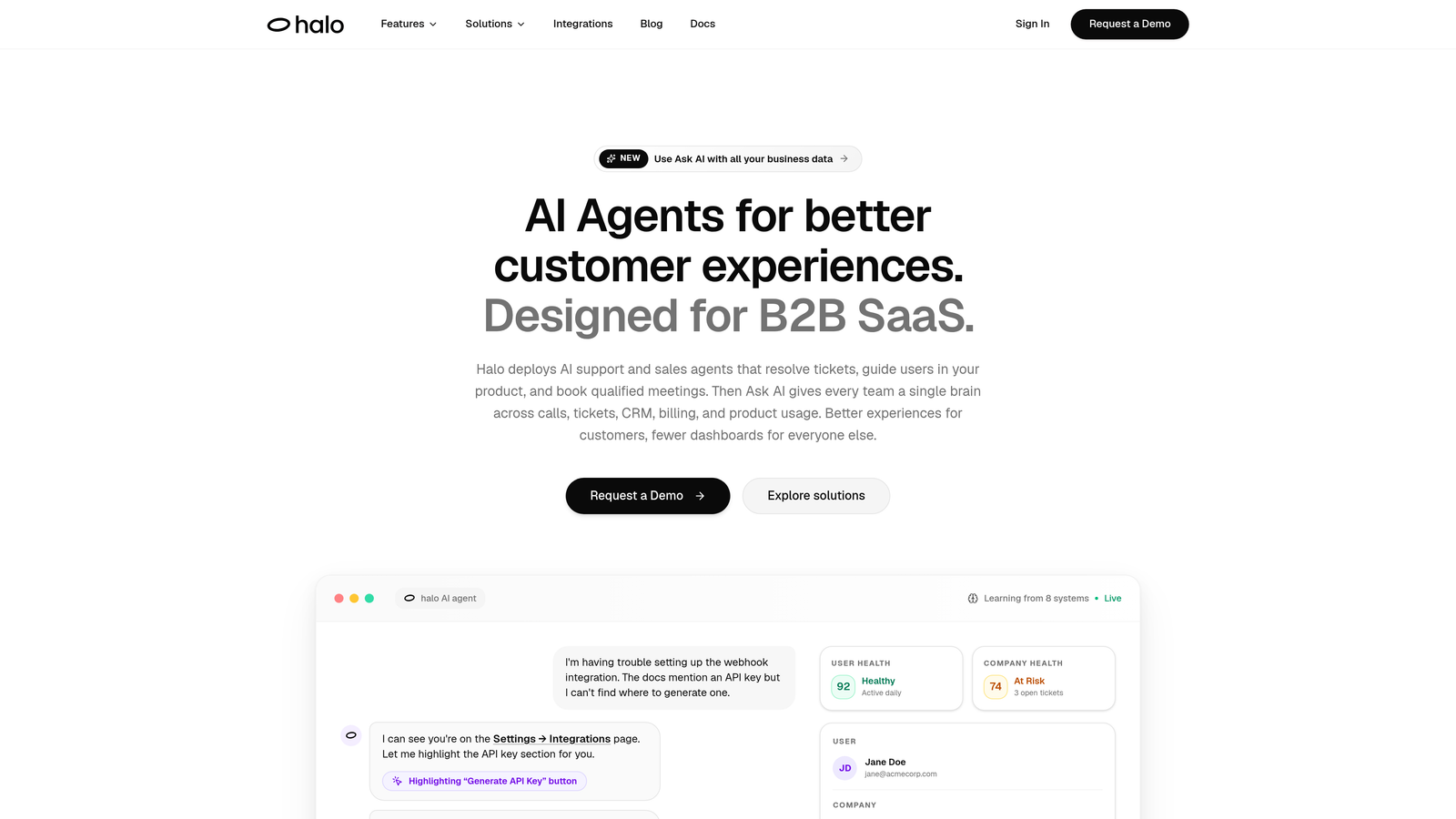
Halo AI is an AI-first customer support platform that deploys intelligent agents to resolve tickets, guide users through your product with page-aware context, and surface business intelligence across your entire customer base.
Where This Tool Shines
Halo isn't a bolt-on AI layer sitting awkwardly on top of a legacy helpdesk. It's built AI-first from the ground up, which means every interaction feeds a continuous learning loop. The longer it runs, the smarter it gets at resolving tickets autonomously and flagging the ones that genuinely need a human.
The page-aware chat widget is a standout differentiator. It sees what your user sees in the product, which means guidance is contextual rather than generic. Pair that with a smart inbox that surfaces customer health signals, revenue anomalies, and trend detection, and you're getting business intelligence alongside support automation.
Key Features
Intelligent Ticket Resolution: AI agents autonomously handle incoming tickets with seamless live agent handoff when conversations need a human touch.
Page-Aware Chat Widget: The widget understands which page a user is on and provides contextual, visual guidance rather than generic responses.
Smart Inbox with Business Intelligence: Surfaces customer health signals, revenue anomalies, and support trend detection beyond standard helpdesk analytics.
Auto Bug Ticket Creation: Automatically generates and routes bug reports directly to Linear or your preferred issue tracking system.
Deep Integration Stack: Connects natively with Slack, HubSpot, Intercom, Stripe, Zoom, PandaDoc, and Fathom for a unified operational view.
Best For
SaaS product teams and B2B companies that want more than ticket deflection. Halo suits teams already using tools like HubSpot, Stripe, and Linear who want their support layer to connect the dots across the entire customer journey, not just answer common questions.
Pricing
Visit haloagents.ai for current pricing tiers. Halo uses a tiered model designed to give growth-stage SaaS teams cost predictability rather than variable per-resolution billing.
2. Intercom (Fin AI)
Best for: Teams already on Intercom who want AI resolution layered into their existing workflow
Intercom Fin is Intercom's native AI agent, built on large language models and designed to resolve customer queries before they reach a human agent inside the Intercom inbox.
Where This Tool Shines
Fin's per-resolution pricing model is genuinely interesting: you only pay when Fin successfully resolves a conversation. For teams with a high proportion of repetitive, answerable queries, this can be very cost-effective. It's also trained on your existing help center content and Intercom conversation history, so setup is relatively fast.
The catch is that per-resolution pricing stacks on top of your existing Intercom plan costs. As ticket volume grows, the math can shift quickly. Teams should model their average monthly volume and expected deflection rate before committing.
Key Features
Per-Resolution Billing: You only pay when Fin successfully resolves a conversation, not for every attempted interaction.
Content-Based Training: Fin learns from your help center articles and existing Intercom conversations without requiring manual configuration.
Native Agent Handoff: Seamlessly escalates to human agents within the same Intercom inbox when resolution isn't possible.
Multilingual Support: Handles queries across major languages without separate configuration.
Resolution Analytics: Dashboard shows resolution rates and cost per resolution for clear ROI visibility.
Best For
Existing Intercom customers with a well-maintained help center and a high volume of repetitive queries. Teams with low ticket volumes or complex, nuanced support needs may find the per-resolution model less advantageous.
Pricing
Charged per resolution on top of your existing Intercom plan. Check intercom.com/pricing for current per-resolution rates.
3. Zendesk AI
Best for: Enterprise support teams with complex, multi-channel workflows already invested in Zendesk
Zendesk AI layers intelligent triage, AI agents, and an agent copilot into their Suite plans, targeting organizations with established Zendesk infrastructure and the budget to match.
Where This Tool Shines
Zendesk's AI capabilities are comprehensive precisely because they're embedded deeply into a mature platform. Intelligent triage routes and prioritizes tickets based on intent and sentiment, while Agent Copilot surfaces suggested responses and next-best actions for human agents handling complex conversations. The depth of workflow integration is hard to match for teams that have built their operations around Zendesk.
The important nuance is total cost of ownership. AI features are available on Suite Professional and above, or as paid add-ons. When you factor in AI modules on top of base plan pricing, the effective per-seat cost can be significantly higher than headline numbers suggest.
Key Features
AI Agents: Automated front-line resolution across chat, email, and messaging channels.
Intelligent Triage: Automatically categorizes, routes, and prioritizes tickets based on intent and sentiment analysis.
Agent Copilot: Suggests responses and next best actions for human agents in real time.
Suite Integration: AI features connect natively to Zendesk's ticketing, reporting, and workflow tools.
Omnichannel Coverage: AI capabilities extend across all channels supported by the Zendesk Suite.
Best For
Enterprise teams with 50+ agents, complex multi-channel support workflows, and existing Zendesk investment. The per-seat model at higher tiers is easier to justify when you're getting full platform value across the entire Suite.
Pricing
AI features are available on Suite Professional (approximately $149/agent/month) and above, or as paid add-ons. Verify current rates at zendesk.com/pricing.
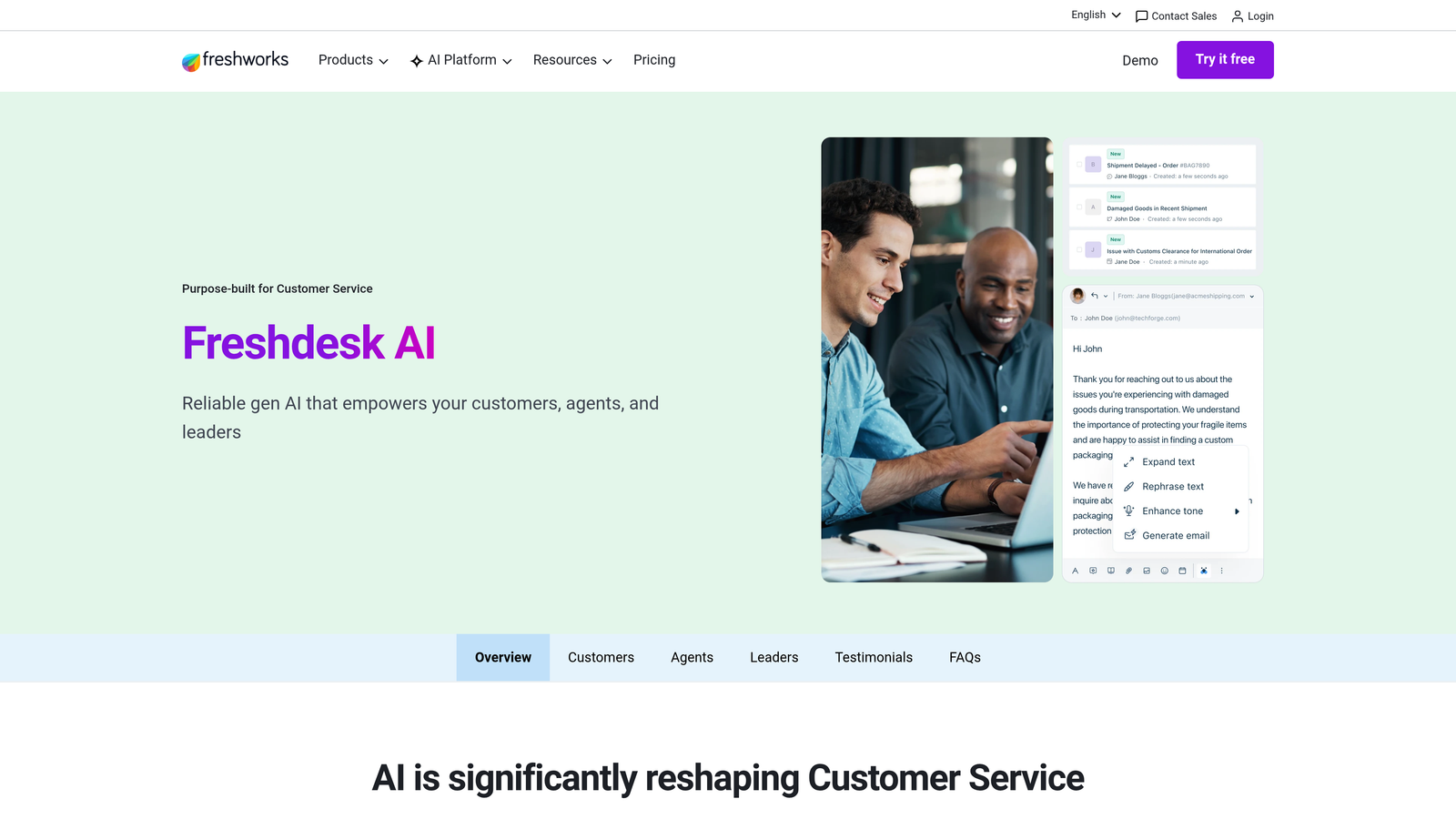
4. Freshdesk Freddy AI
Best for: SMBs and growing teams wanting AI-assisted support at accessible price points
Freshdesk's Freddy AI is Freshworks' embedded AI layer, offering self-service automation and agent assistance at price points that make it one of the more accessible options for teams not yet at enterprise scale.
Where This Tool Shines
Freddy AI's two-pronged approach covers both the customer-facing and agent-facing sides of support. Freddy Self Service deploys AI bots to deflect common queries, while Freddy Copilot assists agents with suggested replies and ticket summaries. Having both in one platform at a competitive price point is a meaningful advantage for smaller teams.
The entry point is notably lower than Zendesk, with basic AI features available from the Growth plan upward. Advanced capabilities unlock at higher tiers, so teams should map their specific needs against the plan structure before assuming the base tier covers everything they want.
Key Features
Freddy Self Service: AI-powered bots deflect common queries across customer-facing channels before they reach an agent.
Freddy Copilot: Assists agents with suggested replies, ticket summaries, and contextual recommendations.
Omnichannel Support: Covers email, chat, phone, and social from a single platform.
Bot Performance Analytics: Built-in reporting tracks deflection rates and bot performance over time.
Tiered AI Access: AI features scale with plan tier, allowing teams to grow into more advanced capabilities.
Best For
SMBs, startups, and growing teams that need AI-assisted support without Zendesk-level pricing. Also a strong fit for teams already using other Freshworks products like Freshsales or Freshservice who want a unified ecosystem.
Pricing
Freddy AI features are included from the Growth plan (approximately $15/agent/month), with advanced AI capabilities at Pro and Enterprise tiers. Verify current rates at freshworks.com/freshdesk/pricing.
5. Tidio
Best for: Early-stage teams and small businesses wanting a free entry point with optional AI upgrade
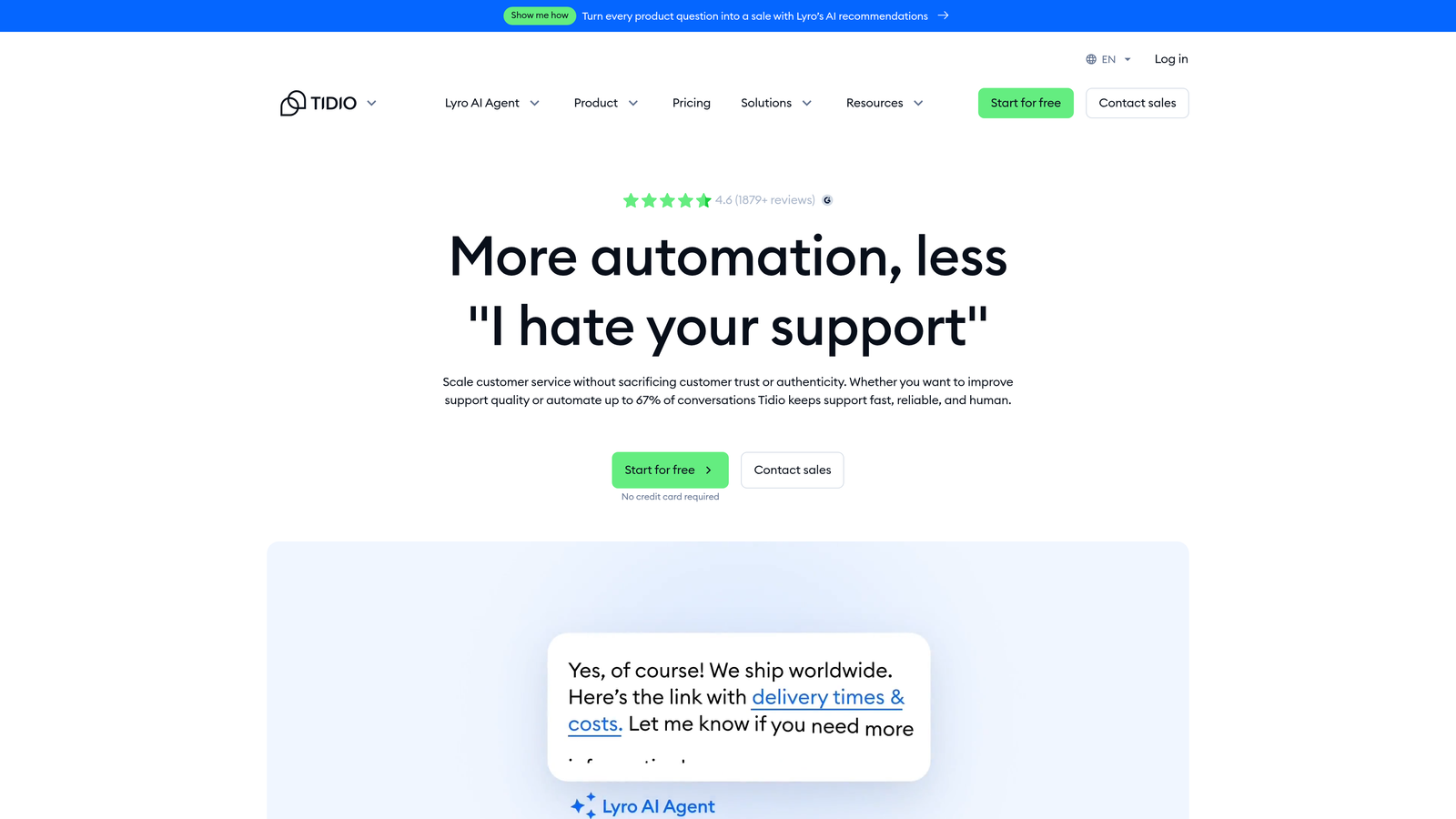
Tidio combines live chat with Lyro AI, its conversational AI agent, in a platform designed for accessibility, including a free tier that makes it one of the lowest-friction options for teams just getting started.
Where This Tool Shines
The free live chat tier is a genuine differentiator for bootstrapped teams or those early in their support automation journey. Lyro AI sits on top as a separately priced add-on, which means you can start with human-handled live chat and layer in AI automation when the volume justifies it. Setup requires no technical expertise, which matters for small teams without dedicated engineering resources.
Tidio's integrations with Shopify, WordPress, and major e-commerce platforms make it particularly popular in that space, though it's worth noting the platform skews toward consumer-facing use cases rather than complex B2B support workflows.
Key Features
Lyro AI Agent: Handles common customer queries autonomously using your existing support content as its knowledge base.
Free Live Chat Tier: Full live chat functionality available at no cost, with AI as an optional upgrade.
No-Code Setup: Visual conversation flow builder and simple configuration require no technical expertise.
E-Commerce Integrations: Native connections to Shopify, WordPress, and major e-commerce platforms.
Volume-Based AI Pricing: Lyro AI is priced by conversation volume, giving small teams control over spend.
Best For
Early-stage startups, small e-commerce businesses, and teams with low-to-moderate ticket volumes who want to test AI-assisted support without a significant upfront commitment.
Pricing
Free live chat tier available. Lyro AI starts from approximately $29/month for 50 conversations. Verify current rates at tidio.com/pricing.
6. Drift (Salesloft)
Best for: B2B revenue teams where support conversations overlap with pipeline generation
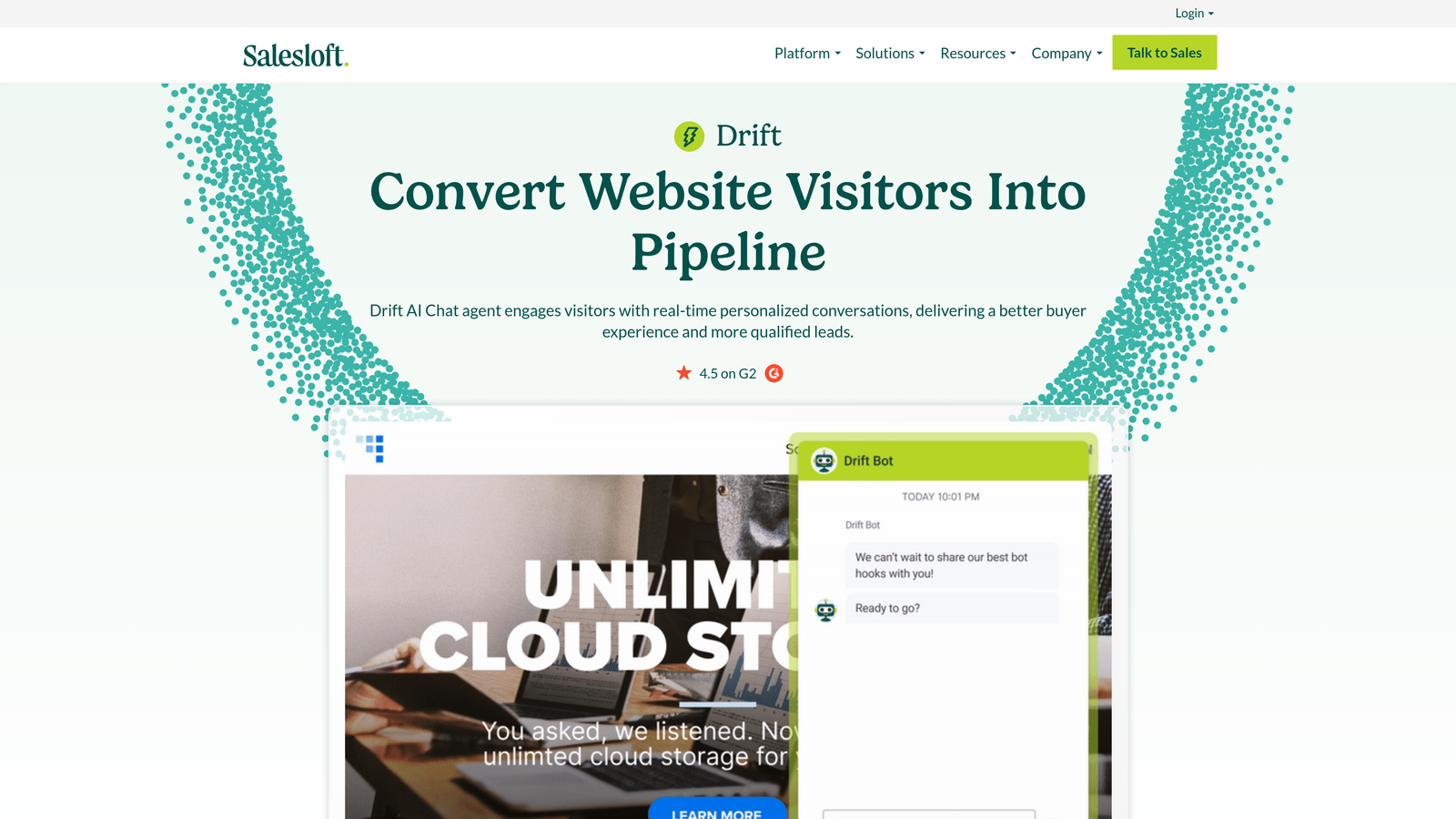
Drift, now part of the Salesloft revenue platform, blends AI-powered chat with pipeline generation, making it a distinct option for B2B teams where the line between support and sales is intentionally blurred.
Where This Tool Shines
Drift's positioning is unusual in this list: it's as much a revenue tool as a support tool. Bionic Chatbots combine AI with human-authored conversation paths, and account-based targeting routes conversations based on company firmographics. If your support team regularly handles pre-sales questions or qualification conversations, this dual focus can create real efficiency.
The trade-off is that Drift's pricing is not publicly listed and requires a sales demo to access. For teams evaluating on budget, this is a friction point. It also means Drift tends to skew toward larger organizations with dedicated revenue operations functions rather than lean support teams.
Key Features
Bionic Chatbots: Combines AI-driven responses with human-authored conversation paths for nuanced interactions.
Account-Based Targeting: Routes conversations based on company firmographics for personalized engagement.
Revenue Analytics: Ties support and chat conversations directly to pipeline outcomes.
CRM and MAP Integrations: Native connections to Salesforce, HubSpot, Marketo, and other major tools.
Sales and Support Overlap: Single platform handles both qualification conversations and customer support queries.
Best For
B2B companies with revenue-focused GTM teams where support, sales development, and customer success functions overlap. Less suited to teams looking purely for support ticket deflection at a predictable cost.
Pricing
Pricing is not publicly listed and requires a sales demo. Contact drift.com for current plans and pricing.
7. Forethought
Best for: Enterprise teams wanting AI triage and deflection layered on top of an existing helpdesk
Forethought is an enterprise-grade AI support platform designed to sit on top of existing helpdesks, offering triage, deflection, and agent assist without requiring a migration away from tools like Zendesk or Salesforce Service Cloud.
Where This Tool Shines
The core value proposition is helpdesk-agnostic AI. If your organization has significant investment in an existing helpdesk and can't justify a migration, Forethought adds an intelligent AI layer without disrupting what's already working. Triage AI categorizes and routes tickets automatically, Solve AI deflects common queries before they reach an agent, and Assist AI surfaces relevant knowledge base content for agents handling complex cases.
Forethought's deflection analytics and ROI reporting are particularly strong, which matters for enterprise teams that need to justify AI investment to leadership with clear, quantifiable outcomes.
Key Features
Triage AI: Automatically categorizes, tags, and routes incoming tickets based on intent and content.
Solve AI: Deflects common queries before they reach a human agent using your existing knowledge base.
Assist AI: Surfaces relevant articles and suggested replies for agents handling escalated conversations.
Helpdesk-Agnostic Architecture: Integrates with Zendesk, Salesforce, ServiceNow, and other major platforms.
ROI Reporting: Strong deflection analytics make it straightforward to measure and communicate AI impact.
Best For
Enterprise support organizations with established helpdesk infrastructure who want AI capabilities without platform migration. Particularly strong for teams using Zendesk or Salesforce at scale.
Pricing
Enterprise pricing available on request. Contact forethought.ai for a custom quote.
8. Kustomer
Best for: Teams that want full customer history context alongside AI-assisted agent responses
Kustomer is a CRM-native customer service platform with AI capabilities built in, giving support agents a unified customer timeline alongside AI-assisted responses and automated workflows.
Where This Tool Shines
Kustomer's differentiator is context depth. Rather than treating each conversation in isolation, it maintains a unified timeline of every customer interaction across all channels. When AI-assisted responses or automated workflows trigger, they do so with full awareness of the customer's history, purchase behavior, and prior support interactions. For teams where context changes the resolution, this is genuinely valuable.
The platform suits organizations that think of customer support as part of a broader CRM strategy rather than a standalone cost center. The per-user pricing model with AI features unlocked at higher tiers follows a familiar structure for teams used to CRM-style pricing.
Key Features
Unified Customer Timeline: All interactions across channels consolidated in one view for full context during every conversation.
AI-Assisted Replies: Suggested responses and conversation summaries generated from customer history and conversation context.
Automated Workflows: Trigger actions based on customer data, conversation signals, and CRM attributes.
Omnichannel Coverage: Handles email, chat, social, and voice within a single platform.
CRM and E-Commerce Integrations: Connects with major marketing, CRM, and e-commerce tools.
Best For
Mid-market and enterprise teams where customer history and CRM context are central to support quality. Particularly relevant for e-commerce and subscription businesses with high customer lifetime value.
Pricing
Enterprise and Ultimate plans include AI features on a per-user pricing model. Verify current rates at kustomer.com/pricing.
9. Capacity
Best for: Organizations wanting a single AI automation layer across customer support, HR, and IT
Capacity is a broader AI automation platform that extends beyond customer-facing support to include internal helpdesk and HR automation, suited to organizations that want one AI layer handling multiple use cases simultaneously.
Where This Tool Shines
Most tools in this list are built for external customer support. Capacity bridges customer-facing and internal use cases on the same platform. The AI-powered knowledge base answers questions from customers and employees alike, while the helpdesk module handles ticket creation, routing, and resolution tracking across departments. For organizations where IT, HR, and customer support teams all struggle with repetitive queries, consolidating onto one platform can simplify both vendor management and budget.
The workflow automation capabilities connect support to HR, IT, and operations processes in ways that purpose-built customer support tools typically don't. This breadth is an advantage for the right organization, but it can also mean the platform goes deeper than necessary for teams with a pure customer support focus.
Key Features
AI Knowledge Base: Answers questions across customer support and internal employee queries from a single knowledge layer.
Helpdesk Module: Handles ticket creation, routing, and resolution tracking for both external and internal requests.
Cross-Department Workflow Automation: Connects support processes to HR, IT, and operations workflows.
Enterprise Integrations: Connects with Slack, Microsoft Teams, Salesforce, and Zendesk.
Tiered AI Access: AI features available from Growth tier and above, scaling with plan level.
Best For
Mid-sized to enterprise organizations with multiple departments handling repetitive query volume, particularly those looking to consolidate customer support, IT helpdesk, and HR automation under one platform and one vendor relationship.
Pricing
Tiered plans available; enterprise pricing on request. Verify current rates at capacity.com/pricing.
Which AI Support Solution Fits Your Team?
The right choice depends less on feature lists and more on how your team actually scales and how your pricing tolerance maps to your ticket volume patterns.
For pure customer support automation with business intelligence baked in, Halo AI is the strongest fit for B2B SaaS teams. Its AI-first architecture, page-aware context, and continuous learning model mean it improves over time rather than plateauing, and the flat-tier pricing gives growth-stage teams the cost predictability that per-resolution models can't always guarantee.
If you're already committed to Intercom, Fin is the path of least resistance and the per-resolution model works well when deflection rates are high. For large teams deeply embedded in Zendesk, the Suite Professional tier with AI add-ons is the pragmatic choice despite the higher cost. Freshdesk Freddy AI remains the most accessible entry point for SMBs on a tighter budget.
Teams evaluating AI support pricing should look beyond headline numbers. Factor in integration costs, the actual AI tier required for the features you need, and whether per-resolution or per-seat billing aligns with your expected growth trajectory. An AI add-on that doubles your effective per-seat cost on a legacy helpdesk may cost more than switching to a purpose-built platform.
Your support team shouldn't scale linearly with your customer base. Let AI agents handle routine tickets, guide users through your product, and surface business intelligence while your team focuses on complex issues that need a human touch. See Halo in action and discover how continuous learning transforms every interaction into smarter, faster support.