9 Best AI Support Systems for B2B Companies in 2026
This guide evaluates the 9 best AI support systems for B2B companies in 2026, helping businesses move beyond basic ticketing to platforms that deliver account-level intelligence, autonomous ticket resolution, and deep tech stack integrations. Each tool is assessed on B2B-specific criteria including multi-stakeholder context, escalation workflows, and the ability to scale enterprise support without proportional headcount growth.
 Grant CooperFounder13 min read
B2B support has a complexity problem. Your customers aren't just individuals with quick questions — they're multi-stakeholder accounts with technical products, long onboarding journeys, and expectations that rival your best enterprise relationships. Traditional helpdesks were built for ticket volume, not for the kind of contextual, account-level intelligence that B2B support actually demands.
That's where purpose-built automated customer support systems change the equation. Modern AI support platforms can resolve tickets autonomously, surface business intelligence from support data, and scale without proportional headcount increases. The best ones connect deeply into your B2B tech stack and understand account relationships, not just individual conversations.
To build this list, we evaluated tools based on B2B-specific capabilities including account-level context, integration depth, escalation workflows, and analytics. We also considered ease of deployment and pricing transparency. Whether you're running on an existing AI helpdesk software stack or starting fresh, there's a solution here for your team. Here are the top AI support systems worth your attention in 2026.
1. Halo AI
Best for: B2B teams wanting an AI-first platform with deep integrations and business intelligence.
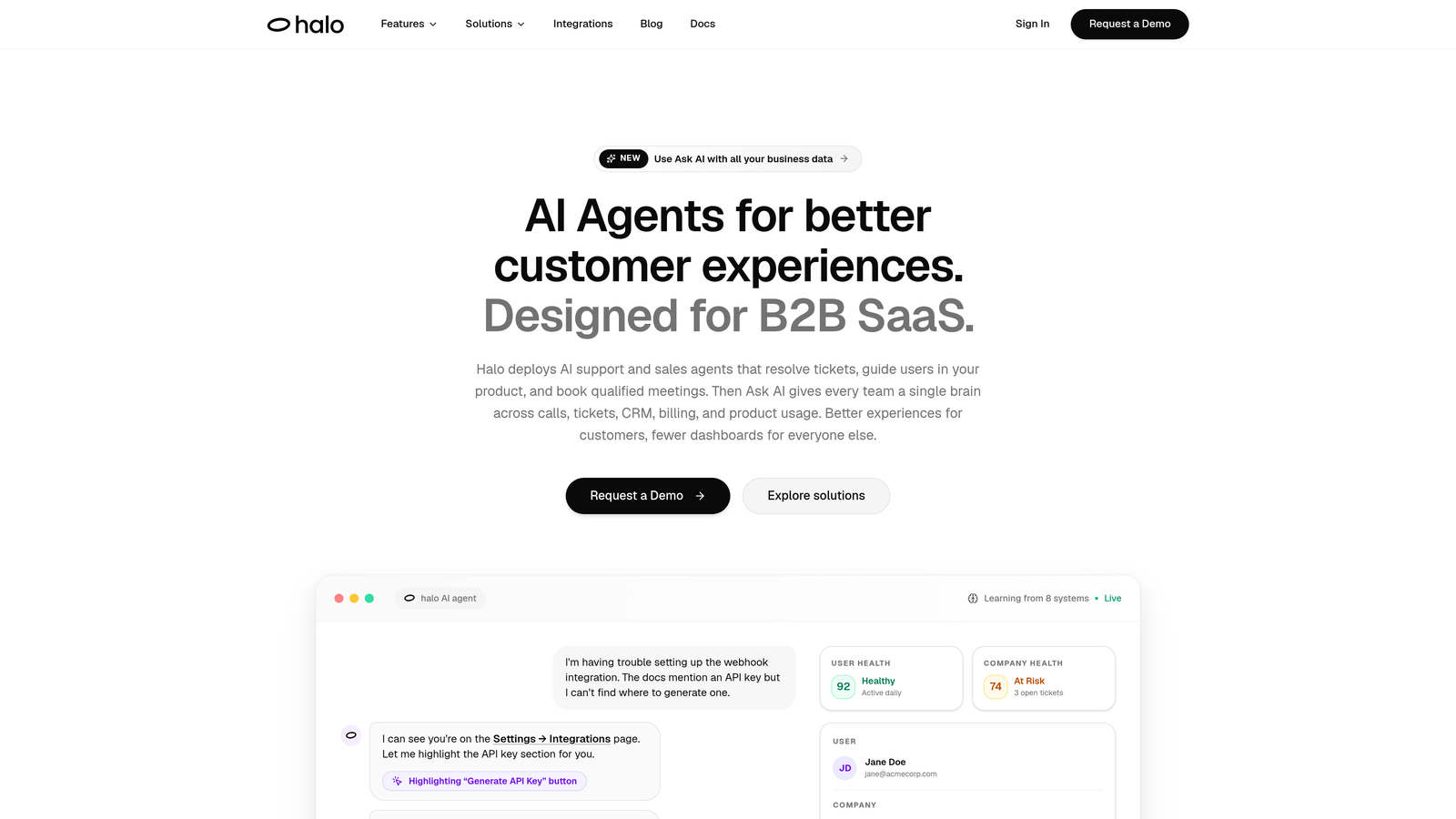
Halo AI is an AI-first customer support platform that deploys autonomous agents to resolve tickets, guide users through your product, and surface business intelligence from every interaction.
Where This Tool Shines
What separates Halo from most support tools is the architecture. Rather than layering AI onto an existing helpdesk, Halo was built from the ground up around autonomous agents. That means AI isn't a feature you toggle on — it's the foundation every interaction runs on.
The page-aware chat widget is particularly compelling for B2B SaaS teams. It sees what your user sees in real time, allowing the AI to provide visual UI guidance that's contextually relevant to exactly where someone is in your product. Combine that with a smart inbox that surfaces customer health signals, revenue intelligence, and anomaly detection, and support starts functioning less like a cost center and more like a strategic intelligence layer.
Key Features
Autonomous AI Agents: Resolve support tickets end-to-end without human intervention, learning continuously from each interaction.
Page-Aware Chat Widget: Sees your user's current screen context to deliver precise, visually guided product assistance.
Smart Inbox with Business Intelligence: Surfaces customer health signals, revenue risk indicators, and anomaly detection from support data.
Auto Bug Ticket Creation: Automatically generates bug reports and integrates directly with Linear and Jira so nothing falls through the cracks.
Deep Tech Stack Integrations: Connects to Slack, HubSpot, Intercom, Stripe, Zoom, PandaDoc, Fathom, and more — making it genuinely useful across the full B2B workflow.
Best For
B2B SaaS companies and product teams that want AI to do more than deflect tickets. Halo is especially strong for teams running complex tech stacks who need their support system to connect with CRM, billing, project management, and communication tools in a single coherent workflow.
Pricing
Contact for pricing. Halo is designed for B2B teams of all sizes, and the team will scope a plan based on your support volume and integration needs.
2. Intercom Fin
Best for: Teams already on Intercom who want native AI resolution without switching platforms.
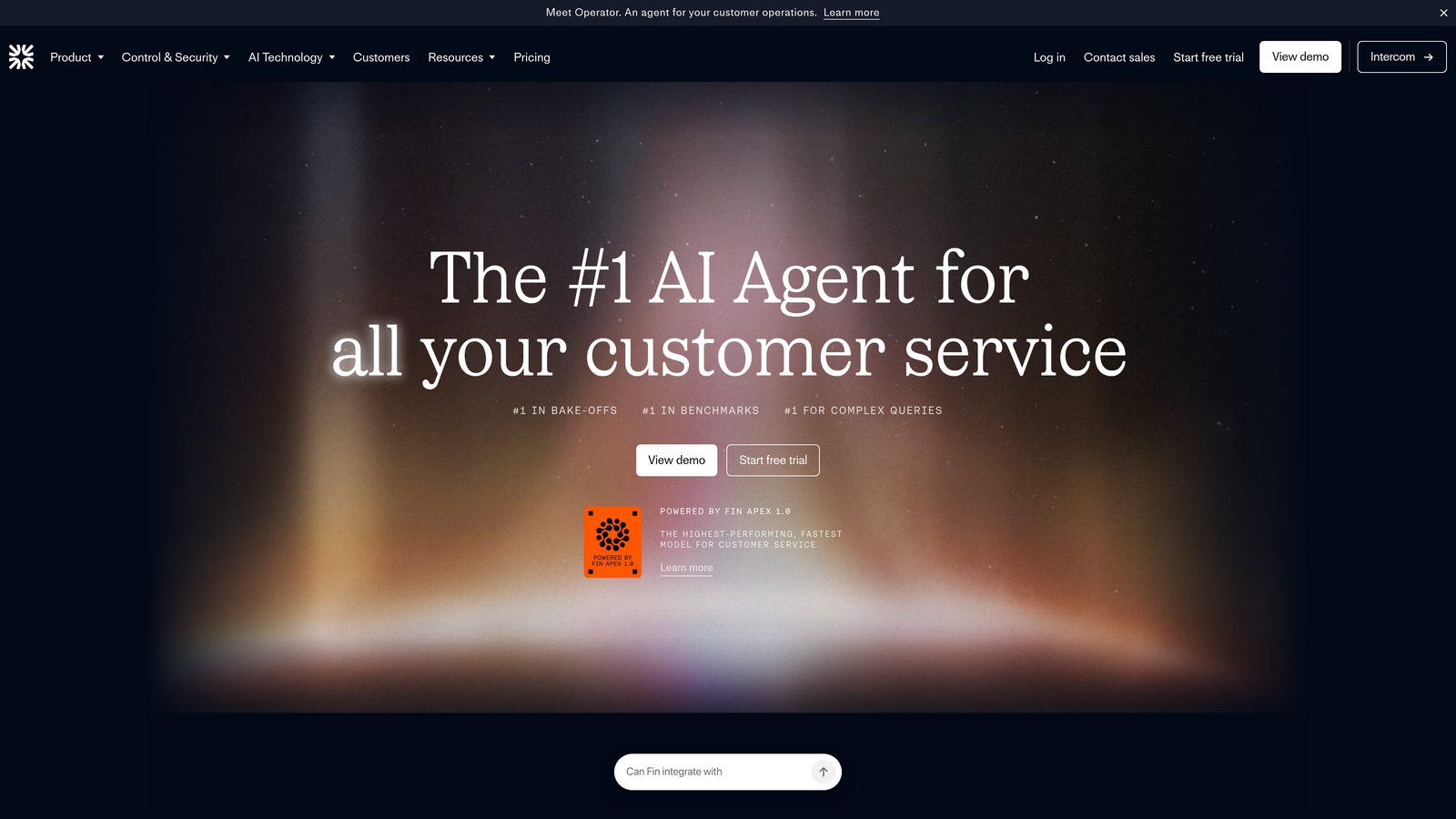
Intercom Fin is Intercom's native AI agent that resolves customer questions using your existing help center content and conversation history.
Where This Tool Shines
If your team is already invested in the Intercom ecosystem, Fin is the path of least resistance to meaningful AI resolution rates. It draws on your existing help center articles and past conversations to answer questions, which means setup time is significantly lower than starting from scratch with a new platform.
The AI Copilot mode is a practical addition for support teams that aren't ready to go fully autonomous. Agents get real-time suggestions and conversation summaries during live interactions, which smooths handoffs and reduces the time spent getting up to speed on context mid-ticket.
Key Features
AI Agent Trained on Your Content: Uses your existing help center articles and conversation history to resolve questions accurately.
Fin AI Copilot: Provides live agents with real-time suggestions and response assistance during active conversations.
Conversation Summarization: Automatically summarizes context before handing off to a human agent.
Native Intercom Integration: Works seamlessly within Intercom's messaging and ticketing infrastructure.
Multilingual Support: Handles customer conversations across multiple languages without additional configuration.
Best For
Companies already using Intercom as their primary support and messaging platform. The value proposition is strongest when you're not looking to migrate infrastructure — just layer in AI resolution on top of what you already have.
Pricing
Fin charges per resolution. Intercom plans start at $39 per seat per month, with Fin available as an add-on. Costs scale with resolution volume.
3. Zendesk AI
Best for: Zendesk Suite customers looking to add intelligent triage and agent assist to existing workflows.
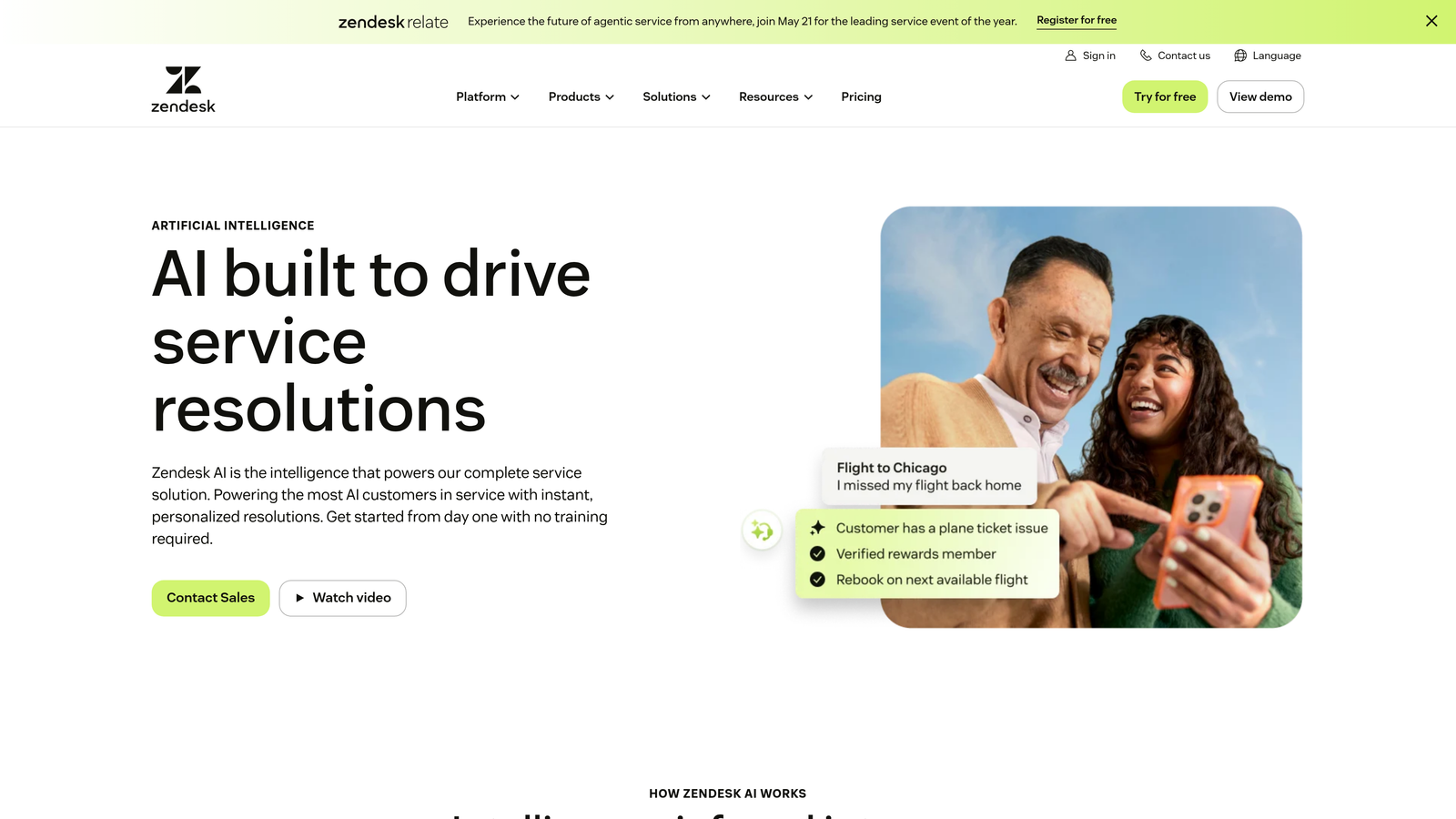
Zendesk AI is a set of AI capabilities layered into the Zendesk Suite, covering intelligent triage, auto-replies, agent assist, and generative AI features.
Where This Tool Shines
Zendesk's core advantage is the training data behind it. The AI has been pre-trained on a substantial corpus of customer service interactions, which gives it a head start on understanding intent, sentiment, and language classification without extensive setup. For teams with high ticket volume and established Zendesk workflows, that's meaningful.
The agent assist features are well-integrated into the agent workspace, surfacing macro recommendations and suggested responses without disrupting existing processes. It's an additive experience rather than a disruptive one, which matters for teams with established support operations.
Key Features
Intelligent Triage: Automatically classifies incoming tickets by intent, language, and sentiment to route them appropriately.
AI-Generated Replies: Drafts responses and suggests knowledge base articles for agents to review and send.
Agent Assist: Surfaces macro and response recommendations directly in the agent workspace.
Pre-Trained on Support Data: Built on a large corpus of customer service interactions for faster time-to-value.
Advanced AI Add-On: Available for Suite Professional and above, unlocking deeper generative AI capabilities.
Best For
Organizations already running Zendesk Suite at scale. Particularly suited to teams that want to improve agent efficiency and triage accuracy without replacing their core helpdesk infrastructure.
Pricing
Zendesk Suite starts at $55 per agent per month. The Advanced AI add-on is available for Suite Professional and above at custom pricing.
4. Ada
Best for: Mid-market and enterprise teams needing omnichannel automation with a no-code builder.
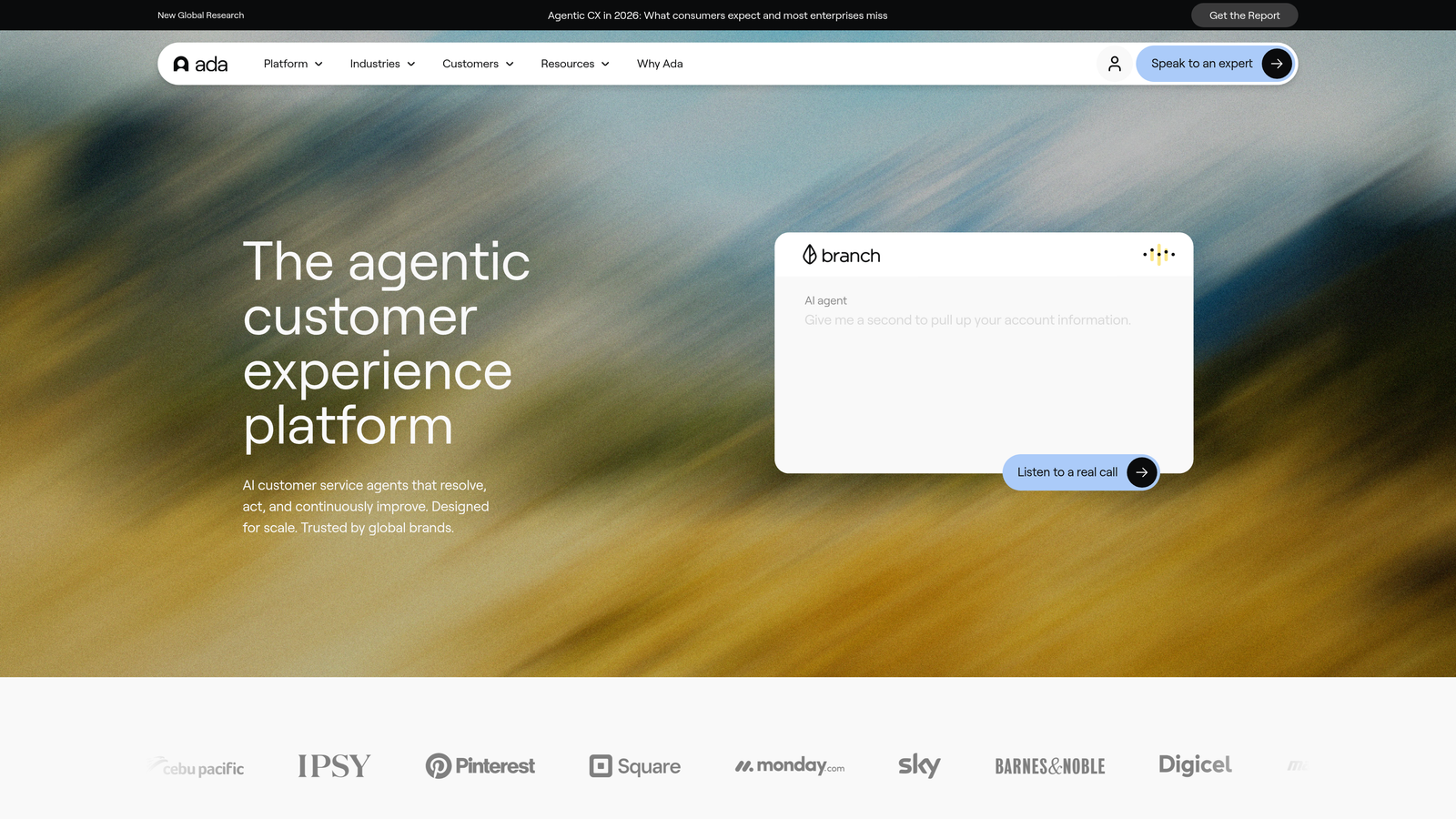
Ada is an AI-powered customer service automation platform with a reasoning engine that resolves complex queries across chat, email, and voice without requiring code.
Where This Tool Shines
Ada's positioning as a no-code platform doesn't mean it's lightweight. The AI reasoning engine can handle genuinely complex queries by chaining together context from multiple sources, which is important for B2B scenarios where a single question might require pulling from account data, product documentation, and billing history simultaneously.
The omnichannel coverage is broad and consistent. Whether a customer reaches out via chat, email, SMS, or voice, the AI maintains context and resolution logic across channels. For B2B companies with customers who contact support through multiple touchpoints, that consistency reduces friction significantly.
Key Features
No-Code Automation Builder: Build and adjust AI workflows without engineering resources using Ada's visual interface.
AI Reasoning Engine: Handles complex, multi-step queries by synthesizing context from multiple sources.
Omnichannel Coverage: Deploys across chat, email, SMS, voice, and social channels with consistent logic.
Multilingual Support: Handles conversations in 50+ languages out of the box.
CRM and Helpdesk Integrations: Connects with Salesforce, Zendesk, and other major platforms to pull account context.
Best For
Mid-market and enterprise B2B companies with high automation ambitions and diverse customer communication channels. Strong fit for teams that need non-technical stakeholders to manage and adjust AI workflows independently.
Pricing
Custom pricing. Ada typically targets mid-market and enterprise customers, so expect a sales conversation before getting specific numbers.
5. Freshdesk Freddy AI
Best for: Freshworks ecosystem users wanting AI across support, CRM, and chat in one platform.
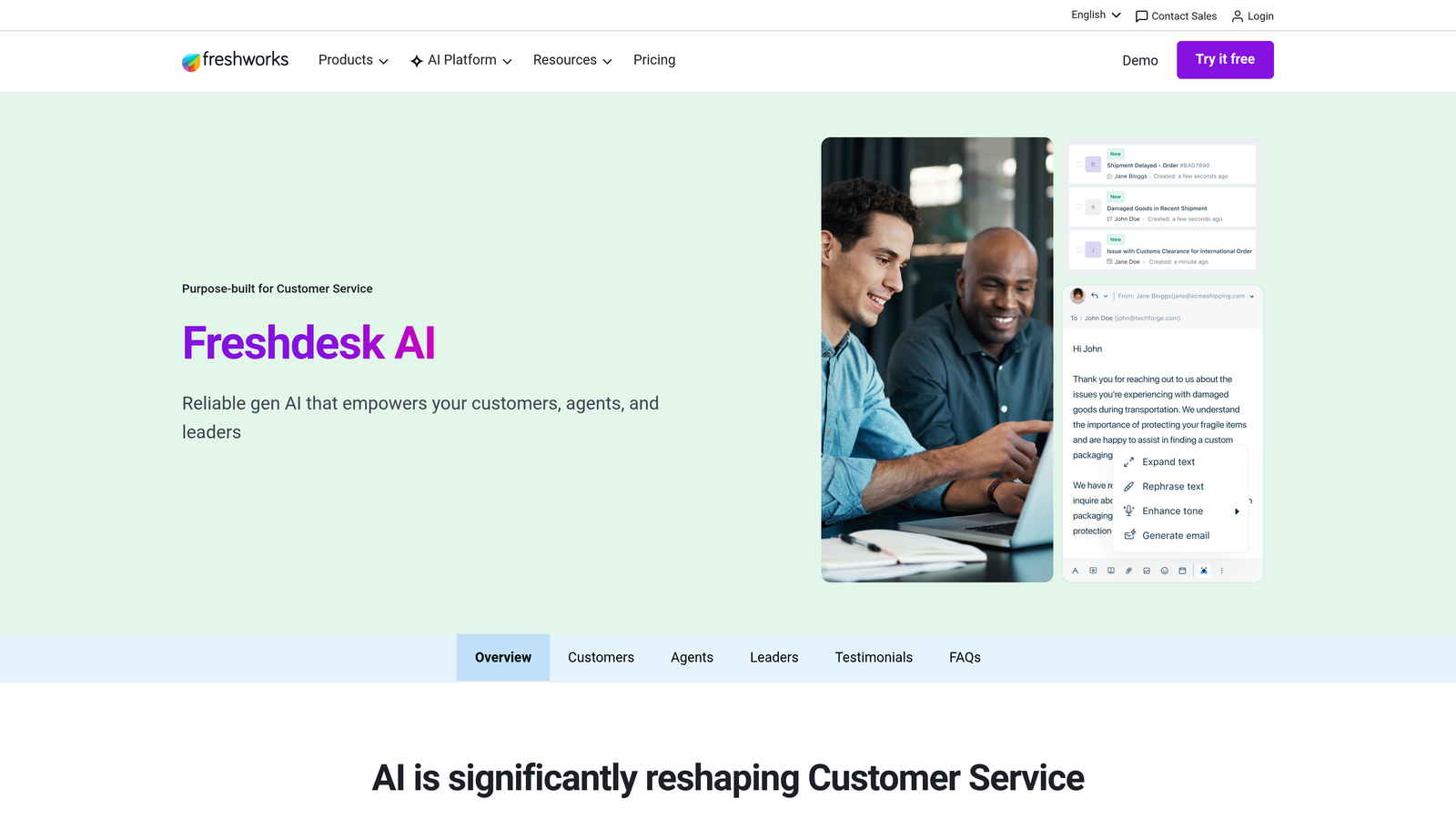
Freshdesk Freddy AI is Freshworks' AI layer for Freshdesk, handling auto-triage, suggested responses, and self-service chatbot capabilities within the broader Freshworks ecosystem.
Where This Tool Shines
Freddy AI's strongest argument is ecosystem coherence. If your team is already using Freshdesk for support, Freshsales for CRM, and Freshchat for messaging, Freddy ties them together with shared AI logic. That means the AI can draw on CRM context when resolving a support ticket without requiring a separate integration build.
The dual-mode approach — Freddy AI Agent for self-service and Freddy Copilot for agent assistance — gives teams flexibility in how aggressively they deploy automation. You can start with copilot mode to build confidence before shifting more resolution responsibility to the autonomous agent.
Key Features
Freddy AI Agent: Autonomous self-service resolution powered by your knowledge base and support history.
Freddy Copilot: Real-time response suggestions and assistance for live agents handling complex tickets.
Auto-Triage: Automatically categorizes and routes incoming tickets based on content and intent.
Freshworks Ecosystem Integration: Native connection to Freshsales CRM, Freshchat, and the broader Freshworks product suite.
Knowledge Base Bot Builder: Builds self-service flows directly from your existing documentation.
Best For
Companies already running multiple Freshworks products who want AI that works across their entire customer operations stack without managing separate integrations. Also a solid option for teams looking for more predictable pricing than enterprise-only alternatives.
Pricing
Freshdesk Pro starts at $49 per agent per month. Freddy AI features are included at higher tiers or available as add-ons depending on the specific capability.
6. Tidio AI (Lyro)
Best for: Smaller B2B teams or startups needing affordable conversational AI with fast setup.
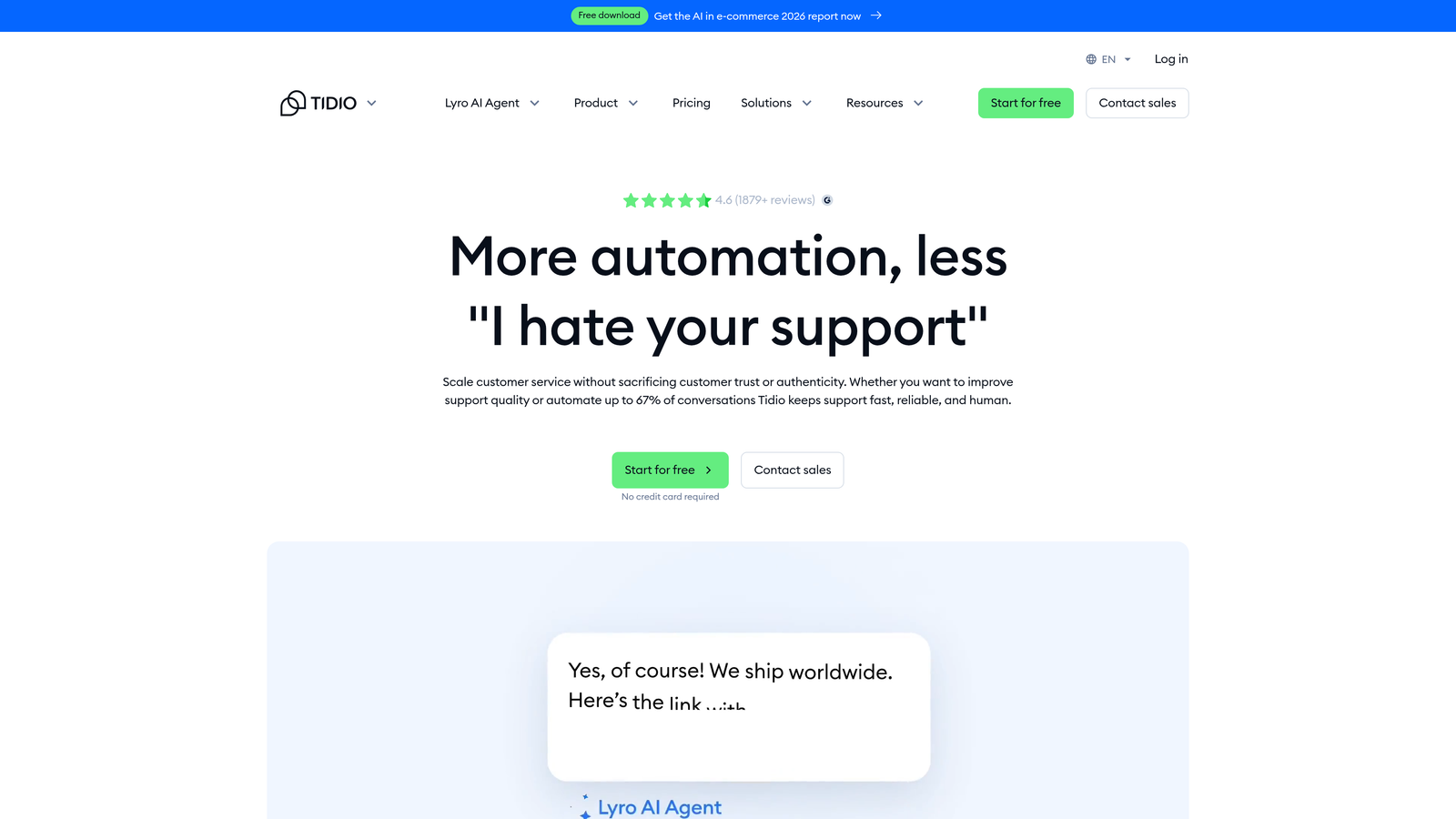
Tidio is an affordable conversational AI platform whose Lyro AI chatbot learns from your existing support content to answer customer questions with minimal configuration time.
Where This Tool Shines
Lyro's headline is speed-to-value. It ingests your existing FAQ and help center content and starts resolving conversations quickly, without the lengthy training cycles or professional services engagements that enterprise platforms often require. For a smaller team that needs something working this week rather than next quarter, that matters.
The pricing model is also genuinely transparent. You pay per conversation rather than navigating complex per-seat or custom enterprise quotes. That predictability is useful for teams with variable support volume who want to control costs without committing to seats they may not fully use.
Key Features
Lyro AI Chatbot: Learns from existing support content in minutes and starts resolving conversations immediately.
Live Agent Handoff: Smoothly escalates conversations to human agents when the AI reaches its limits.
Visual Flow Builder: Drag-and-drop interface for building custom conversation workflows beyond the standard FAQ bot.
Platform Integrations: Connects with Shopify, WordPress, and common e-commerce and CMS platforms.
Conversation-Based Pricing: Transparent per-conversation model that scales with actual usage.
Best For
Smaller B2B teams, early-stage startups, or companies that want to test AI-assisted support before committing to an enterprise platform. Less suited to complex, high-volume B2B environments that require deep CRM or ERP integrations.
Pricing
Free plan available. Lyro AI starts at $39 per month for 50 conversations, with higher tiers available for increased volume.
7. Forethought
Best for: Teams wanting modular AI that layers onto an existing helpdesk without replacing it.
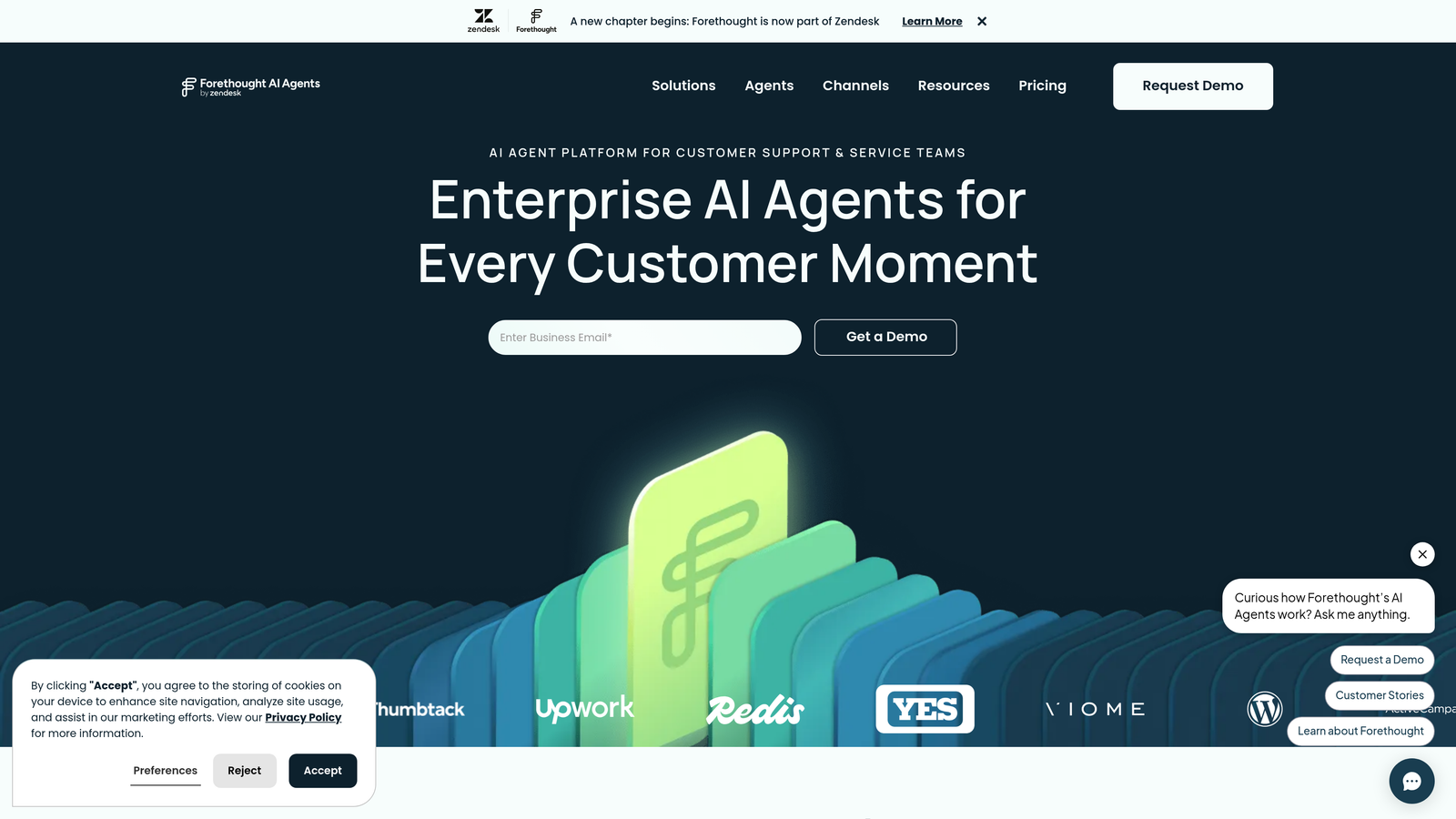
Forethought is a modular AI support platform offering SupportGPT-powered products for self-service, intelligent routing, and agent assistance that layer onto your existing helpdesk infrastructure.
Where This Tool Shines
Forethought's modular architecture is its defining characteristic. Rather than asking you to replace your helpdesk, it layers intelligent capabilities on top of what you already have — Zendesk, Salesforce, or others. You can deploy just the triage module, just the agent assist module, or the full suite depending on where your biggest gaps are.
The Discover module adds a workflow intelligence layer that identifies patterns in your support data: which ticket types consume the most time, where resolution rates drop, and where automation could have the highest impact. For B2B teams making a business case for AI investment, that visibility is genuinely useful.
Key Features
SupportGPT: Generative, context-aware responses that draw on your knowledge base and ticket history.
Modular Products: Solve (self-service), Triage (routing), Assist (agent help), and Discover (workflow insights) can be deployed independently.
Helpdesk-Agnostic Architecture: Layers onto Zendesk, Salesforce Service Cloud, and other existing platforms.
Intelligent Ticket Routing: Routes tickets based on intent, priority, and agent skill matching.
Discover Module: Surfaces workflow insights and identifies automation opportunities from support data patterns.
Best For
B2B companies with existing helpdesk investments they want to protect while adding AI capabilities incrementally. Particularly useful when you want to start with one AI use case and expand over time rather than committing to a full platform replacement.
Pricing
Custom pricing. The modular approach means you pay for what you deploy, which can make Forethought more cost-effective than all-in-one platforms for teams with specific, targeted needs.
8. Cognigy
Best for: Enterprise teams building sophisticated voice and chat AI agents with deep customization needs.
Cognigy is an enterprise-grade conversational AI platform for building sophisticated voice and chat AI agents with LLM orchestration and a visual flow builder.
Where This Tool Shines
Cognigy operates at a different level of complexity than most tools on this list. It's built for organizations that need to design intricate conversation flows, orchestrate multiple LLMs, and deploy across voice channels alongside digital ones. The Voice Gateway capability is particularly distinctive — few platforms handle phone-based AI agents with the same depth.
The LLM orchestration layer gives enterprise teams control over which AI models power different parts of their support experience. That flexibility matters for organizations with specific data residency requirements, compliance constraints, or preferences for particular model providers.
Key Features
Cognigy.AI Visual Flow Builder: Design complex, branching conversation flows without writing code, with full version control.
Voice Gateway: Deploy AI agents over phone channels with natural voice interaction capabilities.
LLM Orchestration: Choose and combine multiple AI models across different parts of your support workflow.
Enterprise Security and Compliance: Built-in features for data governance, compliance requirements, and enterprise security standards.
Omnichannel Deployment: Deploy across 25+ channels from a single platform with consistent conversation logic.
Best For
Large enterprises with complex support operations spanning voice and digital channels, particularly those in regulated industries or with strict data governance requirements. Less practical for smaller teams given the implementation complexity and pricing tier.
Pricing
Enterprise custom pricing. A free trial is available to evaluate the platform before entering a sales process.
9. Salesforce Einstein Service Cloud
Best for: Salesforce-centric organizations needing AI with full CRM context baked in.
Salesforce Einstein Service Cloud is the AI-powered service layer within Salesforce Service Cloud, giving support agents and AI bots complete CRM context including account history, open deals, and customer health data.
Where This Tool Shines
The core argument for Einstein is data depth. If your organization runs Salesforce as its CRM, your support AI has access to account history, open opportunities, contract status, and customer health scores from the moment a conversation starts. That level of context is difficult to replicate through integrations alone, and for complex B2B accounts it can meaningfully change how support interactions are handled.
The native connection between Service Cloud, Sales Cloud, and Marketing Cloud means support data doesn't live in isolation. Patterns identified in support interactions can inform sales conversations, and account health signals surface across the organization rather than staying siloed in a support queue.
Key Features
Einstein Bots: Automated case resolution bots with full Salesforce CRM context available at every step.
AI-Powered Case Classification: Automatically routes and categorizes incoming cases based on content and account data.
Full CRM Context: Account history, open deals, customer health scores, and contract data available to both AI and human agents.
Einstein Reply Recommendations: Surfaces suggested responses for agents based on case content and historical resolutions.
Native Salesforce Integration: Connects directly with Sales Cloud, Marketing Cloud, and Data Cloud without additional middleware.
Best For
Organizations deeply invested in the Salesforce ecosystem where CRM data is the authoritative source of truth for customer relationships. The ROI case is strongest when support, sales, and customer success all operate within Salesforce and need a unified view of account health.
Pricing
Service Cloud Enterprise starts at $165 per user per month. Einstein AI features are included or available as add-ons depending on your tier and specific capabilities needed.
Which Tool Is Right for Your B2B Team?
The right AI support system depends heavily on where you're starting from and where you want to go. Here's a quick orientation by use case.
If you want an AI-first platform built for B2B intelligence, Halo AI is the standout choice. Its page-aware agents, deep integrations, and business intelligence layer make it genuinely different from helpdesks with AI bolted on.
For teams already using Intercom, Fin offers the fastest path to meaningful AI resolution without platform migration. For Zendesk shops, Zendesk AI is the natural extension of an existing investment. And for organizations running everything through Salesforce, Einstein Service Cloud's CRM context is hard to match.
Ada is the go-to for high-volume omnichannel automation at mid-market and enterprise scale. Forethought suits teams that want modular AI layered onto an existing helpdesk rather than a full replacement. Cognigy is purpose-built for enterprises with sophisticated voice and chat requirements. And Tidio Lyro remains the most accessible entry point for smaller teams testing the waters.
The broader shift worth noting: B2B support is moving away from reactive ticket management toward proactive intelligence. The best platforms don't just resolve tickets — they surface signals about customer health, product friction, and revenue risk that inform decisions across your entire organization. Understanding the AI support agent landscape and the conversational AI benefits available today makes it easier to build a case for investment that goes beyond deflection rates.
Your support team shouldn't scale linearly with your customer base. Let AI agents handle routine tickets, guide users through your product, and surface business intelligence while your team focuses on complex issues that need a human touch. See Halo in action and discover how continuous learning transforms every interaction into smarter, faster support.