9 Best AI Support Systems for Businesses in 2026
This guide reviews the 9 best AI support system for businesses options in 2026, evaluating each on autonomous resolution capability, context-awareness, integration depth, and continuous learning — the criteria that separate true AI support platforms from basic chatbot add-ons. Whether you run a lean SaaS team or an enterprise operation, you'll find a clear, practical breakdown to help you choose the right tool for your scale.
 Grant CooperFounder13 min read
Customer support has changed. The old model, where tickets pile up in a queue and agents scramble to keep response times reasonable, is giving way to something fundamentally different: AI systems that resolve issues autonomously, understand context, and get smarter with every interaction. For B2B companies, this shift isn't just about efficiency. It's about building a support function that scales intelligently without scaling headcount.
The difference between a true AI support system and a chatbot bolted onto your helpdesk comes down to a few things: autonomous resolution capability, context-awareness, integration depth with your business stack, and a learning loop that actually improves performance over time. The tools on this list were evaluated on exactly those criteria.
Whether you're running a lean SaaS team or managing enterprise-scale support operations, there's a meaningful difference between tools here. Let's break them down.
1. Halo AI
Best for: B2B SaaS teams that need AI-first autonomous support with business intelligence built in
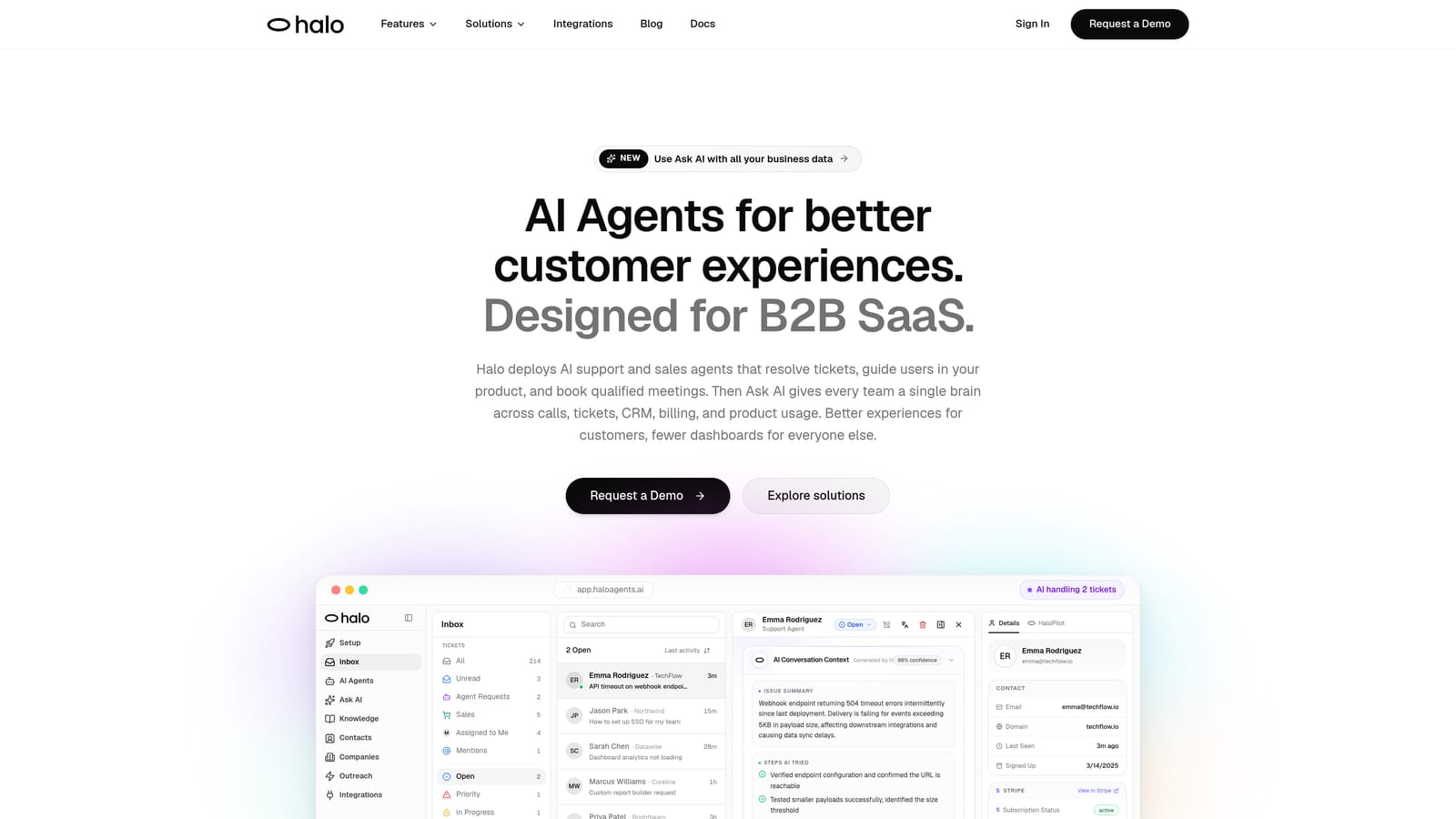
Halo AI is an AI-native customer support platform built specifically for B2B SaaS, deploying intelligent agents that resolve tickets, guide users, and surface business signals.
Where This Tool Shines
Halo isn't a layer added onto a legacy helpdesk. It's built AI-first, which means the architecture is designed around autonomous resolution rather than retrofitted for it. The standout capability is page-awareness: Halo's chat widget understands what page a user is currently on and delivers contextual UI guidance based on that visual context. That's a genuinely different level of support than a generic chatbot response.
Beyond ticket resolution, Halo's smart inbox surfaces business intelligence signals that most support tools never touch: customer health trends, revenue anomalies, and product usage insights. Your support function becomes an intelligence layer for the whole business, not just a cost center managing inbound volume.
Key Features
Page-Aware Chat Widget: Understands the user's current screen and provides contextual, visual UI guidance tailored to their exact location in the product.
Smart Inbox with Business Intelligence: Surfaces customer health signals, revenue anomalies, and product insights directly from support interactions.
Auto Bug Ticket Creation: Automatically generates and routes bug reports to engineering tools like Linear, removing manual steps from the support-to-engineering handoff.
Live Agent Handoff: Escalates complex issues to human agents seamlessly, with full context preserved so agents don't start from scratch.
Deep Integrations: Connects natively with HubSpot, Slack, Intercom, Stripe, Zoom, PandaDoc, Fathom, and Linear for a fully connected business stack.
Continuous Learning Loop: The AI improves with every resolved interaction, building accuracy over time rather than staying static.
Best For
B2B SaaS companies that want more than ticket deflection. Halo is particularly strong for product-led growth teams where in-product guidance, bug detection, and customer health signals matter as much as resolution speed. Teams using Linear, HubSpot, or Stripe will find the integrations especially valuable.
Pricing
Demo-first model with custom pricing. Contact Halo directly via haloagents.ai to explore plans based on your team's needs.
2. Intercom
Best for: Teams wanting conversational AI support alongside lifecycle messaging in one platform
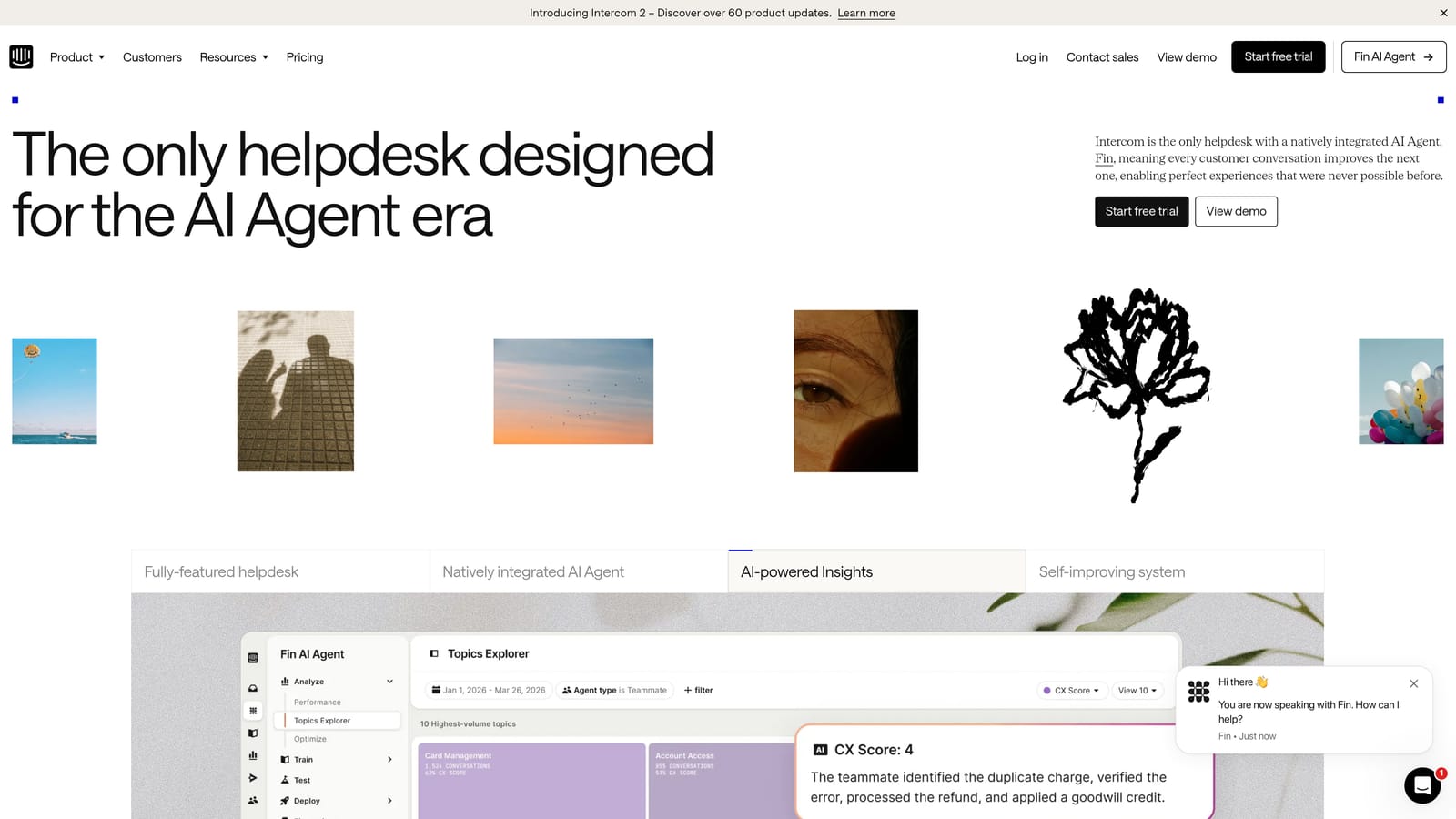
Intercom is a mature all-in-one customer messaging platform with Fin, its generative AI agent, handling autonomous conversational support.
Where This Tool Shines
Intercom's strength is breadth. It combines support, onboarding, and lifecycle messaging in a single platform, which means teams don't need separate tools for proactive outreach and reactive support. Fin, the AI agent, draws directly from your help center content to resolve conversations without human involvement, and the quality of resolution has improved substantially as the underlying models have matured.
For teams already invested in Intercom's broader suite, adding Fin is a natural extension rather than a platform switch. The AI Copilot feature also helps human agents with suggested replies and conversation summarization when escalations occur.
Key Features
Fin AI Agent: Resolves conversations autonomously using large language models trained on your help center content.
Omnichannel Messaging: Covers chat, email, SMS, and in-product messaging from a unified platform.
AI Copilot for Agents: Provides suggested replies, conversation summaries, and next-step recommendations for human agents handling escalations.
Lifecycle Messaging: Onboarding flows and proactive messaging sit alongside support in the same tool.
App Marketplace: Extensive integrations with third-party tools for CRM, billing, and analytics.
Best For
Companies that want conversational AI support and customer lifecycle messaging under one roof. Strong fit for SaaS teams already using Intercom for onboarding and engagement who want to extend into AI-powered support resolution.
Pricing
Essential plan from approximately $39 per seat per month. Fin AI Agent is billed per resolution at approximately $0.99 per resolution, which can add up quickly at scale.
3. Zendesk AI
Best for: Enterprise teams needing a proven, deeply integrated helpdesk with AI across every layer
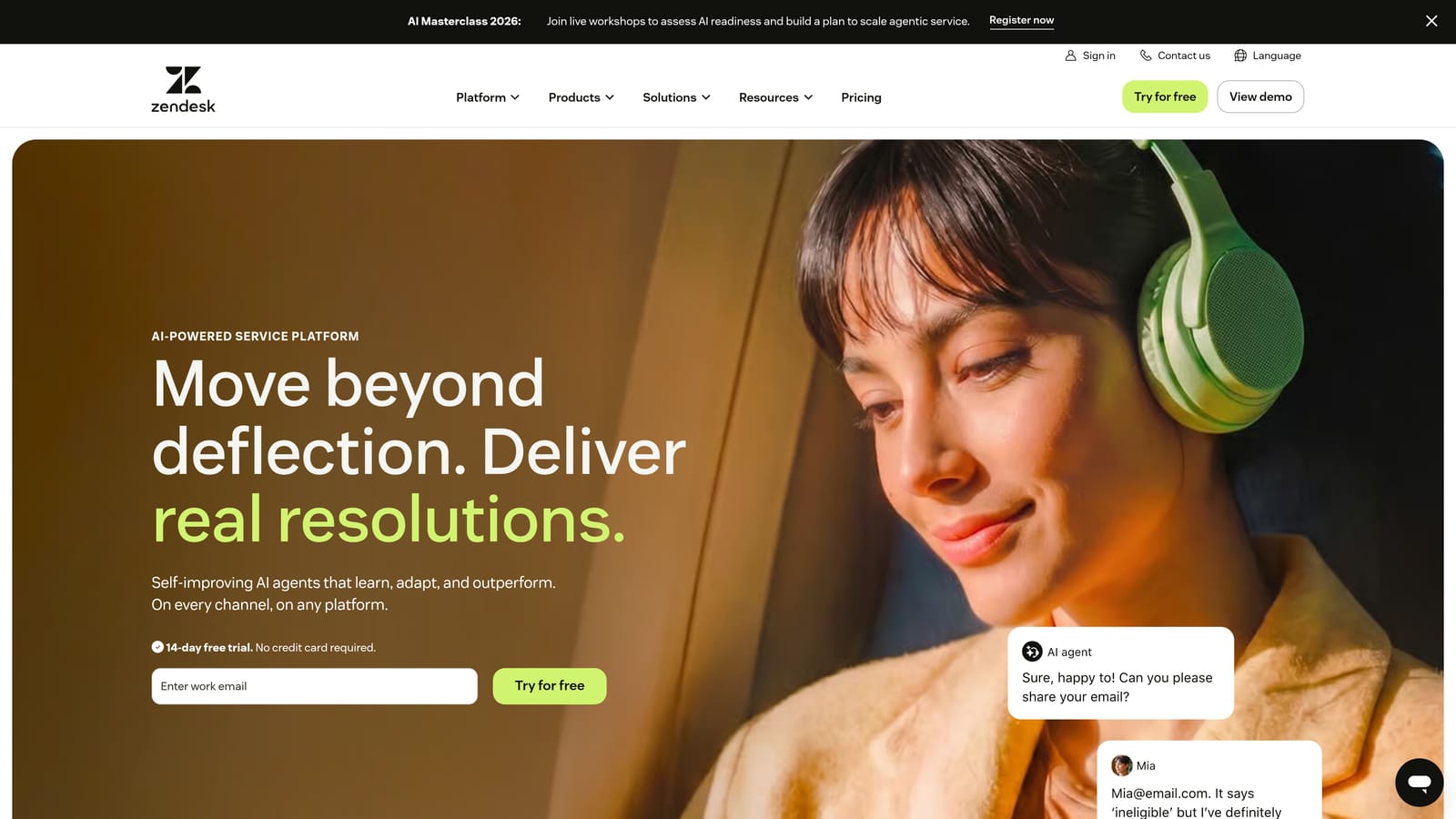
Zendesk is the enterprise-standard helpdesk platform with a comprehensive AI layer covering triage, routing, agent assistance, and self-service deflection.
Where This Tool Shines
Zendesk's AI capabilities aren't a single feature. They're distributed across the entire support workflow: intent and sentiment detection at the triage stage, intelligent routing, agent copilot assistance during resolution, and AI-enhanced self-service for deflection. For large teams with complex routing logic and compliance requirements, this depth is hard to match.
The ecosystem is also a major factor. With over 1,500 marketplace integrations, Zendesk connects to virtually any business tool. If your organization has already standardized on Zendesk, the Advanced AI add-on is a meaningful upgrade rather than a platform change.
Key Features
AI-Powered Triage: Automatically detects intent and sentiment to route tickets to the right agent or team without manual sorting.
Agent Copilot: Provides suggested replies, auto-summarization of long threads, and recommended next steps for agents.
Intelligent Self-Service: AI-enhanced help center and bot flows that deflect common queries before they reach the queue.
Advanced Analytics: Workforce management tools and reporting that give operations teams visibility into support performance.
Extensive Marketplace: Over 1,500 integrations covering CRM, billing, project management, and more.
Best For
Mid-market and enterprise support teams with complex routing needs, compliance requirements, or large agent workforces. Also a strong choice for organizations already using Zendesk who want to add AI capabilities without migrating platforms.
Pricing
Suite plans from approximately $55 per agent per month. The Advanced AI add-on is available on Suite Professional and above. Pricing increases significantly at enterprise tiers.
4. Freshdesk (Freddy AI)
Best for: SMBs and growing teams that want AI-assisted support at accessible price points
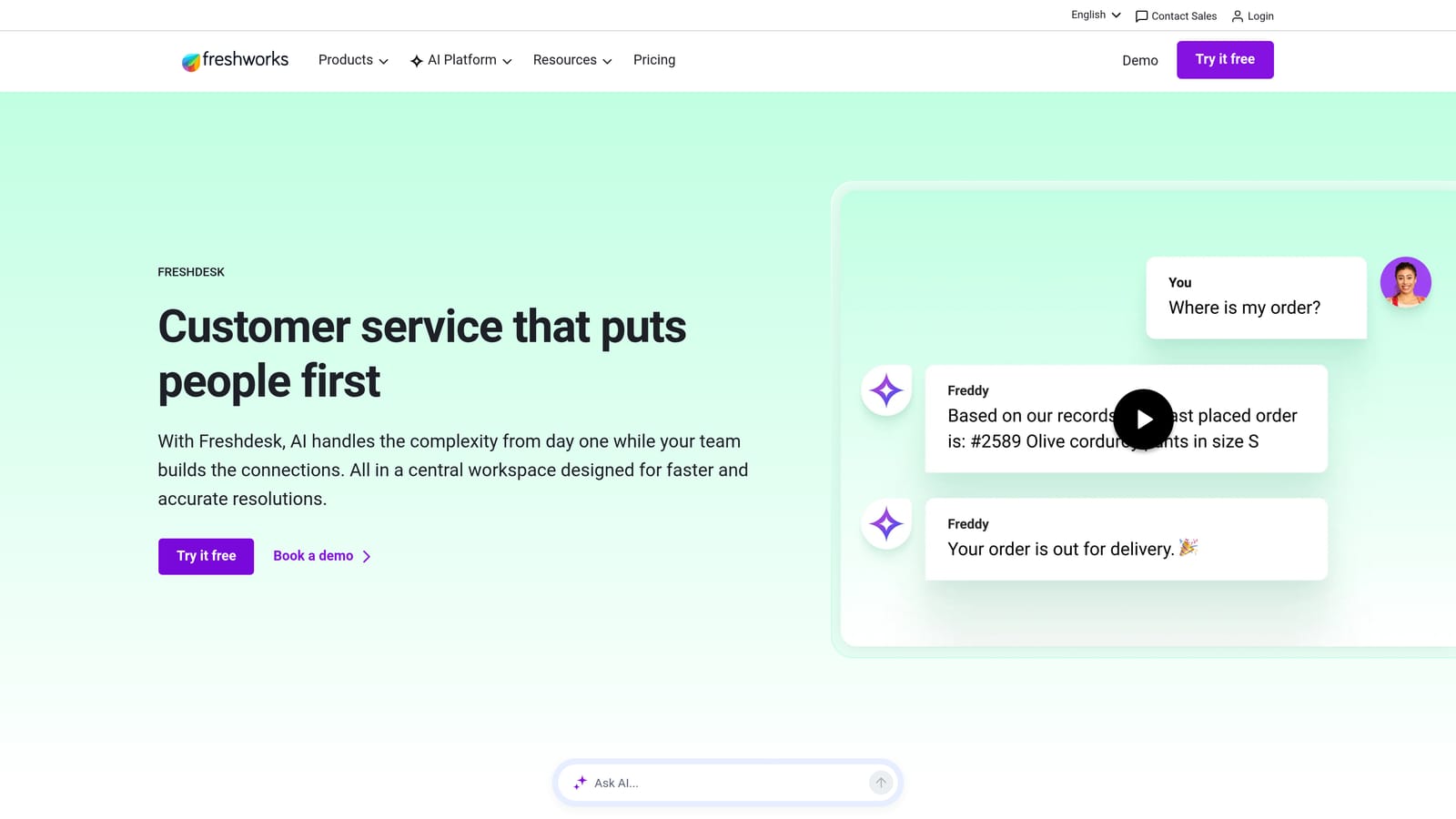
Freshdesk is Freshworks' SMB-friendly helpdesk platform with Freddy AI providing self-service deflection, agent assistance, and analytics without enterprise-level pricing.
Where This Tool Shines
Freshdesk hits a pricing sweet spot that Zendesk and Salesforce simply don't reach. For growing teams that need real AI capabilities without committing to enterprise contracts, Freddy AI offers a practical entry point. Freddy Self Service handles FAQ deflection autonomously, while Freddy Copilot assists agents with suggested responses and ticket summaries during active conversations.
The analytics layer, Freddy Insights, adds trend detection and support performance intelligence that helps smaller teams make data-driven decisions without a dedicated analytics function.
Key Features
Freddy Self Service: Autonomous deflection for common queries using your knowledge base and FAQ content.
Freddy Copilot: Suggested responses, ticket summaries, and tone adjustment tools for agents handling live conversations.
Freddy Insights: AI-driven analytics that surface support trends and performance anomalies.
Omnichannel Support: Email, chat, phone, and social channels managed from a unified inbox.
Free Tier: Available for small teams getting started with basic helpdesk functionality.
Best For
Small to mid-sized businesses that need solid AI-assisted support without enterprise pricing. Particularly well-suited for teams just beginning to automate support workflows who want room to grow into more advanced capabilities.
Pricing
Growth plan from approximately $15 per agent per month. Freddy Copilot is available as a paid add-on on top of base plan pricing.
5. Salesforce Agentforce
Best for: Salesforce-native organizations that want autonomous AI agents working directly within Service Cloud
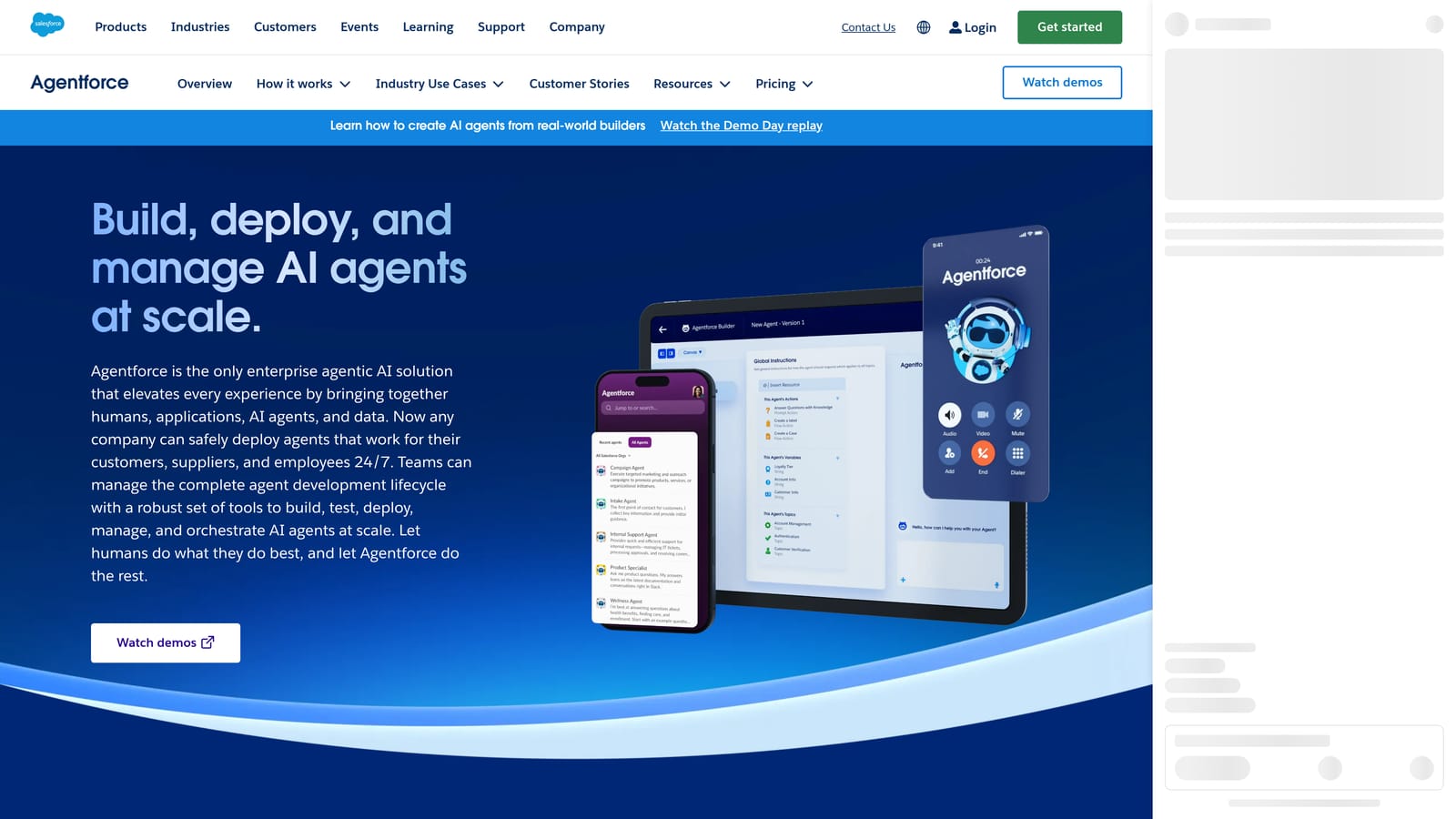
Salesforce Agentforce is Salesforce's autonomous AI agent platform that resolves customer cases end-to-end using full CRM context, without requiring human intervention.
Where This Tool Shines
The core advantage of Agentforce is data access. Because it operates natively within Salesforce, AI agents can draw on complete CRM records, case history, and knowledge base content when resolving issues. That context depth produces more accurate, personalized resolutions compared to AI systems working with limited data inputs.
The Atlas Reasoning Engine enables multi-step problem solving, meaning agents can handle complex support scenarios that require more than a single lookup. For organizations already running Service Cloud, Agentforce is a natural evolution rather than a new platform investment.
Key Features
Autonomous AI Agents: Access full CRM and case history to resolve customer cases without human intervention.
Low-Code Agent Builder: Customize agent behavior, escalation paths, and resolution logic without heavy engineering resources.
Native Service Cloud Integration: No data migration required for existing Salesforce users.
Multi-Channel Deployment: Chat, email, voice, and messaging apps supported from a single configuration.
Atlas Reasoning Engine: Enables multi-step reasoning for complex support scenarios that require chained logic.
Best For
Enterprises already using Salesforce Service Cloud who want to extend into autonomous AI resolution without migrating their support stack. The value scales directly with how much CRM data the organization has already built up in Salesforce.
Pricing
Consumption-based pricing per conversation, layered on top of existing Salesforce licensing. Contact Salesforce directly for current pricing as it varies significantly by organization size and usage.
6. Tidio (Lyro AI)
Best for: Small businesses and e-commerce teams that need fast AI deployment without technical complexity
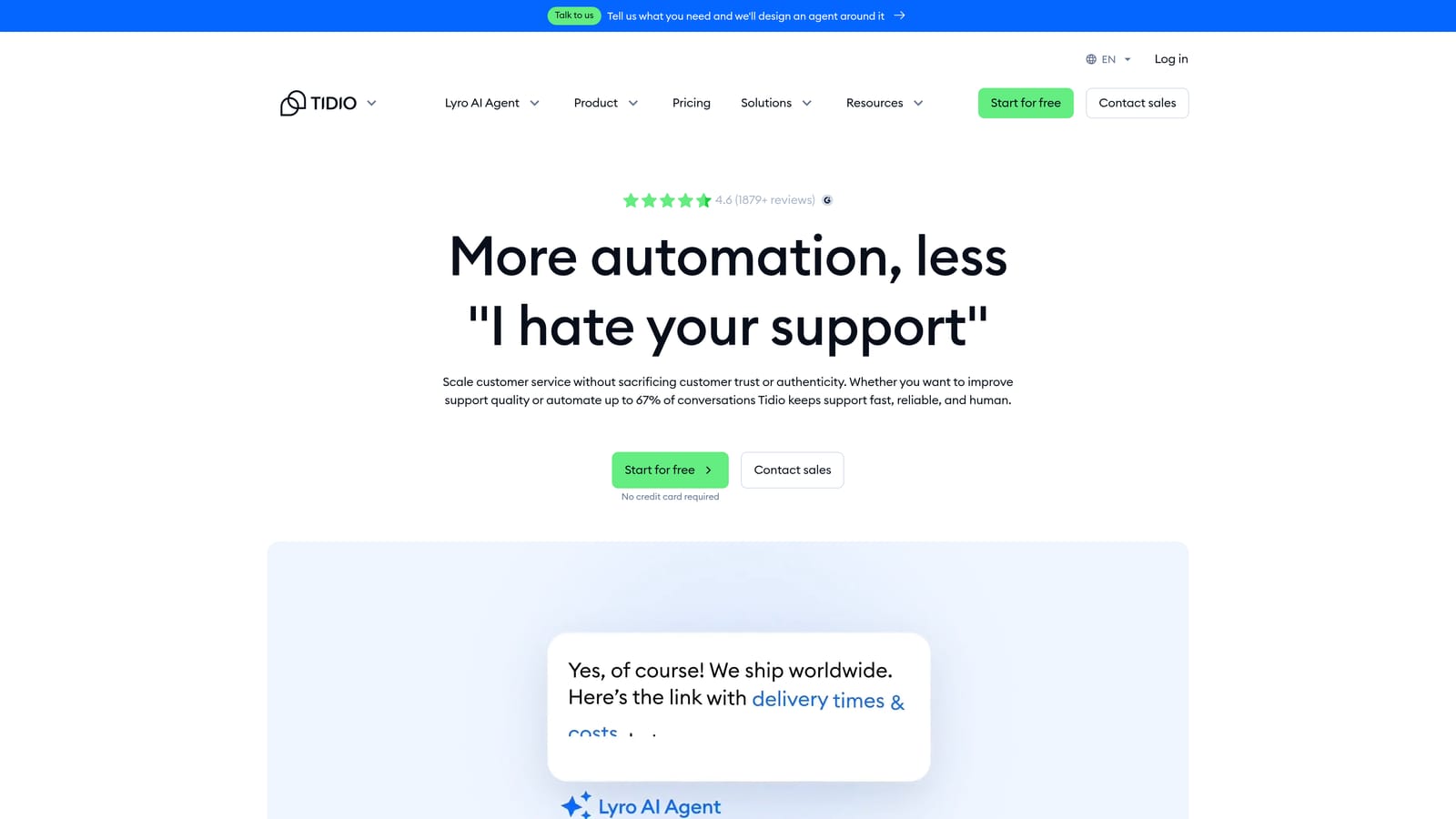
Tidio is a lightweight AI support platform with Lyro AI handling conversational support autonomously from a quick, low-code setup designed for non-technical teams.
Where This Tool Shines
Speed to value is Tidio's defining strength. Teams can typically have Lyro AI live and handling real conversations within hours, not weeks. For small businesses and e-commerce operators who need AI support without a dedicated IT team to deploy it, that matters enormously. Lyro pulls from your existing FAQ content to answer common queries conversationally, and when it reaches its resolution limits, it hands off to a live agent cleanly.
The native Shopify and WooCommerce integrations make Tidio a natural fit for e-commerce support, where order status, returns, and product questions make up the bulk of inbound volume.
Key Features
Lyro AI: Resolves common support queries conversationally using existing FAQ and knowledge base content.
E-Commerce Integrations: Native Shopify and WooCommerce connections for order-related support automation.
Live Chat Fallback: Smooth handoff to human agents when Lyro reaches its resolution boundaries.
Quick Deployment: Typically live within hours, with no engineering resources required.
Free Tier: Available with limited Lyro AI conversations for teams starting out.
Best For
Small businesses, e-commerce brands, and early-stage teams that need AI support up and running quickly without technical overhead. Not the right fit for complex B2B SaaS environments with deep integration requirements.
Pricing
Free tier available. Paid plans start from approximately $29 per month. Lyro AI conversations are billed separately, so costs scale with usage volume.
7. Help Scout
Best for: Teams where maintaining a human, relationship-driven support experience is a core priority
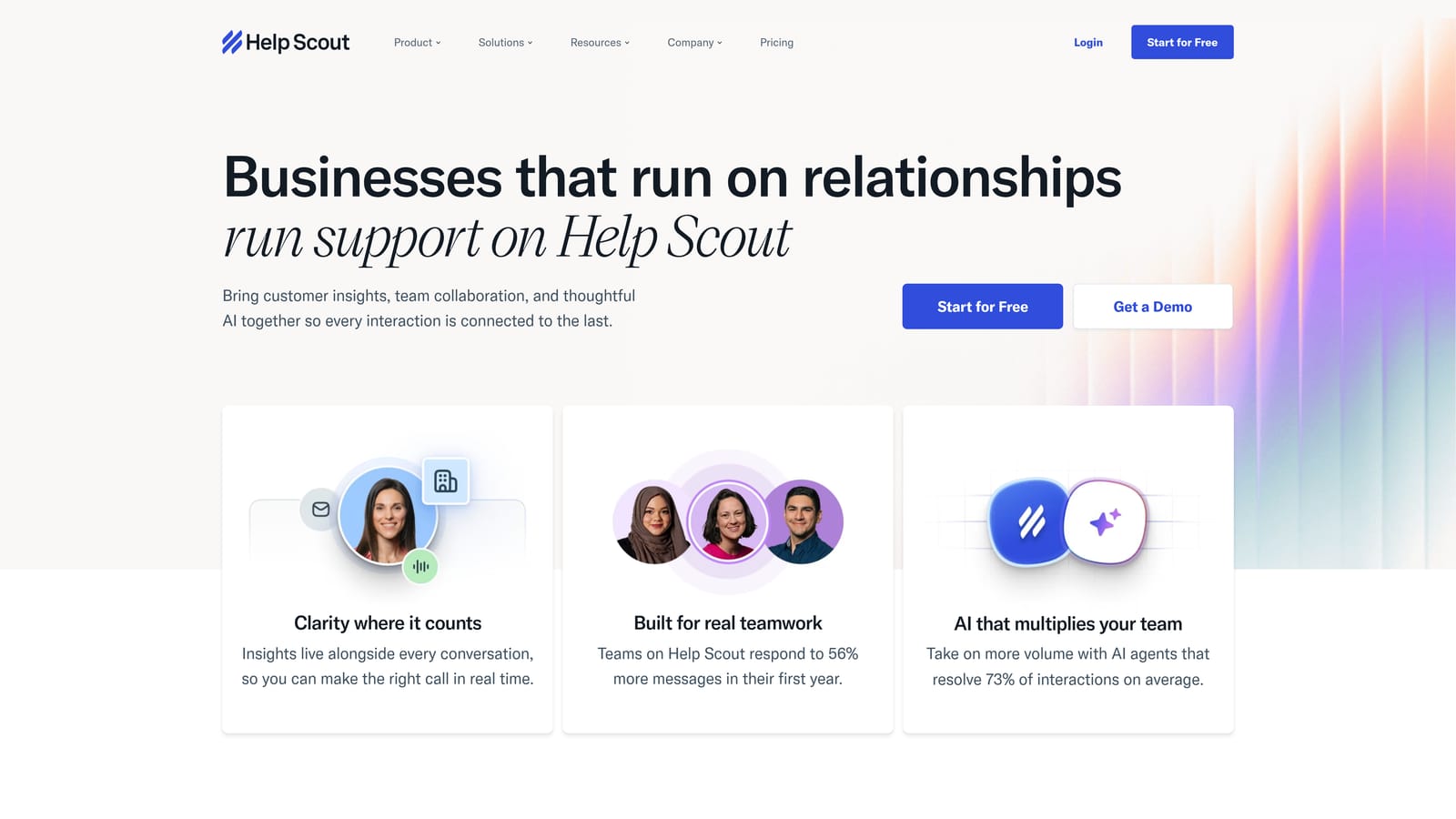
Help Scout is a human-centered support platform that uses AI to assist agents rather than replace them, emphasizing relationship quality alongside resolution speed.
Where This Tool Shines
Help Scout takes a deliberately different philosophy from the autonomous AI tools on this list. Rather than maximizing deflection, it focuses on making human agents faster and more effective. AI Drafts generate full suggested replies that agents review before sending. AI Summarize condenses long conversation threads instantly. The result is a support experience that still feels personal, with AI handling the grunt work behind the scenes.
For businesses where customer relationships are a genuine competitive differentiator, and where a robotic AI response would actually hurt brand perception, Help Scout's approach is a meaningful strategic choice rather than a limitation.
Key Features
AI Summarize: Instant conversation summaries that help agents quickly understand context when switching between tickets.
AI Drafts: Full suggested reply drafts generated for agent review, reducing composition time significantly.
AI Assist: Tone, length, and clarity adjustments for agent-written replies before they're sent.
Beacon: Embeddable help widget with proactive messaging and self-service options.
Shared Inbox: Clean, collaborative team inbox designed for transparent, organized support workflows.
Best For
Customer-success-focused teams, professional services companies, and businesses where support is a relationship function rather than a volume management challenge. Less suited to teams primarily chasing deflection rates.
Pricing
Standard plan from approximately $22 per user per month. AI features are included in the plan rather than gated behind a separate add-on, which simplifies budgeting.
8. Kustomer
Best for: Subscription and D2C businesses with rich customer data that want omnichannel AI resolution
Kustomer is a CRM-native customer service platform that gives AI full customer timeline context for more informed, omnichannel support resolution.
Where This Tool Shines
Kustomer's differentiator is the unified customer timeline. Every purchase, interaction, case, and communication is visible in a single view for both AI and human agents. When AI handles a resolution, it's working with the full picture of who that customer is and what their history looks like, not just the current ticket. That context produces noticeably more relevant responses and routing decisions.
The omnichannel coverage is also comprehensive: email, chat, social, SMS, and voice all feed into the same unified view, which eliminates the context fragmentation that plagues multi-channel support in traditional helpdesks.
Key Features
Unified Customer Timeline: Full purchase, interaction, and case history available to AI and agents in a single view.
AI-Powered Routing: Intelligent ticket routing and suggested responses informed by full customer context.
Omnichannel Resolution: Email, chat, social, SMS, and voice managed from one unified interface.
Automation Builder: Multi-step workflow automation for complex support scenarios requiring chained logic.
Customer Data Depth: Particularly strong for businesses with subscription models or rich transaction histories.
Best For
Subscription businesses, D2C brands, and enterprise teams with large volumes of customer transaction data. The platform's value scales with the richness of customer history available to inform AI decisions.
Pricing
Enterprise pricing model. Contact Kustomer directly for current pricing, as it's structured around organizational scale and usage requirements.
9. Forethought Solve
Best for: Teams that want AI-powered deflection and triage without replacing their existing helpdesk
Forethought is a generative AI layer purpose-built for customer support that integrates with existing helpdesks, letting teams add AI resolution without migrating their current stack.
Where This Tool Shines
Forethought's positioning is smart for organizations that have already invested heavily in a platform like Zendesk, Salesforce Service Cloud, or ServiceNow. Rather than asking teams to rip and replace, Forethought sits on top and adds generative AI capabilities: autonomous deflection via Solve, intelligent routing via Triage, and agent assistance via Assist. The training approach is worth noting: Forethought trains on your historical ticket data, which means deflection accuracy tends to improve with the volume and quality of your existing support history.
For mature support organizations with years of ticket data, that historical training can produce meaningfully higher deflection rates than tools relying solely on help center content.
Key Features
Solve: AI agent trained on historical ticket data for high-accuracy autonomous deflection of common queries.
Triage: Intelligent ticket routing based on intent, sentiment, and priority signals from incoming requests.
Assist: Agent copilot with contextual suggested responses and knowledge retrieval during active conversations.
Native Helpdesk Integrations: Works directly with Zendesk, Salesforce Service Cloud, and ServiceNow without requiring migration.
No Stack Disruption: Designed to layer on top of existing tools rather than replace them.
Best For
Enterprise support teams with established helpdesk investments and significant historical ticket data. Particularly strong for organizations on Zendesk or Salesforce that want AI capabilities without a platform migration project.
Pricing
Enterprise pricing. Contact Forethought directly for current pricing, as it's scoped to organizational size and integration complexity.
Which Tool Is Right for Your Business?
The right AI support system depends on where you are, what you're building, and how much of your stack you're willing to change to get there.
For B2B SaaS teams that want an AI-first architecture with business intelligence built in, Halo AI stands apart. The page-aware context, smart inbox signals, and continuous learning loop make it the strongest choice for product-led teams where support and customer success overlap.
For enterprise teams already on Salesforce, Agentforce is the natural path forward. For those invested in Zendesk, the Advanced AI add-on extends what's already there. And if you want AI on top of your existing helpdesk without migrating, Forethought is the cleanest option.
For SMBs and e-commerce brands that need fast deployment at accessible pricing, Tidio and Freshdesk are the most practical starting points. Help Scout is the right call for teams where relationship quality matters more than deflection volume.
For teams with rich customer data and omnichannel complexity, Kustomer and Intercom both offer strong context-aware resolution across channels.
The best AI support system isn't the one with the most features. It's the one that resolves issues autonomously, learns continuously from every interaction, and connects to your business stack in a way that makes the whole organization smarter. Ticket deflection is table stakes. The real value is in what happens after resolution: the signals surfaced, the patterns detected, and the intelligence compounded over time.
Your support team shouldn't scale linearly with your customer base. Let AI agents handle routine tickets, guide users through your product, and surface business intelligence while your team focuses on complex issues that need a human touch. See Halo in action and discover how continuous learning transforms every interaction into smarter, faster support.