9 Best AI Support System Pricing Compared: What You Actually Pay in 2026
This ai support system pricing comparison breaks down what nine leading AI customer support platforms actually cost beyond their listed prices, exposing hidden fees from per-seat charges, resolution-based billing, and usage caps. Whether you're a lean startup or a scaling B2B team, this guide matches your support volume and budget to the right platform.
 Grant CooperFounder13 min read
If you've spent any time evaluating AI customer support platforms, you already know the pricing pages tell only part of the story. Per-seat fees, resolution-based billing, AI add-on tiers, and usage caps can make two tools with similar sticker prices feel wildly different once you're inside a contract.
This guide cuts through the noise with a direct pricing comparison of nine leading AI support systems, covering what each plan includes, where costs escalate, and which buyer profile each platform suits best. Whether you're a lean SaaS startup looking to deflect tickets without hiring, or a scaling B2B team that needs deep integrations and business intelligence alongside support automation, there's a meaningful pricing difference between these tools.
Halo AI appears first because it's the platform behind this article, but every tool listed here is a legitimate option worth evaluating. Use the breakdown below to match your support volume, stack, and budget to the right platform. For broader context, see our guides on customer support automation strategy and AI support platform features.
1. Halo AI
Best for: B2B SaaS teams that want AI to resolve tickets, guide users, and surface revenue intelligence.
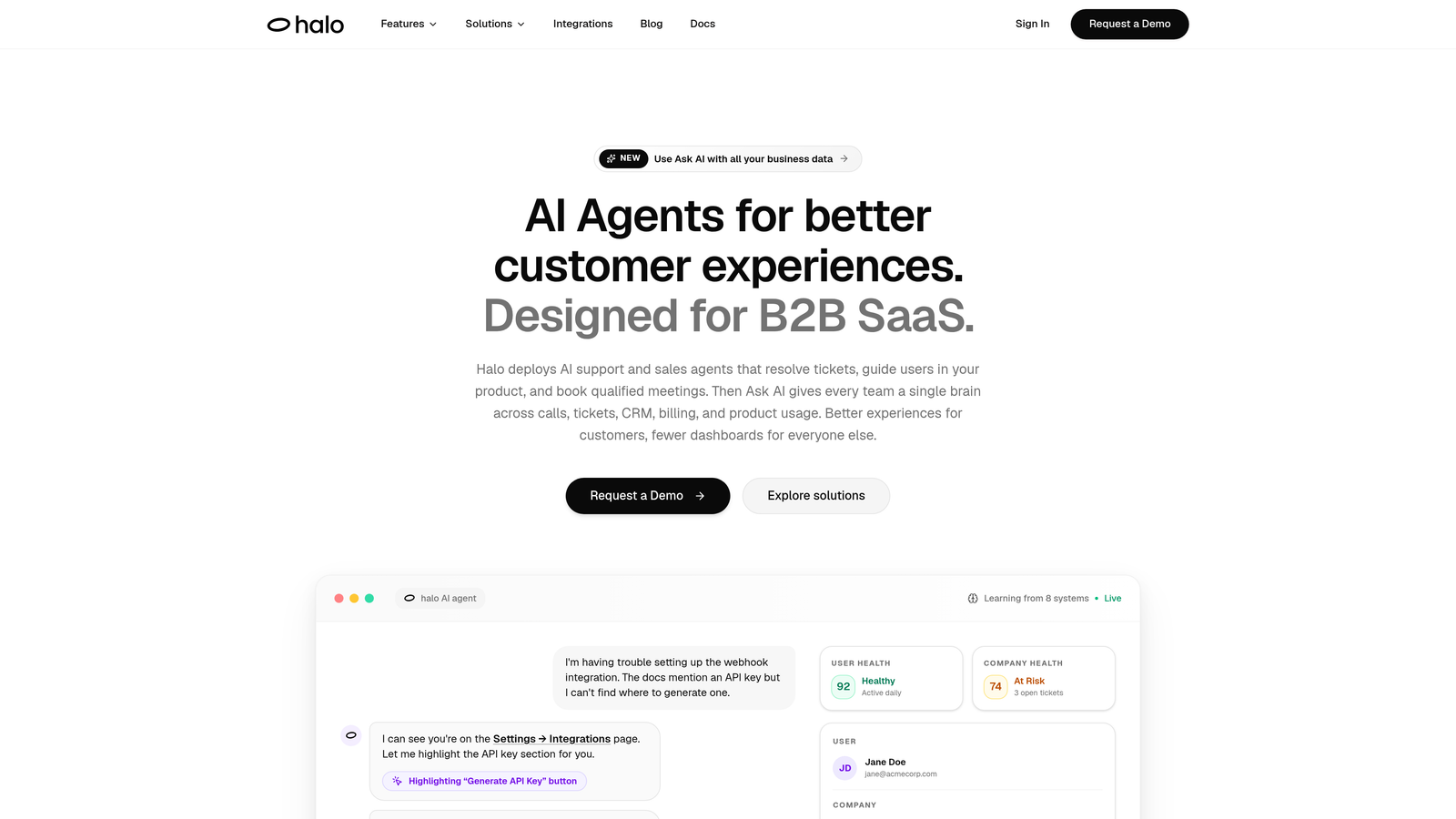
Halo AI is an AI-first customer support platform built around intelligent agents, page-aware chat, and business intelligence analytics for modern B2B teams.
Where This Tool Shines
Most helpdesks bolt AI on top of an existing ticket workflow. Halo is architected the other way around: AI agents are the core, and every interaction feeds a continuous learning loop that makes the system smarter over time. That distinction matters when you're evaluating total cost of ownership, because you're not paying a base helpdesk fee plus an AI add-on tier.
The page-aware chat widget is a standout capability. Rather than responding to typed queries in isolation, Halo's agent sees the same interface your user sees, which means it can deliver contextual, step-by-step UI guidance rather than generic documentation links. Pair that with the smart inbox's business intelligence layer, and support stops being a cost center and starts surfacing customer health signals and anomaly detection that feed directly into product and revenue decisions.
Key Features
AI Agents with Continuous Learning: Agents resolve tickets autonomously and improve with every interaction, reducing manual retraining cycles.
Page-Aware Chat Widget: Sees what the user sees in real time, enabling visual UI guidance instead of static help articles.
Smart Inbox with Business Intelligence: Surfaces customer health signals, anomaly detection, and revenue intelligence alongside support data.
Auto Bug Ticket Creation: Automatically routes bug reports to engineering tools like Linear, closing the loop between support and product teams.
Live Agent Handoff: Escalates complex issues to human agents seamlessly, with full conversation context preserved.
Native Integrations: Connects to Slack, HubSpot, Intercom, Stripe, Zoom, PandaDoc, and Fathom out of the box.
Best For
B2B SaaS companies and product teams that want AI to do more than deflect volume. Particularly strong for teams already using tools like Linear, HubSpot, or Stripe who want support intelligence to flow across their entire stack rather than stay siloed in a helpdesk.
Pricing
Structured around AI agent usage and integrations rather than per-seat helpdesk licensing. Current plan details are available at haloagents.ai. Verify directly for the most up-to-date pricing.
2. Intercom
Best for: Teams that want a mature omnichannel inbox with a capable AI agent layered on top.
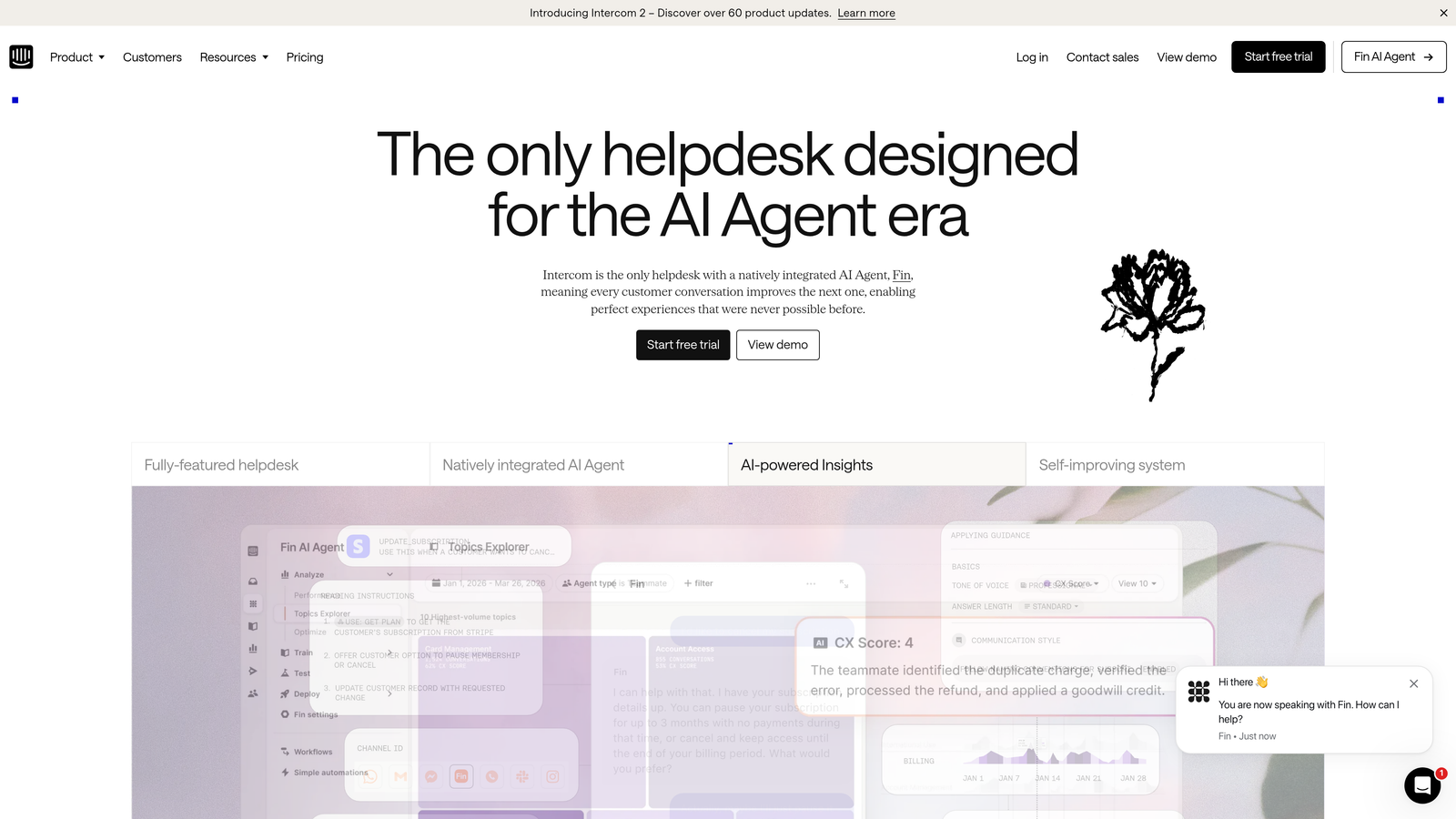
Intercom is a mature customer messaging platform with Fin AI Agent as its flagship AI support product, handling conversations autonomously with human handoff built in.
Where This Tool Shines
Intercom has one of the most polished AI agent experiences available today. Fin is genuinely capable at resolving common support queries using your help center content, and the per-resolution pricing option is appealing in theory: you pay when the AI actually solves something. In practice, the definition of "resolution" matters, so it's worth clarifying exactly what triggers a charge before committing.
The broader platform is strong for teams that need omnichannel coverage across chat, email, and social alongside AI automation. The workflow builder is flexible, and the reporting gives useful visibility into conversation outcomes. The main watch-out is cost at scale: seat-based pricing plus Fin resolution fees can compound quickly as team size and contact volume grow.
Key Features
Fin AI Agent: Handles conversations autonomously with per-resolution pricing available as an alternative to seat-based billing.
Omnichannel Inbox: Unified view across chat, email, and social channels.
Workflow Automation: Visual workflow builder for routing, tagging, and escalation logic.
Help Center Builder: Native knowledge base creation and management tied directly to Fin's training data.
Conversation Analytics: Reporting on resolution rates, response times, and CSAT.
Best For
Mid-market and growth-stage SaaS teams that want a proven omnichannel platform with a capable AI agent. Best suited to teams with established help center content that Fin can draw on immediately.
Pricing
Tiered seat-based plans plus optional per-resolution pricing for Fin AI. Enterprise requires a custom quote. Pricing scales steeply with team size and contact volume. Verify current rates at intercom.com.
3. Zendesk
Best for: Large, complex support organizations that need comprehensive ticketing, voice, and workforce management in one platform.
Zendesk is the industry-standard helpdesk platform with AI Agents and intelligent triage built into higher Suite tiers, suited to enterprise-scale support operations.

Where This Tool Shines
Zendesk's depth is hard to match. The platform covers ticketing, voice, messaging, workforce management, and an extensive app marketplace, making it a strong choice for organizations with complex routing needs, multiple support tiers, or regulatory requirements around data handling. If your support org has more than 50 agents, Zendesk's enterprise tooling starts to justify the cost.
The AI features have matured considerably. AI Agents can handle a meaningful portion of inbound volume on well-documented products, and intelligent triage reduces manual categorization work. The catch is that these capabilities are largely gated behind higher Suite tiers or sold as add-ons, so the entry-level per-agent price doesn't reflect what you'll actually spend to get AI working at a useful level.
Key Features
AI Agents: Automated ticket resolution drawing on your knowledge base, available at higher Suite tiers.
Intelligent Triage: AI-powered routing and categorization to reduce manual queue management.
Comprehensive Channel Coverage: Ticketing, voice, live chat, messaging, and social in one platform.
App Marketplace: Hundreds of integrations covering CRM, billing, analytics, and developer tools.
Workforce Management: Scheduling, forecasting, and quality assurance tools for larger teams.
Best For
Enterprise support teams and organizations with complex multi-tier workflows. Less cost-effective for small teams or startups where the full feature set won't be utilized.
Pricing
Per-agent Suite plans from entry to enterprise tiers. AI features included at higher tiers or available as paid add-ons. Enterprise pricing requires a custom quote. Verify current rates at zendesk.com.
4. Freshdesk
Best for: SMBs and growing teams looking for Zendesk-comparable features at a lower price point.
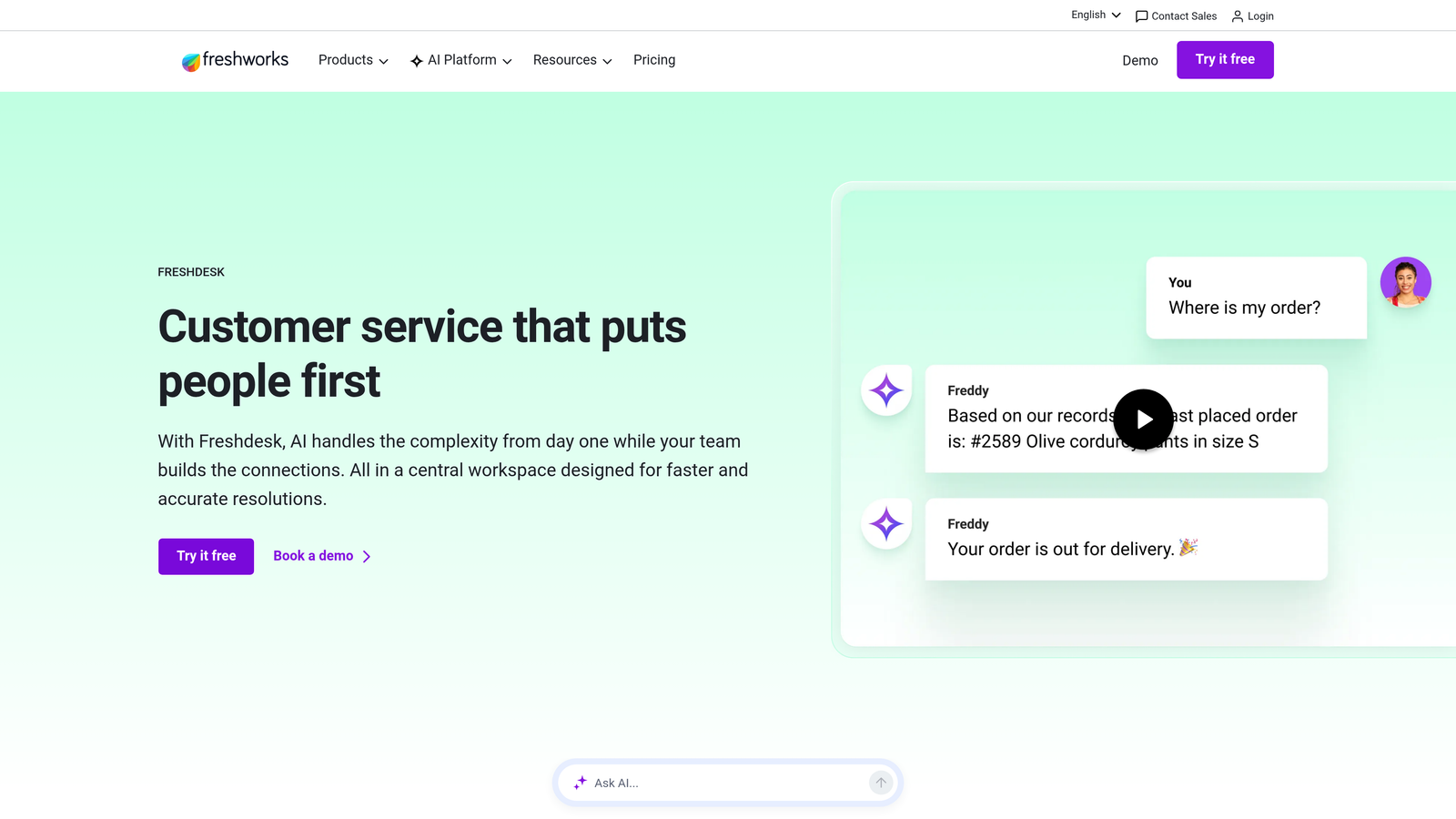
Freshdesk is a cost-competitive helpdesk with Freddy AI providing automation, self-service, and agent assistance across its paid tiers.
Where This Tool Shines
Freshdesk's main competitive advantage is value at the SMB tier. The free plan covers a surprising amount of ground for very small teams, and the paid tiers are generally priced below comparable Zendesk plans. For teams that need solid omnichannel support, a functional knowledge base, and basic automation without enterprise-level complexity, Freshdesk delivers a clean experience.
Freddy AI is the platform's automation layer, but it's worth understanding the tiering carefully. Freddy Self Service (for deflection) and Freddy Copilot (for agent assistance) are gated behind Pro and Enterprise plans. If AI automation is a core requirement rather than a nice-to-have, factor in the tier jump needed to unlock those capabilities when comparing true costs against competitors.
Key Features
Freddy AI Self Service: Automated ticket deflection using your knowledge base content, available on higher tiers.
Freddy Copilot: AI-assisted response suggestions and summarization for human agents.
Omnichannel Support: Email, chat, phone, and social channels unified in one inbox.
Free Tier: Functional free plan covering basic ticketing for small teams with limited agents.
Marketplace Integrations: Connections to common business tools including CRM and billing platforms.
Best For
SMBs and startups that need a capable helpdesk at a lower price point than Zendesk, with a clear upgrade path as the team grows. Also a strong fit for teams migrating off legacy helpdesks who want a familiar workflow.
Pricing
Free tier available with limited agents. Paid plans per agent per month across Growth, Pro, and Enterprise. Freddy AI features gated behind Pro and Enterprise. Verify current rates at freshworks.com.
5. Tidio
Best for: Small businesses and e-commerce teams wanting accessible AI chat at low entry cost.
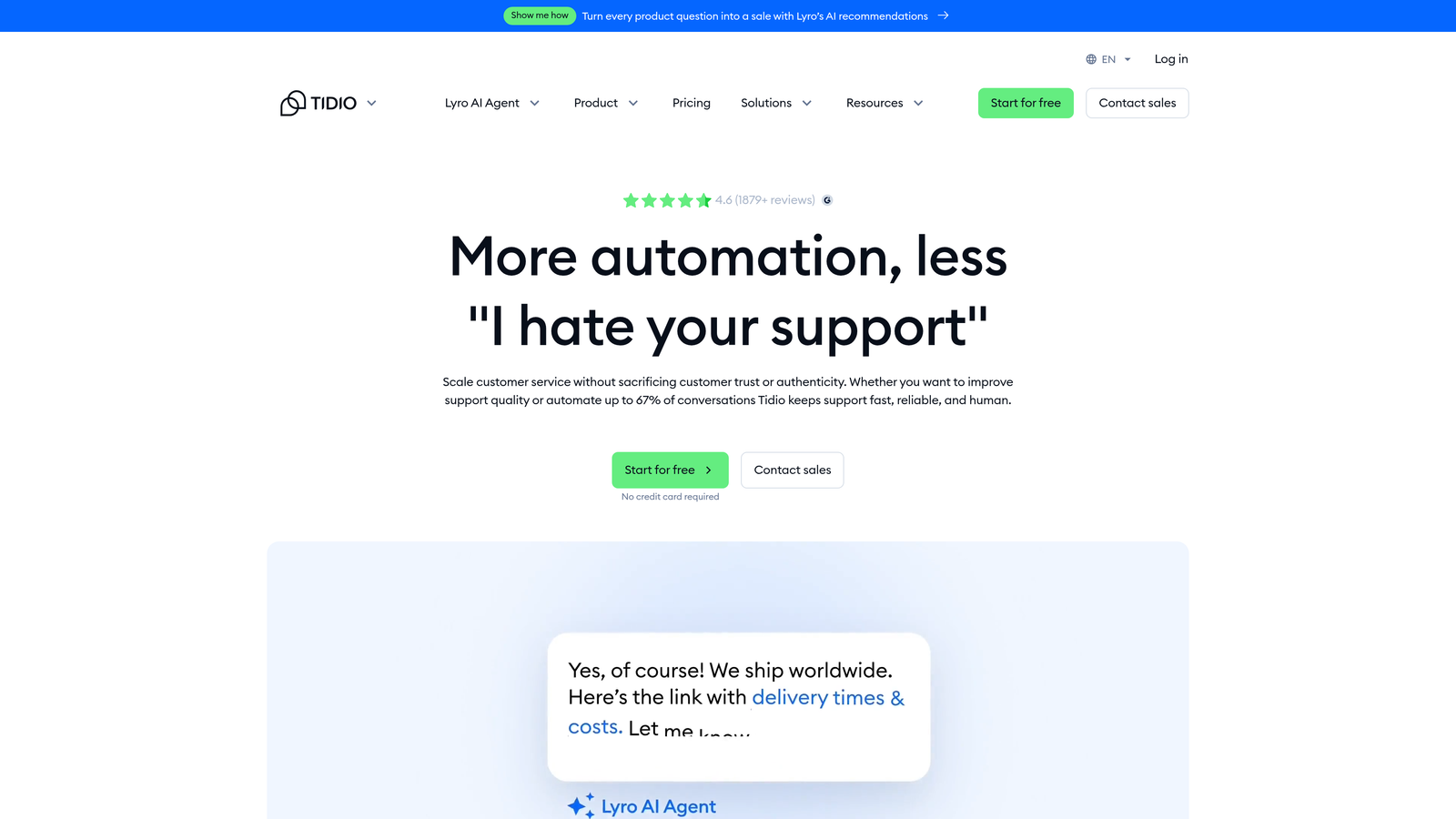
Tidio is an accessible AI chat platform with Lyro AI chatbot, designed for small businesses and e-commerce teams with conversation-based pricing that's easy to start with at low volume.
Where This Tool Shines
Tidio's strength is simplicity and accessibility. The setup process is fast, the interface is clean, and Lyro AI handles common customer questions well for businesses with straightforward support needs. For a small e-commerce team fielding repetitive order and shipping questions, Tidio can deflect a meaningful portion of inbound volume without requiring a dedicated support ops person to configure it.
The conversation-bundle pricing model is transparent and easy to reason about at low volumes. The watch-out is that bundle costs can escalate quickly as volume grows, and the platform's workflow depth doesn't match what you'd get from a full helpdesk. Tidio is best understood as an AI chat layer rather than a complete support system for teams with complex routing or escalation requirements.
Key Features
Lyro AI Chatbot: Automated conversation handling trained on your FAQ and help content.
Live Chat with Agent Fallback: Seamless handoff from Lyro to a human agent when needed.
E-commerce Integrations: Native connections to Shopify and WooCommerce for order-related queries.
Multi-Channel Support: Email and Messenger support alongside live chat.
Visual Flow Builder: No-code chatbot flow creation for custom conversation paths.
Best For
Small businesses, D2C brands, and e-commerce teams with straightforward, high-repetition support queries. Less suited for B2B SaaS teams that need complex ticket routing, API integrations, or deep CRM connectivity.
Pricing
Free tier available. Lyro AI conversations sold in bundles. Paid plans scale with conversation volume. Entry pricing is accessible; costs can rise at higher volumes. Verify current rates at tidio.com.
6. Drift (Salesloft)
Best for: B2B revenue teams where support automation and pipeline engagement overlap significantly.
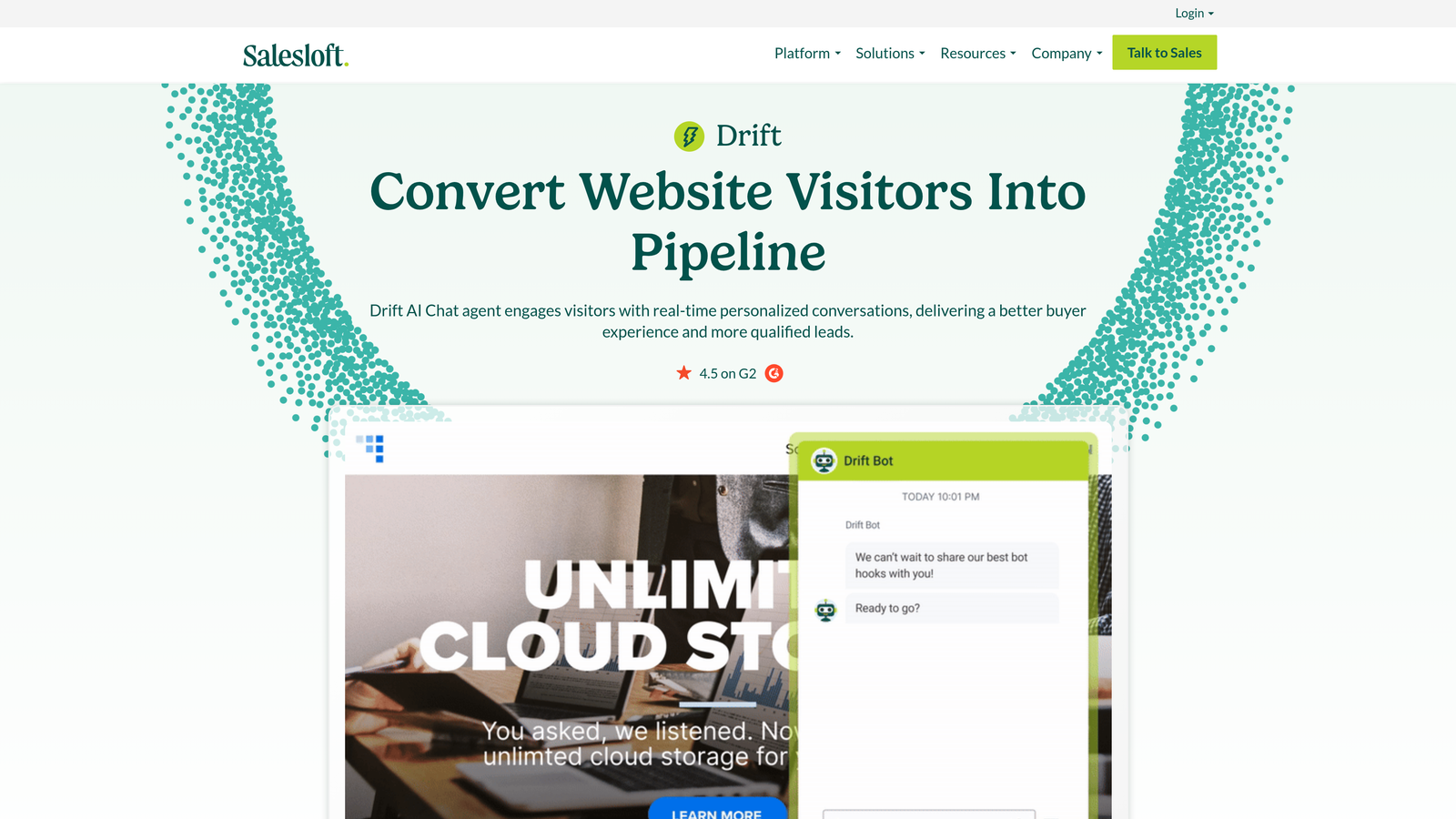
Drift, now part of Salesloft, is a conversational AI platform that blends sales engagement and support automation for mid-market and enterprise B2B teams.
Where This Tool Shines
Drift occupies a distinct position in this comparison: it's less a pure support tool and more a revenue engagement platform that includes support-like capabilities. If your inbound traffic includes a meaningful mix of prospects and customers, and your sales and support teams share ownership of the chat channel, Drift's account-based targeting and real-time buyer routing create experiences that a traditional helpdesk can't replicate.
The Salesloft integration deepens the revenue team angle, connecting conversational data to sales engagement workflows. For a pure support use case, Drift is likely more platform than you need and priced accordingly. But for B2B companies where the line between support and sales is genuinely blurry, it's worth evaluating seriously.
Key Features
AI Conversational Routing: Intelligent routing of inbound conversations based on buyer intent and account data.
Account-Based Targeting: Personalized experiences based on company and contact data from your CRM.
Salesforce and HubSpot Integration: Deep CRM connectivity for revenue team workflows.
Meeting Booking: In-conversation scheduling to accelerate pipeline from support or marketing touchpoints.
Pipeline Acceleration: Connects support interactions to revenue outcomes through Salesloft integration.
Best For
Mid-market and enterprise B2B teams with revenue-focused use cases where support, marketing, and sales share a conversational channel. Not the right fit for teams looking for a dedicated support ticketing system.
Pricing
Enterprise-oriented; pricing is not publicly listed and requires direct sales engagement. Generally positioned for mid-market and enterprise buyers. Contact Drift directly for current pricing.
7. Chatbase
Best for: Teams wanting a fast, lightweight AI deflection layer trained on their own documentation.
Chatbase is a lightweight AI chatbot builder that trains on your documentation and knowledge base, with transparent message-based pricing and rapid deployment.
Where This Tool Shines
Chatbase solves a specific problem extremely well: getting an AI chatbot live quickly, trained on your own content, without needing a developer or a lengthy implementation. You upload documents, point it at URLs, and the chatbot is ready to embed on your site within minutes. For teams that need basic AI deflection as a first layer before tickets hit human agents, the speed-to-value is hard to beat.
The pricing model is among the most transparent in this comparison. Message credits and chatbot limits are clearly published, and entry-level plans are genuinely affordable. The limitation is depth: Chatbase is not a helpdesk. There's no ticket management, no SLA tracking, no workforce management, and integration options are limited compared to full platforms. Think of it as an AI FAQ layer, not a support system replacement.
Key Features
Custom Document Training: Train the chatbot on your own PDFs, URLs, and FAQ content without coding.
Embeddable Widget: Deploy on any website with a simple embed code.
API Access: Available on higher plans for custom integration scenarios.
Lead Capture: Collect contact information within chat conversations.
Multi-Chatbot Management: Manage multiple distinct chatbots from one account on higher tiers.
Best For
Small teams, solo operators, and companies that need a fast, affordable AI deflection layer without full helpdesk infrastructure. Also useful as a supplementary widget alongside an existing support system.
Pricing
Free tier available. Paid plans tiered by message credits and number of chatbots. Transparent, publicly listed pricing. Affordable entry point for lightweight AI deflection. Verify current rates at chatbase.co.
8. Kustomer
Best for: High-volume consumer support teams managing complex customer histories across multiple channels.
Kustomer is a CRM-native AI support platform (Meta-owned) with conversation-based pricing and unified customer timelines, built for teams handling large contact volumes.
Where This Tool Shines
Kustomer's defining characteristic is its CRM-native architecture. Rather than treating each support ticket as an isolated event, the platform builds a unified timeline for every customer across all channels and interactions. For consumer brands managing repeat customers with complex purchase and service histories, that context makes a material difference in resolution quality and agent efficiency.
The conversation-based pricing model is structurally different from per-agent billing, and it can work in your favor if you have a relatively small agent team handling high contact volume. Instead of paying per seat, you pay per conversation, which means the cost scales with actual usage rather than headcount. The tradeoff is that high-volume periods can make cost forecasting harder, and enterprise-level access requires a direct quote.
Key Features
Unified Customer Timeline: Full cross-channel interaction history for every customer in a single view.
AI Conversation Routing: Automated routing and classification based on intent and customer data.
Conversation-Based Pricing: Charges per conversation rather than per agent seat.
Deep CRM Integration: Native CRM data embedded in every support interaction.
Omnichannel Coverage: Chat, email, SMS, social, and voice unified in one platform.
Best For
High-volume consumer support operations, particularly retail and subscription brands with complex customer histories. The conversation pricing model is most advantageous for teams with high contact-to-agent ratios.
Pricing
Enterprise-oriented with conversation-based pricing. Requires a direct quote. Can be cost-effective for high-volume teams with fewer agents relative to contact volume. Verify current rates at kustomer.com.
9. Gorgias
Best for: D2C e-commerce brands on Shopify or BigCommerce that want ticket-based pricing tied to order management.
Gorgias is an e-commerce-focused support platform with ticket-based pricing and deep Shopify, BigCommerce, and Magento integrations, including AI Automate for hands-free ticket resolution.
Where This Tool Shines
Gorgias is purpose-built for e-commerce support, and that focus shows in the product. The Shopify integration goes deep: agents can view order details, issue refunds, edit orders, and apply discounts directly from within the support inbox without switching tools. For D2C brands where the majority of support tickets are order-related, that operational efficiency compounds quickly.
The ticket-based pricing model is a meaningful structural difference from per-seat billing. You pay based on how many tickets you handle per month rather than how many agents you employ, which can be advantageous for teams with seasonal volume spikes or lean agent headcounts. AI Automate handles repetitive ticket types autonomously, and the revenue statistics feature ties support interactions to actual sales data, which is genuinely useful for justifying support investment to leadership.
Key Features
Ticket-Based Pricing: Charges per ticket per month rather than per agent seat.
Deep E-commerce Integrations: Native Shopify, BigCommerce, and Magento connections with in-inbox order management actions.
AI Automate: Autonomous resolution of repetitive order-related tickets without agent involvement.
Revenue Statistics: Ties support interactions to revenue outcomes for ROI reporting.
In-Inbox Order Actions: Refunds, edits, and discount application without leaving the support interface.
Best For
D2C retail brands and e-commerce teams on Shopify or BigCommerce with high volumes of order-related tickets. The platform's strengths are closely tied to e-commerce workflows; it's less relevant for pure SaaS B2B support teams.
Pricing
Starter to Advanced tiers publicly listed, priced by ticket volume per month. Add-ons available for higher automation limits. Verify current rates at gorgias.com.
Which Platform Actually Fits Your Situation
Nine tools, three billing models, and wildly different feature depths. Here's how to cut through the comparison quickly based on where you actually sit.
If you're a B2B SaaS team that wants AI to do more than deflect tickets, and you need support intelligence to flow across your product, engineering, and revenue stack, Halo AI is worth a close look. The AI-first architecture, page-aware context, and business intelligence layer are genuinely differentiated from anything else on this list. See Halo in action and discover how continuous learning transforms every interaction into smarter, faster support.