AI Support Ticket Routing: How It Works and Why It Matters for Your Support Team
AI support ticket routing uses machine learning to automatically analyze and direct incoming tickets to the right agent or team based on issue type, urgency, and expertise—eliminating the costly misrouting cycles that frustrate customers and slow resolution times. For B2B support teams managing high ticket volumes across multiple product areas, intelligent routing reduces unnecessary handoffs, preserves context, and helps customers reach the right specialist faster.
 Matt PattoliFounder12 min read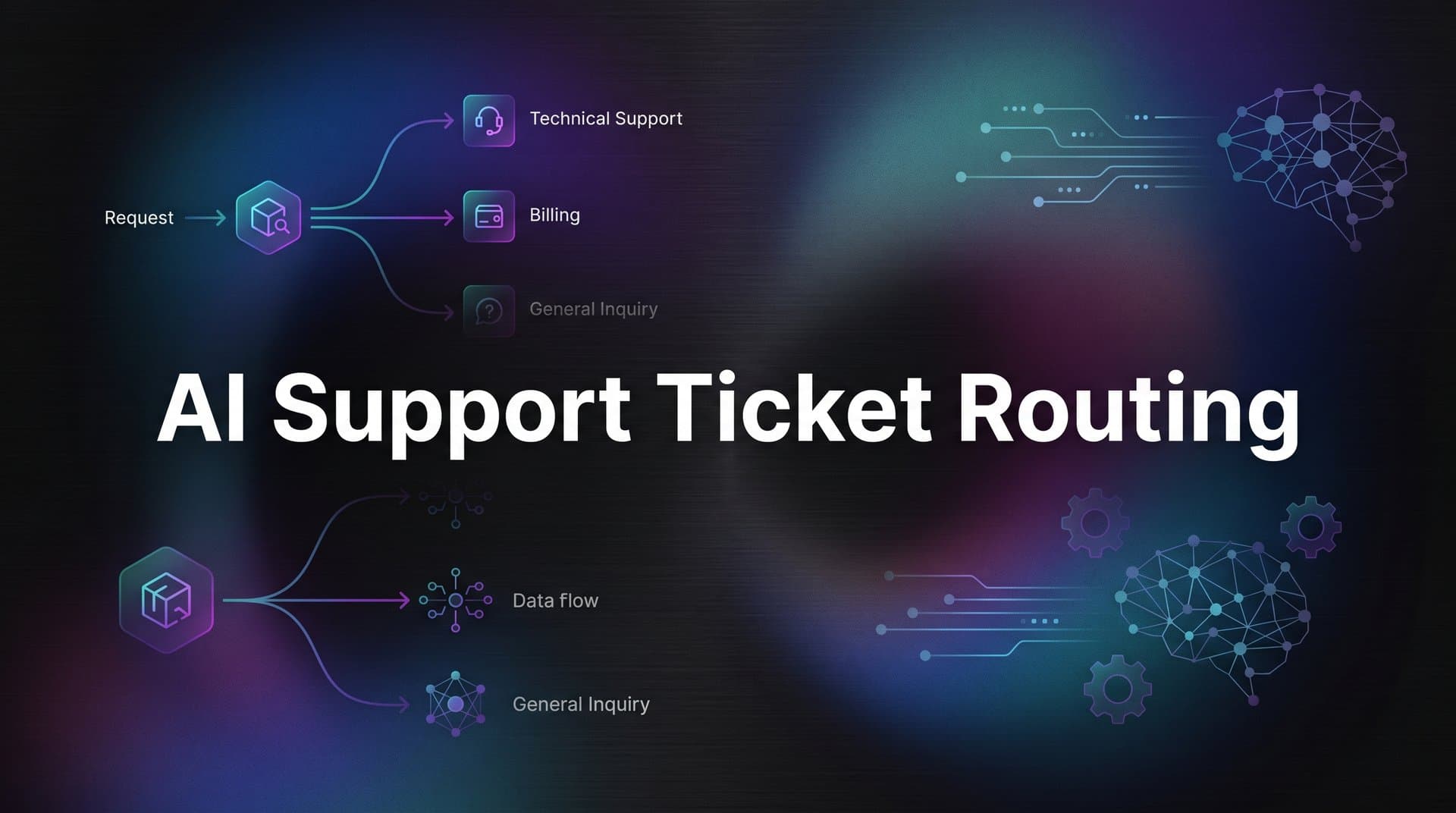
Picture this: a customer submits a support ticket about a billing issue. It lands in the general queue, gets picked up by a product specialist who realizes it's not their area, reassigns it to the billing team, where it sits for another day before someone notices it actually involves a payment processing error that needs a technical engineer. Three days later, the customer finally gets a resolution that should have taken two hours. They're frustrated, they've repeated themselves twice, and their trust in your product has taken a quiet but real hit.
This isn't a rare edge case. For any B2B support team handling volume across multiple product areas, this kind of misrouting happens constantly. And the damage compounds quietly: each reassignment adds queue time, each handoff erodes context, and each frustrated customer is one step closer to churning.
The root cause isn't a lack of effort from support teams. It's the fundamental limitation of traditional routing systems built on manual rules, static categories, and human triage that simply wasn't designed to scale. AI support ticket routing addresses this at the infrastructure level, replacing reactive sorting with intelligent, context-aware assignment that gets smarter over time. This article breaks down how it works, what it changes for your team, and what to look for when evaluating it for your support stack.
The Hidden Cost of Getting Tickets to the Wrong Place
Traditional routing systems are built on a deceptively simple premise: define rules, assign categories, and let the system sort. If the subject line contains "billing," send it to the billing team. If it mentions "login," route it to technical support. On paper, this seems reasonable. In practice, it breaks down almost immediately when you encounter the real complexity of customer language.
Consider the word "billing" alone. A ticket with "billing" in the subject could be a failed payment requiring engineering intervention, a refund request handled by customer success, a pricing question for sales, or a tax compliance issue needing finance. A keyword rule treats all four identically. The result is tickets landing with the wrong team, who then need to read, understand, and reassign them before any actual work begins.
The problem compounds as products grow. Every new feature, pricing tier, or integration creates new ticket categories that existing rules don't account for. Someone has to notice the gap, write a new rule, test it, and deploy it. In fast-moving B2B SaaS environments, rule maintenance becomes a part-time job that still can't keep pace with product evolution.
Misrouting creates a cascade of downstream costs that are easy to underestimate. The most visible is time: reassignment adds queue time at every step, and customers waiting through multiple handoffs experience delays that feel far worse than a single longer wait. But the less visible cost is context loss. Every time a ticket moves between agents or teams, the receiving agent starts from scratch. Customers are asked to repeat information they've already provided, which signals organizational dysfunction and erodes confidence in your support operation.
At scale, manual triage becomes a structural bottleneck. As ticket volume grows, the only way to maintain routing quality under a rule-based system is to add more people doing triage. This creates a direct, linear relationship between customer growth and headcount growth, exactly the scaling dynamic that modern support infrastructure should be designed to break. AI support ticket routing attacks this relationship directly by making the routing layer intelligent enough to handle complexity without proportional human intervention.
How AI Ticket Routing Actually Works Under the Hood
The technical foundation of AI routing is meaningfully different from rule-based systems, and understanding that difference helps clarify why it performs better on complex, real-world ticket data.
At the core is natural language processing. Rather than scanning for specific keywords, NLP models read the full content of a ticket, including the subject, body, any attachments, and associated metadata, to understand what the customer actually means. This is a semantic understanding, not a surface-level match. A transformer-based model can distinguish between "I can't log in" (an authentication issue) and "I logged in but can't access my dashboard" (a permissions or UI problem) even though both sentences contain the word "login." That distinction determines whether the ticket goes to the authentication team or the product team, and getting it right matters.
Intent classification is typically combined with entity extraction and sentiment analysis to build a richer picture of each ticket. Intent classification identifies what the customer is trying to accomplish. Entity extraction pulls out specific references like product names, error codes, or feature areas. Sentiment analysis detects emotional tone and urgency. Together, these signals give the routing model far more to work with than any keyword rule could provide.
The routing decisions themselves are made by machine learning models trained on historical ticket data. This is where the system gets genuinely intelligent over time. During training, the model learns from labeled outcomes: which tickets were resolved fastest, which agents handled which categories most effectively, and which routing decisions led to escalations or reassignments. The model internalizes these patterns and applies them to new tickets, continuously refining its assignments as new data comes in.
One important caveat worth acknowledging: cold-start is a real challenge. Teams with limited historical ticket data may not have enough labeled examples for the model to learn from immediately. In these cases, a hybrid approach combining rule-based routing with AI classification can bridge the gap while the model accumulates sufficient training signal. Over time, as the system processes more tickets and captures more outcome data, the AI component can take on a larger share of routing decisions with increasing confidence.
Beyond the ticket text itself, contextual signals from outside the ticket are layered into routing decisions. Customer tier, account history, the number of open tickets, recent product activity, and even the specific page or feature the user was on when they submitted the ticket all inform where it should go. A routing system connected to your CRM, billing platform, and product analytics can incorporate signals that a helpdesk-only system simply can't see. This integration depth is what separates genuinely intelligent routing from NLP-enhanced keyword matching with a better vocabulary.
Key Routing Signals AI Uses That Humans Miss
Sentiment and urgency detection: A ticket that reads "I've been waiting for three days and this is completely unacceptable" contains the same topical category as a calm, first-contact question about the same issue. But they require very different handling. AI models trained on sentiment analysis can flag the frustrated ticket for priority routing before any human reads it. This is particularly valuable for identifying at-risk customers early, when intervention can still change the outcome. Keyword rules cannot do this reliably because frustrated language is too varied and contextual to capture with static conditions.
Customer context signals: Not all customers are equal in terms of urgency, and AI routing can reflect that without requiring manual prioritization. Account health scores, subscription tier, contract value, days until renewal, and the number of unresolved open issues can all be incorporated into routing priority. An enterprise customer on a premium plan with a billing issue three weeks before renewal should be routed differently than a new trial user with the same question. Static rules can approximate this with tier-based conditions, but they can't dynamically incorporate real-time account health signals the way a system connected to your CRM can.
Page-aware and session context: This is one of the most underappreciated routing signals available. Knowing what feature or page a user was on when they submitted a ticket transforms generic routing into targeted assignment. A ticket submitted from the API documentation page almost certainly involves a technical integration question. A ticket submitted from the billing settings page narrows the issue space considerably. Page-aware context gives the routing model precision that ticket text alone often can't provide, especially for short or ambiguous submissions where customers haven't fully described their problem.
The compounding effect of these signals is significant. A routing decision informed by ticket intent, customer sentiment, account tier, and page context is categorically more accurate than one based on subject line keywords. Each additional signal reduces the probability of misrouting, and the cumulative improvement across thousands of tickets per month translates directly into faster resolution times and fewer frustrated customers experiencing the reassignment cycle described at the outset.
What Changes for Your Support Team When Routing Gets Smarter
The operational impact of intelligent routing extends well beyond the routing layer itself. When tickets consistently arrive matched to the right agent's expertise, the entire support workflow becomes more efficient.
Agents spend less time orienting themselves to unfamiliar territory. When a complex enterprise integration issue lands with a senior technical specialist rather than a generalist, that agent doesn't need to research the product area before they can begin solving the problem. They can engage immediately with full context, reducing handle time and improving the quality of the resolution. This expertise matching is particularly valuable for B2B support teams where issue complexity varies significantly across customer segments.
Volume spikes become more manageable because AI routing distributes load dynamically rather than flooding a single queue. Traditional routing often creates uneven load distribution where certain teams or agents are overwhelmed while others have capacity. Intelligent routing can balance load across available agents while still respecting expertise matching, using real-time queue depth as an input to routing decisions. Teams can absorb higher volumes without the same proportional increase in headcount that rule-based systems require.
The feedback loop also changes. When agents receive well-matched tickets, they resolve them faster and with fewer escalations. This generates better outcome data for the model to learn from, which improves future routing decisions. The system becomes self-reinforcing in a way that rule-based routing never can be, because rules don't learn from outcomes.
Support leaders gain a new layer of operational visibility. Routing analytics reveal patterns that would otherwise be invisible: which categories are most frequently misclassified, where reassignment rates are highest, which agents consistently outperform on specific issue types. This turns the routing layer from a black box into a source of genuine intelligence about where your support operation has gaps and where it's performing well. That visibility informs hiring decisions, training priorities, and product feedback loops in ways that raw ticket volume metrics never could.
Routing vs. Resolution: Where AI Ticket Routing Fits in the Bigger Picture
Here's a distinction worth making explicit, because it's often glossed over in vendor conversations: routing and resolution are different capabilities, and the best support infrastructure needs both.
Routing is the entry point. It determines where a ticket goes: which agent, which team, which queue, or which automated workflow. Even the most sophisticated routing still delivers tickets to a destination. If that destination is a human agent, routing has done its job, but the resolution work hasn't started yet. Getting a ticket to the right place faster is genuinely valuable, but it's not the same as solving the problem.
Resolution is what happens next. AI agents that can actually resolve tickets autonomously reduce the volume that ever needs routing in the first place. When a customer submits a password reset request, an AI agent that can handle the entire interaction end-to-end is more valuable than a routing system that sends it to the right human slightly faster. The two capabilities work best together: AI resolution handles the resolvable tickets immediately, while smart routing ensures that the remaining, more complex issues reach the best-positioned human or specialized workflow without delay and with full context attached.
This distinction matters when evaluating solutions. Many products marketed as "AI routing" are sophisticated classification systems that improve where tickets land but don't reduce the total volume requiring human attention. A platform that combines intelligent routing with autonomous resolution capability represents a fundamentally different value proposition: it reduces the queue while also improving how the queue is managed.
Integration depth is the third piece of this picture. Routing decisions are only as good as the data flowing into them. A routing system connected only to your helpdesk has a narrow view of each ticket. A system connected to your CRM, billing platform, product analytics, and communication tools like Slack and Intercom can incorporate signals from across the business stack. Halo AI's integrations with Linear, HubSpot, Stripe, and others mean that routing decisions can reflect the full customer context, not just what's visible in the support ticket itself. That breadth of signal is what makes routing genuinely contextual rather than just categorically accurate.
Evaluating AI Routing for Your Stack
If you're assessing AI support ticket routing solutions, the right questions will reveal meaningful differences between vendors that surface-level demos often obscure.
Does it learn from outcomes, or rely on static configuration? A system that requires manual rule updates to improve is fundamentally limited by the time and attention of your team. A system that learns from which routing decisions led to fast resolutions, low reassignment rates, and high satisfaction scores improves automatically as it processes more data. Ask vendors specifically how their model is updated and what feedback signals it incorporates.
How does it handle tickets that don't fit existing categories? Every support operation encounters novel issue types, especially in fast-moving B2B products. A routing system that can only classify tickets into predefined categories will fail gracefully or fail badly when something new appears. Ask how the system handles out-of-distribution tickets and whether it surfaces them for human review rather than forcing them into the wrong category.
What signals does it use beyond ticket text? This question separates routing systems from intelligent routing platforms. If the answer is limited to ticket content and basic metadata, you're looking at a more sophisticated version of keyword matching. If the answer includes customer tier, account health, page context, product usage, and CRM data, you're looking at something genuinely different.
On the implementation side, data quality and historical ticket volume matter. Models trained on richer, more accurately labeled historical data produce better routing decisions earlier. Teams should also plan for a feedback mechanism that allows agents to flag misroutes, creating the signal the model needs to improve. Without this loop, even a well-designed system will plateau rather than compound its accuracy over time.
The Bottom Line
The shift from static, rule-based routing to intelligent, context-aware AI routing isn't an incremental improvement. It's a foundational upgrade to how support operations handle complexity and scale. Rule-based systems were designed for a simpler world where ticket categories were stable, customer language was predictable, and support volume was manageable. None of those conditions hold for modern B2B support teams.
AI support ticket routing addresses the problem at the right level: it understands intent rather than matching keywords, incorporates context that humans miss, and improves continuously rather than requiring constant manual maintenance. The operational result is fewer misroutes, faster resolutions, better agent utilization, and support leaders who can actually see what's happening in their routing layer.
But routing is most powerful when it's paired with resolution capability. Getting tickets to the right place faster matters most when the right place can act immediately, whether that's an AI agent resolving the issue autonomously or a human specialist who receives the ticket with full context already assembled.
Your support team shouldn't scale linearly with your customer base. Let AI agents handle routine tickets, guide users through your product, and surface business intelligence while your team focuses on complex issues that need a human touch. See Halo in action and discover how continuous learning transforms every interaction into smarter, faster support.