9 Best AI Support Ticket Systems for B2B Teams in 2026
This guide evaluates nine of the best AI support ticket systems available in 2026, helping B2B SaaS teams move beyond basic auto-replies to platforms that autonomously resolve tickets, intelligently route complex issues, and deliver business intelligence that scales without scaling headcount.
 Grant CooperFounder13 min read
Managing a growing support queue with a lean team is one of the most common scaling challenges in B2B SaaS. AI support ticket systems have moved well beyond simple auto-replies: today's platforms can resolve tickets autonomously, detect patterns across thousands of conversations, route complex issues intelligently, and surface business intelligence that goes far beyond support metrics.
But not all AI ticketing tools are built the same. Some are AI layers bolted onto legacy helpdesks. Others are built AI-first from the ground up, with autonomous resolution at their core architecture. The difference matters more than most teams realize until they're mid-implementation.
This guide covers nine of the best AI support ticket systems available in 2026, evaluated on autonomous resolution capability, integration depth, ease of deployment, and how well they scale without scaling headcount. Whether you're migrating from a traditional helpdesk or adding AI to an existing workflow, here are the top tools to consider.
1. Halo AI
Best for: B2B SaaS teams that need autonomous ticket resolution and business intelligence in one platform.
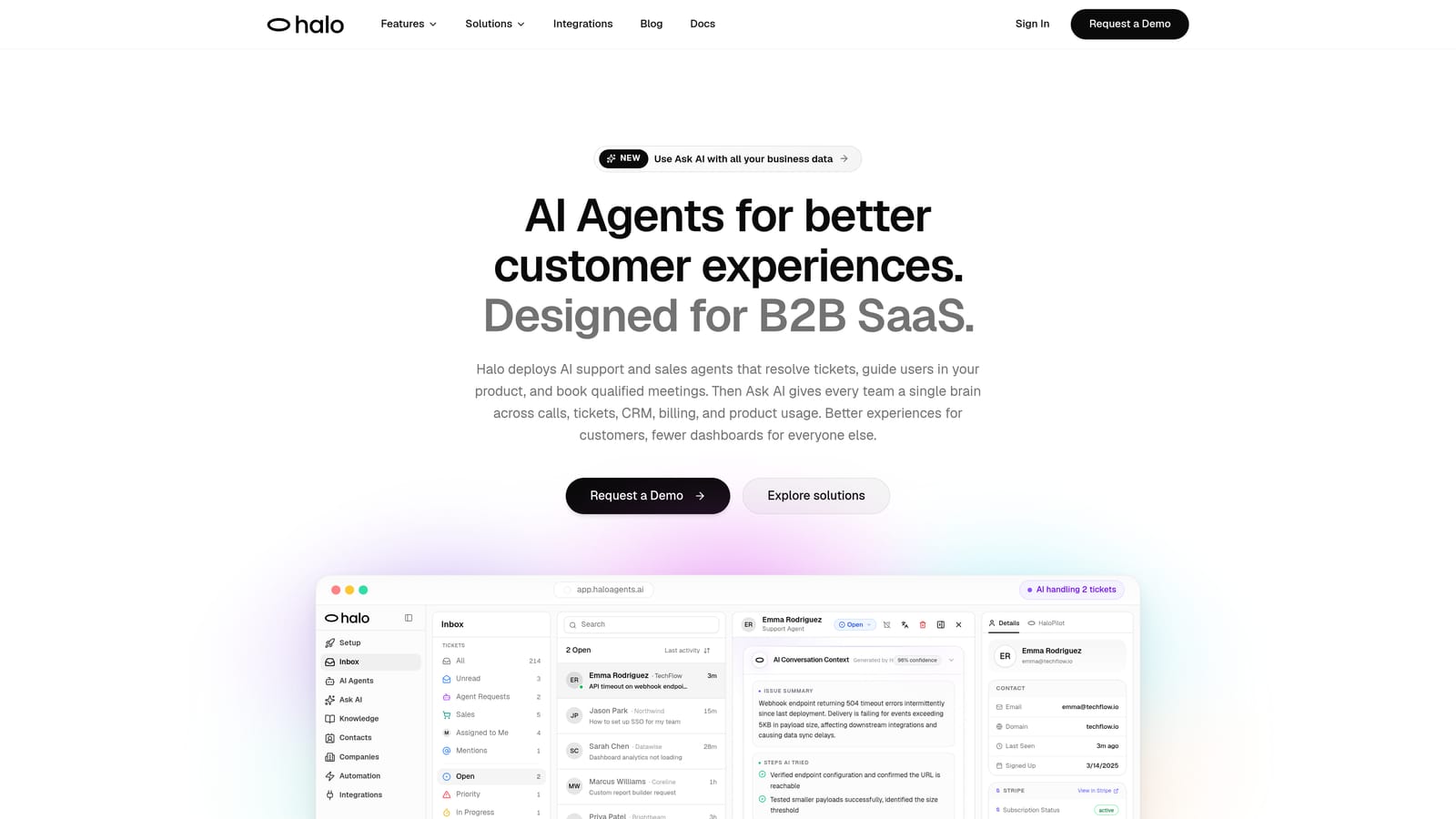
Halo AI is an AI-first customer support platform built to resolve tickets end-to-end, guide users through your product, and surface business intelligence — all without growing your headcount.
Where This Tool Shines
Unlike platforms that add AI as a feature layer on top of existing ticketing infrastructure, Halo is architected around autonomous resolution from the start. Its AI agents handle tickets end-to-end, learning from every interaction to get smarter over time rather than staying static.
What genuinely sets Halo apart for SaaS teams is its page-aware chat widget. The AI knows where a user is in your product when they ask a question, which means it can provide contextually accurate guidance rather than generic answers. Pair that with a smart inbox that surfaces customer health signals and anomaly detection, and you have a support tool that also functions as a business intelligence layer for your product and CS teams.
Key Features
Autonomous AI Agents: Resolve support tickets end-to-end without agent involvement, escalating to humans only when genuinely needed.
Page-Aware Chat Widget: Sees what users see in your product and provides visual UI guidance specific to their current context.
Smart Inbox with Business Intelligence: Surfaces customer health signals, anomaly detection, and revenue intelligence directly from support interactions.
Auto Bug Ticket Creation: Automatically identifies and routes bug reports to engineering via Linear integration, without manual triage.
Live Agent Handoff: Seamlessly transfers complex issues to human agents with full conversation context preserved.
Full Stack Integrations: Connects to Slack, HubSpot, Intercom, Stripe, Zoom, PandaDoc, and Fathom for a genuinely connected support operation.
Best For
B2B SaaS product teams and customer success organizations that want AI to handle routine support autonomously while generating actionable intelligence about customer behavior, product friction, and churn signals. Particularly strong for teams already using tools like Linear, HubSpot, or Intercom.
Pricing
Contact for pricing. A demo is available at haloagents.ai/demo to see the platform in action before committing.
2. Zendesk AI
Best for: Enterprise teams that need a mature, ecosystem-rich helpdesk with AI layered in.
Zendesk AI is an enterprise-grade ticketing platform with AI triage, intent detection, intelligent routing, and agent assist built into one of the most established helpdesk ecosystems available.
Where This Tool Shines
Zendesk's strength has always been its ecosystem maturity. The app marketplace is extensive, the reporting capabilities are robust, and the platform handles complex SLA management well at scale. The AI additions — intent detection, intelligent routing, AI-generated macros — are solid and well-integrated into the existing workflow.
The honest caveat is that Zendesk's AI is additive rather than foundational. If you're evaluating purely on autonomous resolution capability, you'll notice that the AI primarily assists agents rather than replacing their involvement on routine tickets. For large enterprise teams where that model works, it's a strong choice. For teams looking to minimize agent touchpoints entirely, the architecture has limits.
Key Features
AI Intent Detection and Triage: Automatically categorizes incoming tickets based on content and routes them to the right queue or agent.
Intelligent Routing: Matches tickets to agents based on skills, workload, and ticket content.
AI-Generated Macros and Suggested Replies: Speeds up agent response time with contextually relevant reply suggestions.
Large App Marketplace: Hundreds of third-party integrations for connecting Zendesk to your broader stack.
Robust SLA Management and Reporting: Comprehensive tooling for tracking response times, resolution rates, and team performance.
Best For
Enterprise support organizations with established workflows, large agent teams, and a need for deep customization and ecosystem integrations. Less ideal for lean teams prioritizing autonomous resolution over agent assist.
Pricing
Suite plans start at approximately $55 per agent per month. AI features are available on higher tiers, which can increase the per-seat cost meaningfully at scale.
3. Intercom Fin
Best for: Teams with well-documented help content who want conversational AI deflection at the front line.
Intercom Fin is Intercom's AI agent, designed to resolve customer queries using your existing help center content before escalating to human agents.
Where This Tool Shines
Fin's core strength is its conversational quality. It handles natural language queries well and draws on your existing help documentation to generate responses that feel genuinely helpful rather than robotic. For products with comprehensive help content, Fin can deflect a meaningful volume of front-line queries without requiring significant setup.
It's worth noting that Intercom is primarily a messaging and customer communications platform that has added ticketing capabilities over time. If your support operation is chat-first and your team already lives in Intercom, Fin is a natural fit. If you need deeper ticketing infrastructure or complex routing logic, you may find the platform's heritage as a messaging tool creates constraints.
Key Features
Fin AI Agent: Resolves queries using your help center content with natural language understanding and conversational responses.
Seamless Human Handoff: Transfers conversations to live agents when Fin reaches its resolution limits, with context intact.
Multi-Language Support: Handles queries in multiple languages for global support teams.
Resolution Rate Analytics: Tracks Fin's performance and conversation quality so you can identify content gaps.
Chat-Native Interface: Designed for conversational support experiences rather than traditional ticket-based workflows.
Best For
Teams already using Intercom for customer communications who want to add AI deflection without switching platforms. Works best when your help content is thorough and well-organized.
Pricing
Intercom plans start at approximately $39 per month. Fin is priced per resolution as an add-on, so costs scale with usage volume rather than seat count.
4. Freshdesk Freddy AI
Best for: Growing SMB and mid-market teams that need solid AI assistance at competitive price points.
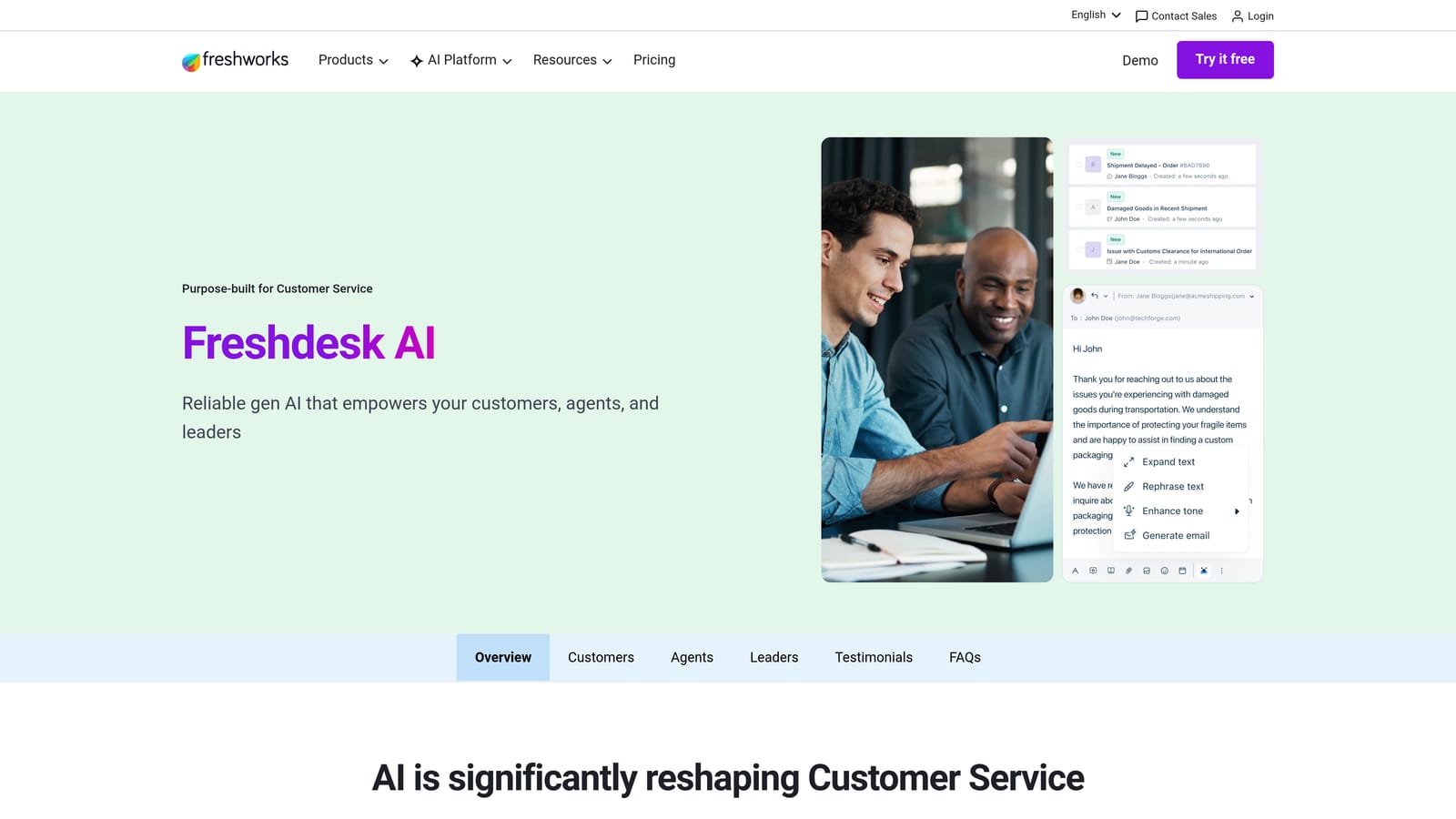
Freshdesk's Freddy AI handles ticket triage, suggested replies, and agent assistance — designed to reduce manual workload for support teams without the enterprise price tag.
Where This Tool Shines
Freshdesk has long been positioned as the more accessible alternative to Zendesk, and Freddy AI continues that trend. The AI features cover the core bases: automated categorization, routing, sentiment analysis, and agent assist. For teams that don't need deep autonomous resolution but want meaningful AI-driven efficiency gains, Freddy delivers at a price point that makes sense for growing teams.
The omnichannel support is genuinely useful, covering email, chat, phone, and social in one platform. Freddy Self Service adds a customer-facing chatbot layer for deflection before tickets are created. It's a well-rounded package for its target market, though teams with complex automation needs may find the AI depth falls short of enterprise-grade alternatives.
Key Features
Freddy AI Triage: Automated ticket categorization and routing based on content analysis.
Agent Assist: Suggested replies and relevant knowledge base articles surfaced in real time as agents work tickets.
Freddy Self Service: Customer-facing AI chatbot for deflecting common queries before they become tickets.
Sentiment Analysis and CSAT Prediction: Flags tickets with negative sentiment and predicts satisfaction outcomes.
Omnichannel Support: Unified inbox across email, chat, phone, and social channels.
Best For
SMB and mid-market support teams that want solid AI assistance without enterprise complexity or pricing. A strong choice for teams migrating away from basic email-based support for the first time.
Pricing
Growth plan starts at approximately $15 per agent per month. Freddy AI features are available on higher tiers, with pricing that remains competitive against enterprise alternatives.
5. Salesforce Service Cloud Einstein
Best for: Enterprise organizations where customer support is deeply tied to Salesforce CRM data.
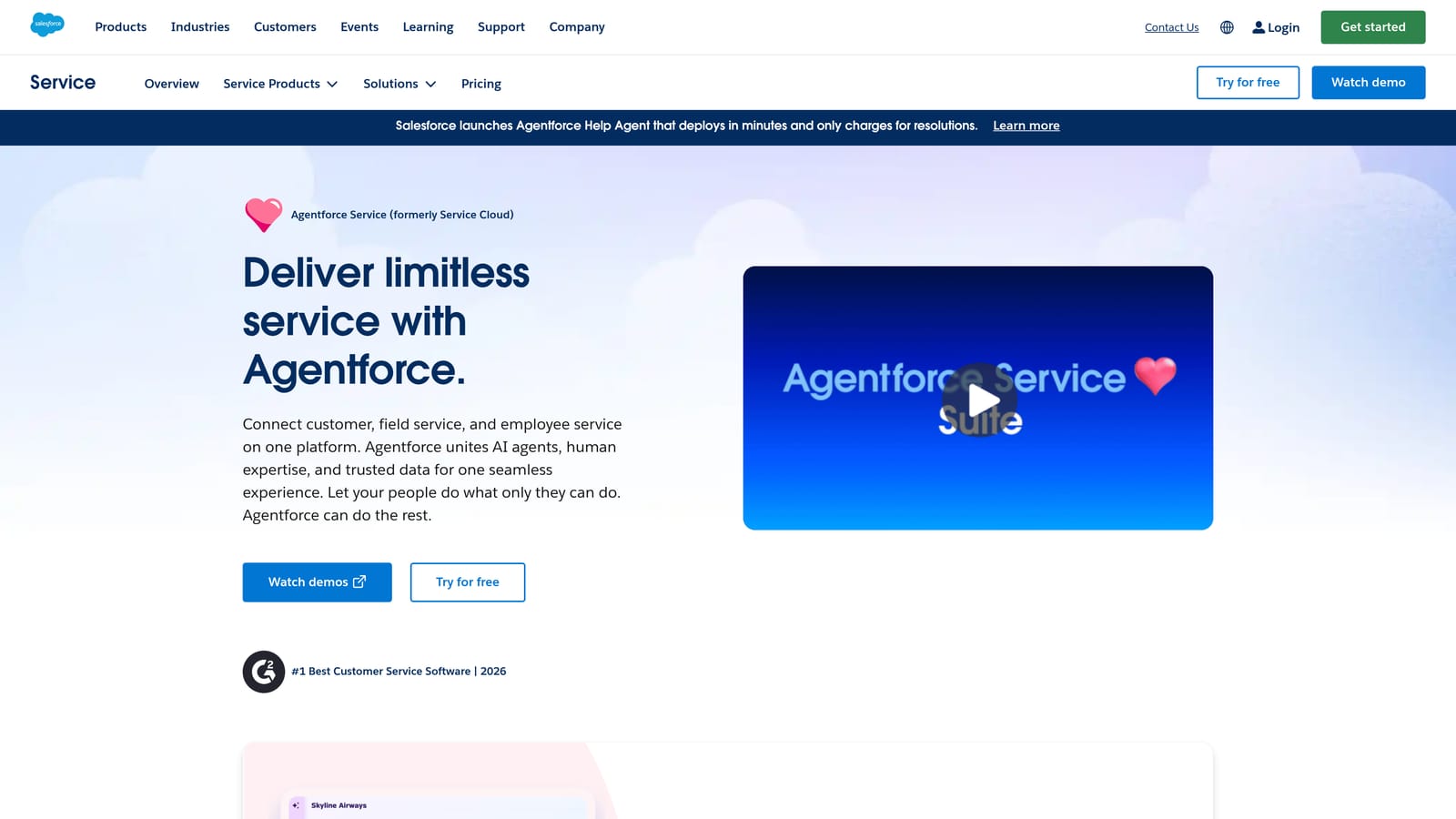
Salesforce Service Cloud Einstein connects support cases directly to deep CRM data, enabling context-rich resolution for complex enterprise customer relationships.
Where This Tool Shines
If your business runs on Salesforce and your support team needs instant access to the full customer relationship context — deal history, account health, contract details, open opportunities — Einstein's integration depth is unmatched. The AI surfaces next-best-action recommendations that are genuinely informed by the customer's full history, not just their recent support interactions.
The tradeoff is implementation complexity and cost. Service Cloud Einstein is an enterprise platform that typically requires significant setup investment and ongoing administration. It's built for organizations with dedicated Salesforce administrators and complex support workflows, not lean teams looking for quick deployment.
Key Features
Einstein Case Classification and Routing: AI-powered case categorization with next-best-action recommendations informed by CRM data.
Deep CRM Integration: Full customer history, account data, and relationship context available within every support case.
Einstein Bots: Self-service deflection bots that can access Salesforce data to personalize responses.
Predictive CSAT and Churn Risk Scoring: Identifies at-risk customers based on support patterns and relationship data.
Omni-Channel Routing: Routes cases across voice, chat, email, and messaging based on agent skills and availability.
Best For
Large enterprises with established Salesforce deployments where CRM integration depth justifies the implementation investment. Not the right fit for teams without existing Salesforce infrastructure.
Pricing
Enterprise plans start at approximately $165 per user per month. Implementation costs are typically significant and should be factored into total cost of ownership.
6. Help Scout AI
Best for: Small to mid-size teams that prioritize clean, simple support tooling with AI assistance built in.
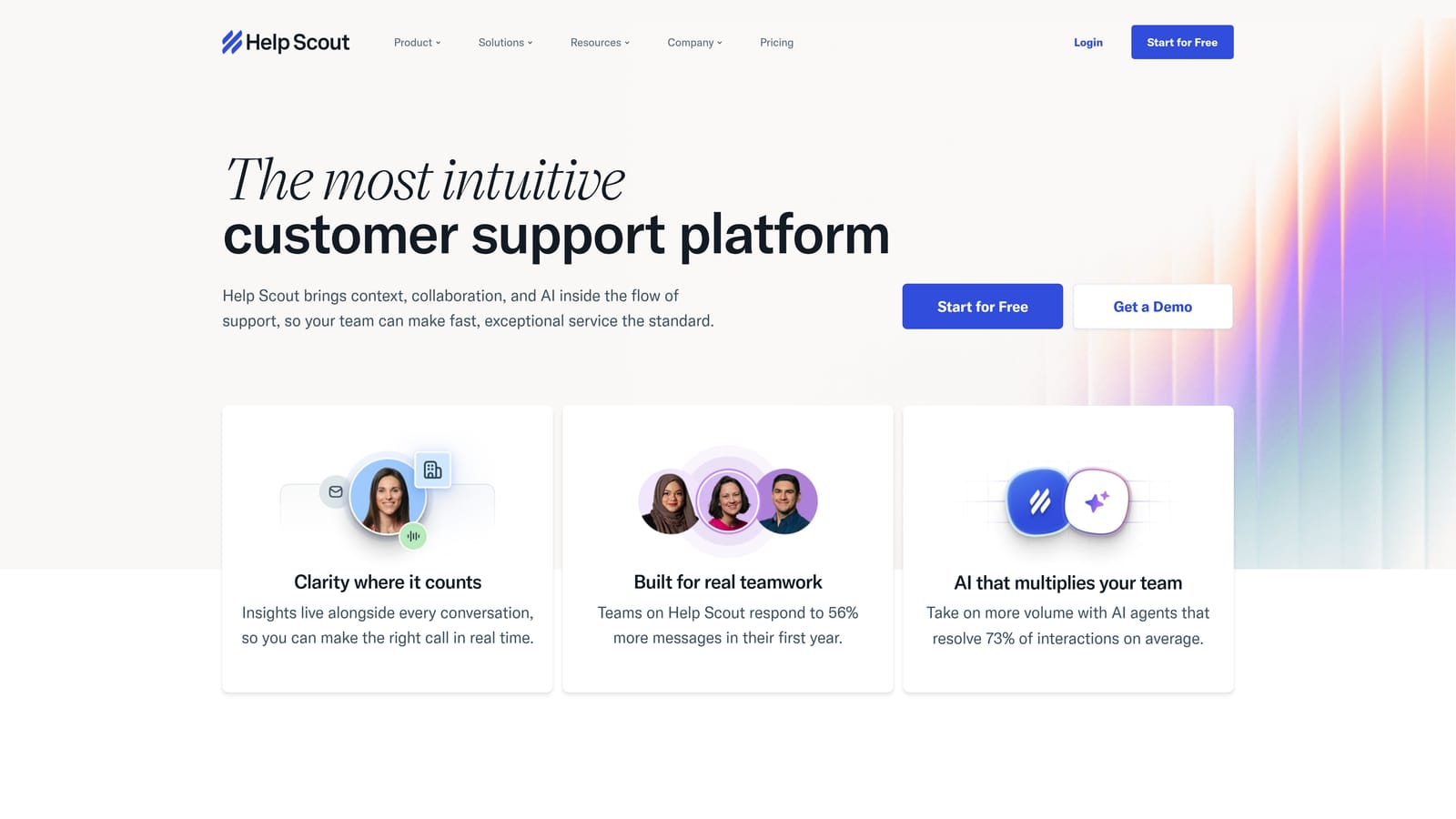
Help Scout is a lightweight helpdesk with AI-powered summarization, draft replies, and answer suggestions — designed for teams that want simplicity without sacrificing usefulness.
Where This Tool Shines
Help Scout has always prioritized the agent experience, and its AI additions follow the same philosophy: reduce friction, surface context faster, and help agents respond more efficiently. AI Summarize condenses long conversation threads into a quick brief, which is genuinely useful when an agent picks up a ticket mid-conversation. AI Drafts generates suggested replies that agents can edit and send rather than composing from scratch.
The platform won't win on automation depth or autonomous resolution capability. But for teams that want human agents to remain in the loop and simply work faster, Help Scout's AI is well-integrated and easy to use without training or configuration overhead.
Key Features
AI Summarize: One-click conversation summaries that give agents instant context on long or complex threads.
AI Drafts: Suggested reply drafts generated from conversation history, ready for agents to review and send.
AI Answers: Surfaces relevant help documentation before a ticket is submitted, reducing inbound volume.
Shared Inbox with Collision Detection: Prevents duplicate replies with real-time visibility into who's working each conversation.
Simple Reporting: Clean performance metrics without enterprise complexity.
Best For
Small to mid-size support teams that value ease of use and a clean agent experience. Ideal for teams that want AI to assist agents rather than replace them, without managing complex automation rules.
Pricing
Standard plan starts at approximately $22 per user per month. AI features are included on most plans, making it one of the more accessible entry points for AI-assisted support.
7. Tidio Lyro AI
Best for: Small businesses and e-commerce teams that want affordable AI deflection before tickets are created.
Tidio Lyro is a conversational AI agent trained on your FAQ and help content to handle repetitive queries automatically, with live chat fallback for anything it can't resolve.
Where This Tool Shines
Lyro's value proposition is straightforward: train it on your help content, deploy it on your site or app, and let it handle the repetitive questions that consume your team's time. For businesses where a significant portion of inbound queries are variations on the same handful of questions, Lyro can deflect meaningfully without complex setup.
The e-commerce integrations with Shopify and WooCommerce make it particularly useful for online retail teams. The pricing model — based on conversation volume rather than seats — keeps costs manageable for smaller operations. It's not the deepest AI ticketing platform on this list, but it delivers solid value at its price point for the right use case.
Key Features
Lyro AI Agent: Trained on your help content to answer repetitive queries automatically in natural conversation.
Live Chat Fallback: Seamlessly transitions to a human agent when Lyro reaches the boundaries of its knowledge.
Flows for Automated Routing: Conversation routing and lead capture automation without coding.
E-Commerce Integrations: Native connections with Shopify and WooCommerce for order-related support queries.
Accessible Pricing: Volume-based pricing that scales affordably for small teams.
Best For
Small businesses, e-commerce teams, and early-stage SaaS companies that want affordable AI deflection without enterprise tooling overhead. Less suited for complex B2B support workflows.
Pricing
A free tier is available. Lyro AI starts at approximately $29 per month, with pricing based on conversation volume rather than agent seats.
8. Kustomer AI
Best for: High-volume consumer support operations that need omnichannel AI workflows across every channel.
Kustomer is a CRM-native omnichannel support platform with AI-powered workflows across email, chat, SMS, and social — built for scale in consumer-facing support environments.
Where This Tool Shines
Kustomer's defining characteristic is its CRM-native design. Every customer interaction — regardless of channel — is organized around the customer timeline rather than individual tickets. Agents see the full history of every interaction in one view, and AI workflows can act on that context to route, respond, and escalate intelligently.
The platform handles omnichannel volume well, which makes it a strong fit for consumer brands dealing with high inbound across multiple channels simultaneously. For B2B SaaS teams, the CRM-native model is useful, though the platform's strengths are most pronounced in high-volume B2C environments where channel diversity and customer timeline context are critical.
Key Features
Omnichannel AI Routing: Intelligent conversation routing across email, chat, SMS, social, and voice in a single platform.
CRM-Native Customer Timeline: Full customer history visible in every interaction, regardless of channel.
AI Deflection Bots: Knowledge base-powered bots that handle common queries before agent involvement.
Workflow Automation: Automates repetitive agent tasks and conversation handling at scale.
Advanced Reporting with LTV Context: Reporting that incorporates customer lifetime value alongside standard support metrics.
Best For
High-volume consumer support teams managing complex omnichannel operations. Strong for DTC brands and consumer apps where channel diversity and customer history context are daily realities.
Pricing
Enterprise plans start at approximately $89 per user per month.
9. Zoho Desk Zia AI
Best for: Teams already embedded in the Zoho ecosystem who want solid AI assistance at an accessible price point.
Zoho Desk's built-in AI assistant Zia provides sentiment analysis, auto-tagging, anomaly detection, and response suggestions within a platform that integrates deeply with the broader Zoho suite.
Where This Tool Shines
Zia's anomaly detection is a genuinely useful feature that often gets overlooked: it alerts your team when ticket volume or response times deviate significantly from normal patterns, which can surface emerging issues before they become crises. Combined with sentiment analysis and auto-tagging, Zia adds meaningful intelligence to the support workflow without requiring complex configuration.
The platform's strongest case is for teams already using Zoho CRM, Zoho Analytics, or other Zoho products. The integration depth within the Zoho ecosystem is a real advantage. As a standalone choice evaluated purely on AI capability, it's competitive at its price point but less differentiated against purpose-built AI platforms.
Key Features
Zia Sentiment Analysis: Detects ticket sentiment and urgency to help prioritize agent workload.
Auto-Tagging and Classification: Automatically categorizes and tags incoming tickets for faster routing and reporting.
Anomaly Alerts: Notifies teams when ticket volume or response time metrics deviate from established norms.
Response Suggestions: Surfaces relevant previous replies to help agents respond consistently and quickly.
Zoho Ecosystem Integration: Deep connections with Zoho CRM, Zoho Analytics, and the full Zoho product suite.
Best For
Teams already invested in the Zoho ecosystem who want AI-assisted support without switching platforms. Offers strong value for the price, particularly for small to mid-size businesses.
Pricing
Standard plan starts at approximately $14 per agent per month. Zia AI features are available on Professional and Enterprise tiers.
Making the Right Choice for Your Team
The most important distinction in this market right now is AI-first versus AI-added. Platforms like Zendesk, Freshdesk, and Salesforce have added AI capabilities to mature helpdesk infrastructure. That works well when you need ecosystem depth, enterprise compliance, or tight CRM integration. But if autonomous resolution is the goal, the architecture matters: AI bolted onto a legacy ticketing system behaves differently from a platform built around autonomous resolution from day one.
Here's a quick orientation by team type:
B2B SaaS product teams that want autonomous resolution, bug detection, and business intelligence from support data should look closely at Halo AI. The page-aware context and full-stack integrations are purpose-built for this use case.
Enterprise teams on Salesforce will find Service Cloud Einstein hard to beat for CRM integration depth, if they can absorb the implementation investment.
Mid-market teams on a budget will get solid AI assistance from Freshdesk Freddy or Zoho Desk Zia without the enterprise price tag.
Small businesses and e-commerce teams should consider Tidio Lyro or Help Scout for accessible, straightforward AI tooling that doesn't require a dedicated admin to manage.
Your support team shouldn't scale linearly with your customer base. Let AI agents handle routine tickets, guide users through your product, and surface business intelligence while your team focuses on complex issues that need a human touch. See Halo in action and discover how continuous learning transforms every interaction into smarter, faster support.