9 Best AI Support Tools Compared: Features, Pricing & Use Cases in 2026
This ai support tool comparison evaluates nine leading platforms across automation capability, integrations, analytics, setup complexity, and scalability to help B2B teams find the right fit. Whether you're a startup managing ticket overload or an enterprise reducing support dependency, the guide breaks down features and pricing to match each tool to specific use cases.
 Grant CooperFounder15 min read
Choosing the right AI support tool has become one of the most consequential decisions a B2B product team can make. The market has matured rapidly — you're no longer choosing between "has AI" and "doesn't have AI." You're evaluating depth of automation, quality of context-awareness, integration breadth, and whether the tool genuinely learns over time or just pattern-matches on keywords.
This comparison covers nine AI support tools evaluated across five dimensions: automation capability, integration ecosystem, analytics depth, ease of setup, and scalability. Whether you're a 10-person startup drowning in tickets or an enterprise team looking to reduce headcount dependency, this guide will help you match the right tool to your specific support model.
We've included Halo AI as our top pick — it's the platform behind this content, and we'll be upfront about that. But every tool on this list earns its place based on genuine capability. Let's get into it.
1. Halo AI
Best for: B2B SaaS teams that want AI-first architecture with business intelligence built in
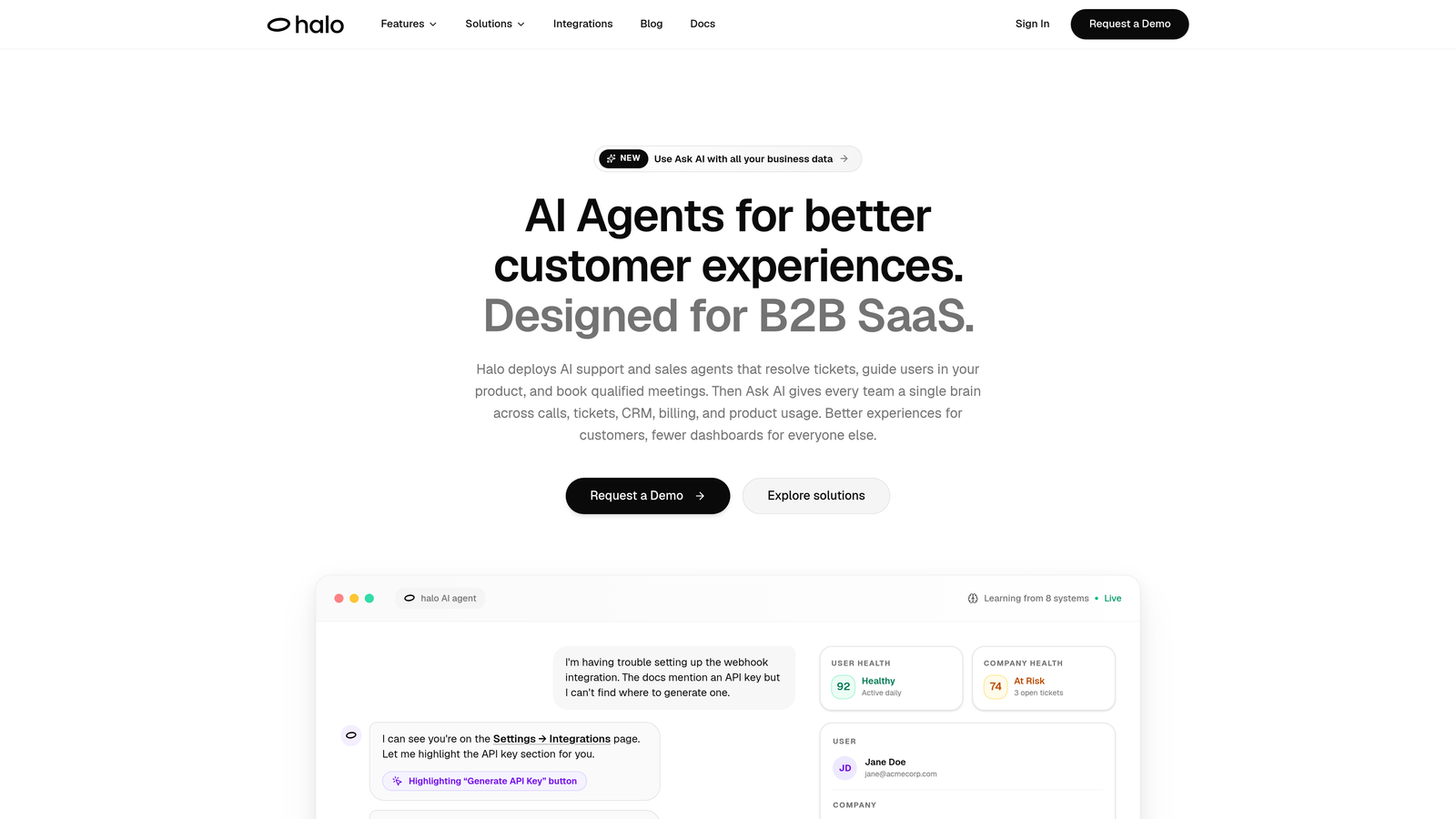
Halo AI is an AI-first customer support platform built specifically for B2B SaaS teams, deploying intelligent agents that resolve tickets, guide users through your product, and surface business intelligence from every support interaction.
Where This Tool Shines
What separates Halo AI from most tools on this list is architecture. It wasn't designed as a helpdesk with AI layered on top — it was built from the ground up with AI as the primary resolution layer. That distinction matters more than it might sound. AI-first platforms tend to have tighter learning loops, more contextual awareness, and analytics that go beyond ticket counts.
The page-aware chat widget is genuinely rare in this space. The AI sees what the user sees on-screen, which means it can provide contextual UI guidance rather than generic knowledge base responses. For product-led SaaS teams where users are navigating complex interfaces, this is a meaningful capability that most competitors simply don't offer.
Key Features
Page-Aware Chat Widget: The AI understands the user's current screen context and delivers guidance specific to where they are in your product, not just generic answers.
Continuous Learning Loop: Every resolved interaction improves future resolution quality, meaning the system gets measurably smarter over time rather than staying static.
Smart Inbox with Business Intelligence: Surfaces customer health signals, revenue anomalies, and product feedback patterns from support data — turning your inbox into a strategic asset.
Auto Bug Ticket Creation: Automatically generates bug reports and routes them to Linear when issues are detected, closing the loop between support and engineering.
Live Agent Handoff: Escalates to human agents with full conversation context preserved, so customers never have to repeat themselves.
Broad Integration Stack: Connects to Linear, Slack, HubSpot, Intercom, Stripe, Zoom, PandaDoc, and Fathom — giving the AI access to your full business context.
Best For
B2B SaaS teams that want more than ticket deflection. If you're looking for a platform that surfaces business intelligence from support data, guides users through complex product workflows, and connects to your entire business stack, Halo AI is built for exactly that use case. Particularly strong for product-led growth companies where support and product experience are closely linked.
Pricing
Visit haloagents.ai for current pricing. Pricing in SaaS changes frequently, so always verify at time of evaluation.
2. Intercom Fin
Best for: Teams already on Intercom who want autonomous AI resolution without switching platforms
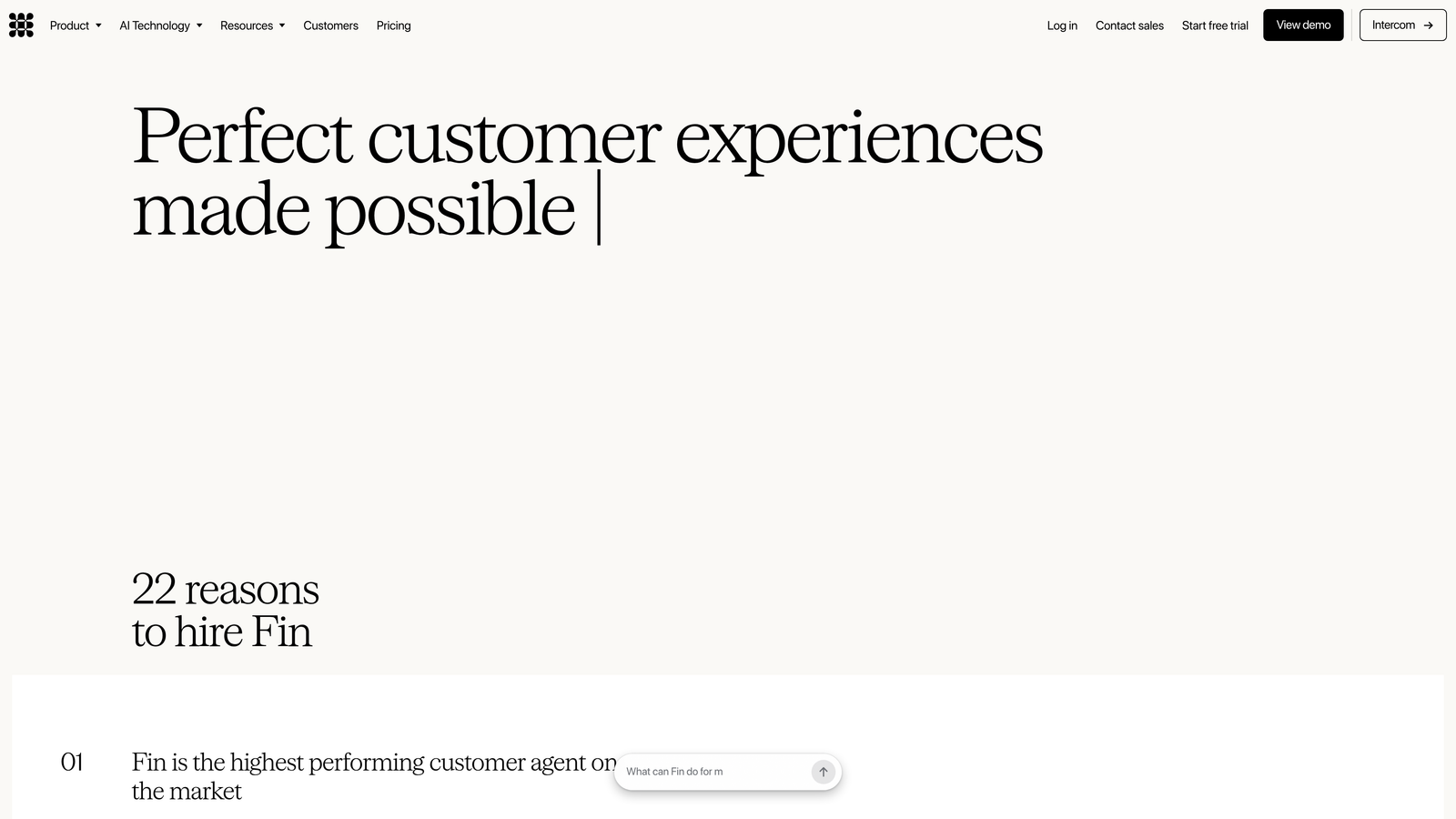
Intercom Fin is the native AI agent built into Intercom's platform, powered by large language models to resolve customer conversations autonomously using your existing knowledge base content.
Where This Tool Shines
If your team is already invested in Intercom, Fin is the path of least resistance to AI-powered resolution. There's no additional integration work, no new platform to onboard, and the AI persona inherits your existing Intercom configuration. For teams with a well-maintained help center, Fin can deflect a meaningful portion of incoming conversations without any heavy lifting.
The resolution-based pricing model is worth understanding before committing. You pay per successful resolution rather than a flat monthly fee, which can be cost-effective at moderate volumes but worth modeling carefully as you scale.
Key Features
LLM-Powered Resolution: Uses large language model capabilities to understand and resolve conversations, not just keyword-match against FAQ content.
Native Intercom Integration: Zero additional setup for existing Intercom customers — Fin lives inside your current platform.
Customizable AI Persona: Adjust tone, name, and behavior to match your brand voice and support style.
Seamless Human Handoff: Escalates to live agents within the same conversation thread, maintaining continuity for the customer.
Resolution-Based Pricing: Pay for outcomes rather than seats, which aligns incentives but requires volume modeling before committing.
Best For
Teams already on Intercom with a solid knowledge base in place. If you're not on Intercom, the value proposition weakens considerably — Fin is designed as a native enhancement, not a standalone product. Best suited to teams with relatively standardized support queries where knowledge base content can drive autonomous resolution.
Pricing
Charged per resolution on top of an existing Intercom subscription. Contact Intercom or visit their pricing page for current resolution rates and plan requirements.
3. Zendesk AI
Best for: Large enterprises with complex Zendesk configurations who want AI across the full support workflow
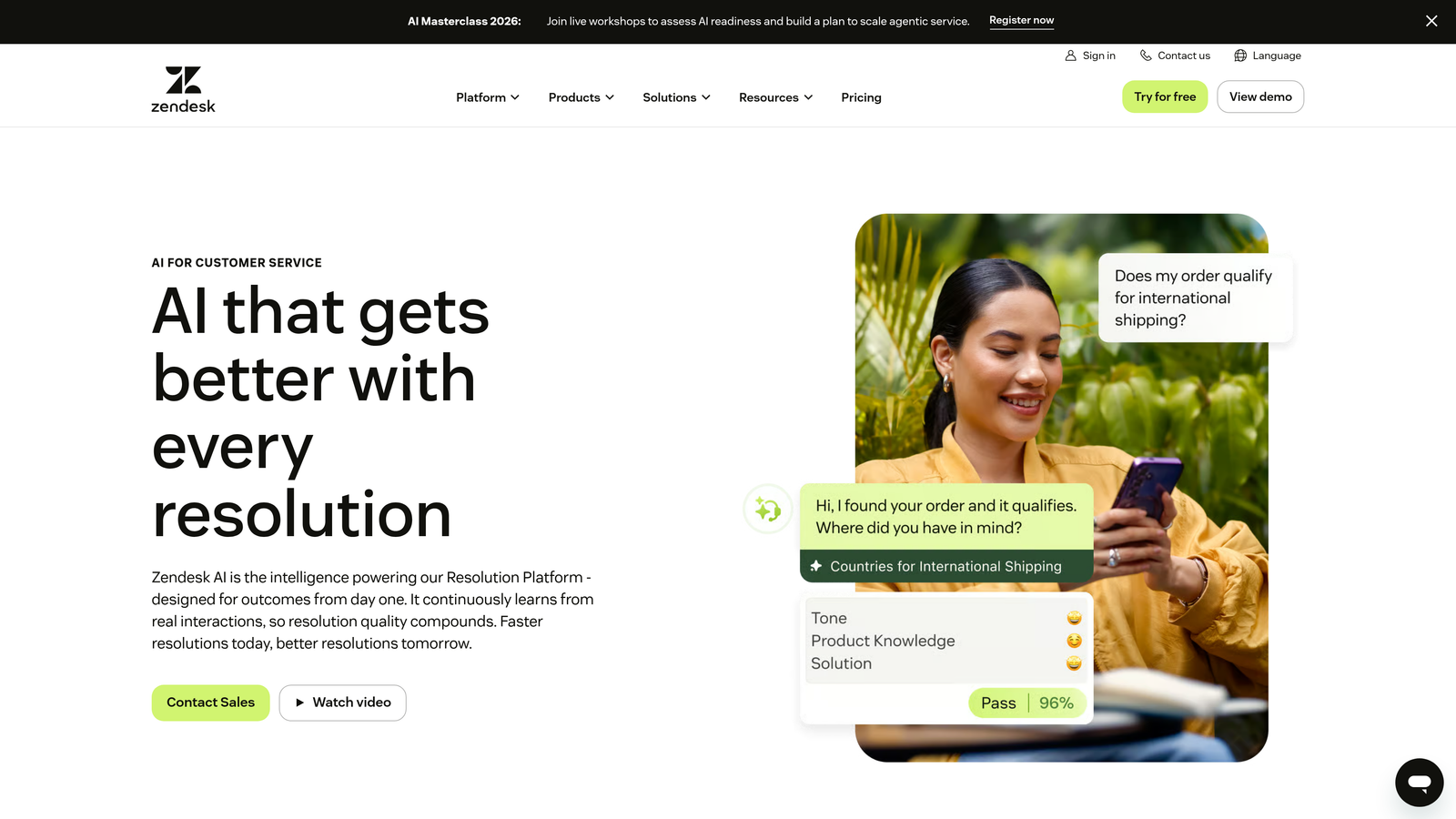
Zendesk AI is the AI layer built into Zendesk's enterprise helpdesk platform, covering intelligent triage, agent copilot features, automated workflows, and generative AI capabilities across the support stack.
Where This Tool Shines
Zendesk AI's strength is breadth. It touches every part of the support workflow: incoming ticket classification, agent-facing suggestions during live interactions, reply drafting, conversation summarization, and workflow automation. For large teams with complex routing logic already built in Zendesk, the AI layer can meaningfully accelerate every stage of the support process.
The Agent Copilot feature is particularly useful for teams where agents handle high-complexity issues. Real-time next-best-action guidance helps less experienced agents perform at a higher level without requiring extensive training. That said, the depth of AI capability is gated behind higher-tier plans and the Advanced AI add-on, so the total cost can escalate quickly for enterprise deployments.
Key Features
Intelligent Triage: Automatically categorizes, prioritizes, and routes incoming tickets based on intent and content.
Agent Copilot: Provides real-time suggestions and next-best-action guidance to agents during live ticket handling.
Generative AI for Reply Drafting: Drafts responses and summarizes long conversation threads to reduce agent effort.
Advanced AI Add-On: Unlocks deeper automation capabilities including more sophisticated intent models and workflow triggers.
Enterprise Workflow Customization: Extensive configuration options for complex routing, SLA management, and multi-team environments.
Best For
Large enterprises already on Zendesk Suite with complex support operations. Teams with simpler needs or smaller budgets will likely find the AI capabilities expensive relative to alternatives. Not the right fit for teams looking to move away from traditional helpdesk architectures.
Pricing
AI features are available on Zendesk Suite plans; the Advanced AI add-on is a separate paid upgrade. Visit zendesk.com for current plan pricing and add-on costs.
4. Freshdesk Freddy AI
Best for: SMB and mid-market teams that want AI capabilities at accessible price points within the Freshworks ecosystem
Freshdesk Freddy AI is Freshworks' AI suite embedded across Freshdesk, offering self-service bots, agent-assist copilot features, and analytics insights designed for teams that need capable AI without enterprise-level investment.
Where This Tool Shines
Freddy AI's appeal is its accessibility. For SMB and mid-market teams that can't justify enterprise pricing but still need meaningful automation, Freshdesk delivers a solid range of AI capabilities across the support workflow. The three-part structure — Self Service for deflection, Copilot for agents, and Insights for analytics — covers the main use cases without requiring a complex implementation.
The native integration across the Freshworks suite is a genuine advantage for teams already using Freshsales or Freshchat. Unified data across products means Freddy can surface more relevant context than standalone tools. The trade-off is that resolution quality depends heavily on the quality of your knowledge base content, which is true of most AI tools but worth noting here.
Key Features
Freddy Self Service: Customer-facing AI chatbot designed for ticket deflection using your knowledge base and configured responses.
Freddy Copilot: Agent-assist layer providing suggested replies, ticket summaries, and next-step guidance during live interactions.
Freddy Insights: AI-driven analytics that surface trends, anomalies, and performance patterns from support data.
Native Freshworks Integration: Works seamlessly across Freshdesk, Freshsales, and Freshchat for unified customer context.
Accessible Pricing: AI features are tiered across Freshdesk plans at price points more accessible than enterprise alternatives.
Best For
SMB and mid-market teams already using or considering Freshworks products. Teams with straightforward support workflows and well-maintained knowledge bases will get the most from Freddy. Less suited to complex B2B SaaS environments requiring deep product context or sophisticated learning loops.
Pricing
Freddy AI features are tiered across Freshdesk plans. Visit freshworks.com for current pricing and to understand which Freddy capabilities are available at each tier.
5. Tidio
Best for: SMB and e-commerce teams that want a low-code AI chatbot with strong Shopify and WooCommerce integrations
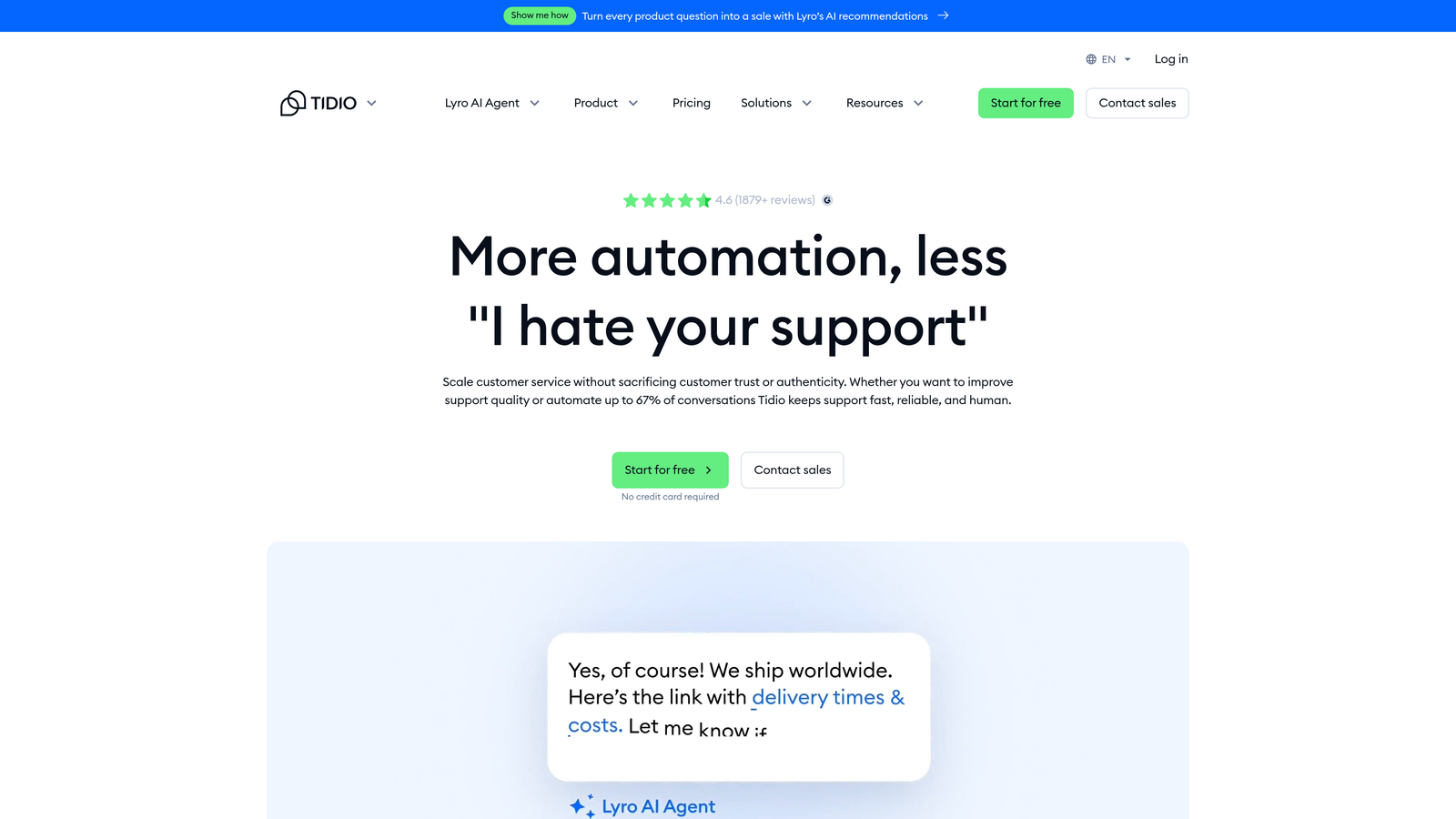
Tidio is a live chat and AI chatbot platform built primarily for SMBs and e-commerce teams, with its Lyro AI handling conversational support autonomously across a clean, accessible interface.
Where This Tool Shines
Tidio's setup experience is genuinely accessible. Non-technical teams can get Lyro AI up and running quickly without developer resources, which matters for small businesses that don't have engineering support for tool implementations. The hybrid approach — AI handles what it can, human agents step in when needed — creates a smooth experience for customers without requiring complex configuration.
The e-commerce integrations are a standout for the right audience. Shopify and WooCommerce connectivity means Lyro can pull order data, track shipments, and handle common post-purchase queries autonomously. For e-commerce support, that's genuinely high-value automation. For complex B2B SaaS environments, however, Tidio's capabilities are more limited — it's not designed for the depth of product context or business intelligence that SaaS teams often need.
Key Features
Lyro AI: Conversational AI trained on your support content for autonomous resolution of common customer queries.
Live Chat and AI Hybrid: Smooth escalation from AI to human agent with conversation continuity preserved.
E-Commerce Integrations: Native connections to Shopify, WooCommerce, and other e-commerce platforms for order and customer data.
Low-Code Setup: Accessible implementation that doesn't require developer resources or technical expertise.
Free Tier: Entry-level plan available for teams getting started with AI chat before committing to paid features.
Best For
SMB and e-commerce teams, particularly those on Shopify or WooCommerce. Tidio is not the right fit for complex B2B SaaS support environments that require deep product context, sophisticated routing logic, or business intelligence from support data.
Pricing
Free tier available for basic live chat. Lyro AI is available on paid plans. Visit tidio.com for current plan pricing and Lyro-specific costs.
6. Forethought
Best for: Teams with existing helpdesk investments who want to add intelligent triage and AI assist without replacing their platform
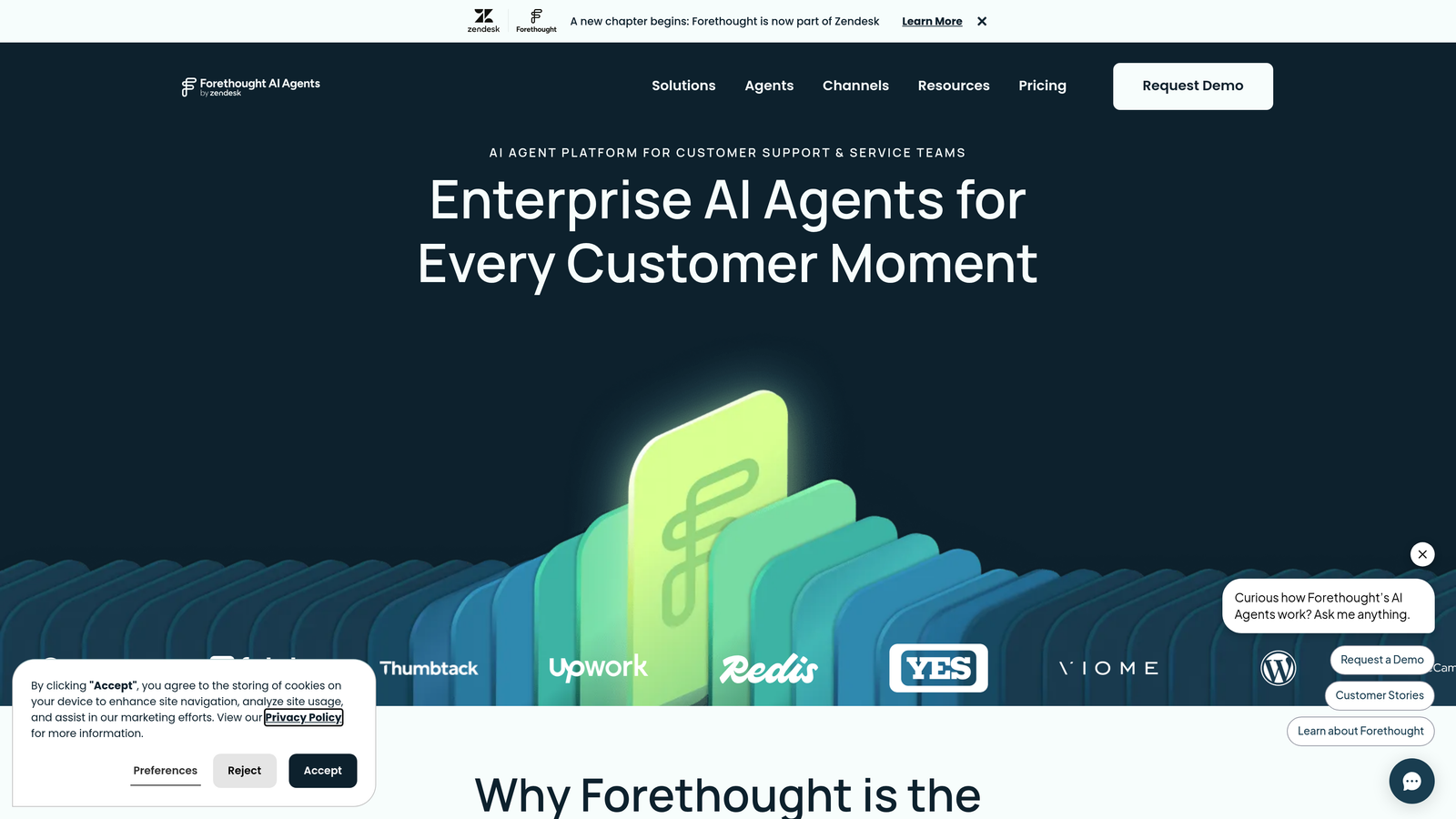
Forethought is an AI layer that sits on top of existing helpdesks like Zendesk and Salesforce Service Cloud, adding intelligent triage, agent-assist, and autonomous resolution without requiring you to rip and replace your current setup.
Where This Tool Shines
Forethought's core value proposition is additive AI. If your team has significant investment in Zendesk or Salesforce — custom workflows, years of ticket history, configured routing rules — Forethought lets you layer AI capabilities on top without starting over. That's a meaningful advantage for enterprise teams where platform migration is genuinely costly and disruptive.
The intent detection and routing capabilities are particularly strong for teams with complex ticket categorization needs. Forethought can learn from historical ticket data to build routing models that reflect how your team actually operates, not just generic templates. The Autoflows feature enables autonomous resolution for well-defined, repeatable use cases without requiring agents to handle every interaction.
Key Features
Triage: Intent detection and intelligent ticket routing based on historical patterns and configured logic.
Assist: Real-time AI suggestions surfaced to agents during live ticket handling, reducing research time and improving response quality.
Autoflows: Autonomous resolution for defined, repeatable use cases without agent involvement.
Helpdesk Integration Layer: Works on top of Zendesk, Salesforce Service Cloud, and other platforms without replacing them.
Complex Routing Support: Strong fit for teams with sophisticated multi-team routing logic and escalation paths.
Best For
Enterprise and mid-market teams with significant existing helpdesk investments who want to add AI capabilities incrementally. If you're evaluating a full platform switch, Forethought's additive model is less compelling — you'd be better served by an AI-first platform built for the whole workflow.
Pricing
Custom pricing based on volume and configuration. Contact Forethought directly for a quote tailored to your team's size and use case.
7. Kustomer
Best for: High-volume B2C and D2C brands that want CRM-native support organized around the full customer timeline
Kustomer is a CRM-native customer service platform that organizes support around the full customer timeline rather than individual tickets, with AI woven into routing, suggestions, and workflow automation throughout.
Where This Tool Shines
Kustomer's differentiation is structural. Where most helpdesks organize around tickets, Kustomer organizes around people. Every agent sees the full customer history — purchase history, previous conversations, past issues — in a unified timeline before they type a single word. For high-volume consumer brands where context is everything, that model can meaningfully improve both efficiency and customer experience.
One piece of context worth noting for enterprise buyers: Kustomer was acquired by Meta in 2022 and subsequently sold to private equity. That ownership history is worth factoring into long-term platform decisions, particularly for teams that prioritize vendor stability. The platform itself remains capable, but the corporate trajectory is something enterprise procurement teams typically want to understand.
Key Features
Unified Customer Timeline: Full interaction history visible across every support touchpoint, giving agents complete context before responding.
AI-Powered Intent Detection: Automatically identifies customer intent and routes conversations to the appropriate team or workflow.
Suggested Replies and Workflow Automation: AI surfaces recommended responses and triggers automated actions based on conversation context.
Omnichannel Support: Email, chat, voice, and SMS unified in a single view for consistent cross-channel experiences.
CRM-Native Architecture: Support data lives within a CRM context, enabling richer customer understanding than ticket-only platforms.
Best For
High-volume B2C and D2C brands where customer history and context are central to support quality. Less common in B2B SaaS environments, where the ticket-centric model is often more appropriate and the CRM-native approach adds complexity without proportional value.
Pricing
Custom enterprise pricing. Contact Kustomer directly for a quote based on your team size and support volume.
8. Help Scout
Best for: Smaller support teams that want AI to boost agent productivity without pushing toward full autonomous resolution
Help Scout is a human-first support platform that uses AI to help agents draft better replies, summarize long threads, and surface relevant context — deliberately keeping humans in the loop rather than optimizing for autonomous resolution.
Where This Tool Shines
Help Scout's philosophy is refreshingly clear: AI should make agents better, not replace them. For teams where the quality of human interaction is a core part of the brand experience, that approach is genuinely appealing. The AI Drafts feature generates reply suggestions for agents to review and edit, which speeds up response time without removing the human judgment that complex or sensitive issues require.
The UX is consistently cited as one of Help Scout's strongest attributes. It's clean, minimal, and easy to onboard — which matters for smaller teams that don't have dedicated support operations staff to manage complex configurations. The trade-off is that Help Scout isn't designed for teams that want to maximize autonomous resolution rates. If ticket deflection is a primary goal, you'll want to look elsewhere.
Key Features
AI Drafts: Generates reply drafts for agents to review, edit, and send — accelerating response time while keeping humans in control.
AI Summarize: Condenses long conversation threads into key points so agents can get up to speed quickly on complex issues.
Docs Knowledge Base: Built-in knowledge base with AI-assisted search to help customers self-serve before reaching an agent.
Clean, Minimal UX: Designed for ease of use with a low learning curve, accessible to teams without dedicated support operations staff.
Human-in-the-Loop Design: Deliberately not optimized for autonomous resolution — AI assists humans rather than replacing them.
Best For
Smaller support teams where relationship quality and human judgment are priorities. Not the right choice for teams with high ticket volumes seeking significant autonomous deflection, or for organizations that need deep integrations across a complex business stack.
Pricing
Plans start at accessible price points with AI features included in standard plans. Visit helpscout.com for current pricing details.
9. Gladly
Best for: Retail, travel, and consumer brands that want omnichannel support organized around the customer, not the ticket
Gladly is a people-centric support platform that organizes every interaction around the customer rather than a ticket number, with AI agent-assist and autonomous resolution layered into a unified omnichannel thread.
Where This Tool Shines
Gladly's people-centric model means every agent sees a single lifetime conversation thread per customer, spanning every channel — email, chat, voice, SMS, and social — in chronological order. That's a fundamentally different experience than ticket-based systems where the same customer might have dozens of disconnected tickets across years of interactions. For consumer brands where loyalty and relationship quality matter, this model creates a noticeably better agent experience and, by extension, a better customer experience.
The AI layer is well-integrated into this model. Hero AI handles autonomous resolution for self-service use cases, while AI Sidekick surfaces real-time suggestions and knowledge content to agents during live interactions. Neither feature feels bolted on — they're designed to enhance the people-centric thread rather than redirect customers away from it.
Key Features
People-Centric Model: Single lifetime conversation thread per customer across all channels, replacing disconnected ticket histories.
AI Sidekick: Real-time agent-assist tool that surfaces suggested actions, knowledge articles, and relevant customer context during live interactions.
Hero AI: Autonomous resolution layer for self-service deflection, handling common queries without agent involvement.
Omnichannel Threading: Email, chat, voice, SMS, and social all unified in one continuous conversation view.
Consumer Brand Focus: Platform design and feature set optimized for retail, travel, and high-volume consumer brands.
Best For
Retail, travel, and consumer brands at scale where omnichannel continuity and relationship quality are central to the support model. Gladly is less commonly deployed in B2B SaaS environments, where the ticket-centric model tends to be more appropriate for the nature of technical support queries.
Pricing
Custom enterprise pricing. Contact Gladly directly for a quote based on your team size, channel mix, and support volume.
Which Tool Is Right for Your Team?
The right AI support tool depends almost entirely on your architectural philosophy and your team's specific context. Here's a quick way to think through the decision.
For AI-first B2B SaaS teams: Halo AI is the standout choice. The combination of page-aware context, continuous learning, business intelligence from support data, and deep integrations across the business stack makes it the most capable option for product-led SaaS companies. If you want your support platform to surface revenue signals and customer health data alongside ticket resolution, nothing else on this list matches that scope.
For enterprise teams on existing helpdesks: Zendesk AI or Forethought, depending on whether you want AI built into your current platform or layered on top of it. Both require meaningful investment; both deliver meaningful capability at scale.
For SMB and mid-market teams on a budget: Freshdesk Freddy AI offers the best balance of capability and accessible pricing within an established helpdesk ecosystem. Tidio is the right call for e-commerce teams specifically.
For teams that want human-first AI assist: Help Scout is the clearest choice — it's deliberately designed for teams where human judgment stays central to the support experience.
For consumer brands with omnichannel complexity: Gladly or Kustomer, depending on whether you prioritize the people-centric model or CRM-native context.
Your support team shouldn't scale linearly with your customer base. Let AI agents handle routine tickets, guide users through your product, and surface business intelligence while your team focuses on complex issues that need a human touch. See Halo in action and discover how continuous learning transforms every interaction into smarter, faster support.