9 Best AI Support Tool Features to Look for in 2026
Choosing the right AI support tool features can make or break your team's efficiency—this guide evaluates the nine most critical capabilities to look for in 2026, from intelligent automation to actionable analytics, with real platform comparisons to help B2B SaaS teams find the best fit for their specific support needs.
 Matt PattoliFounder13 min read
Not all AI support tools are built the same. Some bolt AI onto legacy helpdesks as an afterthought, adding a chatbot here and a suggested-reply button there. Others are built AI-first, learning from every interaction and connecting across your entire business stack. The difference shows up fast: in resolution rates, agent workload, and whether your support data actually tells you something useful about your customers.
This guide breaks down the most important features to evaluate when choosing an AI support tool, with real platforms that do each one well. Whether you're migrating off a traditional helpdesk, scaling a lean support team, or trying to get more signal from your ticket data, this list will help you cut through the noise.
We've included Halo AI as our top pick because it genuinely leads on the features that matter most for B2B SaaS teams. Every other tool is evaluated honestly on what it actually does best, so you can match the right platform to your specific needs.
1. Halo AI
Best for: B2B SaaS teams that want AI-native support with business intelligence built in
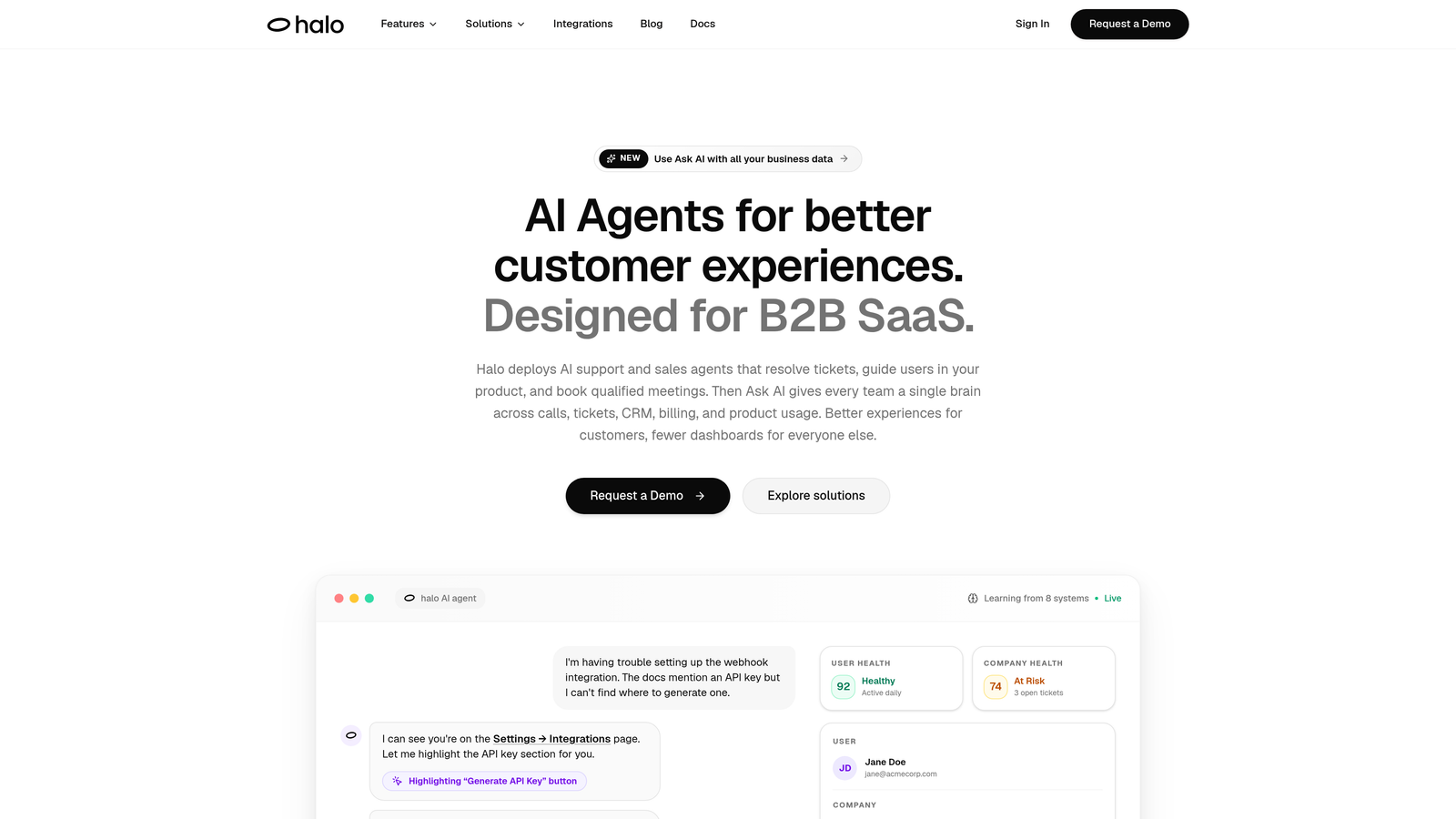
Halo AI is an AI-native customer support platform that resolves tickets, guides users through your product with page-aware context, auto-creates bug reports, and surfaces business intelligence from every interaction.
Where This Tool Shines
Halo AI was built from the ground up as an AI-first system, not a layer added onto a legacy helpdesk. That architectural difference matters: the platform learns continuously from every resolved ticket, which means its resolution accuracy improves over time without manual retraining or rule-writing.
What makes Halo genuinely distinctive is its page-aware context. The AI agent sees exactly what the user sees, which allows it to provide visual UI guidance rather than generic help center links. Combine that with smart inbox analytics that surface customer health signals, revenue anomalies, and churn indicators, and you have a support tool that doubles as a business intelligence layer.
Key Features
Page-Aware AI Agents: The AI sees what users see in real time, enabling visual guidance through your product UI rather than static documentation.
Autonomous Ticket Resolution: Tickets are resolved end-to-end with continuous learning from every interaction, improving accuracy over time.
Auto Bug Ticket Creation: Automatically generates and routes bug reports to Linear or your engineering workflow without agent intervention.
Smart Inbox with Business Intelligence: Goes beyond CSAT to surface customer health signals, revenue anomalies, and churn indicators directly from support data.
Live Agent Handoff: Escalates complex issues to human agents with full context transfer, so nothing gets repeated.
Deep Integrations: Connects to Linear, Slack, HubSpot, Intercom, Stripe, Zoom, PandaDoc, and Fathom for a unified business stack.
Best For
B2B SaaS teams running product-led growth motions that need support AI to do more than deflect tickets. Particularly well-suited for lean support teams that want to scale without scaling headcount, and for product teams that want support data to inform roadmap decisions.
Pricing
Contact for pricing. Halo AI is built specifically for B2B SaaS teams, so pricing is tailored to team size and support volume.
2. Intercom
Best for: Mid-market SaaS teams wanting conversational AI on a mature messaging platform
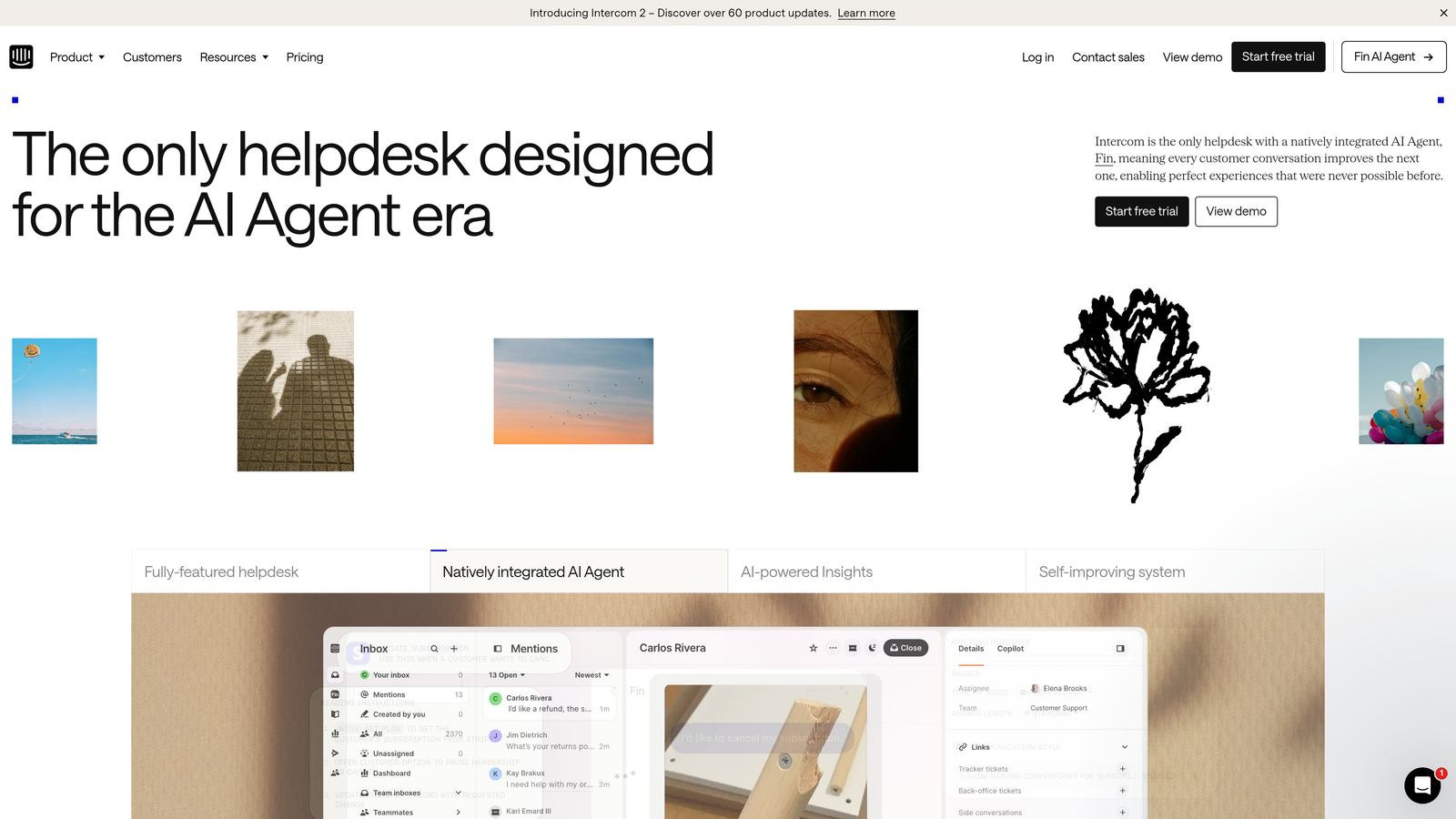
Intercom is a conversational support platform with a Fin AI agent for automated resolution, built on a mature messaging and CRM foundation.
Where This Tool Shines
Intercom's Fin AI agent is trained on your help center content and handles a meaningful portion of common queries without human involvement. The real advantage here is context: Fin draws on Intercom's built-in CRM data, so the AI knows who it's talking to, their plan, and their history before the conversation even starts.
For teams already running their customer communications through Intercom, adding Fin is a relatively low-friction upgrade. The platform's omnichannel coverage across chat, email, and in-app messaging means AI resolution happens wherever your customers reach out.
Key Features
Fin AI Agent: Trained on help center content for autonomous resolution of common support queries.
Built-in CRM Context: Deep customer data from Intercom's native CRM informs every AI interaction.
Omnichannel Messaging: Covers chat, email, and in-app touchpoints from a single platform.
AI-Powered Routing and Tagging: Automatically categorizes and routes conversations to the right team or resolution path.
AI Resolution Reporting: Tracks resolution rates and handoff patterns to measure AI performance over time.
Best For
Mid-market SaaS companies already using Intercom for customer communications who want to add AI resolution without switching platforms. Less suited for teams that need deep engineering workflow integrations or business intelligence beyond support metrics.
Pricing
Base plans start at approximately $74/month. Fin AI is usage-based pricing on top of the base plan, so costs scale with conversation volume.
3. Zendesk AI
Best for: Enterprise teams with complex ticketing needs and existing Zendesk infrastructure
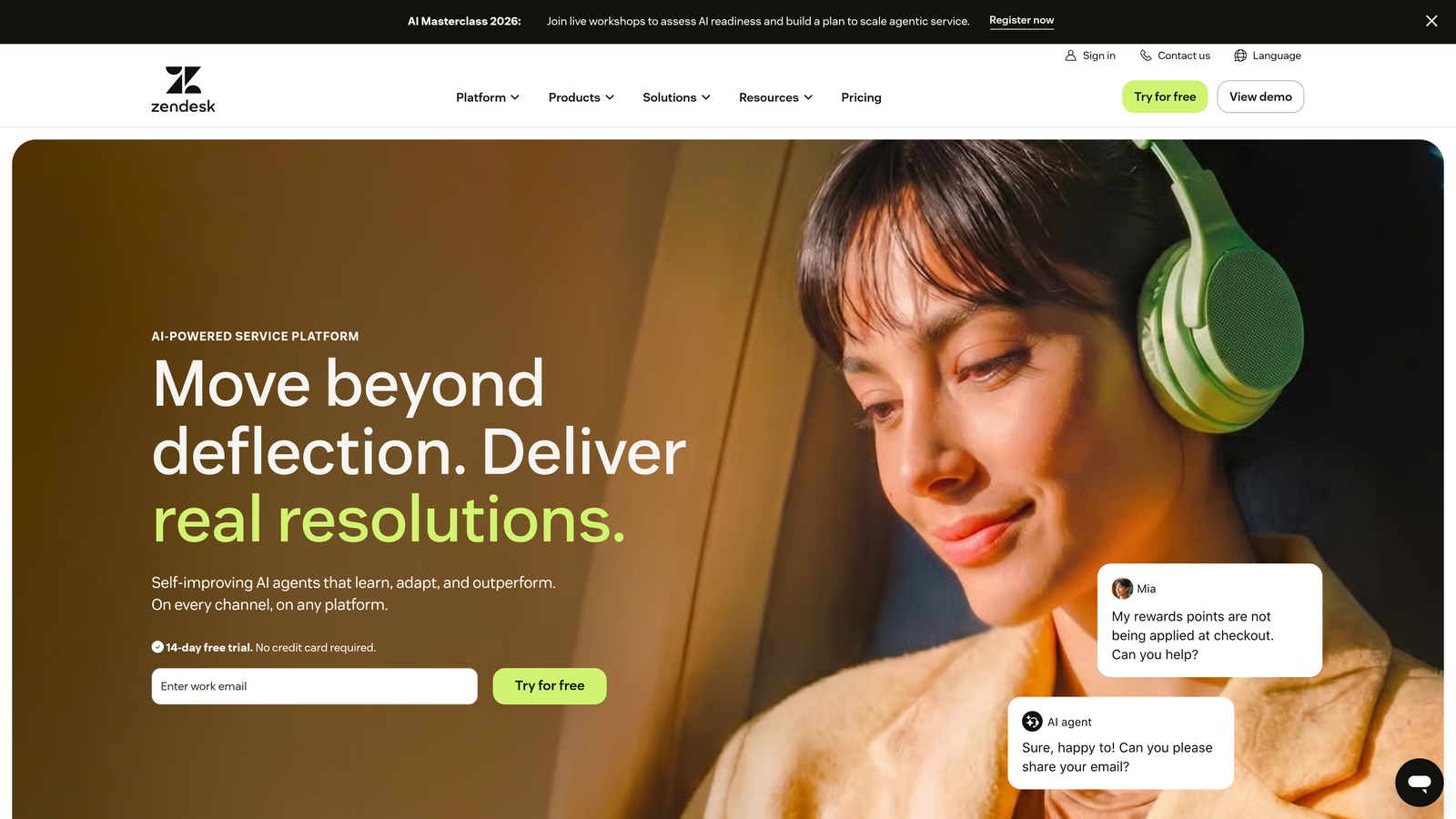
Zendesk AI is an enterprise helpdesk platform with AI Agents, intelligent triage, and Agent Copilot layered onto one of the most mature ticketing systems in the market.
Where This Tool Shines
If your organization is already deeply invested in Zendesk, the AI layer is a natural extension rather than a platform change. AI Agents handle front-line resolution, while Agent Copilot provides suggested replies and next-best-action recommendations to human agents working complex tickets.
Zendesk's intelligent triage is particularly strong: it detects intent, sentiment, and language at intake, which means tickets are classified and routed before any human touches them. For large support organizations managing thousands of tickets daily, that intake intelligence meaningfully reduces manual sorting work.
Key Features
AI Agents: Autonomous front-line resolution for common queries before tickets reach human agents.
Intelligent Triage: Intent, sentiment, and language detection at ticket intake for accurate classification and routing.
Agent Copilot: Suggested replies and next-best-action guidance for human agents handling complex issues.
Generative AI for Content: AI-assisted macro and knowledge base creation to keep documentation current.
SLA Management and Reporting: Robust reporting suite with SLA tracking and AI performance metrics.
Best For
Large enterprises with established Zendesk workflows, complex compliance requirements, and high ticket volumes. The AI features are most powerful when layered onto an existing Zendesk configuration rather than deployed from scratch.
Pricing
Suite plans start at approximately $55/agent/month. AI features are available on higher-tier plans, so total costs increase significantly for teams that want full AI functionality.
4. Freshdesk Freddy AI
Best for: SMBs and growing startups that want AI augmentation at accessible price points
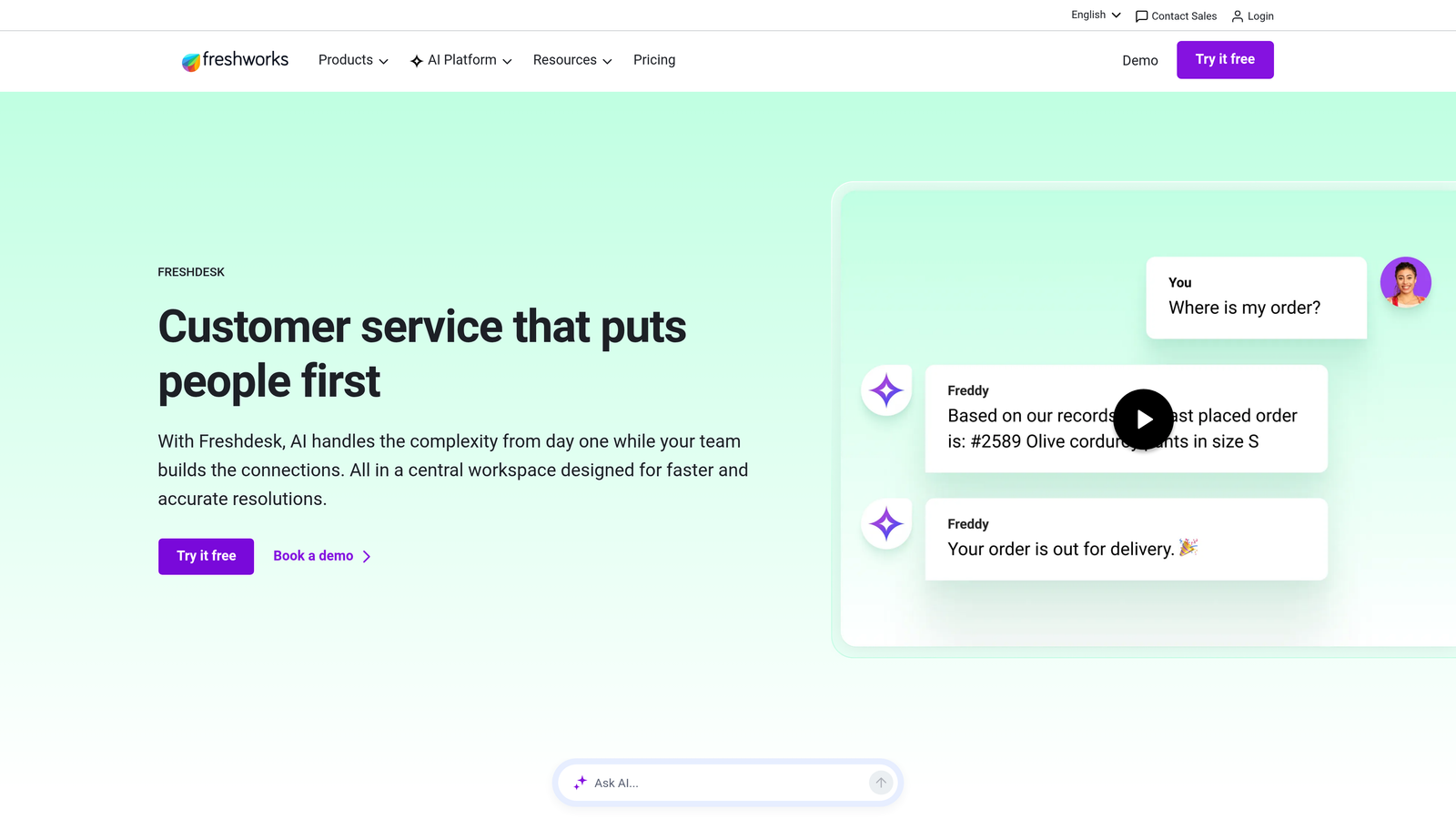
Freshdesk is an SMB-friendly helpdesk with Freddy AI for auto-triage, suggested responses, and basic deflection without enterprise-level pricing.
Where This Tool Shines
Freshdesk's appeal is straightforward: you get meaningful AI functionality without committing to enterprise pricing. Freddy AI handles auto-triage, classifying and prioritizing tickets at intake, while Freddy Self Service manages deflection through AI-powered responses before tickets reach the queue.
The CSAT prediction feature is worth noting. Freddy can flag interactions that are trending toward a poor experience, giving agents a chance to intervene before a customer becomes dissatisfied. For smaller teams without dedicated QA resources, that kind of proactive signal is genuinely useful.
Key Features
Freddy Self Service: AI-powered deflection that resolves common queries before they become tickets.
Auto-Triage: Automatic classification, prioritization, and routing at ticket intake.
Agent Assist: Suggested responses and conversation summarization for agents handling open tickets.
CSAT Prediction: Flags interactions at risk of poor satisfaction scores before they close.
No-Code Bot Builder: Visual flow builder for creating custom automation without engineering support.
Best For
SMBs and startups that want AI-augmented support without the cost or complexity of enterprise platforms. Also a good fit for teams transitioning from purely manual support who want to introduce AI incrementally.
Pricing
Free tier available for small teams. Paid plans start at approximately $15/agent/month. Freddy AI add-on pricing varies by feature set and usage volume.
5. Guru
Best for: Support teams where answer quality depends on keeping knowledge current and accessible
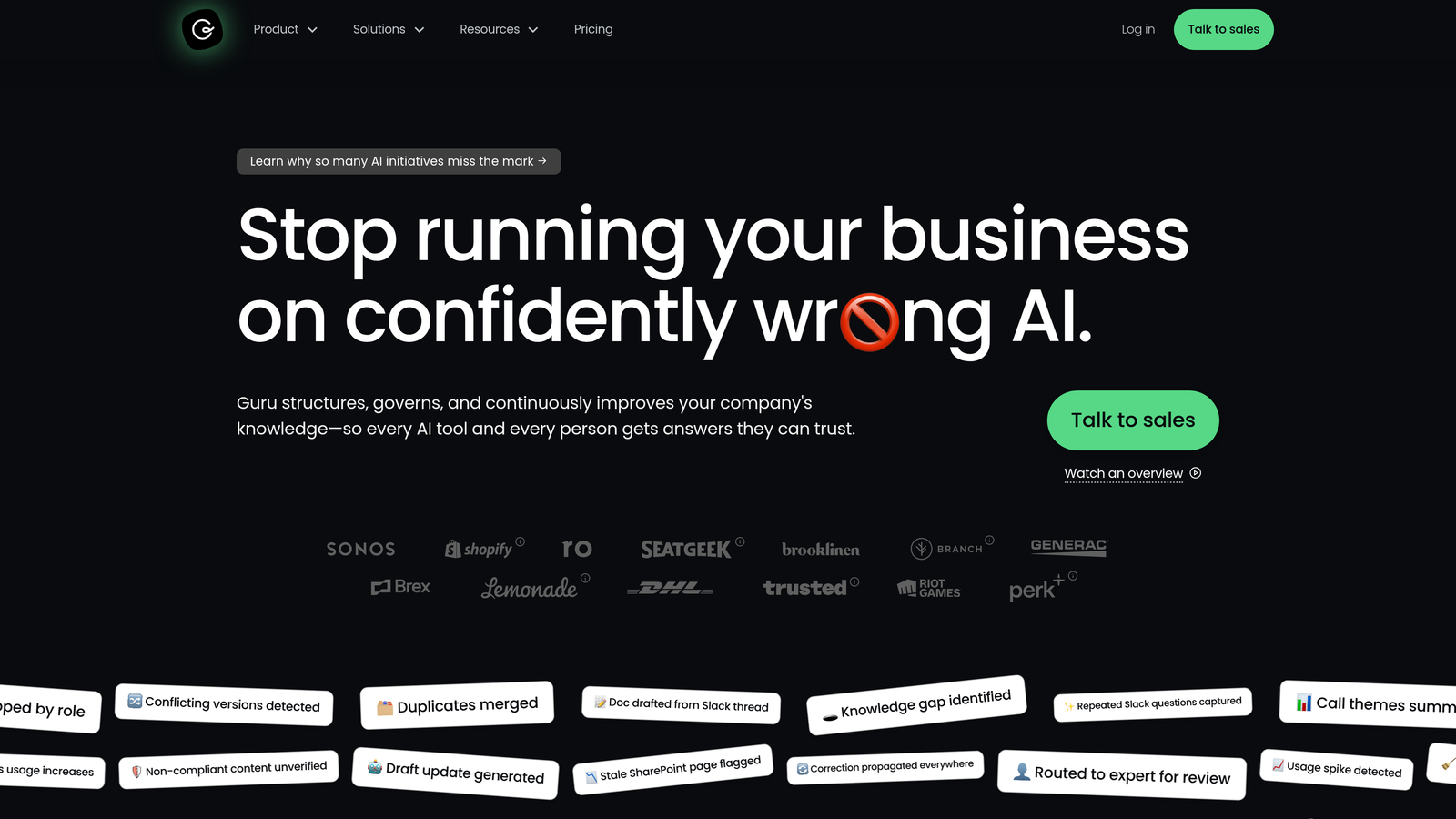
Guru is an AI-powered knowledge management platform that surfaces verified answers inside any support workflow, keeping agent knowledge current and findable.
Where This Tool Shines
Guru solves a problem that most support tools ignore: knowledge decay. Documentation goes stale, agents give inconsistent answers, and new hires spend weeks learning what's already written somewhere. Guru's verified knowledge cards have built-in expiration and review workflows, so information is flagged for review before it becomes a liability.
The browser extension is particularly practical. It surfaces relevant knowledge cards inside Zendesk, Salesforce, Slack, or whatever tool your agents are already using, without requiring them to context-switch to a separate knowledge base. For support teams that live in their helpdesk, that in-context delivery makes a real difference in how consistently agents apply accurate information.
Key Features
AI-Verified Knowledge Cards: Structured knowledge with expiration dates and review workflows to prevent documentation decay.
Browser Extension: Surfaces relevant answers inside any tool your agents are already using.
AI Search: Searches across all connected knowledge sources to surface the most relevant answer.
Duplicate Detection and Gap Analysis: Identifies redundant content and flags missing knowledge based on search failures.
Knowledge Usage Analytics: Tracks which content agents use and where searches come up empty.
Best For
Support teams with large or frequently changing knowledge bases, or organizations where multiple teams (support, sales, success) need access to the same verified information. Guru is a knowledge layer, not a ticketing system, so it works alongside your existing helpdesk.
Pricing
Free for up to three users. Paid plans start at approximately $10/user/month, making it one of the more accessible tools on this list.
6. Forethought
Best for: High-volume teams that want AI triage and routing without replacing their existing helpdesk
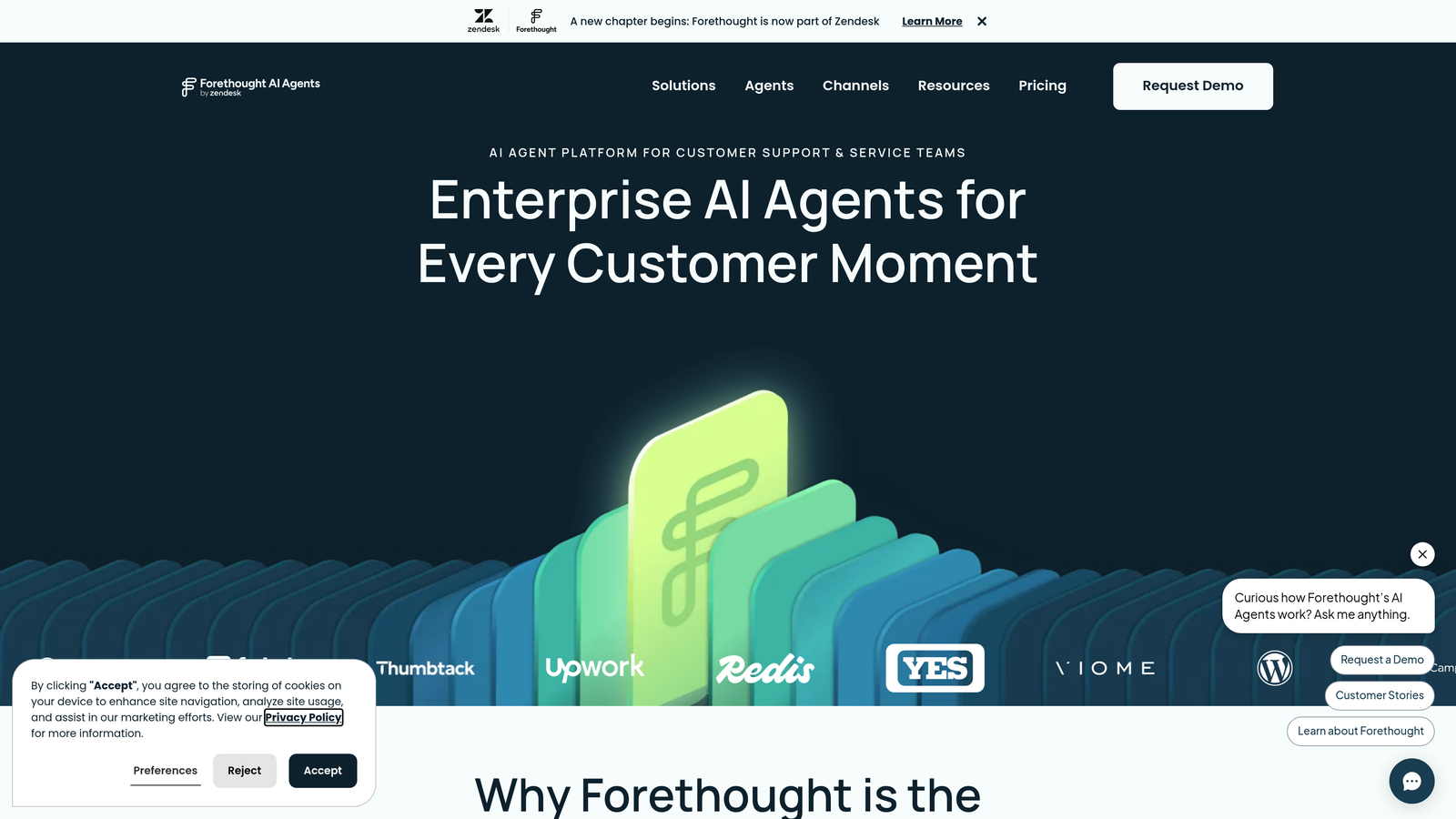
Forethought is an AI platform specializing in predictive triage, intelligent routing, and resolution, designed to layer onto existing helpdesks rather than replace them.
Where This Tool Shines
Forethought's core insight is that the most valuable moment to apply AI is at ticket intake, before any human touches the ticket. Its Triage AI classifies, tags, and routes tickets the moment they arrive, which means agents open their queue to tickets that are already categorized, prioritized, and assigned correctly.
The Discover module adds a strategic layer: it analyzes ticket patterns to identify which issue categories have the highest automation potential, giving support ops leaders a data-driven roadmap for where to invest in AI resolution next.
Key Features
Triage AI: Classifies, tags, and routes tickets at intake before any human review.
Solve AI: Autonomous resolution for common, repeatable queries.
Assist AI: Surfaces relevant knowledge and suggested responses for agents mid-ticket.
Discover: Identifies automation opportunities by analyzing patterns across your ticket history.
Helpdesk Compatibility: Works alongside Zendesk, Salesforce, and other major platforms without requiring migration.
Best For
High-volume support teams that want to add AI intelligence to their existing helpdesk without a platform migration. Particularly strong for ops leaders who want data-driven insight into where automation will have the most impact.
Pricing
Custom pricing. Contact Forethought directly for a quote based on ticket volume and feature requirements.
7. Tidio
Best for: SMBs and e-commerce teams wanting fast AI chatbot deployment with minimal setup
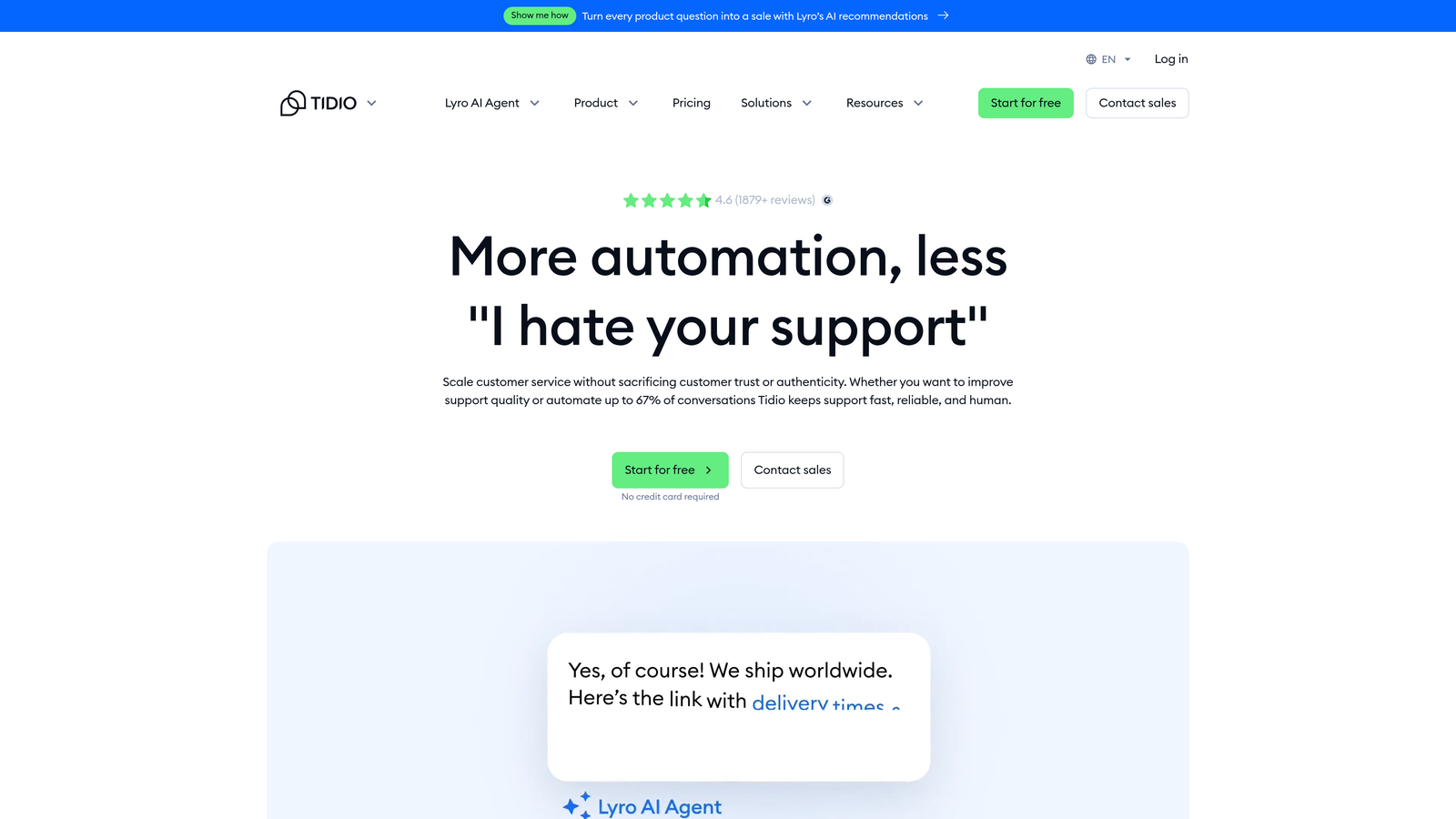
Tidio is an accessible AI chatbot and live chat platform with Lyro AI for conversational resolution, designed for small teams that need to be up and running quickly.
Where This Tool Shines
Tidio's strongest quality is its low barrier to entry. Lyro AI handles conversational resolution without requiring extensive training or configuration, and the visual flow builder lets non-technical users create custom automation without writing a line of code. For a small e-commerce team or a startup with a single support person, that simplicity is a genuine advantage.
The e-commerce integrations are worth calling out specifically. Native connections to Shopify, WooCommerce, and PrestaShop mean Tidio can pull order data into support conversations, which is table stakes for e-commerce support but not always available in more enterprise-focused tools.
Key Features
Lyro AI Chatbot: Conversational resolution for common queries without extensive training or setup.
Visual Flow Builder: No-code automation builder for custom conversation flows and routing logic.
AI-to-Human Handoff: Seamless escalation from Lyro AI to a live agent when queries exceed AI capability.
E-Commerce Integrations: Native connections to Shopify, WooCommerce, and PrestaShop for order-aware support.
Multichannel Coverage: Website chat, email, Instagram, and Messenger from a single platform.
Best For
Small e-commerce businesses, early-stage startups, and teams that need a working AI chatbot quickly without a long implementation process. Less suited for complex B2B SaaS support needs or teams requiring deep CRM and engineering workflow integrations.
Pricing
Free tier available. Lyro AI starts at approximately $29/month, making it one of the most affordable AI-powered support options available.
8. Kustomer
Best for: Subscription and high-repeat-purchase businesses needing AI with deep customer history context
Kustomer is a CRM-native support platform where AI draws on the full customer timeline, including purchase history, past tickets, and sentiment, to deliver context-rich resolutions.
Where This Tool Shines
Kustomer's differentiator is the unified customer timeline. Rather than treating each support interaction as an isolated event, Kustomer assembles a complete picture of the customer: what they've bought, when they've reached out before, how those interactions resolved, and what their current sentiment looks like. The AI then uses that full context when determining how to handle a new inquiry.
This approach is particularly powerful for subscription businesses and brands with high repeat-purchase rates, where the history of the relationship is directly relevant to how support should respond. A customer on their fifth order who's had two previous issues deserves a different response than a first-time buyer asking the same question.
Key Features
Unified Customer Timeline: Combines CRM data, order history, and support interactions into a single customer view.
AI Intent Detection: Identifies customer intent and triggers automated resolution flows accordingly.
Proactive Messaging: Sends outbound messages triggered by customer behavior signals before issues escalate.
Omnichannel Coverage: Chat, email, SMS, voice, and social from a unified platform.
No-Code Workflow Automation: Business process automation builder for custom resolution and escalation logic.
Best For
Subscription businesses, D2C brands, and any organization where customer history is central to support quality. The CRM-native architecture makes it less ideal for teams that already have a separate CRM they want to keep as their source of truth.
Pricing
Enterprise plans start at approximately $89/user/month, positioning Kustomer toward mid-market and enterprise buyers rather than early-stage teams.
9. Assembled
Best for: Support ops leaders managing blended AI and human agent teams at scale
Assembled is a workforce management platform for support operations, with AI-driven forecasting and real-time scheduling designed for teams running AI and human agents in parallel.
Where This Tool Shines
Assembled addresses a problem that emerges once AI deflection is working: how do you staff correctly when AI is handling a variable and growing percentage of your volume? Traditional workforce management tools weren't built for this. Assembled's forecasting models account for AI deflection rates, which means staffing predictions reflect actual human agent demand rather than total ticket volume.
The real-time adherence tracking is useful for distributed or remote support teams. Managers can see at a glance whether agents are on schedule, and the scenario planning tools let ops leaders model staffing decisions before committing to headcount changes.
Key Features
AI-Powered Volume Forecasting: Staffing predictions that account for AI deflection rates, not just raw ticket volume.
Real-Time Agent Adherence: Live visibility into whether agents are following their scheduled activities.
Scenario Planning: Model different staffing configurations before making headcount or scheduling decisions.
Cross-Channel Performance Analytics: Unified reporting across AI and human agent performance metrics.
Helpdesk Integrations: Connects to Zendesk, Salesforce, Intercom, and other major platforms.
Best For
Support operations leaders at companies with significant ticket volume and a mix of AI and human agents. Assembled complements AI resolution tools rather than replacing them, so it's most valuable as part of a broader support stack rather than a standalone purchase.
Pricing
Custom pricing. Contact Assembled directly for a quote based on team size and operational complexity.
Matching the Right Tool to Your Situation
The right AI support tool depends less on feature checklists and more on where your team actually is right now. Here's a quick breakdown to help you orient.
AI-native architecture: Halo AI is the clear choice for teams that want a platform built from the ground up to learn, resolve, and surface business intelligence, rather than one that bolts AI onto a legacy system.
Enterprise scale with existing Zendesk investment: Zendesk AI is the natural path. The AI features are most powerful when layered onto an established Zendesk configuration with mature workflows already in place.
SMB budget: Freshdesk Freddy AI gives you meaningful AI augmentation at a price point that doesn't require a business case to justify. Tidio is even more accessible if your needs are primarily chatbot and live chat.
Knowledge management: Guru is purpose-built for this. If your biggest support problem is inconsistent answers or stale documentation, Guru addresses it directly without requiring a platform migration.
Intelligent ticket routing without a full migration: Forethought layers onto your existing helpdesk and applies AI at the moment of intake, which is often where the most efficiency is lost.
E-commerce and direct-to-consumer: Tidio's Shopify and WooCommerce integrations make it the fastest path to AI-powered support for e-commerce teams. Kustomer is the stronger choice if customer history and repeat-purchase context matter to your support quality.
Workforce operations: Assembled is the only tool on this list built specifically for support ops leaders managing blended human and AI teams. If staffing and scheduling are your primary pain point, it's the right fit.
For B2B SaaS teams that want support AI to do more than deflect tickets, the gap between Halo AI and the rest of the list is meaningful. Page-aware context, auto bug ticket creation, continuous learning, and business intelligence from support data aren't features you can easily replicate by adding plugins to a legacy helpdesk.
Your support team shouldn't scale linearly with your customer base. Let AI agents handle routine tickets, guide users through your product, and surface business intelligence while your team focuses on complex issues that need a human touch. See Halo in action and discover how continuous learning transforms every interaction into smarter, faster support.