9 Best AI Support Tools for Product Teams in 2026
The best AI support tools for product teams go beyond basic chatbots, offering autonomous ticket resolution, seamless integration with engineering workflows like Linear and Jira, and actionable product insights that inform roadmap decisions. This guide evaluates nine platforms specifically designed to eliminate the silos traditional helpdesks create, helping engineers, PMs, and support staff move faster and collaborate more effectively.
 Matt PattoliFounder14 min read
Product teams live in a constant tension: you're building the product while simultaneously fielding the questions, bugs, and confusion that come from people using it. Traditional helpdesks were designed for dedicated support organizations, not for teams where engineers, PMs, and support staff share context and need to move fast. They create silos exactly where product teams need integration.
AI support tools built for product teams change that dynamic. The best ones resolve tickets autonomously, route bugs directly into engineering workflows, and surface the kind of product intelligence that informs roadmap decisions. But there's a wide gap between a retrofitted chatbot and a purpose-built AI agent that genuinely understands how product teams operate.
We evaluated platforms on the criteria that matter most to product teams: autonomous resolution quality, depth of integration with engineering tools like Linear, Jira, and GitHub, ability to surface actionable insights from support data, and the ability to scale without proportional headcount growth. Here are the top options in 2026.
1. Halo AI
Best for: Product teams that need AI-native support deeply integrated with engineering and business workflows.
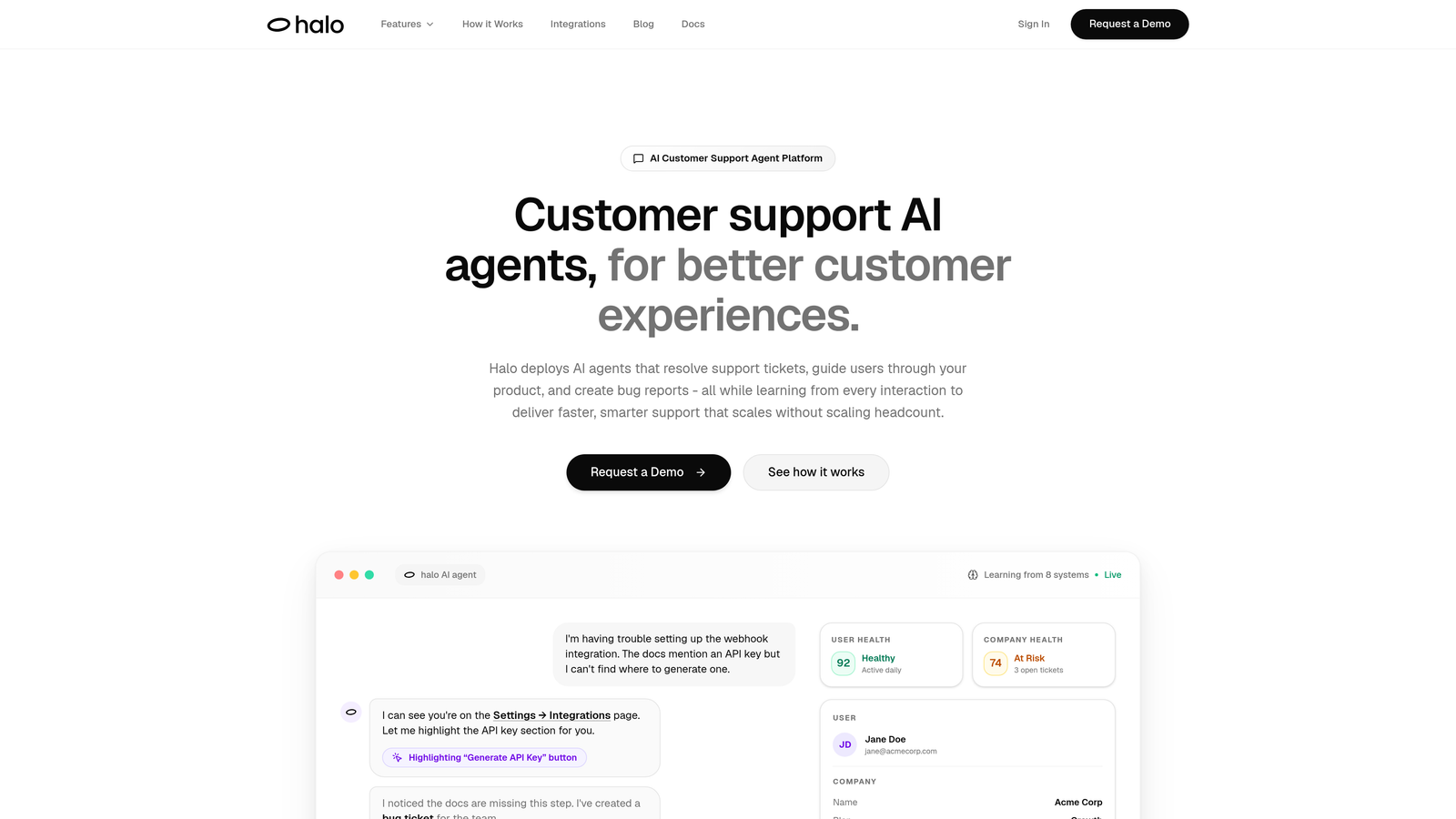
Halo AI is an AI-native customer support platform where intelligent agents resolve tickets, guide users visually through your product, and feed directly into your engineering stack.
Where This Tool Shines
What separates Halo from most tools on this list is that it was built AI-first, not retrofitted. The platform doesn't just handle tickets — it understands the context of where a user is in your product and can provide visual UI guidance in real time. That page-aware capability means users get help that's specific to exactly what they're looking at, not generic documentation links.
The automatic bug ticket creation is particularly valuable for product teams. When a support conversation reveals a reproducible issue, Halo creates a structured bug ticket in Linear or Slack without anyone manually triaging it. That closes the loop between support and engineering in a way that most tools require significant custom work to replicate.
Key Features
Page-Aware Chat Widget: The AI agent sees what the user sees, enabling visual UI guidance and context-specific help that's tied to the user's current location in your product.
Automatic Bug Ticket Creation: Support conversations that surface bugs are automatically converted into structured tickets in Linear and Slack, eliminating manual engineering triage.
Smart Inbox with Business Intelligence: Beyond ticket management, the inbox surfaces customer health signals, anomaly detection, and revenue intelligence — turning support data into product insights.
Live Agent Handoff: Complex issues escalate to human agents with full conversation context preserved, so nothing gets repeated.
Deep Integration Stack: Connects natively with Linear, Slack, HubSpot, Intercom, Stripe, Zoom, PandaDoc, and Fathom — covering the full toolset most product teams already use.
Best For
Product-led SaaS companies that want support integrated with their engineering and business stack from day one. Especially strong for teams using Linear for issue tracking, where the automatic bug routing delivers immediate operational value without custom workflows.
Pricing
Contact for pricing; a live demo is available at haloagents.ai. The platform is positioned for B2B product teams rather than high-volume consumer support operations.
2. Intercom Fin
Best for: Teams already on Intercom who want AI resolution without switching platforms.
Intercom Fin is Intercom's dedicated AI agent, trained on your help center content and past conversations to resolve questions autonomously within the Intercom ecosystem.
Where This Tool Shines
Fin's biggest advantage is how seamlessly it fits into an existing Intercom setup. If your product already uses Intercom for in-app messaging and customer communication, Fin activates without a platform migration. It leverages the content and conversation history you've already built, which means the initial quality can be surprisingly strong out of the box.
The conversation control workflows give product teams meaningful customization over how Fin behaves — you can define when it escalates, how it handles sensitive topics, and what tone it uses across different user segments.
Key Features
Multi-Source Training: Fin learns from help center articles, past conversations, and custom data sources you provide, building a knowledge base from existing content.
Native Intercom Integration: Works directly within Intercom messenger, inbox, and product tours without additional configuration or middleware.
Conversation Control Workflows: Customizable behavior rules that define escalation triggers, topic handling, and tone adjustments.
Multilingual Support: Handles support across multiple languages, useful for product teams with global user bases.
Human Handoff with AI Summary: When escalating to a human agent, Fin provides a full summary of the AI conversation so agents can pick up without asking users to repeat themselves.
Best For
Product teams already invested in the Intercom platform who want to add autonomous resolution without changing their support infrastructure. Less compelling if you're not already on Intercom, since the value is largely tied to that ecosystem.
Pricing
Per-resolution pricing model layered on top of an existing Intercom subscription. Costs scale with resolution volume, so it's worth modeling at your current ticket load before committing.
3. Zendesk AI
Best for: Enterprise product teams that need AI capabilities within a mature, scalable helpdesk infrastructure.
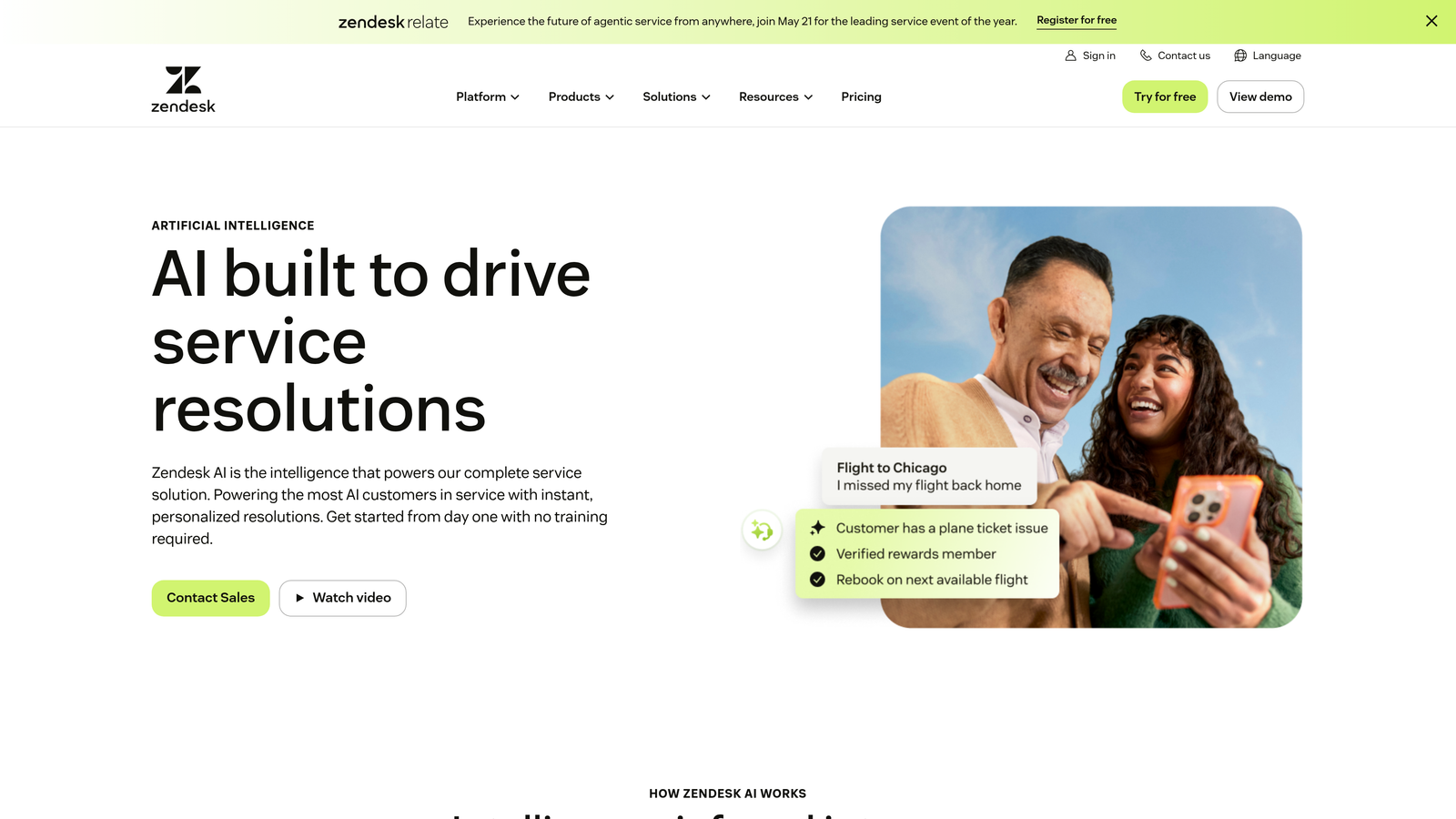
Zendesk AI brings autonomous agents, intelligent triage, and agent assistance to one of the most widely deployed helpdesk platforms in the industry.
Where This Tool Shines
Zendesk's strength has always been its depth — thousands of integrations, robust reporting, and enterprise-grade reliability. The AI layer builds on that foundation rather than replacing it. Intelligent triage that automatically classifies ticket intent, language, and sentiment means support operations can route and prioritize at scale without manual intervention.
The agent copilot is genuinely useful for teams where human agents handle complex escalations. AI-suggested replies and real-time knowledge surfacing reduce the time agents spend searching for answers, which compounds across a high-volume support organization.
Key Features
AI Agents for Autonomous Resolution: Handles incoming tickets across email, chat, and messaging channels without human involvement for routine requests.
Intelligent Triage: Automatically classifies tickets by intent, language, and sentiment to route them to the right queue or workflow.
Agent Copilot: Surfaces AI-suggested replies and relevant knowledge base content to human agents in real time.
Marketplace Integrations: Access to thousands of pre-built integrations covering virtually every business tool in common use.
Advanced Analytics: Detailed reporting on support operations, resolution rates, and agent performance at enterprise scale.
Best For
Larger product organizations that need enterprise reliability, compliance features, and a wide integration ecosystem. The platform's maturity is an advantage for teams with complex workflows, though smaller teams may find it heavier than necessary.
Pricing
AI features are included in Suite plans starting at $55 per agent per month, with an advanced AI add-on available for teams needing deeper capabilities.
4. Ada
Best for: Product teams that need to deploy AI agents quickly across multiple channels without engineering resources.
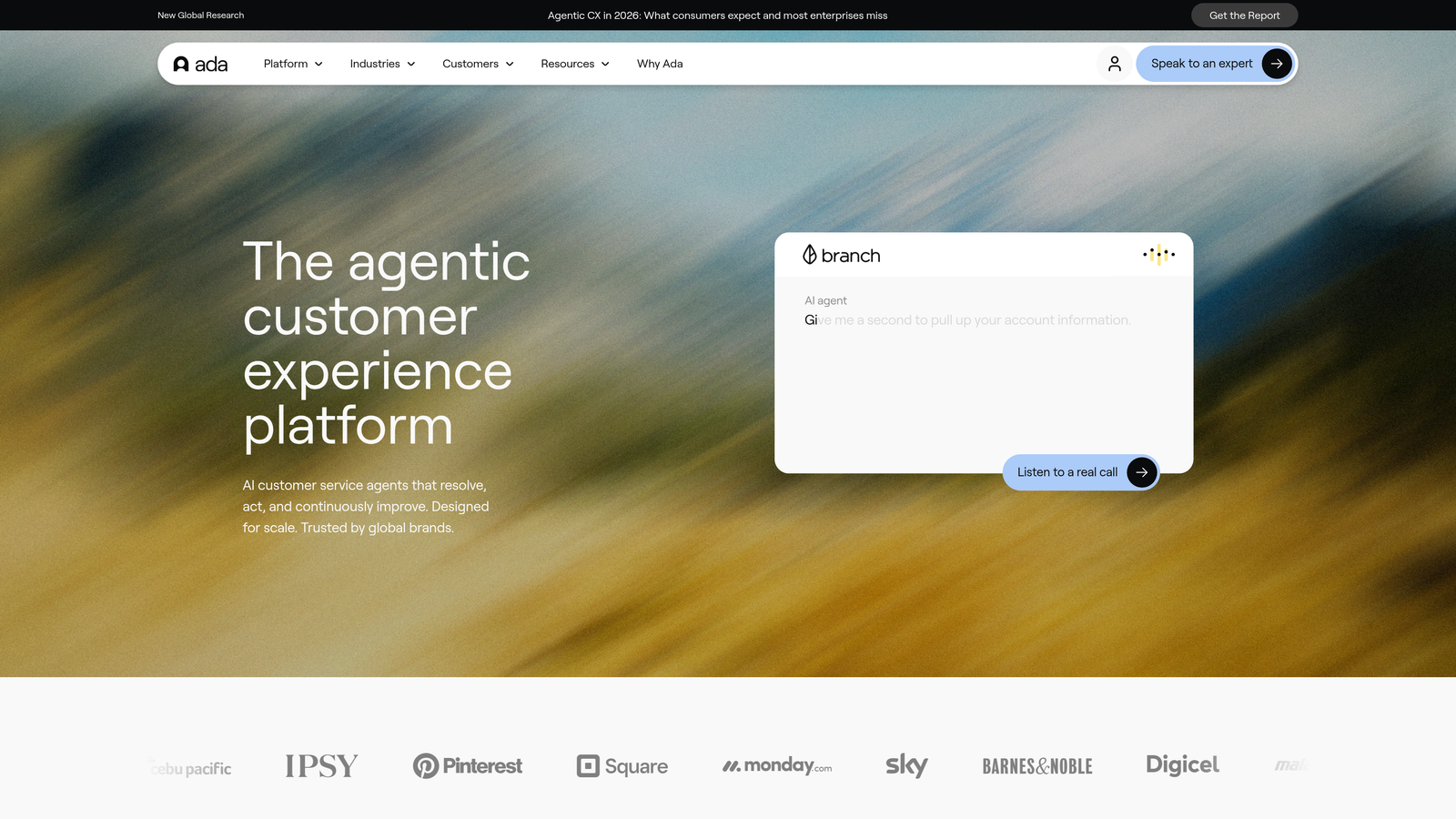
Ada is a no-code AI customer service platform that lets product teams build and deploy AI agents with drag-and-drop tools, strong multilingual support, and broad system integrations.
Where This Tool Shines
Ada's no-code builder genuinely lowers the barrier to deploying AI support. Product managers and support leads can build and iterate on conversation flows without waiting for engineering resources, which matters when your engineering team is already stretched building the product itself.
The coaching tools that continuously improve AI accuracy are worth highlighting. Rather than a static deployment, Ada's agents can be refined over time based on resolution data and feedback — which means performance improves as your team learns what works.
Key Features
No-Code Agent Builder: Drag-and-drop conversation design that non-technical team members can build and modify without engineering support.
50+ Language Support: Multilingual capability out of the box, covering global product teams with diverse user bases.
API-Based Integrations: Connects to CRMs, helpdesks, and business systems via API for data exchange and workflow automation.
Resolution Measurement: Automated tracking of resolution rates and AI performance with analytics to identify improvement areas.
AI Coaching Tools: Continuous accuracy improvement through feedback loops and coaching workflows that refine agent behavior over time.
Best For
Product teams at global companies that need multilingual support and want to move fast without heavy technical implementation. Also a strong fit for organizations where non-technical stakeholders need to own and iterate on the support experience.
Pricing
Custom pricing based on resolution volume. Contact Ada's sales team for a quote tailored to your usage profile.
5. Freshdesk Freddy AI
Best for: Teams already using Freshworks products who want AI support without adding another vendor.
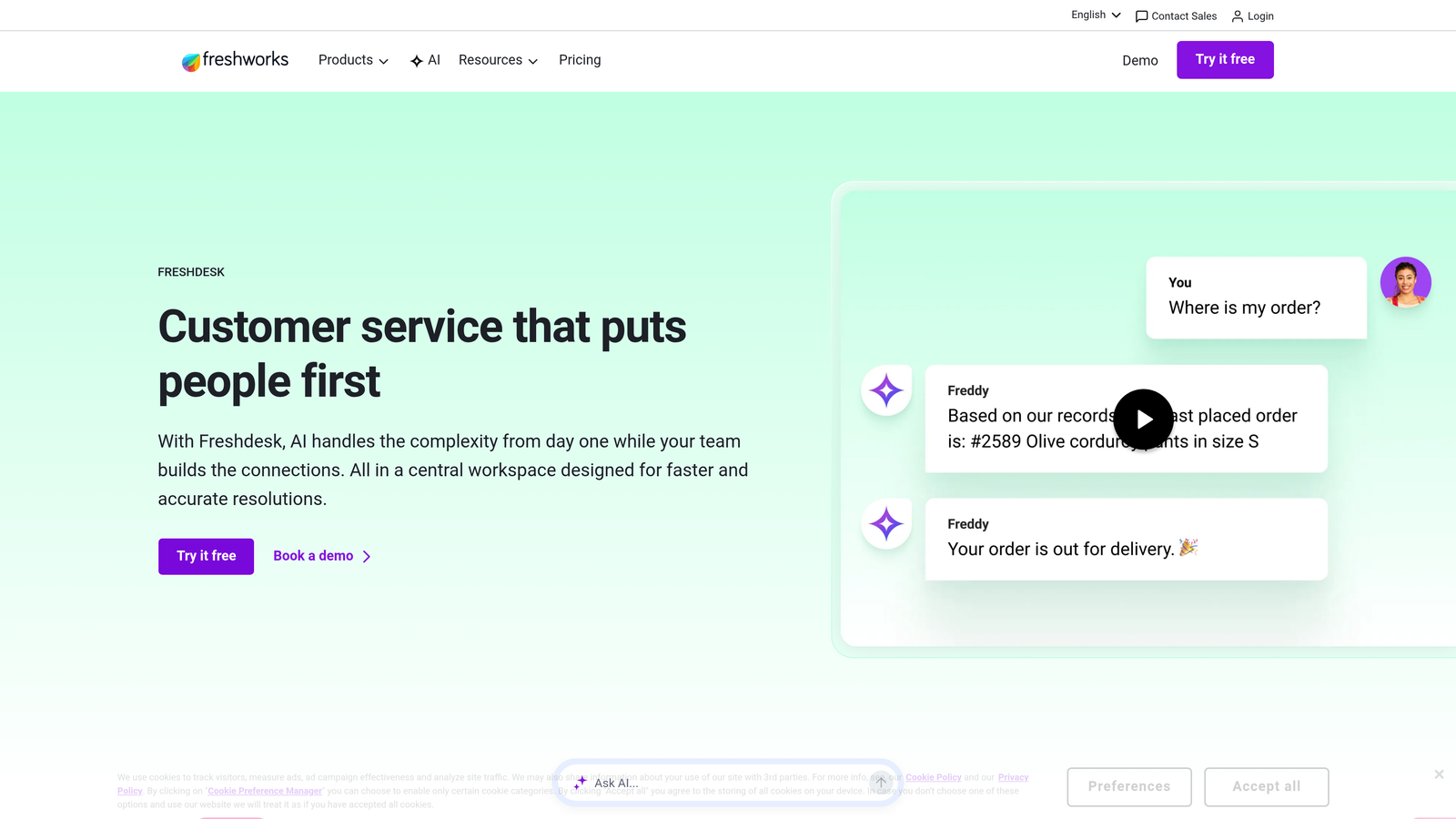
Freshdesk Freddy AI is Freshworks' AI assistant embedded in Freshdesk, handling auto-triage, self-service resolution, and agent assistance within the broader Freshworks ecosystem.
Where This Tool Shines
Freddy AI's value proposition is tightly connected to the Freshworks suite. If your team already uses Freshdesk for support, Freshsales for CRM, or Freshservice for ITSM, Freddy adds AI capabilities across all of those surfaces without introducing a new vendor relationship. That consolidation can simplify both procurement and data flow.
The AI-powered reply suggestions for agents are practical rather than flashy — they surface relevant canned responses and knowledge base content in context, reducing the time agents spend composing routine answers.
Key Features
Freddy AI Agent: Self-service resolution on web and messaging channels, handling common requests without agent involvement.
Auto-Triage: Intelligent ticket classification and routing based on content, intent, and historical patterns.
AI Reply Suggestions: Real-time suggestions for agents including relevant canned responses and knowledge base recommendations.
Knowledge Base AI: Content suggestions that help teams identify gaps and improve self-service documentation over time.
Freshworks Suite Integration: Native connection across Freshdesk, Freshsales, Freshservice, and other Freshworks products for unified data.
Best For
Teams already in the Freshworks ecosystem looking to activate AI without platform migration. The free tier makes it accessible for smaller product teams testing AI support for the first time.
Pricing
A free tier is available for small teams. AI features become available in the Growth plan starting at $15 per agent per month, making it one of the more accessible options on this list.
6. Unthread
Best for: Product teams that run customer support primarily through Slack and need structure without leaving that environment.
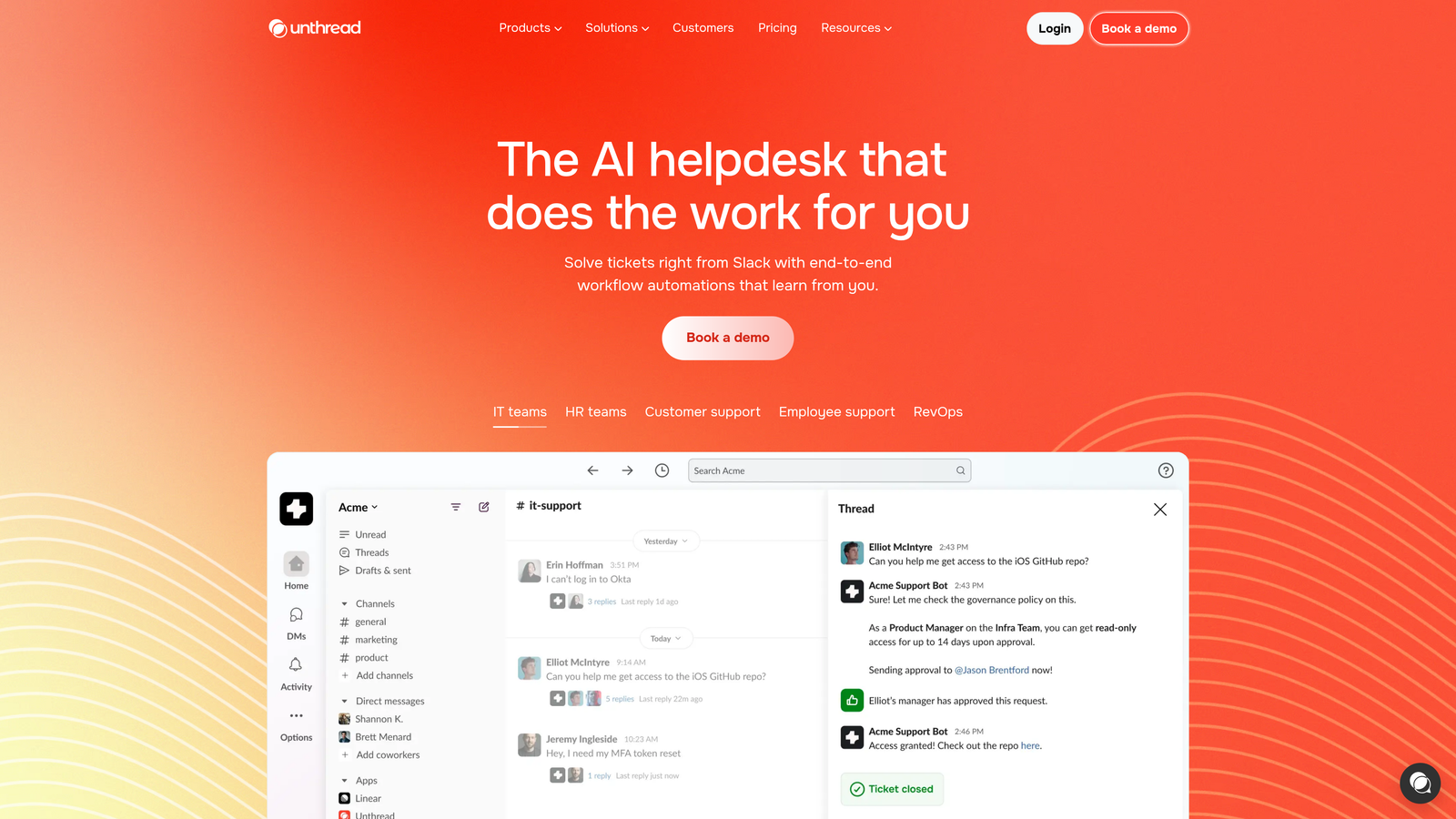
Unthread is a Slack-native support tool that converts Slack messages into trackable tickets, with AI-powered triage and direct integrations with engineering tools like Linear, Jira, and GitHub.
Where This Tool Shines
Many B2B SaaS companies run a meaningful portion of their customer support through Slack Connect channels, where enterprise customers message directly. Unthread brings structure to that chaos without forcing customers or teams to move to a different channel. The ticket tracking, SLA management, and escalation workflows all happen inside Slack.
The engineering tool integrations are particularly relevant for product teams. When a Slack conversation surfaces a bug, Unthread can route it directly to a Linear or Jira issue without anyone manually copying context across systems.
Key Features
Slack-Native Ticket Conversion: Converts Slack messages and threads into structured, trackable support tickets with assignment and status tracking.
AI Auto-Categorization: Automatically assigns categories and priority levels to incoming requests based on content analysis.
SLA Tracking in Slack: Monitors response time commitments and triggers escalation workflows without leaving the Slack environment.
Engineering Tool Routing: Direct integrations with Linear, Jira, and GitHub for routing bugs and feature requests into development workflows.
Support Analytics: Dashboard tracking volume, response times, and resolution trends across your Slack support channels.
Best For
B2B product teams whose enterprise customers communicate via Slack Connect, and teams that want to keep their support workflow inside Slack rather than managing a separate helpdesk platform.
Pricing
A free plan is available for small teams. Paid plans start at $50 per month, making it one of the more affordable structured options for Slack-heavy organizations.
7. DevRev
Best for: Product teams that want a unified system connecting customer support directly to product development work items.
DevRev is a platform purpose-built to close the loop between support and engineering, where customer tickets connect natively to dev work items, sprints, and product roadmap decisions.
Where This Tool Shines
DevRev's core insight is that support and product development aren't separate functions — they're part of the same feedback loop. By building a system where support tickets and engineering issues live in the same data model, DevRev eliminates the translation layer that typically causes friction between support and product teams.
The automatic clustering of similar support issues is particularly valuable for product planning. Rather than manually reviewing tickets to identify patterns, DevRev surfaces clusters of related issues that may point to a shared product gap, giving PMs data to prioritize roadmap decisions.
Key Features
Unified Support-to-Dev Data Model: Customer tickets and engineering work items exist in the same system, with native linking between support issues and dev tasks.
AI PLuG Widget: In-app self-service support widget powered by AI for autonomous resolution within your product.
Issue Clustering: Automatic grouping of similar support issues to identify recurring product problems and prioritize engineering attention.
Sprint Planning Integration: Customer-reported issues feed directly into sprint planning workflows, so product teams can incorporate support data into development prioritization.
Support-to-Roadmap Analytics: Reporting that links support volume and trends to product roadmap decisions with direct data backing.
Best For
Product teams that want to eliminate the organizational gap between support and engineering, particularly those where PMs are actively involved in triaging customer feedback and feeding it into development cycles.
Pricing
A free tier is available for teams getting started. Pro plans are available with custom pricing based on team size and usage requirements.
8. Aide
Best for: Teams that want AI capabilities on top of their existing helpdesk without a platform migration.
Aide is an AI layer that sits on top of Zendesk, Freshdesk, and other helpdesks, adding intelligent classification, automated draft responses, and workflow suggestions without replacing the underlying system.
Where This Tool Shines
The migration problem is real: many teams have years of ticket history, established workflows, and agent training invested in their current helpdesk. Aide addresses this directly by augmenting rather than replacing. You get AI-powered classification and response drafting without the disruption of switching platforms.
For product teams specifically, the trending topic identification is a standout feature. Aide surfaces recurring issues and emerging patterns in real time, giving product managers visibility into what's breaking or confusing users without manually reviewing tickets.
Key Features
Helpdesk Overlay: Works on top of Zendesk, Freshdesk, and other platforms without requiring data migration or workflow rebuilds.
AI Ticket Classification: Automatically tags and categorizes tickets by topic and intent, improving routing accuracy and reporting quality.
Automated Draft Responses: Generates draft responses for agent review, reducing the time spent on initial response composition.
Trending Topic Detection: Identifies emerging issues and recurring themes across your ticket volume in real time.
Workflow Automation Suggestions: Recommends workflow improvements based on historical ticket patterns and resolution data.
Best For
Teams committed to their current helpdesk who want AI capabilities without the cost and disruption of platform migration. Also useful for organizations that want to test AI support value before committing to a full platform change.
Pricing
Volume-based pricing starting at $0.05 per ticket. This model works well for teams with predictable, moderate ticket volumes and makes cost straightforward to forecast.
9. Threado AI
Best for: Product teams that run community-based support across Slack, Discord, and documentation platforms.
Threado AI is an AI support agent trained on community conversations, knowledge bases, and internal documentation — designed for teams where support happens in community spaces rather than traditional helpdesk channels.
Where This Tool Shines
Developer tools, open-source projects, and community-led products often have support needs that traditional helpdesks don't address well. When your users are asking questions in a Discord server or a Slack community, a ticketing system creates friction. Threado meets users where they are, deploying as a native bot within those environments.
The internal knowledge assistant is a useful secondary capability. Team members can query the same AI that handles community questions, making it a knowledge layer for both users and internal staff — particularly useful for teams with distributed documentation across Notion, Confluence, and other platforms.
Key Features
Community-Trained AI Agent: Learns from Slack channels, Discord servers, community forums, and knowledge bases to answer questions in context.
Native Bot Deployment: Deploys directly as a bot in Slack or Discord, or as a web widget, without requiring users to leave their preferred environment.
Internal Knowledge Assistant: Team members can query the AI to surface answers from internal documentation and past community discussions.
Documentation Analytics: Tracks which questions are being asked, identifies gaps in existing documentation, and surfaces trending topics across community channels.
Documentation Platform Integrations: Connects with Notion, Confluence, and other documentation tools to build a comprehensive knowledge source for the AI agent.
Best For
Developer-focused product teams, open-source projects, and community-led SaaS companies where users expect support in community spaces rather than traditional helpdesk interfaces. Less suited for teams whose support volume lives primarily in email or chat widgets.
Pricing
A free tier is available for small communities. Paid plans start at $49 per month, with pricing scaling based on community size and usage volume.
Which Tool Is Right for Your Product Team?
The right choice depends on where your biggest friction lives right now. Here's a quick map to help you decide.
If you want an AI-native platform built specifically for product teams, with page-aware context, automatic bug routing into Linear, and business intelligence layered into the support inbox, Halo AI is the strongest purpose-built option. It's designed from the ground up for the way modern product teams work, not adapted from a traditional helpdesk model.
For teams already on Intercom, Fin activates quickly without disrupting existing workflows. For enterprise organizations that need scale, compliance, and a mature integration ecosystem, Zendesk AI is the reliable choice. If your support-to-engineering feedback loop is the core problem, DevRev's unified data model addresses it more directly than any other platform. And if your customers live in Slack, Unthread brings structure to that environment without forcing a channel change.
The broader shift happening in 2026 is from support as a cost center to support as a product intelligence layer. The tools that enable that shift don't just deflect tickets — they surface the patterns, bugs, and friction points that help you build a better product. That's the standard worth holding every tool on this list to.
Your support team shouldn't scale linearly with your customer base. AI agents can handle routine tickets, guide users visually through your product, and surface business intelligence while your team focuses on the complex issues that genuinely need a human touch. See Halo in action and discover how continuous learning transforms every support interaction into smarter, faster support that gets better over time.