9 Best AI Support Tool Integrations for B2B Teams in 2026
Effective ai support tool integrations go beyond basic connectivity—the best B2B solutions offer bidirectional, real-time syncs with CRM, billing, and engineering systems so AI agents can resolve tickets with full customer context. This guide evaluates nine top tools based on native integration depth, business intelligence capabilities, and how well they connect the systems that actually define your customer relationships.
 Matt PattoliFounder14 min read
The AI in your support stack is only as good as the connections around it. Pick any two AI support tools on the market today and they'll both claim to resolve tickets autonomously, reduce response times, and delight customers. What actually separates them is integration depth: whether the AI can read from and write to your CRM, product, billing, and engineering systems in real time, or whether it's essentially flying blind with a chatbot interface bolted on top.
Shallow integrations produce shallow results. When an AI agent can't see a customer's subscription status in Stripe, their open bug in Linear, or their last conversation in Slack, it can't resolve anything meaningfully. The best AI support integrations are bidirectional, context-aware, and connected to the systems that actually define your customer relationship.
To build this list, we evaluated tools on four criteria: native integration quality, real-time bidirectional sync, business intelligence value surfaced from support data, and scalability for B2B teams. Whether you're running a lean SaaS team or managing enterprise support at scale, the tools below represent the strongest integration stories in the market right now.
1. Halo AI
Best for: B2B SaaS teams wanting AI-first support with deep, native integrations across their full business stack.
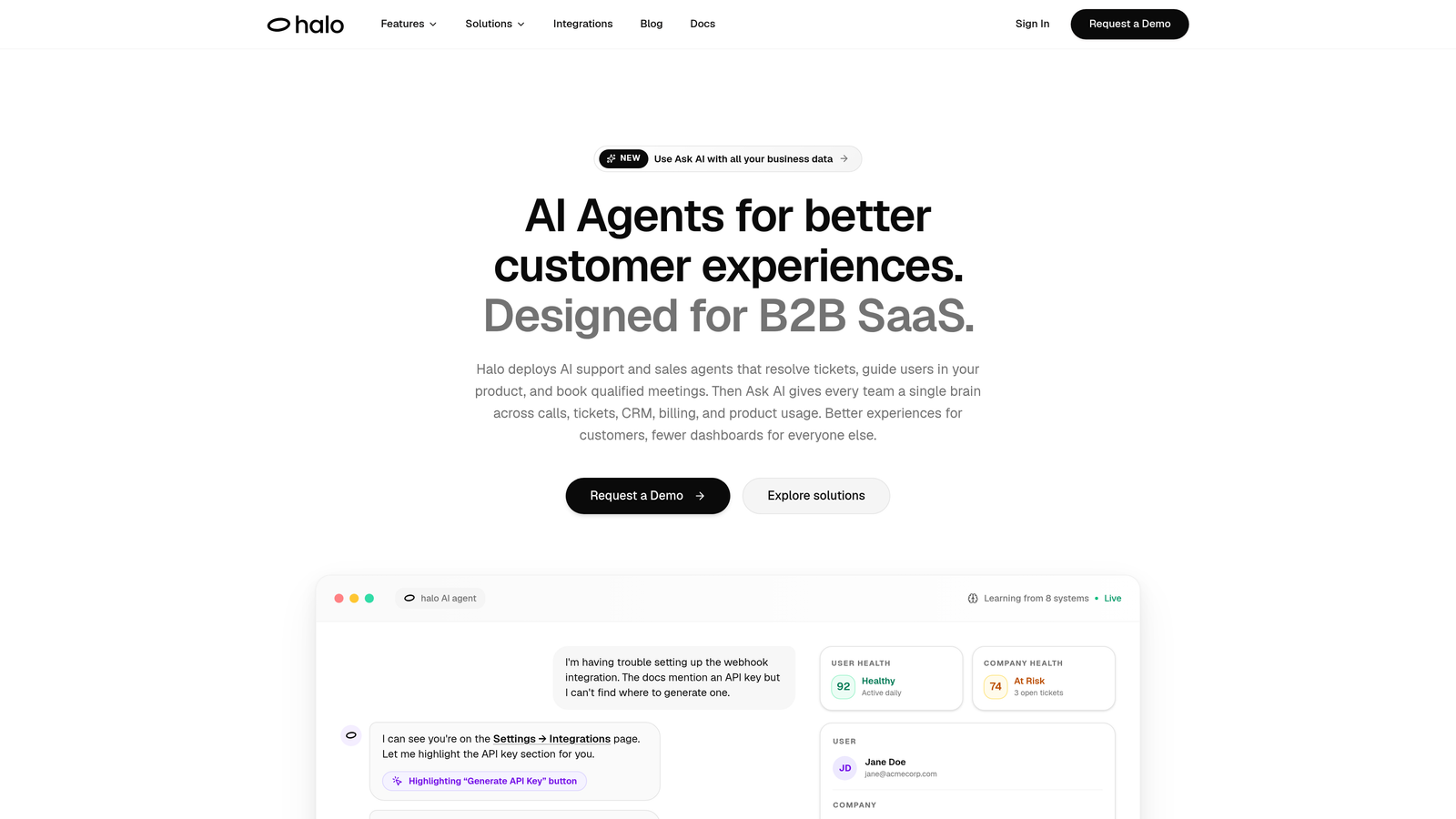
Halo AI is an AI-first customer support platform built specifically for B2B SaaS teams, featuring intelligent agents, page-aware context, and native integrations that connect support to your entire business stack.
Where This Tool Shines
Halo's core architectural advantage is that integrations aren't add-ons. They're built into how the AI reasons. When a customer opens a support conversation, Halo's agent already knows what page they're on, what their account status looks like in Stripe, and whether there's a related bug open in Linear. That context shapes every response before the customer types a single word.
The business intelligence layer is what sets Halo apart from every other tool on this list. The smart inbox doesn't just route tickets. It surfaces customer health signals, revenue anomalies, and churn indicators from support data, turning your support queue into a source of product and revenue intelligence. For B2B teams where every account matters, that's a meaningful operational advantage.
Key Features
Native integration stack: Deep, bidirectional connections with Linear, Slack, HubSpot, Intercom, Stripe, Zoom, PandaDoc, and Fathom — not webhooks, but native integrations built into the AI's reasoning layer.
Page-aware AI context: The agent sees exactly what the user sees in your product, enabling contextually accurate guidance without the customer needing to explain where they are.
Auto bug ticket creation: When a support conversation surfaces a bug, Halo automatically creates and routes a ticket directly to Linear, closing the loop between support and engineering without manual intervention.
Smart inbox with business intelligence: Customer health signals, churn indicators, and revenue anomalies are surfaced directly from support interactions, giving teams visibility beyond ticket volume.
Continuous learning: The AI improves on your specific product and customer base over time, not just generic LLM performance. Every resolved interaction makes the next one faster and more accurate.
Live agent handoff: Complex issues escalate to human agents with full conversation context preserved, so customers never have to repeat themselves.
Best For
B2B SaaS companies that want AI support to do more than deflect tickets. Halo is particularly well-suited for product-led growth teams, companies with complex multi-tool stacks, and teams that want support data to inform product and revenue decisions rather than sit siloed in a helpdesk.
Pricing
Contact for pricing. Halo is designed for B2B SaaS teams and priced for organizational deployment rather than per-seat individual use.
2. Zendesk AI
Best for: Enterprise teams already invested in the Zendesk ecosystem seeking AI-enhanced ticket operations.
Zendesk AI is an enterprise helpdesk platform with AI features layered across ticket triage, routing, macros, and autonomous deflection via its AI agent.
Where This Tool Shines
Zendesk's primary strength is its marketplace breadth. With over 1,500 third-party integrations, teams running complex enterprise stacks can almost always find a native connector. The AI features, including intelligent triage and suggested macros, are well-integrated into the existing agent workflow rather than feeling like a separate product.
For teams that have spent years building Zendesk workflows, the AI layer slots in without requiring a platform migration. That's a real operational advantage, even if the AI-first architecture isn't as deep as newer purpose-built platforms.
Key Features
Intelligent ticket triage: AI automatically categorizes, prioritizes, and routes incoming tickets based on content and historical patterns.
Suggested macros and automated responses: Agents receive AI-generated response suggestions based on ticket content, reducing handle time on common issues.
Zendesk AI agent: Autonomous ticket deflection for common queries, trained on your help center content.
1,500+ marketplace integrations: Native connectors for Salesforce, Slack, Jira, and hundreds of other enterprise tools.
Advanced analytics: Robust reporting across support operations, CSAT, and agent performance metrics.
Best For
Enterprise support teams with established Zendesk workflows who want to layer AI capabilities onto existing operations without a platform change. Less suited for teams wanting AI-first architecture or deep product-and-support data fusion.
Pricing
AI features start from approximately $55 per agent per month on Suite Team. Advanced AI capabilities are available as separate add-ons, which can significantly increase total cost at scale.
3. Intercom Fin
Best for: Product-led growth companies wanting conversational AI support tightly connected to their CRM and messenger.
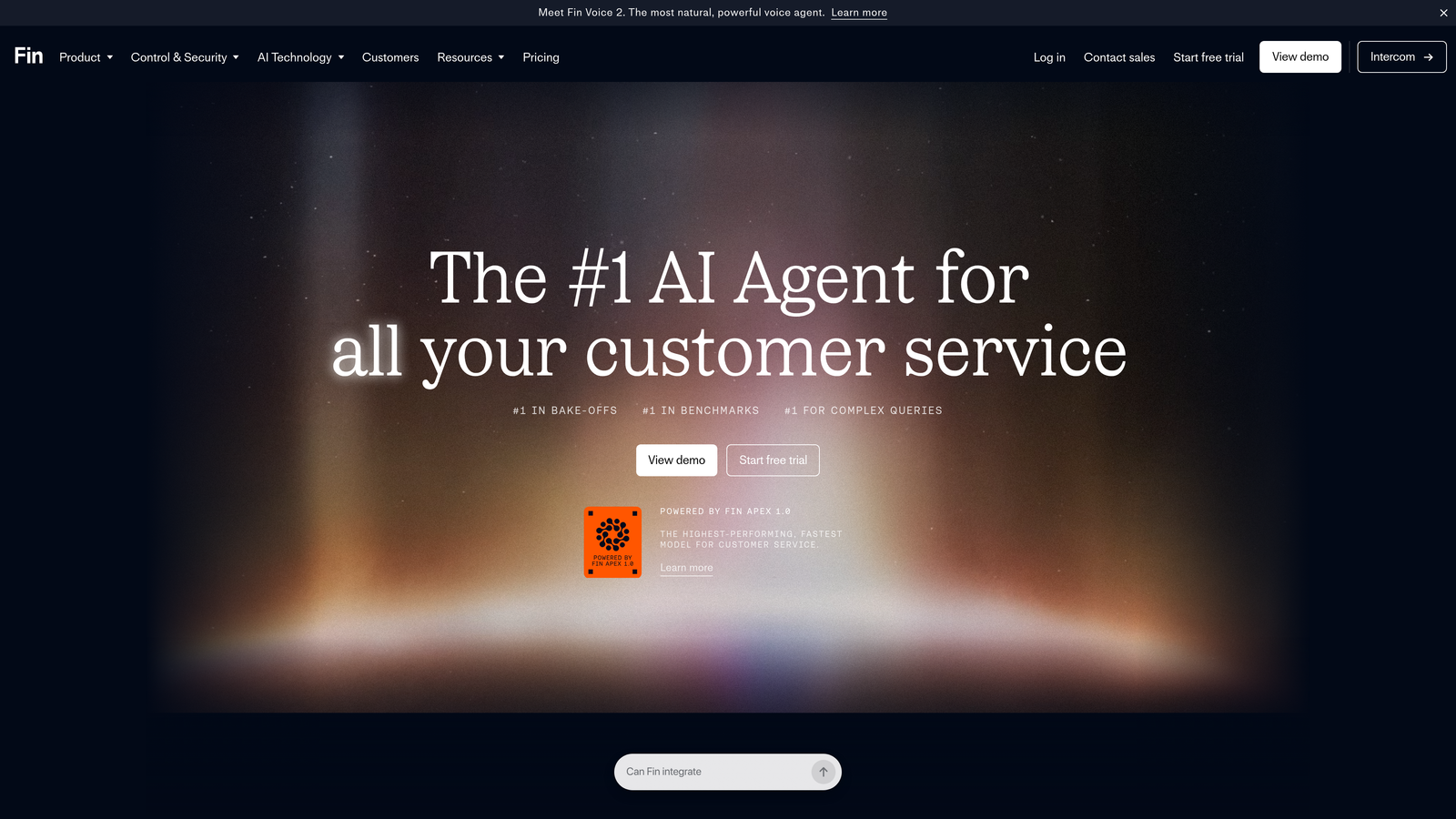
Intercom Fin is Intercom's AI agent, built for conversational support with deep integration into Intercom's messenger, CRM data model, and app marketplace.
Where This Tool Shines
Fin's integration with Intercom's native CRM and conversation data model is genuinely strong. Because Intercom already stores contact history, conversation threads, and product event data, Fin has access to rich customer context without requiring external CRM connections. For teams whose system of record lives inside Intercom, this is a significant advantage.
The custom actions capability is worth noting. Teams can configure Fin to trigger external workflows, look up order data, or update records in connected systems, making it more than a basic FAQ bot. The 600+ app marketplace extends this further for common tool stacks.
Key Features
AI agent on native CRM data: Fin draws on Intercom's contact and conversation history natively, without requiring a separate CRM integration for basic context.
Custom actions: Configurable triggers that connect Fin to external systems, enabling transactional support flows beyond simple Q&A.
600+ app marketplace: Wide integration coverage for common support and business tools.
Configurable human handoff: Escalation to live agents with full conversation context preserved.
Multi-channel deployment: Messenger, email, and third-party channel support from a single platform.
Best For
Product-led growth SaaS companies already using Intercom as their primary customer communication layer. Teams whose CRM lives outside Intercom may find the integration story less compelling.
Pricing
Fin AI agent pricing is based on resolutions rather than seats. Intercom base plans start from approximately $39 per month, with Fin costs scaling with resolution volume.
4. Freshdesk Freddy AI
Best for: Mid-market teams already using the Freshworks suite who want cross-product AI context without additional integrations.
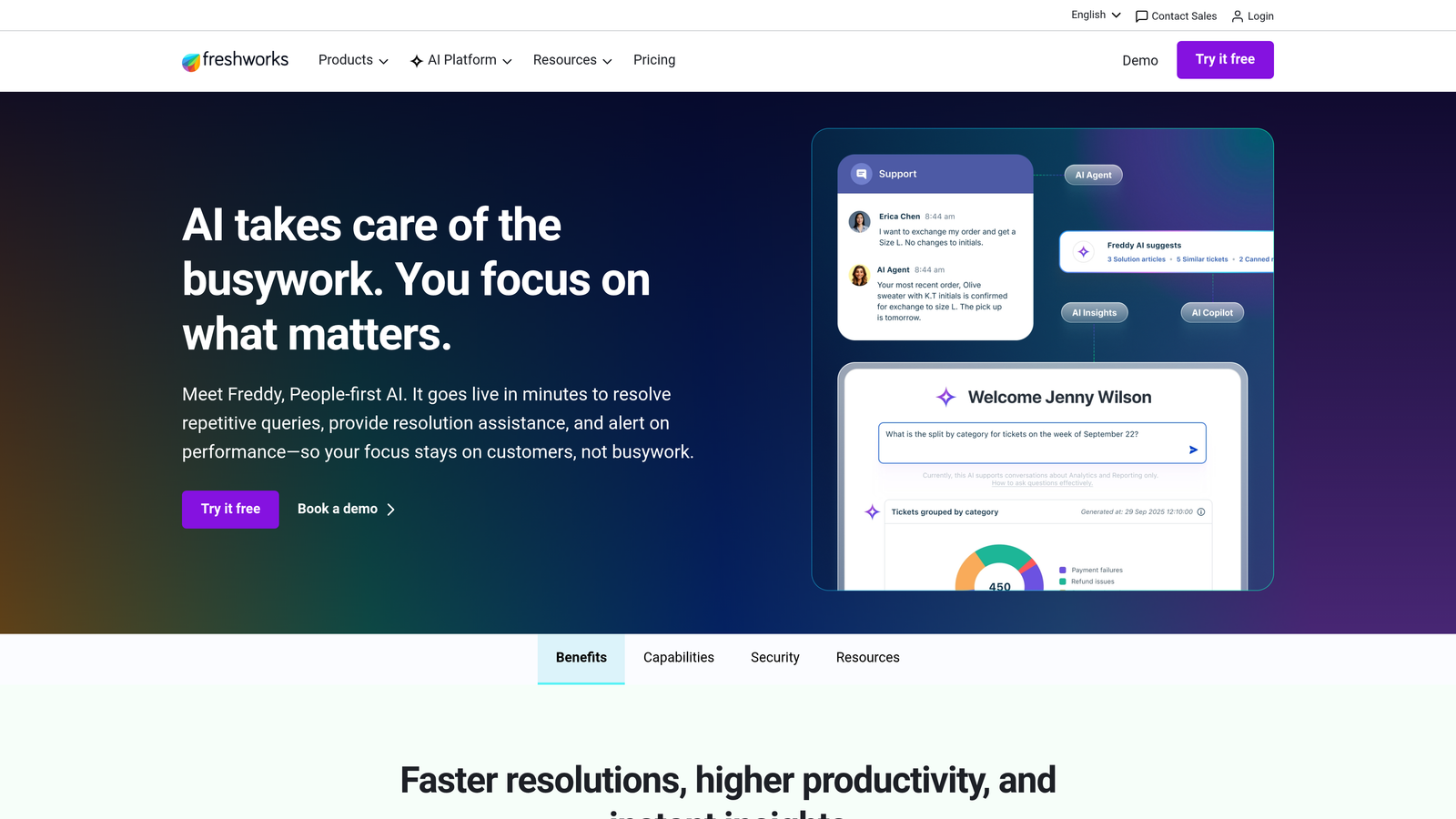
Freshdesk Freddy AI is the intelligence layer across the Freshworks product suite, connecting support, CRM, and ITSM with shared AI context.
Where This Tool Shines
The Freshworks suite integration is Freddy's defining advantage. When a support agent handles a ticket in Freshdesk, they can see CRM data from Freshsales and IT service records from Freshservice in the same interface. That cross-suite visibility eliminates the tab-switching and context loss that slow down most support teams working across separate tools.
For teams that have standardized on Freshworks across departments, this creates a genuinely unified AI layer. The no-code bot builder also makes it accessible for teams without dedicated technical resources to configure custom conversation flows.
Key Features
AI copilot for agents: Suggested responses, tone adjustment, and conversation summarization built into the agent interface.
Freddy Self Service: Customer-facing autonomous resolution for common queries, reducing ticket volume before it reaches agents.
Cross-suite CRM context: Support agents see Freshsales CRM data and Freshservice ITSM records natively, without integration setup.
No-code bot builder: Visual conversation flow builder for creating custom resolution paths without engineering involvement.
Native Freshworks integrations: Seamless data sharing across Freshdesk, Freshsales, and Freshservice out of the box.
Best For
Mid-market companies running Freshdesk alongside other Freshworks products. Teams using Salesforce or HubSpot as their primary CRM will find less native integration value here.
Pricing
Freshdesk plans start from $15 per agent per month. Freddy AI features are available on the Growth tier and above, with advanced capabilities on higher tiers.
5. Salesforce Agentforce
Best for: Enterprise organizations where Salesforce is the primary system of record for customer data.
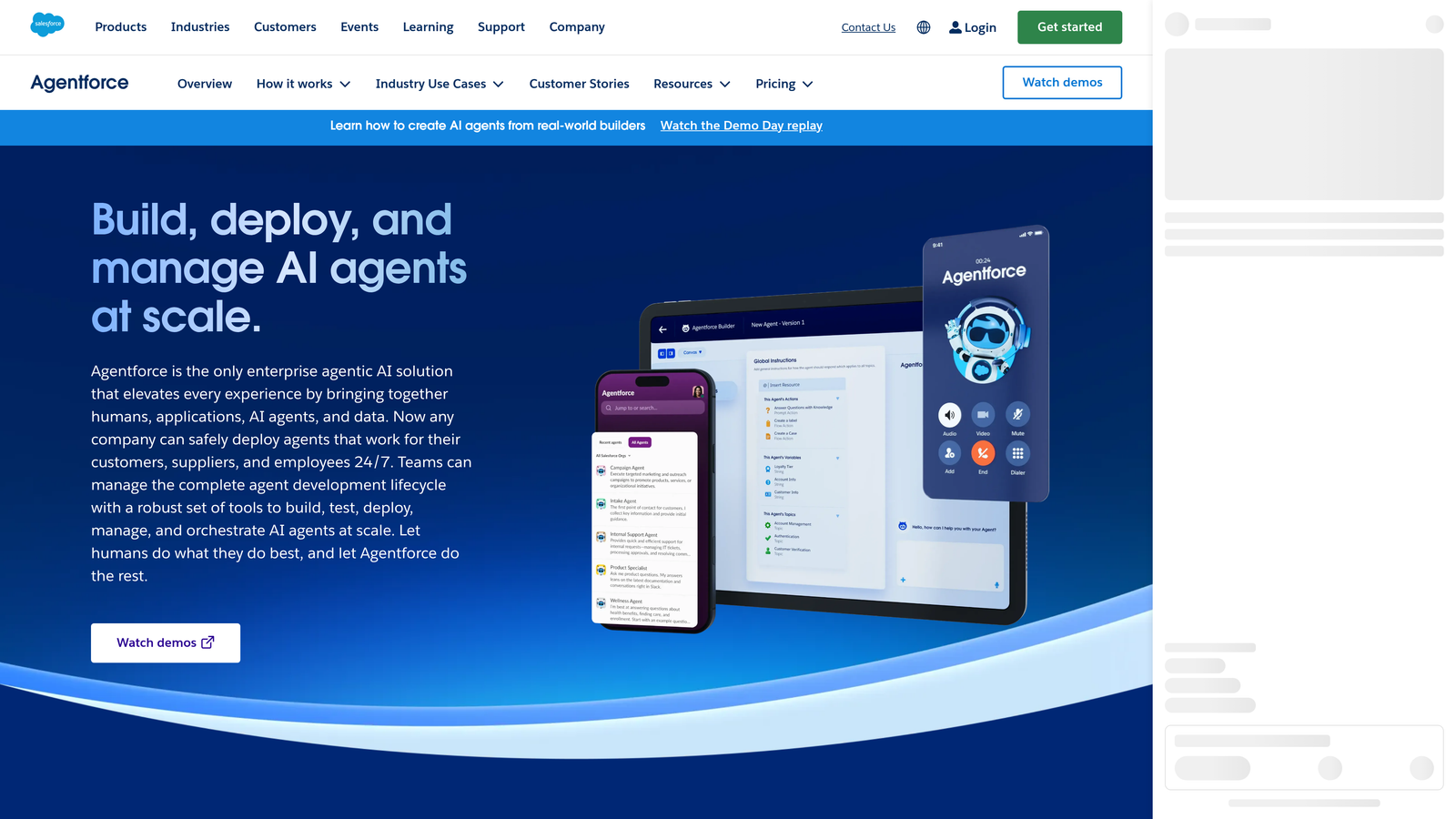
Salesforce Agentforce is a suite of autonomous AI agents built natively on Salesforce's Data Cloud, giving enterprise service teams AI support with full access to the complete Salesforce CRM record.
Where This Tool Shines
If your customer data lives in Salesforce, Agentforce's integration depth is hard to match. The AI operates directly on Data Cloud records, meaning it has access to the full customer history, open opportunities, service cases, and Einstein AI-enriched data without any external data pipeline. That's a genuine architectural advantage for Salesforce-native organizations.
The pre-built agent templates for service, sales, and field service accelerate deployment for teams that don't want to build from scratch. The MuleSoft integration layer also extends Agentforce to non-Salesforce systems, though this adds implementation complexity and cost.
Key Features
Native Data Cloud access: AI agents operate directly on Salesforce's unified customer data layer, with no external sync required.
Pre-built agent templates: Ready-to-deploy agent configurations for service, sales, and field service use cases.
Einstein AI reasoning: Agents leverage Einstein's AI layer with full CRM customer history for contextual decision-making.
MuleSoft integration: Connects Agentforce to third-party systems outside the Salesforce ecosystem for enterprise-wide coverage.
Human escalation with full record context: Agents escalate to human reps with the complete Salesforce record visible and in context.
Best For
Large enterprises with Salesforce as the organizational system of record and dedicated Salesforce admin resources. Implementation complexity and cost make this less suitable for lean teams or companies not already deeply invested in the Salesforce platform.
Pricing
Agentforce starts at $2 per conversation. A Salesforce platform subscription is required, making total cost of ownership significant for teams not already on Salesforce.
6. Guru
Best for: Support teams struggling with knowledge fragmentation across multiple tools who need AI-surfaced answers in context.
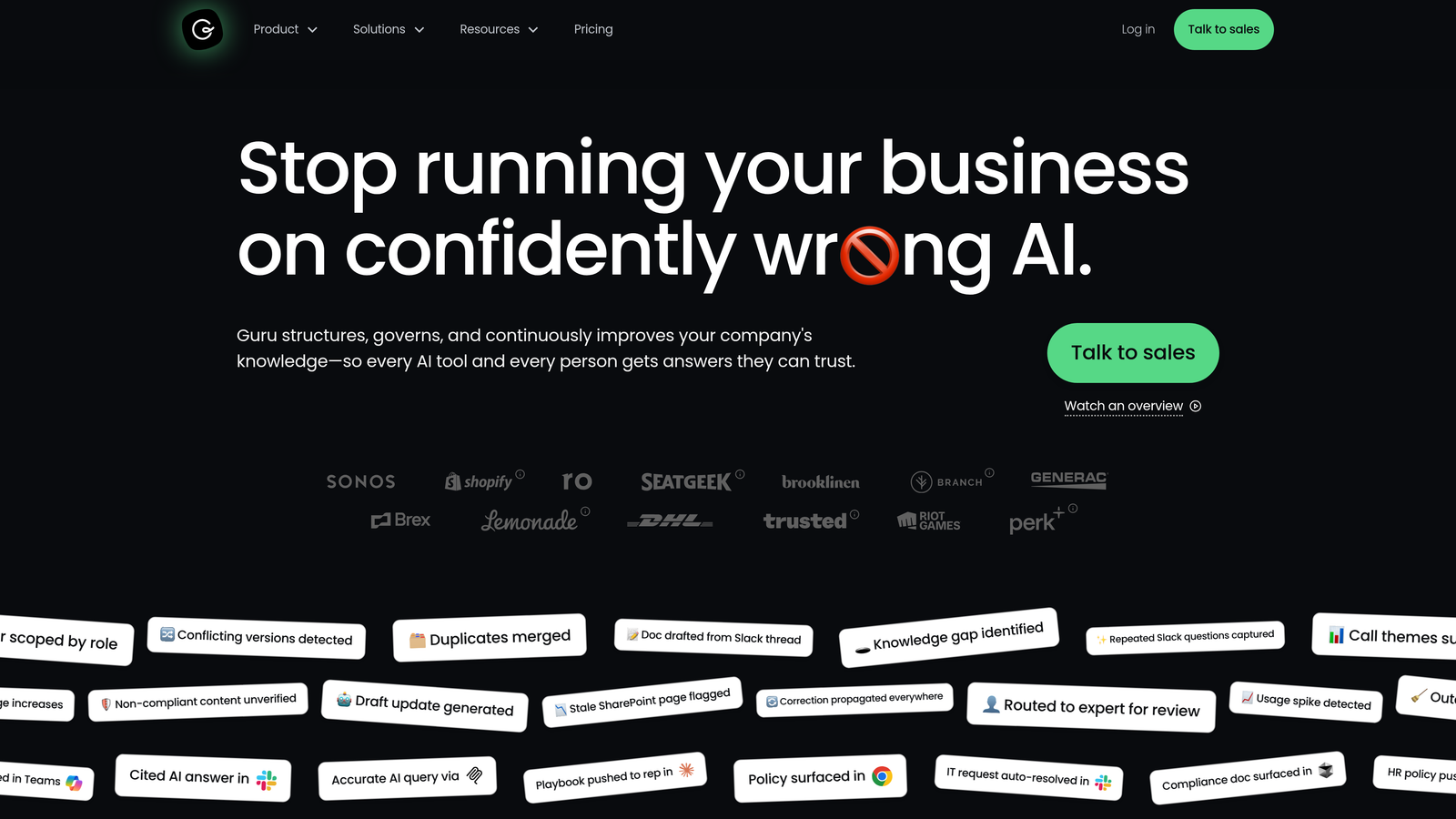
Guru is an AI-powered knowledge management platform that surfaces answers inside the tools your support team already uses, rather than asking them to switch to a separate knowledge base.
Where This Tool Shines
Guru solves a specific and common problem: support agents know the answer exists somewhere, but finding it mid-conversation means leaving the tool they're working in. Guru's AI surfaces relevant knowledge cards directly inside Zendesk, Slack, and Chrome, keeping agents in flow without context switching.
The knowledge verification workflow is an underrated feature. It ensures that the information Guru surfaces stays accurate over time, which matters enormously in fast-moving SaaS products where documentation goes stale quickly. Analytics on knowledge gaps also help teams identify where documentation investment is most needed.
Key Features
In-context knowledge surfacing: AI delivers relevant answers inside Zendesk, Slack, and Chrome without requiring agents to leave their current tool.
Knowledge verification workflows: Built-in review cycles ensure content accuracy over time, preventing agents from acting on outdated information.
Knowledge gap analytics: Identifies which missing or weak documentation is causing the most friction in support operations.
Wide integration coverage: Connects with Salesforce, HubSpot, Confluence, and 100+ additional tools.
AI search: Natural language search across all connected knowledge sources, not just Guru-native content.
Best For
Support teams with distributed knowledge across wikis, docs, and internal tools who need a single AI layer to surface it contextually. Guru is a complement to a support platform, not a replacement for one.
Pricing
Free plan available. Paid plans start from $10 per user per month, making it one of the more accessible tools on this list for teams evaluating knowledge management specifically.
7. Kustomer
Best for: High-volume customer service teams needing a unified customer timeline across many communication channels.
Kustomer is a CRM-native customer service platform that unifies customer data from all channels into a single timeline, with AI automating routing, workflows, and repetitive responses.
Where This Tool Shines
Kustomer's CRM-native architecture means the unified customer timeline isn't an integration you configure. It's the default view. Every email, chat, social message, voice call, and SMS interaction appears in a single chronological record, giving agents and AI alike the full customer history without stitching together data from separate systems.
The AI-suggested responses draw on that full history, which means suggestions are contextually richer than tools that only see the current ticket. For teams handling high volumes across multiple channels, this unified context translates directly into faster, more accurate resolutions.
Key Features
Single customer timeline: All interactions across email, chat, social, voice, and SMS unified in one chronological view per customer.
AI-powered routing and workflow automation: Intelligent routing based on customer history, issue type, and agent availability.
Native CRM data model: Customer data lives natively in Kustomer, eliminating the need for a separate CRM integration for core functionality.
AI-suggested responses with full history: Response suggestions informed by the complete customer interaction history, not just the current ticket.
E-commerce and enterprise integrations: Native connections to Shopify, Salesforce, Slack, and major commerce platforms.
Best For
High-volume customer service teams in retail, e-commerce, or subscription businesses that need omnichannel unification. The pricing tier positions Kustomer toward mid-market and enterprise teams rather than early-stage companies.
Pricing
Plans start from approximately $89 per user per month. Enterprise pricing is available for larger deployments.
8. Zapier Chatbots + AI Actions
Best for: Teams with unique or niche tool stacks that lack native AI support integrations elsewhere.
Zapier's AI capabilities include a no-code chatbot builder and AI Actions, allowing teams to build custom AI support workflows connected to over 7,000 apps without engineering resources.
Where This Tool Shines
Zapier's value in an AI support context is flexibility. When a purpose-built support tool doesn't have a native integration with a critical system in your stack, Zapier can bridge that gap. Teams can build AI-powered support flows that trigger actions in virtually any application, from niche industry tools to internal systems with Zapier connectors.
This makes Zapier particularly useful as a complement to other tools on this list rather than a standalone support platform. It fills integration gaps that even large marketplaces don't cover, and the no-code interface means support operations teams can build and iterate without waiting on engineering.
Key Features
AI chatbot builder: No-code configuration for building conversational support flows connected to your tool stack.
AI Actions: Natural language triggers that initiate automated workflows across connected applications from within support conversations.
7,000+ app integrations: The broadest integration coverage of any tool on this list, including niche and custom platforms.
Zap templates: Pre-built automation patterns for common support workflows, reducing setup time for standard use cases.
No engineering required: Visual builder accessible to operations and support teams without technical development resources.
Best For
Teams with unique tool stacks, early-stage companies building custom support workflows, or organizations using Zapier to extend the integration reach of another primary support platform. Not a replacement for a purpose-built AI support tool.
Pricing
Free plan available. Paid plans start from $19.99 per month. AI features are available on higher tiers, with costs scaling based on task volume and automation complexity.
9. Tidio
Best for: SMBs and e-commerce teams wanting accessible AI support with native platform integrations at an approachable price point.
Tidio is an SMB-focused live chat and AI support platform featuring the Lyro AI agent, with native integrations for major e-commerce platforms and CRMs.
Where This Tool Shines
Tidio's e-commerce integration story is its clearest strength. Native connections to Shopify, WooCommerce, Wix, and BigCommerce mean the Lyro AI agent can access order data, product information, and customer purchase history without complex setup. For e-commerce teams handling high volumes of "where is my order" and product-related queries, this translates to meaningful autonomous resolution rates.
The accessible pricing and visual chatbot builder also lower the barrier for teams without dedicated technical resources. Tidio is designed to be operational quickly, which matters for smaller teams that can't invest weeks in implementation and configuration.
Key Features
Lyro AI agent: Autonomous resolution of common customer queries, trained on your help content and connected to your product data.
Native e-commerce integrations: Direct connections to Shopify, WooCommerce, Wix, and BigCommerce for order and product context.
CRM integrations: Native connections to HubSpot and Klaviyo for customer data enrichment and marketing alignment.
Live chat with AI handoff: Smooth escalation from Lyro to human agents with conversation context preserved.
Visual chatbot flow builder: No-code configuration for custom conversation flows, accessible to non-technical team members.
Best For
SMBs, e-commerce businesses, and early-stage companies that need capable AI support without enterprise pricing or implementation complexity. Less suited for complex B2B SaaS workflows or teams needing deep product and revenue intelligence from support data.
Pricing
Free plan available. Lyro AI starts from $29 per month. Business plans scale with usage volume, keeping entry costs accessible for smaller teams.
Which Tool Is Right for Your Team
The right AI support integration isn't always the most feature-rich option. It's the one that connects most deeply to the systems your team and customers already depend on.
Here's a quick way to think through the decision by use case:
Enterprise Salesforce organizations: Agentforce is the natural choice when Salesforce is your system of record and you have the resources for a structured implementation. The native Data Cloud access is genuinely difficult to replicate through third-party connectors.
Zendesk-native teams: If you've built significant workflow investment in Zendesk, the AI features there are the lowest-friction path to AI-enhanced support. Supplement with Guru if knowledge fragmentation is a separate pain point.
Product-led SaaS teams on Intercom: Fin is a strong fit when Intercom is your primary customer communication layer. The native CRM context and custom actions make it more than a basic deflection bot.
Teams with unique or fragmented tool stacks: Zapier's AI capabilities are the most practical bridge when no purpose-built tool covers your specific integration needs. Use it as a complement, not a replacement.
E-commerce and SMB teams: Tidio delivers strong value at an accessible price point, particularly for teams with Shopify or WooCommerce as the primary data source.
B2B SaaS teams wanting AI-first architecture: This is where Halo AI stands apart from the rest of the list. The integration story isn't about marketplace size. It's about depth: the AI sees what your users see, connects to Linear, Stripe, HubSpot, and Slack natively, surfaces business intelligence from support data, and learns continuously from your specific product and customer base.
Your support team shouldn't scale linearly with your customer base. Let AI agents handle routine tickets, guide users through your product, and surface business intelligence while your team focuses on complex issues that need a human touch. See Halo in action and discover how continuous learning transforms every interaction into smarter, faster support.