10 Best AI Support Tools Compared: Find Your Perfect Fit in 2026
This ai support tools comparison evaluates ten leading platforms across automation depth, learning capabilities, integrations, analytics, and pricing to help B2B companies find the right fit. Whether you're replacing a legacy helpdesk or building an AI-first support operation, this guide cuts through vendor marketing to match each tool to real use cases and team needs.
 Matt PattoliFounder13 min read
AI-powered support tools have moved from nice-to-have to mission-critical for B2B companies scaling their customer experience. But with dozens of platforms now claiming AI capabilities, from bolt-on chatbots to fully autonomous agent systems, choosing the right one can feel overwhelming.
This comparison breaks down ten leading AI support tools across the dimensions that actually matter: automation depth, learning capabilities, integration ecosystems, analytics, and pricing transparency. Whether you're replacing a legacy helpdesk, augmenting your existing support stack, or building an AI-first support operation from scratch, this guide helps you cut through the marketing noise and find the tool that fits your team, your tech stack, and your customers.
We evaluated each platform based on real feature sets, ideal use cases, and where each tool genuinely excels, not just what's on the sales page.
1. Halo AI
Best for: B2B SaaS teams building an AI-first support operation with deep business intelligence
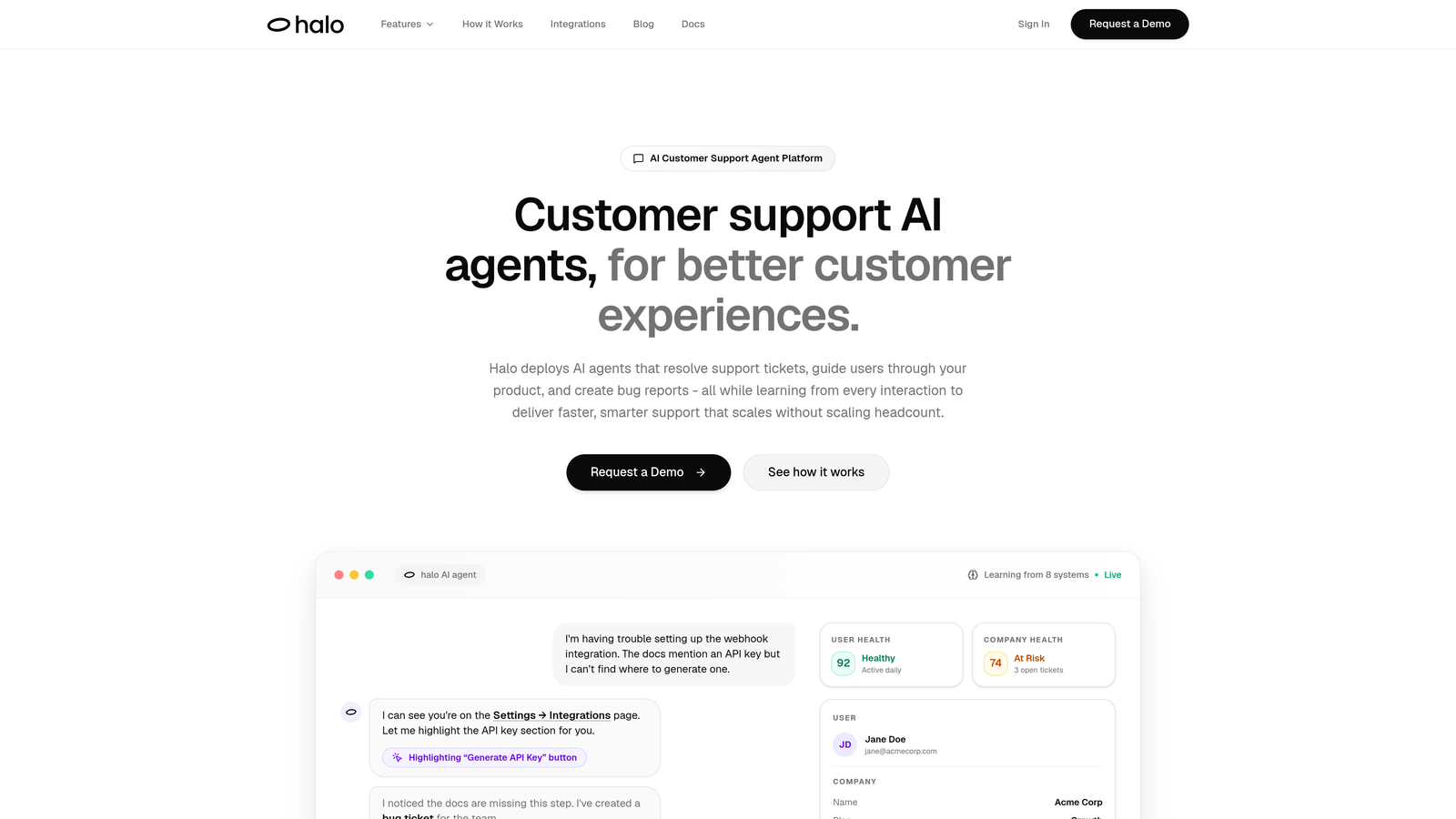
Halo AI is an AI-first customer support platform where autonomous agents resolve tickets, guide users visually through your product, and surface business intelligence, all while learning continuously from every interaction.
Where This Tool Shines
What separates Halo from most tools in this space is its architecture. It wasn't built as a layer on top of an existing helpdesk; it was designed from the ground up around autonomous AI agents. That distinction matters because bolt-on AI often inherits the limitations of the system beneath it.
The page-aware chat widget is a standout capability. Rather than responding to text alone, Halo's agents can see what a user is looking at and provide contextual visual UI guidance in real time. Pair that with a continuous learning engine that improves from every interaction without manual retraining, and you get a system that gets smarter the more you use it.
Key Features
Page-Aware Chat Widget: Sees what users see in real time and delivers visual UI guidance contextually, not generically.
Continuous Learning Engine: Improves autonomously from every resolved ticket and interaction without requiring manual model updates.
Smart Inbox with Business Intelligence: Goes beyond ticket metrics to surface customer health signals, revenue intelligence, and anomaly detection.
Auto Bug Ticket Creation: Automatically generates bug reports and routes them directly to Linear when issues are detected.
Deep Business Stack Integrations: Connects natively with Slack, HubSpot, Intercom, Stripe, Zoom, PandaDoc, and Fathom for a unified operational picture.
Best For
Halo is best suited for B2B SaaS companies and product teams that want AI to do more than deflect tickets. If you're looking for a platform that connects support activity to customer health signals, integrates across your entire business stack, and operates autonomously with smart human escalation, Halo is built for exactly that use case.
Pricing
Contact for pricing; plans are tailored to team size and ticket volume. Reach out directly at haloagents.ai for a custom quote.
2. Intercom Fin
Best for: Existing Intercom users who want native AI resolution without switching platforms
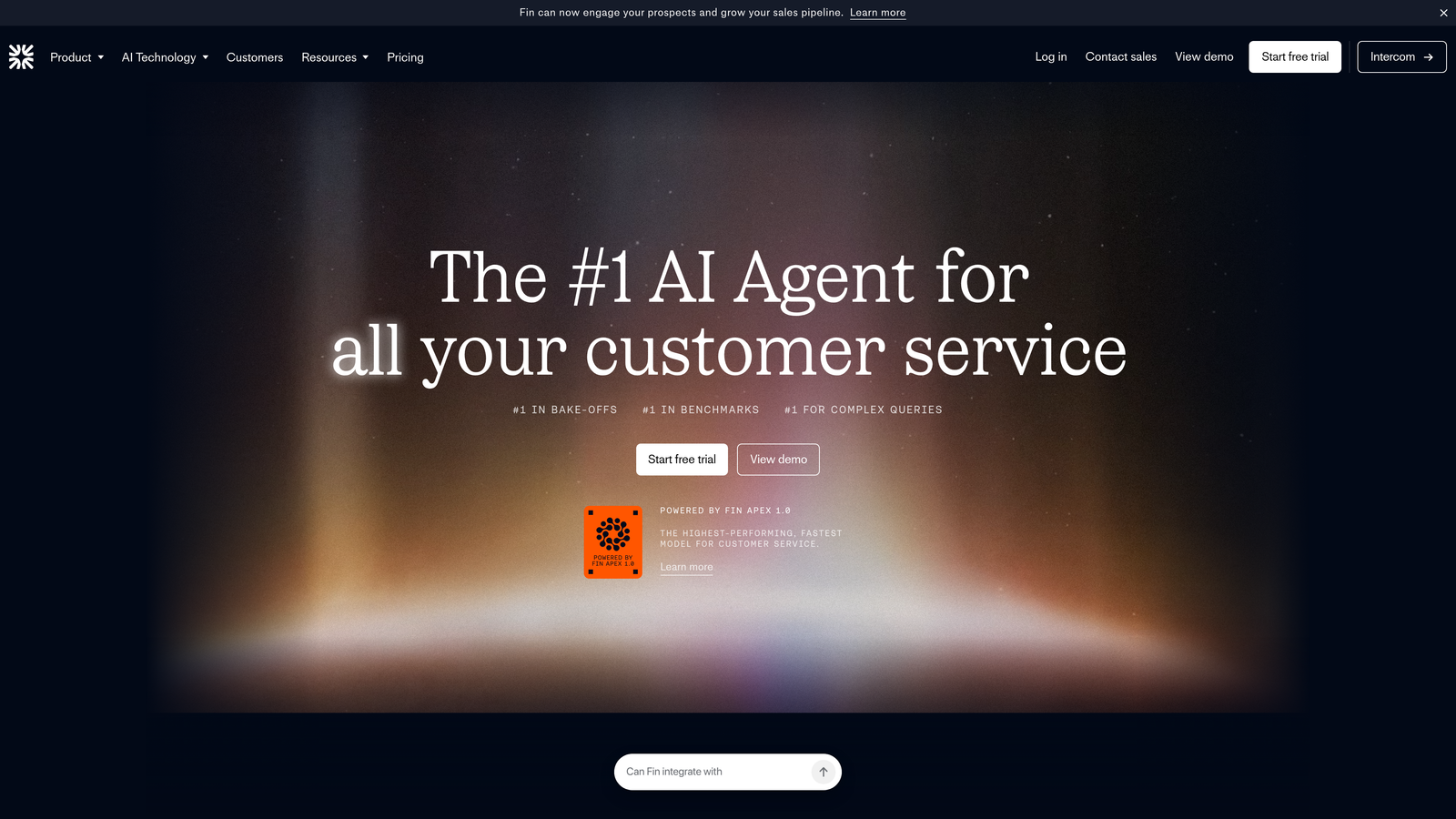
Intercom Fin is Intercom's native AI agent that resolves customer questions using your existing help center and conversation history, with seamless handoff to human teammates.
Where This Tool Shines
If your team already lives in Intercom, Fin is the path of least resistance to AI-powered resolution. It draws on your existing knowledge base, past conversations, and custom content to generate accurate, on-brand answers without requiring a separate implementation project.
The handoff experience is particularly polished. When Fin reaches the edge of its confidence, it transitions to a human agent with full context intact, so customers don't have to repeat themselves. For teams already invested in the Intercom ecosystem, this continuity is a genuine advantage.
Key Features
Native Intercom Integration: Works directly within Intercom Messenger and your existing knowledge base with no additional setup layer.
Multi-Source Answer Generation: Pulls from help articles, past conversations, and custom content to construct accurate responses.
Tone and Persona Customization: Allows teams to configure Fin's communication style to match brand voice.
Resolution Reporting: Built-in dashboards showing AI resolution rates, handoff reasons, and conversation outcomes.
Best For
Teams already using Intercom as their primary support and messaging platform who want to add AI resolution without migrating to a new system. Less ideal for companies looking for AI that operates independently of Intercom's ecosystem.
Pricing
Charged per resolution rather than per seat; pricing varies based on your Intercom plan tier and resolution volume. Costs can scale quickly at high volumes.
3. Zendesk AI
Best for: Enterprise support teams running high-volume helpdesk operations on Zendesk
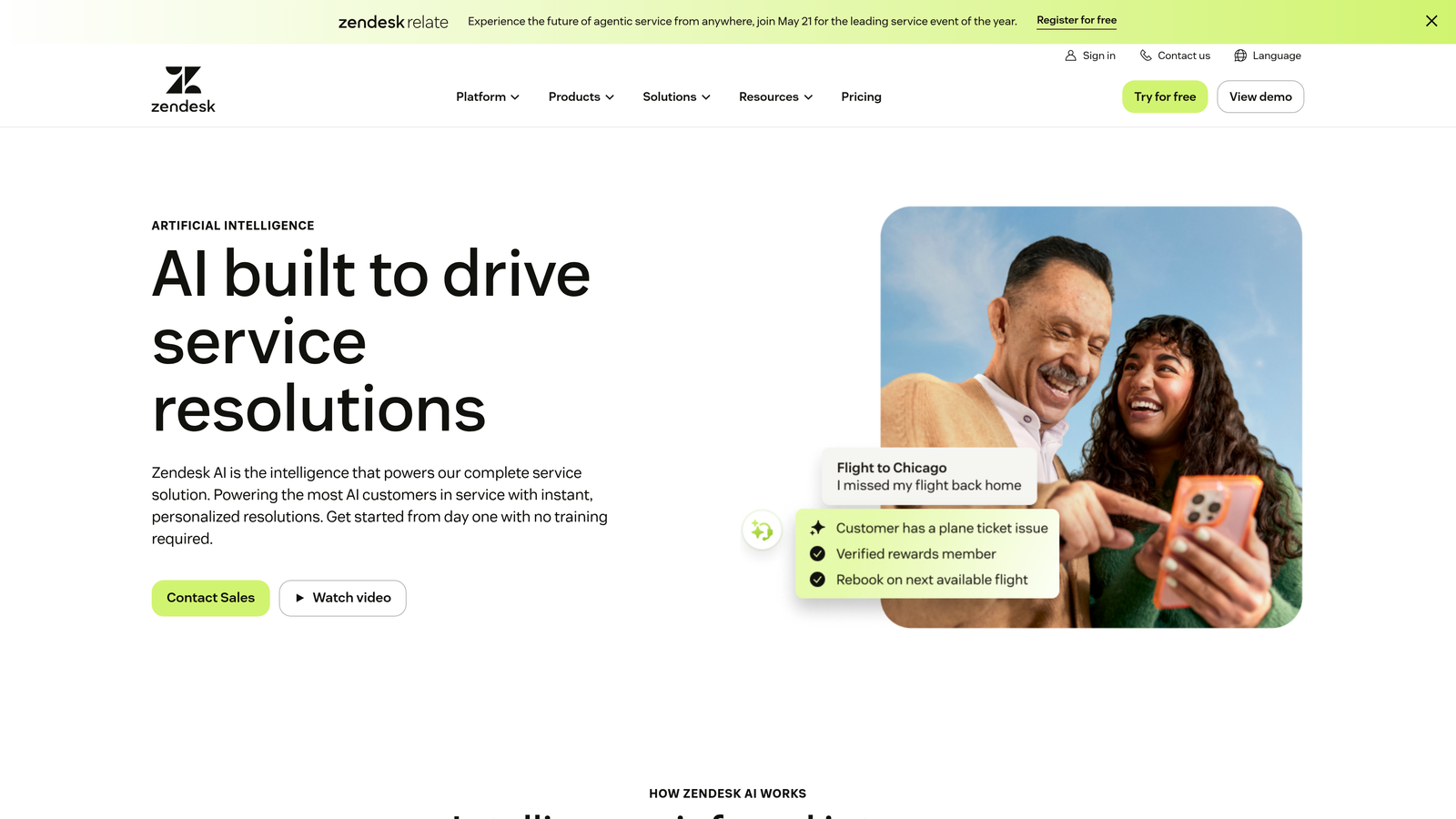
Zendesk AI is an enterprise-grade AI layer for Zendesk's helpdesk platform, offering intelligent triage, AI-generated replies, and agent assist capabilities trained on large-scale CX data.
Where This Tool Shines
Zendesk's AI benefits enormously from the scale of data behind it. Trained on billions of support interactions across industries, its triage and classification capabilities are among the most reliable in the market for common support patterns. Agents get reply suggestions surfaced in context, which meaningfully reduces handle time without requiring full automation.
For organizations already deeply embedded in Zendesk, the AI layer integrates cleanly into existing workflows. The tradeoff is that Zendesk AI is fundamentally an enhancement to a ticket-based system rather than a rethinking of how support should work.
Key Features
Intelligent Triage: Auto-classifies ticket intent, language, and sentiment to route issues to the right queue or agent immediately.
AI-Generated Reply Suggestions: Surfaces knowledge base-sourced response drafts for agents to review, edit, and send.
Autonomous Resolution Bots: Handles common inquiries end-to-end without agent involvement for routine question types.
Pre-Trained CX Model: Leverages Zendesk's proprietary training data from large-scale enterprise support operations.
Best For
Large enterprise support teams with established Zendesk deployments, significant ticket volume, and a preference for AI that augments existing agent workflows rather than replacing them entirely.
Pricing
AI features are included in Suite Professional and above; an Advanced AI add-on is available for teams needing deeper automation capabilities.
4. Freshdesk Freddy AI
Best for: Mid-market teams using the Freshworks suite who want unified AI across support and CRM
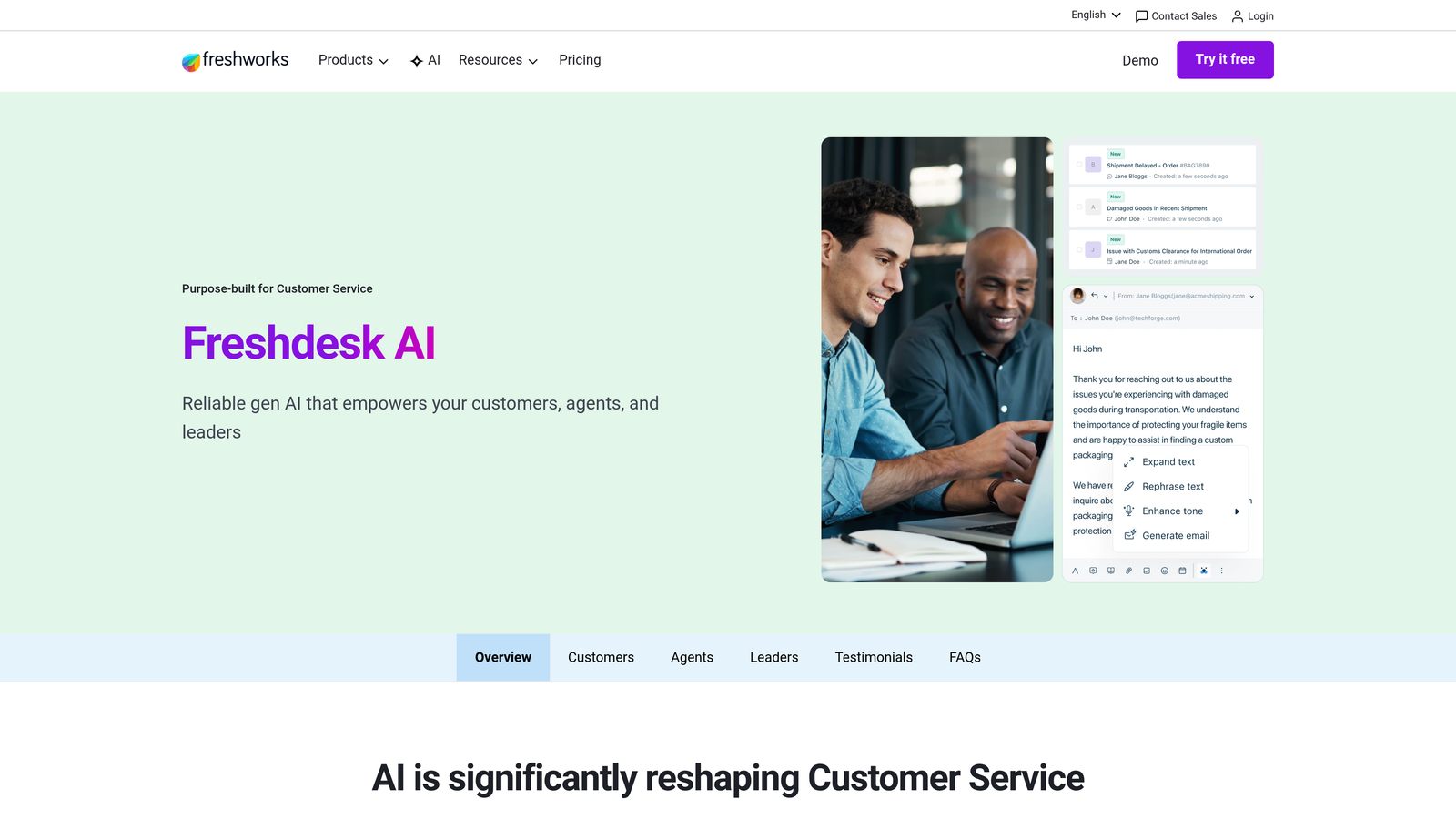
Freshdesk Freddy AI is Freshworks' AI engine powering automated responses, agent assist, and predictive analytics across the Freshdesk support platform.
Where This Tool Shines
Freddy's strongest case is for companies already using multiple Freshworks products. Because the AI layer spans Freshdesk, Freshsales, and Freshservice, teams get a unified intelligence model rather than siloed AI tools for each department. That cross-product context can be genuinely valuable when support agents need CRM data to resolve an issue.
The predictive analytics component is also worth noting. Freddy surfaces ticket volume forecasts and CSAT trend predictions, giving support managers visibility into what's coming rather than just what's already happened.
Key Features
Freddy Self Service Bots: Automated deflection bots that handle common inquiries before they reach the agent queue.
Agent Assist: Real-time suggested responses and next-best-action recommendations surfaced during live conversations.
Predictive Analytics: Forecasts ticket volume trends and CSAT trajectory to help managers plan proactively.
Cross-Suite AI: Unified Freddy intelligence across Freshworks CRM, ITSM, and support products.
Best For
Mid-market companies using Freshworks across multiple departments who want AI that connects support context with CRM and IT service management data in a single ecosystem.
Pricing
AI features are available on Pro and Enterprise plans, starting at $49 per agent per month. Costs scale with agent count and feature tier.
5. Ada
Best for: High-volume consumer brands needing autonomous resolution across multiple channels simultaneously
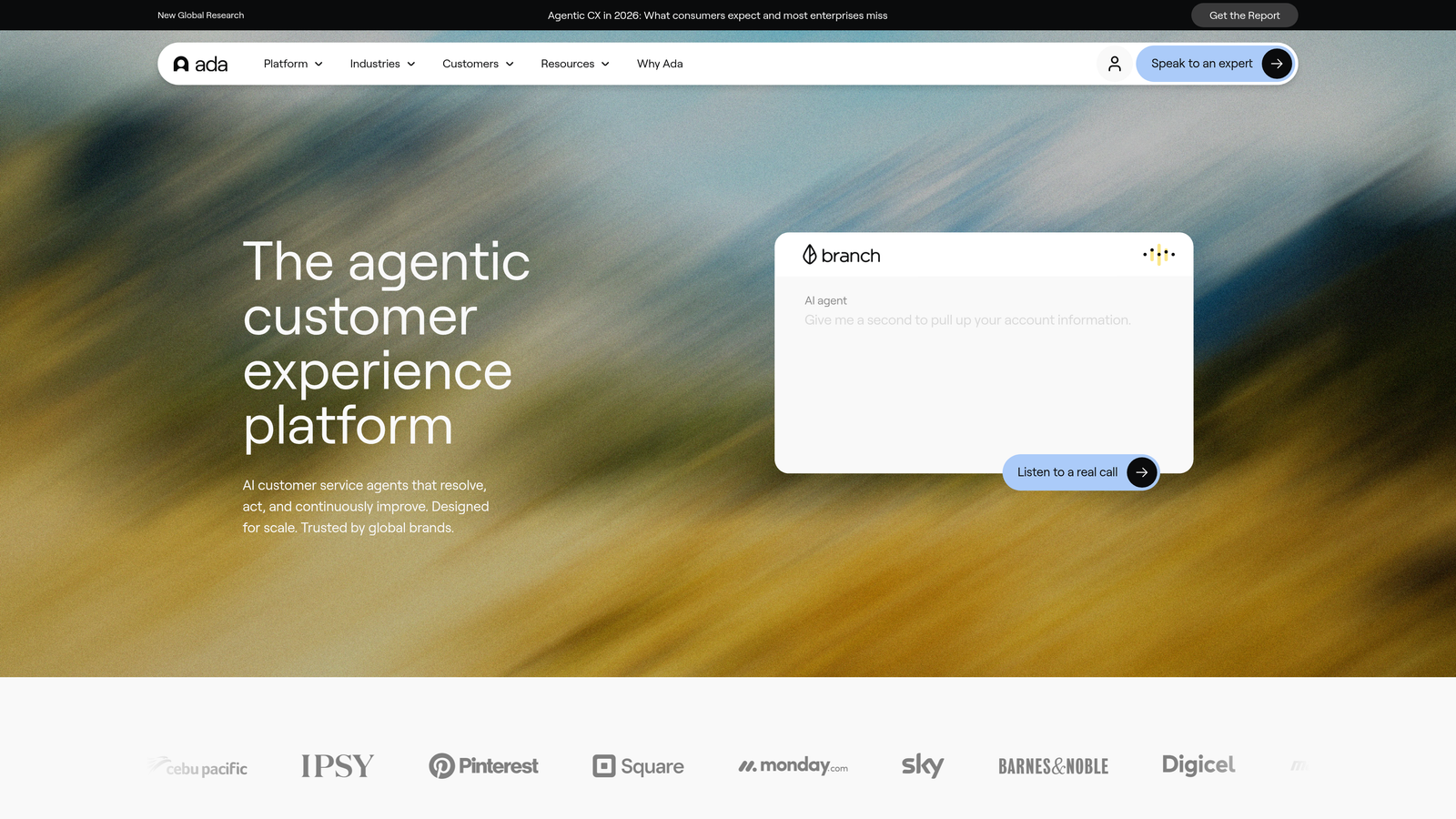
Ada is an AI-powered customer service automation platform designed for high-volume brands, specializing in autonomous resolution across chat, email, voice, and social channels.
Where This Tool Shines
Ada is purpose-built for scale. Its autonomous resolution engine operates across chat, email, SMS, voice, and social from a single platform, which is a meaningful advantage for brands managing high contact volumes across fragmented channels. The multilingual support covering 50+ languages natively makes it particularly strong for global consumer brands.
The no-code conversation builder with an AI reasoning layer gives non-technical teams the ability to design complex resolution flows without engineering involvement, which reduces deployment time considerably.
Key Features
Omnichannel Autonomous Resolution: Handles inquiries across chat, email, SMS, voice, and social from a unified AI engine.
Native Multilingual Support: Covers 50+ languages without requiring separate configurations per language.
No-Code Conversation Builder: Visual flow design with an underlying AI reasoning layer for complex decision paths.
Platform Integrations: Connects with Salesforce, Zendesk, and major e-commerce platforms for data-driven resolution.
Best For
High-volume consumer brands and global enterprises that need autonomous resolution at scale across multiple channels, particularly those with diverse international customer bases.
Pricing
Custom pricing based on resolution volume; contact Ada's sales team for a quote tailored to your channel mix and volume.
6. Tidio
Best for: Small businesses and e-commerce stores looking for an accessible AI chatbot with live chat
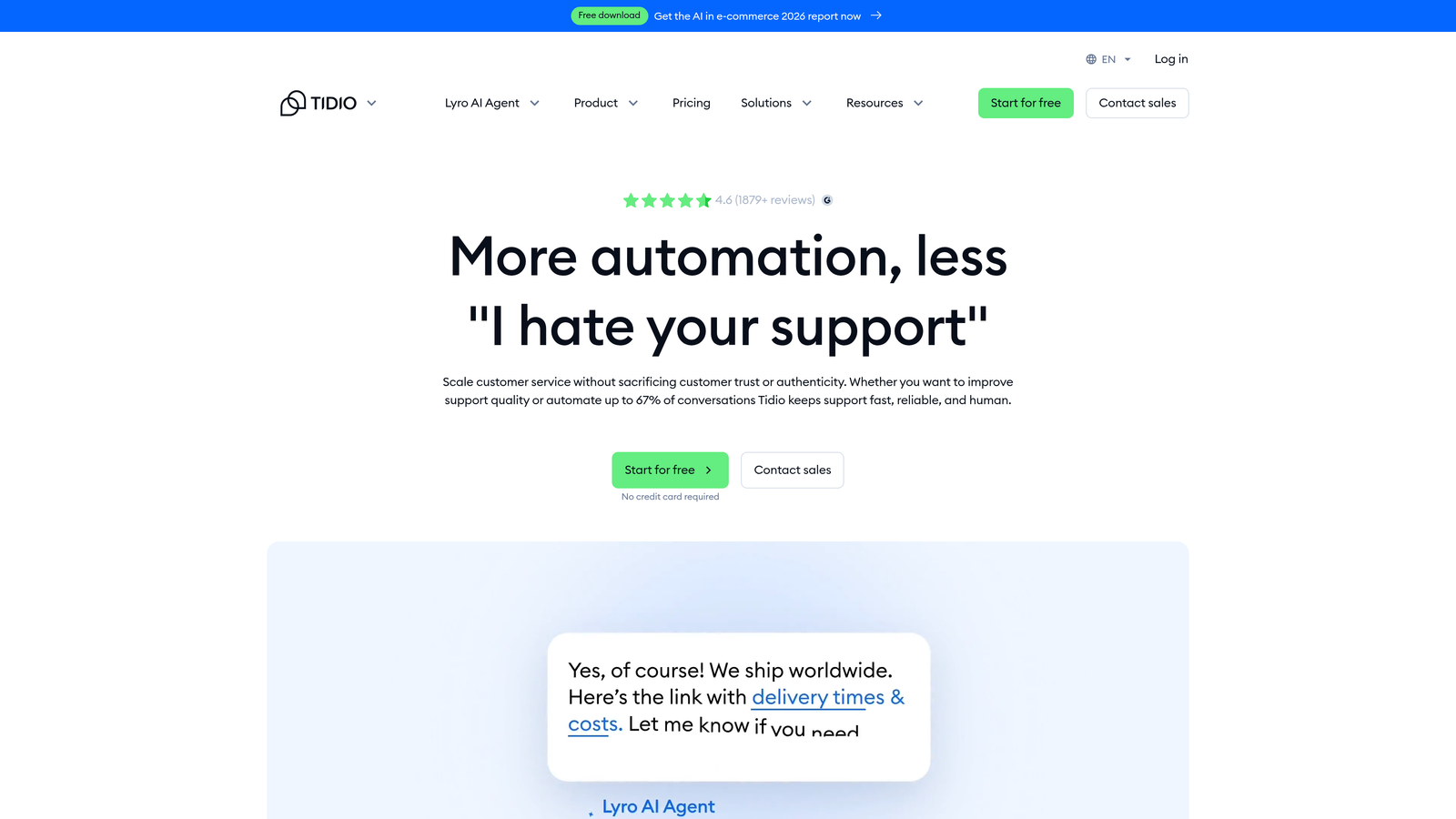
Tidio is an accessible AI chatbot platform combining live chat, the Lyro AI conversational agent, and automation flows designed for small businesses and e-commerce stores.
Where This Tool Shines
Tidio's appeal is its low barrier to entry. The combination of a visual drag-and-drop flow builder and Lyro AI, which trains on your FAQ and knowledge base content, means a small team can deploy functional AI support in hours rather than weeks. That speed-to-value is genuinely rare in this space.
The native Shopify, WooCommerce, and WordPress integrations make it a natural fit for e-commerce operators who need AI support without a dedicated technical implementation team. The single widget combining live chat and AI also simplifies the customer experience.
Key Features
Lyro AI Agent: Conversational AI trained directly on your FAQ and knowledge base content for contextual responses.
Visual Flow Builder: Drag-and-drop chatbot automation builder requiring no coding knowledge.
E-Commerce Integrations: Native connections to Shopify, WooCommerce, and WordPress out of the box.
Unified Chat Widget: Combines live chat and AI in a single customer-facing interface.
Best For
Small to mid-sized e-commerce businesses and startups that need affordable, fast-to-deploy AI support without enterprise complexity. Not designed for deep B2B or multi-system integration requirements.
Pricing
A free plan is available; Lyro AI starts at $39 per month for 50 conversations. Costs scale with conversation volume.
7. Forethought
Best for: Enterprise teams wanting generative AI trained on their own support data, layered on existing helpdesks
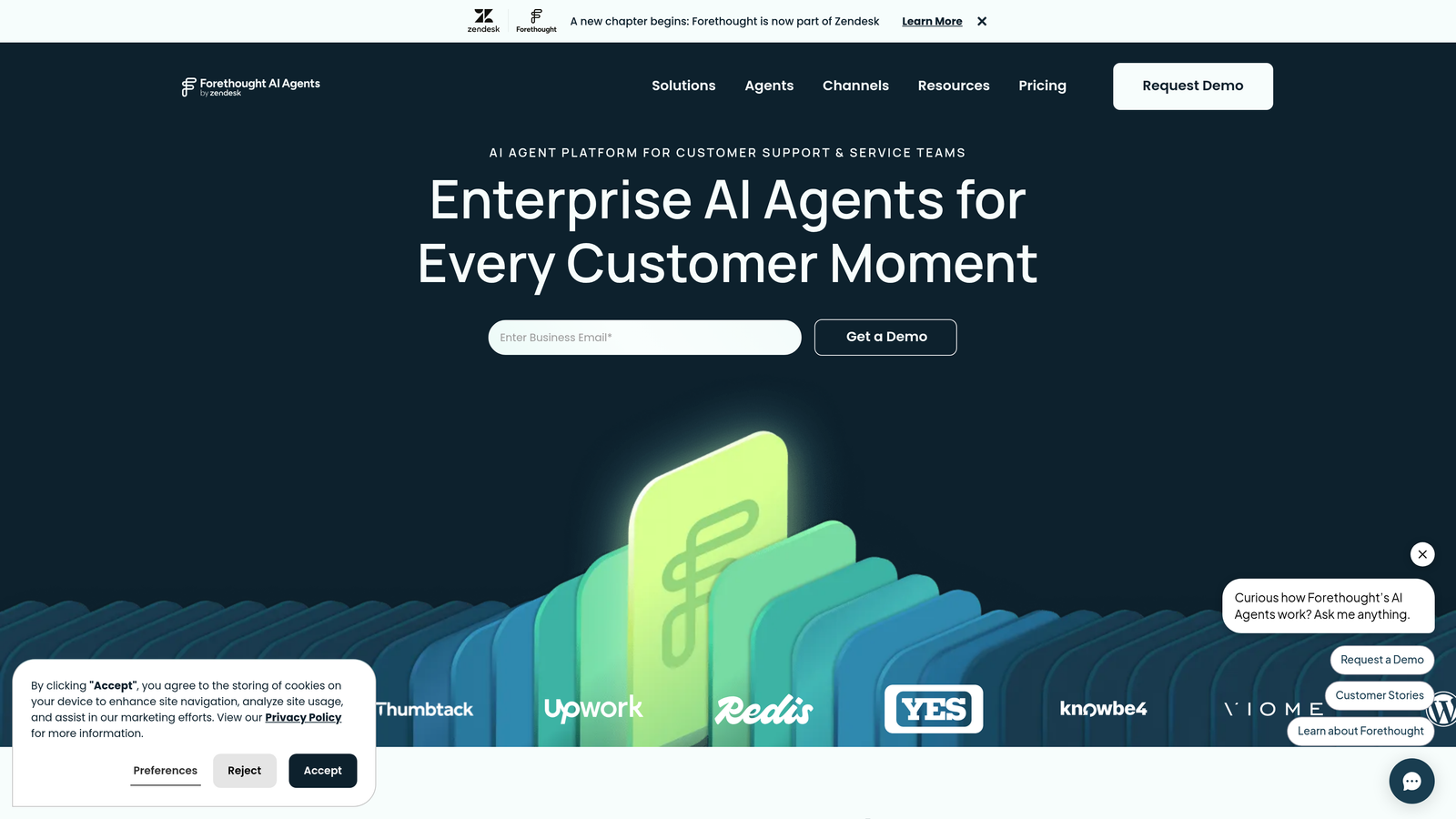
Forethought is an enterprise AI platform focused on intelligent ticket triage, automated resolution, and agent assist, using generative AI trained on your company's own support data.
Where This Tool Shines
Forethought's key differentiator is that its AI learns from your specific support history rather than generic training data. For enterprises with large, well-documented support archives, this means the model reflects your actual customer language, product terminology, and resolution patterns from day one.
The layered architecture, Triage, Solve, and Assist as distinct modules, lets teams deploy incrementally. You can start with intelligent routing, add autonomous resolution for common queries, and layer in agent assist over time without a full platform migration.
Key Features
Triage Module: AI-powered ticket classification and priority routing based on intent and urgency signals.
Solve Module: Autonomous resolution engine for common support queries using your historical data.
Assist Module: Real-time knowledge suggestions surfaced to human agents during active conversations.
Helpdesk-Agnostic Layer: Operates on top of Zendesk, Salesforce Service Cloud, and other existing platforms.
Best For
Enterprises with large support data archives and existing helpdesk investments who want generative AI that reflects their specific business context rather than generic industry training.
Pricing
Custom enterprise pricing; contact Forethought's sales team for a quote based on ticket volume and module selection.
8. Cognigy
Best for: Enterprise contact centers needing voice and text AI agents with compliance and CCaaS integrations
Cognigy is an enterprise conversational AI platform supporting both voice and text-based AI agents with deep customization, compliance controls, and contact center integrations.
Where This Tool Shines
Cognigy is one of the few platforms in this comparison that handles voice AI with genuine sophistication. Its natural language understanding for phone-based support goes well beyond basic IVR replacement, enabling conversational voice agents that can handle complex multi-turn interactions. For enterprises running traditional contact centers alongside digital channels, this unified capability is a significant operational advantage.
The compliance posture is also notable. SOC 2 and GDPR certifications, combined with enterprise security controls, make Cognigy viable for regulated industries where other AI tools may not meet procurement requirements.
Key Features
Voice AI Agents: Natural language phone support with conversational understanding for complex multi-turn interactions.
Low-Code Design Studio: Visual conversation design for complex workflows without requiring deep engineering resources.
Enterprise Compliance: SOC 2 and GDPR certifications with enterprise-grade security controls.
CCaaS Integrations: Native connections to Genesys, NICE, Avaya, and other major contact center platforms.
Best For
Large enterprises and regulated industries operating traditional contact centers who need voice and text AI agents with compliance certifications and deep CCaaS platform integration.
Pricing
Enterprise pricing only; contact Cognigy for a custom quote based on usage volume, channels, and deployment requirements.
9. HubSpot Service Hub AI
Best for: HubSpot-native teams wanting support AI with full CRM lifecycle context
HubSpot Service Hub delivers AI-powered service tools within HubSpot's CRM platform, offering chatbots, ticket automation, and knowledge base AI with full customer lifecycle context.
Where This Tool Shines
The defining advantage of Service Hub AI is CRM context. When an AI chatbot can see a customer's deal stage, lifecycle status, recent sales activity, and past support history simultaneously, it can make smarter routing and response decisions than a standalone support tool ever could. For teams already using HubSpot across marketing, sales, and support, this unified view is a genuine differentiator.
The knowledge base AI is also worth highlighting. It surfaces relevant article suggestions to agents and identifies content gaps based on unanswered questions, creating a feedback loop that improves self-service over time.
Key Features
CRM-Contextual AI Chatbot: Accesses deal stage, lifecycle status, and interaction history to inform every conversation.
Automated Ticket Routing: AI-driven routing with SLA management built into the workflow.
Knowledge Base AI: Suggests relevant articles to agents and flags content gaps based on unresolved questions.
Unified Reporting: Cross-functional dashboards connecting marketing, sales, and support data in one view.
Best For
B2B companies using HubSpot as their primary CRM who want support AI that operates with full customer lifecycle visibility, particularly teams where sales and support workflows overlap frequently.
Pricing
Service Hub Professional starts at $100 per seat per month; AI features are included at the Professional tier and above.
10. Kustomer
Best for: Omnichannel support teams wanting a CRM-native approach without a separate ticketing system
Kustomer is a customer service CRM with a timeline-based view and AI capabilities for omnichannel support, operating independently after its period under Meta's ownership.
Where This Tool Shines
Kustomer's timeline view is genuinely distinctive. Rather than organizing support around tickets, it organizes everything around the customer, showing every interaction across every channel in a single chronological view. For support teams handling complex, multi-touch customer relationships, this context-first approach reduces the cognitive load on agents considerably.
The AI intent detection and automated routing layer sits on top of this unified data model, which means routing decisions benefit from the full relationship history rather than just the current ticket's content.
Key Features
Unified Customer Timeline: Chronological view of every interaction across all channels in a single customer record.
AI Intent Detection: Identifies conversation intent and routes automatically based on the full interaction context.
Omnichannel Coverage: Handles email, chat, SMS, social, and voice from a unified interface.
CRM-Native Architecture: No separate ticketing system required; support is built directly into the customer data model.
Best For
Omnichannel support teams that handle complex, multi-interaction customer relationships and want AI routing built on full relationship context rather than individual ticket data.
Pricing
Enterprise plan starts at $89 per user per month; AI features are available at higher tiers. Best suited for teams with sufficient volume to justify the per-seat investment.
Choosing the Right AI Support Tool for Your Team
The ten tools in this comparison reflect three distinct categories, and knowing which category fits your situation is the fastest way to narrow your shortlist.
AI-first platforms like Halo AI, Ada, and Forethought are built around autonomous resolution as the default. They're the right choice if you want AI to handle the majority of interactions independently, with human agents serving as escalation points rather than the primary responders.
Legacy helpdesks with AI layers like Zendesk AI, Freshdesk Freddy, and HubSpot Service Hub are the right choice if you have significant existing investments in those platforms and want to add AI capabilities incrementally without a full migration.
Conversational AI platforms like Cognigy and Tidio serve support as one use case among many. Cognigy is the right fit for enterprise contact centers needing voice AI; Tidio is the right fit for small businesses that need fast, affordable deployment.
For B2B SaaS teams specifically, the evaluation should go beyond ticket deflection rates. Ask whether the platform can surface customer health signals, integrate with your product and revenue stack, and improve autonomously over time. Those capabilities separate tools that reduce support costs from tools that actively make your business smarter.
Your support team shouldn't scale linearly with your customer base. Let AI agents handle routine tickets, guide users through your product, and surface business intelligence while your team focuses on complex issues that need a human touch. See Halo in action and discover how continuous learning transforms every interaction into smarter, faster support.