9 Best AI Support Tools for B2B Teams in 2026
Discover the 9 best AI support tools for B2B teams in 2026, evaluated for their ability to handle complex multi-product queries, deep tech stack integrations, and enterprise-grade intelligence that goes beyond basic ticket deflection. Whether you're scaling support without adding headcount or turning customer interactions into revenue signals, this guide helps B2B teams find the right solution for their specific needs.
 Grant CooperFounder14 min read
B2B support teams face a challenge that most off-the-shelf tools weren't designed to solve. Your customers aren't casual shoppers browsing a returns policy: they're power users, technical decision-makers, and revenue-critical accounts who expect fast, knowledgeable responses every single time they reach out. A generic chatbot or a basic ticketing system simply doesn't cut it at that level.
The good news is that the AI support landscape has matured considerably. A new generation of tools is purpose-built for B2B complexity, handling multi-product queries, integrating deeply with your existing tech stack, and surfacing business intelligence that goes well beyond simple ticket deflection. Whether you're drowning in a backlog, trying to scale without adding headcount, or looking to turn support interactions into revenue signals, there's a tool on this list for you.
We evaluated each option on depth of AI capability, B2B-specific features, integration ecosystem, and real-world usability for product and support teams. Here are the top AI support tools for B2B in 2026.
1. Halo AI
Best for: B2B SaaS teams that want AI-first support with built-in business intelligence
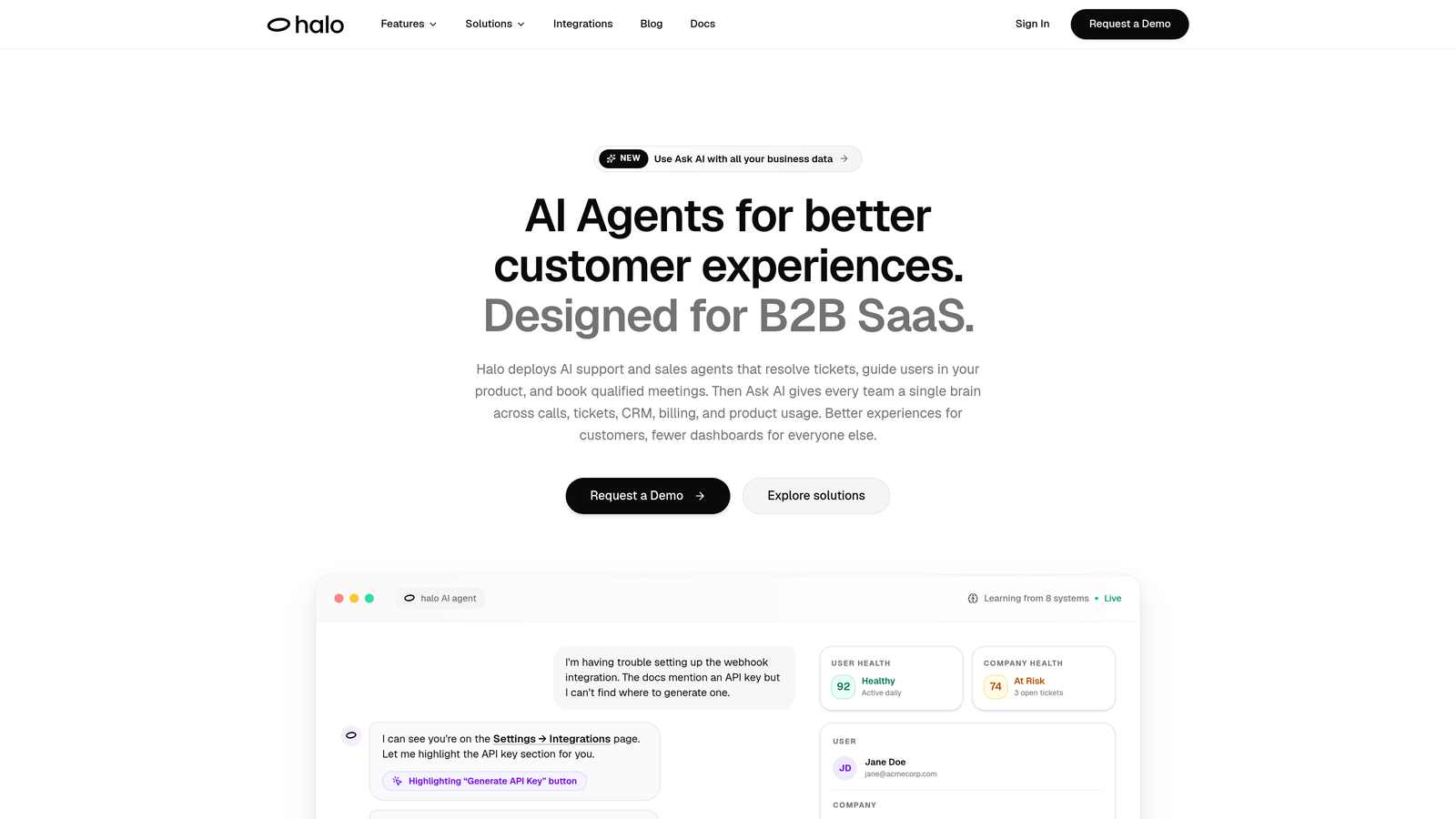
Halo AI is an AI-first customer support platform built specifically for B2B SaaS teams, deploying intelligent agents that resolve tickets, guide users through your product, and surface revenue intelligence from every interaction.
Where This Tool Shines
What separates Halo from most tools on this list is its architecture. It wasn't built as a bolt-on to an existing helpdesk: the entire platform is designed around AI-first operation from the ground up. That means the AI isn't a feature layered on top of a legacy system; it's the core of how the product works.
The page-aware chat widget is a standout capability. Halo's AI agents understand what a user is currently viewing inside your product, allowing them to provide contextually accurate guidance rather than generic answers pulled from a knowledge base. Combined with continuous learning from every resolved interaction, the system gets meaningfully smarter over time without manual retraining.
Key Features
Page-Aware AI Agents: Agents understand what users are currently viewing in your product, enabling precise, context-specific guidance rather than generic responses.
Auto Bug Ticket Creation: Automatically generates and routes bug reports directly to Linear or your issue tracker when a support interaction reveals a product issue.
Smart Inbox with Business Intelligence: Goes beyond ticket management to surface customer health scores, revenue signals, anomaly detection, and churn indicators from support data.
Live Agent Handoff: Escalates complex issues to human agents with full conversation context preserved, so customers never have to repeat themselves.
Deep Integration Ecosystem: Connects natively with Linear, Slack, HubSpot, Intercom, Stripe, Zoom, PandaDoc, and Fathom, covering your entire business stack.
Best For
Halo is particularly well-suited for product-led SaaS teams and B2B companies that want support to do more than close tickets. If you want your support operation to generate business intelligence, catch bugs automatically, and scale without growing headcount, this is the platform to evaluate first.
Pricing
Contact for pricing at haloagents.ai. Given the platform's enterprise-grade capabilities, expect a conversation tailored to your team size and use case.
2. Intercom
Best for: B2B teams wanting a mature, all-in-one messaging and AI resolution platform
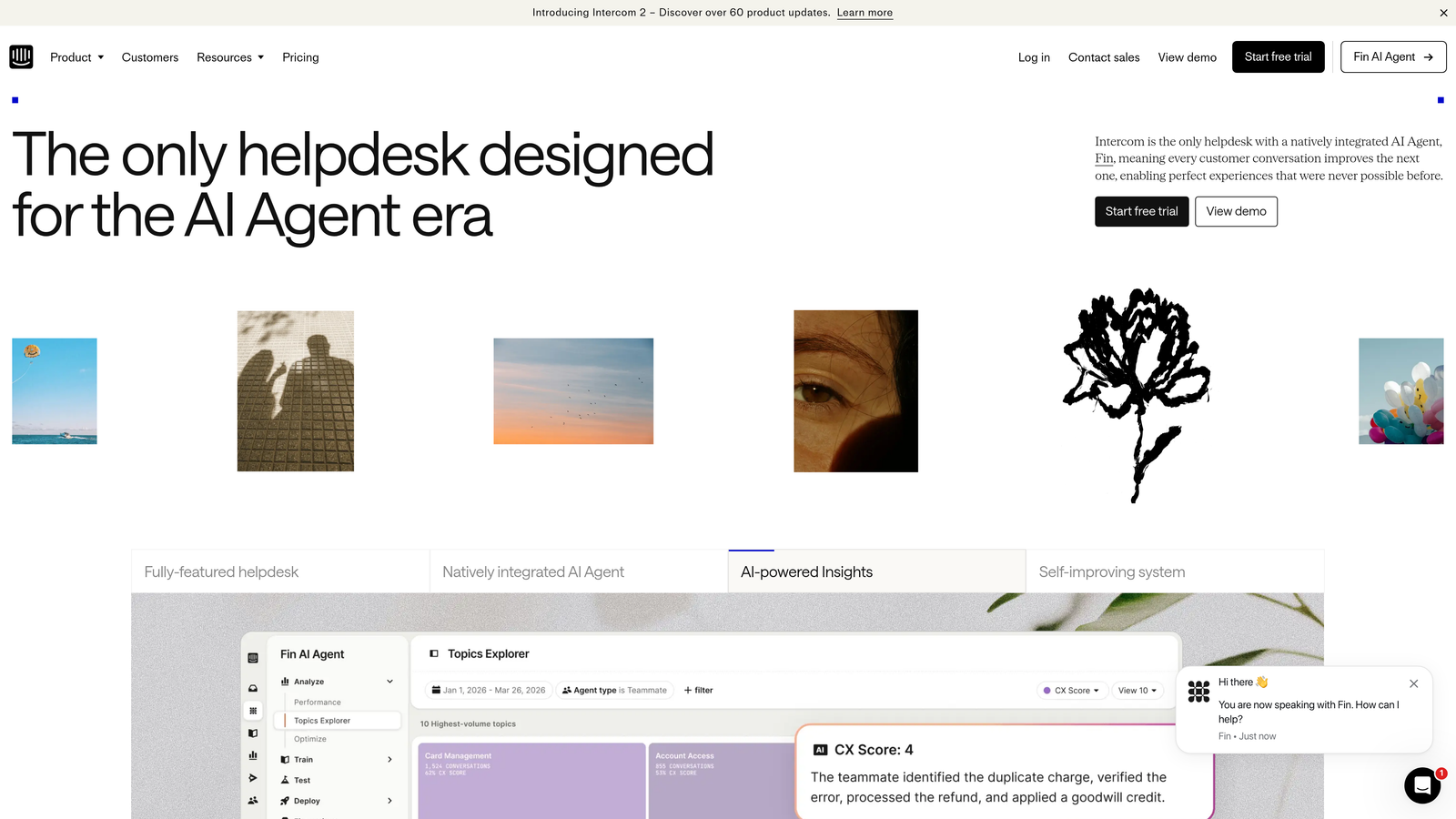
Intercom is a veteran customer messaging platform whose Fin AI agent brings autonomous query resolution to one of the most established ecosystems in B2B support.
Where This Tool Shines
Intercom's strength is breadth. Messenger, inbox, help center, and AI agent all live under one roof, which significantly reduces the integration complexity that plagues multi-tool support stacks. Fin, their flagship AI agent, is built on large language models trained on your help content and delivers responses with source citations, which builds customer trust in AI-generated answers.
The platform's maturity is both an asset and a consideration. You get a deeply refined product with a large integration marketplace, but the AI layer is built on top of an established platform rather than designed from scratch with AI at the center.
Key Features
Fin AI Agent: Resolves queries autonomously using your help content, with citations that show customers where answers come from.
Unified Inbox: Combines chat, email, and in-app messaging into a single agent workspace.
AI Conversation Summaries: Automatically summarizes long conversations and suggests replies to speed up agent responses.
Help Center Builder: Robust knowledge base tools that feed directly into Fin's resolution capabilities.
App Marketplace: Over 300 integrations covering CRMs, analytics tools, and developer platforms.
Best For
Mid-market to enterprise B2B teams that want a proven platform with strong AI capabilities and don't need to replace their entire support stack from scratch. Particularly strong if you want messenger, knowledge base, and AI agent in a single vendor relationship.
Pricing
Plans start around $39 per seat per month; Fin AI is priced on a usage-based model. Verify current pricing at intercom.com as costs can escalate at scale.
3. Zendesk AI
Best for: Enterprise B2B teams with complex, high-volume support operations
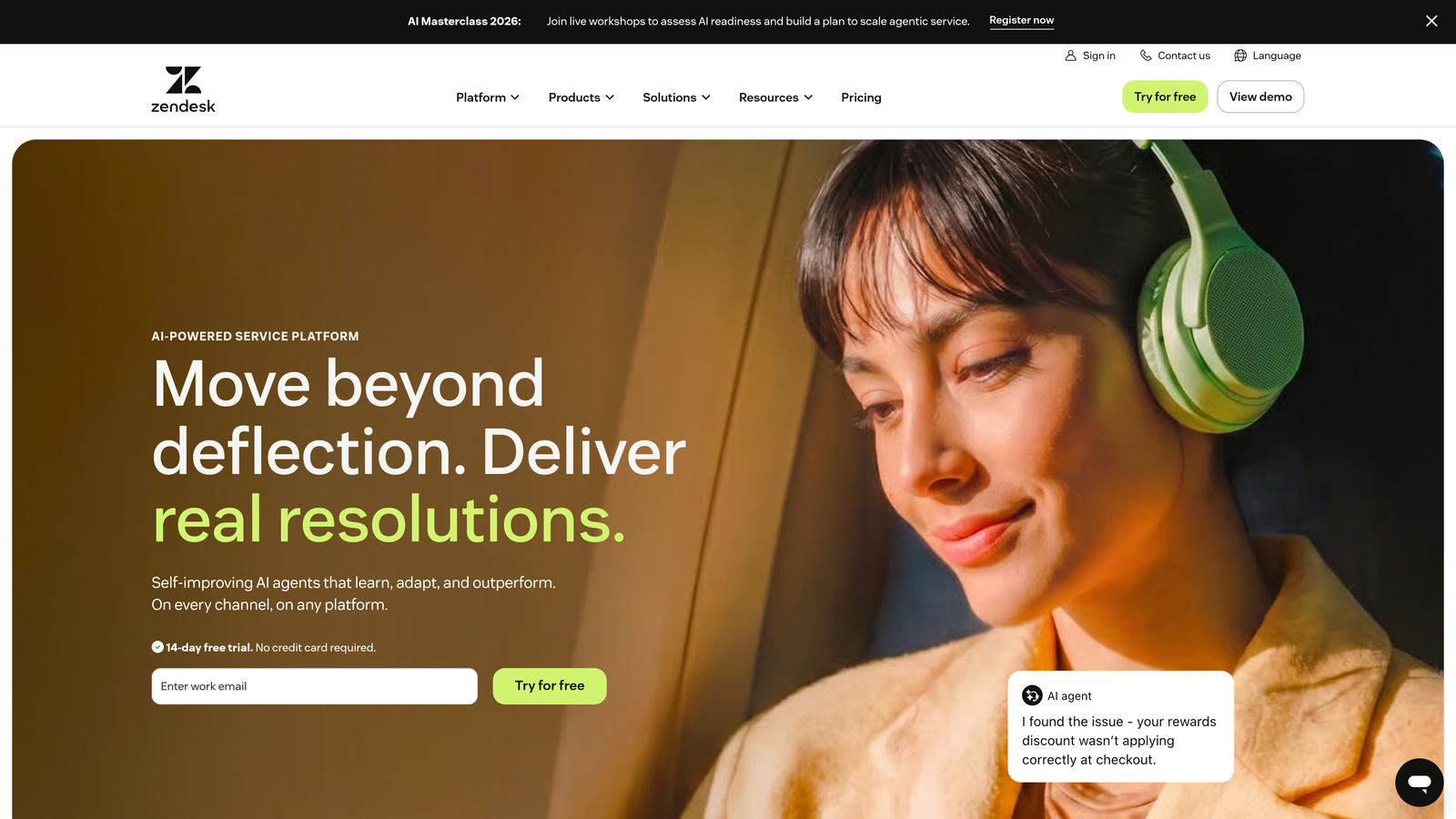
Zendesk is the industry's most widely deployed enterprise helpdesk, now with a substantial AI layer spanning intelligent triage, autonomous bots, agent copilot features, and workforce management.
Where This Tool Shines
Zendesk's scale advantage is real. If you're running a large support operation with multiple teams, complex SLA requirements, and enterprise compliance needs, few platforms match its depth of configuration and reporting. The AI triage and routing capabilities are particularly valuable for high-volume environments where manual ticket assignment creates bottlenecks.
The Agent Copilot feature surfaces suggested replies and next-best-action guidance in real time, helping agents resolve tickets faster without fully removing the human from the loop. Some users note that the AI capabilities feel more like additions to an existing system than a native AI experience, but the breadth of functionality is hard to argue with.
Key Features
Intelligent Triage and Routing: AI automatically classifies, prioritizes, and routes incoming tickets based on content and context.
Zendesk AI Agents: Self-service resolution bots that handle common queries before a human agent is needed.
Agent Copilot: Provides suggested replies, next-best-action recommendations, and conversation summaries directly in the agent workspace.
Advanced Analytics: AI-driven reporting with workforce management tools built in.
Enterprise Compliance: Robust security, SLA management, and compliance tooling for regulated industries.
Best For
Large enterprise B2B teams with established support operations, complex routing requirements, and a need for deep reporting. Also strong for companies in regulated industries where compliance and audit trails matter.
Pricing
Suite plans start around $55 per agent per month; AI add-ons are priced separately. Verify current tiers at zendesk.com.
4. Freshdesk (Freddy AI)
Best for: B2B teams in the Freshworks ecosystem looking for strong AI value at competitive price points
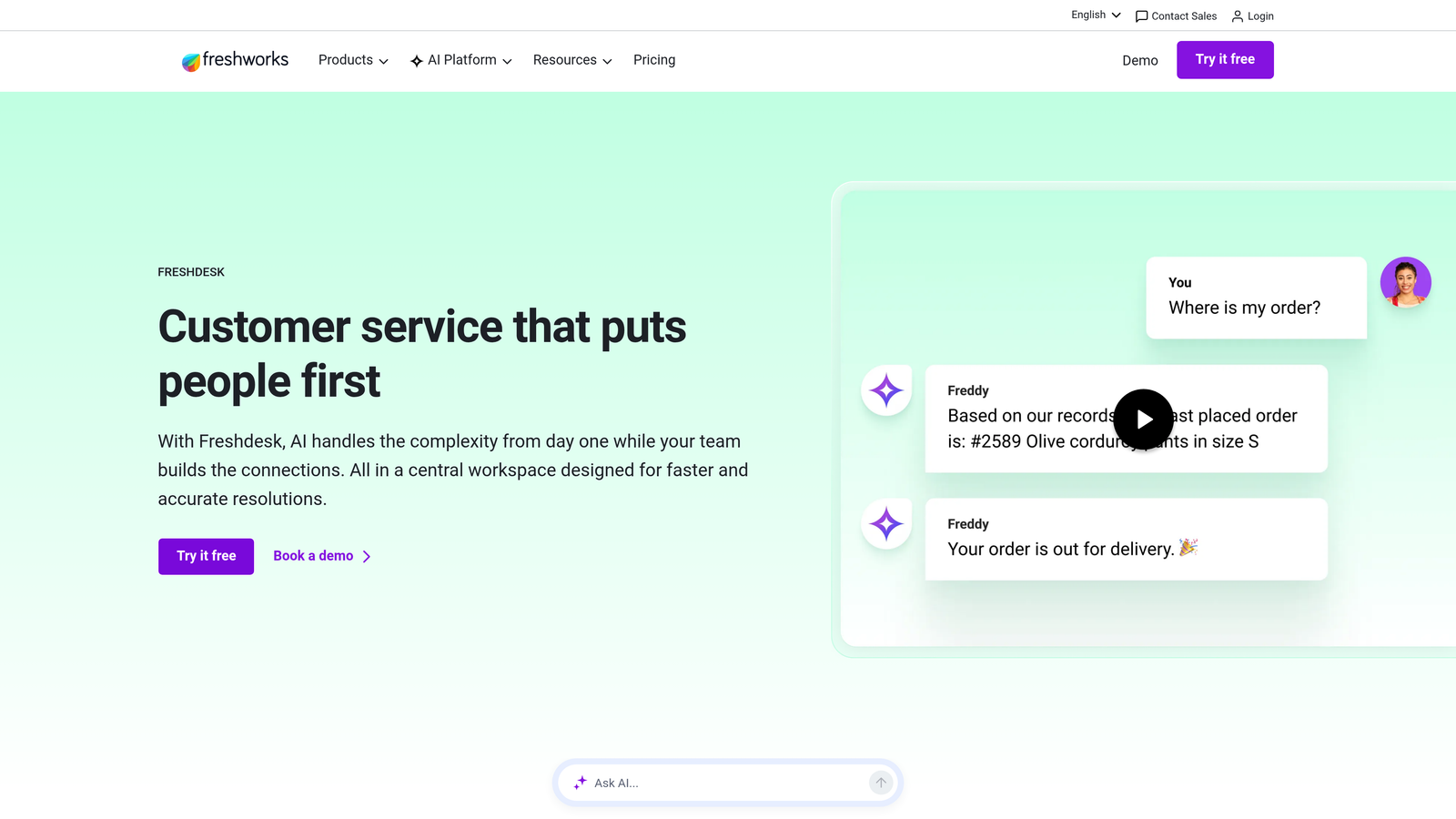
Freshdesk is a full-featured helpdesk with Freddy AI woven across self-service, agent assistance, and analytics, with particular cross-suite value for teams already using Freshsales or Freshservice.
Where This Tool Shines
Freshdesk's value proposition becomes compelling when you zoom out to the broader Freshworks suite. If your team also uses Freshsales for CRM or Freshservice for ITSM, Freddy AI operates across all three, creating a unified intelligence layer that spans your entire customer-facing operation. That's a meaningful differentiator for B2B teams managing both customer support and internal IT support.
For teams not already in Freshworks, Freshdesk still offers a strong standalone product. Freddy Copilot assists agents with summaries, suggested replies, and tone adjustment, while Freddy Self Service handles end-user queries autonomously. The pricing is more accessible than Zendesk at comparable tiers, which matters for growing teams watching unit economics.
Key Features
Freddy Self Service: AI-powered bot that resolves end-user queries without agent involvement.
Freddy Copilot: Assists agents with conversation summaries, suggested replies, and tone adjustment in real time.
Freddy Insights: AI-driven analytics that surface support trends and performance gaps.
Cross-Suite AI: Freddy operates across Freshdesk, Freshsales, and Freshservice for teams using multiple Freshworks products.
Accessible Pricing: Free tier available for small teams, with Freddy AI unlocked on Growth plans and above.
Best For
B2B teams already invested in the Freshworks ecosystem, and growing teams that need solid AI-assisted support without Zendesk-level pricing. Also a good fit for companies managing both customer support and internal IT helpdesk from a single vendor.
Pricing
Free tier available; paid plans from approximately $15 per agent per month with Freddy AI on Growth tier and above. Verify at freshdesk.com.
5. Gorgias
Best for: B2B companies with high-volume transactional support tied to orders and invoices
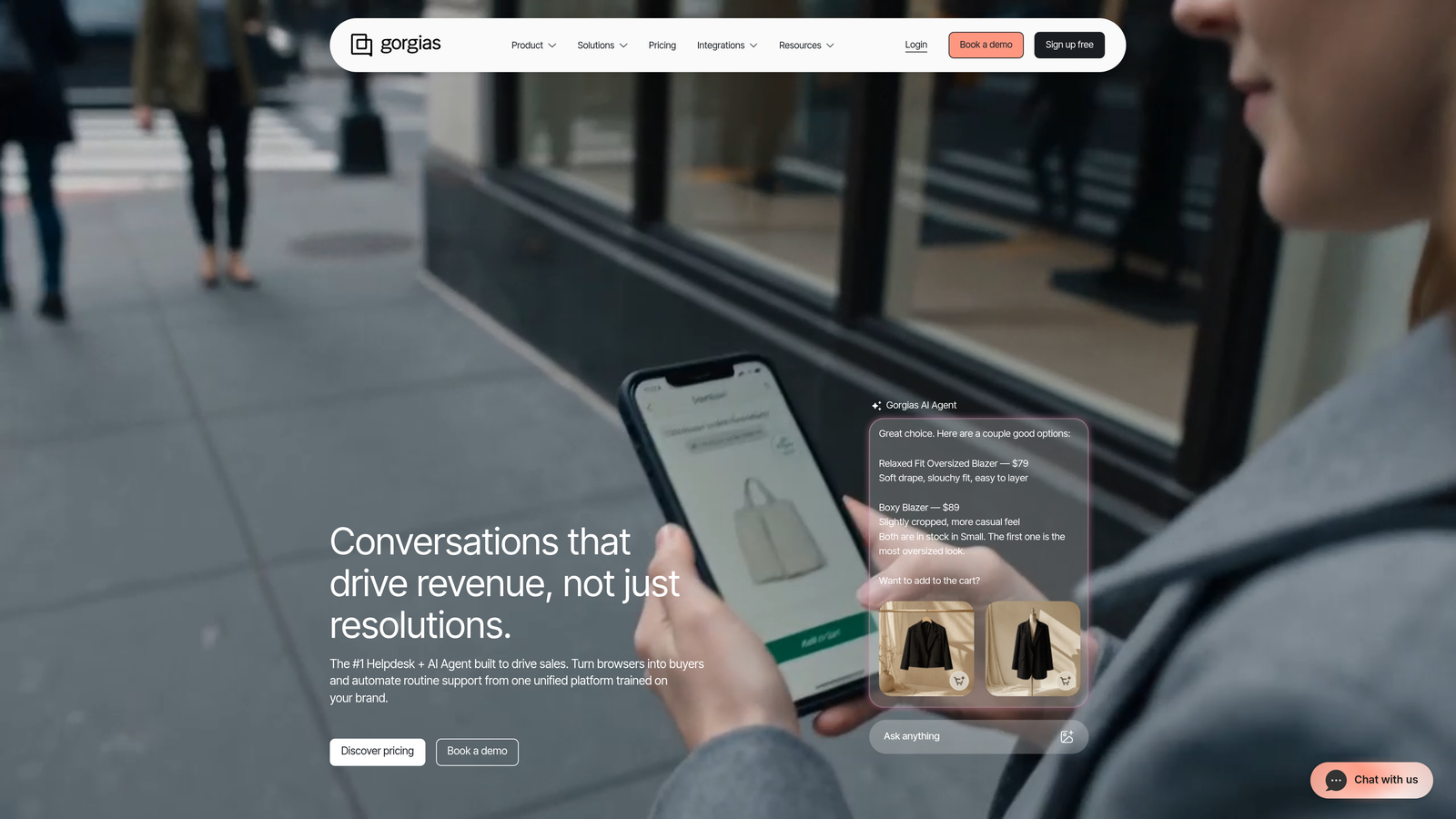
Gorgias is a support platform with strong AI automation capabilities, purpose-built for businesses where support interactions are closely tied to order management and transactional workflows.
Where This Tool Shines
Gorgias earns its place on a B2B list specifically for companies selling physical products or managing order-heavy support at volume. Its deep integration with Shopify, WooCommerce, and Magento means agents and AI bots have immediate access to order data, invoice history, and shipping status without switching tools. The AI auto-responder handles common transactional queries, which is where a large percentage of support volume typically concentrates.
For pure SaaS B2B support with complex technical queries, Gorgias is less well-suited. But for B2B brands managing wholesale orders, distributor relationships, or high-volume invoice queries, it's a focused and effective solution.
Key Features
AI Auto-Responder: Automatically handles common transactional queries including order status, invoice requests, and return processing.
E-commerce Integrations: Deep native connections to Shopify, WooCommerce, and Magento with order data surfaced directly in the inbox.
Macros and Automation Rules: Configurable rules for high-volume ticket deflection and routing.
Revenue Attribution: Ties support interactions directly to revenue statistics, showing the business impact of support conversations.
Omnichannel Inbox: Consolidates email, chat, social, and SMS into a single agent workspace.
Best For
B2B companies with significant transactional support volume: wholesale distributors, manufacturers, or B2B brands managing order and invoice queries at scale. Less suited for complex technical SaaS support environments.
Pricing
Starts around $10 per month on a ticket-based pricing model. Verify current tiers at gorgias.com.
6. Tidio
Best for: Smaller B2B teams that need AI support coverage deployed quickly
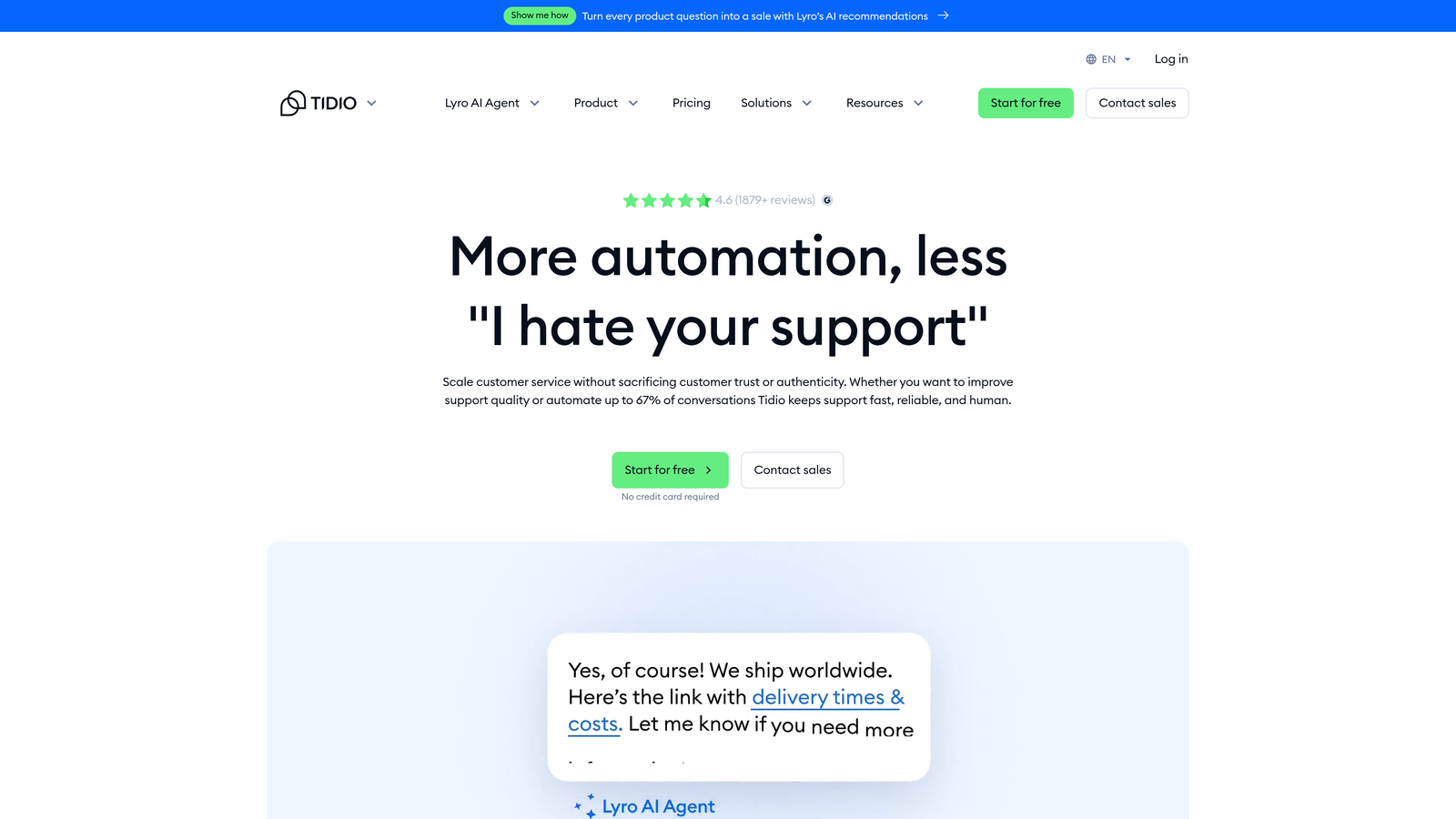
Tidio offers Lyro, an AI agent designed for fast deployment with minimal configuration, making it a strong choice for teams that need AI coverage without a lengthy implementation project.
Where This Tool Shines
Speed to value is Tidio's defining advantage. Lyro can be trained on your FAQ and help content and go live in hours rather than weeks, which matters enormously for lean teams that don't have dedicated IT resources to manage a complex deployment. The live chat fallback is well-implemented: when Lyro reaches the edge of its knowledge, the handoff to a human agent is smooth and contextual.
Tidio is honest about its positioning. It's not trying to compete with Zendesk on enterprise depth. It's focused on making AI-assisted support accessible and fast for teams that need something working immediately.
Key Features
Lyro AI Agent: Trained on your FAQ and help content to resolve common queries autonomously.
Fast Setup: Typically live within hours, with minimal technical configuration required.
Live Chat Fallback: Smooth handoff to human agents when Lyro reaches the limits of its knowledge.
Visitor Behavior Tracking: Proactive chat triggers based on visitor behavior to engage users at the right moment.
CRM and Platform Integrations: Connects with Shopify, WordPress, Wix, and major CRM platforms.
Best For
Early-stage B2B companies and smaller teams that need AI support coverage quickly without heavy IT involvement. Also a good fit for teams testing AI support before committing to a larger enterprise platform.
Pricing
Free tier available; Lyro AI from approximately $29 per month. Verify at tidio.com.
7. Drift (Salesloft)
Best for: B2B teams where technical support and pre-sales conversations frequently overlap
Drift, now part of the Salesloft revenue platform, offers conversational AI that bridges support deflection and pipeline qualification in environments where the two are hard to separate.
Where This Tool Shines
Drift occupies a unique position on this list. It's not a pure-play support tool: it's a revenue conversation platform that also handles support deflection. For B2B teams where prospects routinely ask technical questions that blur the line between pre-sales and support, that dual capability is genuinely useful. The integration with Salesforce, HubSpot, and Salesloft means buyer intent signals surface across your entire go-to-market stack.
Since the Salesloft acquisition, Drift's positioning has shifted further toward revenue teams. If you're looking for a dedicated support platform, it may not be the right fit. But if your support team is also a touchpoint in the sales cycle, Drift's conversational AI handles that complexity well.
Key Features
Conversational AI: Handles both support deflection and pipeline qualification within the same conversation flow.
Bionic Chatbots: Combines AI automation with human-authored playbooks for nuanced conversation handling.
Buyer Intent Signals: Surfaces real-time intent data to sales and support teams simultaneously.
CRM Integration: Deep connections to Salesforce, HubSpot, and Salesloft for full revenue context.
Meeting Booking: Allows prospects and customers to book meetings directly within conversation flows.
Best For
B2B companies where the support function is also a sales touchpoint, particularly those running account-based marketing or PLG motions where technical queries often precede or accompany purchase decisions.
Pricing
Enterprise pricing. Contact Drift or Salesloft sales directly for current packages at drift.com.
8. Kustomer
Best for: B2B teams that need full CRM context alongside support in a single platform
Kustomer is a CRM-native support platform, owned by Meta, that provides a unified customer timeline across all interactions, with AI-powered workflow automation layered throughout.
Where This Tool Shines
Kustomer's unified customer timeline is a genuine differentiator for B2B account-based support. Rather than toggling between your CRM and your helpdesk, agents see every interaction, purchase, and touchpoint for a customer in a single chronological view. For complex B2B accounts with long relationship histories, that context dramatically improves the quality of support conversations.
KustomerIQ handles AI-powered routing, tagging, and suggested responses, while the platform's highly customizable workflow engine lets teams build automation that reflects the nuances of their specific support processes. It's a more complex platform to configure than Tidio or Freshdesk, but the depth it provides for account-centric B2B support is hard to match.
Key Features
Unified Customer Timeline: Every interaction, purchase, and touchpoint consolidated in a single chronological view per customer.
KustomerIQ: AI-powered routing, tagging, and suggested responses built into the core platform.
Omnichannel Support: Email, chat, voice, social, and SMS managed from a unified workspace.
Customizable Workflows: Highly flexible automation rules that can reflect complex B2B support processes.
CRM + Support in One: Eliminates the need for a separate CRM for teams that want account context alongside support history.
Best For
B2B teams running account-based support models where full customer history and CRM context are essential to every interaction. Particularly strong for companies managing long-term enterprise customer relationships with complex account structures.
Pricing
Starts around $89 per agent per month. Verify current pricing at kustomer.com.
9. Forethought
Best for: Enterprises augmenting existing Zendesk or Salesforce deployments with AI intelligence
Forethought specializes in AI that augments your existing helpdesk rather than replacing it, with a focused product suite covering triage, routing, agent assistance, and analytics.
Where This Tool Shines
Forethought answers a specific question that many enterprise teams ask: "We already have Zendesk. How do we make it smarter?" Rather than requiring a platform migration, Forethought layers intelligent AI on top of your existing system. Solve handles self-service resolution before a ticket is even created; Triage classifies and routes tickets intelligently; Assist surfaces relevant knowledge to agents in real time; and Discover identifies automation opportunities and knowledge gaps from your support data.
This modular, additive approach is particularly valuable for large organizations where ripping out an established helpdesk is politically or operationally impractical. You get meaningful AI uplift without the disruption of a full platform change.
Key Features
Solve: AI-powered self-service resolution that deflects queries before a ticket enters the queue.
Triage: Intelligent ticket classification, tagging, and routing based on content and intent.
Assist: Agent copilot that surfaces relevant knowledge and suggested responses in real time.
Discover: Analytics module that identifies automation opportunities and surfaces knowledge base gaps.
Platform Agnostic: Works alongside Zendesk, Salesforce Service Cloud, ServiceNow, and other major helpdesks.
Best For
Enterprise B2B teams with established helpdesk deployments that want to add AI intelligence without a platform migration. Ideal for organizations where Zendesk or Salesforce Service Cloud is deeply embedded and a full replacement is not on the table.
Pricing
Enterprise pricing. Contact Forethought directly for current packages at forethought.ai.
Which Tool Is Right for Your B2B Team?
The right choice depends heavily on where you are today and what you're trying to achieve. Here's a quick-reference guide to cut through the noise.
If you want AI-first architecture with business intelligence built in: Start with Halo AI. It's the only platform on this list designed from the ground up around AI operation, with page-aware agents, auto bug ticket creation, and a smart inbox that turns support interactions into revenue signals. Purpose-built for B2B SaaS teams.
If you want a proven all-in-one platform with a large ecosystem: Intercom is the natural choice. Fin AI is mature, the integration marketplace is extensive, and the platform covers messenger, inbox, and knowledge base in one vendor relationship.
If you're a large enterprise with complex operations: Zendesk remains the benchmark for scale, compliance, and workforce management depth. Forethought is worth evaluating alongside it if you want to add AI intelligence without replacing what's already working.
If you're budget-conscious or in the Freshworks ecosystem: Freshdesk with Freddy AI offers strong value, especially for teams also using Freshsales or Freshservice. The cross-suite AI layer is a meaningful differentiator.
If you're a smaller team that needs AI coverage fast: Tidio's Lyro agent can be live in hours, not weeks, with accessible pricing that scales as you grow.
If support and sales overlap in your customer conversations: Drift, now part of Salesloft, handles that dual-function environment better than any pure-play support tool on this list.
The broader shift happening across all of these tools is clear: AI in B2B support is moving from simple deflection to genuine intelligence. The platforms that will matter most over the next few years are those that don't just close tickets faster, but surface what those tickets actually mean for your business.
Your support team shouldn't scale linearly with your customer base. Let AI agents handle routine tickets, guide users through your product, and surface business intelligence while your team focuses on complex issues that need a human touch. See Halo in action and discover how continuous learning transforms every interaction into smarter, faster support.