9 Best AI Support Tools for SaaS Companies in 2026
This guide evaluates the 9 best AI support tools for SaaS companies in 2026, comparing platforms on end-to-end ticket resolution, bug detection, dev tool integrations, and scalability—helping support teams move beyond basic FAQ automation to handle the technical complexity and rapid release cycles that define modern SaaS products.
 Matt PattoliFounder13 min read
SaaS support teams face a challenge that generic helpdesks were never designed to solve. Your users are technically sophisticated, your product ships new features every sprint, and your ticket queue grows faster than your headcount ever will. A tool that handles basic FAQs isn't enough. You need AI that can resolve tickets end-to-end, understand where in your product a user is stuck, surface bugs before they become incidents, and hand off intelligently when a human is genuinely needed.
The good news is that AI support tooling has matured significantly. The options below were evaluated on depth of AI capability, SaaS-specific features like bug detection and dev tool integrations, pricing transparency, and how well each scales from early-stage to enterprise. Whether you're replacing a legacy helpdesk or layering AI onto an existing stack, there's an option here for your team.
1. Halo AI
Best for: B2B SaaS product teams that want an AI-first support platform built for their stack
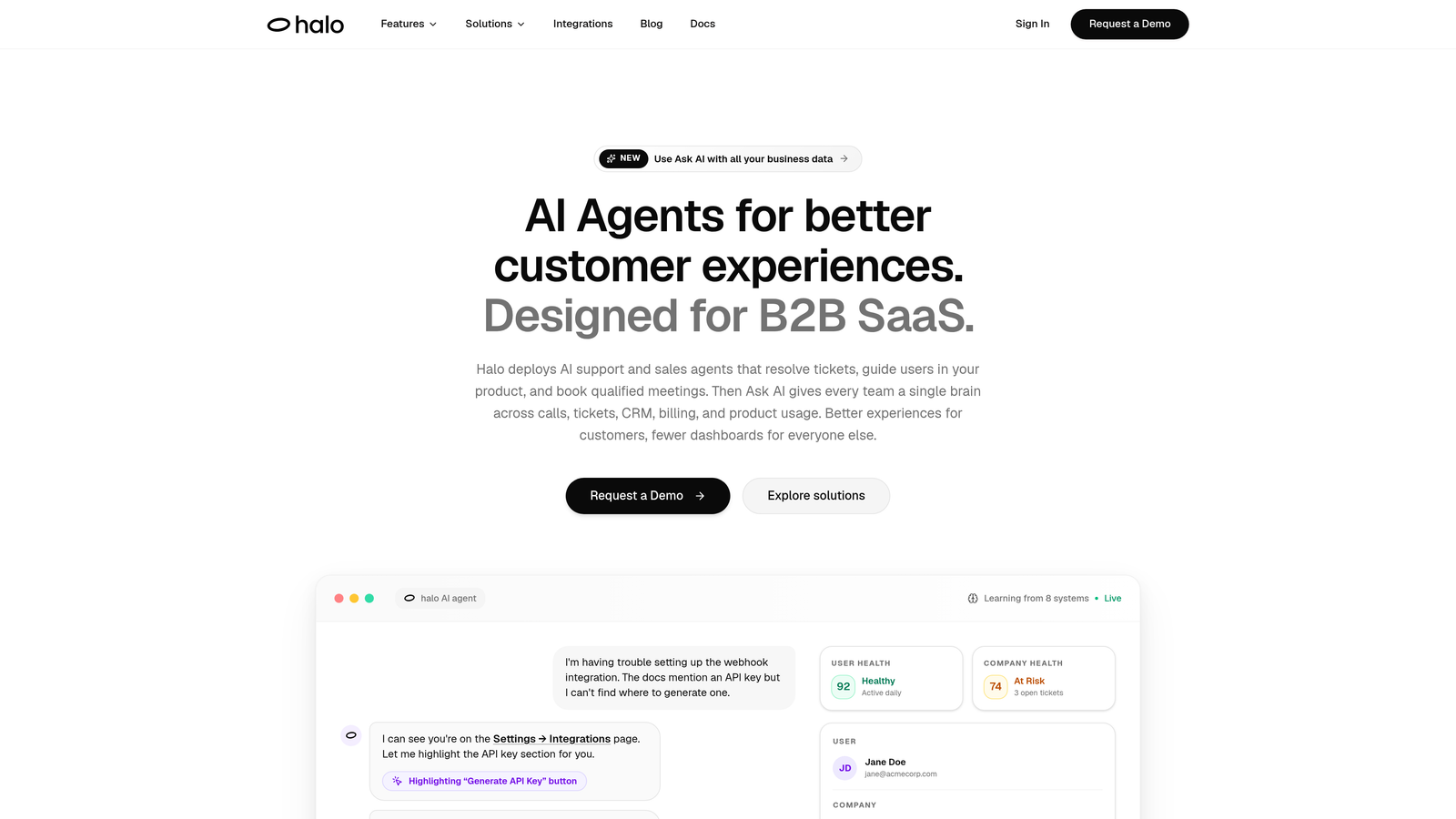
Halo AI is an AI-native customer support platform designed specifically for SaaS companies, deploying autonomous agents that resolve tickets, guide users through your product, and surface business intelligence — all while learning from every interaction.
Where This Tool Shines
What separates Halo from most tools on this list is its page-aware context engine. The chat widget understands what page a user is on and what they're seeing in your product UI, which means AI responses are grounded in real context rather than generic knowledge base lookups. For complex SaaS products where users can be stuck in a dozen different states, that context makes a meaningful difference in resolution quality.
The auto bug ticket creation feature is genuinely rare in this category. When a user reports something that looks like a product issue, Halo can automatically create and route a bug ticket to Linear or equivalent dev tools, closing the loop between support and engineering without requiring manual triage. The smart inbox layer adds another dimension, surfacing customer health signals, revenue intelligence, and anomaly detection so your team gets business intelligence alongside ticket management.
Key Features
Page-Aware Chat Widget: Understands the user's current location and state within your product UI, enabling context-specific responses.
Autonomous Ticket Resolution: AI agents handle tickets end-to-end with smart escalation to human agents when complexity warrants it.
Auto Bug Ticket Creation: Detects product issues from support conversations and routes bug tickets directly to Linear or connected dev tools.
Smart Inbox with Business Intelligence: Surfaces customer health signals, anomaly detection, and revenue intelligence alongside standard support workflows.
Deep SaaS Integrations: Connects natively with Linear, Slack, HubSpot, Intercom, Stripe, Zoom, PandaDoc, and Fathom.
Continuous Learning: Every resolved interaction improves the AI's accuracy and resolution rate over time.
Best For
Product-led and sales-led SaaS companies that want an AI-first architecture rather than a bolt-on layer. Particularly strong for teams with complex product UIs, active dev pipelines, and a need for support data to feed back into product and revenue decisions.
Pricing
Custom pricing tailored to team size and usage. Contact Halo directly for a quote based on your support volume and integration requirements.
2. Intercom (Fin AI)
Best for: Teams already invested in Intercom's ecosystem who want AI-native conversation handling
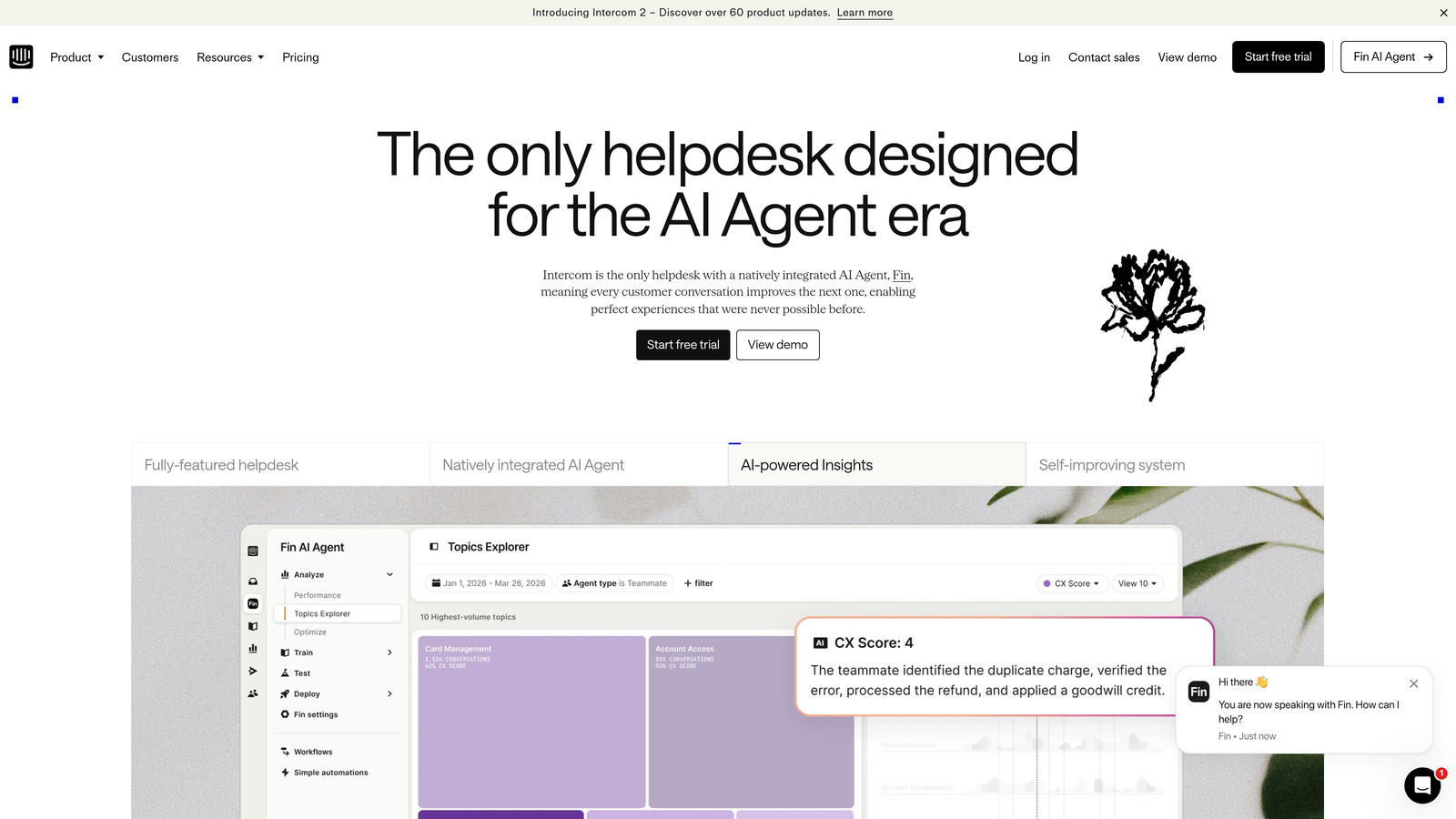
Intercom is a customer messaging platform with Fin, its AI agent, handling support conversations autonomously and routing complex issues to human agents.
Where This Tool Shines
Fin is trained on your help center content and past conversations, which gives it a strong starting point for resolving common questions without agent involvement. The handoff logic is well-developed: when Fin can't resolve something, it routes to a human agent with full conversation context intact.
Beyond AI resolution, Intercom's broader platform adds in-app messaging capabilities including product tours, checklists, and banners. For SaaS teams that want support and user onboarding managed from a single platform, that breadth is a real advantage. The tradeoff is that switching costs are high once you're embedded in the ecosystem.
Key Features
Fin AI Agent: Trained on help center content and conversation history for autonomous resolution of common support queries.
Intelligent Routing: Escalates unresolved conversations to human agents with full context preserved.
In-App Messaging Suite: Product tours, checklists, and banners for onboarding and engagement alongside support.
Broad Integration Ecosystem: Connects with CRMs, analytics tools, and other SaaS platforms through an extensive marketplace.
Best For
SaaS teams already using Intercom for messaging who want to extend into AI-powered support without adopting a separate platform. Less ideal for teams evaluating from scratch due to pricing complexity.
Pricing
Base plans start at approximately $39 per seat per month. Fin AI resolution-based pricing applies separately and can add up at higher conversation volumes.
3. Zendesk AI
Best for: Enterprise SaaS teams running high-volume, multi-channel support operations
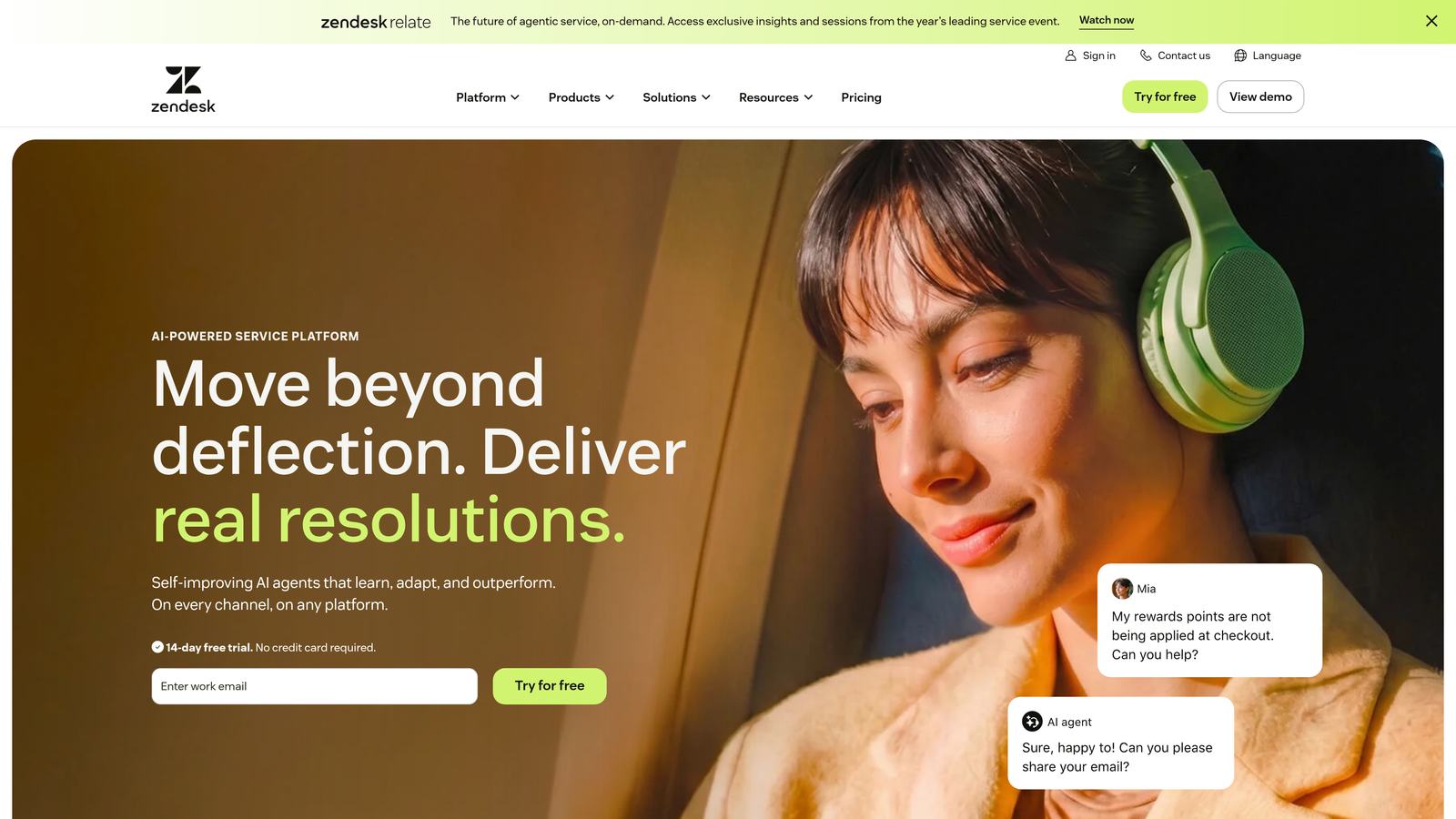
Zendesk is an enterprise helpdesk platform with AI-powered triage, intent detection, intelligent routing, and an agent copilot embedded across its support suite.
Where This Tool Shines
Zendesk's AI capabilities are built for scale. Intent detection and intelligent routing handle high ticket volumes across multiple teams and channels without manual triage, and the agent copilot provides real-time suggestions during live conversations to reduce handle time.
The integration marketplace is one of the most mature in the category, with connections to virtually every tool in a modern SaaS stack. That breadth makes Zendesk a natural fit for larger organizations with complex tooling environments, though it can feel like overkill for leaner teams.
Key Features
AI Triage and Intent Detection: Automatically categorizes and prioritizes incoming tickets at enterprise scale.
Intelligent Routing: Distributes tickets across teams and channels based on skills, availability, and context.
Agent Copilot: Provides real-time response suggestions and knowledge retrieval during live agent conversations.
Advanced Analytics: Detailed reporting on resolution rates, agent performance, and support trends.
Extensive Marketplace: Hundreds of integrations covering CRM, billing, dev tools, and more.
Best For
Established SaaS companies with large support teams and high ticket volumes. Less suited for early-stage teams where the setup investment and per-seat pricing may not be justified.
Pricing
Suite plans start at approximately $55 per agent per month. AI features are available on higher tiers or as add-ons, which can significantly increase total cost.
4. Freshdesk (Freddy AI)
Best for: SMB and mid-market SaaS teams wanting AI features without enterprise-level spend
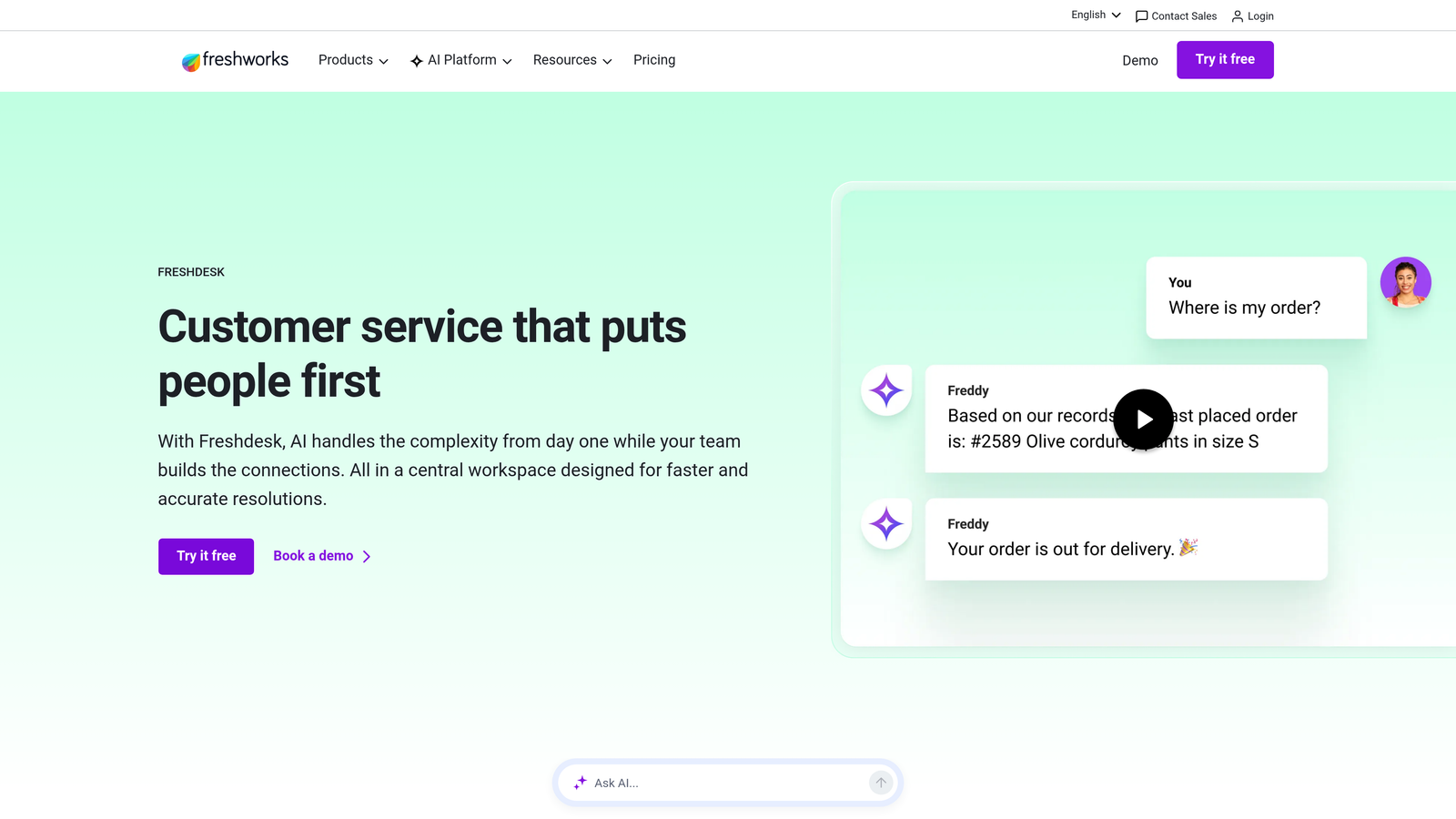
Freshdesk is a cloud-based helpdesk with Freddy AI spanning self-service deflection, real-time agent assist, and support analytics at pricing that's accessible to growing teams.
Where This Tool Shines
Freddy AI is split into distinct functional layers: Freddy Self Service handles autonomous ticket deflection before an agent gets involved, Freddy Copilot assists agents in real time with suggested responses and context, and Freddy Insights surfaces AI-powered analytics on support trends and team performance. That modular structure lets teams adopt what they need without paying for what they don't.
Freshdesk also covers omnichannel support across email, chat, phone, and social from a single interface. For SaaS teams managing support across multiple touchpoints, that consolidation reduces context-switching and keeps agent workflows clean.
Key Features
Freddy Self Service: Autonomous deflection layer that resolves common queries before ticket creation.
Freddy Copilot: Real-time agent assist with suggested replies and contextual knowledge retrieval.
Freddy Insights: AI-powered analytics surfacing trends, bottlenecks, and performance patterns.
Omnichannel Support: Unified inbox across email, chat, phone, and social media channels.
Best For
Growing SaaS teams that want AI-assisted support without committing to enterprise pricing. A strong choice for teams migrating off basic email-only tools who want a meaningful step up in capability.
Pricing
Free tier available. Paid plans start at approximately $15 per agent per month, with Freddy AI features unlocking on higher tiers.
5. Forethought
Best for: SaaS teams with helpdesk lock-in who want smarter AI without a platform migration
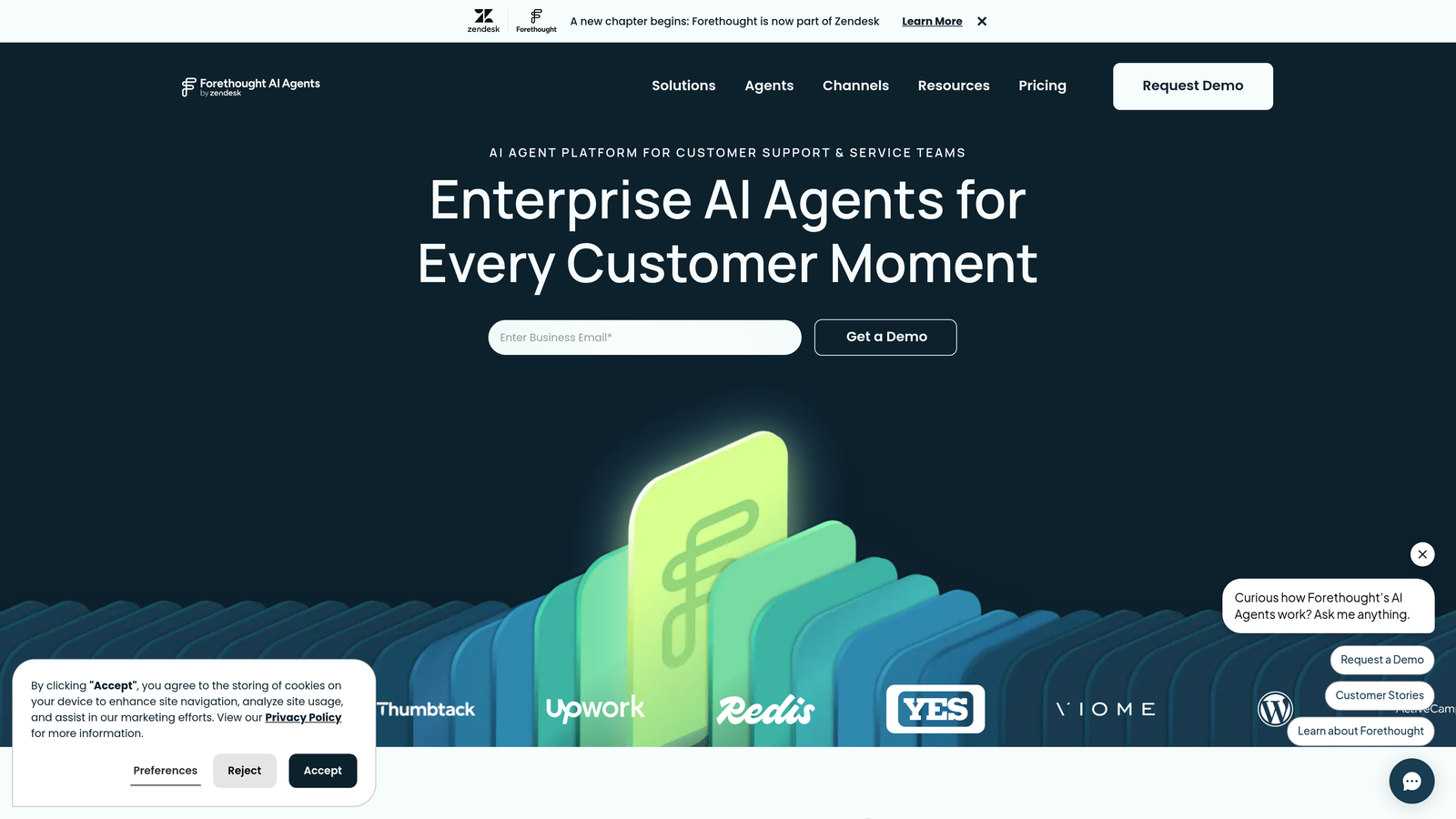
Forethought is an AI middleware layer that sits on top of existing helpdesks like Zendesk and Salesforce Service Cloud, adding intelligent triage, deflection, and agent assist without requiring a rip-and-replace.
Where This Tool Shines
The core value proposition here is additive intelligence. If your team is deeply embedded in Zendesk or Salesforce and switching isn't realistic, Forethought layers AI capabilities on top of your existing workflows rather than replacing them. Triage, deflection, and agent assist all operate within the interfaces your team already uses.
The SupportGPT backbone reflects a modern LLM-powered approach to understanding and routing support conversations. For teams that have invested heavily in their current helpdesk but feel the AI capabilities are lagging, Forethought is a practical bridge solution.
Key Features
AI Triage and Routing: Intelligent classification and routing layered on top of existing helpdesk workflows.
Deflection Engine: AI-powered self-service that intercepts common queries before ticket creation.
Agent Assist: Suggested responses and knowledge retrieval surfaced within existing agent interfaces.
SupportGPT Backbone: LLM-powered understanding of conversation intent and context.
Helpdesk Integrations: Native integrations with Zendesk, Salesforce Service Cloud, and other major platforms.
Best For
Mid-market and enterprise SaaS teams with significant investment in existing helpdesk infrastructure who need better AI without the disruption of platform migration.
Pricing
Custom pricing. Contact Forethought directly for a quote based on your helpdesk environment and usage volume.
6. Tidio
Best for: Early-stage SaaS teams looking for a low-barrier entry into AI-powered support
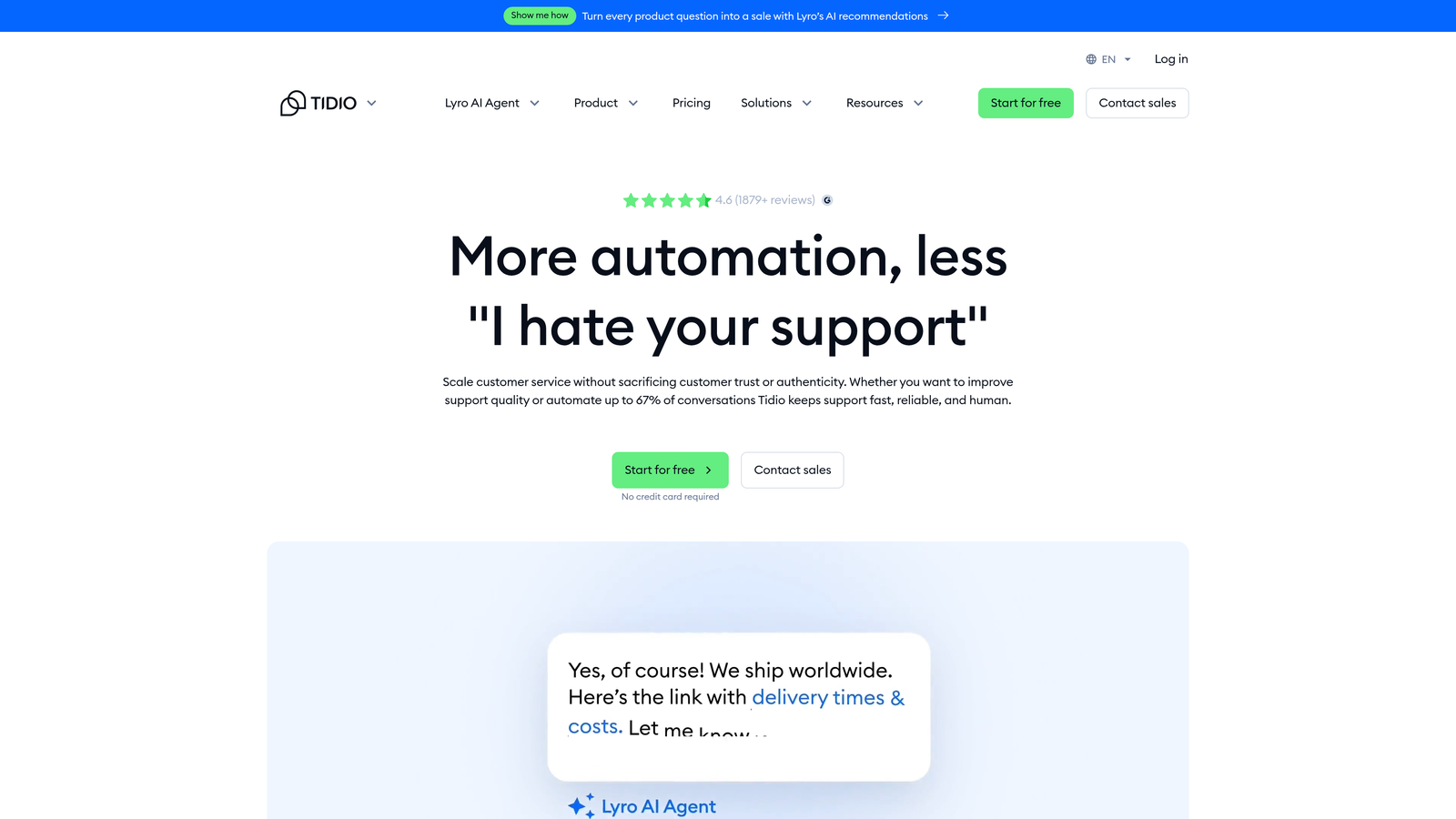
Tidio is a chat and AI support platform with Lyro AI handling customer conversations autonomously, designed for teams that want to deploy AI support quickly without heavy setup investment.
Where This Tool Shines
Lyro AI handles common support conversations end-to-end and escalates to live agents when needed. The setup process is notably lighter than enterprise alternatives, which makes Tidio a realistic option for small teams or early-stage products that can't dedicate weeks to onboarding a new platform.
Pre-built automation flows for common support scenarios reduce the time-to-value further. The tradeoff is depth: Tidio doesn't offer the SaaS-specific integrations or business intelligence features you'd find in more specialized platforms, but for teams whose primary need is deflection and basic conversation handling, it delivers solid value at an accessible price.
Key Features
Lyro AI Agent: Autonomous conversation handling for common support queries with live agent fallback.
Live Chat: Seamless handoff to human agents when AI resolution isn't appropriate.
Pre-Built Automation Flows: Ready-to-use automations for frequently recurring support scenarios.
Multi-Channel Support: Covers email, live chat, and Messenger from a unified interface.
Best For
Early-stage SaaS companies and small teams that want AI support capabilities without enterprise complexity or budget. Also useful as a quick-deploy option while evaluating more comprehensive platforms.
Pricing
Free tier available. Lyro AI plans start at approximately $29 per month based on conversation volume.
7. Kustomer
Best for: SaaS teams with complex account histories that need full customer context in every support interaction
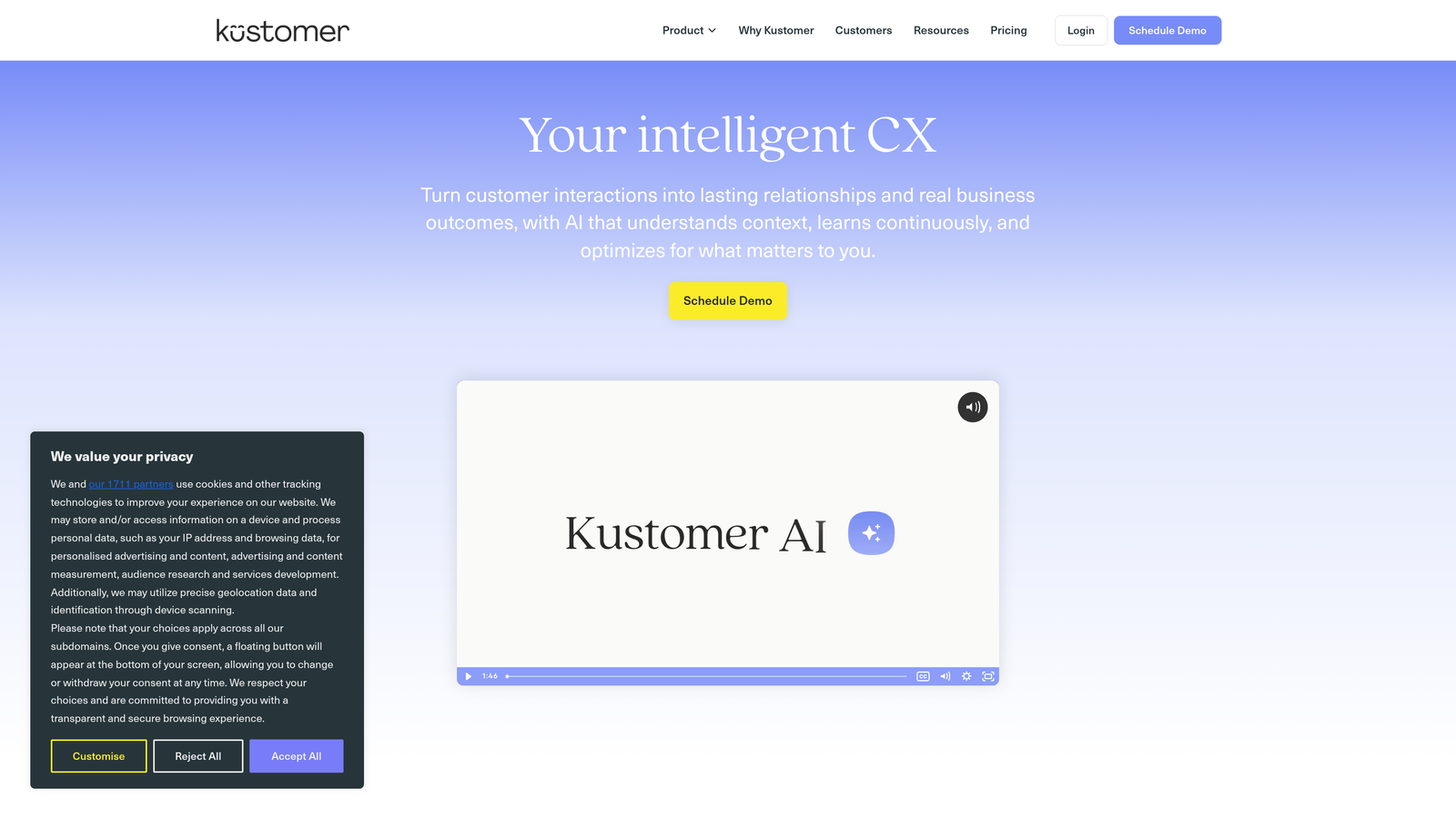
Kustomer is a CRM-native support platform that centers the full customer timeline, with AI features for routing, agent assist, and self-service built around that complete account view.
Where This Tool Shines
Most support tools treat tickets as the primary object. Kustomer treats the customer as the primary object, surfacing the full timeline of interactions, purchases, and history as the default context for every conversation. For SaaS companies with complex account structures, long customer lifecycles, or high-value accounts, that difference in architecture matters.
AI routing and prioritization work on top of that customer context, which means high-value or at-risk accounts can be identified and escalated appropriately. The multi-channel coverage across email, chat, social, and voice is solid, and workflow automation spans the full customer lifecycle rather than just individual tickets.
Key Features
Customer Timeline: Full account history as the core support object, giving agents complete context in every conversation.
AI Routing and Prioritization: Intelligent conversation assignment based on customer context, not just ticket attributes.
Agent Assist: Suggested responses and knowledge retrieval informed by customer history.
Multi-Channel Support: Unified handling across email, chat, social, and voice.
Lifecycle Workflow Automation: Automations that span the full customer relationship, not just individual support interactions.
Best For
Mid-market and enterprise SaaS teams with complex, high-value account relationships where full customer context is critical to support quality. Less suited for high-volume, transactional support environments.
Pricing
Plans start at approximately $89 per agent per month. Enterprise plans available with expanded AI and automation capabilities.
8. Drift (Salesloft)
Best for: PLG SaaS teams where support and expansion conversations frequently overlap
Drift is a conversational AI platform now part of Salesloft, blending support and sales conversations in ways that are particularly relevant for product-led growth SaaS companies.
Where This Tool Shines
Drift's AI chatbots were originally built for sales qualification, and that heritage shows in how the platform handles revenue-aware conversations. For PLG SaaS teams where a support interaction can quickly turn into an upgrade conversation, having AI that understands both contexts in a single workflow is genuinely useful.
The integration with Salesloft's broader sales engagement platform adds depth for teams that want support and sales motions coordinated. Playbook-driven automation lets teams define exactly how different conversation types should be handled, from technical support routing to meeting booking for account expansion. The positioning continues to evolve post-acquisition, so it's worth evaluating current capabilities directly.
Key Features
AI Chatbots: Handles support routing, qualification, and meeting booking within a single conversation flow.
Revenue-Aware Intelligence: Conversation handling informed by account status, intent signals, and expansion potential.
Salesloft Integration: Connected to broader sales engagement workflows for coordinated support and expansion motions.
Playbook Automation: Configurable playbooks for defining how specific conversation types are handled end-to-end.
Best For
PLG and hybrid SaaS teams where support conversations regularly intersect with expansion, upsell, or renewal opportunities, and where coordinating support and sales motions in one platform has clear value.
Pricing
Custom pricing. Contact Drift or Salesloft directly for current packaging and pricing details.
9. Help Scout
Best for: SaaS teams that prioritize agent experience and relationship-based support
Help Scout is a human-first support platform with AI Summarize and AI Assist features that augment agents rather than replace them, built around a clean and deliberate agent experience.
Where This Tool Shines
Help Scout's philosophy is that AI should make agents better, not obsolete. AI Summarize gives agents instant context on long conversation threads without reading every message. AI Assist helps with suggested replies and tone adjustments without taking over the conversation. That restraint is a deliberate product choice, and it resonates with SaaS teams where relationship quality matters as much as resolution speed.
The tight integration between the Beacon chat widget, the Docs knowledge base, and the inbox creates a coherent self-service and agent-assisted experience without requiring multiple platforms. The agent UI is consistently praised for its clarity, which reduces onboarding time and keeps agents focused on customers rather than navigating tooling.
Key Features
AI Summarize: Instant conversation summaries that give agents immediate context without reading full thread histories.
AI Assist: Suggested replies and tone adjustments that support agents without removing their voice from the conversation.
Beacon Chat Widget: In-app chat with integrated self-service Docs access for users before they need to contact support.
Docs Knowledge Base: Tightly integrated with support workflows so agents and users access the same content.
Clean Inbox UI: Agent-friendly interface designed to reduce cognitive load and improve focus.
Best For
SaaS teams that value agent experience, relationship-based support, and a human-in-the-loop philosophy. Strong for companies where support is a differentiator and tone and quality matter as much as speed.
Pricing
Plans start at approximately $22 per user per month. AI features are included on Standard plans and above.
Which Tool Is Right for Your Team
The right AI support tool depends heavily on where your team is today and where you're trying to go. Here's a quick framework for thinking through the decision.
Early-stage SaaS: Tidio offers the lowest barrier to entry with real AI conversation handling. Help Scout is a strong alternative if agent experience and clean workflows matter more than autonomous resolution.
Scaling SaaS that wants AI-first architecture: Halo AI is built specifically for this scenario. Page-aware context, auto bug ticket creation, continuous learning, and deep SaaS integrations address the exact pressures that growing product teams face. It's not a helpdesk with AI bolted on; it's an AI platform designed around how SaaS support actually works.
Enterprise teams with high ticket volume: Zendesk AI has the maturity, marketplace depth, and routing sophistication to handle large-scale operations. Kustomer is the better choice if account complexity and full customer context are the primary drivers.
Teams with helpdesk lock-in: Forethought is the practical option. It layers AI intelligence on top of Zendesk or Salesforce without requiring migration, which makes it a realistic upgrade path for teams that can't absorb platform change right now.
PLG teams where support and sales overlap: Drift's revenue-aware conversation handling and Salesloft integration make it a natural fit for product-led companies where support interactions frequently turn into expansion conversations.
Your support team shouldn't scale linearly with your customer base. AI agents can handle routine tickets, guide users through complex product workflows, and surface business intelligence while your team focuses on the interactions that genuinely need a human. See Halo in action and discover how continuous learning transforms every support interaction into smarter, faster resolution at scale.