9 Best AI Support Tools for Scale-Ups in 2026
Scale-ups struggling to maintain support quality during rapid growth will find this guide to the best AI support tools for scale-ups essential reading. It evaluates nine purpose-built solutions across autonomous resolution capability, implementation speed, and scalability—helping fast-growing teams handle compounding ticket volume without proportionally expanding headcount.
 Grant CooperFounder14 min read
Scale-ups face a support challenge that's almost paradoxical: the faster you grow, the harder it becomes to maintain the quality that drove your growth in the first place. Ticket volume compounds, customer expectations keep rising, and hiring your way out of the problem stops making financial sense somewhere around the time you're onboarding your tenth support agent in a year.
AI support tools have matured to the point where they can genuinely absorb that growth, resolving tickets autonomously, surfacing product insights, and handing off to humans only when the situation actually warrants it. But not every tool is built for the scale-up stage. Some are designed for enterprise complexity with implementation timelines to match; others are too lightweight for a team doubling year over year.
This list focuses specifically on tools that work well when you're past early-stage scrappiness but not yet a 500-person enterprise. We evaluated each across autonomous resolution capability, integration depth, learning over time, pricing scalability, and deployment speed for lean teams. Whether you're running support on Zendesk, Freshdesk, Intercom, or building something custom, there's an option here for you.
1. Halo AI
Best for: B2B SaaS teams wanting an AI-first support layer with business intelligence built in
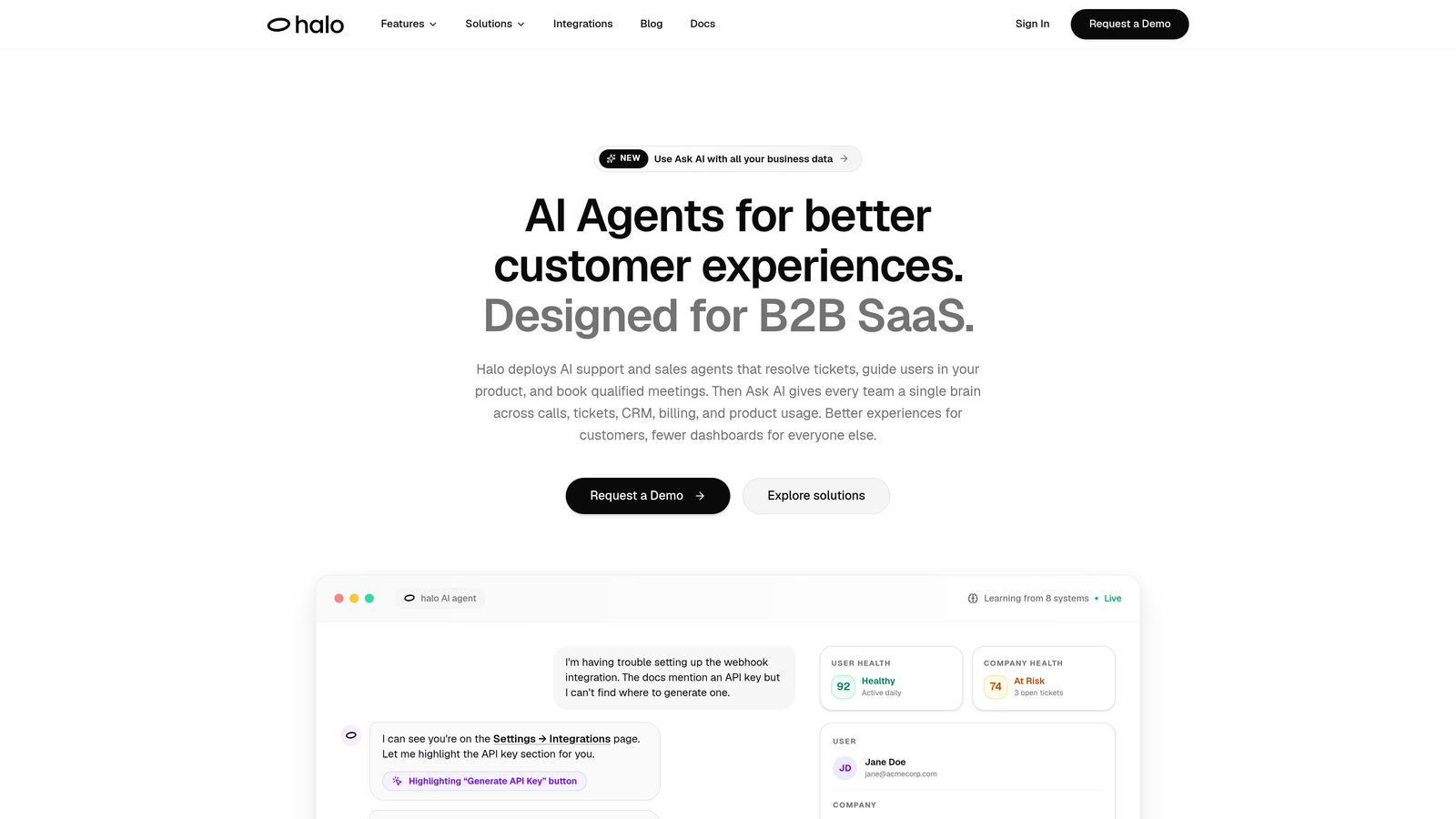
Halo AI is an AI-first customer support platform that resolves tickets autonomously, guides users visually through your product, and surfaces business intelligence from every support interaction.
Where This Tool Shines
What sets Halo apart from most tools on this list is its architecture. Rather than bolting AI onto an existing helpdesk, Halo is designed from the ground up as the primary support layer. That distinction matters: the AI isn't suggesting responses to a human agent, it's resolving tickets end-to-end and getting smarter with every interaction it handles.
The page-aware chat widget is a genuinely differentiated capability. The AI sees exactly what the user is looking at in your product, which means it can provide contextual visual guidance rather than generic instructions. For SaaS products with complex onboarding flows or feature-dense interfaces, this closes a gap that most support tools leave wide open.
Key Features
Intelligent AI Agents: Autonomous ticket resolution with continuous learning built in, so the system improves from every interaction rather than staying static.
Page-Aware Chat Widget: The AI sees what the user sees, enabling contextual guidance tied to the specific part of your product they're navigating.
Smart Inbox with Business Intelligence: Goes beyond support metrics to surface customer health signals, revenue anomalies, and product friction patterns from support data.
Auto Bug Ticket Creation: Automatically generates and routes bug tickets to Linear or Jira when support interactions reveal product issues, closing the loop between support and engineering.
Live Agent Handoff: Seamlessly escalates complex issues to human agents without dropping context or forcing the customer to repeat themselves.
Deep Integration Stack: Connects with Linear, Slack, HubSpot, Intercom, Stripe, Zoom, PandaDoc, and Fathom, making it a genuine hub rather than an isolated tool.
Best For
B2B SaaS teams that want AI to do real resolution work, not just deflection. Particularly strong for product-led growth companies where support interactions are closely tied to activation, retention, and revenue signals. Teams that want support data to inform product decisions will find the business intelligence layer especially valuable.
Pricing
Pricing is built to scale with B2B SaaS teams. Visit haloagents.ai for current plans and details.
2. Intercom (Fin AI Agent)
Best for: Teams already on Intercom who want AI resolution without a platform migration
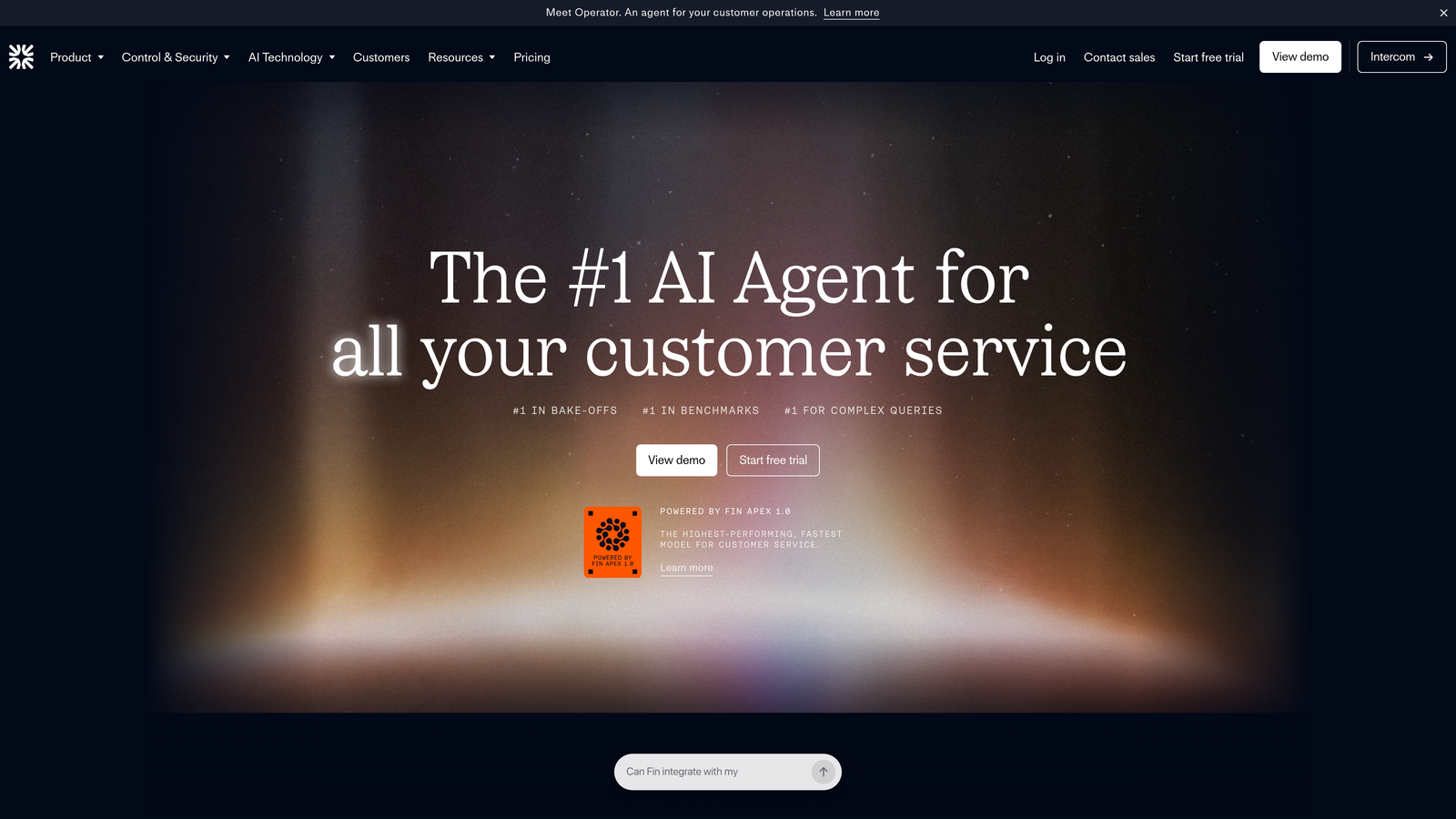
Intercom Fin is Intercom's native AI agent that resolves customer queries directly within the Intercom messenger using LLM-powered understanding of your knowledge base.
Where This Tool Shines
Fin's biggest advantage is zero friction for existing Intercom users. There's no new UI to deploy, no separate platform to manage, and no disruption to the customer experience your team has already built. If your support workflow lives in Intercom, Fin slots in cleanly and starts resolving queries from your existing help center content.
The LLM-powered understanding means Fin handles natural language variations well, not just keyword matching against your articles. It can synthesize answers from multiple knowledge sources rather than returning a single article link, which meaningfully improves resolution quality for complex queries.
Key Features
LLM-Powered Resolution: Generates accurate answers from connected knowledge sources rather than pattern-matching to FAQs.
Native Messenger Integration: Lives inside the Intercom UI your customers already use, with no additional widget or interface required.
Multi-Source Knowledge Ingestion: Pulls from your help center, PDFs, and URLs to build a comprehensive knowledge foundation.
Seamless Human Handoff: Escalates to human agents within the same inbox when the AI can't confidently resolve a query.
Usage-Based Pricing: Pay for resolved conversations rather than a flat seat fee, which aligns costs with actual value delivered.
Best For
Scale-ups already invested in the Intercom ecosystem. If you're running customer communications, onboarding, and support through Intercom, Fin is the lowest-friction path to adding autonomous AI resolution. Less compelling if you're not already on Intercom, since the platform cost is significant.
Pricing
Usage-based add-on to existing Intercom plans. Check intercom.com for current resolution pricing and plan requirements.
3. Zendesk AI
Best for: Scale-ups with established Zendesk workflows looking to add AI without leaving the platform
Zendesk AI is an AI suite built natively into the Zendesk platform, offering intelligent triage, suggested responses, and autonomous agent capabilities for high-volume support operations.
Where This Tool Shines
Zendesk AI's strength is depth of integration with everything you've already built in Zendesk. Your macros, triggers, routing rules, and reporting infrastructure all work with the AI layer rather than around it. For teams with mature Zendesk setups, this means AI augmentation without rebuilding your workflows from scratch.
The triage and intent detection capabilities are particularly well-developed, routing tickets to the right queue or agent before a human even reads them. At scale, that routing intelligence compounds into meaningful efficiency gains across the entire support operation.
Key Features
AI-Powered Triage: Detects intent and sentiment on incoming tickets to route them accurately before human review.
Intelligent Suggested Responses: Surfaces relevant answers and macros to agents based on ticket context, reducing handle time.
Autonomous AI Agent: Handles deflection and resolution before tickets reach the human queue.
Deep Workflow Integration: Works natively with Zendesk macros, triggers, views, and reporting rather than sitting alongside them.
AI Performance Analytics: Tracks resolution rates, deflection, and AI accuracy within Zendesk's existing reporting environment.
Best For
Teams with significant existing investment in Zendesk who want to add AI without a platform migration. Well-suited for scale-ups with complex routing logic already built in Zendesk. Pricing at higher tiers can become a meaningful line item, so evaluate total cost carefully as you scale.
Pricing
Included in higher Zendesk tiers; an Advanced AI add-on is also available. See zendesk.com for current pricing by plan.
4. Freshdesk Freddy AI
Best for: Cost-conscious scale-ups wanting AI-assisted support without enterprise-tier pricing
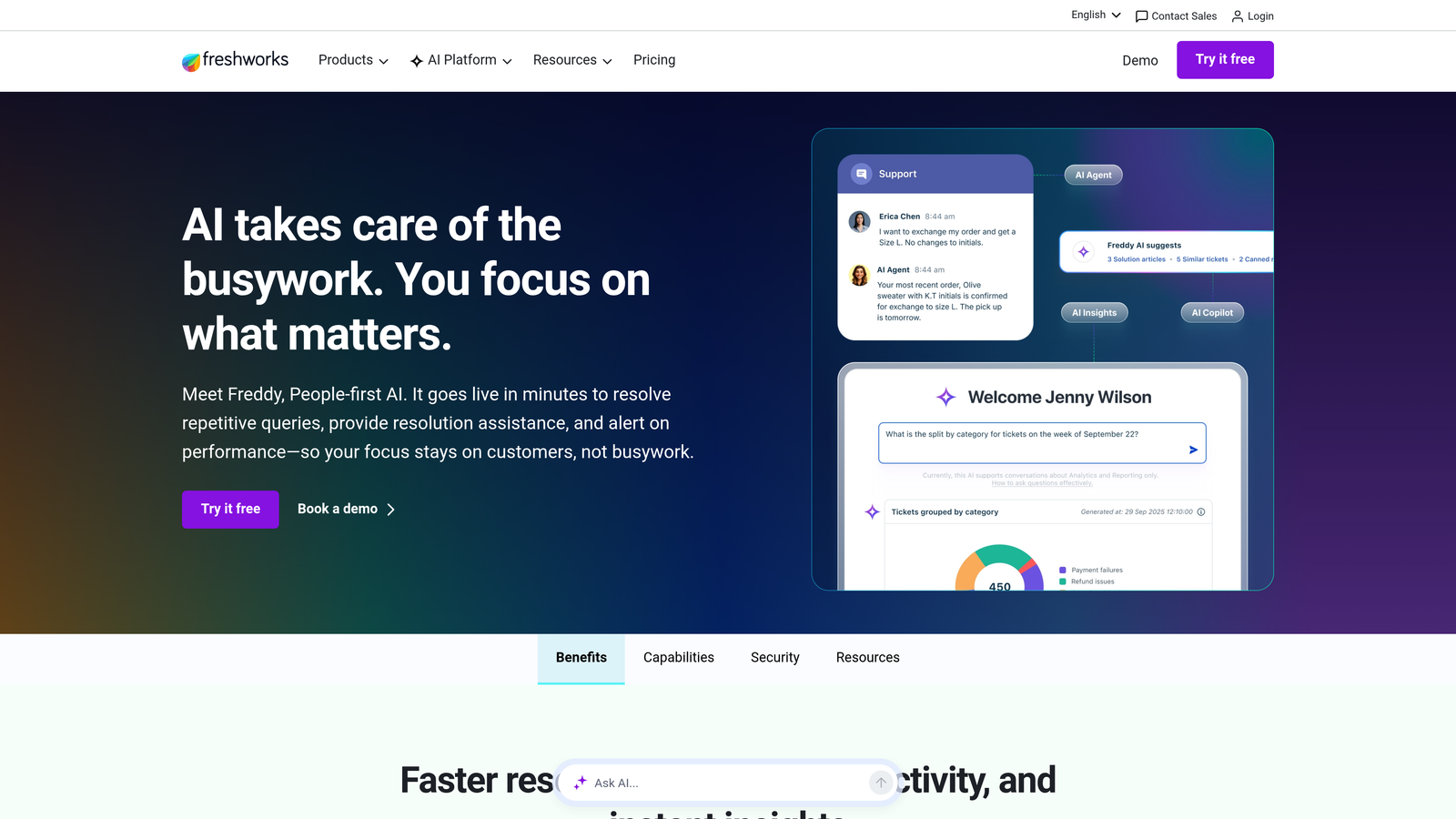
Freshdesk Freddy AI is Freshworks' AI layer for Freshdesk, offering self-service bots, agent assistance, and auto-triage at a price point accessible to growing teams.
Where This Tool Shines
Freddy AI's value proposition is straightforward: you get meaningful AI capabilities at a price point that doesn't require a CFO sign-off. For scale-ups watching unit economics closely, Freshdesk often delivers comparable core functionality to pricier alternatives without the enterprise overhead.
The two-track approach, with Freddy Self Service handling customer-facing deflection and Freddy Copilot assisting agents, means you can deploy AI across both sides of your support operation without stitching together separate tools.
Key Features
Freddy Self Service: Customer-facing AI bot that handles deflection before queries reach the agent queue.
Freddy Copilot: Provides agents with AI-generated response suggestions, ticket summaries, and next-step recommendations.
Auto-Triage and Classification: Automatically tags and routes incoming tickets based on intent and content.
Multilingual Support: Handles queries in multiple languages out of the box, useful for scale-ups with international customer bases.
Native Freshdesk Integration: Works within existing Freshdesk workflows without additional configuration overhead.
Best For
Growing teams on Freshdesk or evaluating Freshdesk as a primary helpdesk. Particularly attractive for scale-ups where budget efficiency is a priority and the support complexity doesn't yet require the most advanced AI capabilities on the market.
Pricing
Freddy AI is available across Freshdesk Growth and higher plans. Visit freshworks.com for current plan details and add-on pricing.
5. Forethought
Best for: Teams with complex routing logic who want AI layered on top of an existing helpdesk
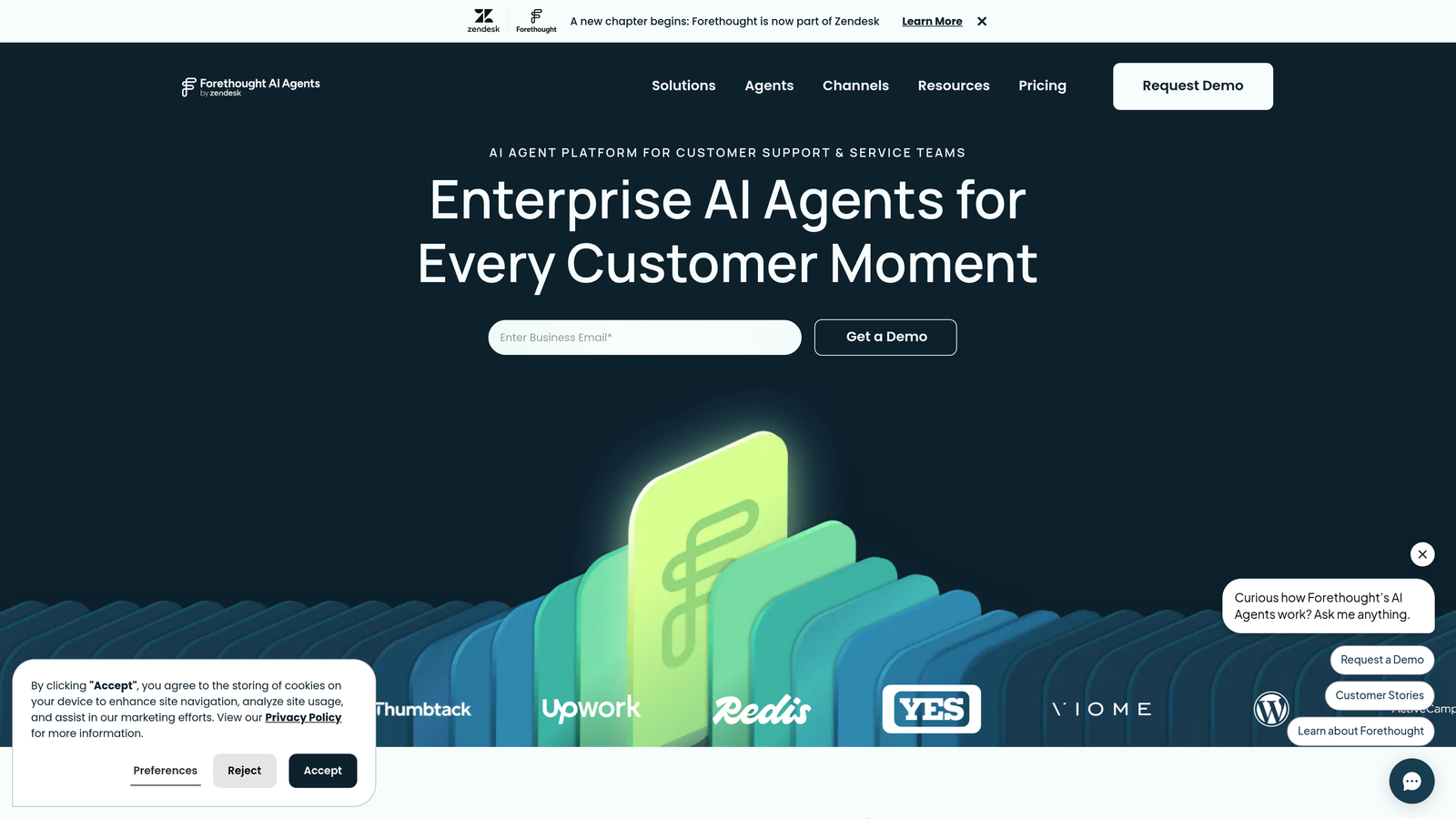
Forethought is an AI-powered support workflow platform specializing in intelligent triage, ticket deflection, and CSAT prediction that sits on top of your existing helpdesk infrastructure.
Where This Tool Shines
Forethought's positioning is deliberately additive rather than replacement-oriented. If you've built significant workflow logic in Zendesk, Salesforce Service Cloud, or ServiceNow, Forethought enhances those workflows with AI intelligence rather than asking you to migrate away from them. That's a meaningful advantage for scale-ups with mature support operations.
The CSAT and churn risk prediction signals are a standout capability. Rather than simply deflecting tickets, Forethought surfaces early warning indicators that let support teams prioritize proactively, focusing human attention on customers most at risk before they escalate or churn.
Key Features
AI Triage with Intent and Sentiment: Classifies and routes tickets based on customer intent and emotional signals, not just keywords.
Ticket Deflection: Surfaces self-service answers before queries reach the agent queue, reducing inbound volume.
CSAT and Churn Risk Prediction: Identifies at-risk customers from support interaction patterns before issues escalate.
Broad Helpdesk Compatibility: Works with Zendesk, Salesforce, ServiceNow, and other major platforms without requiring migration.
Complex Routing Automation: Handles multi-tier routing logic for organizations with specialized support teams or SLA tiers.
Best For
Scale-ups with established helpdesk investments and complex routing requirements. Particularly valuable for teams that need AI intelligence layered into existing workflows rather than a platform replacement. Worth noting that Forethought was acquired by Salesforce, which may influence long-term roadmap direction.
Pricing
Pricing is available on request. Visit forethought.ai to connect with their sales team for a current quote.
6. Tidio Lyro
Best for: Teams wanting fast AI deployment with predictable, conversation-based pricing
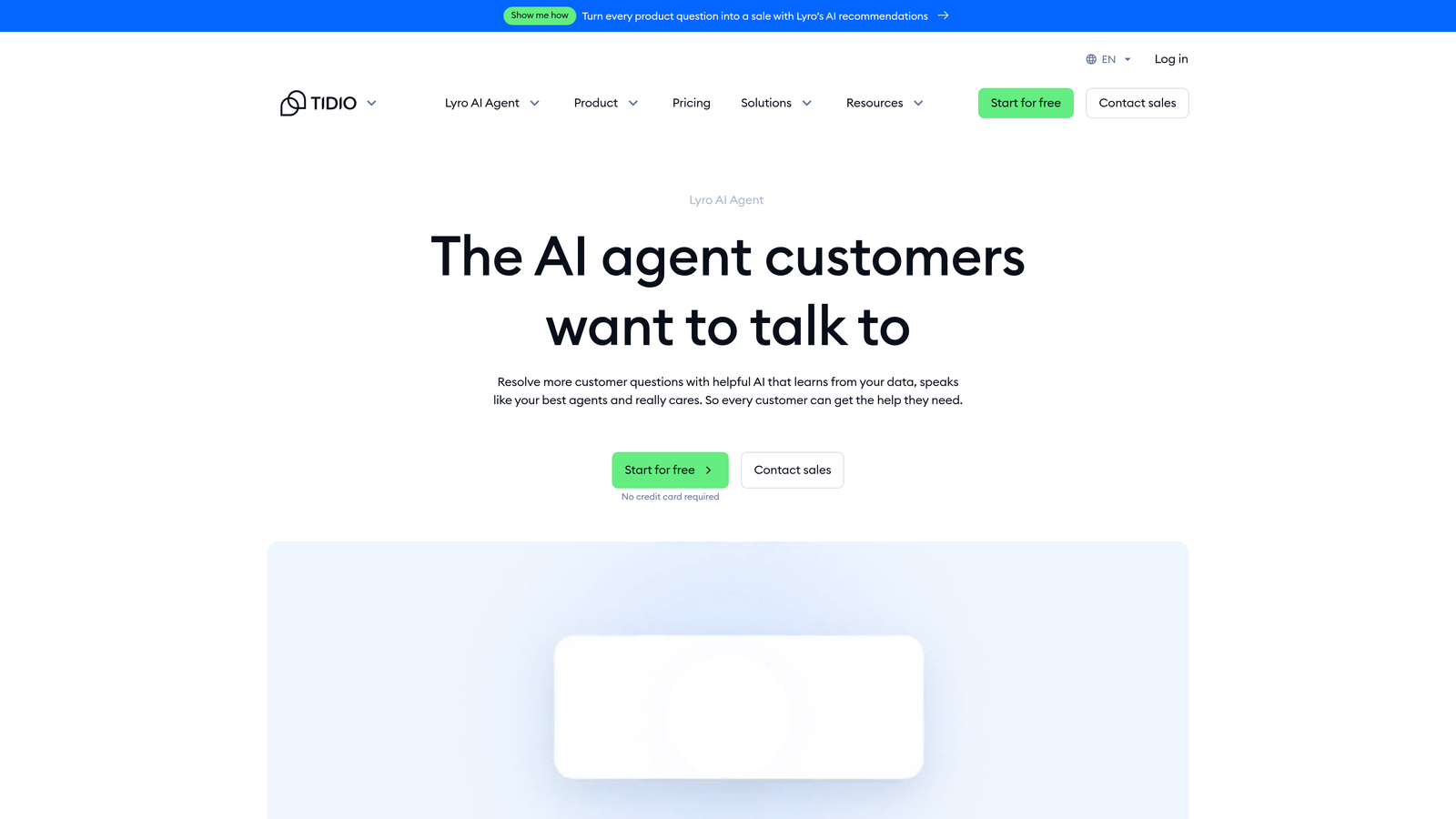
Tidio Lyro is Tidio's conversational AI product designed for fast deployment and autonomous handling of common support queries, with transparent per-conversation pricing.
Where This Tool Shines
Lyro's standout quality is its time-to-value. Setup is genuinely fast, the AI trains on your existing support content without heavy configuration, and you can have autonomous conversations handling customer queries within hours rather than weeks. For scale-ups that need to move quickly, that deployment speed is a real advantage.
The per-conversation pricing model removes one of the common frustrations with AI support tools: unpredictable cost scaling. You know exactly what each resolved conversation costs, which makes forecasting straightforward as volume grows.
Key Features
Autonomous AI Conversations: Handles common support queries end-to-end using your existing support content as its knowledge base.
Fast Setup: Goes live without heavy configuration or lengthy onboarding, making it accessible for lean teams.
Per-Conversation Pricing: Costs scale directly with volume, making budget forecasting predictable as your support load grows.
Confidence-Based Handoff: Escalates to live agents when the AI's confidence falls below a threshold, rather than guessing at an answer.
Multi-Channel Coverage: Works across website chat, email, and Messenger from a single configuration.
Best For
Scale-ups with high FAQ-level query volume that want fast deployment and predictable costs. Strong for e-commerce and SMB SaaS with relatively straightforward support needs. Less suited for complex B2B technical support where deep product context and multi-step troubleshooting are common.
Pricing
Lyro includes a free tier; paid plans scale by conversation volume. See tidio.com for current plan details.
7. Gorgias
Best for: E-commerce scale-ups with high order-related ticket volume on Shopify or similar platforms
Gorgias is an AI-powered helpdesk purpose-built for e-commerce brands, with deep integrations into Shopify and order management systems powering automated responses.
Where This Tool Shines
Gorgias does one thing exceptionally well: e-commerce support. The Shopify integration runs deep enough that the AI can pull order status, shipping information, and return eligibility in real time to resolve queries autonomously. For DTC brands where a significant portion of tickets are "where's my order" and "how do I return this," that translates directly into deflection rates that matter.
The revenue tracking capability is a genuinely useful differentiator. Connecting support interactions to order data means you can see which support conversations are influencing purchase decisions, not just resolving problems, which reframes how you think about support ROI.
Key Features
Deep E-Commerce Integrations: Native connections to Shopify, WooCommerce, and BigCommerce power real-time order data in every conversation.
AI Auto-Close: Automatically resolves and closes routine order status and shipping queries without agent involvement.
Unified Omnichannel Inbox: Manages email, chat, social media, and SMS in a single interface.
Revenue Attribution: Connects support interactions to order data to show the revenue impact of support conversations.
Macro and Rule Automation: Handles high-volume repetitive patterns with automation built specifically for e-commerce workflows.
Best For
DTC and e-commerce scale-ups with Shopify-centered operations and high order-related ticket volume. Not well-suited for B2B SaaS support, where the query types and integration requirements are fundamentally different.
Pricing
Plans start at approximately $10/month and scale by ticket volume. Visit gorgias.com for current pricing tiers.
8. Kustomer
Best for: Teams that want support data and CRM data unified in a single AI-powered platform
Kustomer is a CRM-first support platform that unifies the full customer timeline with AI automation, giving agents and AI agents rich context for every interaction.
Where This Tool Shines
Kustomer's core insight is that support quality improves dramatically when agents have full customer context, not just the current ticket. The platform unifies support history, order data, and CRM attributes into a single timeline view, so every interaction starts from a position of genuine understanding rather than starting from scratch.
For AI specifically, that context richness translates into more accurate suggested replies and smarter automation. When the AI knows a customer's purchase history, previous support interactions, and account status, it can make better decisions about how to respond and when to escalate.
Key Features
Full Customer Timeline: Unifies support history, orders, and CRM data into a single view accessible to both agents and AI.
Context-Aware AI Replies: Generates response suggestions with full customer context baked in, not just the current message.
Behavior-Triggered Workflows: Automates actions based on customer attributes and behavioral signals, not just ticket content.
Omnichannel Inbox: Manages email, chat, voice, and social in one unified interface.
Team and Customer Health Reporting: Tracks both agent performance and customer satisfaction trends over time.
Best For
Scale-ups where the boundary between support and CRM is blurry and where customer context is essential to support quality. Particularly strong for high-touch B2C businesses and companies where support interactions directly influence retention and upsell decisions. Pricing sits at the higher end of this list.
Pricing
Enterprise-tier pricing applies. Visit kustomer.com for current plan details and to request a quote.
9. Capacity
Best for: Scale-ups growing both customer-facing and internal support simultaneously
Capacity is an AI helpdesk and knowledge management platform that serves both customer-facing and internal support teams, useful for scale-ups growing both sides at the same time.
Where This Tool Shines
Most support tools on this list are focused exclusively on customer-facing support. Capacity takes a different angle: it serves both external customers and internal teams, IT and HR included, from the same platform. For scale-ups where internal support load is growing as fast as customer support load, consolidating both onto a single AI platform has real operational and cost advantages.
The knowledge management layer is notably strong. Capacity's AI doesn't just search a static knowledge base; it learns from every query to identify gaps, surface outdated content, and improve answer quality over time. That continuous improvement loop is particularly valuable for fast-growing teams where documentation struggles to keep pace with product changes.
Key Features
Adaptive Knowledge Base: Learns from every query to surface gaps and improve answer quality continuously, rather than staying static.
Dual-Use Platform: Handles both customer-facing support and internal employee helpdesk (IT, HR) from a single system.
Workflow Automation: Routes and escalates tickets based on configurable rules across both support contexts.
Broad Integration Support: Connects with HR systems, IT tools, and customer support platforms to pull context from across the organization.
Knowledge Gap Analytics: Reports on what customers and employees are asking that the knowledge base can't yet answer, guiding content investment.
Best For
Scale-ups experiencing simultaneous growth in customer support and internal support needs. Particularly useful for teams where knowledge management is a bottleneck and where a single platform serving multiple support functions would simplify operations meaningfully.
Pricing
Pricing is available on request. Visit capacity.com to connect with their team for current plan details.
Which Tool Is Right for Your Scale-Up?
The right choice depends less on which tool has the longest feature list and more on where your specific growth pressure is coming from.
For B2B SaaS teams: Halo AI is the strongest fit if you want an AI-first platform that resolves tickets autonomously, understands product context, and surfaces business intelligence beyond support metrics. Its page-aware guidance and continuous learning architecture are purpose-built for the SaaS support model. If you're already deeply invested in Intercom, Fin is the lowest-friction path to adding AI resolution without a migration.
For Zendesk or Freshdesk users: Zendesk AI and Freddy AI both offer solid native AI capabilities that layer onto your existing workflows. Zendesk AI suits teams with mature, complex Zendesk setups; Freddy AI is the better choice if budget efficiency is a priority. Forethought is worth evaluating if your routing logic is complex and you want AI intelligence without switching platforms.
For e-commerce scale-ups: Gorgias is the clear choice for Shopify-centered DTC brands with high order-related ticket volume. Tidio Lyro is a strong option if you need fast deployment and predictable per-conversation costs.
For teams unifying support and CRM data: Kustomer's customer timeline approach is compelling if context richness is central to your support quality. Capacity is worth evaluating if internal support is growing alongside customer support and you want a single platform for both.
Whatever tool you choose, the underlying principle holds: your support team shouldn't scale linearly with your customer base. See Halo in action and discover how continuous learning transforms every interaction into smarter, faster support, so your team can focus on the complex issues that actually need a human touch.