9 Best AI Support & Live Chat Software Tools in 2026
The debate between AI support and live chat software is no longer either/or — the best support teams use both strategically. This guide reviews nine leading platforms across the AI-native and live chat spectrum, evaluating each on autonomy, integration depth, scalability, and how seamlessly they manage the handoff between automated and human support.
 Grant CooperFounder13 min read
The debate between AI support and live chat software has largely been settled by the market: the best teams use both, just not the same way. AI agents handle the volume, speed, and consistency that human agents can't scale to. Live chat keeps humans in the loop for complex, high-stakes conversations. The question isn't which approach wins. It's which tools give you the right combination for your support operation.
This list covers nine platforms across the AI-native and live chat spectrum, evaluated on autonomy, integration depth, scalability, and how well they handle the handoff between automated and human support. We've also paid close attention to that critical transition moment when AI should step aside and a human should take over, because that transition defines the quality of your customer experience.
Whether you're a lean SaaS team drowning in tickets or an enterprise rethinking your support stack entirely, you'll find a clear recommendation here.
1. Halo AI
Best for: B2B SaaS teams that want AI-native autonomous support with deep business intelligence built in.
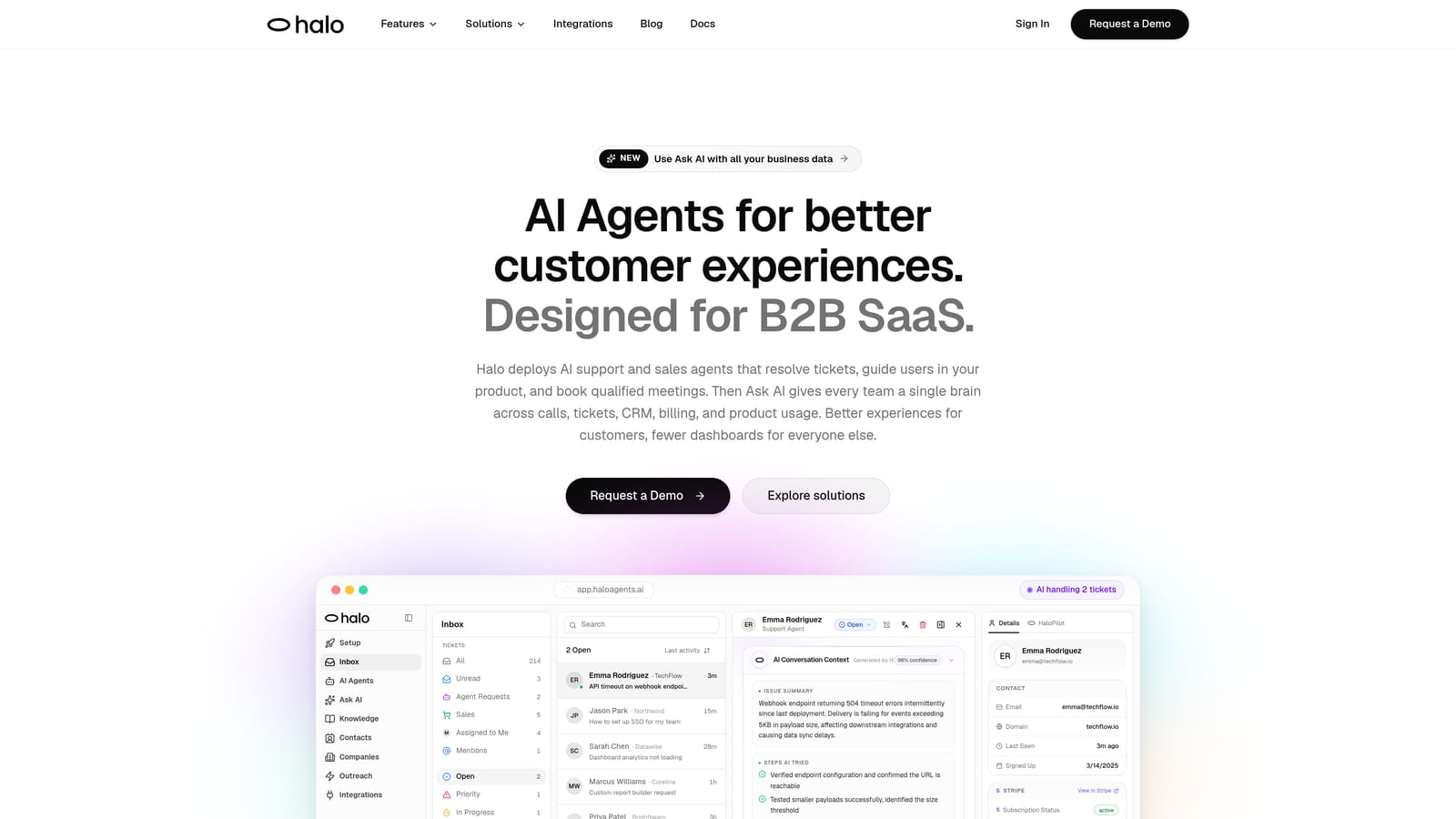
Halo AI is an AI-native customer support platform that deploys autonomous agents for ticket resolution, bug reporting, and product guidance — with page-aware context and business intelligence baked in from the ground up.
Where This Tool Shines
Halo's most distinctive capability is its page-aware context. The AI agent actually sees what the user is looking at and can provide visual UI guidance specific to that moment in the product. That's a meaningful step beyond generic chatbot responses that treat every conversation identically regardless of where the user is or what they're trying to do.
The business intelligence layer also sets it apart from traditional support tools. Halo's smart inbox surfaces signals like churn risk, customer health indicators, and revenue anomalies derived from support conversations. Your support operation stops being a cost center and starts generating intelligence your product and revenue teams actually want to act on.
Key Features
Page-Aware Chat Widget: The AI sees what users see in real time, enabling visual UI guidance that's contextually accurate rather than generic.
Autonomous Ticket Resolution: AI agents resolve tickets independently and continuously learn from every interaction, improving resolution quality over time.
Auto Bug Ticket Creation: Automatically generates and routes bug reports to Linear or other dev tools without requiring agent intervention.
Smart Inbox with Business Intelligence: Surfaces churn signals, revenue anomalies, and customer health data directly from support conversations.
Live Agent Handoff: Escalates complex issues to human agents with full conversation context preserved so nothing is lost in the transition.
Deep Integrations: Connects natively with Slack, HubSpot, Intercom, Stripe, Zoom, PandaDoc, and Fathom.
Best For
Halo is built specifically for B2B SaaS teams that are scaling support without scaling headcount. It's the right fit if you want AI that operates autonomously, not just AI that suggests responses to human agents. Teams already using tools like HubSpot, Linear, or Intercom will find the integration depth immediately useful.
Pricing
Pricing is available on request. A demo is required to get a quote — book one at haloagents.ai/demo.
2. Intercom
Best for: Teams that want a mature conversational support platform with both AI resolution and a polished human inbox.
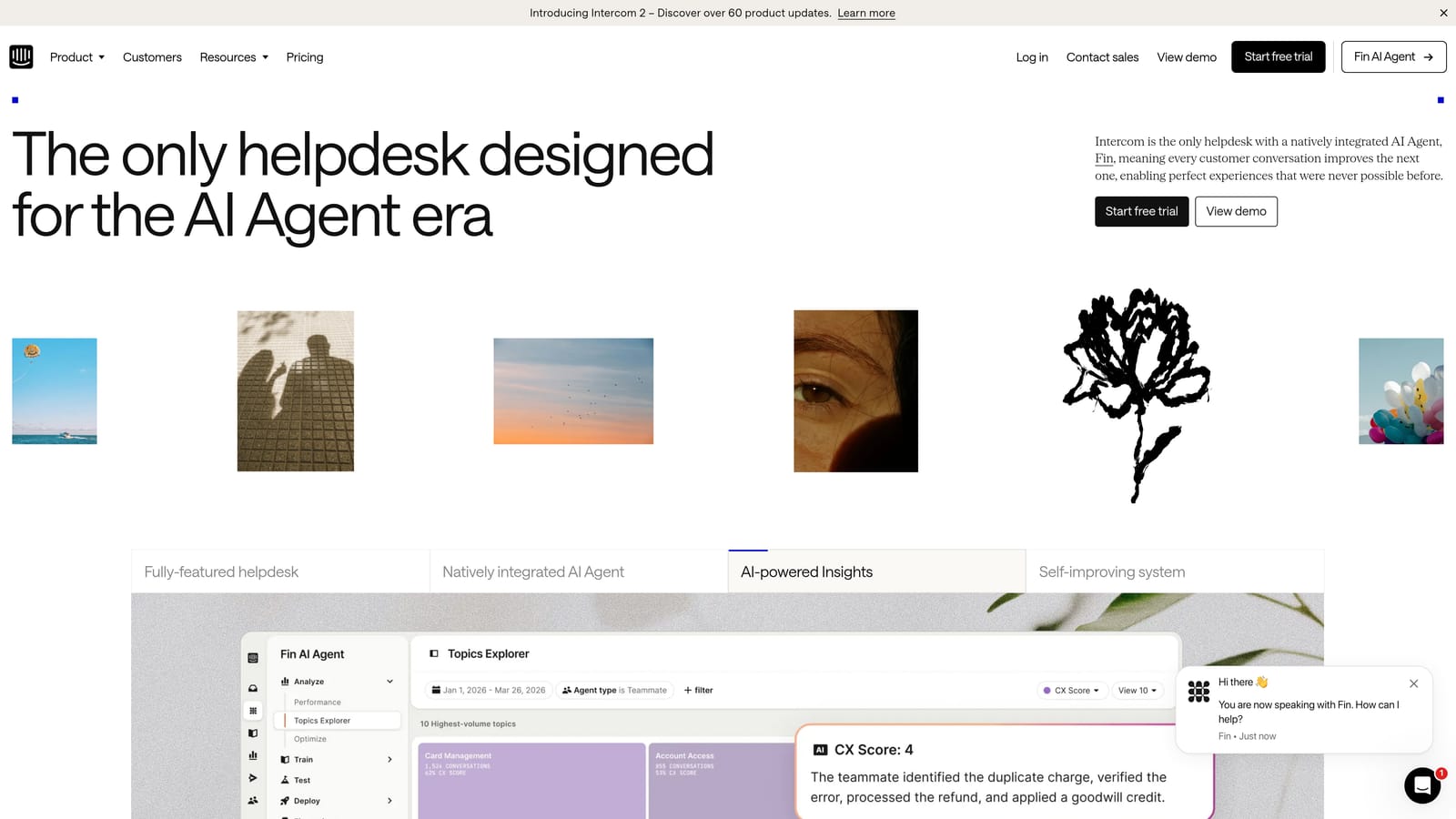
Intercom is a conversational support platform combining its Fin AI agent for autonomous resolution with a well-developed human inbox built for escalations and complex conversations.
Where This Tool Shines
Intercom has one of the most mature ecosystems in the conversational support space. Fin AI handles repetitive queries reliably, and the human inbox that handles escalations is genuinely well-designed, with strong routing, assignment logic, and team collaboration tools.
The platform also goes beyond support with proactive messaging and product tours built in. If your team wants to use the same platform for onboarding communication, in-app messaging, and support, Intercom makes that possible without stitching together separate tools. The caveat is that AI feels like a layer added onto a live chat foundation rather than the architecture itself.
Key Features
Fin AI Agent: Handles repetitive support queries autonomously, with the ability to escalate to human agents when needed.
Unified Human Inbox: Strong routing, assignment, and collaboration tools for human agents handling escalations.
Proactive Messaging and Product Tours: Built-in tools for onboarding and in-app engagement beyond reactive support.
Integration Marketplace: Extensive third-party integrations covering CRM, billing, analytics, and more.
Reporting and CSAT Tracking: Solid analytics and customer satisfaction measurement built into the platform.
Best For
Intercom suits mid-market and enterprise teams that want a single platform covering support, onboarding, and proactive messaging. It's a strong choice if you're already in the Intercom ecosystem and want to add AI resolution without migrating your stack.
Pricing
Plans start at approximately $39/month. AI features and volume-based pricing require custom quotes for larger teams.
3. Zendesk
Best for: Enterprise teams with complex workflows, compliance requirements, and large agent teams.
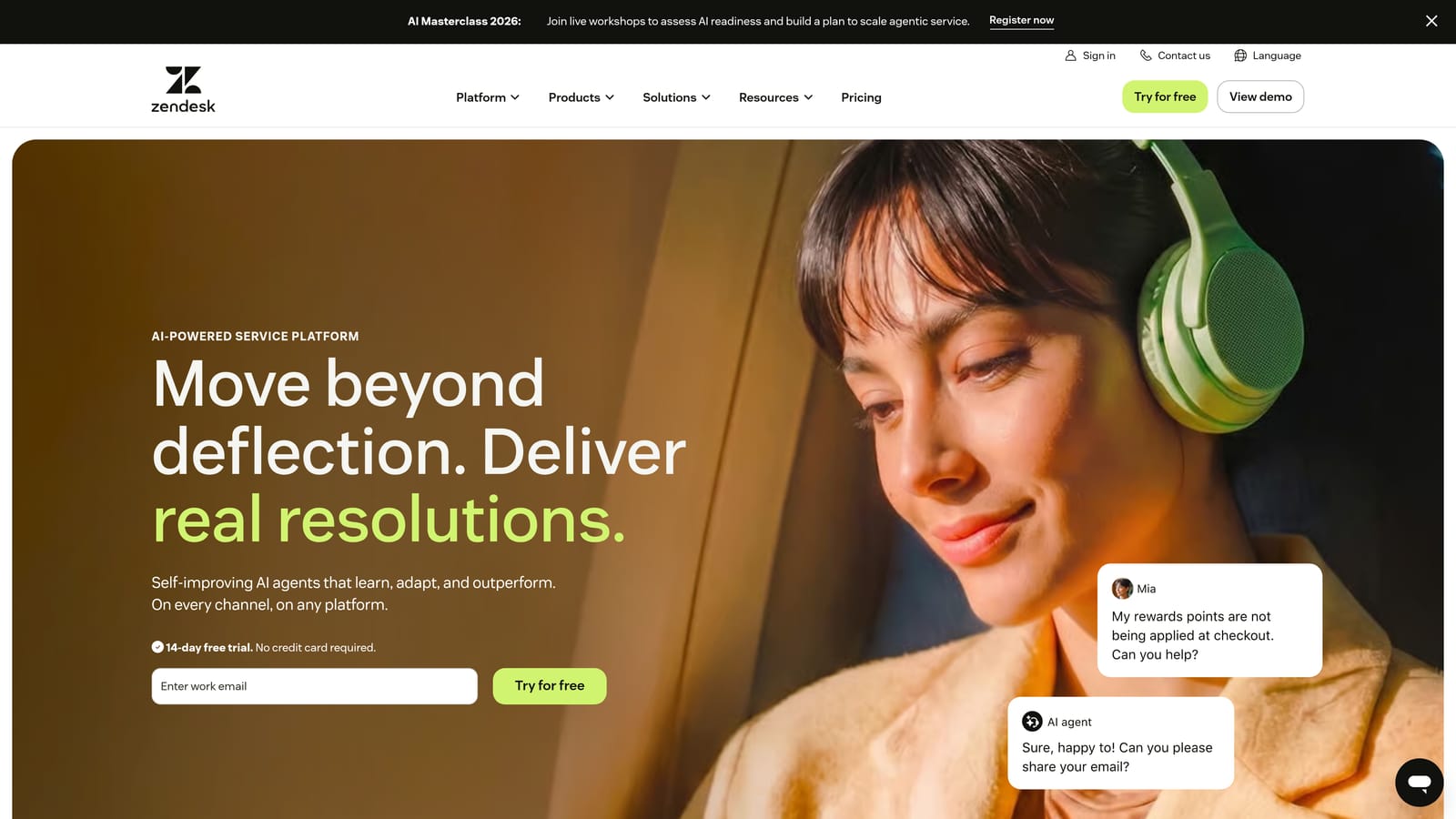
Zendesk is an enterprise-grade helpdesk with structured ticketing, AI-assisted workflows via Zendesk AI, and one of the largest integration ecosystems in the industry.
Where This Tool Shines
Zendesk's strength is customization and compliance. The workflow engine is deeply configurable, and the platform has the security, audit, and compliance capabilities that enterprise procurement teams require. If your support operation has complex routing logic, SLA requirements, and a large agent team, Zendesk can accommodate that complexity.
The tradeoff is administrative overhead. Zendesk takes real effort to configure and maintain. AI features, now branded as Zendesk AI, are available as add-ons rather than core capabilities, which means they feel bolted on rather than foundational. For teams whose primary need is autonomous AI resolution, that distinction matters.
Key Features
Intelligent Triage and AI-Assisted Routing: AI helps classify and route incoming tickets to the right team or agent automatically.
Highly Customizable Workflows: Extensive automation rules and workflow configuration for complex support operations.
Large App Marketplace: Over 1,000 integrations available covering virtually every business tool category.
Compliance and Security: Enterprise-grade audit logs, access controls, and compliance certifications.
Omnichannel Support: Covers email, chat, voice, and social channels from a single platform.
Best For
Zendesk is the right call for large enterprise teams with established support operations, complex compliance needs, and significant agent headcount. Smaller or faster-moving teams often find the configuration burden outweighs the flexibility.
Pricing
Suite plans start at approximately $55/agent/month. AI features are available as a paid add-on, with enterprise pricing significantly higher.
4. Freshdesk
Best for: SMB and mid-market teams that want solid omnichannel helpdesk functionality at an accessible price point.
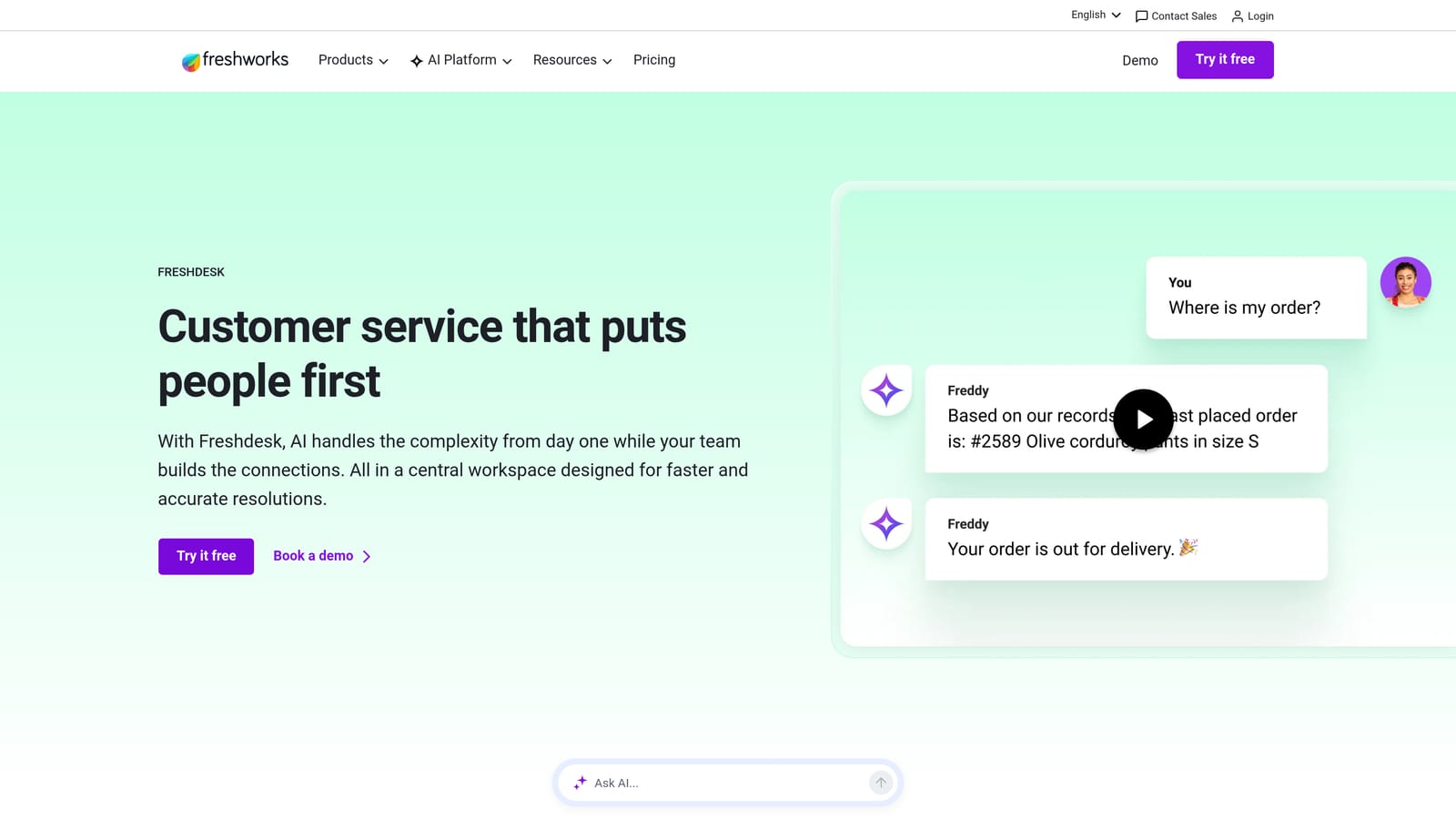
Freshdesk is an affordable helpdesk by Freshworks with Freddy AI built in, offering ticket management, automation, and omnichannel support without the enterprise price tag.
Where This Tool Shines
Freshdesk hits a practical sweet spot: more capable than basic live chat tools, more affordable than Zendesk, and easier to configure than most enterprise alternatives. Freddy AI handles auto-triage, suggested responses, and basic self-service deflection across multiple tiers of the pricing plans.
The collision detection feature is a small but genuinely useful detail. It prevents two agents from responding to the same ticket simultaneously, which is a common frustration in shared inboxes. The free tier also makes it a realistic starting point for small teams that need structure without immediate budget commitment.
Key Features
Freddy AI: Provides auto-triage, suggested responses, and self-service capabilities across multiple pricing tiers.
Omnichannel Inbox: Covers email, chat, phone, and social channels in a unified interface.
Collision Detection: Prevents duplicate agent responses by showing when another agent is already working a ticket.
SLA Management: Built-in escalation rules and SLA tracking to keep response times on target.
Free Tier: Available for small teams as a genuine starting point, not just a trial.
Best For
Freshdesk works well for SMB and mid-market teams that need a structured helpdesk with AI assistance but aren't ready for Zendesk's complexity or cost. Teams scaling from basic email support will find the onboarding experience relatively smooth.
Pricing
Free plan available. Paid plans start at approximately $15/agent/month, with omnichannel features available at higher tiers.
5. Drift
Best for: Revenue and marketing teams that want AI-powered chat optimized for sales qualification alongside support.
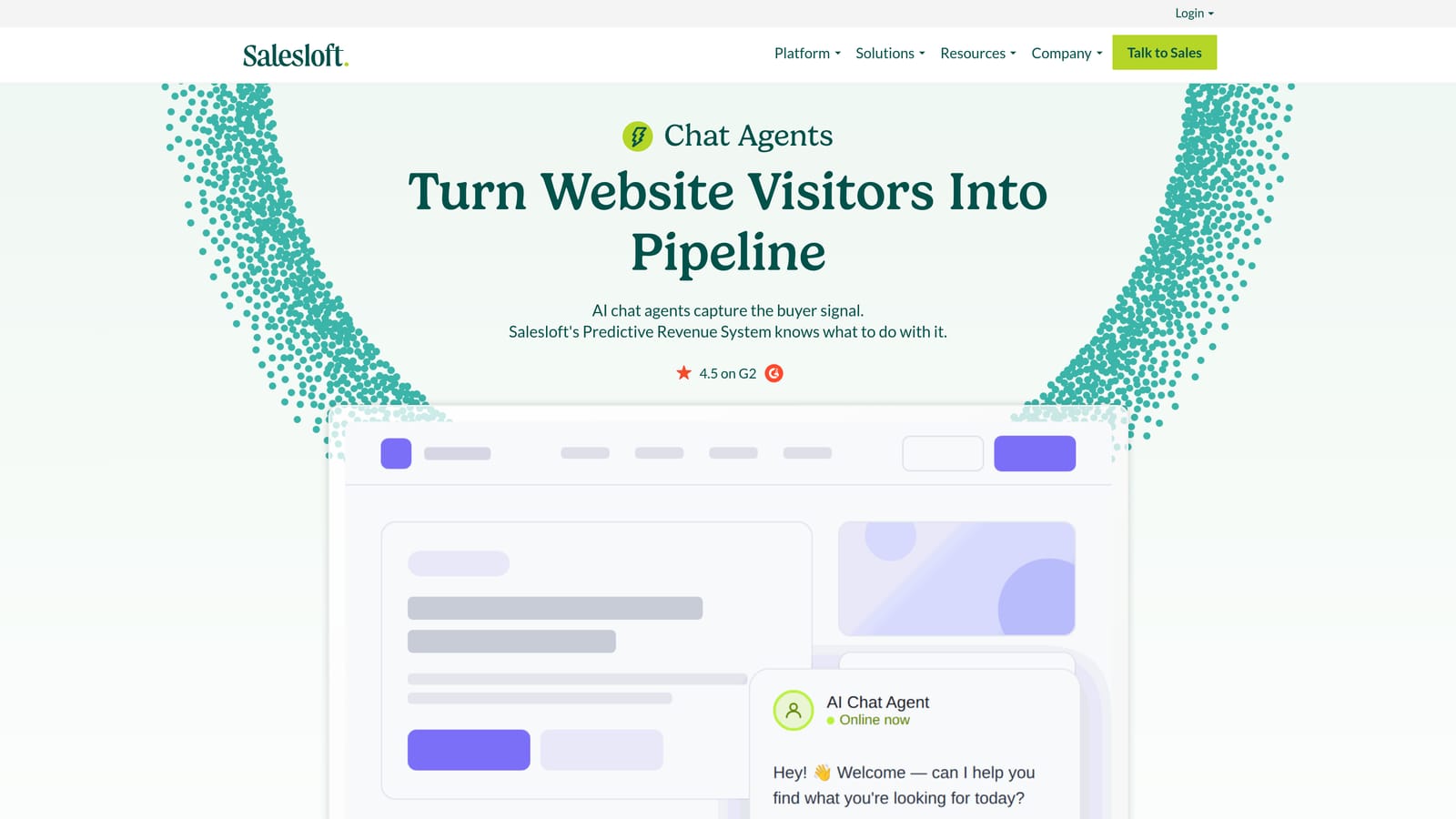
Drift is a conversational marketing and sales platform, now part of Salesloft, with AI-powered chat playbooks designed to qualify buyers and route conversations to sales, with support use cases as a secondary function.
Where This Tool Shines
Drift's AI playbooks are genuinely well-designed for buyer journey stages. If your website chat needs to qualify leads, book meetings, and route pipeline conversations to the right sales rep, Drift handles that workflow better than most pure support tools. The intent-based targeting for proactive chat engagement is particularly strong for revenue-focused teams.
The honest caveat: Drift is not primarily a support tool. If ticket resolution, SLA management, and autonomous AI support are your core requirements, you'll find Drift's capabilities oriented in a different direction. It's a strong choice when your website chat serves both sales qualification and support, and your team is comfortable with that dual purpose.
Key Features
AI Playbooks: Structured conversation flows built around buyer journey stages for sales qualification.
Real-Time Sales Routing and Meeting Booking: Routes qualified conversations directly to sales reps and books meetings from chat.
Intent-Based Targeting: Proactive chat engagement triggered by visitor behavior and intent signals.
CRM Integrations: Native connections to Salesforce, HubSpot, and Marketo for pipeline data flow.
Conversational Landing Pages: Chat-native landing pages for campaign-specific engagement.
Best For
Drift is the right fit for B2B companies where the website chat function is as much about pipeline generation as it is about support. Revenue operations and marketing teams will get more value from it than pure support teams.
Pricing
Premium plans start at approximately $2,500/month. Enterprise pricing is available on request.
6. LiveChat
Best for: Teams that prioritize agent productivity and real-time human conversation quality above AI autonomy.
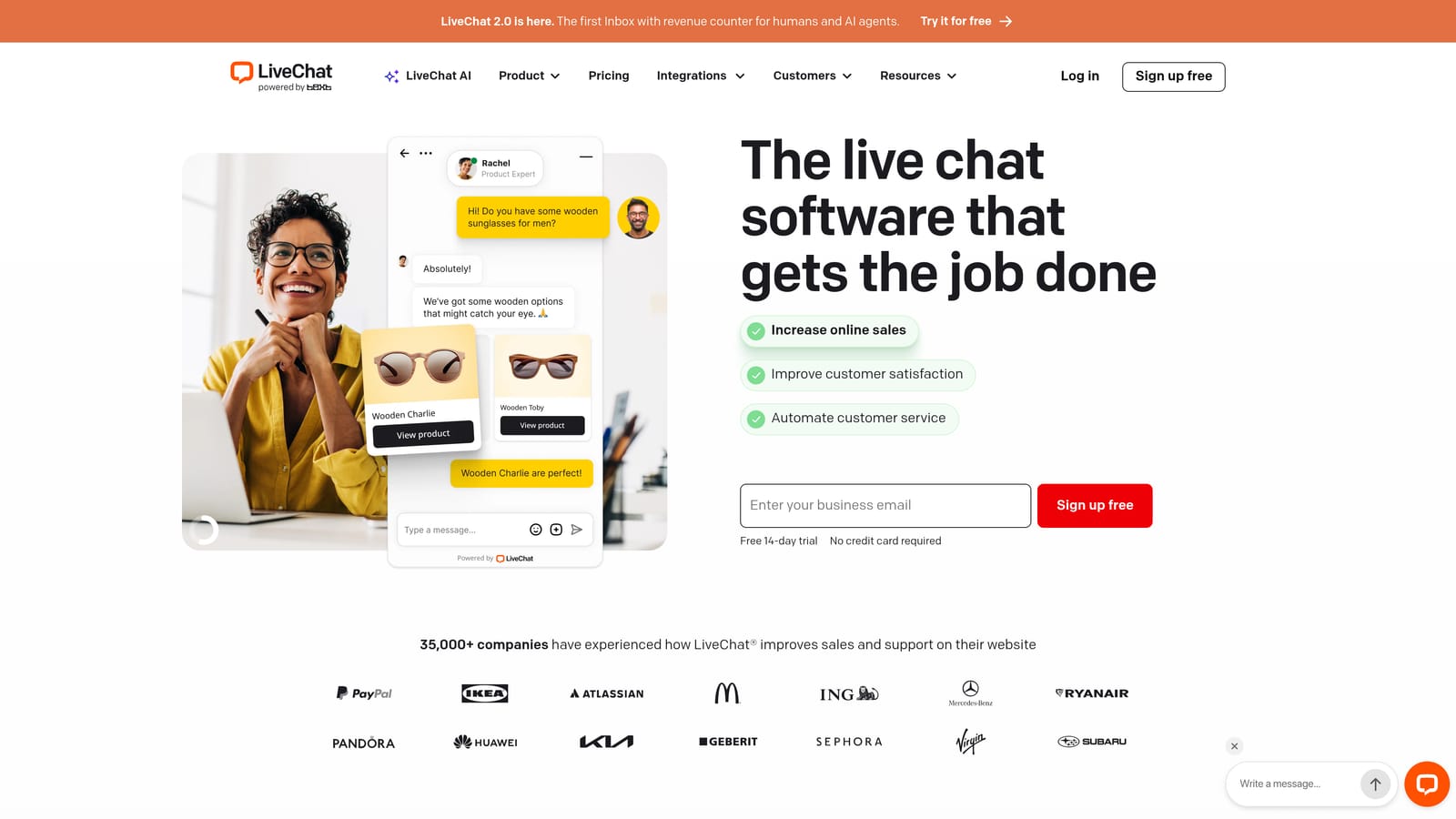
LiveChat is a dedicated live chat platform focused on agent productivity, real-time human conversations, and e-commerce integrations, with AI capabilities available through its ChatBot.com integration.
Where This Tool Shines
LiveChat's agent UI is one of the most polished in the category. Canned responses, keyboard shortcuts, chat routing, and tagging are all designed with agent efficiency in mind. For teams where human agents are handling high chat volumes and speed of response is critical, the UX investment here is noticeable.
The platform is part of the broader LiveChat, Inc. ecosystem, which also owns ChatBot.com and HelpDesk.com. That means you can layer AI automation on top via ChatBot integration, but it does require connecting separate products rather than working within a unified AI-native system.
Key Features
High-Performance Agent UI: Canned responses, shortcuts, and a workflow-optimized interface built for speed.
Chat Routing and Transfer: Flexible routing, tagging, and transfer workflows for team-based support.
E-Commerce Integrations: Native connections to Shopify and WooCommerce for order and customer context.
Visitor Tracking and Proactive Triggers: Behavior-based triggers for initiating proactive chat conversations.
AI Chatbot via ChatBot.com: AI automation available through integration with the companion ChatBot platform.
Best For
LiveChat suits e-commerce and service businesses with dedicated human agent teams where chat quality and agent efficiency are the primary metrics. Teams that want AI-first autonomous resolution will need to look elsewhere or invest in the ChatBot.com integration.
Pricing
Plans start at approximately $20/agent/month.
7. Tidio
Best for: Small e-commerce and SMB teams that want quick AI chatbot deployment without heavy implementation overhead.
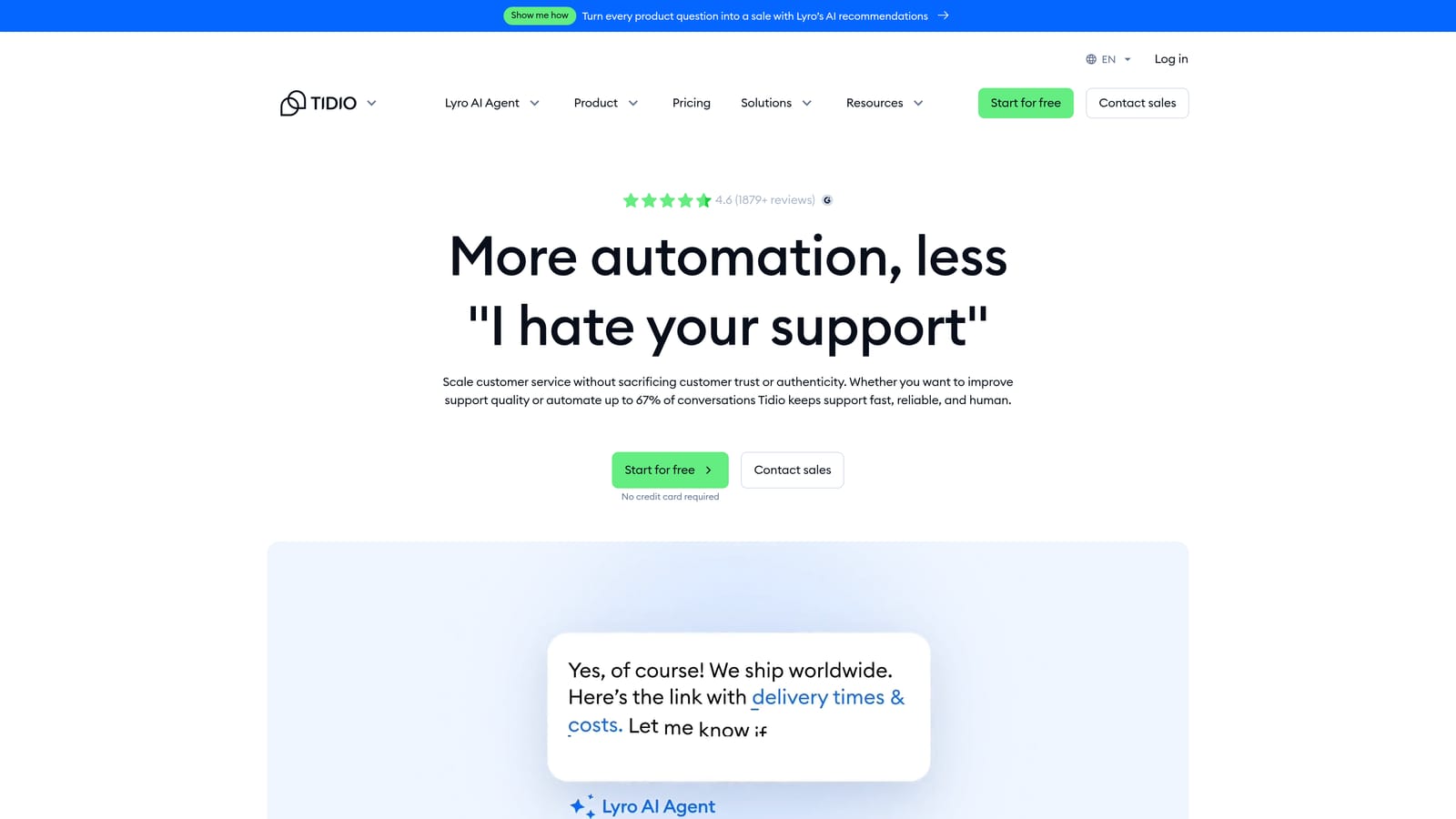
Tidio is an SMB-friendly platform combining its Lyro AI chatbot with live chat, designed for fast deployment on e-commerce and small business websites.
Where This Tool Shines
Tidio's biggest advantage is speed to value. The setup process is straightforward, Shopify and WooCommerce integrations work out of the box, and Lyro AI can start handling common queries quickly without requiring significant configuration work. For small teams that need basic AI deflection without a dedicated implementation project, that matters.
The visual chatbot flow builder requires no coding knowledge, which makes it accessible to non-technical team members who need to adjust conversation flows without engineering support. The mobile app for live chat agents is also a practical feature for small teams where support is handled by people wearing multiple hats.
Key Features
Lyro AI Chatbot: Handles automated query resolution with a conversational AI layer designed for SMB use cases.
Live Chat with Mobile App: Lets agents respond from mobile devices, useful for small teams without dedicated support staff.
Visual Flow Builder: No-code chatbot flow editor for building and adjusting conversation paths without engineering help.
Unified Inbox: Email and Messenger support alongside live chat in a single interface.
Best For
Tidio is the right starting point for small e-commerce businesses and early-stage teams that want AI chatbot capability without significant setup investment. It's less suited for complex B2B support workflows or teams with sophisticated escalation requirements.
Pricing
Free plan available. Lyro AI plans start at approximately $29/month.
8. HubSpot Service Hub
Best for: HubSpot-first organizations that want every support conversation enriched with full CRM context.
HubSpot Service Hub is a CRM-native support and chat platform that gives every conversation full contact and deal history without requiring any integration setup.
Where This Tool Shines
The core value proposition is simple: if you're already using HubSpot as your CRM, Service Hub eliminates the data gap between sales and support. Every conversation comes with full contact history, deal stage, and lifecycle information visible to the agent. That context changes how support conversations go, especially for high-value accounts.
The AI capabilities in Service Hub are improving but remain less advanced than dedicated AI support platforms. If autonomous ticket resolution at scale is your primary goal, HubSpot isn't optimized for that. But if your priority is giving human agents maximum context and keeping support data inside your existing CRM, it's a natural fit.
Key Features
Full CRM Context on Every Conversation: Contact history, deal stage, and lifecycle data visible to agents without any additional integration.
Live Chat and Chatbot Builder: Basic chat and automation tools included across pricing tiers.
Shared Inbox: Team collaboration features for managing conversations across agents.
Knowledge Base and Customer Portal: Self-service resources that connect to the support workflow.
CSAT and NPS Tracking: Built-in satisfaction measurement without needing a separate survey tool.
Best For
HubSpot Service Hub is ideal for teams already committed to the HubSpot ecosystem. If you're running sales and marketing on HubSpot, adding Service Hub keeps your customer data unified. Teams outside the HubSpot ecosystem will find better-specialized options elsewhere.
Pricing
Starter plans from approximately $15/month. Professional plans from approximately $90/month per seat.
9. Crisp
Best for: Early-stage teams that need a lightweight multi-channel inbox at minimal cost.
Crisp is a lightweight multi-channel inbox covering live chat, email, WhatsApp, Messenger, Instagram, and more, with basic chatbot automation at an accessible price point for early-stage teams.
Where This Tool Shines
Crisp's strength is breadth at low cost. The ability to manage conversations from live chat, email, WhatsApp, and social channels in a single inbox is genuinely useful for small teams that are present across multiple channels but don't have the budget for enterprise-tier tools. The co-browsing feature is a nice differentiator for teams that need to walk users through complex issues visually.
The chatbot automation is basic, which is an honest limitation. Crisp is not the right tool if you need sophisticated AI resolution or complex escalation logic. But for an early-stage startup that needs a unified inbox and simple automation flows to buy time for the human team, it does the job without unnecessary complexity.
Key Features
Unified Multi-Channel Inbox: Manages chat, email, WhatsApp, Instagram, and Messenger conversations in one place.
Basic Chatbot Builder: Simple automation flows for common queries without requiring coding knowledge.
Co-Browsing: Real-time visual support that lets agents see and interact with what the user is seeing.
Built-In CRM and Contact Notes: Basic contact management and conversation history within the platform.
Team Inbox with Assignment: Internal notes and assignment tools for small team coordination.
Best For
Crisp suits early-stage startups and small teams that need multi-channel coverage without enterprise pricing. Teams that have outgrown basic email support but aren't ready for a full helpdesk implementation will find it a reasonable bridge.
Pricing
Free plan available. Pro plans from approximately $25/month per workspace.
Which Tool Is Right for Your Support Operation?
The right answer depends on where your support operation sits today and where you need it to go.
If you're a B2B SaaS team that wants AI agents operating autonomously, surfacing business intelligence, and integrating across your entire stack, Halo AI is the clear starting point. The page-aware context and continuous learning model are purpose-built for exactly this use case.
If you're already deep in the Intercom ecosystem and want a mature AI layer without migrating your stack, Intercom's Fin agent is a solid choice. For large enterprise teams with compliance requirements and complex routing logic, Zendesk remains the industry standard despite its administrative overhead.
Freshdesk is the practical mid-market option when budget matters and you need omnichannel coverage without Zendesk's complexity. HubSpot Service Hub wins if your team lives in HubSpot and CRM context on every conversation is the priority.
For e-commerce and SMB teams, Tidio offers the fastest path to AI chatbot deployment. LiveChat suits teams where agent productivity and real-time human conversation quality are the metrics that matter most. Drift is worth serious consideration when your website chat serves both sales qualification and support simultaneously.
Crisp is the right call for early-stage teams that need multi-channel coverage at minimal cost before they're ready for a more specialized platform.
Your support team shouldn't scale linearly with your customer base. Let AI agents handle routine tickets, guide users through your product, and surface business intelligence while your team focuses on complex issues that need a human touch. See Halo in action and discover how continuous learning transforms every interaction into smarter, faster support.