9 Best AI Ticket Management Tools for Enterprises in 2026
This guide evaluates the 9 best AI ticket management tools for enterprises in 2026, comparing platforms on autonomous resolution capability, integration depth, and scalability to help enterprise support teams move beyond manual triage and rule-based workflows that can't keep pace with growing customer demands.
 Matt PattoliFounder13 min read
Enterprise support teams are drowning in tickets. As product complexity grows and customer expectations rise, traditional helpdesk workflows—manual triage, rule-based routing, siloed data—can't keep pace. AI ticket management platforms change the equation: they resolve issues autonomously, surface business intelligence from support data, and scale without adding headcount.
But not all AI ticketing tools are built for enterprise realities. Some bolt AI onto legacy systems; others are built AI-first from the ground up. Some handle ticket resolution; others go further, connecting support data to revenue signals and engineering workflows.
Below are the top AI ticket management platforms for enterprise teams in 2026, evaluated on autonomous resolution capability, integration depth, analytics quality, and scalability.
1. Halo AI
Best for: B2B SaaS product teams wanting AI-first ticket resolution with deep business intelligence
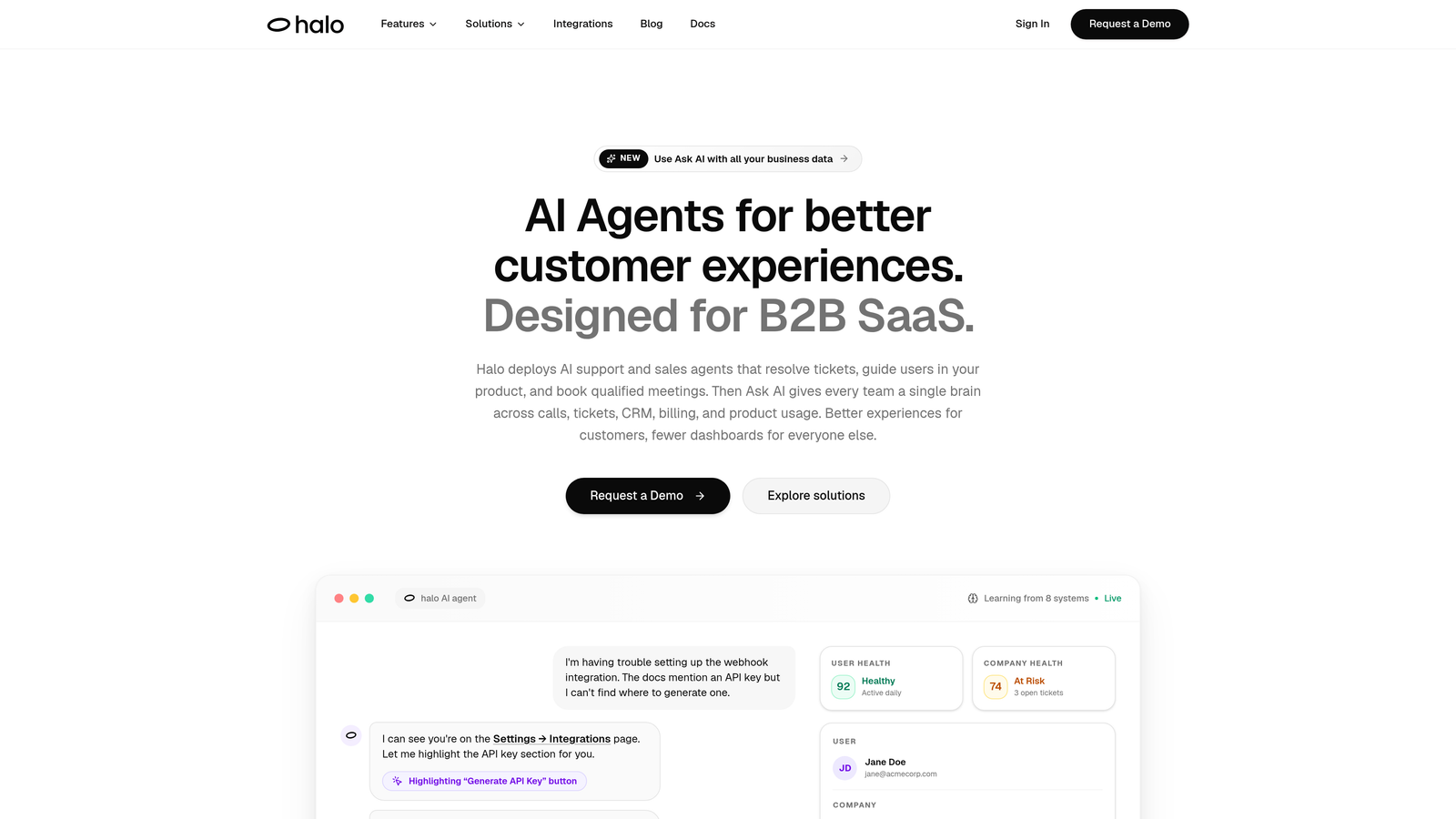
Halo AI is an AI-first customer support platform that deploys intelligent agents to resolve tickets, guide users through products, and surface business intelligence—without requiring headcount growth.
Where This Tool Shines
Halo is built AI-first, not retrofitted. That architectural difference matters: rather than layering AI suggestions on top of a legacy helpdesk, Halo's agents operate autonomously end-to-end, resolving tickets, creating bug reports, and identifying customer health signals without waiting for a human to initiate each step.
The page-aware chat widget is a standout capability. It understands what a user is looking at in real time, allowing the AI to give contextually relevant guidance rather than generic answers. Combined with the smart inbox that surfaces revenue anomalies and churn indicators, Halo positions support as a strategic intelligence layer, not just a cost center.
Key Features
Autonomous Ticket Resolution: AI agents handle support tickets end-to-end, from intake through resolution, without requiring human intervention on routine issues.
Page-Aware Chat Widget: The widget understands what users are viewing in real time, enabling precise, contextual guidance that reduces back-and-forth.
Auto Bug Ticket Creation: Automatically generates bug reports and routes them to Linear, keeping engineering teams informed without manual handoffs from support.
Smart Inbox with Business Intelligence: Surfaces customer health signals, revenue anomalies, and churn indicators directly from support interaction data.
Live Agent Handoff: Escalates complex issues to human agents with full conversation context preserved, so nothing gets repeated.
Broad Integration Stack: Connects natively with Linear, Slack, HubSpot, Intercom, Stripe, Zoom, PandaDoc, and Fathom, linking support data to the broader business stack.
Best For
B2B SaaS companies and product teams that want AI-native ticket resolution with real business intelligence output. Particularly well-suited for teams already using tools like Slack, HubSpot, and Linear who want support data flowing into their existing workflows rather than sitting in a siloed helpdesk.
Pricing
Contact for enterprise pricing at haloagents.ai. Custom pricing reflects team size, integration requirements, and resolution volume.
2. Zendesk AI
Best for: Large enterprises already invested in the Zendesk ecosystem seeking AI augmentation
Zendesk AI is a suite of AI capabilities layered across the Zendesk platform, offering intelligent triage, agent copilot features, and autonomous resolution for teams with existing Zendesk infrastructure.
Where This Tool Shines
Zendesk's AI capabilities benefit from years of accumulated support data and a mature enterprise compliance posture. For organizations already running support operations on Zendesk, adopting Zendesk AI is an incremental step rather than a platform migration, which significantly reduces deployment friction.
The agent copilot features are particularly strong: AI-generated ticket summaries reduce handle time, and macro recommendations help agents respond faster without sacrificing quality. Autonomous resolution is available but works best on well-documented, high-volume ticket categories.
Key Features
Intelligent Triage and Routing: AI classifies and routes incoming tickets based on intent, sentiment, and priority before any agent touches them.
Agent Copilot: Suggests responses, recommends macros, and provides contextual information to help agents resolve tickets faster.
AI-Generated Ticket Summaries: Condenses long ticket threads into concise summaries, reducing the time agents spend getting up to speed.
Automated Workflows: Triggers AI-driven actions based on ticket content, routing rules, and escalation conditions.
Enterprise Security and Compliance: Meets the compliance and audit requirements expected by large regulated organizations.
Best For
Enterprise support teams already operating on Zendesk who want to layer AI capabilities onto their existing workflows without migrating platforms. Less suited to teams looking for AI-first architecture or deep engineering integrations.
Pricing
AI features are available as add-ons to existing Zendesk plans. Enterprise pricing is available on request through Zendesk's sales team.
3. Freshdesk Freddy AI
Best for: Teams on Freshdesk wanting incremental AI adoption across self-service, agent assist, and analytics
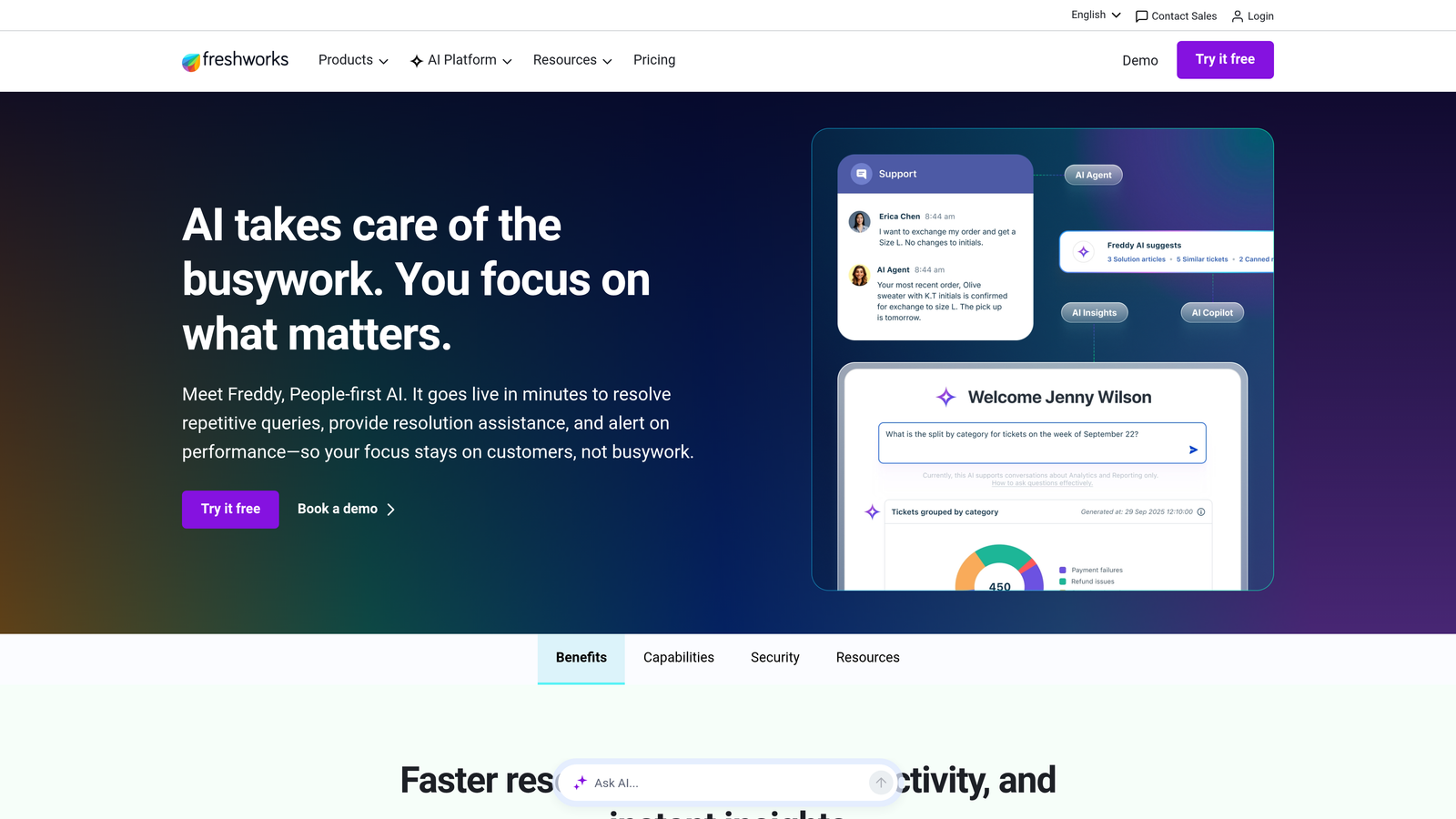
Freshdesk Freddy AI is Freshworks' AI layer embedded across the Freshdesk helpdesk suite, offering three distinct capability tiers for teams at different stages of AI adoption.
Where This Tool Shines
Freddy AI's tiered structure is genuinely useful for enterprises that don't want to flip a switch on full AI autonomy overnight. Teams can start with Freddy Copilot for agent assistance, then expand to Freddy Self Service for autonomous resolution as confidence in the AI grows. This staged rollout model reduces organizational risk.
The native integration across Freshdesk, Freshchat, and Freshservice means support, chat, and IT service management data share context, which improves AI accuracy across ticket types.
Key Features
Freddy Self Service: Handles autonomous customer-facing ticket resolution for common queries without agent involvement.
Freddy Copilot: Assists agents with response suggestions, knowledge retrieval, and ticket context during live interactions.
Freddy Insights: Provides analytics on support trends, agent performance, and ticket volume patterns to inform operational decisions.
Cross-Suite Integration: Shares data natively across Freshdesk, Freshchat, and Freshservice for a unified support view.
Configurable AI Personas: Allows teams to customize tone, escalation thresholds, and response style to match brand voice.
Best For
Organizations already using the Freshworks suite that want AI capabilities without platform migration. The tiered model suits teams that prefer gradual AI adoption over a full autonomous deployment from day one.
Pricing
Freddy Copilot and Self Service are add-ons to existing Freshdesk plans. Pricing varies by tier and seat count; contact Freshworks for current enterprise rates.
4. Intercom Fin AI
Best for: SaaS and tech companies with knowledge-base-driven support needing conversational AI resolution
Intercom Fin is a GPT-4-powered AI agent designed for conversational ticket resolution, particularly effective for teams whose support content lives in structured knowledge bases.
Where This Tool Shines
Fin's strength is conversational depth. Rather than pattern-matching keywords to canned responses, it reads and reasons over help center content to construct accurate, contextual answers. For SaaS companies with well-maintained documentation, this means Fin can resolve a wide range of queries without any custom training.
The escalation experience is smooth: when Fin reaches its confidence threshold, it hands off to a human agent within Intercom Messenger with full conversation context intact. For teams already on Intercom's platform, this feels native rather than bolted on.
Key Features
LLM-Powered Conversational Resolution: Uses large language models to answer questions with nuance rather than keyword matching.
Knowledge Base Integration: Draws answers directly from your help center content and custom data sources without requiring manual training.
Configurable Tone and Escalation: Teams can set persona, tone, and the conditions under which Fin escalates to a human.
Seamless Human Handoff: Transfers to live agents within Intercom Messenger with full context preserved.
Resolution-Based Pricing: You pay per successful resolution, aligning cost directly with value delivered.
Best For
SaaS and tech companies with mature help center content who want high autonomous resolution rates without heavy AI configuration. Best suited to teams already using Intercom's messenger infrastructure.
Pricing
Priced per resolution. Check intercom.com for current rates, as resolution-based pricing can vary by volume and plan tier.
5. ServiceNow AI
Best for: Large enterprises managing IT, HR, and cross-departmental ticketing at scale
ServiceNow AI is an enterprise ITSM platform with AI capabilities embedded across the Now Platform, handling complex multi-departmental workflows that go well beyond customer-facing support.
Where This Tool Shines
ServiceNow is the enterprise standard for ITSM, and its AI capabilities reflect that pedigree. Predictive intelligence, intelligent routing, and Virtual Agent work together to automate ticket handling across IT, HR, facilities, and legal workflows within a single platform. For organizations with complex approval chains and cross-departmental dependencies, this level of orchestration is difficult to replicate elsewhere.
The tradeoff is implementation complexity. ServiceNow deployments typically require significant configuration investment, and the platform is primarily oriented toward internal service delivery rather than customer-facing support.
Key Features
AI-Powered Classification and Routing: Automatically categorizes and routes tickets across departments based on content and priority.
Predictive Intelligence: Prioritizes issues based on historical patterns and predicted business impact.
Virtual Agent: Provides self-service ticket resolution for employees and customers through a conversational interface.
Cross-Departmental Workflow Automation: Orchestrates workflows across IT, HR, facilities, and other business functions from a single platform.
Enterprise Compliance and Audit Capabilities: Meets the security, audit, and regulatory requirements of large regulated organizations.
Best For
Large enterprises with complex internal service delivery needs spanning multiple departments. Less suited to companies primarily focused on customer-facing support or teams that need fast deployment timelines.
Pricing
Enterprise licensing model. Contact ServiceNow's sales team directly for pricing based on module selection and organizational scale.
6. Salesforce Einstein for Service Cloud
Best for: Enterprises running support operations inside the Salesforce ecosystem needing unified CRM and case data
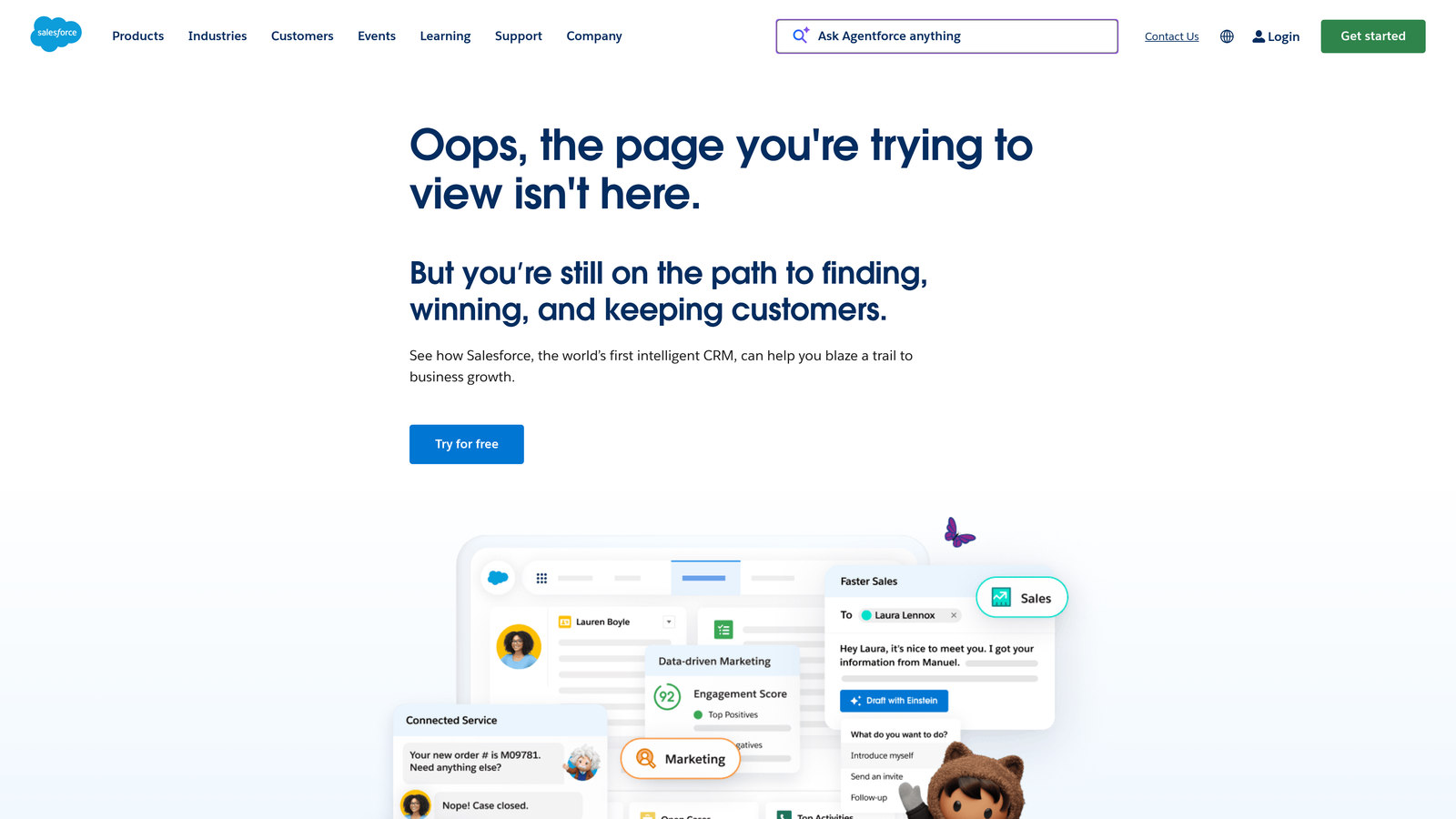
Salesforce Einstein for Service Cloud embeds AI capabilities directly into Service Cloud, connecting ticket management with CRM data for case classification, agent recommendations, and unified customer views.
Where This Tool Shines
Einstein's core advantage is data unification. When support ticket data and CRM account data live in the same platform, AI can make far more informed decisions: case priority scoring that accounts for customer lifetime value, next-best-action recommendations that reflect the full account history, and generative reply drafts that reference prior interactions. For enterprise sales-led organizations, this context is invaluable.
The limitation is ecosystem lock-in. Einstein's value scales directly with Salesforce investment, making it less compelling for teams that don't already rely heavily on the Salesforce stack.
Key Features
AI-Powered Case Classification: Automatically categorizes and scores incoming cases based on content, customer data, and historical patterns.
Next-Best-Action Recommendations: Suggests the most appropriate agent action based on case context and CRM data.
Einstein Bots: Handles self-service ticket deflection through conversational AI before routing to agents.
Unified Customer Data: Combines CRM account history with support case data for a complete customer view.
Generative AI Reply Drafts: Produces suggested responses and knowledge article recommendations using generative AI.
Best For
Enterprise organizations deeply invested in Salesforce CRM who want support and sales data unified under one AI layer. Not the right fit for teams outside the Salesforce ecosystem.
Pricing
Available as an add-on to Salesforce Service Cloud. Enterprise pricing is available on request through Salesforce's sales team.
7. Moveworks
Best for: Large enterprises with high internal IT and HR support ticket volume
Moveworks is a conversational AI platform focused on employee-facing ticket automation, resolving internal IT and HR support requests autonomously across enterprise systems.
Where This Tool Shines
Moveworks is purpose-built for the internal support use case, and that focus shows. It handles the high-frequency, low-complexity requests that consume significant IT and HR team capacity: password resets, software access requests, benefits questions, onboarding tasks. By resolving these autonomously through Slack or Teams, it reduces ticket volume without requiring employees to navigate a separate portal.
The integration depth with enterprise systems—ServiceNow, Jira, Workday, Active Directory—means Moveworks can actually execute resolutions rather than just answering questions. That's a meaningful distinction from chatbots that only provide information.
Key Features
Autonomous IT Ticket Resolution: Handles password resets, software provisioning, and access requests without human intervention.
HR Query Automation: Responds to policy, benefits, and onboarding questions by pulling from HR systems and documentation.
Enterprise System Integrations: Connects with ServiceNow, Jira, Workday, and enterprise directories to execute actions, not just provide answers.
Conversational Interface: Operates through Slack, Microsoft Teams, or web chat, meeting employees where they already work.
Resolution Analytics: Tracks resolution rates, ticket deflection, and AI performance across departments.
Best For
Large enterprises with substantial internal IT and HR support volume. Not designed for customer-facing support; this is an internal operations tool.
Pricing
Enterprise licensing model. Contact Moveworks directly for pricing based on headcount and deployment scope.
8. Tidio Lyro AI
Best for: Growing and mid-market teams needing fast AI deployment with strong coverage of common queries
Tidio Lyro is a conversational AI agent offering lower-barrier AI ticket handling for teams that need AI running quickly without a lengthy enterprise implementation cycle.
Where This Tool Shines
Lyro's primary advantage is speed to value. While enterprise platforms like ServiceNow or Zendesk can take months to configure fully, Lyro can be trained on existing support content and handling live queries in a fraction of the time. For teams that need AI coverage quickly—particularly for high-volume, repetitive query categories—this matters.
The platform handles FAQ resolution, common product questions, and escalation to live chat smoothly. It's not the deepest AI platform on this list, but it's practical, accessible, and increasingly capable as Tidio builds out its enterprise tier.
Key Features
Content-Trained AI Agent: Learns from your existing support documentation and FAQs without requiring manual rule configuration.
Autonomous Query Handling: Resolves repetitive queries independently before escalating edge cases to human agents.
Live Chat Fallback: Provides smooth handoff to human agents when queries exceed AI confidence thresholds.
E-Commerce and SaaS Coverage: Handles common support use cases across both e-commerce and SaaS support contexts.
Fast Implementation: Significantly shorter deployment cycle than enterprise-first platforms, getting AI live quickly.
Best For
Growing companies and mid-market teams that need AI ticket handling deployed quickly without an extended implementation project. Also a good fit for teams testing AI resolution before committing to a larger enterprise platform.
Pricing
Tiered pricing with a free entry point. Lyro AI is available on paid plans; check tidio.com for current plan details and resolution limits.
9. Forethought AI
Best for: Enterprises wanting AI enhancement on top of existing Zendesk, Salesforce, or Freshdesk deployments
Forethought AI is an AI layer that sits on top of existing helpdesks to add intelligent triage, routing, agent assist, and autonomous resolution without replacing the underlying platform.
Where This Tool Shines
Forethought's positioning is deliberately additive. Rather than asking enterprises to migrate off Zendesk or Salesforce, it enhances those platforms with AI capabilities that the native tools don't fully deliver. For organizations with significant investment in an existing helpdesk, this reduces the switching cost of AI adoption considerably.
The product suite covers the full ticket lifecycle: Triage handles classification and routing, Assist surfaces knowledge and suggested responses for agents, and Solve handles autonomous resolution for qualifying tickets. Each component can be deployed independently, allowing teams to start with the capability they need most.
Key Features
Triage: AI-powered ticket classification and intelligent routing based on content, intent, and priority signals.
Assist: Surfaces relevant knowledge articles and suggested responses to agents during live ticket handling.
Solve: Autonomous resolution for tickets that meet defined confidence and complexity thresholds.
Helpdesk Compatibility: Works alongside Zendesk, Salesforce Service Cloud, and Freshdesk without requiring platform migration.
AI Performance Analytics: Provides dashboards tracking resolution rates, deflection metrics, and AI accuracy over time.
Best For
Enterprise teams with established Zendesk, Salesforce, or Freshdesk deployments who want meaningful AI improvement without the disruption of a full platform change. Also strong for teams that want modular AI adoption, starting with triage or assist before enabling autonomous resolution.
Pricing
Contact Forethought directly for enterprise pricing. Pricing is typically structured around ticket volume and the specific product modules deployed.
Which Platform Is Right for Your Team?
The right choice depends on where you're starting from and what you're optimizing for. Here's a quick framework to cut through the options.
If you're building AI-first for B2B SaaS: Halo AI is the strongest fit. Its page-aware context, auto bug ticket creation, and business intelligence output go beyond ticket resolution—it connects support to engineering, revenue, and customer health signals in ways the other platforms don't.
If you're already on Zendesk or Freshdesk: Zendesk AI and Freshdesk Freddy AI are the lowest-friction paths to AI capabilities. Forethought is worth evaluating if you want AI features that the native tools don't fully cover.
If conversational resolution is the priority: Intercom Fin is purpose-built for this, especially for teams with strong knowledge bases. Its resolution-based pricing also aligns cost with outcomes.
If you're managing internal IT and HR tickets at scale: Moveworks and ServiceNow AI are built for this use case. ServiceNow handles complex multi-departmental workflows; Moveworks is faster to deploy for IT and HR automation specifically.
If you need AI running quickly without a long implementation: Tidio Lyro offers the fastest path from signup to live AI handling, making it practical for teams that can't wait months for a full enterprise deployment.
The broader trend worth noting: the category is shifting from AI-assisted (AI helps agents respond) to AI-autonomous (AI resolves tickets without agents). When evaluating any platform, ask specifically what percentage of tickets the AI can close without human involvement, and under what conditions it escalates. That number tells you more about real-world impact than any feature list.
Your support team shouldn't scale linearly with your customer base. Let AI agents handle routine tickets, guide users through your product, and surface business intelligence while your team focuses on complex issues that need a human touch. See Halo in action and discover how continuous learning transforms every interaction into smarter, faster support.