8 Best AI Ticket Resolution Tools for B2B Companies in 2026
B2B support teams deal with higher ticket complexity and tighter SLAs than consumer teams — challenges that generic helpdesk automation can't handle. This guide evaluates 8 AI ticket resolution tools purpose-built for B2B companies, comparing them on autonomous resolution capability, integration depth, learning mechanisms, and how effectively they manage the nuanced, multi-stakeholder tickets that define enterprise support.
 Grant CooperFounder13 min read
B2B support teams face a different kind of pressure than consumer-facing ones. Higher ticket complexity, enterprise SLAs, multi-stakeholder accounts, and the expectation that every interaction reflects your product's quality — these aren't problems a basic chatbot can solve. Generic helpdesk automation often falls short here: it deflects simple questions but struggles with the nuanced, context-heavy tickets that define B2B relationships.
AI ticket resolution has matured significantly. The best tools today don't just classify and route tickets — they resolve them autonomously, learn from past interactions, surface business intelligence, and hand off gracefully to human agents when needed. That's a meaningful shift for teams trying to scale support without scaling headcount.
This guide covers the top AI ticket resolution tools purpose-built (or well-adapted) for B2B. We evaluated each on autonomous resolution capability, integration depth, learning mechanisms, and how well they handle the complexity typical of B2B accounts. Whether you're running a lean support team or scaling a customer success operation, there's a fit here for your stack.
1. Halo AI
Best for: B2B SaaS teams wanting an AI-first support platform with deep product and CRM context
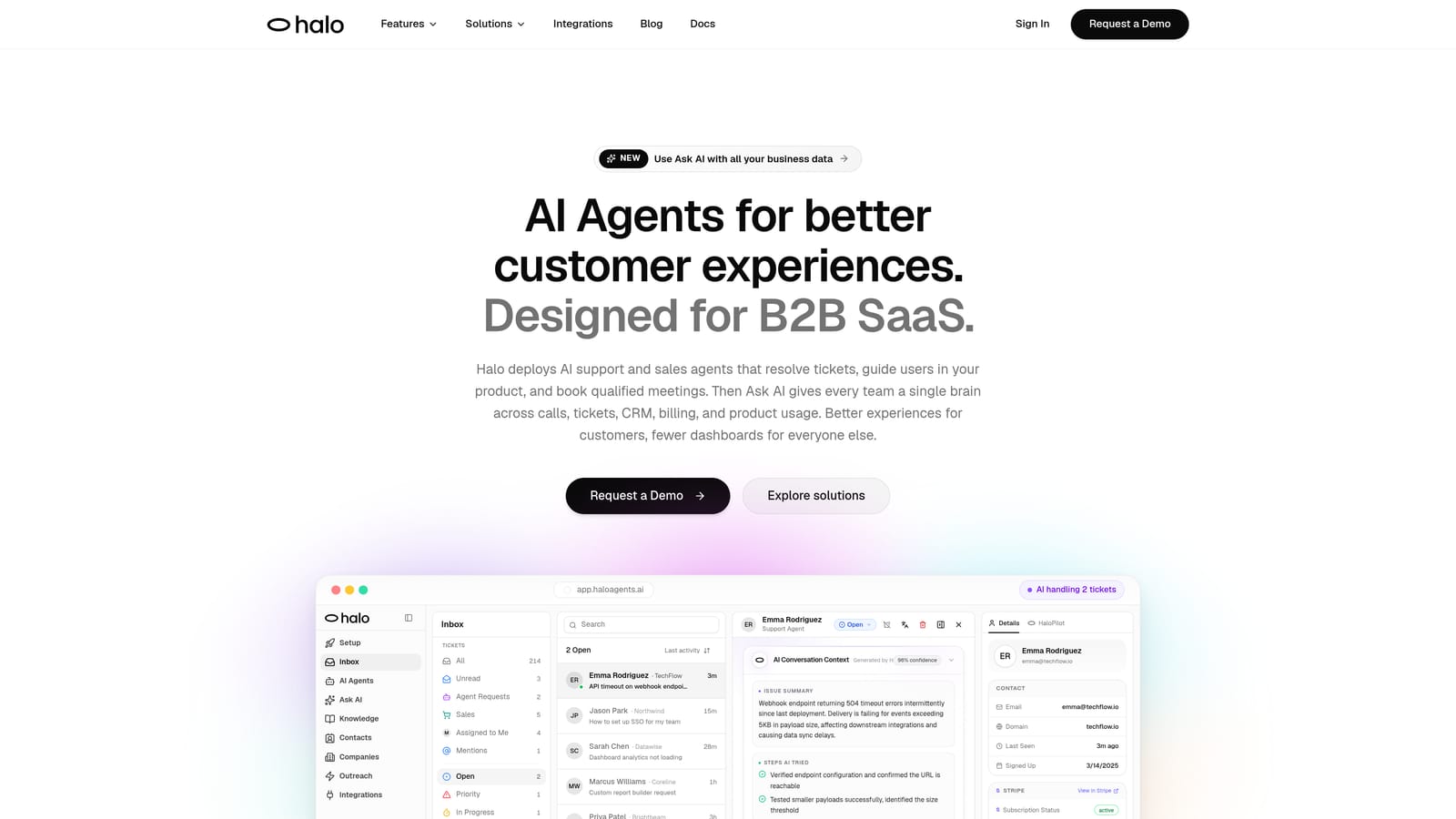
Halo AI is an AI-first customer support platform that deploys intelligent agents to resolve tickets, guide users visually through your product, and surface business intelligence — all while learning from every interaction.
Where This Tool Shines
Halo's most distinctive capability is its page-aware context engine. The chat widget doesn't just respond to what a user types — it sees what the user sees, understanding which page they're on, what UI elements are visible, and where they might be stuck. For SaaS products with complex workflows, this is a genuine differentiator: the AI can provide step-by-step visual guidance rather than generic documentation links.
Beyond ticket resolution, Halo operates as a layer of business intelligence. Its smart inbox surfaces churn signals, revenue anomalies, and customer health indicators from support interactions — giving your team context that goes well beyond "ticket closed." The auto bug ticket creation feature, which routes issues directly to Linear or your engineering workflow, is particularly valuable for product-led teams where support and engineering are tightly coupled.
Key Features
Page-Aware Chat Widget: Sees what the user sees and delivers contextual, visual UI guidance based on their current product state.
Autonomous Ticket Resolution: AI agents resolve tickets end-to-end with continuous learning from interaction history, improving accuracy over time.
Auto Bug Ticket Creation: Automatically generates and routes bug reports to Linear or your engineering workflow when issues are detected.
Smart Inbox with Business Intelligence: Surfaces churn signals, revenue anomalies, and customer health indicators from support data.
Live Agent Handoff: Escalates complex issues to human agents with full context preserved — no information loss between AI and human.
Integration Stack: Connects natively with Linear, Slack, HubSpot, Intercom, Stripe, Zoom, PandaDoc, and Fathom.
Best For
Product-led B2B SaaS teams that want an AI-first architecture rather than a bolt-on layer. Particularly strong for companies where support, product, and engineering workflows overlap, and where customer health signals from support data have real revenue implications.
Pricing
Contact for pricing. Halo is designed for B2B SaaS teams and offers custom plans based on team size and usage. Visit haloagents.ai to get started.
2. Intercom Fin
Best for: Teams already using Intercom who want native AI resolution without adding another platform
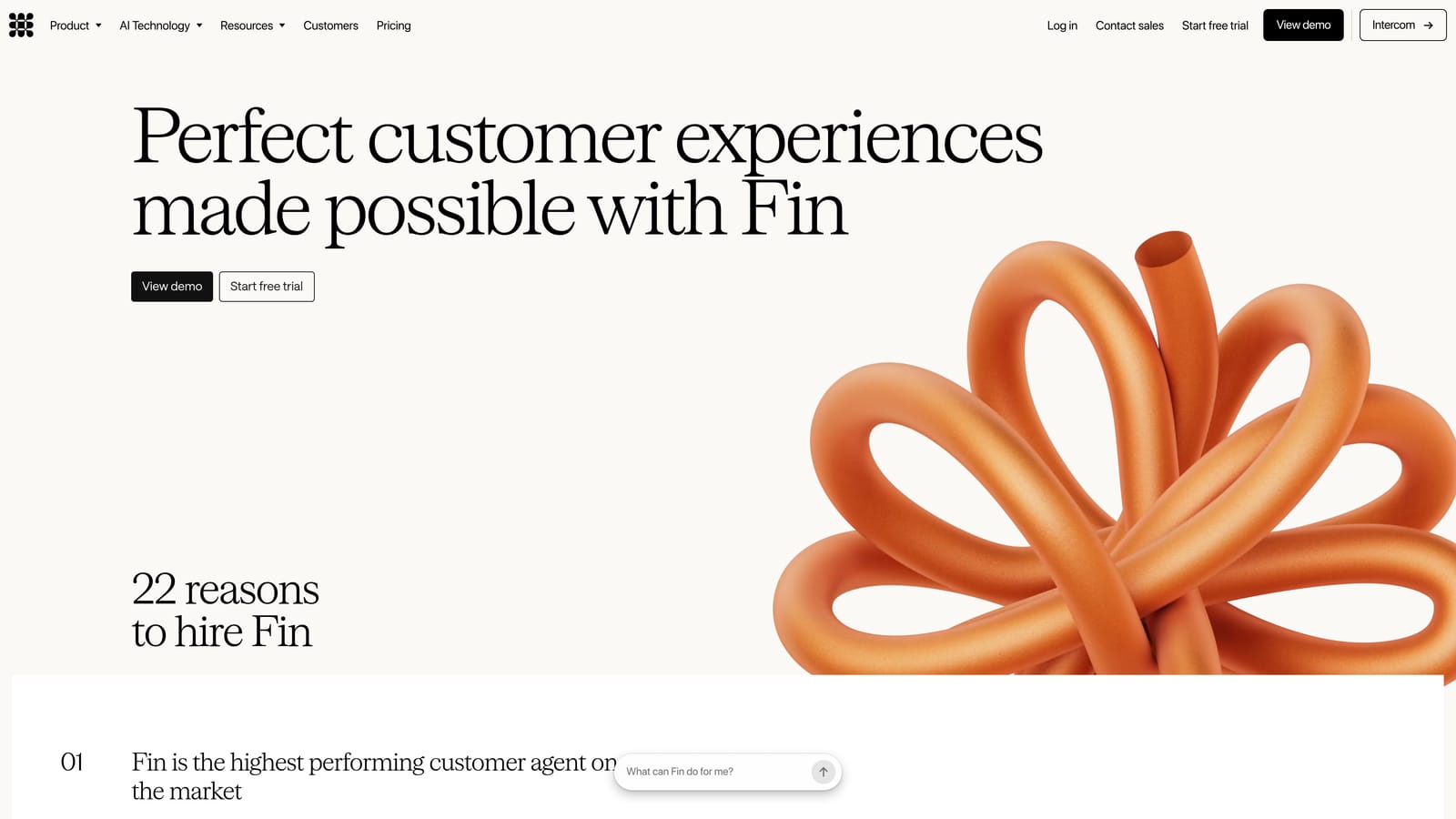
Intercom Fin is Intercom's native AI agent that resolves customer conversations using your help center content, custom answers, and workflows — built directly into the Intercom messenger experience.
Where This Tool Shines
Fin's biggest advantage is how naturally it fits into an existing Intercom setup. If your team already uses Intercom for messaging and your documentation lives in the Intercom help center, Fin can be activated without significant additional configuration. It uses large language models to generate responses grounded in your actual content rather than generic answers.
The Fin AI Copilot feature runs alongside autonomous resolution, helping human agents draft replies and surface relevant knowledge during live conversations. This dual-mode approach — autonomous for routine tickets, copilot for complex ones — makes it a practical fit for teams that need both self-service and agent-assist in one place.
Key Features
LLM-Powered Resolution: Generates accurate responses grounded in your existing help center content and custom answer sets.
Native Messenger Integration: Works directly within the Intercom messenger with no separate implementation required.
Fin AI Copilot: Assists human agents with reply suggestions and knowledge surfacing during live conversations.
Conversation Routing and Handoff: Routes unresolved conversations to the appropriate human agent with context intact.
Multi-Language Support: Handles conversations in multiple languages, useful for B2B teams with global customer bases.
Best For
B2B teams already invested in the Intercom ecosystem. Resolution quality scales with the depth and quality of your existing documentation, so teams with well-maintained help centers will see the strongest results.
Pricing
Fin is available across Intercom plans. Pricing varies by plan tier and resolution volume. Contact Intercom or visit their pricing page for current details.
3. Zendesk AI
Best for: High-volume B2B support operations needing enterprise-grade triage and intelligent routing
Zendesk AI is the AI layer built into the Zendesk Suite, covering intelligent triage, intent detection, sentiment analysis, generative agent assist, and self-service automation across the platform.
Where This Tool Shines
Zendesk AI excels at the classification and routing layer — something that matters enormously in high-volume B2B environments where tickets need to reach the right team quickly. Its intent detection, sentiment analysis, and language identification work together to ensure tickets are triaged accurately before any human or AI touches them for resolution.
The generative AI capabilities for agent assist are well-developed: reply suggestions, ticket summarization, and next-best-action recommendations help agents work faster without sacrificing quality. For organizations with complex routing logic and multiple support tiers, Zendesk AI's depth in this area is hard to match.
Key Features
Intelligent Triage: Detects intent, sentiment, and language automatically to route tickets accurately from the moment they arrive.
Generative Agent Assist: Suggests replies, summarizes tickets, and surfaces relevant knowledge for human agents in real time.
AI-Powered Self-Service: Automates resolution flows for common ticket types without agent involvement.
Advanced Routing: Routes tickets based on AI-detected attributes including topic, urgency, and customer segment.
Copilot for Agents: Surfaces next-best-actions and relevant knowledge base articles during active conversations.
Best For
Larger B2B organizations with complex routing requirements and high ticket volumes. Better suited for teams that need sophisticated triage and agent augmentation than for those prioritizing fully autonomous resolution from day one.
Pricing
AI features are included in Zendesk Suite plans; advanced AI capabilities are available as an add-on. Contact Zendesk for current pricing based on your plan and team size.
4. Freshdesk Freddy AI
Best for: Growing B2B teams wanting accessible AI across self-service, agent assist, and analytics in one platform
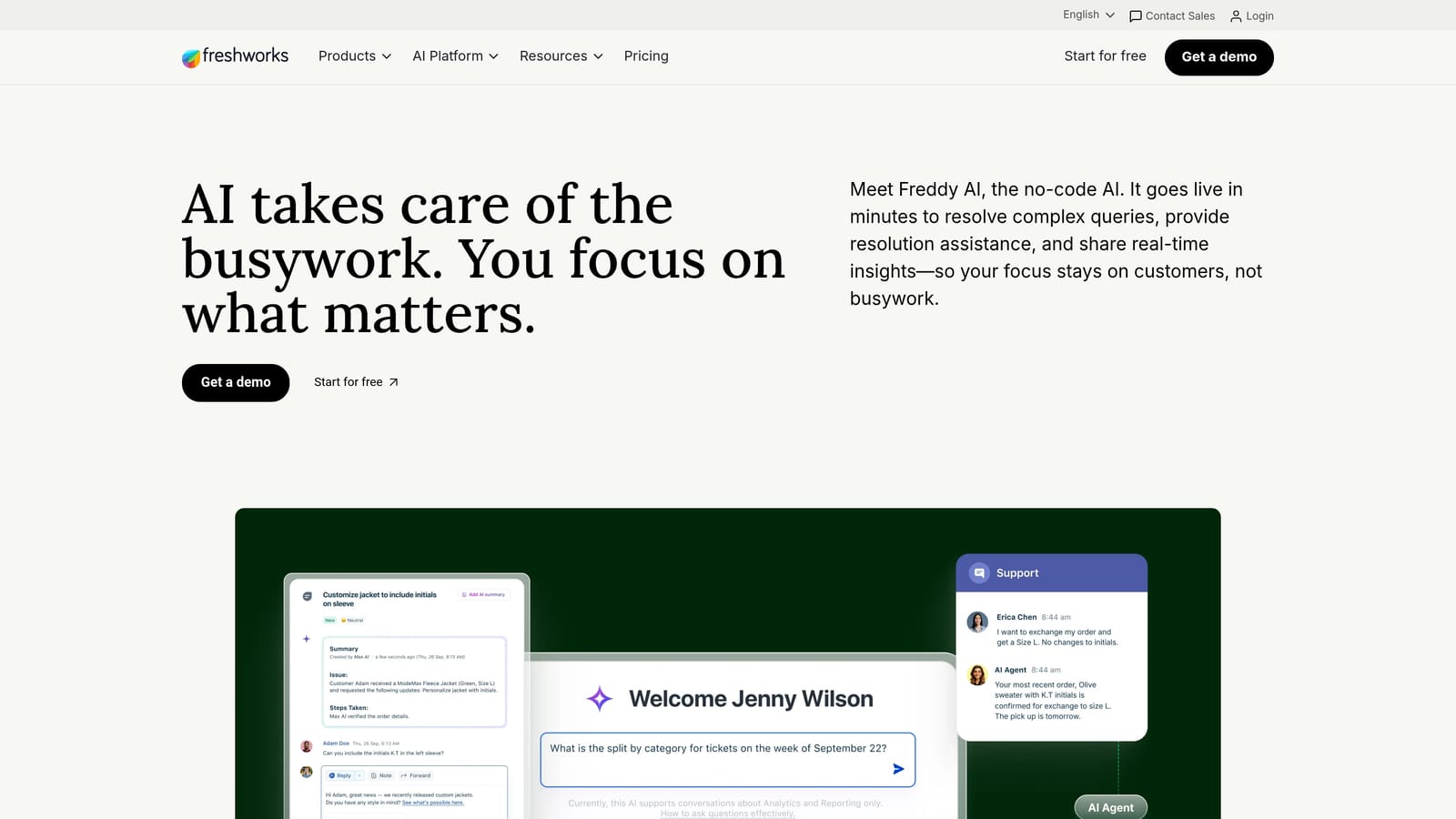
Freshdesk Freddy AI is Freshworks' AI engine across the Freshdesk platform, offering self-service automation, agent copilot capabilities, and analytics insights under a unified brand.
Where This Tool Shines
Freddy AI is structured across three distinct layers: Freddy Self Service for autonomous deflection and resolution, Freddy Copilot for real-time agent assist, and Freddy Insights for support analytics and trend detection. This modular approach means teams can adopt the capabilities they need without overhauling their entire workflow at once.
For growing B2B teams that find Zendesk's pricing steep, Freshdesk offers a more accessible entry point without sacrificing meaningful AI capability. Freddy handles common ticket types well autonomously; more complex B2B issues with deep account context may still benefit from agent involvement, but the copilot layer helps agents handle those faster.
Key Features
Freddy Self Service: Autonomous ticket deflection and resolution for high-frequency, repeatable support requests.
Freddy Copilot: Real-time agent assist with reply drafting, knowledge suggestions, and context surfacing during live tickets.
Freddy Insights: Support analytics and trend detection to identify patterns and improvement opportunities.
Omnichannel Coverage: Handles tickets across email, chat, phone, and social from a unified inbox.
Flexible Pricing Tiers: AI features available across Growth, Pro, and Enterprise plans, making it accessible at different stages of team maturity.
Best For
Mid-market and growing B2B teams looking for a capable all-in-one AI support platform at a competitive price point. A strong choice for teams migrating from basic helpdesks who want AI built in from the start.
Pricing
Freddy AI features are available across Growth, Pro, and Enterprise Freshdesk plans. Pricing starts at SMB-accessible rates; visit Freshworks for current plan details.
5. Salesforce Agentforce
Best for: Enterprise B2B teams already in the Salesforce ecosystem needing CRM-native AI resolution
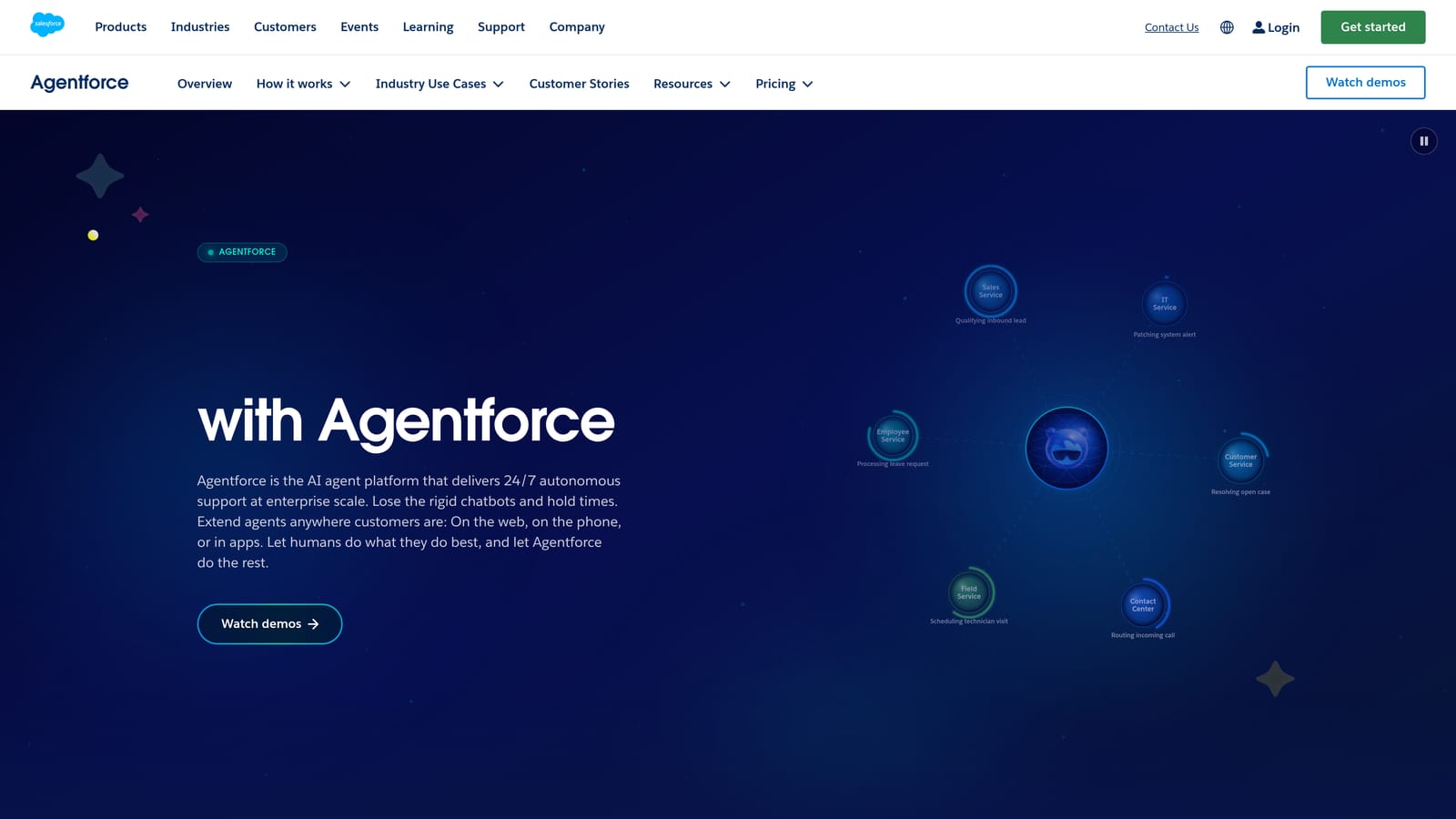
Salesforce Agentforce is Salesforce's autonomous AI agent platform that resolves support cases using full CRM context — account history, deal stage, contract data — natively within the Salesforce ecosystem.
Where This Tool Shines
Agentforce's defining advantage for B2B is CRM-native context. When an AI agent resolves a ticket, it has access to the full Salesforce account record: ARR, renewal proximity, deal stage, support history, and contract terms. That's the kind of context that changes how a ticket should be handled — and most standalone AI tools simply don't have it.
For enterprises already running Salesforce as their system of record, Agentforce can automate case resolution in ways that feel genuinely intelligent rather than generic. The tradeoff is implementation complexity: getting Agentforce configured and deployed requires meaningful Salesforce expertise and is not a quick-start solution.
Key Features
CRM-Native Context: Accesses full Salesforce account data — deal stage, contract value, support history — to inform every resolution decision.
Autonomous Case Handling: Resolves support cases end-to-end within defined guardrails, escalating when needed.
Einstein AI Integration: Combines predictive and generative AI capabilities from Salesforce's Einstein platform.
Salesforce Flow Automation: Deep workflow automation for routing, escalation, and post-resolution actions.
Enterprise Security and Compliance: Audit trails, role-based access, and enterprise-grade data governance built in.
Best For
Large B2B enterprises with Salesforce as their primary CRM and a mature implementation team. Not ideal for companies outside the Salesforce ecosystem or those needing fast time-to-value.
Pricing
Agentforce pricing varies by edition and usage volume. Enterprise contracts are typical. Contact Salesforce directly for a quote based on your organization's scale.
6. Forethought SupportGPT
Best for: B2B teams operating across multiple helpdesk systems who need a helpdesk-agnostic AI layer
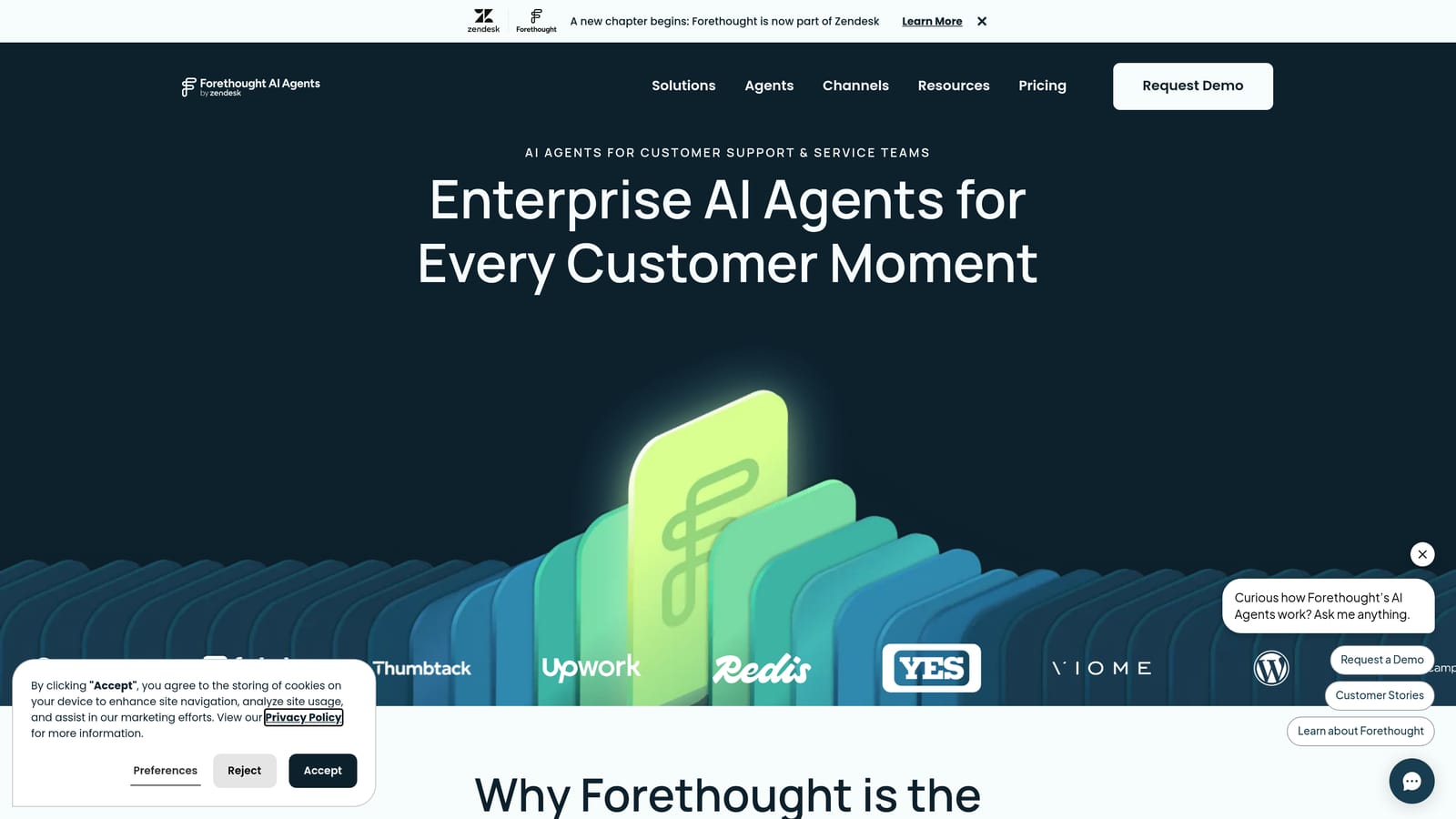
Forethought SupportGPT is a helpdesk-agnostic AI platform that layers intelligent triage, routing, and resolution capabilities on top of existing helpdesk systems including Zendesk, Salesforce, ServiceNow, and Freshdesk.
Where This Tool Shines
Forethought's positioning as a helpdesk-agnostic layer is its core differentiator. If your organization uses multiple helpdesk systems, or if you don't want to be locked into a single platform's AI offering, Forethought sits on top and adds consistent AI capability across your stack. This is particularly valuable in enterprise environments where different teams may use different tools.
The platform splits its capabilities across two distinct modules: Solve for autonomous self-service resolution, and Assist for agent copilot functionality. Both are well-regarded in the enterprise segment, and the analytics dashboard gives support leaders clear visibility into resolution rates and deflection performance.
Key Features
Multi-Helpdesk Compatibility: Works natively with Zendesk, Salesforce Service Cloud, ServiceNow, Freshdesk, and other major platforms.
AI Triage with Intent Classification: Classifies tickets by intent and assigns priority scores before routing.
Solve Module: Autonomous self-service resolution for common ticket types without agent involvement.
Assist Module: Agent copilot with real-time suggestions and knowledge surfacing during active tickets.
Analytics Dashboard: Tracks resolution rate, deflection rate, and AI performance over time.
Best For
Enterprise B2B teams with complex, multi-system helpdesk environments who want consistent AI capability without rebuilding their entire support stack. Also a strong choice for teams evaluating AI without committing to a single platform's native offering.
Pricing
Enterprise pricing based on volume and integrations. Contact Forethought for a custom quote tailored to your helpdesk environment and ticket volume.
7. Tidio Lyro AI
Best for: Smaller B2B teams or early-stage companies needing fast AI deployment with minimal setup
Tidio Lyro AI is a conversational AI tool focused on fast deployment and accessible pricing, handling common customer questions and tickets autonomously with minimal technical setup.
Where This Tool Shines
Lyro's strength is speed to value. Most AI ticket resolution tools require meaningful implementation effort; Lyro is designed to get you resolving tickets autonomously within hours, not weeks. It trains on your existing FAQs and support content without requiring a technical implementation team.
For smaller B2B teams dealing with high volumes of repetitive, lower-complexity tickets, Lyro handles the load effectively and frees up human agents for the nuanced issues that actually need them. It's not designed for the depth of CRM integration or account-level context that enterprise B2B teams often require, but for the right use case, its simplicity is a genuine advantage.
Key Features
Conversational AI: Trained on your FAQs and support content to handle common questions autonomously.
Fast Setup: No technical implementation required — deployable in hours with existing content.
Autonomous Ticket Handling: Resolves high-frequency, lower-complexity tickets without agent involvement.
Live Chat Handoff: Escalates conversations to human agents when issues exceed the AI's scope.
Multichannel Support: Covers website chat and email from a single interface.
Best For
Early-stage or smaller B2B companies that need immediate AI-assisted ticket resolution without the budget or resources for enterprise implementation. A practical starting point before graduating to a more sophisticated platform.
Pricing
Lyro AI is available on Tidio plans. A free tier is available, with paid plans starting at accessible SMB pricing. Check Tidio's website for current plan details.
8. Kustomer AI
Best for: B2B teams where full relationship history and customer timeline context drive resolution quality
Kustomer AI is a CRM-native helpdesk platform with AI capabilities built on a unified customer timeline, enabling context-rich ticket resolution for B2B teams where relationship history matters.
Where This Tool Shines
Kustomer's unified customer timeline is its defining architectural choice. Every interaction, purchase, support ticket, and behavioral signal is consolidated into a single view — and the AI operates on top of that complete picture. For B2B teams where knowing a customer's full history changes how you respond, this context richness translates directly into better resolution quality.
The platform's proactive support triggers are also worth noting: Kustomer can initiate outreach based on customer behavior signals before a ticket is even submitted. For B2B teams focused on proactive customer success alongside reactive support, this adds a meaningful capability layer.
Key Features
Unified Customer Timeline: Consolidates all interactions, purchases, and support history into a single view that informs every AI decision.
AI-Powered Routing and Suggested Responses: Routes tickets and generates response suggestions based on complete customer context.
Intelligent Deflection: Chatbot and self-service flows that handle common requests before they reach an agent.
Proactive Support Triggers: Initiates outreach based on customer behavior signals, enabling proactive issue resolution.
Omnichannel Inbox: Covers email, chat, SMS, and social from a unified interface.
Best For
Mid-market and enterprise B2B teams where customer relationship history is central to support quality — particularly those in industries with long sales cycles, high-touch accounts, or complex renewal dynamics.
Pricing
Enterprise pricing. Contact Kustomer for a quote. Typically suited to mid-market and enterprise B2B teams rather than early-stage companies.
Choosing the Right Tool for Your B2B Support Stack
The right AI ticket resolution tool depends on three things: where your helpdesk maturity sits today, how complex your typical B2B tickets are, and whether you need a standalone AI layer or a full platform built for AI from the ground up.
Here's a quick framework for thinking through the decision:
If you're building AI-first from scratch: Halo AI is designed for exactly this scenario. Its page-aware context, continuous learning, and business intelligence capabilities go beyond ticket resolution into genuine product and revenue intelligence — making it the strongest fit for B2B SaaS teams that want AI at the center of their support operation, not bolted onto it.
If you're already on Intercom or Zendesk: Fin and Zendesk AI are the natural starting points. They extend your existing investment without adding platform complexity. Fin is better for conversational resolution; Zendesk AI is better for complex triage and routing at scale.
If you're on Salesforce and enterprise-grade: Agentforce is the most context-rich option for CRM-native resolution. The implementation lift is real, but the payoff — AI that knows your account's ARR, deal stage, and renewal date — is significant for high-stakes B2B relationships.
If you need helpdesk-agnostic AI across multiple systems: Forethought SupportGPT is purpose-built for this. It adds consistent AI capability across Zendesk, Salesforce, ServiceNow, and Freshdesk without forcing a platform migration.
If you're a smaller team that needs speed: Tidio Lyro AI gets you to autonomous resolution fast, with minimal setup and accessible pricing. It's a practical entry point before your support needs outgrow it.
The broader point is this: B2B support AI isn't a commodity category. The tools that perform best are the ones that understand account context, learn from your specific ticket history, and escalate gracefully when complexity demands a human. Evaluate on those dimensions, not just on deflection rate.
Your support team shouldn't scale linearly with your customer base. Let AI agents handle routine tickets, guide users through your product, and surface business intelligence while your team focuses on complex issues that need a human touch. See Halo in action and discover how continuous learning transforms every interaction into smarter, faster support.