9 Best AI Ticket Resolution Tools and Their Pricing in 2026
This guide compares AI ticket resolution pricing across nine leading platforms in 2026, breaking down per-resolution, per-seat, and flat-fee models so support teams can identify the structure that fits their scale and budget. Whether you're a lean startup deflecting L1 tickets or a mid-market team replacing a legacy helpdesk, you'll find clear, side-by-side pricing context to make a confident decision.
 Matt PattoliFounder13 min read
Buying an AI ticket resolution tool without understanding its pricing model is like signing a lease without reading the terms. Some platforms charge per resolution, others per seat, and a few bundle everything into a flat monthly fee. The difference can mean thousands of dollars at scale, and the wrong choice can leave your team locked into a structure that punishes growth.
This guide breaks down nine of the best AI ticket resolution tools available in 2026, with clear notes on what each one costs, how the pricing scales, and who it's best suited for. Whether you're a lean SaaS startup looking to deflect L1 tickets without hiring, or a mid-market product team ready to replace your legacy helpdesk entirely, you'll find a clear comparison here. Tools are ranked starting with our top overall pick, followed by strong alternatives across different use cases and budgets.
1. Halo AI
Best for: B2B SaaS product teams wanting AI-first support with built-in business intelligence
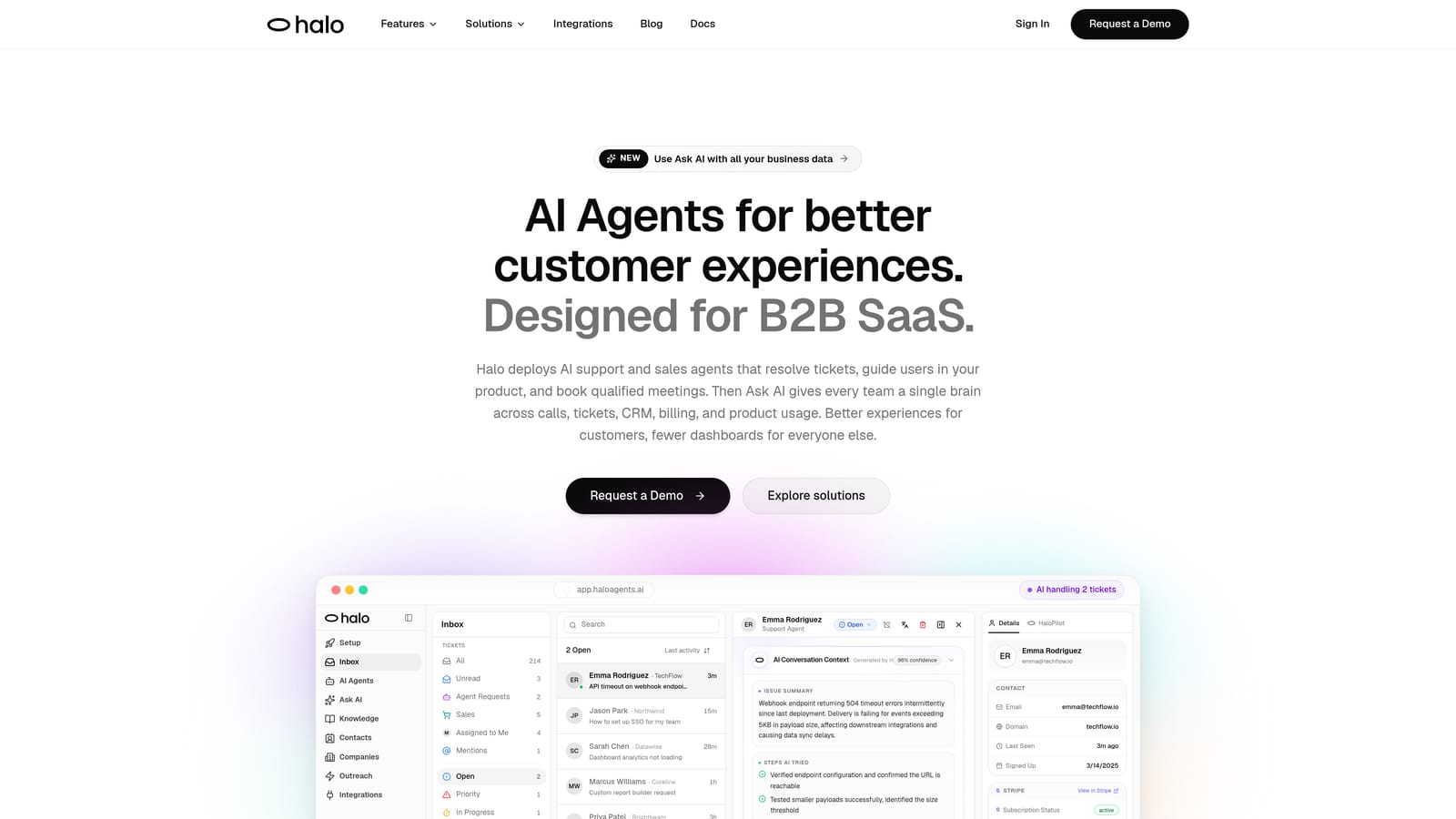
Halo AI is an AI-first customer support platform that deploys intelligent agents to resolve tickets, guide users through your product, and surface business intelligence signals — all while learning from every interaction.
Where This Tool Shines
Most AI support tools are bolt-ons: they sit on top of a legacy helpdesk and add a layer of automation. Halo is built differently. Its AI-first architecture means intelligence is woven into every part of the platform, from the moment a ticket arrives to the moment it's resolved or escalated.
The standout capability is page-aware context. Halo's chat widget understands exactly which part of your product a user is looking at, so its AI agents can deliver guidance that's specific to that screen, workflow, or feature. For B2B SaaS teams, this is the difference between generic FAQ responses and genuinely useful product guidance.
Key Features
Page-Aware AI Agents: The chat widget reads the user's current product context, enabling resolution that's specific to where they are in your app rather than generic deflection.
Auto Bug Ticket Creation: When the AI identifies a recurring issue or product error, it automatically logs a structured bug report without any agent intervention.
Smart Inbox with Business Intelligence: Goes beyond support metrics to surface customer health signals, revenue anomalies, and usage patterns that matter to product and revenue teams.
Live Agent Handoff: Complex or sensitive issues escalate seamlessly to human agents with full conversation context preserved.
Deep Integration Stack: Connects to Linear, Slack, HubSpot, Intercom, Stripe, Zoom, PandaDoc, and Fathom, making it a genuine hub rather than an island.
Best For
Halo is the strongest fit for B2B SaaS companies and product teams that want more than ticket deflection. If your support data should be informing product decisions, customer success, and revenue intelligence, Halo's smart inbox turns every interaction into a signal your broader team can act on.
Pricing
Custom pricing based on team size and volume. Contact the team or book a demo at haloagents.ai/demo for a tailored quote.
2. Intercom Fin
Best for: Teams already using Intercom who want native AI resolution without switching platforms
Intercom Fin is Intercom's native AI resolution agent, built directly into the Intercom messenger for teams already invested in the Intercom ecosystem.
Where This Tool Shines
If your team lives inside Intercom, Fin is the path of least resistance to AI resolution. There's no migration, no new vendor relationship, and no integration work. Fin 2, released in 2025, added multi-step reasoning and tool-use capabilities, meaningfully raising the ceiling on what it can resolve autonomously.
The conversation-first UX is consistent with Intercom's messenger experience, which matters for teams that have invested in a specific customer-facing brand. Handoff to human agents is seamless because it's all one platform.
Key Features
Multi-Step Reasoning: Fin 2 can work through complex, multi-part queries rather than just matching against FAQ content.
Seamless Human Handoff: Escalations happen within the same Intercom interface, with full conversation history intact.
Trained on Your Help Content: Fin learns from your existing Intercom articles and knowledge base without requiring a separate training process.
Consistent Messenger UX: Maintains the look and feel your customers already know from your Intercom-powered support.
Best For
Teams already on Intercom who want to add AI resolution without changing platforms or adding a new vendor. Less compelling as a standalone purchase if you're not already an Intercom customer.
Pricing
Per-resolution pricing applies on top of existing Intercom seat costs. This model can compound at scale. Check intercom.com for current rates, as pricing is subject to change.
3. Zendesk AI
Best for: Established support teams already committed to the Zendesk infrastructure
Zendesk AI is an Advanced AI add-on to Zendesk Suite plans, bringing ticket triage, intelligent routing, and automated resolution to teams already running on the Zendesk platform.
Where This Tool Shines
Zendesk's strength has always been its depth: robust reporting, a large app marketplace, and enterprise-grade workflow management. The AI layer integrates natively with all of that, meaning your existing automations, triggers, and reporting dashboards don't need to be rebuilt.
For teams with established Zendesk workflows, adding AI here is genuinely low-friction. Intent detection and ticket triage work within the same interface your agents already use daily, reducing the learning curve.
Key Features
Native Zendesk Integration: AI triage and routing work inside existing Suite workflows without requiring a separate platform or migration.
Intent Detection: Automatically categorizes incoming tickets by topic and urgency to route them correctly from the start.
Automated Responses and Article Suggestions: Deflects common queries with relevant help content before a human agent needs to engage.
Large App Marketplace: Hundreds of integrations available to extend functionality beyond core support.
Best For
Teams that have already built significant process infrastructure inside Zendesk and want to add AI without migrating away from it. Less attractive for teams starting fresh, where an AI-first platform may offer better value from day one.
Pricing
Zendesk AI is an add-on priced per agent per month, applied on top of your existing Suite plan cost. Visit zendesk.com for current pricing tiers.
4. Freshdesk Freddy AI
Best for: SMBs and growing teams wanting accessible AI features without enterprise price tags
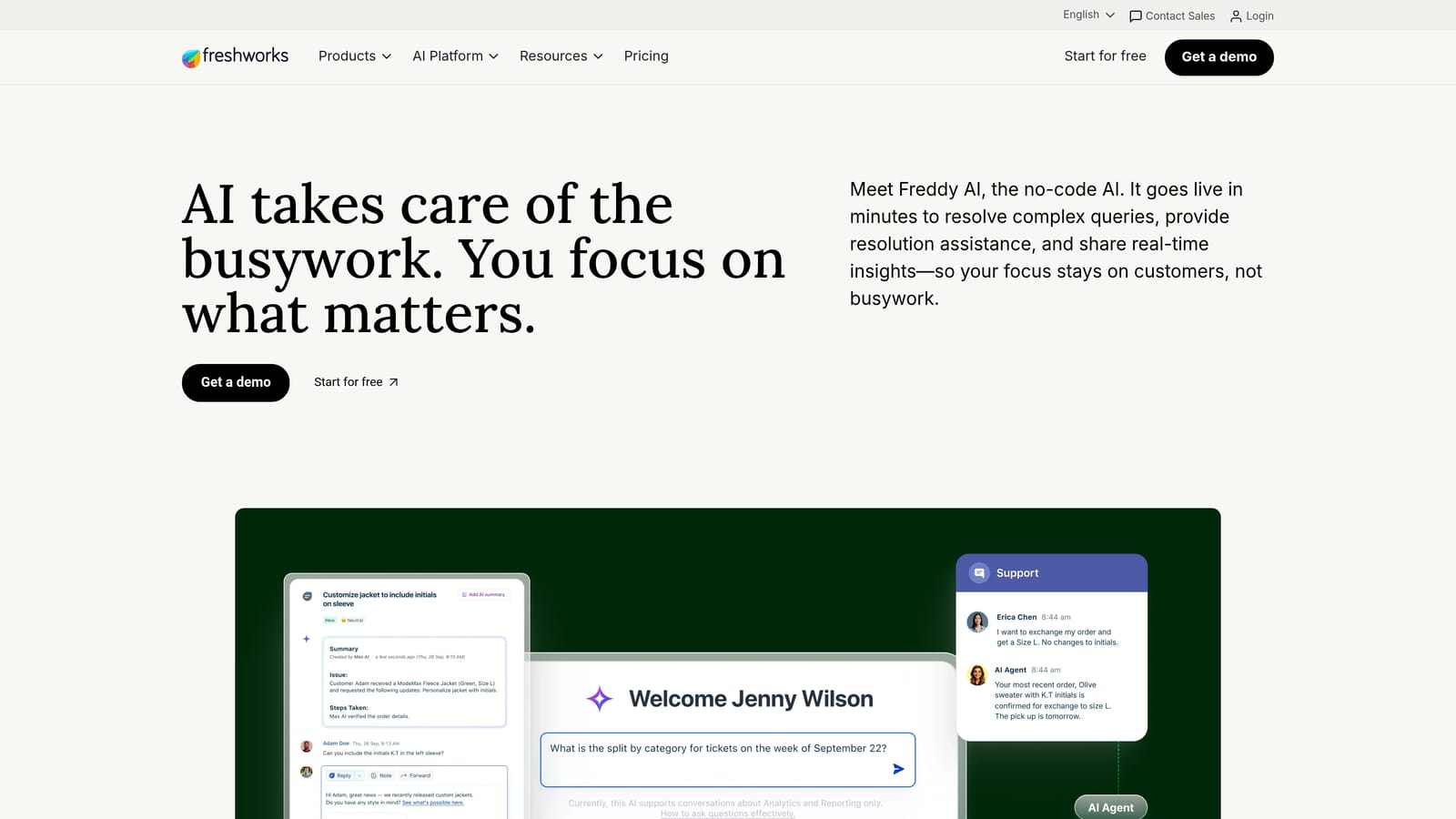
Freshdesk Freddy AI is Freshworks' AI layer embedded across the Freshdesk platform, covering self-service resolution, agent assistance, and support analytics.
Where This Tool Shines
Freddy AI's biggest advantage is accessibility. Some Freddy capabilities are included in higher Freshdesk tiers without additional cost, which makes it a strong option for teams that want to experiment with AI resolution before committing to dedicated AI platform spend.
The three-part structure of Freddy Self Service, Freddy Copilot, and Freddy Insights covers the full support workflow: customer-facing deflection, agent assistance, and performance analytics. That breadth at a relatively lower price point is genuinely useful for teams scaling from 5 to 50 agents.
Key Features
Freddy Self Service: Customer-facing AI that deflects common queries before they reach a human agent.
Freddy Copilot: Suggests replies and assists agents in real time, reducing handle time on tickets that do require human attention.
Freddy Insights: Analytics layer with anomaly detection to surface support trends and team performance signals.
Accessible Entry Pricing: Some features included in standard Freshdesk tiers, making AI capabilities available without a separate platform budget.
Best For
SMBs and mid-market teams already using Freshdesk who want AI capabilities without switching platforms or taking on enterprise-level spend. Less suited for teams needing deep integrations with a broader business tech stack.
Pricing
Some Freddy features are included in Freshdesk's higher tiers; Freddy Copilot and Self Service carry separate add-on pricing. Check freshworks.com for current tier inclusions and add-on costs.
5. Forethought
Best for: Enterprise teams with complex routing needs across multiple helpdesk platforms
Forethought is a helpdesk-agnostic AI layer that adds intelligent triage, routing, and resolution on top of existing platforms including Zendesk, Salesforce Service Cloud, and ServiceNow.
Where This Tool Shines
Forethought's key differentiator is platform independence. If your organization runs support across multiple systems, or if you're not ready to migrate off your current helpdesk, Forethought can add AI capabilities without requiring a platform change. That's a meaningful advantage for enterprise teams with entrenched infrastructure.
Its intent detection and sentiment analysis capabilities are well-regarded for complex ticket workflows where routing logic matters. The ability to train on your historical ticket data means the AI gets smarter based on your specific support patterns rather than generic training data.
Key Features
Helpdesk Agnostic: Works across Zendesk, Salesforce Service Cloud, ServiceNow, and other major platforms without requiring migration.
AI Triage and Routing: Sophisticated intent detection routes tickets to the right team or resolution path from the start.
Sentiment Analysis: Identifies at-risk customer interactions for priority escalation before they become churn risks.
Custom AI Training: Trains on your historical ticket data to reflect your specific support patterns and terminology.
Best For
Enterprise teams with complex multi-platform support operations or sophisticated routing requirements. Less suited for SMBs or teams looking for transparent self-serve pricing, as Forethought requires a sales conversation to get started.
Pricing
Custom enterprise pricing; not self-serve. Requires a sales engagement. Pricing transparency is limited, which can make budget planning difficult without a direct conversation with their team.
6. Tidio Lyro
Best for: SMBs and e-commerce teams needing fast setup and accessible entry-level pricing
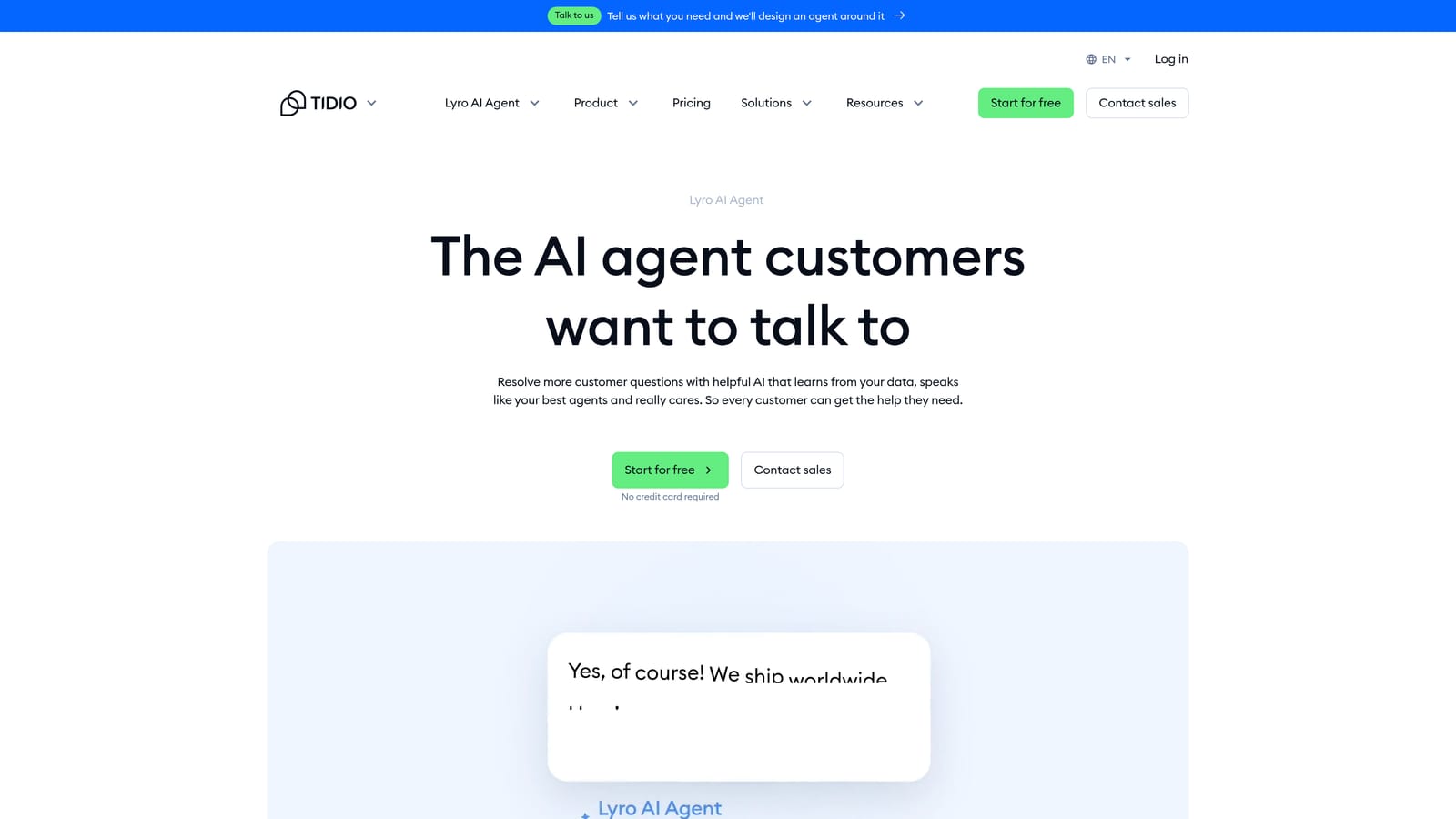
Tidio Lyro is an AI conversation and resolution tool built for smaller teams, offering quick deployment and a free tier for teams with low support volumes.
Where This Tool Shines
Lyro's strength is its accessibility. Setup is fast, the interface is straightforward, and the free tier gives low-volume teams a genuine way to test AI resolution without any financial commitment. For e-commerce businesses handling repetitive FAQ queries at scale, Lyro delivers meaningful deflection without complexity.
The live chat fallback ensures that when Lyro can't resolve something, a human agent steps in without the customer experiencing a jarring transition. For SMBs where every customer interaction matters, that continuity is valuable.
Key Features
Conversational AI Deflection: Handles common FAQ queries and repetitive questions without human agent involvement.
Free Tier: Available for low-volume teams, making it a genuine no-risk entry point for AI resolution.
Fast Setup: Minimal configuration required to get Lyro operational, reducing time-to-value significantly.
Live Chat Fallback: Seamless handoff to human agents when queries exceed Lyro's resolution capability.
Best For
SMBs, e-commerce teams, and early-stage companies handling high volumes of repetitive queries. Not the right fit for complex B2B SaaS support workflows or teams needing deep integrations with a broader business stack.
Pricing
Free tier available for low-volume usage. Paid Lyro plans are priced per conversation. Check tidio.com for current conversation pricing and tier limits.
7. Kustomer
Best for: High-volume consumer support teams that need full customer history at every interaction
Kustomer is a CRM-native customer service platform with built-in AI resolution, giving both agents and AI agents full customer history context at the point of every interaction.
Where This Tool Shines
Kustomer's unified customer timeline is genuinely differentiated. When a customer contacts support, the AI has access to their full interaction history across every channel, not just the current ticket. That context enables more accurate resolution and more personalized responses, which matters particularly for consumer-facing brands where customer relationships are long-term.
The platform's workflow automation capabilities handle complex multi-step support processes, and the AI-powered suggested responses help agents move faster on tickets that do require human attention.
Key Features
CRM-Native Context: AI resolution draws on full customer history across all channels, not just the current conversation.
Unified Interaction Timeline: Every touchpoint from every channel is visible in a single view for agents and AI alike.
AI-Powered Auto-Resolution: Handles routine queries autonomously with full customer context informing each response.
Built-In Workflow Automation: Multi-step support processes can be automated without external tools or complex integrations.
Best For
High-volume consumer support operations where customer history context meaningfully improves resolution quality. The per-seat pricing model makes it less cost-efficient for B2B SaaS teams with smaller customer bases and more complex, technical queries.
Pricing
Per-agent per-month pricing with AI features included in platform tiers. Check kustomer.com for current pricing, as seat costs sit at the higher end relative to pure helpdesk tools.
8. Capacity
Best for: Organizations needing AI support automation for both customer-facing and internal IT/HR helpdesks
Capacity is an AI support automation platform that covers both external customer support and internal helpdesk use cases, with strong knowledge base automation and a tiered pricing model that includes a free entry point.
Where This Tool Shines
Capacity's multi-department coverage is its defining feature. Most AI support tools focus exclusively on customer-facing tickets. Capacity handles IT helpdesk, HR queries, and customer support from a single platform, which makes it particularly attractive for mid-sized organizations looking to consolidate their internal and external support automation under one roof.
The knowledge base automation is well-developed, making it straightforward to build and maintain the content library that powers AI resolution. The workflow builder handles multi-step support processes without requiring engineering resources.
Key Features
Multi-Department Coverage: Handles customer support, IT helpdesk, and HR queries from a single platform.
Knowledge Base Automation: Builds and maintains the content layer that powers AI resolution with minimal manual effort.
Workflow Builder: Creates multi-step support processes without requiring technical configuration or developer involvement.
Free Tier Available: Small teams can start with a no-cost plan before committing to paid tiers.
Best For
Mid-sized organizations that want to unify customer-facing and internal support automation on one platform. Less specialized for B2B SaaS product support than dedicated AI agent platforms, particularly for teams that need deep product context in every resolution.
Pricing
Free tier available; paid plans scale with usage and feature requirements. Check capacity.com for current tier pricing and usage limits.
9. Aisera
Best for: Large enterprises with complex ITSM requirements and strict compliance needs
Aisera is an enterprise-grade generative AI platform for IT service management and customer service, with deep ITSM integrations and compliance features designed for large organizations.
Where This Tool Shines
Aisera is built for the enterprise environment where compliance, security, and audit capabilities are non-negotiable. Its deep integrations with ServiceNow, Jira, Salesforce, and similar platforms make it a natural fit for organizations where ITSM is a core operational function rather than a secondary concern.
Multi-language support and global deployment options extend its reach for multinational organizations managing support across different regions and regulatory environments. For these teams, Aisera's depth is a genuine advantage over lighter-weight alternatives.
Key Features
Generative AI for ITSM and Customer Service: Covers both IT service management and customer support workflows from a single AI platform.
Deep ITSM Integrations: Native connections to ServiceNow, Jira, Salesforce, and other enterprise platforms without custom development.
Enterprise Compliance and Security: Audit capabilities, security controls, and compliance features built for regulated industries and large organizations.
Multi-Language Global Deployment: Supports international teams managing support across different languages and regional requirements.
Best For
Large enterprises with complex ITSM operations, strict compliance requirements, and global support teams. Cost-prohibitive and feature-heavy for SMBs and early-stage SaaS companies that don't need this level of enterprise infrastructure.
Pricing
Custom enterprise pricing; not self-serve. Requires a sales engagement with Aisera's team. Not suitable for teams needing quick, transparent pricing without a procurement process.
Which Tool Is Right for Your Team
The right AI ticket resolution tool depends on three things: your current infrastructure, your team size, and what you actually need the AI to do. Here's a quick orientation to help you match the options above to your situation.
If you're a B2B SaaS team wanting AI-first support with business intelligence: Halo AI is the strongest fit. Its page-aware agents, auto bug ticket creation, and smart inbox go beyond deflection to make support a source of product and revenue intelligence. It's built for teams that want their support platform to do more than close tickets.
If you're already on Intercom or Zendesk: Fin and Zendesk AI are the low-friction paths to AI resolution without migration. Both are add-ons to existing investments rather than standalone platforms, which makes them practical but also means their pricing compounds on top of existing seat costs.
If you're an SMB or e-commerce team on a tight budget: Tidio Lyro's free tier and per-conversation pricing make it the most accessible entry point. Freshdesk Freddy AI is the right call if you're already on Freshdesk and want AI capabilities included in your existing plan.
If you need to cover both customer support and internal IT/HR helpdesk: Capacity's multi-department platform consolidates that under one roof without requiring separate tools for each function.
If you're an enterprise with complex ITSM or multi-platform requirements: Forethought handles helpdesk-agnostic AI triage across multiple systems, while Aisera is purpose-built for organizations where compliance, security, and ServiceNow depth are non-negotiable.
Your support team shouldn't scale linearly with your customer base. Let AI agents handle routine tickets, guide users through your product, and surface business intelligence while your team focuses on complex issues that need a human touch. See Halo in action and discover how continuous learning transforms every interaction into smarter, faster support.