9 Best AI Ticketing Systems for Developers in 2026
Choosing the right AI ticketing system for developers means going beyond generic helpdesks — this guide evaluates 9 tools on AI resolution quality, bug detection, and developer workflow integrations like Jira and Linear. Whether you're a SaaS team drowning in bug reports or scaling developer-facing support, these picks help you triage faster and resolve more without growing headcount.
 Matt PattoliFounder13 min read
Developer support is a different beast entirely. When a user files a ticket saying "the API returns a 500 on POST requests after OAuth token refresh," your support team needs context fast. Generic helpdesks weren't built for this kind of technical complexity, and bolting AI onto legacy infrastructure doesn't solve the core problem.
AI ticketing systems designed for technical teams can triage bug reports, auto-create Linear or Jira issues, detect patterns across error logs, and route tickets to the right engineer without manual intervention. The tools below were evaluated on AI resolution quality, developer workflow integrations, bug detection capabilities, and how well they handle technically complex tickets.
Whether you're a SaaS product team drowning in bug reports or a developer-facing company trying to scale support without scaling headcount, there's a fit here for you.
1. Halo AI
Best for: Developer-facing SaaS teams that need AI-native bug ticket automation and deep workflow integrations.
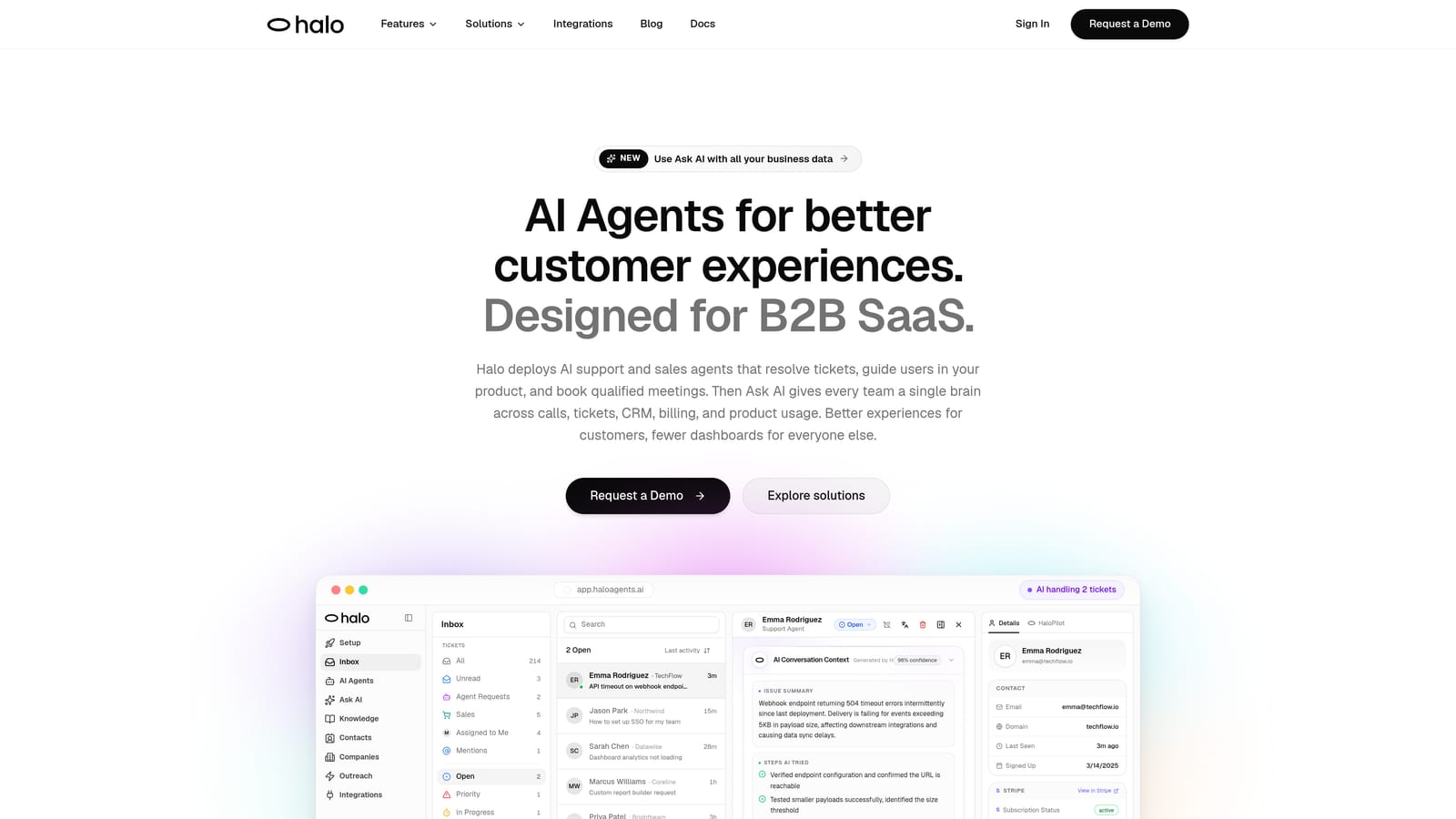
Halo AI is an AI-first customer support platform built with page-aware agents, automatic bug ticket creation, and native integrations into developer workflows like Linear and Slack.
Where This Tool Shines
What separates Halo from most tools on this list is its architecture. Rather than layering AI features onto an existing helpdesk, Halo was designed AI-first from the ground up. That distinction matters when you're handling technically complex tickets where context is everything.
The page-aware chat widget is particularly useful for developer-facing products. The AI agent can see exactly what the user sees, including the current page state, which means it can provide precise technical guidance rather than generic troubleshooting steps. When an issue genuinely requires engineering attention, Halo automatically creates a bug ticket and routes it directly to Linear or Slack, removing the manual handoff that typically slows resolution down.
Key Features
Page-Aware AI Agent: The AI sees the user's current page and state, enabling precise, context-specific technical guidance rather than generic responses.
Auto Bug Ticket Creation: Automatically generates and routes bug tickets to Linear or Slack when issues require engineering escalation.
Smart Inbox with Business Intelligence: Surfaces anomalies, customer health signals, and revenue intelligence beyond standard support metrics.
Continuous Learning: The AI improves from every resolved interaction, getting smarter about your product and your users over time.
Live Agent Handoff: Seamlessly escalates complex issues to human agents with full conversation context preserved.
Deep Integrations: Connects natively with Linear, Slack, HubSpot, Intercom, Stripe, Zoom, PandaDoc, and Fathom.
Best For
Halo is the strongest fit for B2B SaaS product teams and developer-facing companies that want AI to handle routine tickets autonomously while automatically surfacing bugs to engineering. Teams that are already using Linear for issue tracking will find the native integration particularly valuable.
Pricing
Contact for pricing. Enterprise and growth plans are available, with options designed to scale with your support volume rather than seat count.
2. Zendesk (with AI)
Best for: Large enterprise support teams that need a mature, proven helpdesk platform with AI capabilities layered on top.
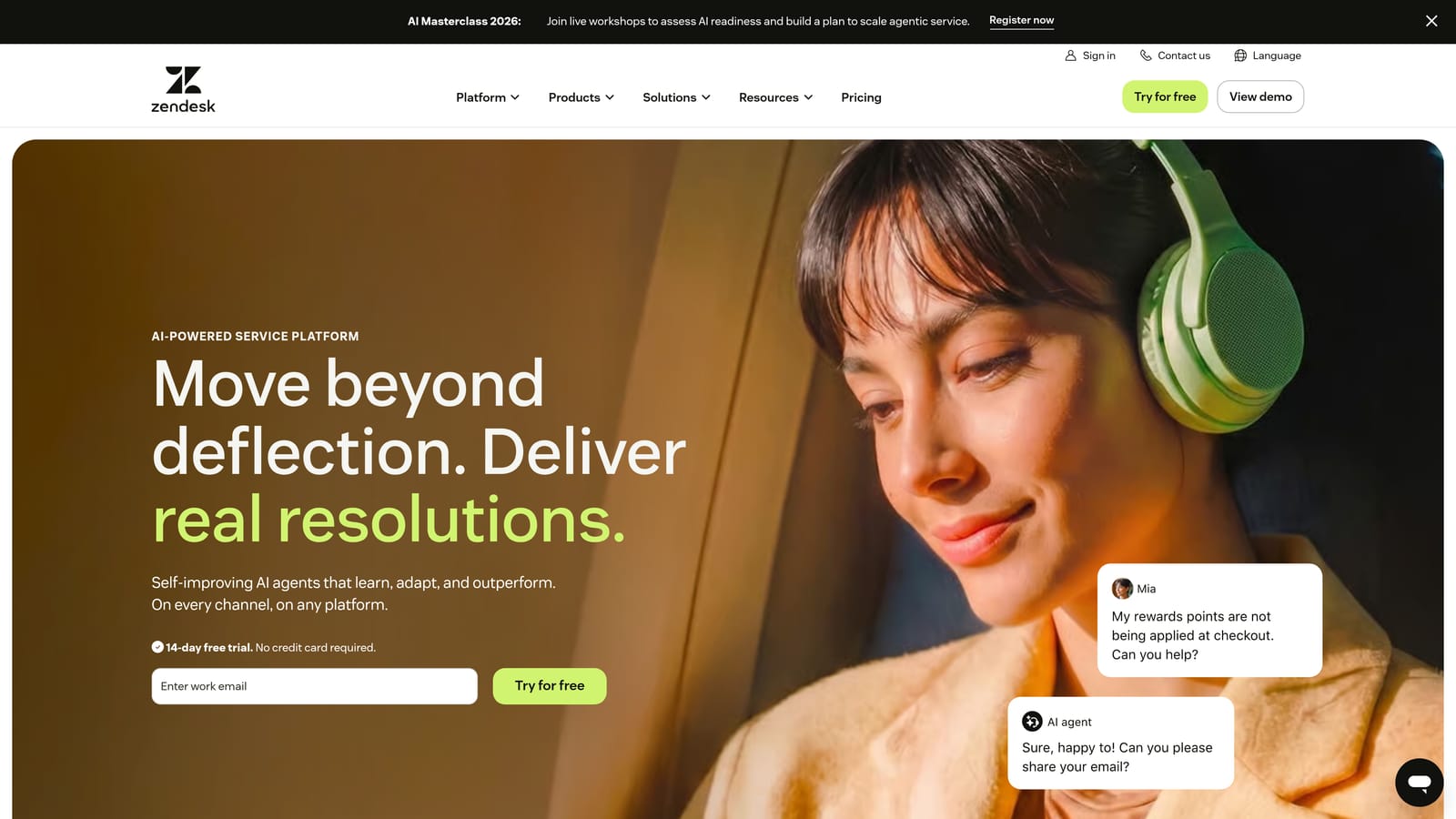
Zendesk is one of the most established helpdesk platforms available, with AI features including suggested replies, intent detection, and ticket summarization added through its AI suite.
Where This Tool Shines
Zendesk's primary strength is its maturity. It has an enormous app marketplace, robust omnichannel support, and deep analytics capabilities that many enterprise teams have built workflows around for years. If your organization already has significant Zendesk infrastructure, its AI features add meaningful value without requiring a platform migration.
For developer-facing teams specifically, Zendesk's extensive integration marketplace means you can connect it to most engineering tools. The trade-off is that these integrations often require configuration work, and the AI capabilities feel like additions to an existing platform rather than the core of the product.
Key Features
AI-Powered Suggested Replies: Recommends responses based on similar past tickets, reducing agent response time on common issues.
Ticket Summarization: Automatically condenses long ticket threads so agents can get up to speed quickly on complex cases.
Intent and Sentiment Detection: Routes tickets based on detected intent and customer sentiment signals.
Extensive App Marketplace: Hundreds of integrations with developer tools, CRMs, and business applications.
Advanced Analytics: Detailed reporting dashboards for tracking support performance and team efficiency.
Best For
Enterprise teams with established Zendesk infrastructure and the resources to configure AI features and integrations. Less ideal for teams starting fresh who want AI-native architecture from day one.
Pricing
AI features are available on Suite plans starting at $115 per agent per month, billed annually. Full AI capabilities require higher-tier plans.
3. Intercom
Best for: PLG SaaS companies that prioritize conversational support and in-app user guidance alongside ticket resolution.
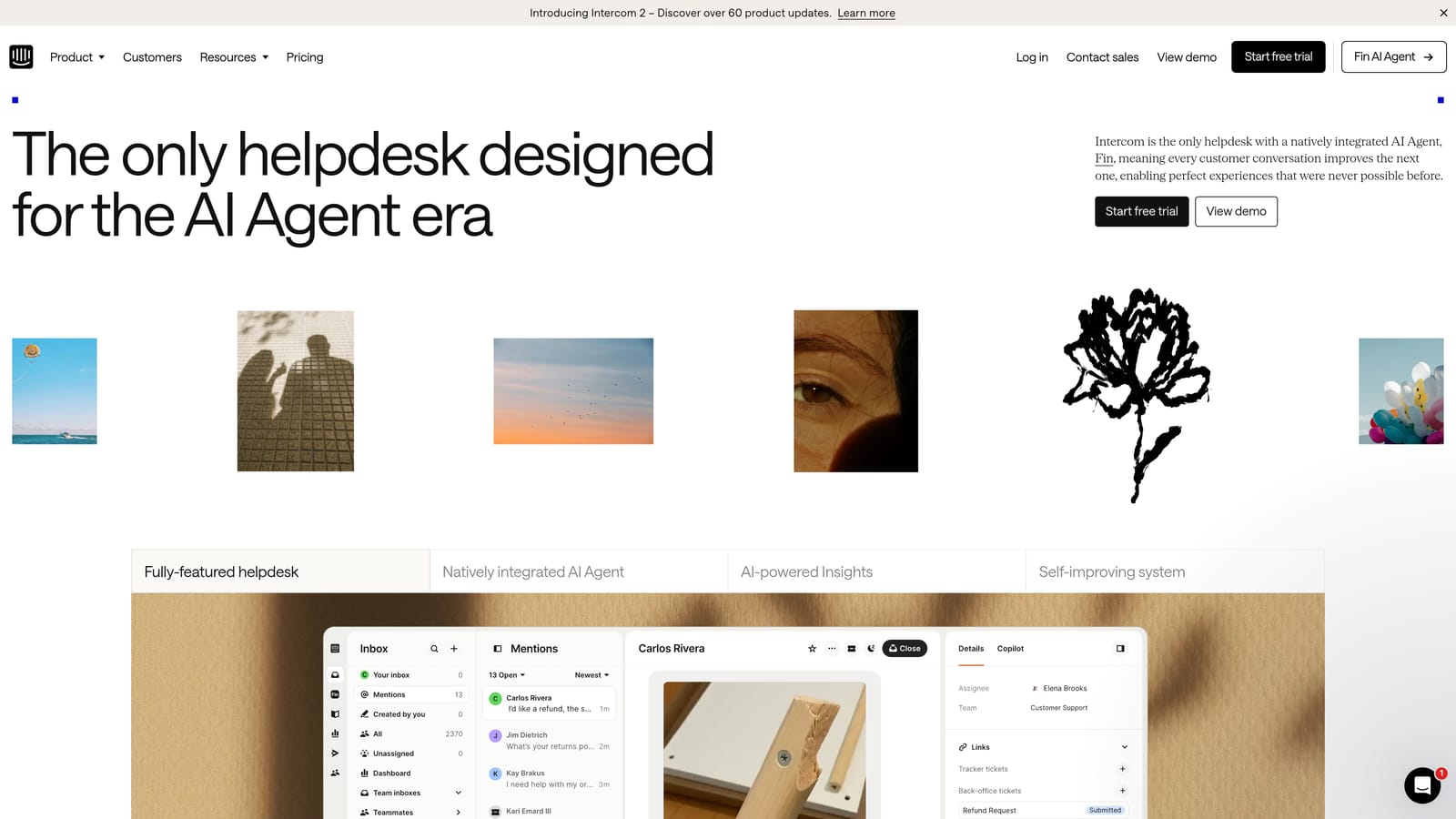
Intercom is a conversational support platform with its Fin AI agent handling ticket resolution across chat and email, popular with product-led growth SaaS teams and developer-facing products.
Where This Tool Shines
Intercom's Fin AI agent is well-regarded for its conversational resolution quality. It handles a broad range of support queries autonomously and integrates naturally into in-app messaging flows, which is useful for SaaS products where users encounter issues mid-product rather than reaching out via email.
The product tour and in-app messaging capabilities add a layer of proactive support that most helpdesks don't offer. For developer-facing products, Intercom can connect to Jira and Linear via third-party connectors, though these integrations require additional setup compared to native connections.
Key Features
Fin AI Agent: Handles autonomous ticket resolution across chat and email with conversational accuracy.
In-App Messaging and Product Tours: Proactively guides users through product features to reduce inbound support volume.
Shared Inbox with AI Assist: Provides agents with AI-suggested replies and conversation context.
Conversation Routing: Routes tickets based on detected intent and customer data attributes.
Third-Party Integrations: Connects to Jira and Linear via connectors for bug escalation workflows.
Best For
PLG SaaS companies with high chat volume and teams that want strong in-app messaging alongside AI ticket resolution. Teams that need native Linear or Jira integration without connector setup may find other options more efficient.
Pricing
Starts at $39 per seat per month. Fin AI resolution is charged per resolved conversation, so costs scale with AI usage volume.
4. Linear (AI-Assisted)
Best for: Engineering teams that want an AI-assisted issue tracker as the destination for escalated bug tickets from a connected support tool.
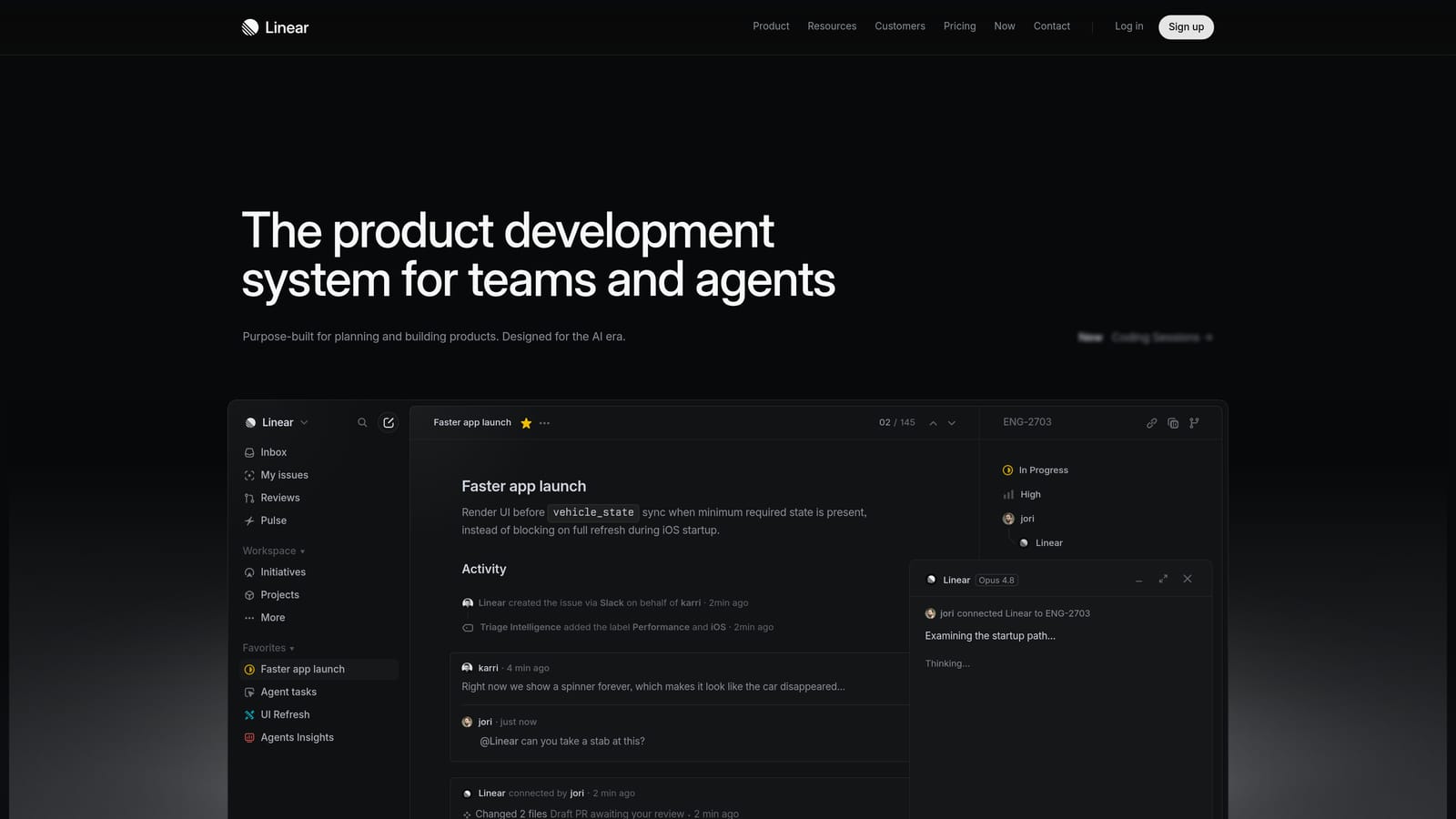
Linear is an engineering-native issue tracker with AI-assisted triage and prioritization, best positioned as the receiving end of escalated bug tickets rather than a standalone customer-facing helpdesk.
Where This Tool Shines
Linear isn't a traditional helpdesk, and it doesn't try to be. Its value in a developer support stack is as the engineering workflow layer: where bug tickets land, get triaged, and get resolved. The AI-assisted duplicate detection and issue prioritization reduce the manual work engineers spend sorting incoming reports.
The GitHub integration is particularly strong, linking commits directly to issues so teams can track resolution progress from report to deployment. For teams using Halo AI or another support tool that natively pushes to Linear, this combination creates a clean handoff from customer-facing support to engineering execution.
Key Features
AI-Assisted Triage: Automatically suggests priority and detects duplicate issues as they come in.
GitHub Integration: Links commits and pull requests directly to Linear issues for end-to-end visibility.
Cycle and Roadmap Planning: Helps engineering teams manage sprint priorities alongside incoming bug reports.
Webhooks and API: Supports custom automation workflows for teams with specific routing or notification requirements.
Fast, Keyboard-First Interface: Designed for engineering teams who want speed over complexity.
Best For
Engineering teams that want a purpose-built issue tracker with AI triage, used in conjunction with a customer-facing support tool that can push bug tickets directly into Linear.
Pricing
Free tier available. Paid plans start at $8 per user per month, making it one of the more accessible tools on this list.
5. Freshdesk (Freddy AI)
Best for: Mid-market teams that want AI-assisted support capabilities without the enterprise pricing of Zendesk or Intercom.
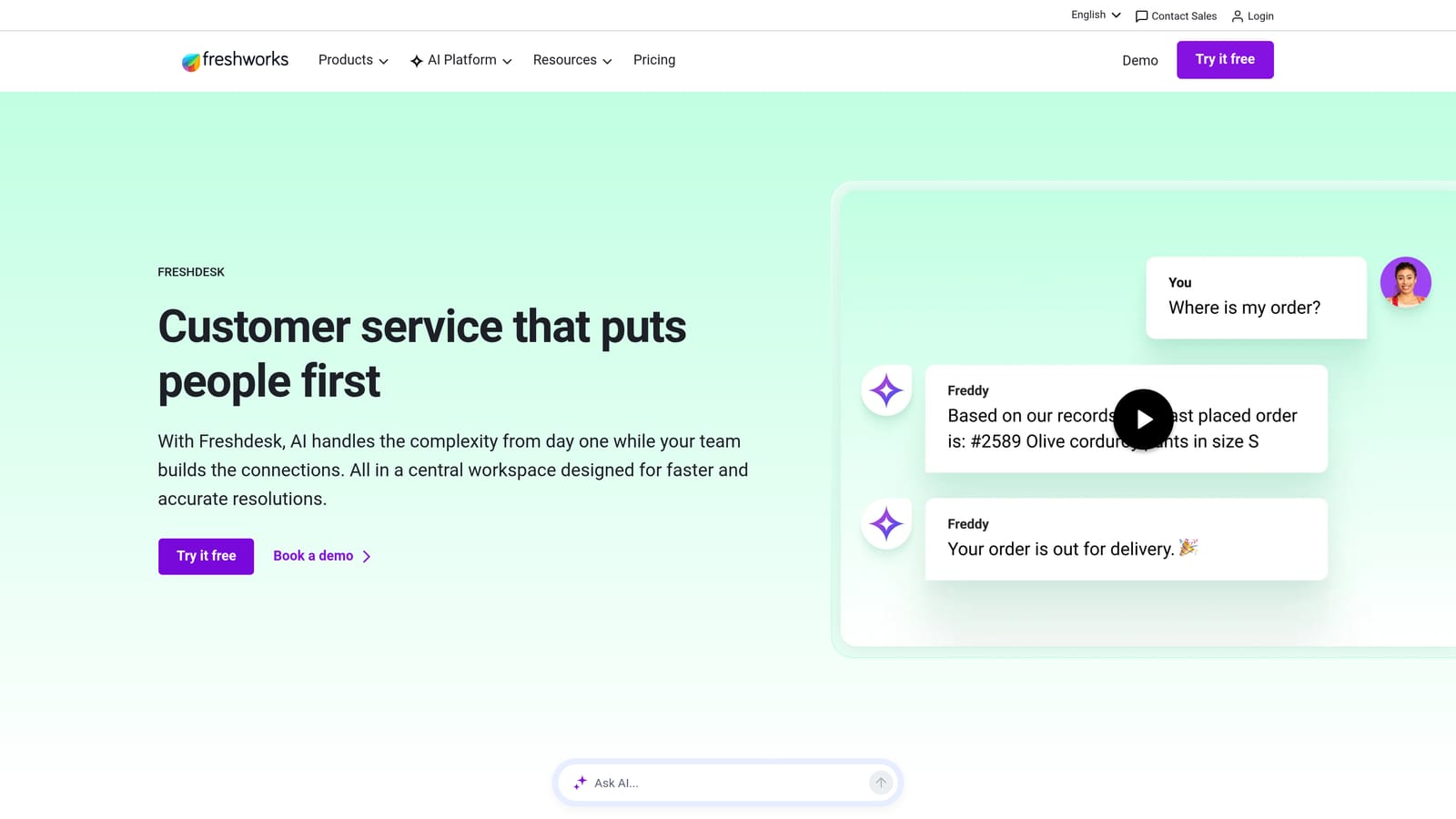
Freshdesk is a mid-market helpdesk platform with Freddy AI handling ticket summaries, suggested responses, and sentiment detection at more accessible price points.
Where This Tool Shines
Freshdesk occupies a practical middle ground: more AI capability than basic helpdesks, more accessible pricing than enterprise alternatives. Freddy AI handles the core AI tasks that matter most for support teams, including summarizing long ticket threads, suggesting responses, and detecting sentiment signals that indicate an escalation is needed.
For developer-facing teams, the integrations with Jira and Slack provide a functional bug escalation path. It won't match the native developer workflow integration depth of tools like Halo AI, but for teams that primarily need a solid omnichannel helpdesk with AI assistance, Freshdesk delivers reliable value.
Key Features
Freddy AI Suggested Replies: Recommends contextually relevant responses to reduce agent drafting time.
Ticket Summarization: Condenses complex ticket threads so agents can quickly understand the full context.
Sentiment Detection: Flags tickets with negative sentiment signals for priority handling.
Omnichannel Ticketing: Manages support across email, chat, phone, and social from a unified inbox.
Developer Tool Integrations: Connects with Jira, Slack, and other common engineering tools for escalation workflows.
Best For
Mid-market SaaS teams that want AI-assisted support at a manageable price point, particularly those already using Jira for engineering issue tracking.
Pricing
Free plan available. Paid plans start at $15 per agent per month. AI features are available on higher-tier plans.
6. Jira Service Management
Best for: Teams already embedded in the Atlassian ecosystem that want customer support tickets linked directly to engineering sprints in Jira Software.
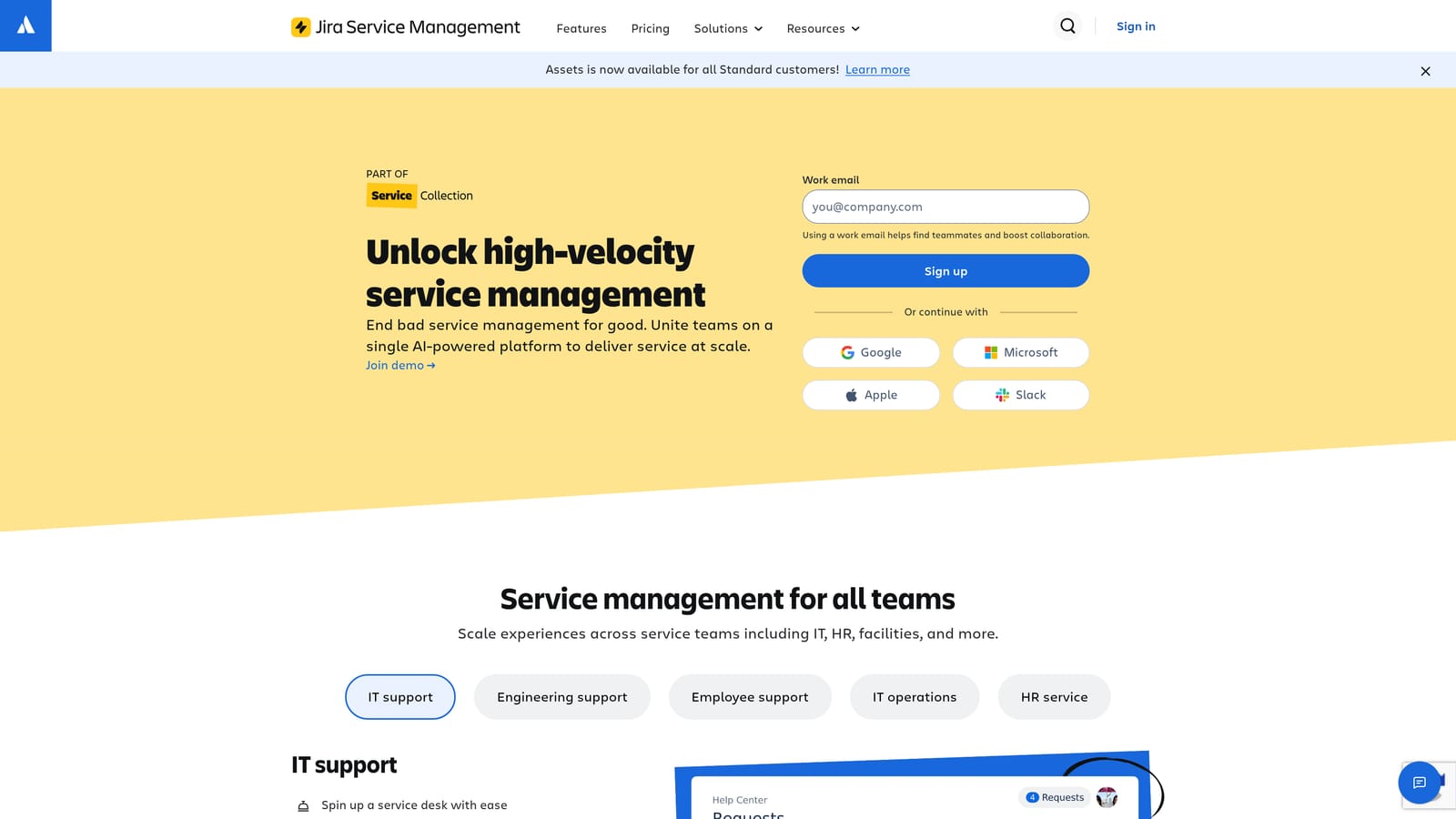
Jira Service Management is Atlassian's ITSM platform that connects customer support tickets directly to engineering workflows, with AI-powered virtual agent and smart triage capabilities.
Where This Tool Shines
For teams already using Jira Software for engineering, Jira Service Management's biggest advantage is the native link between customer support tickets and engineering issues. A support ticket can be directly associated with a Jira Software issue, giving engineering teams full visibility into what customers are experiencing while they work on a fix.
The virtual AI agent deployed via Slack or Microsoft Teams is a practical addition for internal IT support scenarios. The change management automation is also useful for developer teams coordinating releases, helping prevent support spikes around deployments.
Key Features
Virtual AI Agent: Handles support queries via Slack and Microsoft Teams with automated responses and routing.
Smart Triage: Links incoming support tickets to related Jira Software issues for engineering visibility.
Change Management Automation: Coordinates release-related workflows to reduce support impact during deployments.
Asset and Configuration Management: Tracks technical assets and configurations relevant to support context.
Atlassian Ecosystem Integration: Deep connections with Confluence, Bitbucket, and the broader Atlassian toolchain.
Best For
Engineering organizations already using Jira Software and Confluence that want customer support tightly integrated into their existing Atlassian workflows.
Pricing
Free for up to 3 agents. Paid plans start at $17.65 per agent per month.
7. Plain
Best for: Developer tools companies and API-first SaaS teams that want a clean, API-native support tool built specifically for technical teams.
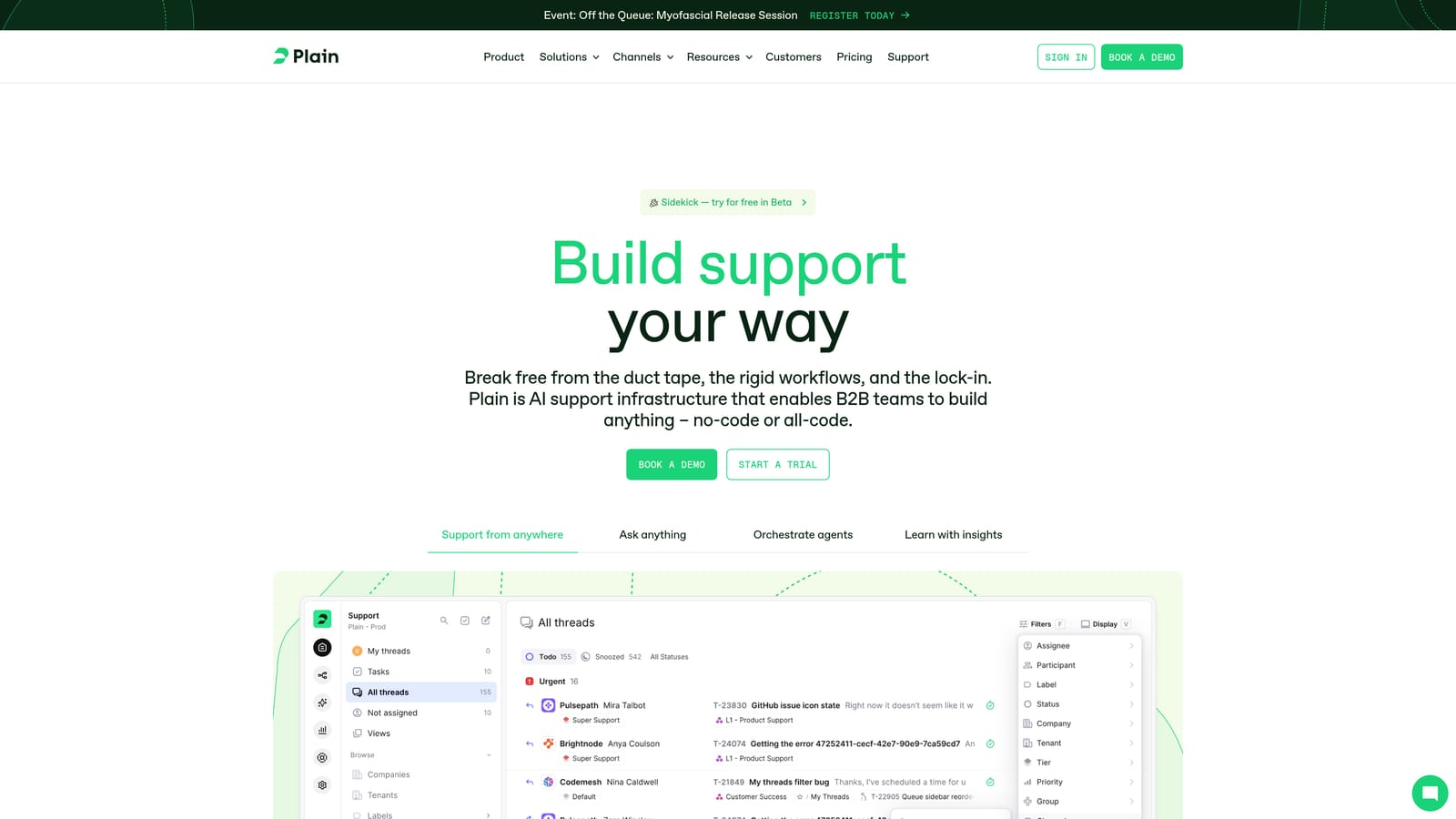
Plain is an API-native support tool built specifically for developer-facing companies, with a Slack-first workflow and a clean interface designed for technical teams who find legacy helpdesks bloated.
Where This Tool Shines
Plain was built with developer tools companies in mind, and that focus shows in every design decision. The API-first architecture means technical teams can build custom integrations and workflows without fighting against the tool's assumptions. Handling tickets directly from Slack, rather than switching to a separate helpdesk interface, fits naturally into how engineering-heavy teams already work.
The customer timeline gives support teams a clean view of every interaction a user has had, which is valuable when debugging complex technical issues that span multiple conversations. Plain doesn't try to be everything, and that restraint makes it genuinely fast and focused.
Key Features
API-First Architecture: Full GraphQL API and webhooks for building custom integrations and automation workflows.
Slack-Native Support: Handle and respond to customer tickets directly from Slack without leaving your engineering workspace.
Customer Timeline: Complete interaction history for each customer, giving support teams full context on technical issues.
Lightweight Interface: Fast, focused UI without the legacy helpdesk complexity that slows teams down.
Developer Customization: Webhooks and GraphQL API give technical teams full control over workflow automation.
Best For
Developer tools companies, API-first SaaS teams, and technical support teams that want a purpose-built tool with strong API access and Slack-native workflows rather than a traditional helpdesk interface.
Pricing
Starts at $200 per month for small teams, with pricing that scales based on usage and team size.
8. Kustomer
Best for: B2B teams that want customer support data unified with a full CRM timeline for account health visibility.
Kustomer is a CRM-meets-helpdesk platform that unifies customer support tickets with a complete customer timeline, using AI for routing, intent detection, and conversation summarization.
Where This Tool Shines
Kustomer's core differentiator is the unified customer timeline. Instead of viewing tickets in isolation, support agents see the full customer history: past conversations, account data, purchase history, and custom technical attributes all in one view. For B2B SaaS companies where a single customer might represent significant ARR, that context changes how support teams prioritize and respond.
The AI-powered routing and conversation summarization reduce the manual overhead of managing complex, multi-touch support cases. Custom objects allow teams to store technical account data, like API usage patterns or integration configurations, directly in the customer record.
Key Features
Unified Customer Timeline: Combines support tickets with full CRM data for complete customer context in every conversation.
AI-Powered Routing: Routes conversations based on detected intent and customer data attributes.
Conversation Summarization: Automatically summarizes long conversations to speed up agent handoffs.
Omnichannel Inbox: Manages email, chat, SMS, and social support in a unified view.
Custom Objects: Store technical account data, integration details, and custom fields directly in customer records.
Best For
B2B SaaS teams with high-value accounts where support context and customer health data need to be unified, and teams that want CRM functionality built into their support platform.
Pricing
Enterprise plan starts at $89 per agent per month, positioning Kustomer at the higher end of the mid-market range.
9. Tidio (Lyro AI)
Best for: Early-stage SaaS teams that need an accessible entry point into AI-powered ticket resolution without enterprise-level costs.
Tidio is an accessible AI support platform with its Lyro AI agent handling repetitive ticket resolution, designed as a practical starting point for smaller teams with limited budgets.
Where This Tool Shines
Tidio's value proposition is accessibility. Lyro AI handles repetitive, high-volume queries well, freeing up small support teams to focus on the complex issues that genuinely require human judgment. For early-stage SaaS companies that are still figuring out their support volume and ticket patterns, Tidio provides a low-risk way to introduce AI resolution without significant investment.
Setup is intentionally lightweight, which is a genuine advantage for teams without dedicated support operations resources. The trade-off is that Lyro is better suited to handling common, repetitive queries than technically complex developer support tickets involving stack traces or API errors.
Key Features
Lyro AI Agent: Handles automated resolution of repetitive, high-volume support queries with minimal setup.
Unified Inbox: Combines live chat and email ticketing in a single interface.
AI Conversation Analytics: Tracks AI performance and resolution rates to identify improvement areas.
Pre-Built Integrations: Connects with common SaaS tools, Shopify, and WordPress out of the box.
Quick Setup: Minimal technical configuration required, making it accessible for non-technical teams.
Best For
Early-stage SaaS companies and small teams that want to introduce AI ticket resolution quickly and affordably, particularly those with high volumes of repetitive queries rather than complex technical support cases.
Pricing
Free plan available. Lyro AI starts at $29 per month, with pricing that scales with conversation volume.
Which Tool Is Right for Your Team?
The right AI ticketing system depends heavily on where your team sits today: your current toolstack, ticket complexity, team size, and how much engineering involvement your support workflow requires.
For teams that want the most developer-native experience, a few tools stand out for different reasons. Halo AI is the strongest fit if you want AI-first architecture with page-aware context, automatic bug ticket creation into Linear, and business intelligence that goes beyond support metrics. It's purpose-built for the exact scenario where a user files a technically complex ticket and your team needs context, routing, and resolution to happen automatically.
Plain is worth serious consideration for developer tools companies that want API-native flexibility and Slack-first workflows without legacy helpdesk overhead. Jira Service Management makes the most sense if your team is already deep in the Atlassian ecosystem and wants support tickets linked directly to engineering sprints.
Here's a quick reference to help narrow your decision:
AI-native architecture with bug automation: Halo AI
Enterprise teams with existing Zendesk infrastructure: Zendesk with AI
PLG SaaS with high chat volume: Intercom
Engineering issue tracking destination: Linear
Mid-market teams on a budget: Freshdesk
Atlassian-embedded organizations: Jira Service Management
API-first developer tools companies: Plain
B2B teams needing CRM and support unified: Kustomer
Early-stage teams with limited budgets: Tidio
Your support team shouldn't scale linearly with your customer base. Let AI agents handle routine tickets, guide users through your product, and surface business intelligence while your team focuses on complex issues that need a human touch. See Halo in action and discover how continuous learning transforms every interaction into smarter, faster support.