9 Best AI vs Traditional Customer Service Tools: Which Approach Wins in 2026?
This comprehensive guide compares 9 leading customer service platforms across the full ai vs traditional customer service spectrum, evaluating AI-first tools, legacy helpdesks with AI layers, and hybrid solutions to help businesses determine the right automation balance for their support operations.
 Grant CooperFounder14 min read
The debate between AI and traditional customer service isn't really a debate anymore. It's a spectrum, and the real question is where your business should sit on it. Some companies still rely entirely on human agents. Others have gone fully autonomous. Most are somewhere in between, trying to figure out which tickets to automate and which ones still need a human voice.
This guide covers tools that represent both ends of that spectrum: AI-first platforms built to resolve tickets without human intervention, traditional helpdesks that are layering AI on top of existing infrastructure, and hybrid solutions that let you dial the ratio up or down. Whether you're evaluating a full migration to AI support or just looking to automate your most repetitive tickets, this comparison will help you understand what each approach actually delivers and where the tradeoffs live.
Selection criteria: scalability, automation depth, integration ecosystem, pricing transparency, and real-world fit for B2B SaaS teams.
1. Halo AI
Best for: B2B SaaS teams wanting autonomous AI support with business intelligence built in
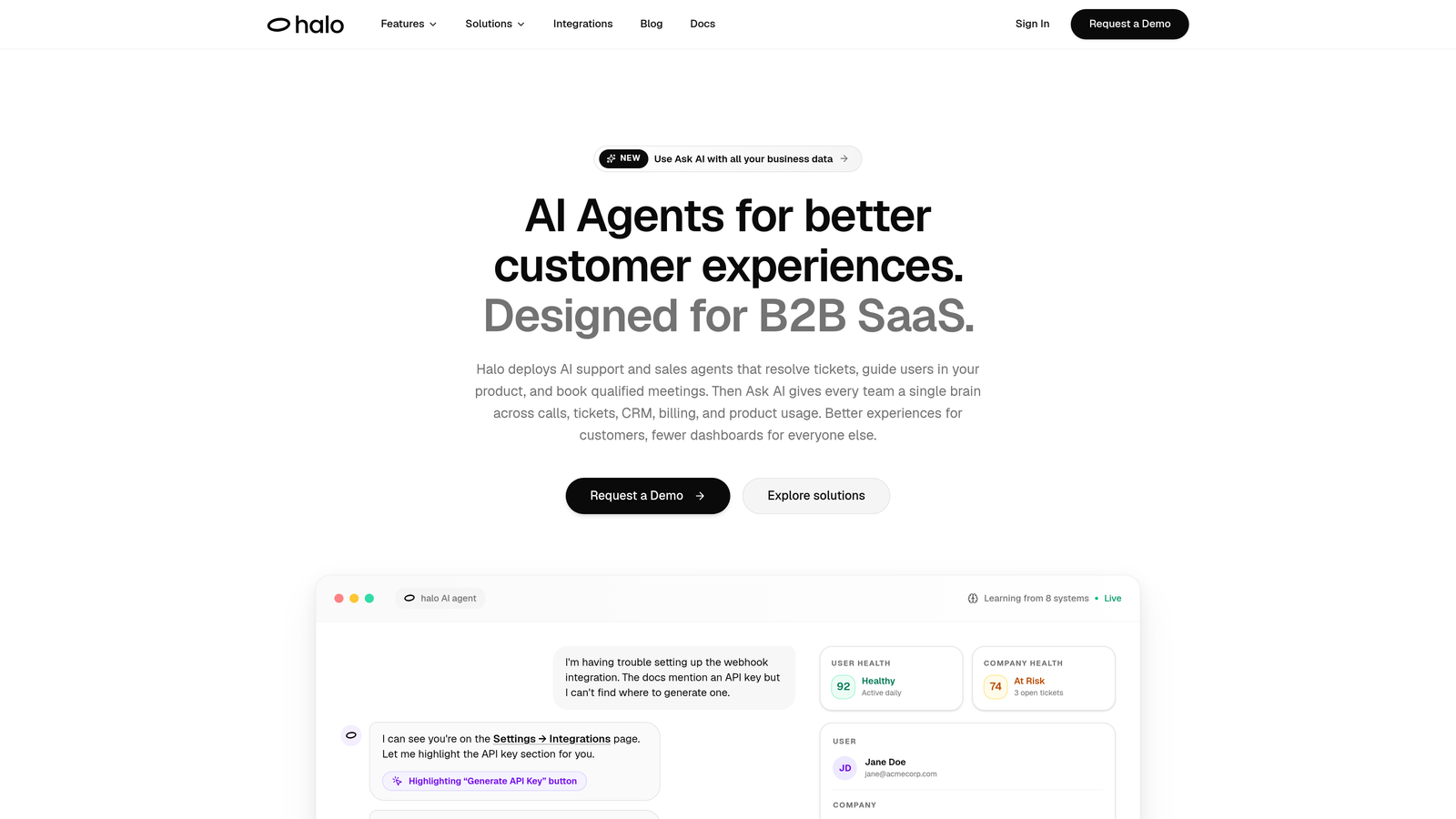
Halo AI is an AI-first customer support platform that deploys autonomous agents to resolve tickets, guide users through your product with page-aware context, and surface business intelligence — all while learning from every interaction.
Where This Tool Shines
Halo was built as an AI-native platform, not a traditional helpdesk with AI bolted on afterward. That architectural difference matters. The platform is designed around autonomous resolution as the default, with human escalation as the exception for genuinely complex issues that require judgment or relationship context.
The standout capability here is page-aware context. Halo's chat widget actually sees what the user is looking at, which means it can provide visual, contextual guidance rather than generic answers. For SaaS product teams, this is a meaningful differentiator. Add the auto bug ticket creation that routes directly to Linear or your issue tracker, and you have a support layer that feeds directly into your product development workflow.
Key Features
Page-Aware AI Chat Widget: The AI sees what the user is currently viewing and provides contextual visual guidance specific to that screen or workflow.
Autonomous Ticket Resolution: AI agents handle tickets end-to-end with intelligent live agent handoff for complex or sensitive issues that need a human.
Auto Bug Ticket Creation: Automatically identifies and routes bug reports directly to Linear or your preferred issue tracker, closing the loop between support and product.
Smart Inbox with Business Intelligence: Goes beyond support metrics to surface customer health signals, anomaly detection, and revenue intelligence from your support interactions.
Broad Integration Ecosystem: Connects with Slack, HubSpot, Intercom, Stripe, Zoom, PandaDoc, Fathom, and more, plugging into your existing business stack rather than replacing it.
Best For
B2B SaaS teams whose ticket volume is growing faster than their headcount budget. Particularly strong for product-led growth companies where users need in-app guidance and where support data should be feeding back into product decisions, not sitting in a siloed helpdesk.
Pricing
Contact for pricing. Halo is designed specifically for B2B SaaS teams, so pricing is structured around your use case rather than a generic per-seat model.
2. Zendesk
Best for: Large organizations with complex agent workflows and compliance requirements
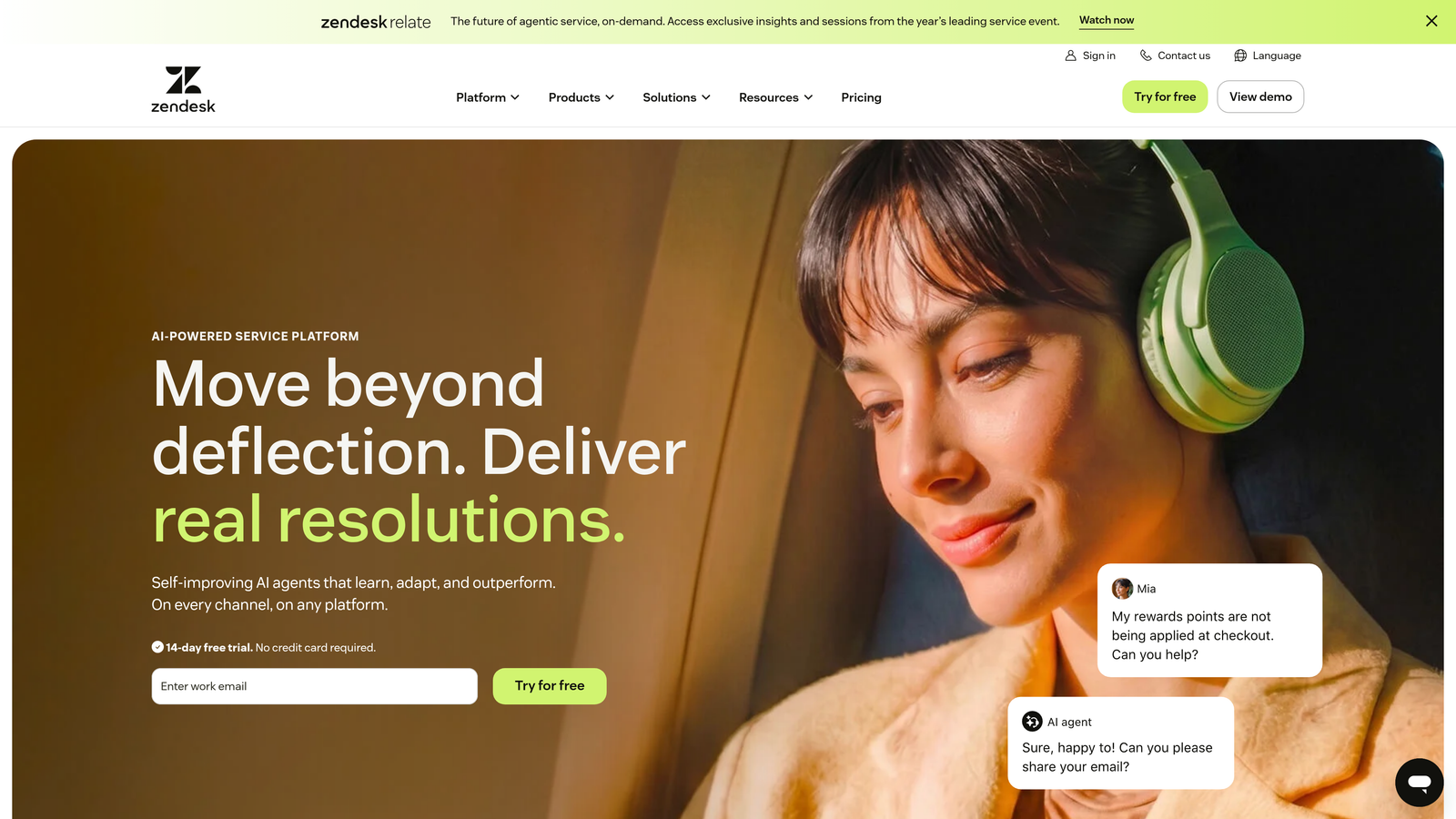
Zendesk is the market-leading traditional helpdesk with mature ticketing infrastructure and AI capabilities layered on through Zendesk AI.
Where This Tool Shines
Zendesk's strength is its depth. Years of development have produced a genuinely robust ticketing engine with sophisticated routing rules, SLA management, and workflow automation built for large agent teams. If you have 50 or 500 support agents and need enterprise-grade compliance controls, Zendesk has the infrastructure to support it.
The AI additions through Zendesk AI (built on an OpenAI partnership) add intelligent triage, suggested replies, and AI agents into the existing workflow. The key distinction: Zendesk is still fundamentally agent-centric. The AI assists and accelerates human agents rather than replacing them as the primary resolver. For teams where that's the right model, it works well.
Key Features
Zendesk AI: Intelligent triage, suggested replies, and AI-powered agents that assist human agents rather than operate fully autonomously.
Workflow Automation: Robust routing rules, triggers, and automations built for complex, multi-team support operations.
App Marketplace: Hundreds of integrations covering virtually every business tool your team might already use.
Omnichannel Support: Email, chat, phone, social, and messaging channels unified in one platform.
Advanced Reporting and SLA Management: Enterprise-grade compliance and reporting tools for organizations with strict service level requirements.
Best For
Large enterprises and mid-market companies with established agent teams, complex workflow requirements, and compliance obligations. Less well-suited for lean SaaS teams looking for autonomous AI resolution without significant per-seat overhead.
Pricing
Suite plans start at approximately $55 per agent per month (billed annually). Costs scale with seat count, which can add up quickly for growing teams.
3. Intercom
Best for: SaaS companies already in the Intercom ecosystem wanting AI-powered autonomous resolution
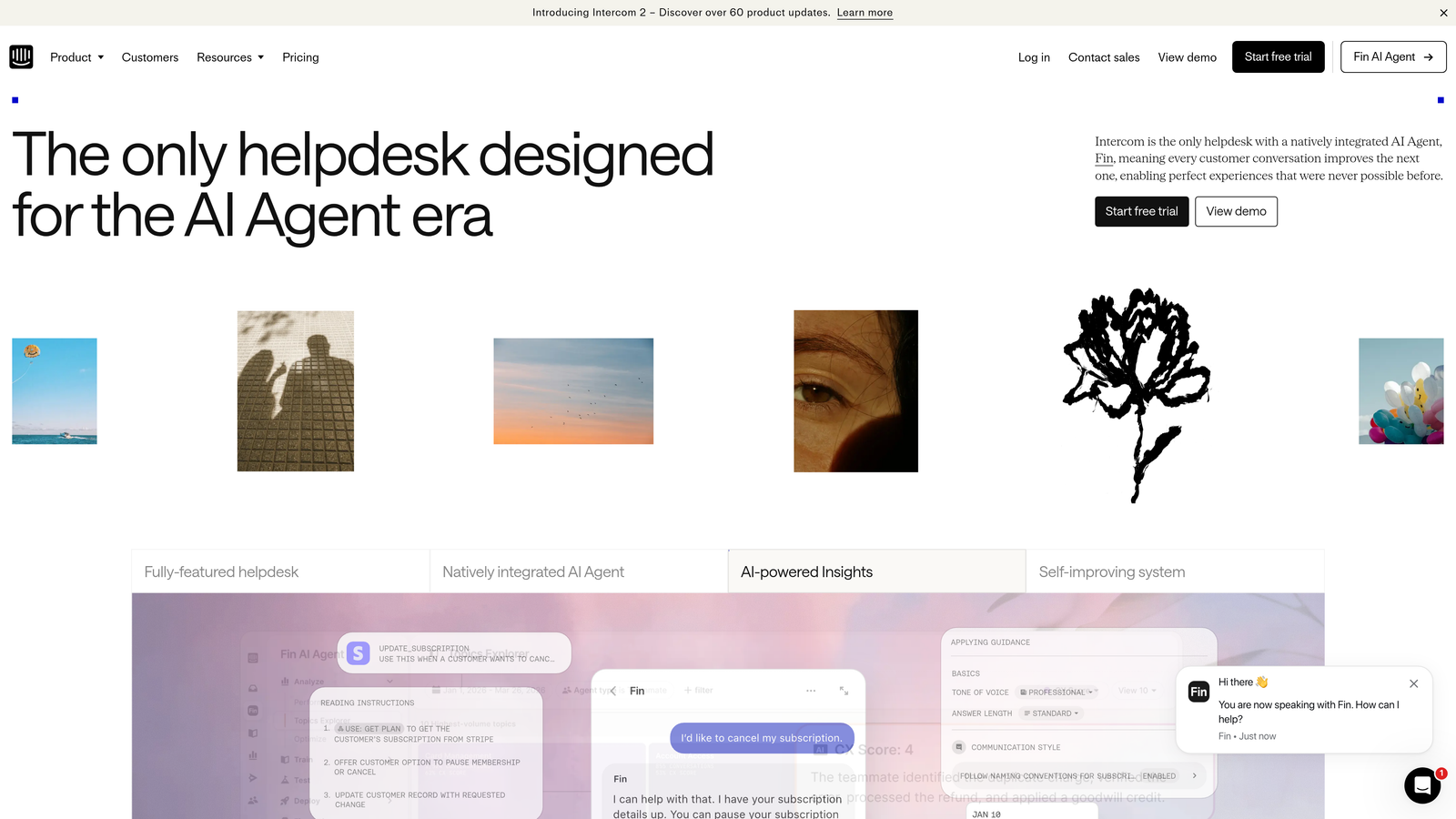
Intercom is a conversational support platform with Fin, their AI agent built to resolve customer queries autonomously within the Intercom messenger.
Where This Tool Shines
Intercom has positioned itself aggressively as an AI-first customer service platform, and Fin is the centerpiece of that positioning. Fin can handle a meaningful share of common queries autonomously across chat, email, and messaging channels without human involvement. For SaaS teams already using Intercom for product messaging and in-app communication, adding Fin is a natural extension of an existing workflow.
The unified inbox that combines AI-handled and human-handled conversations is genuinely useful for teams managing the transition from mostly-human to mostly-AI support. You can see exactly what Fin is resolving and where it's handing off, which makes tuning the system straightforward.
Key Features
Fin AI Agent: Autonomous query resolution across chat, email, and messaging channels, drawing on your help content and knowledge base.
Unified Inbox: Combines AI-handled and human-handled conversations in a single view for seamless handoffs and oversight.
Product Tours and In-App Messaging: Proactive support and onboarding flows built directly into the messenger.
Help Center Builder: Robust knowledge base creation with content that Fin uses directly to answer questions.
SaaS and CRM Integrations: Deep connections with popular SaaS tools, CRMs, and the broader Intercom ecosystem.
Best For
SaaS companies already using Intercom for product communication who want to extend that investment into autonomous support. Teams evaluating a fresh implementation should weigh the pricing structure carefully, as Fin AI is billed separately per resolution.
Pricing
Essential plan starts at approximately $39 per seat per month. Fin AI usage is billed separately based on resolutions, which means costs can vary significantly with volume.
4. Freshdesk
Best for: SMBs wanting traditional helpdesk functionality with optional AI assistance at accessible pricing
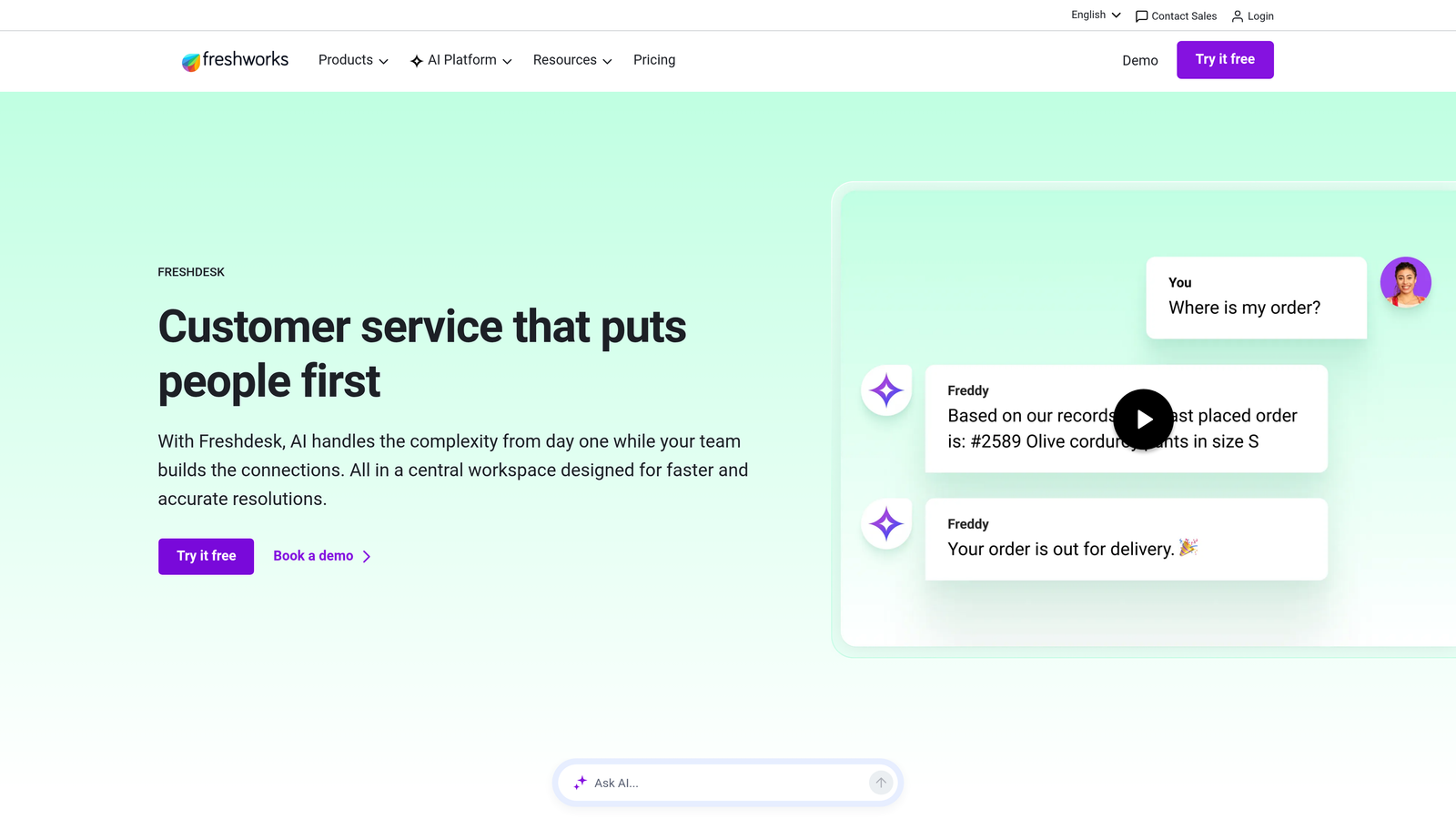
Freshdesk is an affordable traditional helpdesk from Freshworks with Freddy AI as an optional automation and agent assistance layer.
Where This Tool Shines
Freshdesk's strongest card is accessibility. The free plan is genuinely functional for small teams, and the paid tiers are priced well below Zendesk for comparable core ticketing features. For SMBs that need a solid shared inbox with collision detection, multi-channel support, and basic automation, Freshdesk delivers without enterprise pricing.
Freddy AI sits on top of the traditional ticketing architecture as an assist layer: suggested responses, ticket summarization, and basic automation. It's AI-augmented rather than AI-native, which is the right model for teams that aren't ready to hand resolution over to an AI agent but want to reduce the manual work their human agents do.
Key Features
Freddy AI: Suggested responses, ticket summarization, and basic automation to accelerate human agents rather than replace them.
Traditional Ticketing: Shared inbox with collision detection, private notes, and team collaboration built for human agent workflows.
Multi-Channel Support: Email, phone, chat, and social media channels in one platform.
Marketplace Integrations: Connections with popular business tools across CRM, billing, and communication categories.
Free Plan: A functional entry tier for small teams that want to get started without a budget commitment.
Best For
Small to mid-sized businesses wanting a cost-effective traditional helpdesk with AI assistance available when needed. Also a reasonable starting point for teams new to structured support tooling who aren't yet ready for a fully AI-native platform.
Pricing
Free plan available for up to 10 agents. Paid plans start at approximately $15 per agent per month, making it one of the more accessible options in this category.
5. Salesforce Service Cloud
Best for: Enterprise organizations already running on the Salesforce platform
Salesforce Service Cloud is enterprise-grade customer service built natively into the Salesforce CRM ecosystem, with Einstein AI powering intelligent automation.
Where This Tool Shines
If your entire organization runs on Salesforce, Service Cloud is the obvious choice for support. The unified customer record combining support history with full CRM data is genuinely powerful: your support agents see the complete account picture, including sales history, open opportunities, and marketing interactions, right alongside the support conversation.
Einstein AI handles case classification, next best action recommendations, and predictive routing. The depth of customization through Flow and Apex means you can build extremely sophisticated workflows. The tradeoff is implementation complexity and cost, which make Service Cloud a poor fit for most SaaS startups and mid-market companies that aren't already invested in the Salesforce ecosystem.
Key Features
Einstein AI: Case classification, next best action recommendations, and predictive routing built into the Salesforce platform.
Unified Customer Record: Full CRM context alongside every support interaction, combining sales, marketing, and support history.
Omni-Channel Routing: Intelligent routing across voice, digital, and field service channels.
Extensive Customization: Flow and Apex tools for building complex enterprise workflows beyond what standard configurations support.
Native Salesforce Integration: Deep connections with Sales Cloud, Marketing Cloud, and the broader Salesforce platform.
Best For
Large enterprises already committed to the Salesforce ecosystem. Significant overkill for SaaS startups or mid-market teams without existing Salesforce infrastructure, given the implementation cost and complexity.
Pricing
Starter Suite from approximately $25 per user per month. Enterprise and Unlimited plans are significantly higher, and implementation costs can add substantially to the total investment.
6. Gorgias
Best for: E-commerce brands running on Shopify, WooCommerce, or BigCommerce
Gorgias is an AI-powered support platform purpose-built for e-commerce brands, with deep integrations into major e-commerce platforms and the ability to take direct order actions.

Where This Tool Shines
Gorgias solves a specific problem extremely well: e-commerce support where the majority of tickets are about orders. The AI doesn't just answer questions about orders, it can actually process refunds, cancel orders, and update shipping information directly from the support interface. For high-volume DTC brands, that's a meaningful operational capability.
The Shopify integration is particularly deep, surfacing full order data directly in the support view so agents never have to toggle between platforms. Revenue statistics tied to support conversations also give e-commerce teams visibility into how support interactions affect purchasing behavior. Worth noting: Gorgias is purpose-built for e-commerce and is less relevant for B2B SaaS teams.
Key Features
Action-Taking AI: AI that can process refunds, cancel orders, and update shipping information directly, not just answer questions about them.
Deep Shopify Integration: Full order data surfaced directly in the support view without platform switching.
Automated E-Commerce Responses: Pre-built automations for the most common e-commerce queries: order status, returns, and tracking.
Revenue Attribution: Statistics connecting support conversations to revenue impact.
Multi-Channel Inbox: Email, chat, social DMs, and SMS unified in one view.
Best For
E-commerce brands on Shopify, WooCommerce, or BigCommerce with high ticket volumes around order management. Not designed for B2B SaaS teams, but included here to illustrate how AI support tools are being purpose-built for specific verticals.
Pricing
Starter plan from approximately $10 per month. Pricing scales by ticket volume rather than seat count, which suits e-commerce teams with variable support demand.
7. Help Scout
Best for: Teams where personal, relationship-driven support is a core brand differentiator
Help Scout is a human-first support platform that uses AI as a drafting and summarization aid rather than an autonomous resolver.
Where This Tool Shines
Help Scout is philosophically distinct from most tools on this list. It's designed for teams that have made a deliberate choice to keep humans at the center of every support interaction. The AI features (AI Assist for drafting replies, summarizing threads, and adjusting tone) are explicitly positioned as tools that make human agents more effective, not replacements for them.
For companies where support is a genuine brand differentiator, where customers expect a thoughtful human response and would notice the difference, Help Scout's approach makes real sense. The Beacon widget adds in-app help center access and proactive messaging without pushing the product toward autonomous resolution.
Key Features
AI Assist: Drafts replies, summarizes long threads, and adjusts tone to help agents respond faster without removing the human voice.
Beacon Widget: In-app help center access and proactive messaging for contextual self-service without full AI chat.
Shared Inbox: Collision detection, private notes, and team collaboration features designed for human agent workflows.
Docs Knowledge Base: Built-in knowledge base with search, integrated with Beacon for self-service support.
Customer Data Sidebar: Account context and conversation history surfaced alongside every ticket.
Best For
Teams that have deliberately chosen relationship-driven support as a brand differentiator and want AI to assist rather than replace their agents. Also a solid choice for companies in regulated industries where human oversight of every interaction is required.
Pricing
Standard plan from approximately $22 per user per month. Straightforward per-seat pricing without the complexity of usage-based AI add-ons.
8. Tidio
Best for: Smaller teams wanting to test AI-powered chat without enterprise pricing or complexity
Tidio is an accessible AI chat platform with Lyro, their AI chatbot, designed for smaller teams entering AI-powered support for the first time.
Where This Tool Shines
Tidio's value proposition is accessibility. The free plan gets you started, Lyro AI is available at a price point that doesn't require a budget approval process, and the visual chatbot builder means you don't need technical resources to set up custom conversation flows. For a small team that wants to experience what AI-powered chat actually feels like in production, Tidio is a low-friction entry point.
Lyro works by drawing on your existing help content to answer questions, which means the quality of your knowledge base directly affects the quality of the AI's responses. The live chat handoff between bot and human agent is clean and quick, which matters for teams that aren't ready to fully automate and want a safety net.
Key Features
Lyro AI Chatbot: Automated query handling based on your help content, with a straightforward setup process that doesn't require technical configuration.
Live Chat with Handoff: Clean transition between AI handling and human agent for conversations that exceed the bot's scope.
Visual Chatbot Builder: No-code tool for creating custom conversation flows and routing logic.
E-Commerce Integrations: Connections with Shopify, WooCommerce, and PrestaShop for teams selling online.
Basic Analytics: Conversation volume, resolution rates, and agent performance metrics for teams getting started with support data.
Best For
Small teams and startups wanting to test AI chat without enterprise pricing. A practical starting point before committing to a more sophisticated platform, though teams with significant scale requirements will likely outgrow it.
Pricing
Free plan available. Lyro AI from approximately $29 per month based on conversation volume, making it one of the most accessible AI chat options available.
9. Kustomer
Best for: High-volume teams needing rich customer context alongside every conversation
Kustomer is a CRM-style support platform with AI-powered workflow automation, now part of Meta, designed for teams that need a complete customer timeline alongside every support interaction.
Where This Tool Shines
Kustomer's defining feature is the unified customer timeline: every interaction, order, and piece of history consolidated in one view. For high-volume support teams handling complex customer relationships, having that context immediately available changes how agents approach conversations. You're not just answering a ticket in isolation; you're responding with full knowledge of the customer's history.
The Meta acquisition has added a meaningful advantage: deeper WhatsApp Business integration than most competing platforms can offer. For companies with significant customer bases on WhatsApp, that's a practical differentiator. The AI-powered workflow automation handles routing, tagging, and suggested responses across a genuinely omnichannel inbox.
Key Features
Unified Customer Timeline: All interactions, orders, and history consolidated in a single view alongside every support conversation.
AI-Powered Workflow Automation: Intelligent routing, tagging, and suggested responses across all channels.
Omnichannel Inbox: Email, chat, voice, SMS, social, and WhatsApp in one unified interface.
No-Code Workflow Builder: Business process automation without requiring engineering resources for standard configurations.
Deep WhatsApp Integration: Native Meta ownership enables tighter WhatsApp Business integration than most competing platforms.
Best For
High-volume support teams that need rich customer context alongside every conversation and want a CRM-style experience without a full Salesforce implementation. Particularly relevant for teams with significant WhatsApp customer bases.
Pricing
Enterprise plan from approximately $89 per user per month, positioning Kustomer at the higher end of the market. Best suited for teams where the context richness justifies the investment.
Which Tool Is Right for Your Team?
The right choice depends less on which tool has the most features and more on where your team sits on the AI-to-human spectrum right now, and where you want to be in 12 months.
If you're a B2B SaaS team whose ticket volume is growing faster than your headcount budget, an AI-native platform is worth serious consideration. Halo AI is purpose-built for this scenario: autonomous resolution, page-aware guidance, and a business intelligence layer that turns support data into product and revenue signals. It's not just a ticket deflector; it's a system that learns and improves with every interaction.
If you're a large enterprise with complex compliance requirements and an established agent team, Zendesk or Salesforce Service Cloud gives you the infrastructure depth those situations demand. The AI features are useful, but the real value is the workflow control and auditability.
If you're in transition, still figuring out which tickets to automate and which to keep human, Intercom's Fin or Freshdesk with Freddy AI let you dial that ratio gradually. Help Scout is the right call if personal support is genuinely a brand differentiator and you want AI to assist rather than replace your agents. Tidio is the lowest-friction entry point if you're a smaller team that just wants to see what AI chat feels like in production.
Your support team shouldn't scale linearly with your customer base. Let AI agents handle routine tickets, guide users through your product, and surface business intelligence while your team focuses on the complex issues that need a human touch. See Halo in action and discover how continuous learning transforms every interaction into smarter, faster support.