9 Best AI vs Traditional Helpdesk Software Options Compared in 2026
This comprehensive comparison of AI vs traditional helpdesk software evaluates nine leading platforms across both categories, helping support teams identify the right fit based on volume, team size, and budget. From AI-native tools that automate tier-1 tickets to legacy systems with deep customization, the guide covers pricing, use cases, and where each approach genuinely outperforms the other.
 Grant CooperFounder13 min read
If you're still routing every support ticket through a human queue, you're likely falling behind. The debate between AI-powered support platforms and traditional helpdesk software has shifted from "if" to "which," and the options are more varied than ever. Whether you're a lean SaaS team looking to automate tier-1 tickets or an enterprise needing deep customization, the right choice depends on your support volume, team size, and growth trajectory.
This guide breaks down the top tools across both categories so you can see exactly where each one fits, what it costs, and who it's built for. We've also included our take on where AI-native platforms outperform legacy helpdesks and where traditional tools still hold their own. For more context on the broader landscape, check out our overview of AI helpdesk software and automated customer support.
AI-Native vs. Traditional: What's Actually Different in 2026
The customer support software market splits into two broad categories. Traditional helpdesks like Zendesk and Freshdesk are ticket-based, human-routed systems with rule-driven automation. They've added AI as a bolt-on layer to their existing infrastructure, which means the core architecture is still built around a human handling every ticket.
AI-native platforms are built from the ground up to resolve tickets without human intervention, escalating only when necessary. The key differentiator is architecture: AI-first versus AI-added. That distinction matters most when you're evaluating ticket deflection rates, time-to-resolution, and total cost of ownership against headcount costs.
With that framing in mind, here's how the leading options stack up.
1. Halo AI
Best for: SaaS and B2B teams that want autonomous ticket resolution with continuous learning
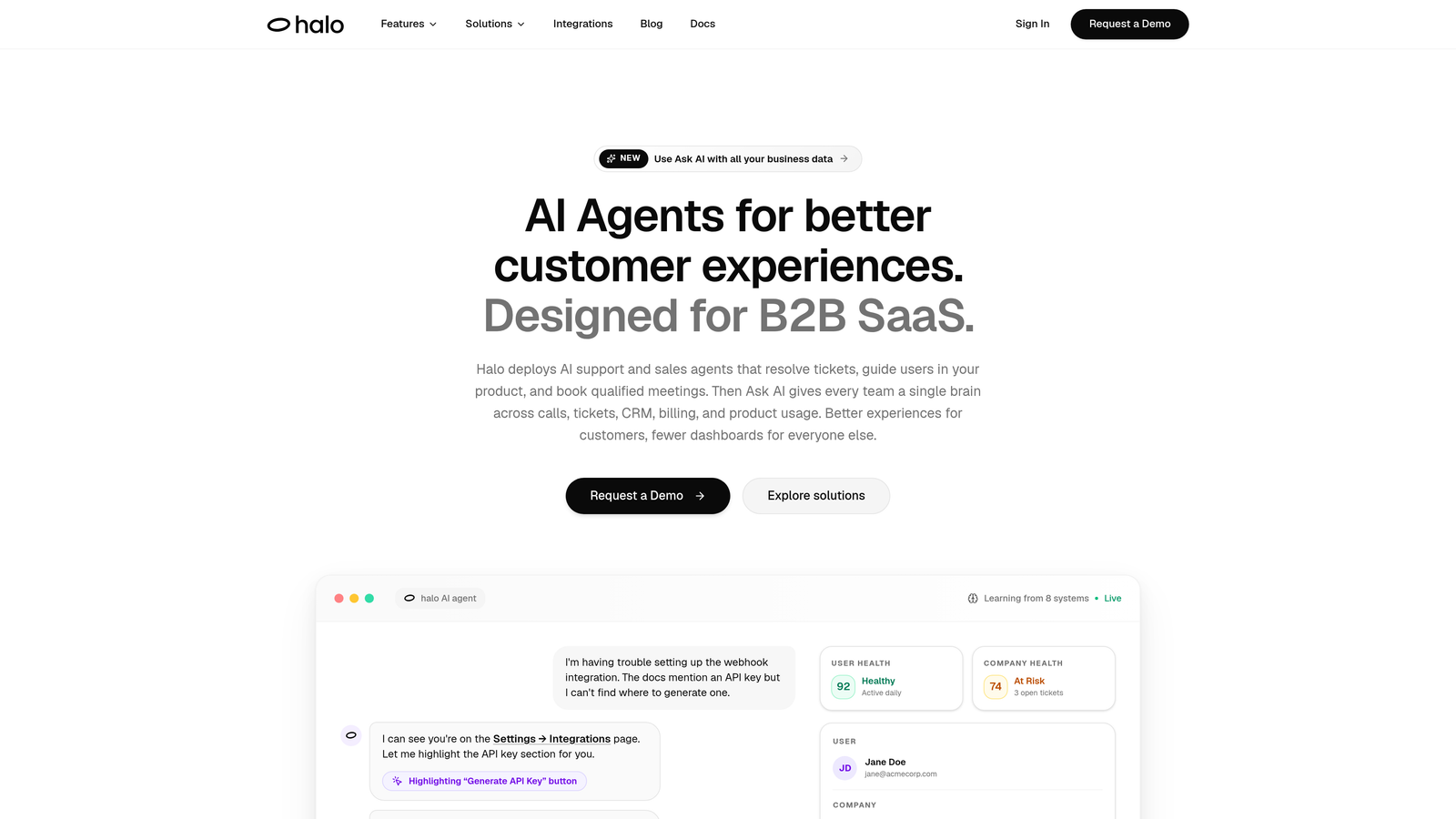
Halo AI is an AI-first customer support platform that deploys autonomous agents to resolve tickets, guide users through your product with page-aware context, and surface business intelligence across your entire support operation.
Where This Tool Shines
What separates Halo from most tools on this list is architecture. It isn't a traditional helpdesk with AI features layered on top. The entire platform is built around the idea that AI agents should resolve tickets end-to-end, escalating to humans only when a situation genuinely requires judgment. Every interaction feeds back into the system, so the agents get smarter over time without manual retraining.
The page-aware chat widget is a standout capability. Rather than offering generic responses, Halo's widget sees what the user is looking at in your product and delivers guidance that's specific to their current context. Combined with a smart inbox that surfaces customer health signals and revenue anomalies, Halo functions as more than a support tool. It becomes a source of business intelligence.
Key Features
Autonomous AI Agents: Resolve tickets end-to-end without human involvement, handling common support requests at scale.
Page-Aware Chat Widget: Sees what the user sees on screen, enabling precise, context-specific guidance rather than generic FAQ responses.
Smart Inbox with Business Intelligence: Surfaces customer health signals, revenue anomalies, and product insights directly from support interactions.
Auto Bug Ticket Creation: Automatically identifies and routes product issues to Linear, closing the loop between support and engineering.
Live Agent Handoff: Escalates seamlessly to human agents when a conversation requires judgment, with full context preserved.
Broad Integration Stack: Connects with Slack, HubSpot, Intercom, Stripe, Zoom, PandaDoc, Fathom, and more.
Best For
SaaS companies and B2B product teams that want to automate tier-1 and tier-2 tickets without growing headcount, particularly those who need their support platform to integrate deeply with their CRM, billing, and engineering tools. Less suited for teams that prefer a fully manual, human-first support philosophy.
Pricing
Contact for pricing. Visit haloagents.ai for current plan details and to request a demo.
2. Zendesk
Best for: Enterprise teams needing mature ticketing, SLA management, and compliance controls
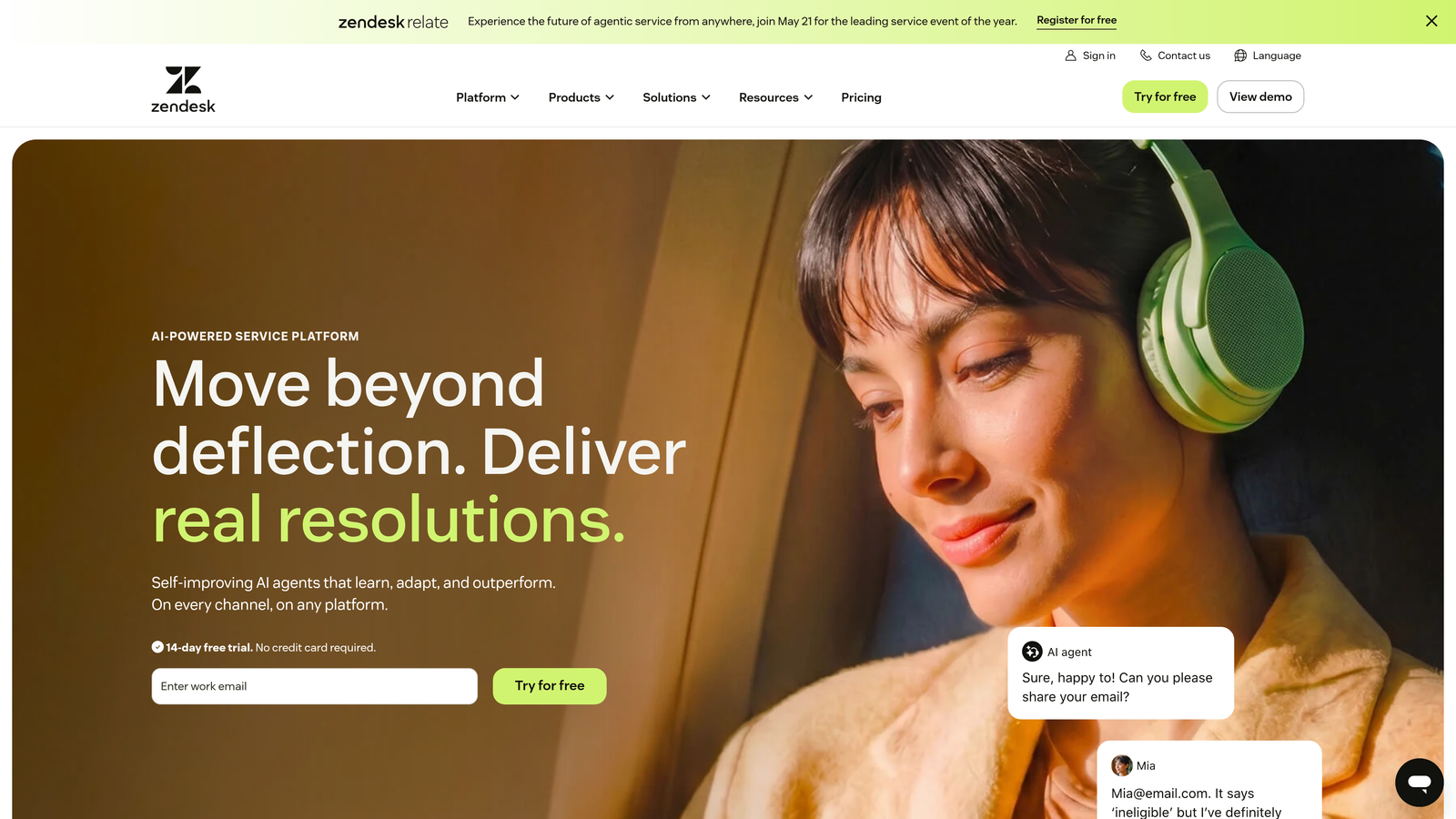
Zendesk is the market-leading traditional helpdesk platform, offering enterprise-grade ticketing with AI capabilities added through its Zendesk AI layer.
Where This Tool Shines
Zendesk has the most mature ticketing infrastructure in the category. SLA management, escalation workflows, and compliance controls are all deeply built out, which makes it a reliable choice for large support organizations with complex operational requirements. Its app marketplace is extensive, and the reporting capabilities are strong.
The Zendesk AI layer, powered by an OpenAI partnership, adds intelligent triage, agent suggestions, and automated responses. It's capable, but it's worth understanding that AI here is an enhancement to the existing ticket-based architecture, not a replacement for it. Teams that need autonomous resolution at scale may find the AI features require significant configuration to deliver results.
Key Features
Advanced SLA and Escalation Workflows: Mature tooling for managing ticket priorities, response times, and escalation paths.
Zendesk AI: Intelligent triage, agent assist suggestions, and automated responses built on top of the core ticketing system.
1,000+ App Marketplace: Extensive integrations covering virtually every tool in a modern support stack.
Robust Reporting Dashboards: Customizable analytics for tracking team performance, ticket volume, and customer satisfaction.
Enterprise-Grade Compliance: Security controls and compliance certifications suited for regulated industries.
Best For
Mid-market and enterprise teams with high ticket volumes, complex SLA requirements, and a need for deep customization. Organizations already invested in the Zendesk ecosystem will find the most value here.
Pricing
Starts at approximately $55 per agent per month for Suite Team. AI features are available on higher-tier plans.
3. Intercom
Best for: SaaS companies that use one platform for support, onboarding, and in-app messaging
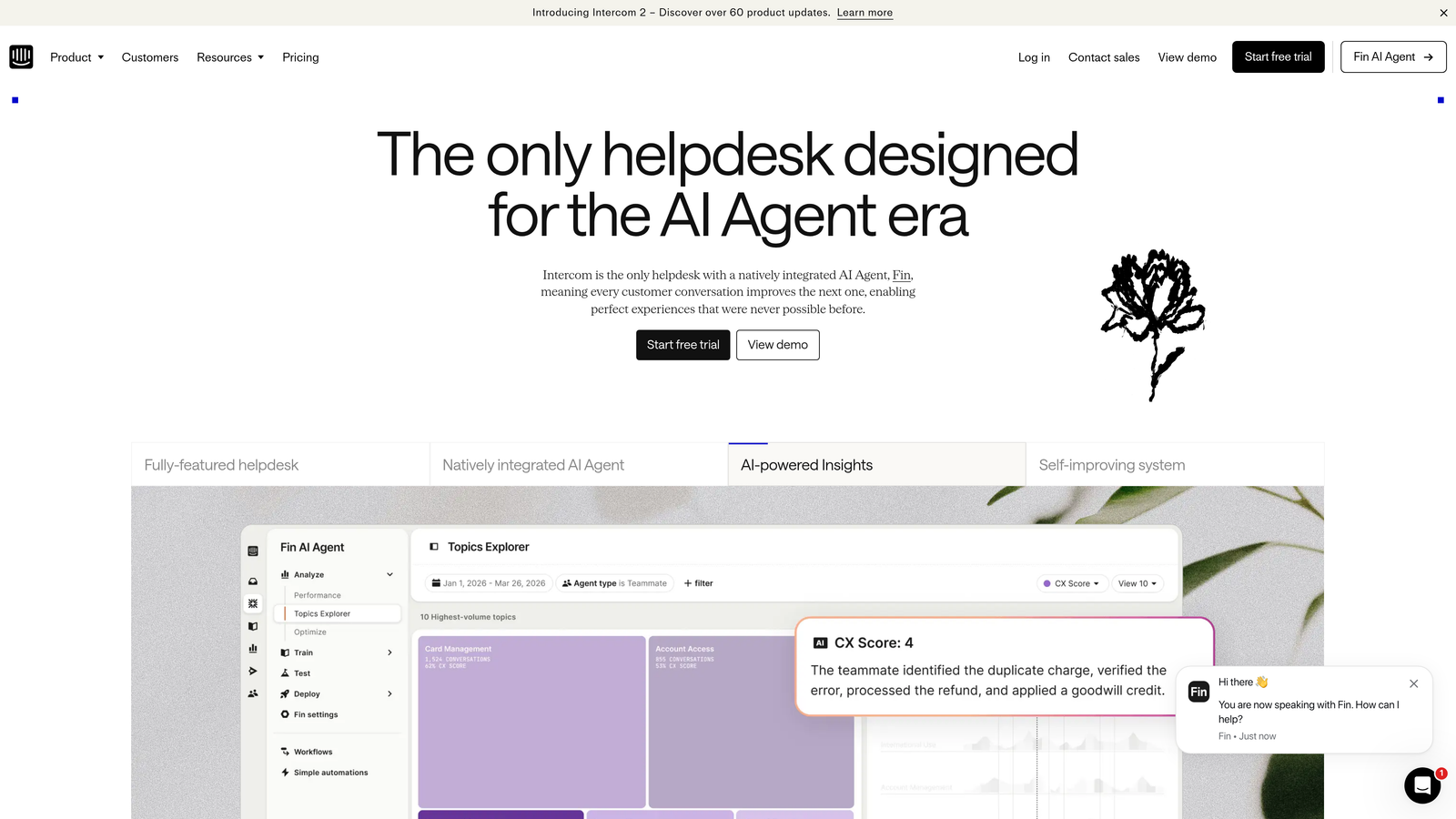
Intercom is a messenger-first customer platform combining live chat, AI-powered support via its Fin agent, and lightweight CRM features in a single product.
Where This Tool Shines
Intercom's strength is consolidation. If your team manages customer onboarding, product tours, and support conversations in separate tools, Intercom can bring those together. The Fin AI agent handles ticket deflection by drawing on your existing help content, which means setup time is relatively low for teams with a well-maintained knowledge base.
The platform started as a messaging tool rather than a support system, and that heritage shows in its design. It's particularly well suited to SaaS companies that want a conversational, low-friction experience for customers, though teams with complex structured ticketing needs may find it less rigid than Zendesk.
Key Features
Fin AI Agent: Autonomous ticket deflection built on your help content, with resolution billing that aligns cost to outcomes.
Unified Inbox: Combines chat, email, and social channels into a single view for agents.
Product Tours and Onboarding Flows: In-platform tools for guiding new users, built into the same system as support.
Customer Segmentation: Targeted messaging based on user behavior and attributes.
CRM Integrations: Connects with Salesforce, HubSpot, Stripe, and others.
Best For
SaaS teams that want to manage support and customer engagement in one platform, particularly those already using Intercom for onboarding and product communication.
Pricing
Starts at approximately $39 per month. Fin AI usage is billed per resolution, so costs scale with deflection volume.
4. Freshdesk
Best for: SMBs stepping up from email-only support who want structured ticketing at an accessible price
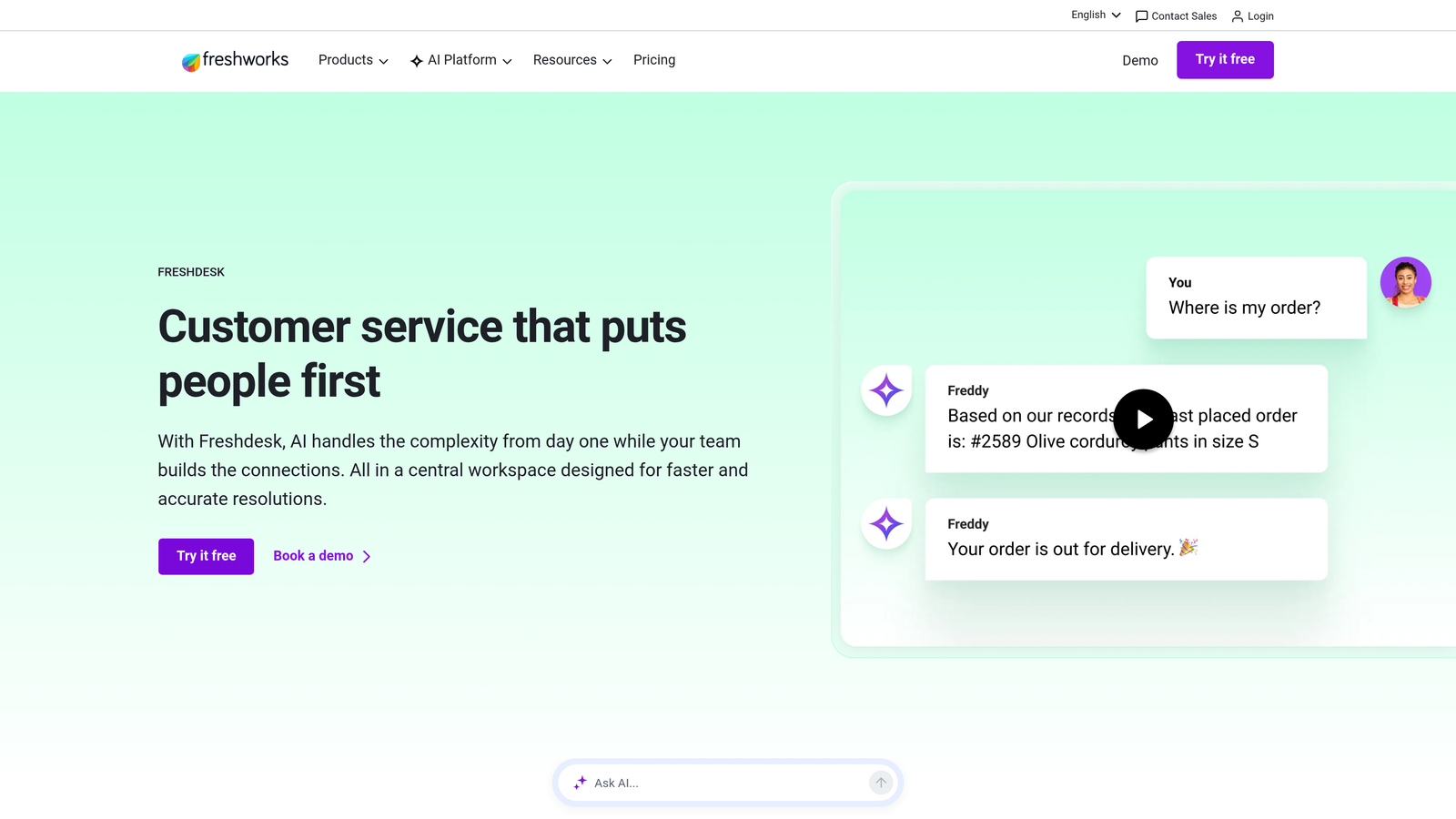
Freshdesk is a widely used helpdesk from Freshworks, offering structured ticketing and Freddy AI for automation at a competitive price point.
Where This Tool Shines
Freshdesk hits a practical sweet spot for growing teams: more structure than a shared inbox, more affordable than Zendesk, and easy enough to configure without a dedicated admin. Freddy AI handles auto-triage, suggested responses, and sentiment detection, which meaningfully reduces manual sorting for support teams handling moderate ticket volumes.
The free tier makes it accessible for small teams testing a more formal support workflow for the first time. As teams scale, the paid plans add more automation depth without a dramatic pricing jump.
Key Features
Freddy AI: Handles ticket auto-triage, suggested responses, and sentiment detection to reduce manual agent effort.
Multi-Channel Support: Covers email, chat, phone, and social from a single interface.
Collision Detection: Prevents two agents from responding to the same ticket simultaneously.
Knowledge Base Management: Built-in tools for creating and maintaining help content alongside canned responses.
Free Tier: Available for small teams with basic needs, lowering the barrier to entry.
Best For
Small to mid-sized businesses that need structured ticketing with basic AI assistance and are price-sensitive. Less suited for teams that need deep autonomous resolution or complex enterprise compliance.
Pricing
Free plan available. Paid plans start at approximately $15 per agent per month.
5. Tidio
Best for: Small businesses and e-commerce teams that need fast deployment and simple FAQ deflection
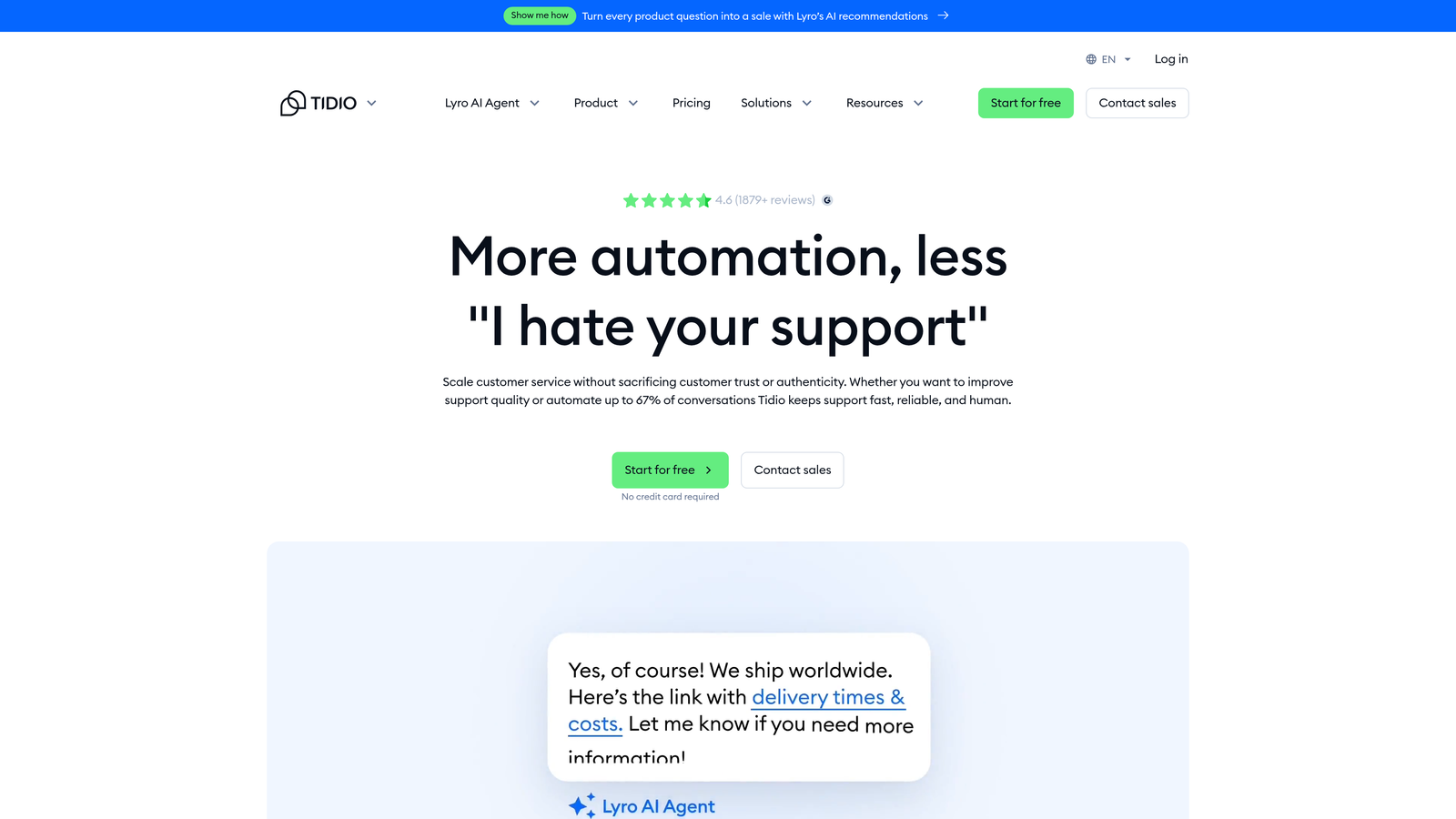
Tidio is a lightweight customer support and live chat tool with Lyro AI, designed for teams that need to get up and running quickly without developer involvement.
Where This Tool Shines
Tidio's biggest advantage is simplicity. The setup process is fast, the interface is clean, and Lyro AI can start deflecting common questions with minimal training data. For e-commerce brands fielding repetitive questions about orders, shipping, and returns, it handles the basics well without requiring a complex implementation.
It's worth being clear about the ceiling here. Tidio is built for straightforward FAQ deflection rather than deep ticket resolution or complex B2B support workflows. Teams with more sophisticated needs will likely outgrow it.
Key Features
Lyro AI Chatbot: Handles common questions with minimal training data, reducing repetitive agent workload.
Fast Live Chat Setup: No developer required; the widget can be live in minutes.
E-Commerce Integrations: Native connections to Shopify and WooCommerce for order-related support.
Visitor Analytics: Basic tracking of chat history and visitor behavior.
Mobile App: Lets support staff manage conversations on the go.
Best For
Small businesses and e-commerce teams with limited technical resources that need a simple, affordable way to handle common customer questions. Not designed for B2B SaaS support workflows or complex ticket management.
Pricing
Free plan available. Lyro AI starts at approximately $29 per month.
6. Help Scout
Best for: Teams that prioritize relationship-focused, human-first support with a clean email-like experience
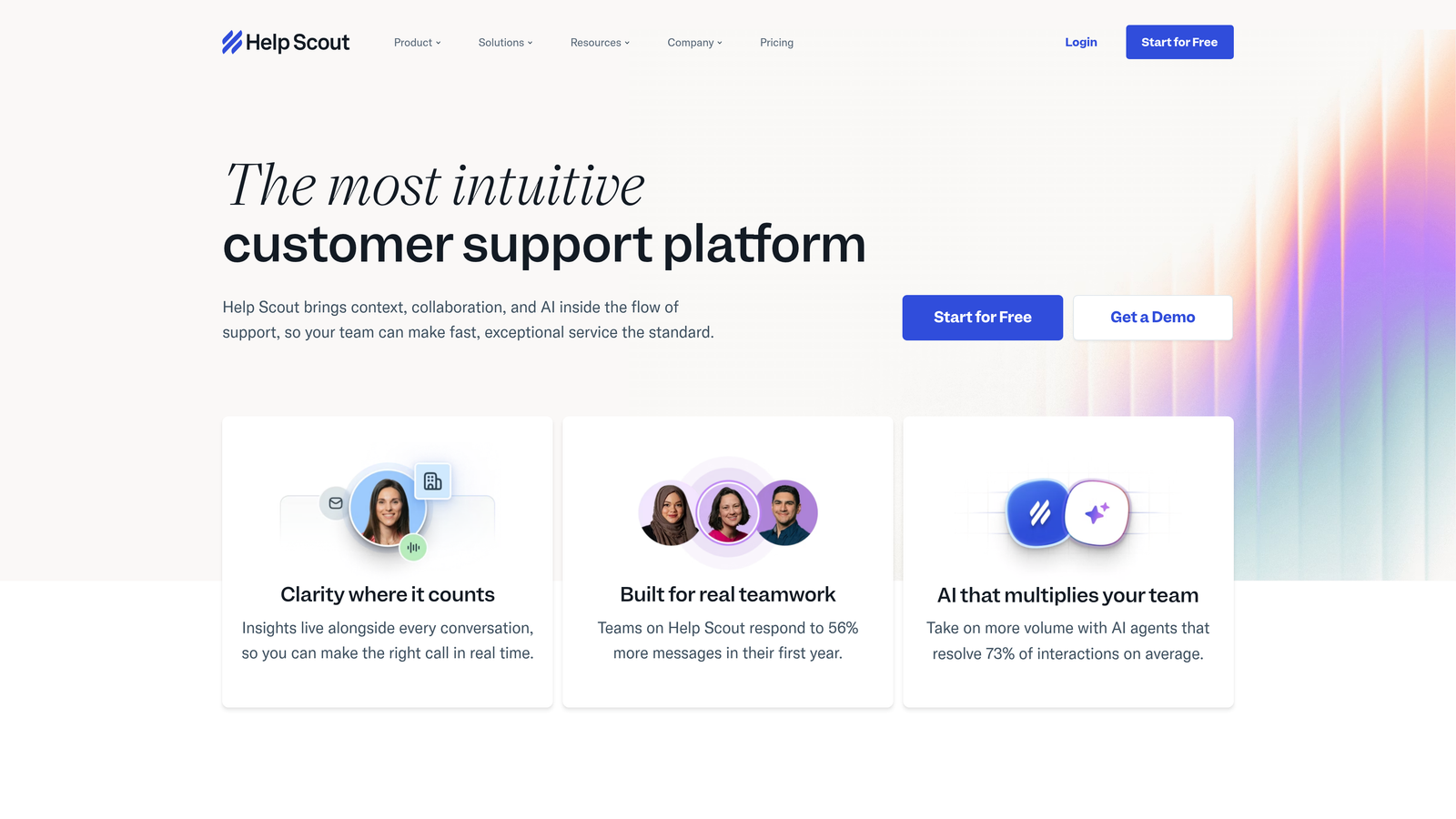
Help Scout is an email-first helpdesk built around a human, relationship-focused support philosophy, with AI-assisted drafting and an in-app help widget.
Where This Tool Shines
Help Scout's defining characteristic is its deliberate design choice to hide ticket numbers from customers. Conversations feel like email exchanges rather than support cases, which resonates with teams that view every interaction as a relationship touchpoint rather than a volume metric. The experience is intentionally warm and low-friction for customers.
The AI Drafts feature helps agents compose replies faster without replacing them. This is an assistive AI philosophy rather than an autonomous one, which aligns with teams that want to maintain a human voice in every response. It's a principled approach, though teams looking for high deflection rates should look elsewhere.
Key Features
Email-Style Shared Inbox: No ticket numbers shown to customers; conversations look and feel like personal email.
AI Drafts: Assists agents in composing replies faster without removing the human element.
Beacon In-App Widget: Enables self-service help and live chat directly within your product.
Customer Profiles: Full conversation history tied to each customer for context-rich support.
Collaboration Tools: Collision detection and internal notes for team coordination on shared tickets.
Best For
Customer-centric teams, particularly in SaaS and subscription businesses, that prioritize tone, relationship quality, and a human-first support experience over automation and deflection rates.
Pricing
Starts at approximately $22 per user per month on the Standard plan.
7. Kustomer
Best for: High-volume consumer support teams that need full customer context alongside every conversation
Kustomer is a CRM-native customer service platform that shows full customer timelines alongside support conversations, with AI automation via its KIQ layer.
Where This Tool Shines
Kustomer's core differentiator is the unified customer timeline. Rather than seeing an isolated ticket, agents see every order, conversation, and interaction a customer has ever had, all in one view. For high-volume consumer support teams where context is critical to resolution quality, this significantly reduces the back-and-forth that frustrates customers.
KIQ AI handles deflection, suggested responses, and workflow automation, layered on top of that rich customer data. The combination makes Kustomer particularly effective for brands where support quality directly influences retention and repeat purchase behavior.
Key Features
Unified Customer Timeline: Every order, conversation, and interaction displayed in a single view for full context.
KIQ AI: Handles deflection, suggested responses, and workflow automation built on customer data.
Omnichannel Inbox: Covers email, chat, SMS, social, and voice in one interface.
No-Code Workflow Builder: Business process automation without engineering involvement.
E-Commerce Integrations: Deep connections with Shopify, Magento, and custom APIs.
Best For
Consumer-facing brands and high-volume support teams where customer history and order context are central to every conversation. Less commonly adopted in pure B2B SaaS environments.
Pricing
Starts at approximately $89 per user per month at the Enterprise tier.
8. Gorgias
Best for: E-commerce brands on Shopify, BigCommerce, or Magento that need AI to take direct order actions
Gorgias is a helpdesk purpose-built for e-commerce brands, with deep platform integrations and AI that can take order actions directly from the support interface.
Where This Tool Shines
Gorgias is the most specialized tool on this list, and that focus is its strength. The native Shopify, BigCommerce, and Magento integrations go beyond surface-level data pulls. Gorgias AI can issue refunds, cancel orders, and update shipping details without any agent involvement, which dramatically reduces handling time for the most common e-commerce support scenarios.
Revenue statistics tied to support conversations give e-commerce teams visibility into how support interactions affect purchasing behavior. This is a capability that general-purpose helpdesks don't offer, and it makes Gorgias genuinely useful for brands that see support as a revenue function.
Key Features
Native E-Commerce Integrations: Deep connections with Shopify, BigCommerce, and Magento for order data in every conversation.
Action-Taking AI: Can issue refunds, cancel orders, and update shipping without agent involvement.
Automated Ticket Routing: Tags and routes tickets based on order data and customer attributes.
Revenue Statistics: Ties support conversations to revenue outcomes for performance tracking.
Macros: Templated responses for fast handling of common order-related queries.
Best For
E-commerce brands that run primarily on Shopify, BigCommerce, or Magento. Not suitable for SaaS companies, service businesses, or any team without a transactional e-commerce model at its core.
Pricing
Starts at approximately $10 per month on the Starter plan. Pricing scales with ticket volume rather than agent count.
9. Drift (Salesloft)
Best for: B2B revenue teams where sales qualification and support conversations overlap
Drift, now part of Salesloft, is a conversational AI platform designed for B2B teams where support and sales interactions often happen in the same chat window.
Where This Tool Shines
Drift occupies a unique position: it blurs the line between support and sales in a way that no other tool on this list does. AI chatbots qualify leads, answer product questions, and route visitors to the right sales rep or support agent depending on the conversation. For B2B companies where a prospect asking a product question is also a potential revenue opportunity, that routing intelligence has real value.
The Bionic Chatbots feature combines AI responses with human-authored playbooks, giving revenue teams control over how conversations flow while still automating the routine parts. Real-time account visit notifications add a proactive dimension that pure support tools don't offer.
Key Features
AI Chatbots with Lead Qualification: Qualify visitors, answer product questions, and route to sales or support based on conversation context.
Bionic Chatbots: Combines AI with human-authored playbooks for controlled, branded conversation flows.
Account Visit Notifications: Alerts revenue teams in real time when target accounts are on your site.
Meeting Scheduling: Built directly into chat flows to reduce friction from conversation to booked call.
CRM Integrations: Native connections with Salesforce and HubSpot for full revenue context.
Best For
B2B revenue teams, particularly those in sales-led or product-led growth motions, where support and sales conversations frequently overlap. Less suited for teams focused purely on ticket management or post-sale customer support.
Pricing
Contact for pricing. Enterprise-focused with no public self-serve tier.
Which Tool Fits Your Team?
The right answer depends on what you're actually optimizing for. Here's a quick way to think through the decision.
Lean SaaS teams focused on automation: Halo AI is the strongest fit if your priority is autonomous ticket resolution, continuous learning, and deep integration with your existing product and business stack. If you're already on Intercom for messaging and onboarding, its Fin agent is a reasonable starting point before committing to a full platform switch.
Enterprise teams with complex workflows: Zendesk remains the most mature choice for organizations with strict SLA requirements, compliance needs, and large agent teams. The AI capabilities are solid if configured properly, though they require investment to deliver real deflection at scale.
E-commerce brands: Gorgias is the clear category leader for Shopify-native brands. If your support queue is dominated by order-related questions and you want AI that can take action, not just suggest it, Gorgias is purpose-built for that scenario.
Teams that value the human touch: Help Scout is the right call for teams that want to maintain a personal, relationship-driven support experience without sacrificing efficiency. The AI features assist agents rather than replace them, which is exactly what some support philosophies call for.
Across all categories, the underlying trend is the same: the gap between AI-native platforms and traditional helpdesks with AI bolt-ons is widening. Tools built from the ground up for autonomous resolution are outperforming legacy systems on deflection rates, time-to-resolution, and total cost of ownership as ticket volumes grow.
Your support team shouldn't scale linearly with your customer base. Let AI agents handle routine tickets, guide users through your product, and surface business intelligence while your team focuses on complex issues that need a human touch. See Halo in action and discover how continuous learning transforms every interaction into smarter, faster support.