9 Best Augmented Support Team Software Tools in 2026
Augmented support team software helps overwhelmed support teams handle rising ticket volumes without expanding headcount by layering AI agents and automation alongside human agents. This guide evaluates the 9 best platforms for 2026 based on AI resolution capability, helpdesk integrations, live agent handoff quality, and pricing transparency, helping teams from lean startups to mid-market operations find the right fit.
 Matt PattoliFounder13 min read
Support teams are under more pressure than ever. Ticket volumes grow, customer expectations rise, and headcount budgets stay flat. Augmented support team software bridges that gap by layering AI agents, automation, and intelligence on top of your human team, so agents handle fewer repetitive tickets and focus on the work that actually needs a human touch.
This list covers the top platforms for augmenting your support team in 2026, evaluated on AI capability, helpdesk integrations, ease of deployment, and how well they complement rather than replace your existing workflows. Whether you're running a lean startup support team or scaling a mid-market operation, there's a tool here that fits.
Selection criteria: native AI resolution capability, live agent handoff quality, integration depth, analytics beyond basic ticket metrics, and pricing transparency. The market splits broadly into AI-first platforms built ground-up around automation, helpdesk-native AI layers added to established products, and vertical-specific tools optimized for industries like e-commerce. Each category has its place, and the right choice depends heavily on where your team already lives.
1. Halo AI
Best for: B2B SaaS product teams wanting an AI-first support platform that continuously learns
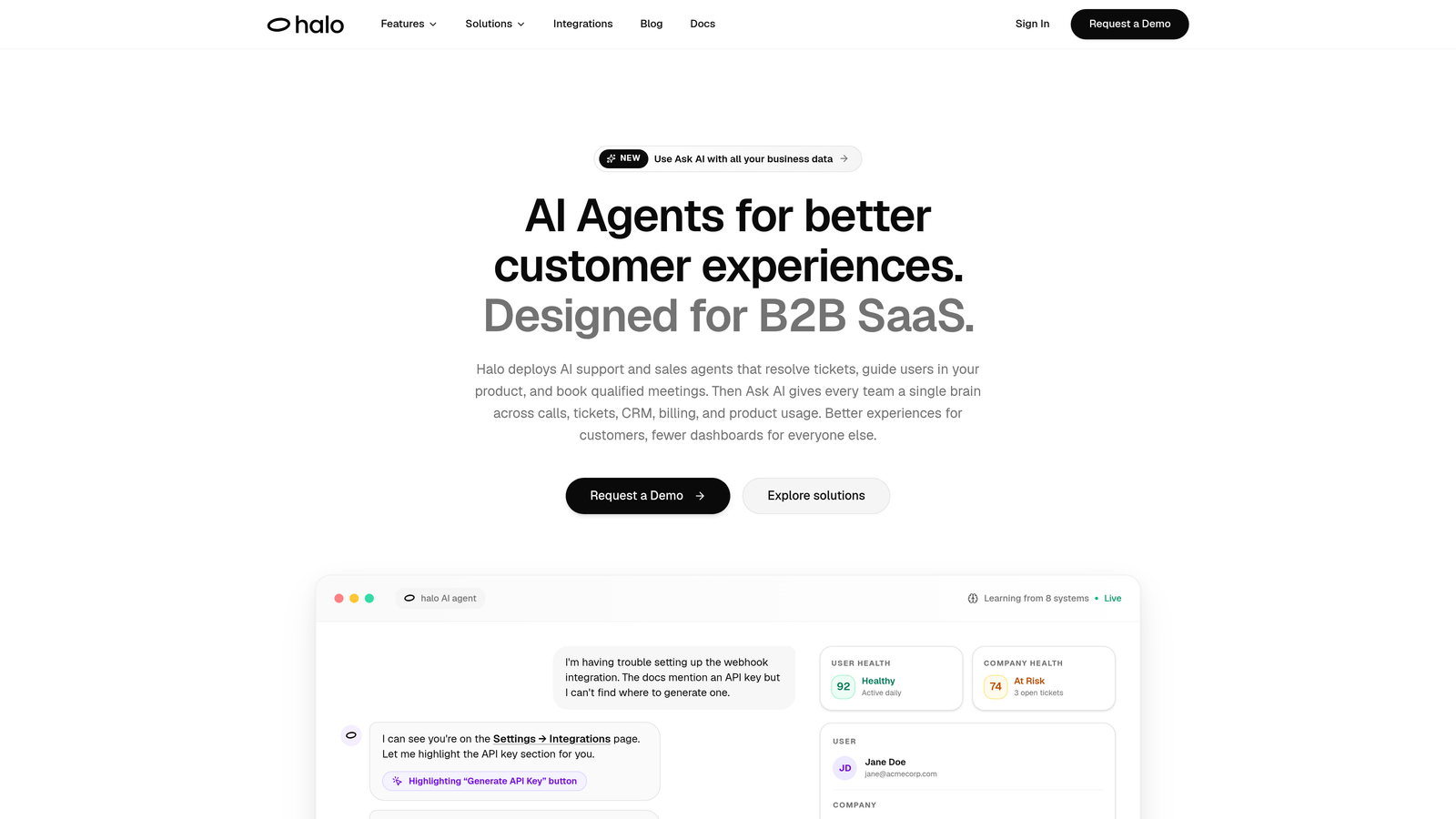
Halo AI is an AI-first customer support platform that deploys intelligent agents to resolve tickets, guide users through your product, and surface business intelligence signals.
Where This Tool Shines
What sets Halo apart from helpdesk-native AI is its architecture. Rather than bolting AI onto an existing ticketing system, Halo was built from the ground up around AI resolution. That means the AI isn't a feature you toggle on, it's the core of how support works. Every resolved interaction feeds back into the model, so the system genuinely gets smarter over time rather than staying static.
The page-aware chat widget is particularly distinctive for SaaS teams. It sees what the user sees on-screen, giving the AI the context it needs to provide precise in-product guidance rather than generic answers. Pair that with auto bug ticket creation routed directly to Linear or your issue tracker, and you have a support layer that connects the customer experience directly to your product development workflow.
Key Features
Page-Aware Chat Widget: The AI sees what users see on-screen, enabling precise, contextual in-product guidance instead of generic help content.
Smart Inbox with Business Intelligence: Surfaces customer health signals, revenue anomalies, and trend detection beyond standard support metrics.
Auto Bug Ticket Creation: Automatically generates bug reports and routes them to Linear or your issue tracker without agent intervention.
Live Agent Handoff: Escalates to human agents with full conversation context preserved, so customers never have to repeat themselves.
Broad Integration Stack: Connects to Linear, Slack, HubSpot, Intercom, Stripe, Zoom, PandaDoc, and Fathom for a unified view across your business tools.
Continuous Learning Architecture: The AI improves with every resolved interaction, compounding its effectiveness over time.
Best For
B2B SaaS companies and product teams that want an AI-first foundation rather than an AI add-on. Particularly well-suited for teams whose support workflows connect closely to product development, where routing bugs to engineering and surfacing customer health signals is as important as resolving tickets.
Pricing
Contact for pricing. See haloagents.ai for current plans and to book a demo.
2. Intercom (Fin AI Agent)
Best for: Existing Intercom users wanting native AI resolution without switching platforms
Intercom Fin is Intercom's native AI agent that resolves customer conversations end-to-end using connected knowledge sources before handing off to human agents.
Where This Tool Shines
Fin's biggest advantage is how tightly it integrates with Intercom's existing messenger and inbox. If your team already lives in Intercom, adding Fin doesn't require workflow changes or migration risk. The AI pulls from your connected help center and knowledge base to resolve conversations, and when it can't, the handoff to a human agent preserves the full conversation context.
The resolution-based pricing model is worth understanding before you commit. You pay per resolved conversation rather than a flat seat fee, which aligns costs with actual AI value delivered. For teams with high deflection rates, this works well. For those still building out their knowledge base, it's worth modeling the numbers first.
Key Features
End-to-End Conversation Resolution: Fin resolves queries autonomously using your help center and knowledge base content without agent involvement.
Context-Preserving Handoff: When escalating to human agents, the full conversation history transfers seamlessly.
Multi-Channel Support: Handles conversations across chat, email, and social channels from a single platform.
Built-In Reporting: Tracks AI resolution rates and CSAT scores directly within Intercom's reporting suite.
Native Inbox Integration: Works within Intercom's existing agent workspace without requiring separate tooling.
Best For
Teams already using Intercom as their primary support and messaging platform. The tight native integration makes Fin the lowest-friction AI upgrade for Intercom shops, though teams on other helpdesks would need to migrate to benefit fully.
Pricing
Fin is available as part of Intercom plans with pricing based on resolved conversations. See intercom.com for current rates.
3. Zendesk AI
Best for: Enterprise teams running Zendesk Suite who want AI woven throughout the agent workspace
Zendesk AI is an integrated AI layer across the Zendesk Suite, offering agent copilot features, intelligent triage, and automated workflows built directly into the agent workspace.
Where This Tool Shines
Zendesk AI's strength is breadth. Rather than a single AI feature, it layers intelligence across the entire support workflow: triage, routing, agent assist, self-service deflection, and quality assurance. For large teams managing thousands of tickets daily, having AI at every stage of the workflow compounds efficiency gains significantly.
The agent copilot experience is particularly well-developed. Suggested replies, conversation summaries, and next-best-action prompts give agents a meaningful productivity boost without requiring them to change how they fundamentally work. The AI fits into existing habits rather than demanding new ones.
Key Features
AI-Powered Triage: Detects intent and sentiment to classify and route incoming tickets automatically before agents engage.
Agent Copilot: Provides suggested replies, conversation summaries, and next-best-action prompts within the agent workspace.
Automated Ticket Routing: Routes tickets based on AI classification, reducing manual queue management.
Self-Service AI Bots: Deflects common queries before tickets are created, reducing overall volume.
AI-Powered QA Tools: Surfaces quality assurance insights and analytics to help managers coach agents more effectively.
Best For
Enterprise support organizations already invested in Zendesk Suite who want to maximize their existing platform investment. Teams considering Zendesk primarily for the AI features should evaluate whether the full Suite cost is justified versus AI-first alternatives.
Pricing
Included in higher Zendesk Suite tiers; an AI add-on is available for some plans. See zendesk.com for current pricing details.
4. Freshdesk (Freddy AI)
Best for: SMBs wanting a full AI-augmented helpdesk without enterprise-level pricing
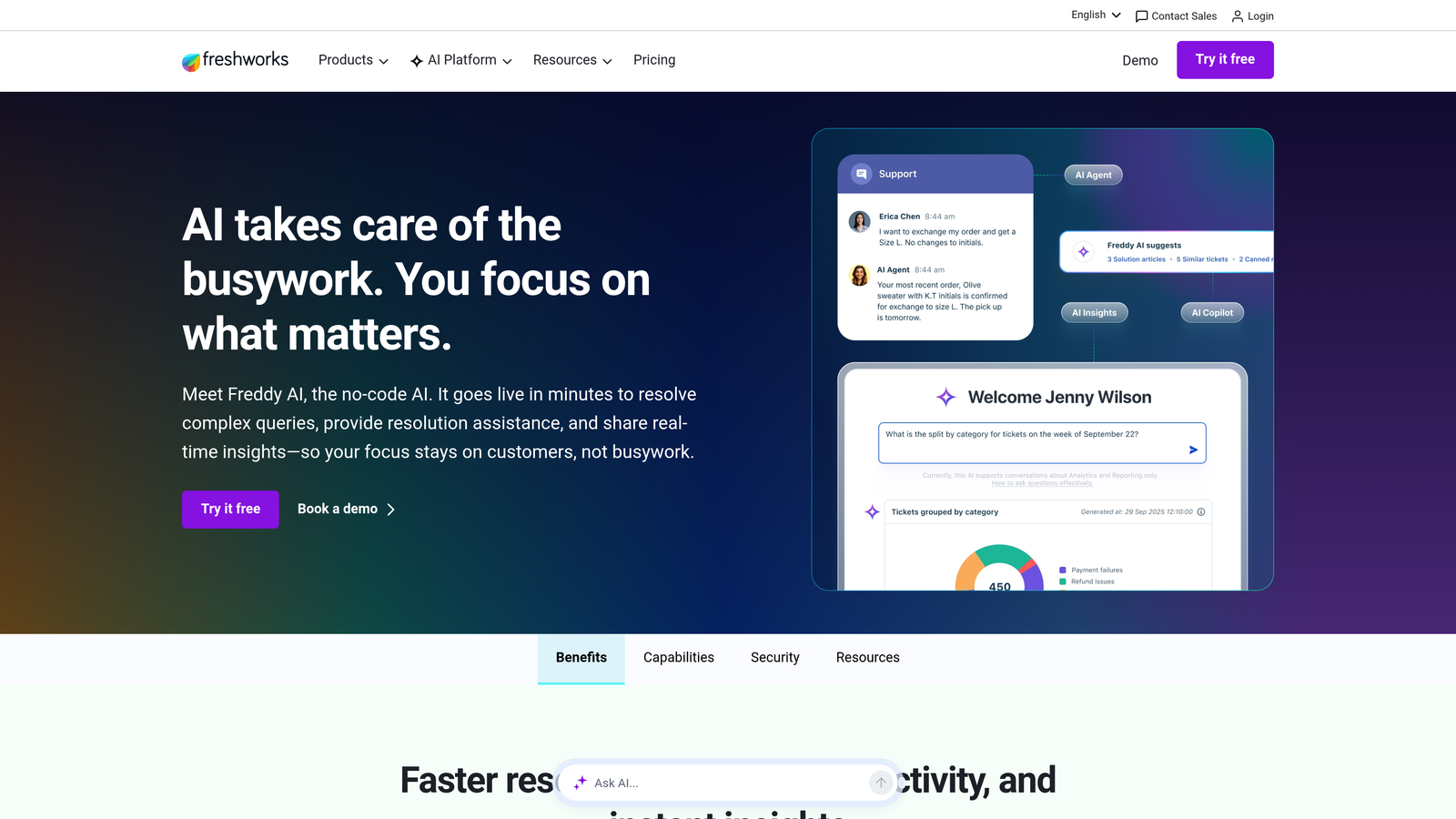
Freshdesk with Freddy AI is Freshworks' AI assistant embedded across Freshdesk, covering self-service deflection, agent assist, and analytics in one SMB-friendly package.
Where This Tool Shines
Freddy AI is structured across three distinct functions: Self Service for autonomous deflection, Copilot for agent productivity, and Insights for analytics. This modular approach means teams can prioritize whichever layer delivers the most immediate value without needing to overhaul everything at once.
Freshdesk's pricing accessibility is a genuine differentiator for smaller teams. The platform offers a free tier and paid plans that are generally positioned more affordably than comparable Zendesk tiers, making AI-augmented support accessible to teams that can't justify enterprise contracts.
Key Features
Freddy Self Service: Handles autonomous customer query resolution before tickets reach agents, reducing inbound volume.
Freddy Copilot: Provides agents with reply drafts, conversation summaries, and tone suggestions to speed up responses.
Freddy Insights: Generates AI-driven analytics and performance recommendations for support managers.
Omnichannel Coverage: Manages support across email, chat, phone, and social from a unified inbox.
Accessible Pricing Tiers: Free tier available with paid plans structured for SMB budgets.
Best For
Small to mid-sized businesses that need a complete AI-augmented helpdesk without the overhead of enterprise platforms. Also a strong fit for teams migrating away from manual email-based support who want to start with AI baked in from day one.
Pricing
Free tier available; paid plans start at accessible monthly rates. See freshworks.com for current pricing.
5. Tidio (Lyro AI)
Best for: Small businesses and e-commerce teams wanting fast AI deployment with minimal setup
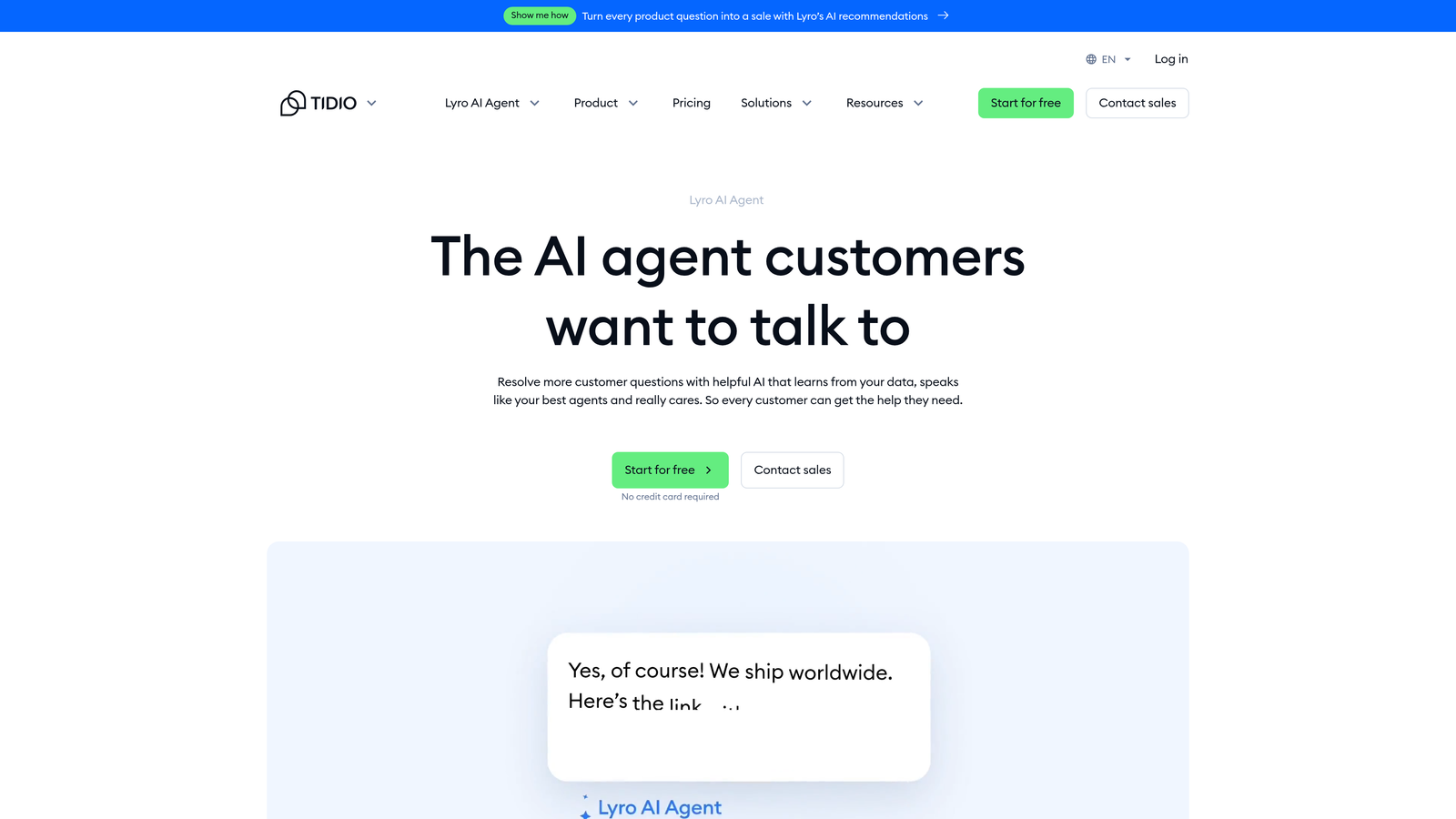
Tidio's Lyro AI resolves customer questions autonomously using your existing knowledge base with minimal setup, designed specifically for small businesses and e-commerce teams.
Where This Tool Shines
Lyro's defining characteristic is speed of deployment. There's no developer setup required, and the AI can be live in minutes by ingesting your existing FAQ and help content. For teams that have been putting off AI because it feels technically complex, Lyro removes that barrier almost entirely.
The scope management is also thoughtful. Lyro handles a defined set of topics autonomously and escalates cleanly when a query falls outside its knowledge. That predictability matters for small teams who can't afford AI giving confident wrong answers. It knows what it knows and hands off what it doesn't.
Key Features
Autonomous Resolution: Handles customer questions using existing FAQ and help content without manual training.
Zero-Developer Setup: Deploys in minutes without engineering involvement or technical configuration.
Defined Scope with Clean Escalation: Handles topics within its knowledge set and escalates outside queries to human agents.
Live Chat Fallback: Built-in human agent fallback ensures customers always reach a person when needed.
E-Commerce Integrations: Native integrations with Shopify and WooCommerce for order-related support queries.
Best For
Small businesses, e-commerce stores, and teams with limited technical resources who need AI support automation running quickly. Less suited to complex B2B SaaS environments where deep integrations and business intelligence are priorities.
Pricing
Free tier available; Lyro AI conversations are available on paid plans. See tidio.com for current rates.
6. Kustomer
Best for: High-volume consumer brands needing full CRM context in every AI-assisted interaction
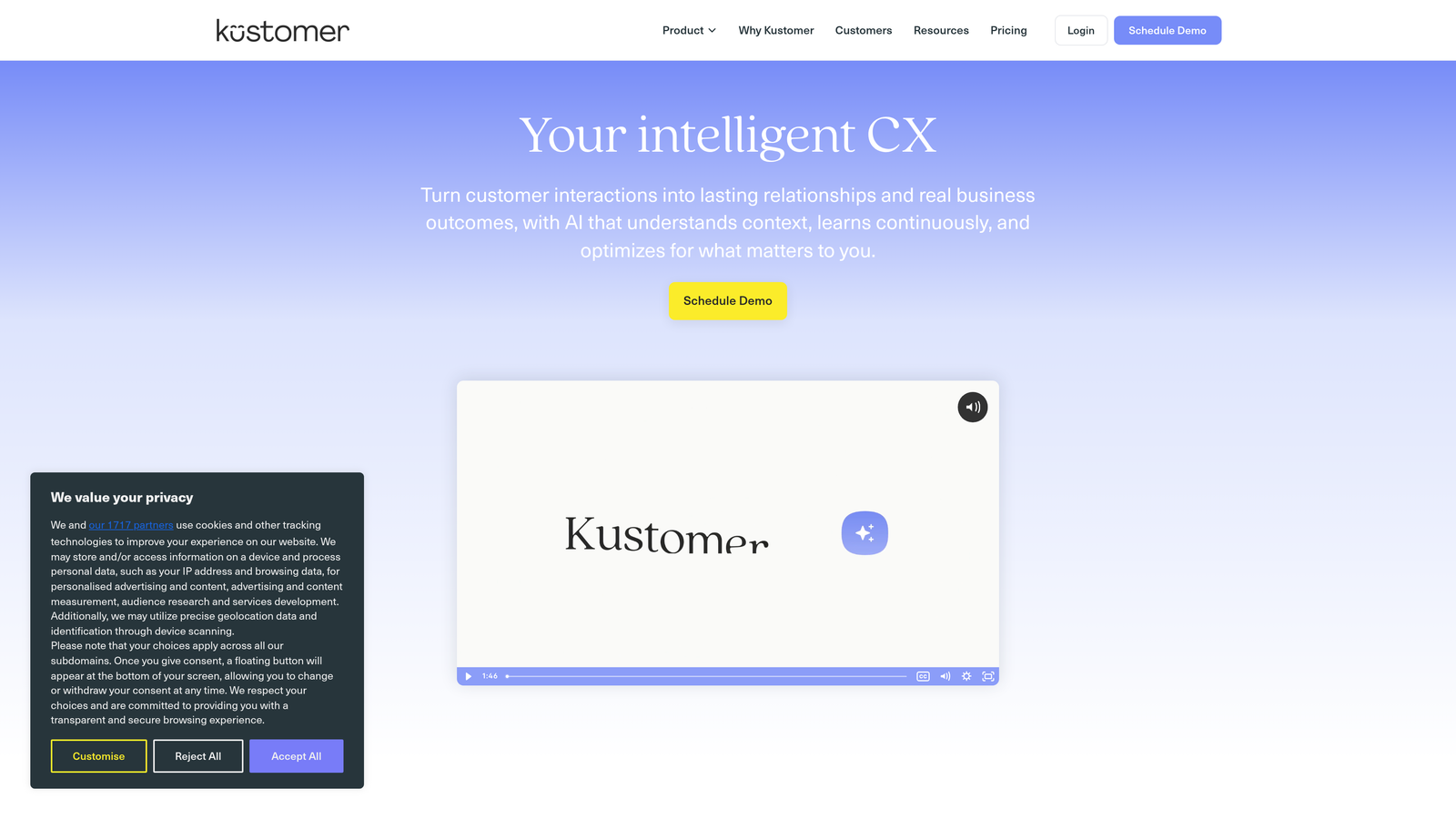
Kustomer is a CRM-first customer service platform that gives AI full customer context, including order history, past tickets, and sentiment, before responding to any inquiry.
Where This Tool Shines
Kustomer's differentiator is the unified customer timeline. Rather than treating each conversation as an isolated ticket, the platform consolidates every interaction across every channel into a single view. When AI or agents respond, they do so with the full history of that customer relationship visible, which meaningfully improves response quality for complex, multi-touch issues.
For high-volume consumer brands handling thousands of interactions daily, the automation workflows triggered by customer data and behavior allow teams to build sophisticated routing and response logic that goes beyond simple keyword matching. The AI works with richer inputs and produces more contextually appropriate outputs as a result.
Key Features
Unified Customer Timeline: Consolidates all channels and interaction history into a single customer view for agents and AI alike.
AI-Powered Routing and Suggested Responses: Routes conversations intelligently and suggests contextually relevant replies.
Behavior-Triggered Automation: Builds workflows triggered by customer data, purchase history, and behavioral signals.
Omnichannel Inbox: Manages email, chat, SMS, social, and voice from one unified workspace.
Deep CRM Data for AI Context: AI responses are informed by the full customer record, not just the current conversation.
Best For
Consumer brands and retailers managing high interaction volumes where customer history and order data are central to resolving queries effectively. Less optimized for B2B SaaS environments where product-level context and engineering integrations matter more than purchase history.
Pricing
Enterprise pricing. Contact Kustomer directly for current rates.
7. Help Scout
Best for: Teams that want AI productivity gains while preserving a genuinely human support experience
Help Scout is a human-centric support platform that uses AI to help agents respond faster and more consistently, without making interactions feel automated.
Where This Tool Shines
Help Scout has made a deliberate positioning choice: AI that assists agents rather than attempting to replace them. That philosophy shows up in the feature design. AI Summarize condenses long email threads so agents can get up to speed quickly. AI Drafts suggests full reply drafts. AI Assist edits tone and length. Each feature is about making the agent better, not making the agent optional.
For teams where brand voice and relationship quality are non-negotiable, this approach reduces the risk of AI degrading the customer experience. The tradeoff is lower autonomous deflection rates compared to AI-first platforms, but for many teams, that's an acceptable trade for maintaining consistency and warmth in customer interactions.
Key Features
AI Summarize: Condenses long email threads into quick briefings so agents can respond without reading entire histories.
AI Drafts: Suggests full reply drafts based on conversation context, which agents can edit and send.
AI Assist: Adjusts tone, length, and clarity of agent-written replies before they're sent.
Shared Inbox and Knowledge Base: Combines team inbox and help documentation in a single clean interface.
Human-First Design Philosophy: AI is positioned as an agent productivity tool, not a customer-facing replacement.
Best For
Teams with strong brand voice requirements, relationship-driven support models, or customer bases that respond poorly to obviously automated interactions. Startups and small teams who want AI assistance without the complexity of deploying fully autonomous agents.
Pricing
Plans start at accessible monthly rates for small teams. See helpscout.com for current pricing.
8. Gorgias
Best for: E-commerce and DTC brands running on Shopify, BigCommerce, or Magento
Gorgias is a support platform purpose-built for e-commerce, with deep Shopify integration that enables AI to autonomously resolve order status, returns, and shipping queries using live order data.
Where This Tool Shines
The majority of e-commerce support tickets are variations of the same questions: where's my order, how do I return this, when will it arrive. Gorgias is built specifically to automate that category of inquiry. The AI pulls live order data directly from Shopify, BigCommerce, or Magento, so it can answer order-specific questions accurately without agent involvement.
The revenue attribution feature is a useful addition for e-commerce teams that need to justify support investment to leadership. Tracking which support interactions influence purchases connects the support function to revenue outcomes in a way that generic helpdesks rarely do.
Key Features
Native E-Commerce Platform Integration: Deep connections to Shopify, BigCommerce, and Magento with live order data access.
Autonomous Order Query Resolution: AI handles order status, refund, and shipping queries using real-time order data.
Automation Rules Engine: Builds automated responses for repetitive e-commerce support scenarios.
Omnichannel Inbox: Manages email, chat, SMS, and social DMs from one workspace.
Revenue Attribution: Tracks support interactions that influence customer purchases.
Best For
DTC brands, e-commerce retailers, and Shopify merchants with high volumes of order-related support queries. Teams outside e-commerce will find limited value in Gorgias's core differentiators, as the platform is heavily optimized for retail support workflows.
Pricing
Pricing is based on ticket volume. See gorgias.com for current plans.
9. Forethought (Solve AI)
Best for: Enterprise teams wanting AI augmentation without migrating away from Zendesk, Salesforce, or ServiceNow
Forethought is an enterprise AI augmentation layer that sits on top of existing helpdesks, adding AI triage and resolution without requiring migration.
Where This Tool Shines
Forethought's core value proposition is straightforward: you don't have to rip and replace your existing helpdesk to get meaningful AI augmentation. For large enterprises with years of workflow configuration, custom integrations, and agent training built around Zendesk, Salesforce Service Cloud, or ServiceNow, that's a significant practical advantage. The AI layer adds on top rather than underneath.
The triage capability deserves particular attention. Forethought classifies and routes incoming tickets before agents see them, which means the AI is reducing cognitive load and prioritization time even on tickets it doesn't resolve autonomously. Combined with the Assist AI that surfaces relevant knowledge to agents mid-conversation, the platform augments both the pre-ticket and in-ticket stages of support work.
Key Features
Stack-Agnostic Architecture: Works on top of Zendesk, Salesforce Service Cloud, ServiceNow, and other major helpdesks without migration.
AI Triage: Classifies and routes incoming tickets automatically before agents engage with them.
Solve AI: Resolves common queries autonomously via self-service before they reach the agent queue.
Assist AI: Provides agents with relevant knowledge articles and suggested replies during live conversations.
No Migration Required: Augments existing helpdesk investment rather than replacing it.
Best For
Large enterprises with established helpdesk configurations that want AI capabilities without the disruption and cost of platform migration. Teams evaluating AI-first alternatives should weigh Forethought's augmentation model against the potential long-term benefits of a ground-up AI architecture.
Pricing
Enterprise pricing. Contact Forethought directly for current rates.
Which Augmented Support Tool Is Right for Your Team?
The right platform depends less on which tool has the most features and more on where your team already operates and what kind of augmentation model fits your support culture.
Here's a quick way to think through the decision:
AI-first SaaS teams: Halo AI is the strongest fit for B2B product teams that want continuous learning, page-aware context, and business intelligence built into every interaction.
Existing Intercom users: Fin is the lowest-friction upgrade. Stay on the platform your team knows and add AI resolution without migration risk.
Enterprise Zendesk shops: Zendesk AI extends your existing investment across triage, agent assist, and deflection without introducing new tooling.
SMBs on a budget: Freshdesk with Freddy AI delivers a complete AI-augmented helpdesk at pricing that scales with smaller teams.
E-commerce and Shopify brands: Gorgias is purpose-built for your use case. The live order data integration alone resolves the majority of common DTC support queries.
Human-first support culture: Help Scout gives agents AI productivity tools without pushing toward full automation.
Enterprise with existing helpdesk lock-in: Forethought augments Zendesk, Salesforce, or ServiceNow without requiring you to start over.
One principle applies across all of them: the best augmented support platform is the one your agents will actually use alongside the AI. A technically impressive system that disrupts existing workflows will underperform a simpler tool that integrates cleanly into how your team already works.
Your support team shouldn't scale linearly with your customer base. Let AI agents handle routine tickets, guide users through your product, and surface business intelligence while your team focuses on complex issues that need a human touch. See Halo in action and discover how continuous learning transforms every interaction into smarter, faster support.