9 Best Automated Customer Experience Platforms in 2026
This guide evaluates the 9 best automated customer experience platforms in 2026, comparing AI-first tools, helpdesk hybrids, and CRM-native suites across key criteria including AI autonomy, integration depth, and pricing transparency. Whether you're a lean SaaS startup or a scaling B2B team, it helps you identify the right platform to resolve tickets faster, reduce repetitive agent work, and eliminate costly response delays.
 Grant CooperFounder14 min read
The support ticket queue that never empties. The customer waiting 48 hours for a response. The agent answering the same question for the hundredth time. These aren't just operational headaches — they're churn risks, and in 2026, there's no excuse for tolerating them.
Automated customer experience platforms have matured well beyond simple chatbots. The best ones today resolve tickets autonomously, guide users through products in real time, detect bugs before they escalate, and hand off to humans at exactly the right moment. The market has split into distinct categories: AI-first native platforms, helpdesk-plus-AI hybrids, messaging-first tools, and CRM-native support suites. Each approach has genuine strengths depending on your team's size, stack, and goals.
This list evaluates the top platforms on AI autonomy, integration depth, analytics quality, pricing transparency, and real-world usability for B2B teams. Whether you're running a lean support operation at a SaaS startup or managing enterprise-level ticket volume, the right fit is here.
1. Halo AI
Best for: B2B SaaS teams that want AI-first support with business intelligence built in.
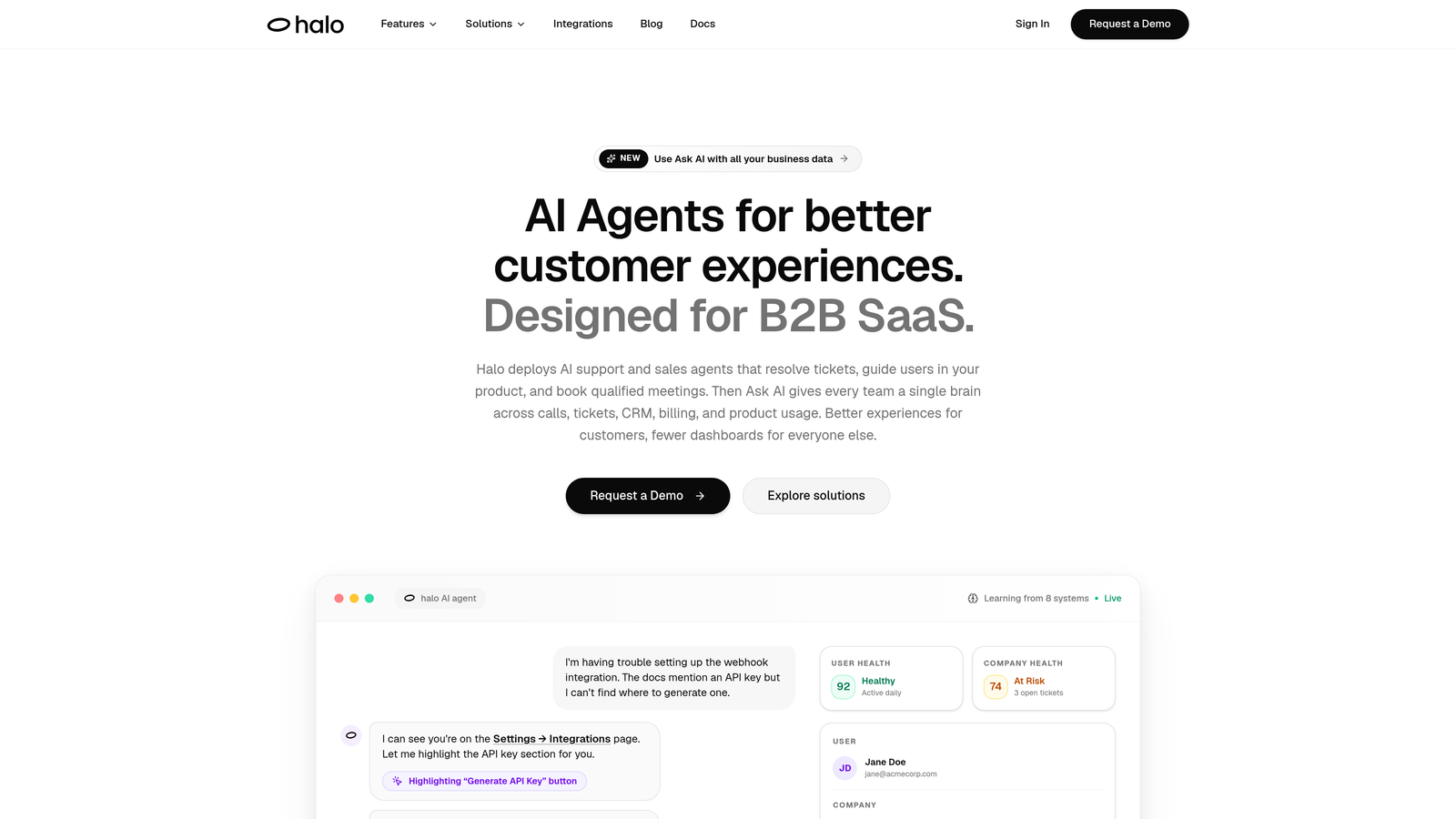
Halo AI is an AI-native customer support platform built from the ground up for B2B SaaS teams, not retrofitted onto traditional helpdesk infrastructure.
Where This Tool Shines
What separates Halo from most platforms on this list is its page-aware architecture. The AI agent doesn't just read what a user types — it sees what they're looking at, understands the context of their current screen, and provides visual UI guidance that maps directly to their situation. This is a fundamentally different interaction model than a generic chatbot pulling from a static knowledge base.
Halo also goes beyond ticket resolution. Its smart inbox surfaces business intelligence signals: customer health indicators, revenue anomalies, and product usage patterns that help support teams understand what's actually happening across their customer base. Every resolved interaction feeds back into the learning loop, so the AI gets measurably smarter over time rather than staying static.
Key Features
Page-Aware AI Agents: The agent sees the user's current screen context and delivers guidance specific to where they are in the product, not generic answers.
Continuous Learning: Every resolved ticket improves future responses, creating a compounding intelligence advantage over time.
Auto Bug Ticket Creation: When users report product issues, Halo automatically generates bug tickets routed directly to engineering tools like Linear, closing the loop between support and product.
Smart Inbox with Business Intelligence: Surfaces customer health signals, revenue intelligence, and anomaly detection beyond standard support metrics.
Live Agent Handoff: Full context is preserved when escalating to a human agent, so customers never have to repeat themselves.
Deep Integration Stack: Connects with Slack, HubSpot, Intercom, Stripe, Zoom, PandaDoc, and Fathom, making it part of your entire business workflow rather than an isolated support tool.
Best For
B2B SaaS companies that want AI to handle routine tickets autonomously while also generating product and customer intelligence. Particularly strong for teams using Linear for engineering, HubSpot for CRM, or Intercom for messaging who want those systems connected to support outcomes.
Pricing
Contact for pricing. Halo is positioned for B2B SaaS teams and scales with your support volume. Visit the website for a demo and tailored quote.
2. Intercom
Best for: Product-led SaaS companies wanting AI support tightly integrated with in-app messaging.
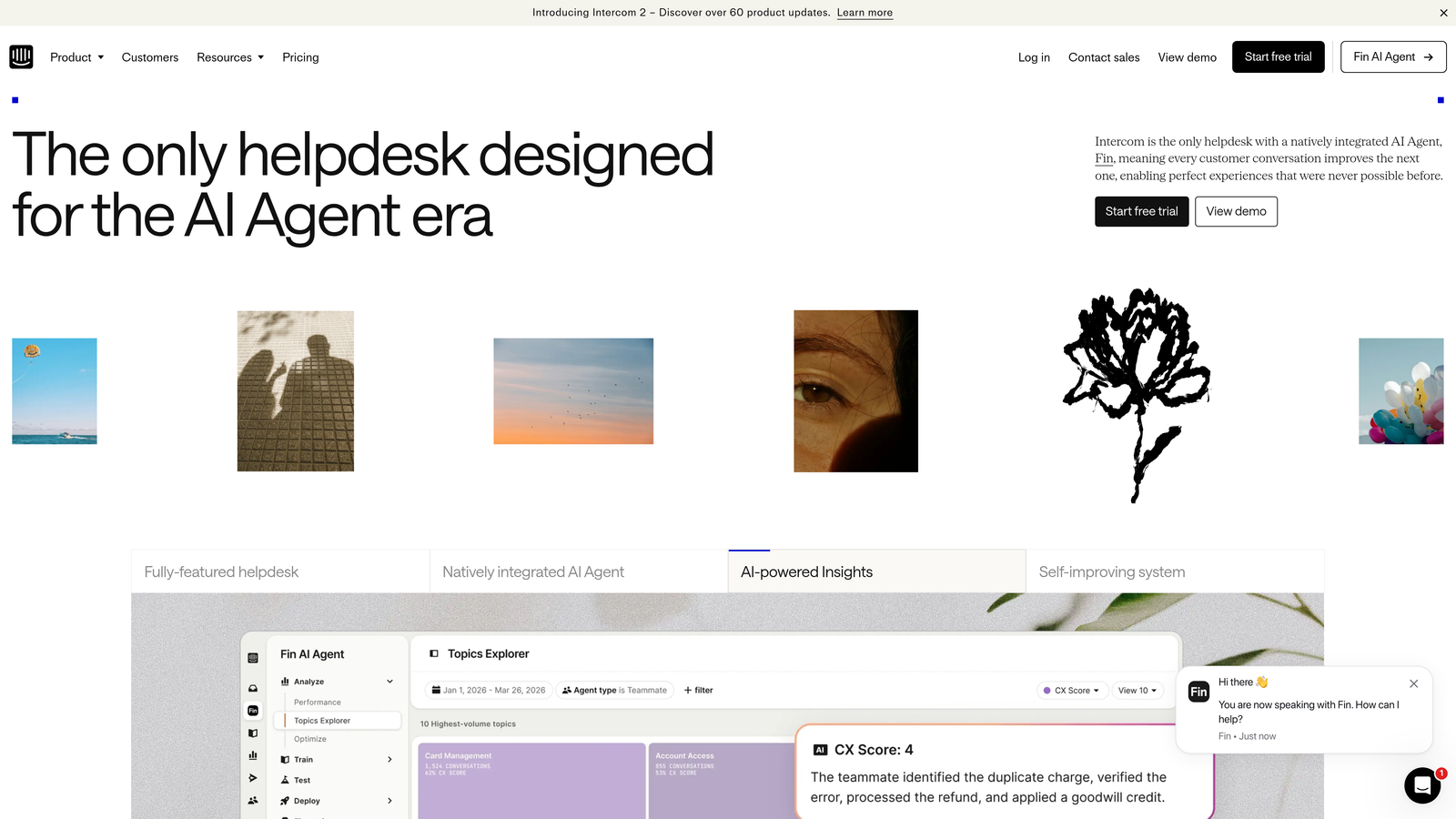
Intercom is a mature customer messaging and AI support platform widely used across SaaS and e-commerce companies of all sizes.
Where This Tool Shines
Intercom's Fin AI agent is one of the more capable front-line bots available, trained on your help center content and powered by large language models. It handles a meaningful share of inbound conversations before escalating to human agents, and the escalation path feels natural rather than jarring.
The platform's real strength is its unified inbox. Email, in-app chat, and messaging channels all flow into one place, with workflow automation handling routing, tagging, and prioritization. For product-led growth companies where support and onboarding overlap heavily, Intercom's product tours and in-app messaging make it a natural fit.
Key Features
Fin AI Agent: LLM-powered bot trained on your existing help content, handling front-line queries with escalation built in.
Unified Inbox: Email, chat, and in-app messaging consolidated with workflow automation for routing and tagging.
Product Tours: In-app onboarding flows and feature announcements built directly into the platform.
Workflow Automation Builder: Visual builder for creating custom routing, tagging, and response workflows without code.
Reporting and CSAT: Built-in tracking for conversation volume, resolution rates, and customer satisfaction scores.
Best For
SaaS companies with an established help center who want AI to deflect common queries while maintaining strong in-app engagement. Best suited for teams where support and product onboarding are closely linked functions.
Pricing
Starter plans begin at approximately $39 per seat per month. Fin AI and advanced automation features are available in higher tiers. Check Intercom's website for current pricing.
3. Zendesk
Best for: Enterprise teams with complex ticketing workflows and high integration requirements.
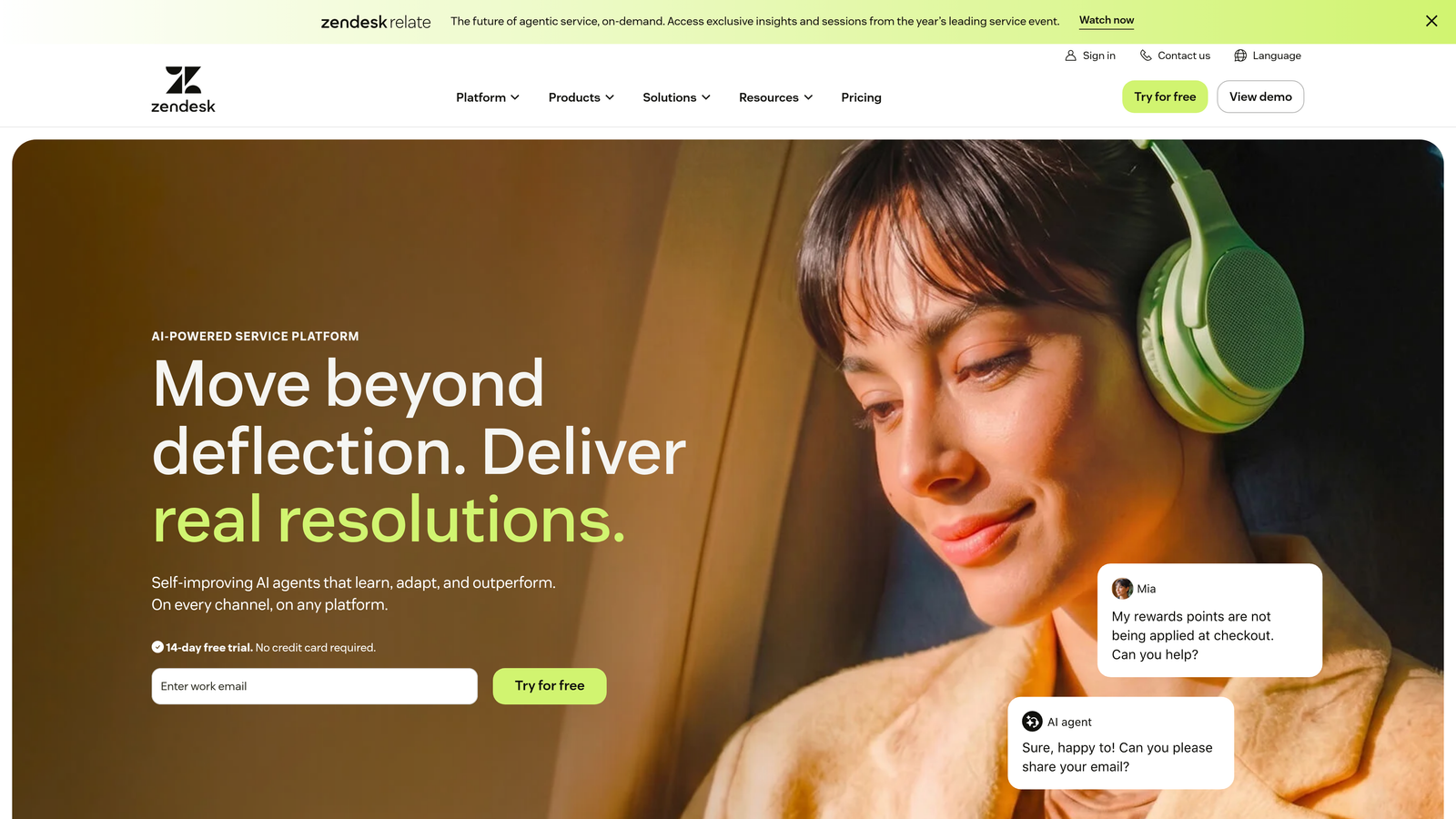
Zendesk is the established enterprise helpdesk standard, now with a substantial AI layer built into its core ticketing and workflow infrastructure.
Where This Tool Shines
Zendesk's AI capabilities are built on top of its already mature ticketing foundation. Intelligent triage automatically classifies and routes incoming tickets by intent, while the agent copilot surfaces suggested replies, macro recommendations, and next-step guidance directly in the agent's workspace. For teams with years of ticket history, Zendesk's AI can leverage that data immediately.
The integration marketplace is unmatched at over 1,000 apps, making Zendesk a strong anchor for complex enterprise support stacks. If your team has existing workflows, SLA structures, and reporting built around Zendesk, the AI additions are a natural evolution rather than a rip-and-replace decision.
Key Features
AI-Powered Triage: Automatic intent detection and ticket classification to route issues to the right team or agent.
Agent Copilot: Real-time reply suggestions, macro recommendations, and workflow guidance for human agents.
Omnichannel Support: Email, live chat, voice, and social channels managed from a single platform.
App Marketplace: Over 1,000 integrations spanning CRM, analytics, e-commerce, and developer tools.
Advanced Reporting and SLA Management: Granular performance tracking with customizable dashboards and SLA breach alerts.
Best For
Enterprise support teams with established ticketing workflows who want to layer AI capabilities onto existing infrastructure. Particularly strong for organizations with complex routing rules, multi-brand support, or compliance-heavy environments.
Pricing
Suite Team plans start at approximately $55 per agent per month. AI features are available in higher tiers. Visit Zendesk's website for current plan details.
4. Freshdesk (Freddy AI)
Best for: SMBs and growing teams wanting capable AI support at accessible price points.
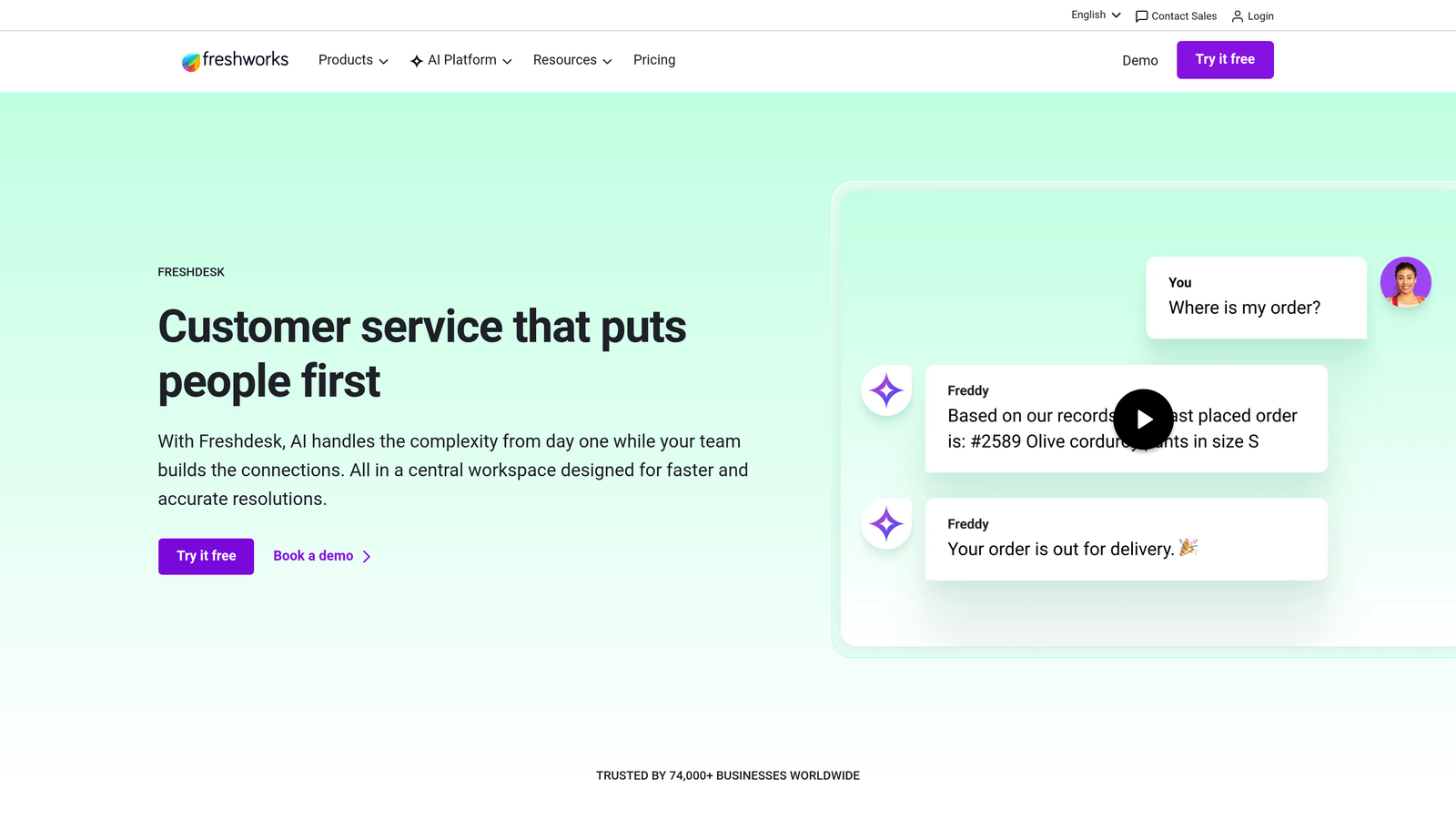
Freshdesk brings AI-powered support through its Freddy AI suite, covering self-service bots, agent assist, and analytics within an accessible pricing structure.
Where This Tool Shines
Freshdesk's Freddy AI is actually three distinct capabilities: Freddy Self Service for deflecting common questions via bot, Freddy Copilot for real-time agent assistance and auto-summarization, and Freddy Insights for AI-generated analytics. This modular approach means teams can adopt the pieces that matter most without overhauling everything at once.
The broader Freshworks ecosystem is a genuine advantage for SMBs. If your team also uses Freshsales or Freshservice, the shared data layer across products creates a more unified customer view without enterprise-level complexity or pricing.
Key Features
Freddy Self Service: AI bot that handles common inbound questions and deflects tickets before they reach agents.
Freddy Copilot: Real-time suggestions, response drafting, and automatic conversation summarization for agents.
Freddy Insights: AI-generated analytics with anomaly alerts and performance recommendations.
Multi-Channel Support: Email, live chat, phone, and social channels in a unified inbox.
Free Tier: A functional free plan for small teams, making it accessible for early-stage companies testing support automation.
Best For
SMBs and mid-market teams scaling their support operations without enterprise budgets. Also a strong fit for companies already using Freshworks products who want support data connected to CRM and ITSM workflows.
Pricing
A free tier is available for small teams. Growth plans start at approximately $15 per agent per month. Freddy AI features unlock in Pro and Enterprise plans. Check Freshdesk's website for current details.
5. Salesforce Service Cloud
Best for: Enterprise organizations already invested in the Salesforce ecosystem.
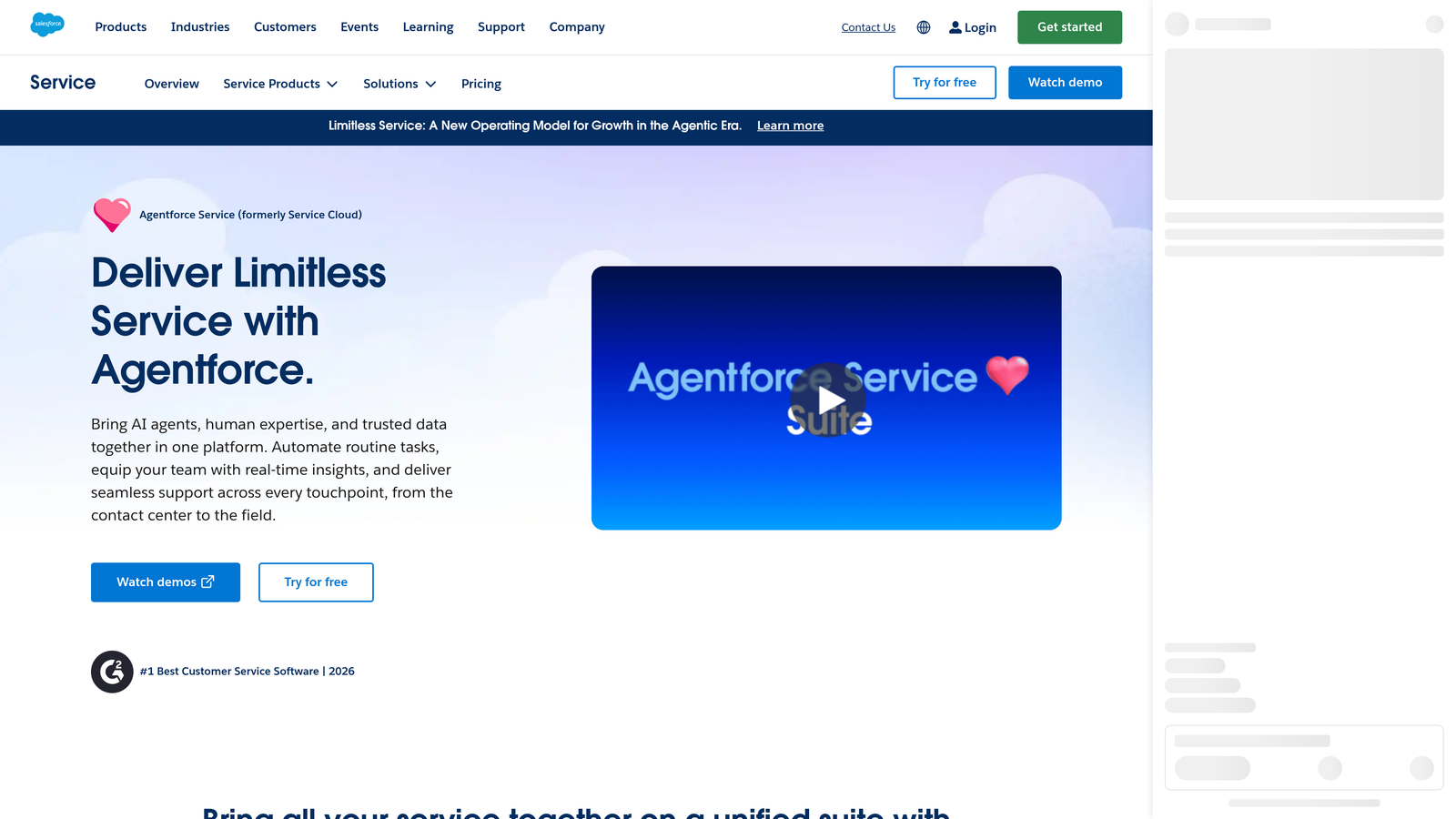
Salesforce Service Cloud is enterprise-grade support automation embedded within the world's largest CRM platform, connecting support data to sales and marketing context through Einstein AI.
Where This Tool Shines
The core advantage here is data depth. When an AI agent or human agent handles a support case in Service Cloud, they're working with a complete customer record that includes purchase history, sales interactions, marketing touchpoints, and prior support cases. Einstein AI uses that unified context for case classification, routing, and next-best-action recommendations in ways that siloed support tools simply cannot replicate.
For regulated industries or organizations with complex compliance requirements, Service Cloud's security controls and audit capabilities are difficult to match. The tradeoff is implementation complexity and cost, which make it a poor fit for smaller teams without dedicated Salesforce administrators.
Key Features
Einstein AI: Case classification, intelligent routing, and next-best-action recommendations powered by unified CRM data.
Unified Customer Data: Support cases connected to Sales Cloud and Marketing Cloud records for full customer context.
Omnichannel Routing: Skills-based assignment across email, chat, voice, and social channels.
Self-Service Portals: AI-powered knowledge base and customer community tools for deflecting common queries.
Compliance and Security Controls: Enterprise-grade governance features for regulated industries including financial services and healthcare.
Best For
Large enterprises already on Salesforce where connecting support outcomes to CRM data is a strategic priority. Overkill for companies without an existing Salesforce investment or dedicated admin resources.
Pricing
Starter plans begin at approximately $25 per user per month. Enterprise and Unlimited tiers are significantly higher. Einstein AI features typically require higher-tier plans. Visit Salesforce for current pricing.
6. Tidio
Best for: Small businesses and e-commerce teams wanting fast AI deployment with minimal setup.
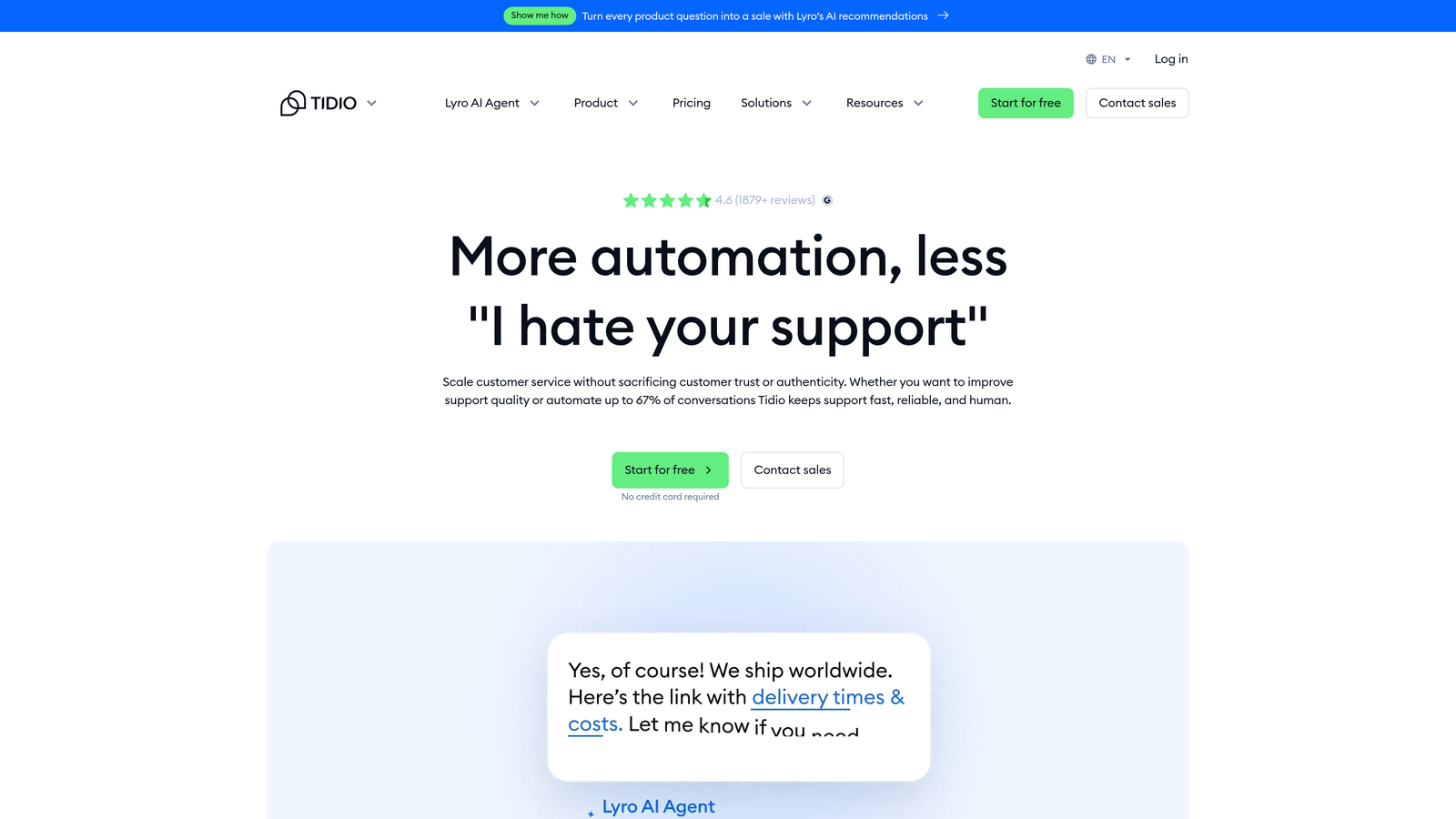
Tidio is a lightweight, fast-to-deploy AI customer experience tool built for small businesses and e-commerce, with its Lyro AI chatbot handling common queries automatically.
Where This Tool Shines
Tidio's biggest selling point is speed to value. You can have Lyro AI handling customer queries within hours of setup, without technical resources or lengthy onboarding. For Shopify and WooCommerce merchants, the native integrations mean the bot can answer order status questions, shipping inquiries, and return policies with real customer data rather than generic responses.
The visual automation builder makes it easy for non-technical teams to customize conversation flows, escalation triggers, and response logic. It won't match the depth of enterprise platforms, but for teams where simplicity and affordability are the priority, Tidio delivers genuine value quickly.
Key Features
Lyro AI Chatbot: Automated responses to FAQ and order-related queries with minimal configuration required.
Native E-Commerce Integrations: Direct Shopify and WooCommerce connections for order data and customer context.
Live Chat with Agent Takeover: Seamless transition from AI conversation to human agent when needed.
Visual Automation Builder: Drag-and-drop flow builder for custom conversation logic without code.
Free Tier: A functional entry point for very small teams before committing to paid AI conversation volumes.
Best For
Small businesses, e-commerce merchants, and early-stage teams that need AI support automation quickly and affordably. Not designed for complex B2B support workflows or high-volume enterprise environments.
Pricing
A free tier is available. Lyro AI plans start at approximately $29 per month. Higher tiers unlock greater AI conversation volumes. See Tidio's website for current options.
7. Drift (Salesloft)
Best for: B2B teams where support and revenue generation overlap in a single conversation interface.
Drift, now part of Salesloft, is a conversational platform that blends customer experience automation with B2B pipeline generation in a single interface.
Where This Tool Shines
Drift occupies a unique position: it handles qualification, meeting booking, routing, and support simultaneously. For B2B companies where a website visitor might be a prospect, an existing customer, or a churning account all at once, having a single AI interface that adapts to context is genuinely useful. The integration with Salesloft's sales engagement workflows means support conversations can trigger sales follow-up actions automatically.
Account-based targeting lets you personalize conversations by company, firmographic data, or CRM status, so a known customer sees a different experience than an anonymous visitor. This level of personalization is difficult to replicate in pure support tools.
Key Features
AI-Powered Conversation Handling: Qualification, routing, and support managed through a single AI interface.
Meeting Booking Automation: Direct calendar integration for scheduling sales and support calls from within the chat experience.
Account-Based Targeting: Conversation personalization based on company identity, CRM data, and visitor behavior.
Salesloft Workflow Integration: Support conversations connected to sales engagement sequences and pipeline tracking.
Real-Time Notifications: Alerts for sales and support teams when high-value accounts are active on site.
Best For
B2B companies where the line between support and revenue is blurry, particularly those already using Salesloft for sales engagement. Less suited for teams that want a dedicated, deep-dive support resolution platform.
Pricing
Contact for pricing. Drift has moved to an enterprise model following its acquisition by Salesloft. Reach out directly for current packages.
8. Ada
Best for: Enterprise teams needing no-code AI agents that take action, not just answer questions.
Ada is an enterprise no-code AI agent platform focused on action-oriented automation, capable of executing transactions rather than simply providing answers.
Where This Tool Shines
Most AI support tools answer questions. Ada's agents can do things: process refunds, update account details, change subscription plans, and execute other transactional tasks through integrations with your back-end systems. For support teams where a significant share of tickets require an action rather than an answer, this distinction matters considerably.
Ada's multilingual capabilities are among the strongest in this list, supporting dozens of languages with quality that holds up across global deployments. The no-code builder means CX teams can build and iterate on AI flows without waiting for engineering resources, which is a meaningful operational advantage at scale.
Key Features
Action-Oriented AI: Agents that execute transactions like refunds and account updates, not just retrieve information.
No-Code Builder: Visual flow builder accessible to non-technical CX and operations teams.
Multilingual Support: Conversation handling across dozens of languages for global customer bases.
Policy Guardrails: Built-in controls for regulated industries where AI responses need to stay within defined boundaries.
Pre-Built Integrations: Connections to major CRM and helpdesk platforms for data access during automated interactions.
Best For
Enterprise CX teams with high volumes of transactional support requests and global customer bases. Particularly strong for financial services, telecom, and subscription businesses where account actions are a core part of the support workload.
Pricing
Contact for pricing. Ada operates on an enterprise model. Reach out through their website for a custom quote.
9. Kustomer
Best for: High-volume consumer brands needing full interaction history across every support channel.
Kustomer is a CRM-native customer support platform built for high-volume consumer brands, centering its experience around a unified customer timeline rather than individual tickets.
Where This Tool Shines
Kustomer's defining feature is its customer timeline view. Instead of treating each interaction as an isolated ticket, it aggregates every conversation, purchase, return, and support touchpoint into a single chronological record. Both AI automation and human agents work from this unified context, which enables more relevant and efficient responses without asking customers to re-explain their history.
The business rules engine is particularly powerful for high-volume operations, allowing teams to build complex automation logic for routing, tagging, SLA management, and escalation without custom code. For subscription brands and DTC companies managing thousands of daily interactions, this kind of workflow depth is often the deciding factor.
Key Features
Customer Timeline View: All interactions across every channel aggregated into a single chronological customer record.
AI-Powered Automation: Intelligent routing, tagging, and response suggestions based on full customer context.
Omnichannel Support: Chat, email, SMS, social, and voice channels unified in one platform.
Business Rules Engine: Complex workflow automation for routing, escalation, and SLA management without custom development.
Subscription and DTC Fit: Purpose-built capabilities for brands with recurring relationships and high interaction frequency.
Best For
High-volume consumer brands, subscription businesses, and DTC companies where the full customer relationship context is essential for both AI and human resolution. Less suited for B2B SaaS teams with lower ticket volumes and more complex product-specific queries.
Pricing
Contact for pricing. Kustomer operates on an enterprise model. Visit their website for current package information.
Which Platform Is Right for Your Team
The honest answer is that the best platform depends on where you're starting from and what you're trying to accomplish. Here's a practical breakdown by use case.
AI-first B2B SaaS teams: Halo AI's page-aware architecture and business intelligence layer make it the strongest choice if you want support AI that learns from your specific product and surfaces insights beyond resolved tickets.
Enterprise with Salesforce investment: Service Cloud is the natural fit when unified CRM-to-support data is the priority and you have the resources to implement it properly.
Mid-market messaging-first teams: Intercom remains a strong choice for product-led SaaS companies where support and in-app engagement are closely connected.
SMBs on a budget: Freshdesk's Freddy AI offers solid capability at accessible pricing, and Tidio is the fastest path to AI support for small e-commerce teams.
B2B revenue and support overlap: Drift's integration with Salesloft makes it uniquely suited for teams where the same conversation might involve a prospect or a churning customer.
Global enterprise needing transactional AI: Ada's action-oriented agents and multilingual depth are difficult to match for large-scale, compliance-sensitive deployments.
High-volume DTC and subscription brands: Kustomer's customer timeline model and rules engine are built specifically for this context.
Before finalizing any decision, ask four questions: Does the AI learn from your specific product data, or does it rely on generic knowledge? Can it take action, or can it only answer? How does it handle the handoff to a human without losing context? And does it give you intelligence beyond the resolved ticket itself?
Your support team shouldn't scale linearly with your customer base. Let AI agents handle routine tickets, guide users through your product, and surface business intelligence while your team focuses on complex issues that need a human touch. See Halo in action and discover how continuous learning transforms every interaction into smarter, faster support.