9 Best Tools for Automated Customer Service Best Practices in 2026
This guide reviews the 9 best tools for implementing automated customer service best practices in 2026, covering AI-native platforms and helpdesk solutions that resolve tickets end-to-end, reduce backlog, and improve first-contact resolution. Evaluated on AI capability, integration breadth, and scalability, these picks help B2B SaaS support teams working within Zendesk, Freshdesk, or Intercom environments make smarter, data-driven decisions.
 Grant CooperFounder14 min read
Automated customer service has moved well beyond simple FAQ bots. Today's best tools resolve tickets end-to-end, surface business intelligence, and hand off to human agents without friction. But with dozens of platforms competing for your stack, knowing which tool fits which job matters more than ever.
This list covers tools that represent the current state of the art for automated customer service in 2026: from AI-native platforms built for autonomous resolution to helpdesk powerhouses with strong automation layers. Selection criteria include depth of AI capability, integration breadth, scalability for B2B SaaS teams, and real-world usability for support teams managing Zendesk, Freshdesk, or Intercom environments.
Whether you're trying to cut ticket backlog, improve first-contact resolution, or get smarter about what your support data is telling you about your product, there's a tool here for you.
1. Halo AI
Best for: B2B SaaS teams that want autonomous ticket resolution and business intelligence from support data.
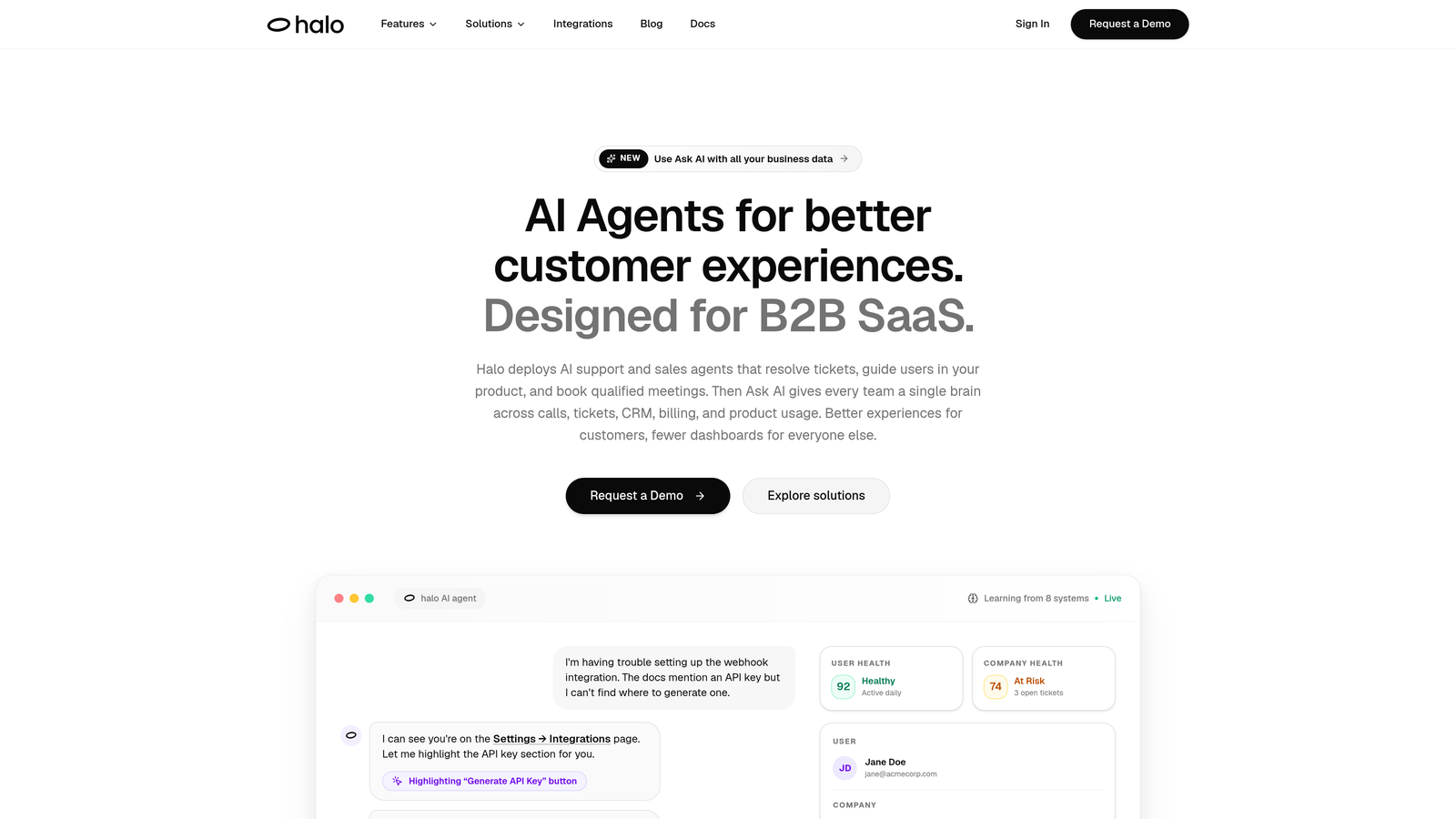
Halo AI is an AI-native customer support platform that deploys intelligent agents to resolve tickets end-to-end, guide users through your product with page-aware context, and surface business intelligence from every interaction.
Where This Tool Shines
What separates Halo from most platforms on this list is its architectural approach. Rather than bolting AI onto an existing helpdesk, Halo is built AI-first from the ground up. That means every interaction feeds a continuous learning loop, so the system gets measurably smarter over time rather than staying static between manual updates.
The page-aware chat widget is a standout capability. Instead of responding to typed queries in isolation, Halo's widget sees what the user sees: their current page, their UI context, where they are in a workflow. That context allows it to provide visual guidance that's genuinely relevant, not generic. For SaaS products with complex interfaces, this is the difference between deflection that actually works and deflection that frustrates users into escalating anyway.
Key Features
Page-Aware Chat Widget: Understands the user's current UI context and delivers in-product visual guidance that reflects exactly where they are in your product.
End-to-End Ticket Resolution: AI agents resolve tickets autonomously, not just suggest replies for human agents to approve, which drives genuine deflection rather than partial automation.
Smart Inbox with Business Intelligence: Surfaces customer health signals, revenue anomalies, and churn indicators from support data, turning your inbox into a source of product and business intelligence.
Auto Bug Ticket Creation: Detects product issues from support conversations and automatically routes bug tickets to Linear or your existing engineering workflow.
Live Agent Handoff: Escalates to human agents with full conversation context preserved, so agents never start from scratch.
Deep Integrations: Connects bidirectionally with Slack, HubSpot, Intercom, Stripe, Zoom, PandaDoc, and Fathom, enabling automation that touches your entire business stack.
Best For
B2B SaaS product teams and support leaders who want more than ticket deflection. Halo is particularly well-suited for teams whose support data contains untapped signals about product quality, customer health, and revenue risk, and who want a platform that learns continuously rather than requiring constant manual retraining.
Pricing
Contact for pricing at haloagents.ai. Halo is positioned as an enterprise-ready platform; pricing is tailored to team size and integration requirements.
2. Zendesk
Best for: Enterprise support teams needing mature SLA management, extensive integrations, and a proven helpdesk foundation.
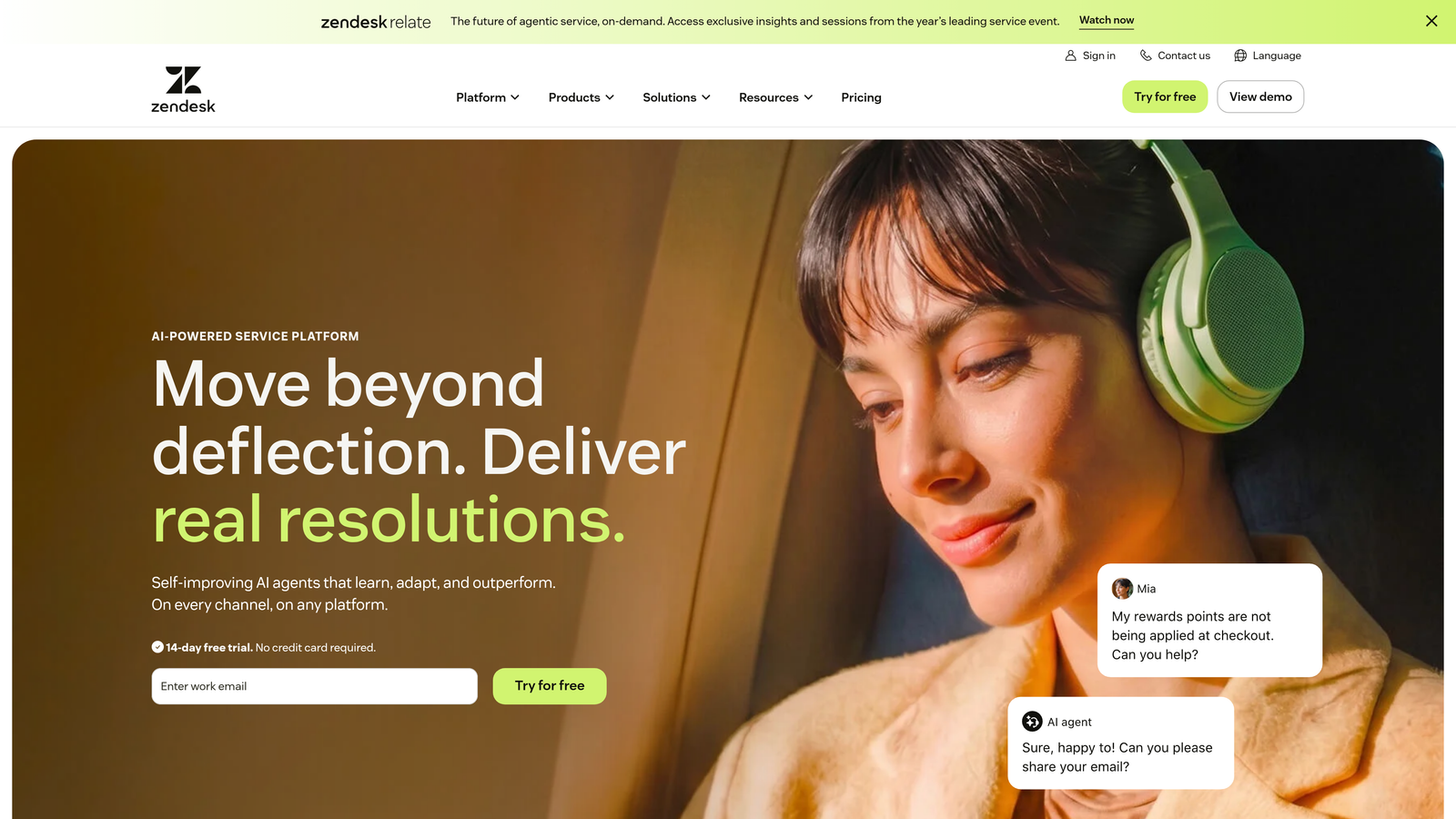
Zendesk is the industry-standard helpdesk platform with a maturing AI layer, backed by one of the largest support tool ecosystems available.
Where This Tool Shines
Zendesk's core strength is its depth and reliability as a helpdesk. SLA management, routing logic, escalation rules, and compliance controls are as mature as they come. If your support operation requires enterprise-grade governance, Zendesk has been solving those problems longer than most competitors have existed.
The more recent addition of AI Copilot and AI-powered self-service agents brings automation capability into the fold, though it's worth noting these are layered onto the existing platform rather than native to its original architecture. For teams already running on Zendesk, these additions can meaningfully extend automation without a platform migration.
Key Features
AI Copilot: Assists human agents with suggested replies, next-best-action guidance, and ticket summarization to speed up resolution time.
AI Agents for Self-Service: Automated resolution across email, chat, and messaging channels, trained on your help content.
Advanced SLA Management: Granular routing, escalation, and priority rules that enterprise support operations depend on.
Marketplace Ecosystem: Hundreds of third-party integrations covering CRM, billing, engineering, and communication tools.
Enterprise Reporting: Comprehensive analytics dashboards for tracking team performance, resolution rates, and customer satisfaction.
Best For
Enterprise support teams with established workflows who want to layer AI onto a proven helpdesk foundation without migrating platforms. Also a strong choice for teams that need extensive third-party integrations from day one.
Pricing
Suite Team starts at $55 per agent per month. AI add-ons are available at additional cost. Enterprise pricing scales significantly; review Zendesk's pricing page for current tier details.
3. Intercom
Best for: SaaS teams that want conversational support and in-product messaging from a single platform.
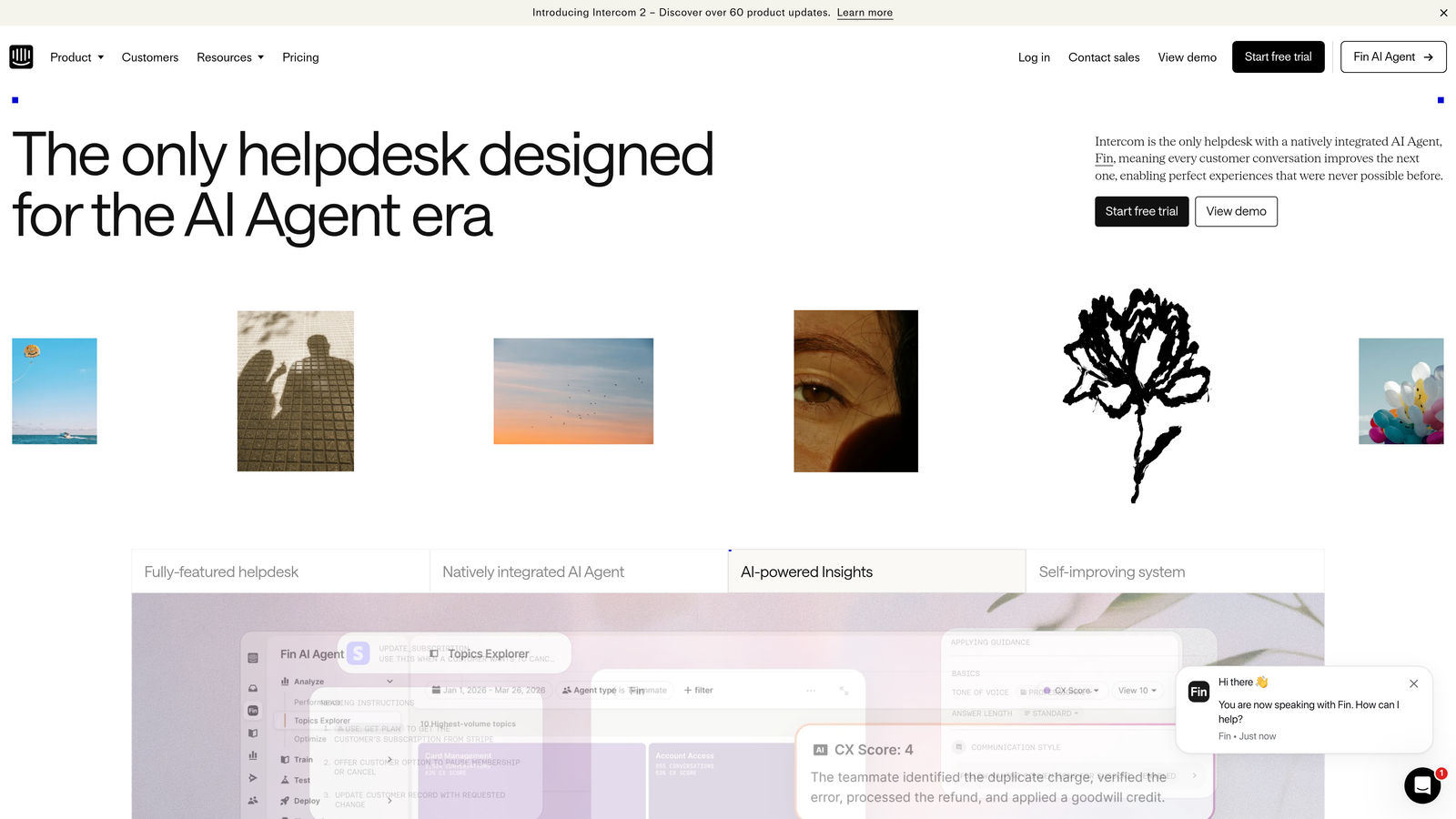
Intercom is a conversational support platform built around Fin, its natively developed AI agent that resolves queries using your own content, paired with powerful in-product messaging tools.
Where This Tool Shines
Fin is one of the more capable AI agents available in a commercial support platform. Built on large language models and trained directly on your help documentation, Fin handles multi-step, nuanced questions rather than just matching keywords to canned responses. For SaaS companies with well-maintained help content, the deflection quality tends to be notably high.
Intercom also excels at combining reactive support with proactive lifecycle messaging. If you want to send targeted onboarding flows, trigger messages based on user behavior, and handle inbound support queries all from one platform, Intercom's unified approach avoids the fragmentation of managing separate tools for each.
Key Features
Fin AI Agent: LLM-powered agent trained on your help content, capable of handling complex multi-turn conversations without scripted flows.
In-Product Messenger: Proactive messaging, onboarding flows, and behavioral triggers built into the same interface as support.
AI-Assisted Shared Inbox: Human agents get AI-suggested replies and context to handle escalated conversations efficiently.
Customer Data Platform: Segmentation and targeting based on user attributes and behavior for more personalized support and messaging.
Integrations: Native connections with Salesforce, Stripe, GitHub, and major SaaS tools.
Best For
SaaS companies that want support and lifecycle communication in one platform, particularly those with strong help content who want Fin's AI deflection to work from day one. Less suited for teams that need deep ITSM or complex enterprise SLA workflows.
Pricing
Essential plan starts at $29 per seat per month. Fin AI Agent is priced per resolution rather than per seat, which can be cost-effective for high-deflection use cases.
4. Freshdesk
Best for: Growing teams that need omnichannel support with AI capabilities at an accessible price point.
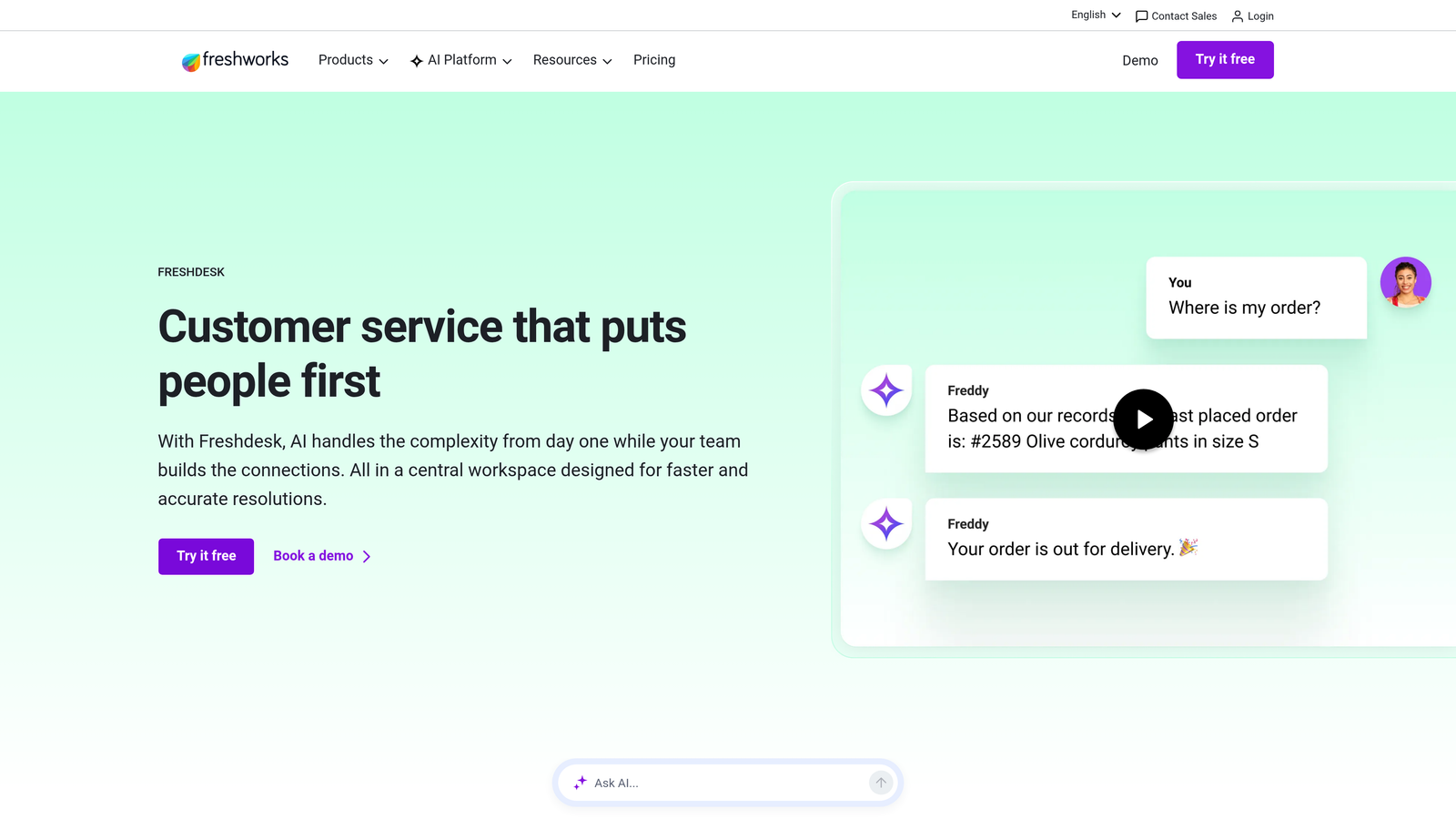
Freshdesk is an omnichannel helpdesk from Freshworks with Freddy AI embedded across ticketing, agent assist, and self-service, offering strong automation at a more accessible price than enterprise alternatives.
Where This Tool Shines
Freshdesk's value proposition centers on breadth without the enterprise price tag. The omnichannel coverage is genuine: email, chat, phone, social media, and WhatsApp all feed into a unified inbox. For teams managing customer contacts across multiple channels, this consolidation alone can meaningfully reduce operational complexity.
Freddy AI spans multiple layers of the support workflow. Ticket summarization and suggested responses help agents work faster, sentiment detection flags at-risk conversations before they escalate, and Freddy Self Service handles deflection before tickets are created. The Freshworks suite integration also means Freshdesk connects naturally with Freshsales CRM and Freshservice ITSM for teams already in that ecosystem.
Key Features
Freddy AI Agent Assist: Ticket summarization, suggested responses, and sentiment detection to accelerate human agent workflows.
Freddy Self Service: AI-powered chatbot deflection trained on your knowledge base content.
Omnichannel Coverage: Unified inbox across email, chat, phone, social media, and WhatsApp.
Automation Rules: Ticket routing, assignment, and escalation rules that reduce manual triage overhead.
Freshworks Suite Integration: Native connections with Freshsales CRM and Freshservice ITSM for teams using the broader Freshworks ecosystem.
Best For
Growing support teams that need genuine omnichannel coverage and AI-assisted workflows without Zendesk-level pricing. Particularly strong for teams already using other Freshworks products.
Pricing
Free plan available. Growth plan starts at $15 per agent per month. Freddy AI capabilities are available as add-ons on higher tiers.
5. Tidio
Best for: Small teams and e-commerce businesses that need fast deployment and accessible AI automation without engineering support.
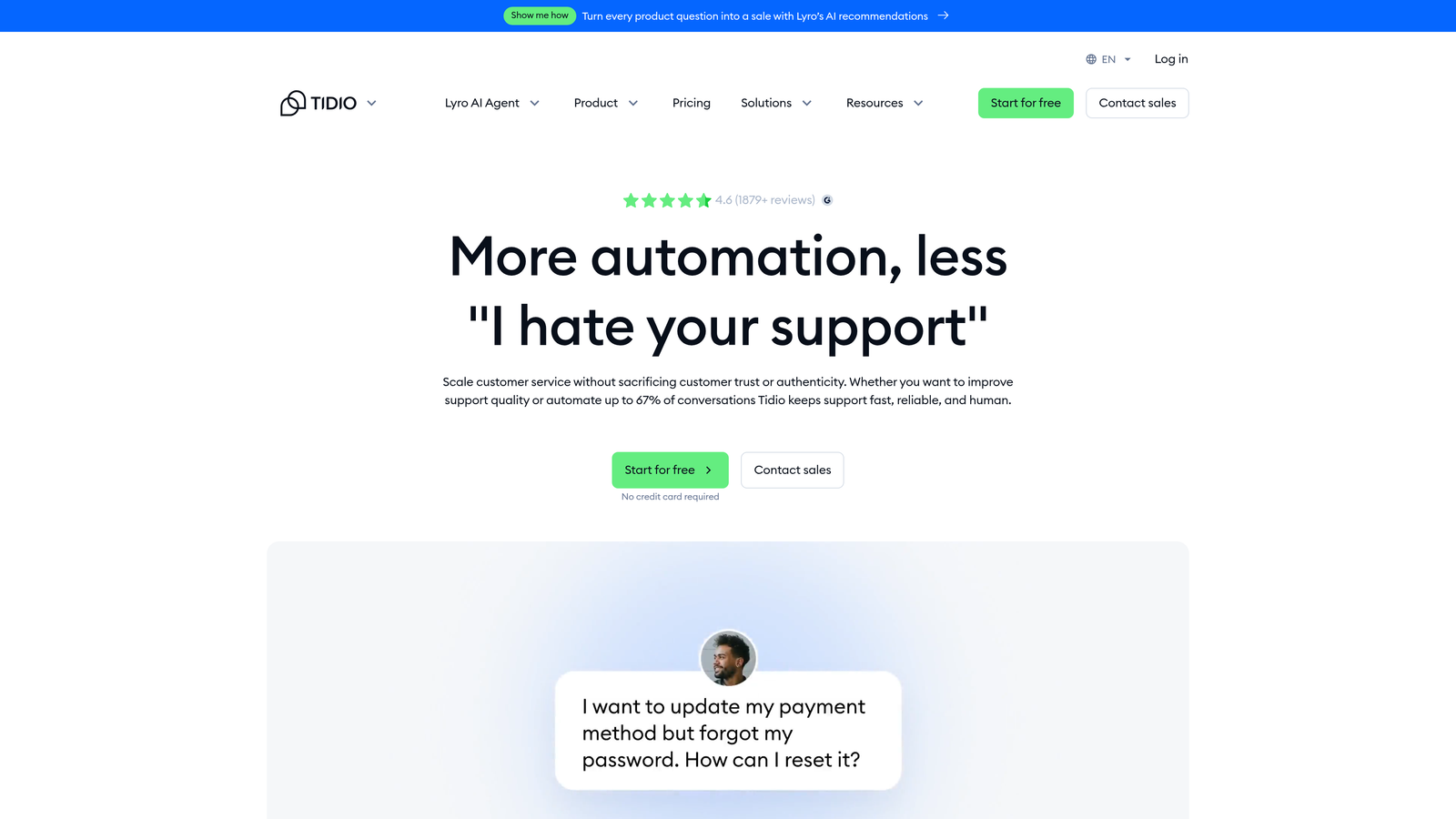
Tidio is a live chat and AI agent platform built for speed-to-value, featuring Lyro AI for automated query resolution and a visual flow builder that empowers non-technical teams to deploy automation independently.
Where This Tool Shines
Tidio's defining advantage is how quickly a team can go from signup to live automation. The visual drag-and-drop flow builder requires no coding knowledge, and Lyro AI can be configured against your knowledge base without a complex implementation project. For lean teams that need automation working this week rather than this quarter, Tidio removes the typical barriers to entry.
Lyro handles conversational query resolution competently for common support scenarios, and the real-time visitor monitoring in the live chat layer gives human agents useful context when they step in. The platform's integrations with Shopify, WordPress, and Wix make it particularly practical for e-commerce and content-driven businesses.
Key Features
Lyro AI Agent: Conversational query resolution trained on your knowledge base, handling common questions without human intervention.
Visual Flow Builder: Drag-and-drop automation builder for creating custom conversation flows without engineering resources.
Live Chat with Visitor Monitoring: Real-time visibility into active visitors for proactive human agent engagement.
E-Commerce Integrations: Native connections with Shopify, WordPress, Wix, and other major e-commerce and CMS platforms.
Fast Deployment: Typically deployable in under an hour for standard use cases.
Best For
Small to mid-sized businesses, e-commerce teams, and anyone who needs working automation quickly without dedicated technical resources. Less suited for complex B2B SaaS support workflows that require deep integration with engineering or CRM systems.
Pricing
Free plan available. Lyro AI starts at $29 per month. Paid plans scale with conversation volume rather than agent seats.
6. Ada
Best for: Enterprise teams that need high-volume AI deflection with strict brand voice controls and multilingual support.
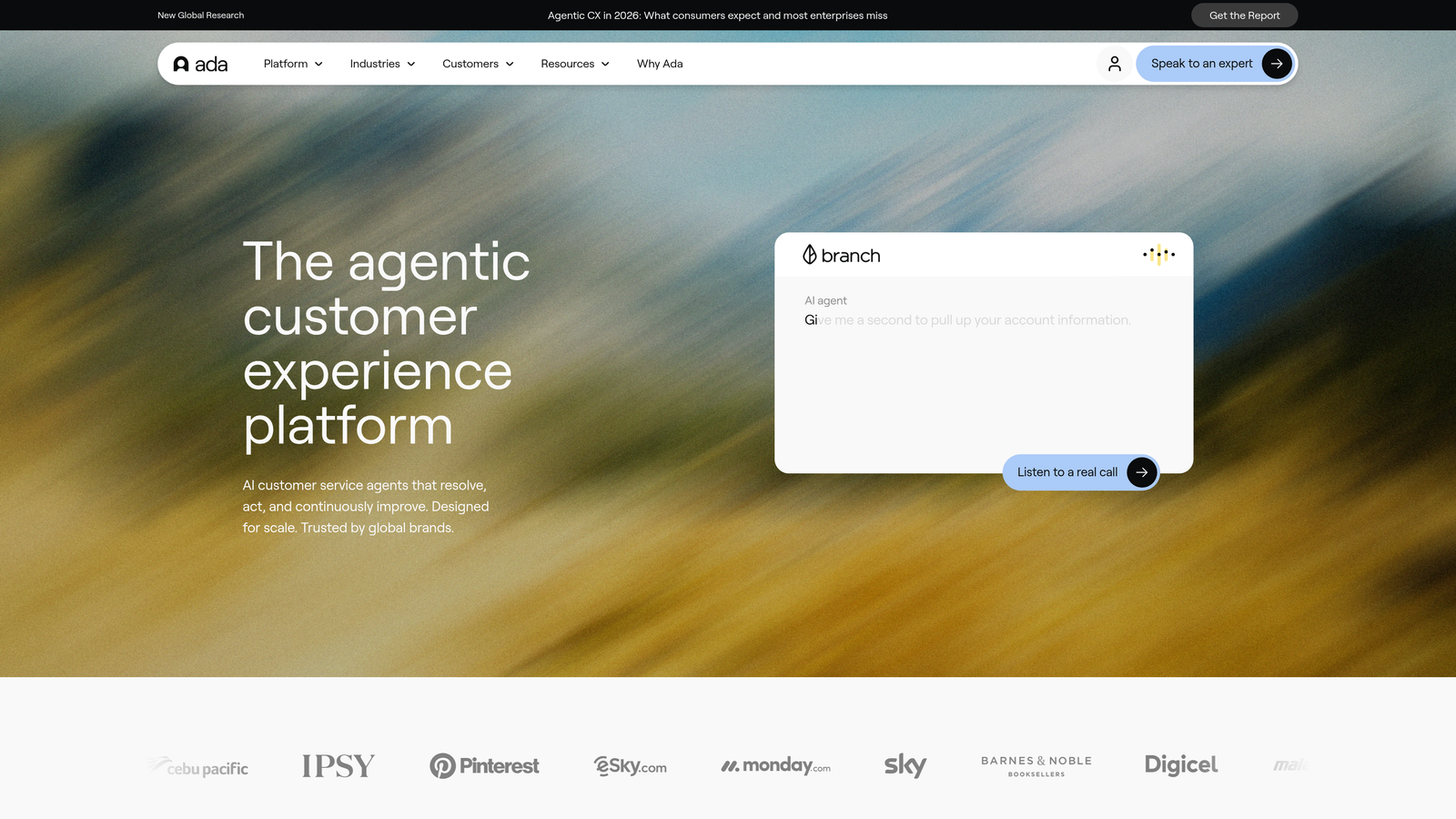
Ada is an enterprise-grade no-code AI agent platform designed for large-scale deflection, with strong brand consistency controls and native multilingual capability across global customer bases.
Where This Tool Shines
Ada's reasoning-based AI handles complex, multi-turn conversations without relying on scripted decision trees, which means it can navigate nuanced queries that would break simpler flow-based bots. For enterprise teams with diverse, unpredictable support volumes, this flexibility at scale is a meaningful differentiator.
The no-code builder gives enterprise teams direct control over AI behavior without depending on engineering resources for every update. Combined with brand voice and tone controls, Ada lets large organizations maintain consistent customer experience across thousands of automated interactions, a real concern for companies where off-brand AI responses create reputational risk.
Key Features
Reasoning-Based AI: Handles complex multi-turn conversations without scripted flows, adapting to unpredictable query paths.
No-Code Builder: Enterprise teams can manage and update AI behavior independently without engineering involvement.
Multilingual Support: Out-of-the-box support across dozens of languages for global customer bases.
Brand Voice Controls: Configurable tone and response style to ensure AI interactions stay on-brand at scale.
Enterprise Integrations: Native connections with Salesforce, Zendesk, Genesys, and major enterprise systems.
Best For
Large enterprises with high support volumes, global customer bases, and strict requirements for brand consistency. Ada requires more implementation investment than SMB-focused tools but is built for the complexity that comes with enterprise scale.
Pricing
Contact Ada directly for pricing. Ada operates on custom enterprise contracts; pricing is not publicly listed.
7. Gorgias
Best for: E-commerce brands that need AI agents capable of taking real order actions, not just answering questions.
Gorgias is a customer support platform purpose-built for e-commerce, with deep integrations that allow AI agents to execute order actions like refunds, cancellations, and edits directly within the support interface.
Where This Tool Shines
Most support platforms can answer the question "Where is my order?" Gorgias can actually fix the order. Its deep integrations with Shopify, BigCommerce, and Magento give both AI agents and human agents the ability to take action on orders without leaving the support interface. For e-commerce brands where the majority of support volume is transactional, this capability transforms support from a cost center into an efficient operational function.
The revenue attribution feature is another genuine differentiator. Gorgias tracks which support interactions influence conversion, giving teams visibility into support's actual impact on revenue rather than just ticket counts. This reframes how support teams justify headcount and tooling investment.
Key Features
Order Management Actions: Direct refunds, edits, and cancellations from within the support interface, executable by both AI agents and human agents.
Revenue Attribution: Per-ticket and per-agent revenue tracking that connects support activity to conversion outcomes.
E-Commerce AI Agent: AI trained on e-commerce-specific intents and connected to order data for accurate, actionable responses.
Omnichannel Coverage: Email, chat, SMS, social media, and voice in a unified inbox.
Native E-Commerce Integrations: Deep connections with Shopify, BigCommerce, Magento, and WooCommerce.
Best For
Direct-to-consumer and e-commerce brands where transactional support queries dominate volume. Less relevant for pure B2B SaaS environments, but a dominant choice for DTC support operations.
Pricing
Starter plan at $10 per month. Pricing scales by ticket volume rather than agent seats, which can be cost-effective for teams with variable support demand.
8. Kustomer
Best for: High-volume customer operations that need AI automation grounded in full customer history across every touchpoint.
Kustomer is a CRM-native support platform (owned by Meta) that gives agents a unified customer timeline across every interaction, enabling AI automation built on complete customer context rather than isolated ticket data.
Where This Tool Shines
Kustomer's core differentiator is its CRM-native architecture. Where most helpdesks organize work around individual tickets, Kustomer organizes around the customer. Every email, chat, order, and previous interaction is consolidated into a single timeline, giving both AI systems and human agents full context before they respond. For high-volume operations where customer history matters, this context layer meaningfully improves resolution quality.
The workflow automation engine supports conditional logic across the full customer lifecycle, not just within individual tickets. This allows teams to build sophisticated automation that responds to customer behavior patterns rather than just ticket attributes.
Key Features
Unified Customer Timeline: All interactions, orders, and history consolidated in a single view for every customer.
Context-Aware AI: Routing, deflection, and agent assist built on full customer history rather than just the current conversation.
Omnichannel Inbox: Email, chat, SMS, social media, voice, and WhatsApp unified in one interface.
Lifecycle Workflow Automation: Conditional logic that triggers automation based on customer behavior across the full relationship lifecycle.
Integrations: Native connections with Shopify, Salesforce, Slack, and major platforms.
Best For
High-volume B2C operations where customer history context is critical to resolution quality. Less common in pure B2B SaaS environments, but a strong choice for consumer brands managing complex, multi-touchpoint customer relationships.
Pricing
Enterprise plan starts at $89 per agent per month. Ultimate plan at $139 per agent per month. Kustomer is positioned as an enterprise platform; pricing reflects that positioning.
9. Guru
Best for: Teams whose automation quality is bottlenecked by inconsistent, outdated, or hard-to-find internal knowledge.
Guru is an AI-powered knowledge management platform that serves as the knowledge foundation for accurate automation, surfacing verified answers inside any support workflow and preventing AI agents from working with outdated information.
Where This Tool Shines
Guru addresses a problem that often goes undiagnosed: AI agents are only as accurate as the knowledge they're trained on. When that knowledge is scattered, outdated, or inconsistently maintained, even the most capable AI agent will produce unreliable responses. Guru solves this at the source with AI-verified knowledge cards and built-in review workflows that keep content current.
The browser extension is a practical standout. It surfaces relevant knowledge cards inside Zendesk, Intercom, Salesforce, and other tools as agents work, eliminating the context-switching that slows down resolution. For teams where agents spend significant time hunting for the right answer, this in-workflow delivery can meaningfully improve efficiency without requiring a platform change.
Key Features
AI-Verified Knowledge Cards: Built-in review workflows ensure knowledge stays accurate and current, reducing the risk of AI agents surfacing outdated information.
Browser Extension: Surfaces relevant knowledge inside Zendesk, Intercom, Salesforce, and other tools without requiring agents to leave their workflow.
Intent-Based AI Search: Understands what agents are looking for based on context and intent, not just keyword matching.
Knowledge Gap Analytics: Identifies what agents search for but cannot find, highlighting content gaps that need to be filled.
Integrations: Connects with Slack, Google Workspace, Zendesk, Salesforce, and more.
Best For
Support teams whose automation accuracy suffers from knowledge inconsistency, and organizations that want a single verified knowledge layer that feeds both AI agents and human agents across multiple platforms. Works best as a complement to a primary helpdesk rather than a standalone support solution.
Pricing
Free plan available for up to 3 users. All-in-One plan starts at $18 per user per month.
Which Tool Is Right for Your Team
The right choice depends less on feature checklists and more on where your biggest constraint actually sits. Here's a quick orientation by use case.
AI-native autonomous resolution: Halo AI is built for this from the ground up, with continuous learning and business intelligence baked into the architecture rather than added on.
Enterprise helpdesk with automation layers: Zendesk remains the default for teams that need mature SLA management, compliance controls, and an extensive integration marketplace alongside AI features.
In-product conversational support: Intercom's combination of Fin AI and lifecycle messaging makes it the natural choice for SaaS teams that want support and user engagement in one platform.
SMB multichannel on a budget: Freshdesk delivers genuine omnichannel coverage and Freddy AI at a price point that growing teams can actually sustain.
E-commerce order-action automation: Gorgias is purpose-built for this and has no real peer when it comes to taking real actions on orders from within the support interface.
No-code enterprise deflection at scale: Ada's reasoning-based AI and brand voice controls make it the go-to for large organizations with complex, high-volume support needs.
Knowledge-first accuracy: Guru doesn't replace your helpdesk, but it makes every AI agent and human agent working inside it more accurate and consistent.
Before making a final decision, ask three questions: Does this tool learn from interactions over time, or does it require constant manual retraining? Can it connect meaningfully to the rest of your stack, beyond basic webhooks? And does it give you intelligence beyond ticket counts, like customer health signals, churn risk, or product quality feedback?
The best automated customer service tools don't just deflect tickets. They make your entire support operation smarter with every interaction that passes through them.
Your support team shouldn't scale linearly with your customer base. Let AI agents handle routine tickets, guide users through your product, and surface business intelligence while your team focuses on complex issues that need a human touch. See Halo in action and discover how continuous learning transforms every interaction into smarter, faster support.