9 Best Automated Customer Service Software Tools in 2026
Automated customer service software has evolved far beyond basic chatbots, giving B2B teams a practical way to handle growing ticket volumes without scaling headcount. This guide evaluates nine leading platforms across AI capability, integration depth, scalability, and pricing to help SaaS teams and enterprise operations find the right fit for their support workflows.
 Grant CooperFounder14 min read
Your support queue doesn't shrink on its own. As B2B teams scale, the gap between ticket volume and team capacity widens fast, and the old answer of "hire more agents" no longer holds up against the economics of modern SaaS growth. Automated customer service software has become the practical solution, but the category has expanded dramatically. You're no longer choosing between a basic chatbot and a full helpdesk. You're choosing between AI-first platforms built around autonomous resolution, established helpdesk giants that have layered AI onto proven infrastructure, and conversational tools designed around messaging and chat workflows.
This list covers tools across all three approaches. To build it, we evaluated each platform on AI capability and architecture, integration depth, scalability, ease of deployment, and pricing transparency. Whether you're a lean SaaS team looking to deflect tickets without adding headcount, or an enterprise operation managing thousands of conversations daily, there's a fit here for your stack and your stage.
1. Halo AI
Best for: SaaS teams that want AI-first autonomous support with business intelligence baked in
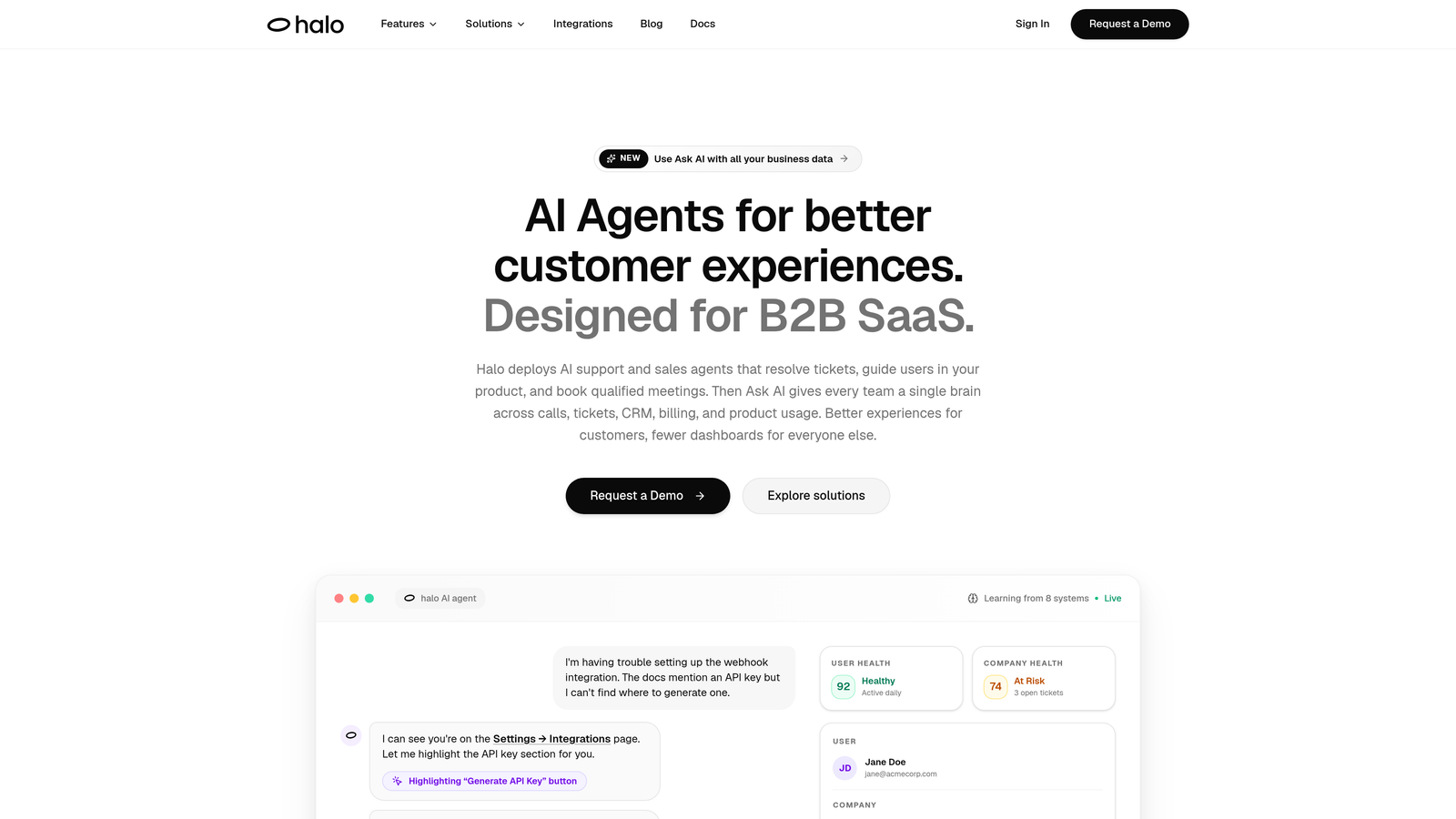
Halo AI is an AI-native customer support platform that deploys autonomous agents to resolve tickets, guide users through your product, and surface business intelligence from every support interaction.
Where This Tool Shines
What separates Halo from tools that bolt AI onto an existing helpdesk is the architecture. It was designed from the ground up around autonomous resolution, which means the AI isn't a layer on top of a ticket queue. It's the core of how support gets done. The page-aware chat widget is a genuine differentiator: it sees what the user sees, understands which part of your product they're on, and delivers contextual UI guidance rather than generic answers.
The smart inbox goes further than most teams expect from a support tool. Beyond routing and resolution, it surfaces customer health signals, flags revenue anomalies, and identifies patterns that typically live buried in CRM or product analytics data. For SaaS teams, this turns support from a cost center into a source of business intelligence.
Key Features
Page-Aware Chat Widget: Understands the user's current context within your product and delivers guidance specific to what they're looking at, not just keyword-matched answers.
Smart Inbox with Business Intelligence: Goes beyond ticket management to surface customer health signals, revenue intelligence, and anomaly detection across your support data.
Auto Bug Ticket Creation: Automatically identifies and routes bug reports directly to engineering tools like Linear, eliminating the manual handoff between support and engineering teams.
Live Agent Handoff: Escalates complex conversations to human agents with full context preserved, so agents never start from scratch.
Full Stack Integrations: Connects natively with Slack, HubSpot, Intercom, Stripe, Zoom, PandaDoc, and Fathom, making it a genuine hub rather than an isolated support tool.
Continuous Learning Model: Improves resolution accuracy with every interaction, compounding value over time rather than requiring constant manual retraining.
Best For
Product-led SaaS companies and B2B teams that want AI agents handling routine tickets autonomously while generating actionable business intelligence. Particularly strong for teams already using tools like Linear, HubSpot, or Stripe who want support connected to the broader business stack.
Pricing
Visit haloagents.ai for current plans. Pricing is not listed here as plans may have been updated since publication.
2. Zendesk
Best for: Enterprise support organizations needing omnichannel automation at scale
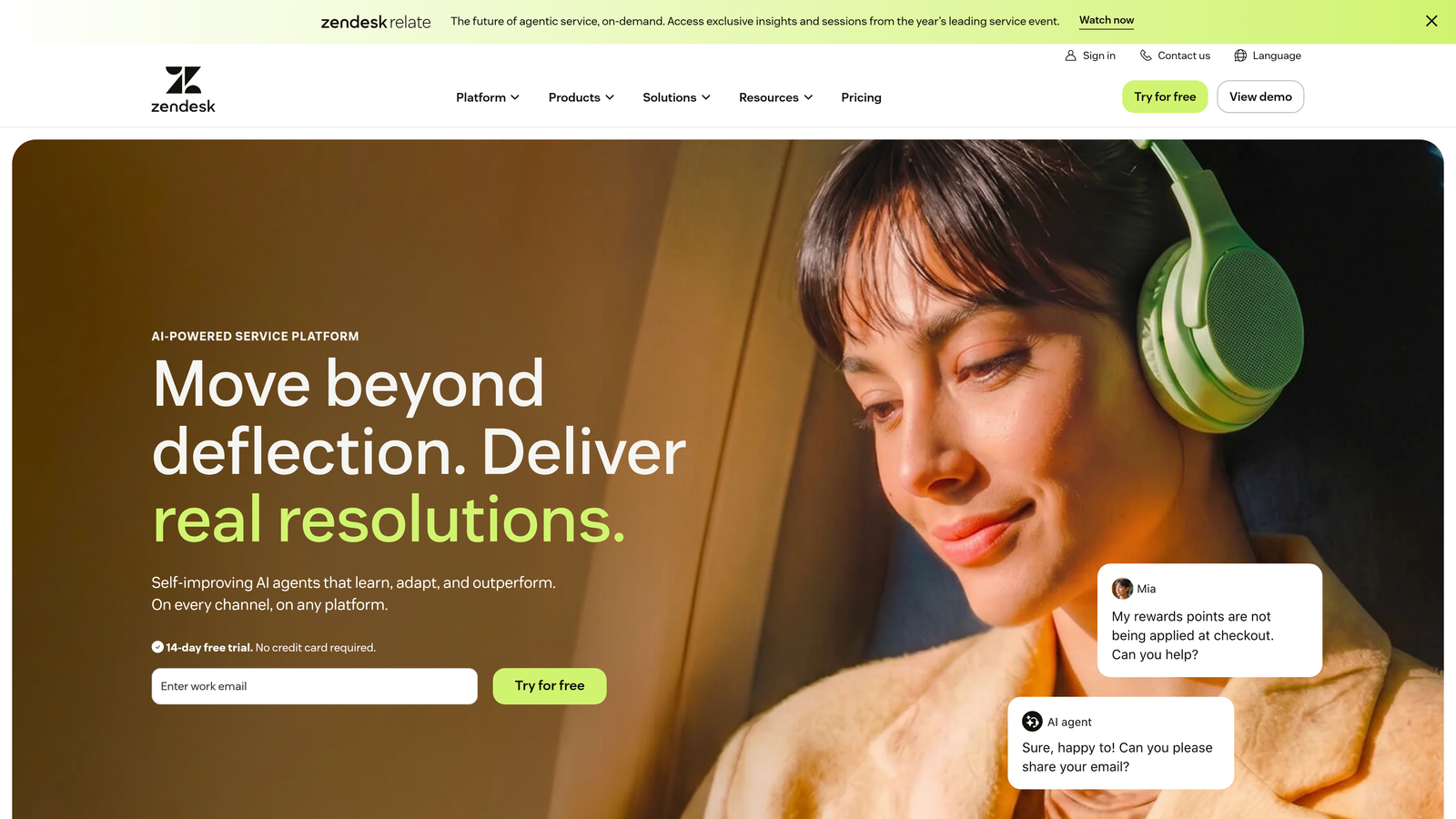
Zendesk is the dominant enterprise helpdesk platform, combining omnichannel support with AI-powered triage, agent copilot features, and one of the deepest integration marketplaces in the category.
Where This Tool Shines
Zendesk's strength is breadth. It handles email, chat, voice, social, and messaging from a single platform, and its workflow automation engine is mature enough to handle complex SLA management, routing logic, and escalation paths that large support orgs depend on. The 1,000+ app marketplace means it connects to almost any tool in your stack.
The Zendesk AI layer, built in partnership with OpenAI, adds intelligent triage, intent detection, and ticket summarization that meaningfully reduces agent handle time. The agent copilot feature surfaces suggested replies and next-best-action recommendations, which helps newer agents perform closer to senior level faster.
Key Features
Zendesk AI: Handles intelligent triage, ticket summarization, and intent detection to reduce manual sorting and improve routing accuracy.
Agent Copilot: Provides real-time suggested replies and next-best-action guidance during live conversations.
Omnichannel Support: Unified management across email, chat, voice, social media, and messaging apps from one workspace.
Marketplace Integrations: Over 1,000 pre-built integrations covering CRM, analytics, ecommerce, and developer tools.
Advanced Workflow Automation: Triggers, automations, and SLA management rules give ops teams granular control over ticket routing and escalation.
Best For
Large support teams and enterprise organizations with complex routing needs, multiple channels, and a requirement for deep customization. Less ideal for small teams who will find the platform's complexity and cost hard to justify at lower volumes.
Pricing
Suite Team starts around $55/agent/month. Verify current pricing at zendesk.com as plans change regularly.
3. Intercom
Best for: Product-led SaaS companies combining support, onboarding, and lifecycle messaging
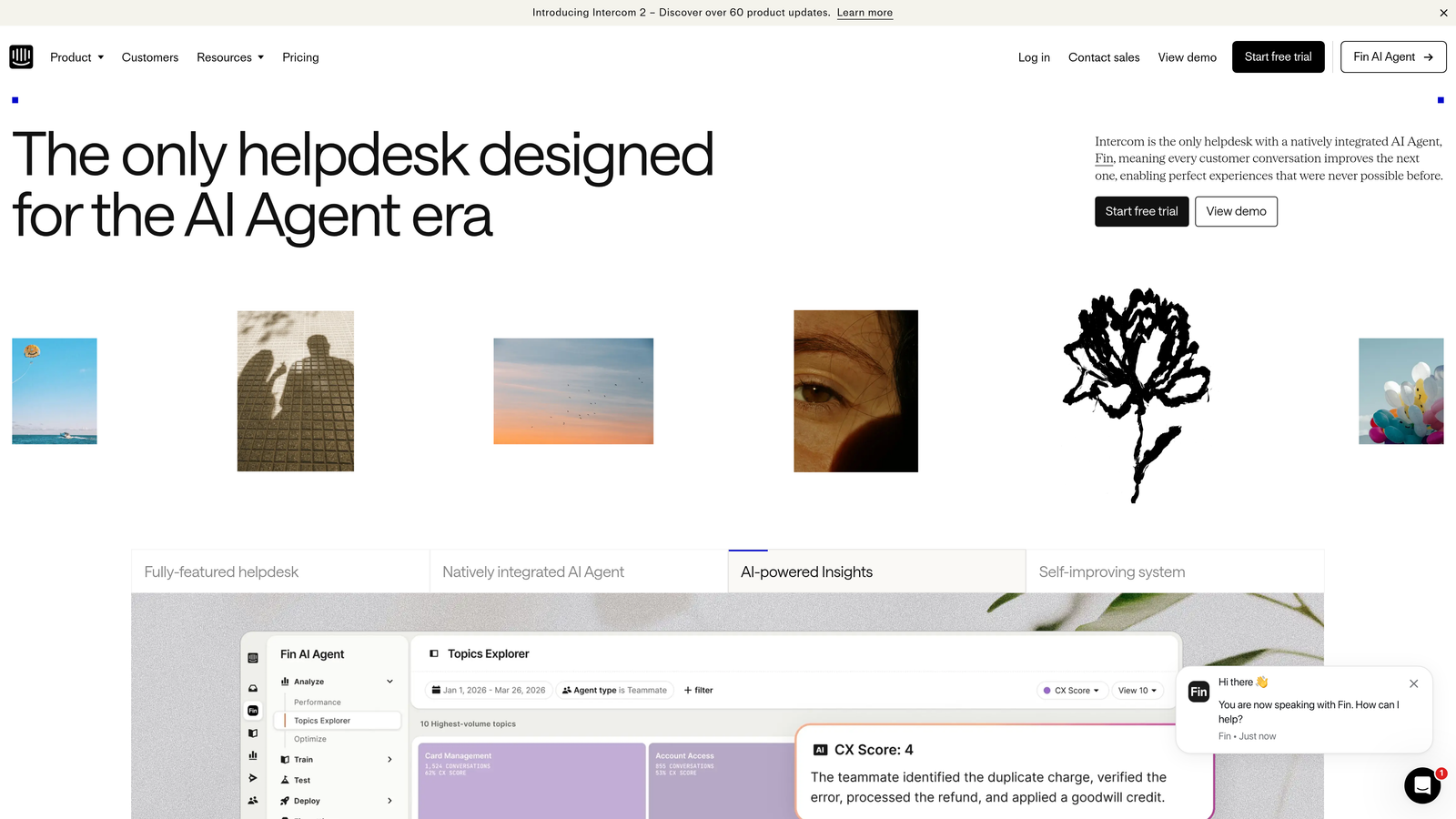
Intercom is a conversational support platform built around in-app messaging, with the Fin AI Agent handling autonomous ticket resolution and a unified inbox bringing support and lifecycle communications together.
Where This Tool Shines
Intercom's Fin AI Agent is one of the more credible autonomous resolution products in the market. It resolves conversations using your existing knowledge base with a design emphasis on reducing hallucination risk, which matters a great deal for B2B teams concerned about AI giving customers incorrect information. The per-resolution pricing model is also worth noting: you pay for outcomes, not seats, which aligns incentives well.
Beyond support, Intercom's product tours and onboarding flows make it genuinely useful for product teams who want a single platform for user activation and support. This dual-purpose positioning makes it particularly compelling for SaaS companies in growth mode.
Key Features
Fin AI Agent: Resolves conversations autonomously using your knowledge base, with a focus on accuracy and low hallucination risk.
Unified Inbox: Combines support, sales, and lifecycle messaging in a single workspace rather than siloing them across tools.
In-App Product Tours: Guides users through product features directly within your application to improve activation and reduce support volume.
Conversation Routing: Automated assignment and routing rules based on intent, customer attributes, and team availability.
Per-Resolution Pricing for Fin: Fin AI is priced on resolutions rather than seats, tying cost directly to value delivered.
Best For
SaaS companies that want to combine customer support with product onboarding and lifecycle messaging. Strong for teams where the line between support and product engagement is intentionally blurred.
Pricing
Starter plans from around $39/seat/month; Fin AI priced separately per resolution. Verify current pricing at intercom.com.
4. Freshdesk
Best for: SMB and mid-market teams wanting omnichannel automation at a competitive price point
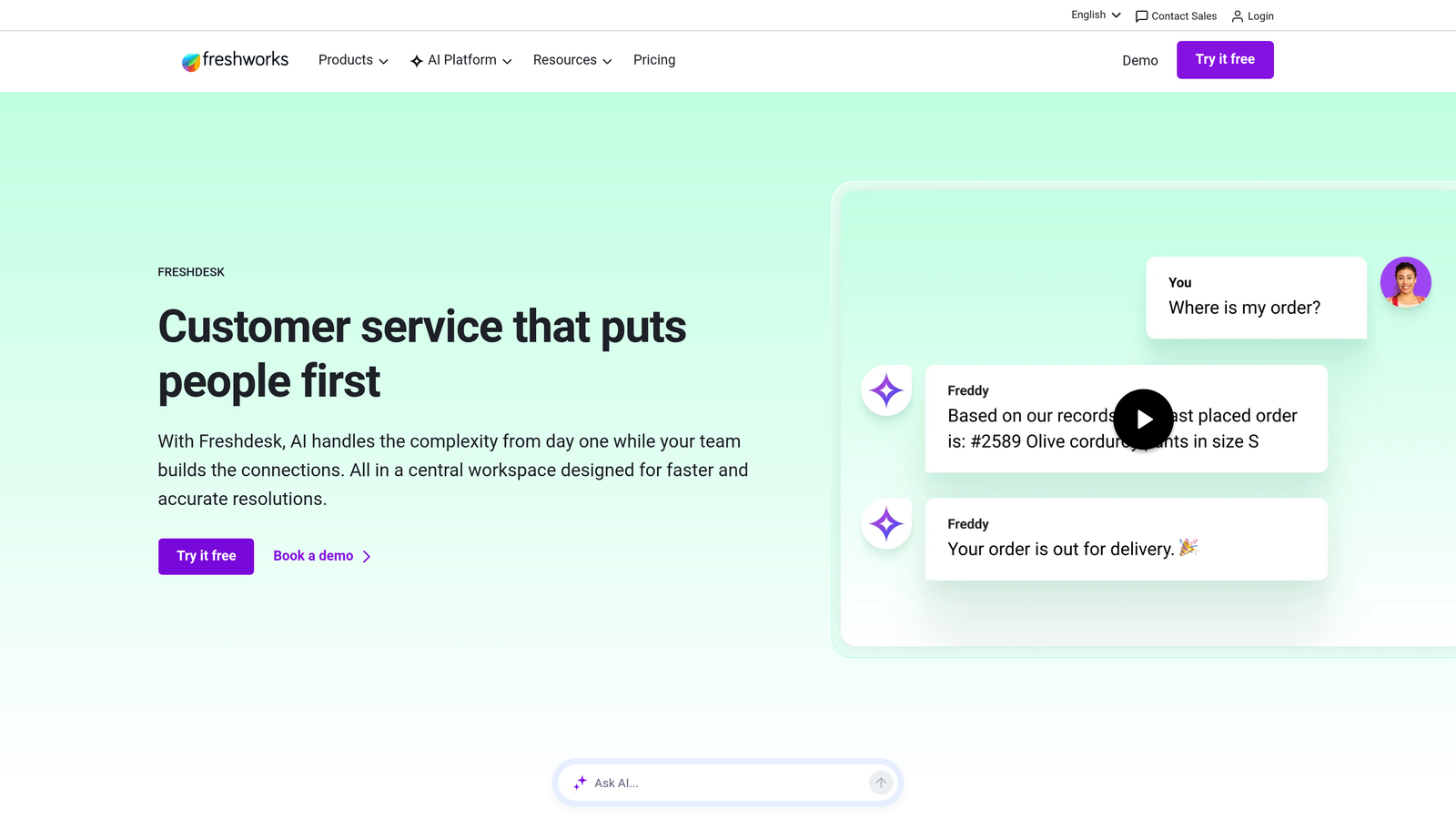
Freshdesk is Freshworks' helpdesk platform, offering omnichannel ticketing with Freddy AI handling intelligent automation, agent assist, and support analytics at pricing that undercuts the enterprise tier alternatives.
Where This Tool Shines
Freshdesk's value proposition is strong coverage at a lower cost than Zendesk or Intercom. The Freddy AI suite handles ticket summarization, auto-triage, and suggested responses in a way that genuinely reduces agent workload, and Freddy Copilot adds real-time assistance during live conversations. For teams that need omnichannel support across email, chat, phone, and social without enterprise-level spend, Freshdesk is a natural fit.
The free tier is also a legitimate entry point for small teams, not just a trial. It provides core ticketing functionality that many early-stage teams can operate on for a meaningful period before needing to upgrade.
Key Features
Freddy AI: Handles ticket summarization, auto-triage, and suggested responses to reduce manual agent effort across high-volume queues.
Freddy Copilot: Provides real-time agent assistance during live conversations, surfacing relevant knowledge and response suggestions.
Omnichannel Support: Covers email, chat, phone, and social media from a unified ticketing interface.
Collision Detection: Prevents multiple agents from simultaneously responding to the same ticket, reducing duplicate effort and customer confusion.
Free Tier: A functional free plan that gives small teams access to core ticketing without requiring immediate commitment to paid plans.
Best For
SMBs, mid-market teams, and growing companies that need solid omnichannel automation without the cost structure of enterprise platforms. Also a strong choice for teams already in the Freshworks ecosystem using tools like Freshsales or Freshchat.
Pricing
Free tier available; Growth plans from around $15/agent/month. Verify current pricing at freshdesk.com.
5. Tidio
Best for: Small businesses and e-commerce teams wanting fast, no-code chatbot deployment
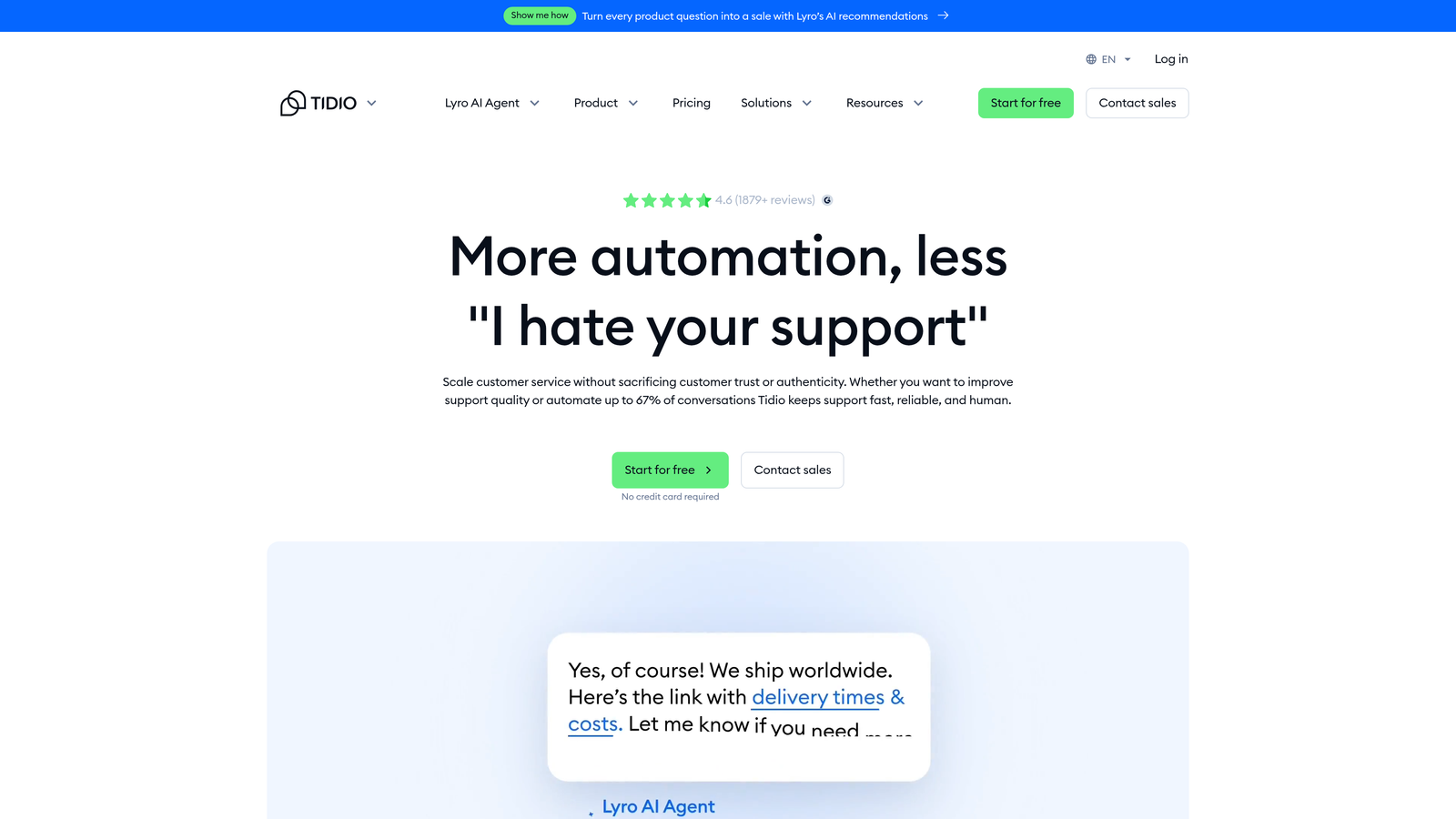
Tidio is a live chat and AI chatbot platform built for speed-to-value, featuring the Lyro AI chatbot and a visual flow builder that non-technical teams can deploy without writing a single line of code.
Where This Tool Shines
Tidio wins on simplicity and time-to-value. The visual drag-and-drop flow builder means a small business owner or a support manager without engineering support can build and deploy automated conversation flows in hours, not weeks. The native integrations with Shopify, WooCommerce, and WordPress make it a natural fit for e-commerce teams who want automation without a complex implementation project.
Lyro AI handles automated conversation handling using your content, and the live chat agent takeover feature means human agents can step in from automated flows when needed. For the target audience, this balance of automation and human availability is exactly right.
Key Features
Lyro AI Chatbot: Handles automated conversation resolution using your knowledge base content, with natural language understanding for common customer questions.
Visual Flow Builder: Drag-and-drop interface for building chatbot conversation flows without coding, accessible to non-technical team members.
E-Commerce Integrations: Native connections to Shopify, WooCommerce, and WordPress for order status, product queries, and customer data.
Live Agent Takeover: Allows human agents to seamlessly take over automated conversations when complexity requires it.
Free Tier: Core live chat and basic automation available without payment, making it accessible for teams just starting with chat automation.
Best For
Small businesses, e-commerce brands, and teams without dedicated engineering resources who need working chat automation quickly. Less suited for complex B2B enterprise use cases with deep CRM or workflow requirements.
Pricing
Free tier available; paid plans from around $29/month. Verify current pricing at tidio.com.
6. Drift (Salesloft)
Best for: B2B revenue teams where support and sales workflows overlap significantly
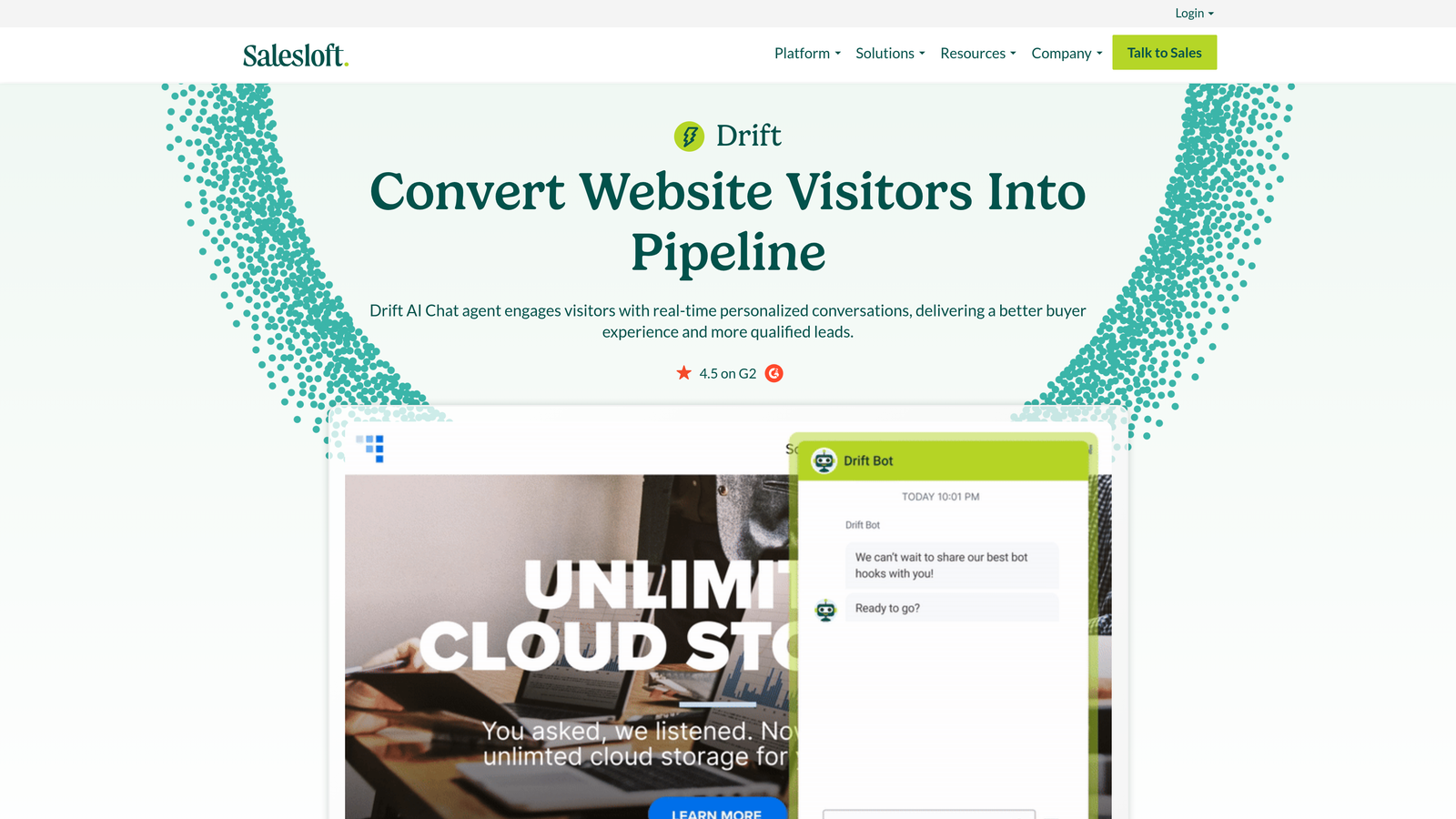
Drift, now part of Salesloft, is a conversational platform that combines AI-powered chat automation with buyer intent signals and account-based routing, bridging the gap between support and revenue operations.
Where This Tool Shines
Drift's differentiation is its revenue alignment. Where most support tools focus purely on deflection and resolution, Drift connects visitor behavior and chat interactions to account-level intent data, routing high-value accounts to the right rep or support agent based on who they are, not just what they're asking. For B2B teams where sales and support share responsibility for customer relationships, this is a meaningful capability.
The Salesloft acquisition has deepened the integration between conversational workflows and broader revenue operations. Teams already using Salesloft for sales engagement will find Drift fits naturally into that motion, though the positioning has shifted more toward revenue workflows than pure support automation.
Key Features
AI Playbooks: Automated conversation routing and qualification flows that respond to visitor behavior and intent signals.
Buyer Intent Signals: Identifies and prioritizes high-value accounts based on behavioral data to ensure the right conversations get human attention.
Account-Based Routing: Routes visitors to the correct rep or support agent based on account attributes, not just availability.
Salesloft Integration: Post-acquisition, connects directly into Salesloft revenue workflows for teams using both platforms.
Meeting Booking Automation: Allows prospects and customers to book meetings directly within chat conversations without leaving the page.
Best For
B2B teams where customer support and sales development overlap, particularly those already operating within the Salesloft ecosystem. Less suited for teams focused purely on support automation without a revenue component.
Pricing
Contact Drift or Salesloft directly for current pricing. Verify at drift.com.
7. Zoho Desk
Best for: Teams already in the Zoho ecosystem wanting native CRM integration and AI-assisted support
Zoho Desk is a helpdesk platform from Zoho that integrates natively with Zoho CRM and Zoho One, with Zia AI handling sentiment analysis, anomaly detection, and intelligent response suggestions.
Where This Tool Shines
Zoho Desk's strongest argument is ecosystem value. If your team is already using Zoho CRM, the two-way sync between customer records and support tickets creates a level of context that standalone helpdesk tools can't match without complex integrations. Zia AI's anomaly detection feature, which flags unusual spikes in ticket volume, is a practical capability that helps support managers catch problems before they escalate.
The Blueprint workflow automation is worth calling out specifically: it lets teams map out standardized support processes with defined stages, conditions, and actions, which is particularly useful for teams with compliance requirements or complex escalation paths that need to be consistently followed.
Key Features
Zia AI: Handles sentiment analysis, ticket tagging, response suggestions, and anomaly detection to assist agents and surface operational insights.
Zoho CRM Sync: Native two-way integration with Zoho CRM gives agents full customer context without switching platforms.
Anomaly Detection: Flags unusual ticket volume patterns so support managers can respond to emerging issues proactively.
Multi-Department Support: Separate queues, SLAs, and workflows for different teams or business units within a single instance.
Blueprint Automation: Visual workflow builder for standardizing support processes with defined stages and transition conditions.
Best For
Companies already operating within the Zoho ecosystem, particularly those using Zoho CRM or Zoho One. The value proposition weakens considerably outside the Zoho stack, where the integration advantages disappear.
Pricing
Standard plans from around $14/agent/month. Verify current pricing at zoho.com/desk.
8. Help Scout
Best for: Teams that prioritize human-feeling support and brand voice over autonomous deflection
Help Scout is a shared inbox platform with AI assist features designed to feel like email rather than a ticket system, combining lightweight automation with a clean UX that keeps the focus on personal, high-quality responses.
Where This Tool Shines
Help Scout occupies a distinct position in this list: it's not trying to maximize autonomous deflection. The design philosophy is that some support teams want AI to make their agents better, not replace them. The AI Summarize and AI Assist features help agents work faster and write better replies without removing the human from the conversation. For brands where tone and relationship quality are differentiators, this approach makes sense.
The Beacon in-app widget and integrated Docs knowledge base create a self-service layer that reduces inbound volume without a complex chatbot implementation. It's a lighter-weight automation approach that fits teams who find full chatbot deployments more overhead than they're worth.
Key Features
AI Summarize: Condenses long conversation threads into quick summaries so agents get up to speed instantly without reading full history.
AI Assist: Drafts and improves agent replies in real time, helping teams write faster without sacrificing tone or accuracy.
Beacon Widget: In-app self-service widget combining knowledge base search, proactive messaging, and chat in a lightweight embed.
Shared Inbox with Collision Detection: Prevents duplicate responses with real-time visibility into who is viewing or replying to each conversation.
Docs Knowledge Base: Built-in knowledge base that integrates directly with the Beacon widget for seamless self-service delivery.
Best For
Customer-focused teams where brand voice and personal tone are a priority, and where the goal is augmenting human agents rather than replacing them. Strong fit for SaaS, professional services, and subscription businesses with relationship-driven support models.
Pricing
Plans start around $22/user/month. Verify current pricing at helpscout.com.
9. Kustomer
Best for: High-volume B2C and D2C operations needing a CRM-native support platform
Kustomer is a CRM-native customer service platform built for high-volume support operations, offering a unified customer timeline view, AI-powered deflection and routing, and deep automation for brands managing complex order and customer histories.
Where This Tool Shines
Kustomer's customer timeline view is its most distinctive feature. Rather than presenting support as a series of disconnected tickets, it unifies every touchpoint, order, interaction, and customer attribute into a single chronological view. For high-volume B2C operations where context is everything, this dramatically reduces the time agents spend piecing together customer history before they can respond.
The visual business rules engine for workflow automation is powerful enough to handle complex routing and deflection logic without requiring engineering involvement. For operations teams managing large support volumes across multiple channels, the combination of CRM context and flexible automation makes Kustomer a strong platform when the implementation investment is justified.
Key Features
Customer Timeline View: Unifies all touchpoints, order history, and interactions in a single chronological screen, giving agents complete context instantly.
AI-Powered Deflection: Chatbot and self-service automation to handle common queries before they reach a human agent.
Intelligent Routing: Routes incoming conversations based on customer attributes, history, and detected intent rather than simple queue assignment.
Visual Business Rules Engine: Drag-and-drop workflow automation for building complex routing, escalation, and response logic without code.
E-Commerce Integrations: Deep connections with Shopify, Magento, and custom APIs for brands with complex order management needs.
Best For
High-volume B2C and D2C brands, particularly in e-commerce and subscription retail, where customer history and order context are central to every support interaction. The implementation complexity and enterprise pricing make it less suitable for smaller teams or simpler use cases.
Pricing
Enterprise pricing; contact Kustomer directly for a quote at kustomer.com.
Which Tool Is Right for Your Team
Nine tools, three architectural approaches, and a wide range of price points. Here's how to cut through the options based on your actual situation.
If you're building a SaaS product and want AI agents that resolve tickets autonomously, understand product context, and surface business intelligence beyond the support queue, Halo AI is the purpose-built choice. It's designed for this use case from the ground up, not retrofitted onto a legacy helpdesk architecture.
For enterprise organizations with complex omnichannel needs and large support teams, Zendesk remains the most mature platform in the category. For product-led SaaS companies that want support and onboarding in one tool, Intercom is the natural fit. Budget-conscious SMBs and mid-market teams will find Freshdesk covers most of the same ground at a meaningfully lower cost.
Tidio is the clear winner for small businesses and e-commerce teams who need fast deployment without technical resources. Drift makes the most sense for B2B revenue teams where support and sales overlap. Zoho Desk is the logical choice for teams already committed to the Zoho ecosystem. Help Scout is ideal for brands where human tone and relationship quality are non-negotiable. And Kustomer is built for high-volume B2C operations where CRM context drives every support interaction.
The broader direction the category is heading is clear: autonomous resolution and business intelligence from support data are becoming baseline expectations, not differentiators. The tools that treat every support interaction as a signal, not just a ticket to close, are the ones worth building around.
Your support team shouldn't scale linearly with your customer base. Let AI agents handle routine tickets, guide users through your product, and surface business intelligence while your team focuses on complex issues that need a human touch. See Halo in action and discover how continuous learning transforms every interaction into smarter, faster support.