9 Best Automated Customer Service Software Tools Compared for 2026
This automated customer service software comparison evaluates nine tools — from AI-first autonomous platforms to traditional helpdesks with automation layers — across AI capability, integration ecosystems, deployment ease, and value for B2B SaaS teams, helping you cut through marketing noise and choose the right solution for your support stack.
 Grant CooperFounder12 min read
Choosing the right automated customer service software is one of the highest-leverage decisions a B2B product team can make. The wrong pick means agents drowning in repetitive tickets. The right one means customers getting instant answers at 3 a.m. while your team focuses on work that actually requires human judgment.
This comparison covers nine tools across the spectrum, from AI-first agent platforms to traditional helpdesks with automation layers added later. We evaluated each on depth of AI capability, integration ecosystem, ease of deployment, and value for B2B SaaS teams specifically. Whether you're replacing a legacy helpdesk, layering AI onto an existing system, or building a support stack from scratch, this guide cuts through the marketing noise. For broader context on the category, our guide to automated customer support is a solid starting point.
1. Halo AI
Best for: B2B SaaS teams that want AI-first autonomous resolution with deep product context
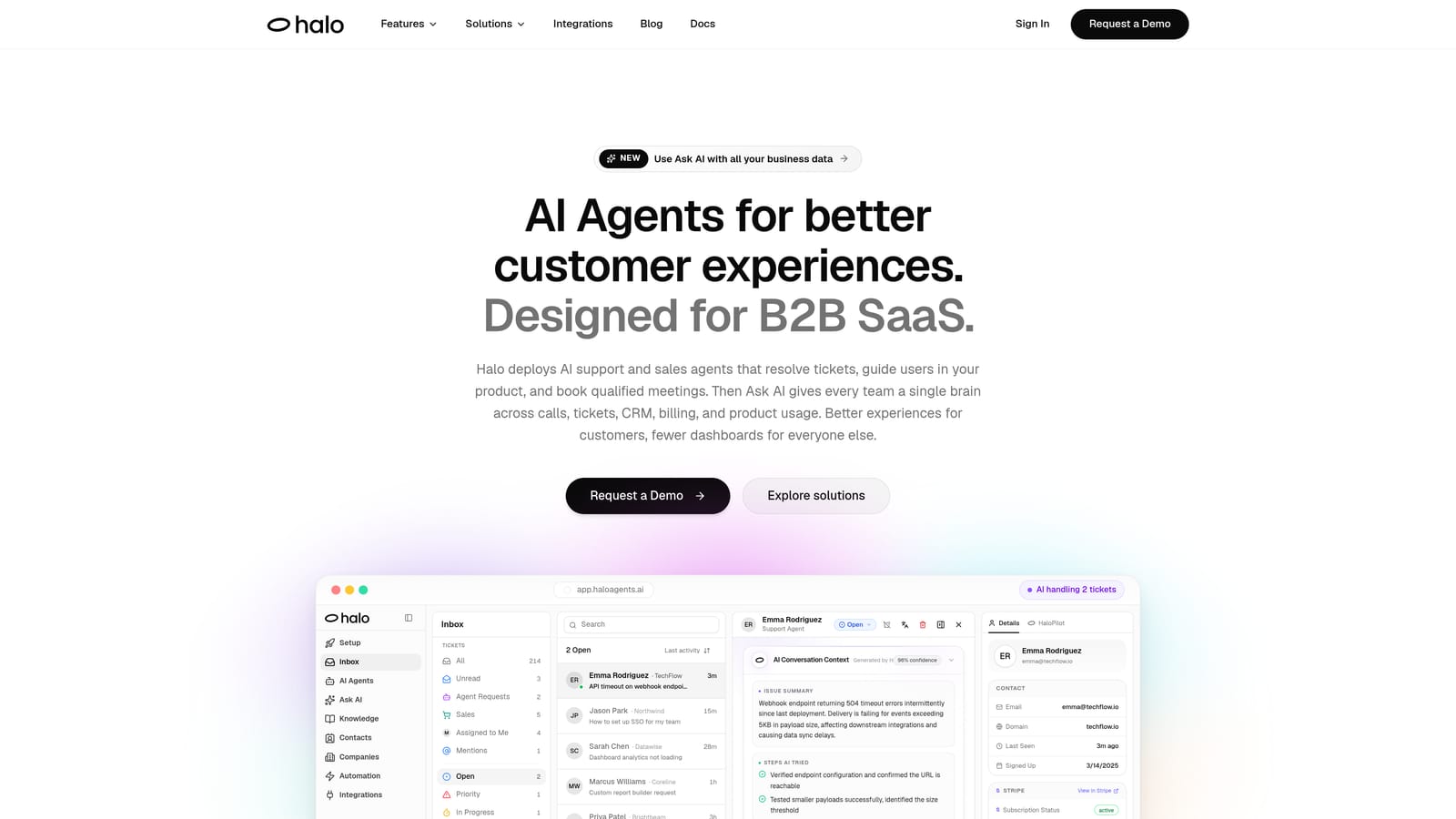
Halo AI is an AI-native customer support platform purpose-built for B2B SaaS teams who want autonomous ticket resolution, not just AI-assisted agents.
Where This Tool Shines
The standout capability here is page-aware context. Halo's chat widget knows exactly which screen a user is on when they ask for help, which means the AI can provide visual, contextual guidance rather than generic answers. That's a meaningful difference when your product has dozens of workflows and users get stuck in very specific places.
Beyond resolution, Halo surfaces business intelligence signals that most support tools ignore entirely. The smart inbox doesn't just show you ticket volume; it flags customer health trends, revenue anomalies, and support patterns that connect directly to retention and growth decisions. The auto bug ticket creation, routed straight to Linear or your issue tracker, is a workflow differentiator that product teams genuinely appreciate.
Key Features
Page-Aware Chat Widget: The AI sees what screen the user is on and delivers contextual, visual guidance specific to that moment in the product.
Autonomous AI Agents: Resolves tickets end-to-end and escalates complex issues to live agents with full conversation context intact.
Auto Bug Ticket Creation: Automatically generates and routes bug reports to Linear or your preferred issue tracker without manual intervention.
Smart Inbox with Business Intelligence: Surfaces customer health signals, revenue anomalies, and support trends beyond standard ticket metrics.
Full-Stack Integrations: Connects to Linear, Slack, HubSpot, Intercom, Stripe, Zoom, PandaDoc, and Fathom for a unified operational picture.
Continuous Learning: The AI improves with every resolved interaction, getting smarter about your product and your customers over time.
Best For
B2B SaaS product and support teams that want AI to handle routine tickets autonomously, need deep integration across their business stack, and want support data to inform product and customer success decisions, not just measure deflection rates.
Pricing
Custom pricing based on volume and integrations. Contact Halo AI directly for a demo and tailored quote.
2. Zendesk
Best for: Enterprise support teams needing omnichannel coverage with deep customization
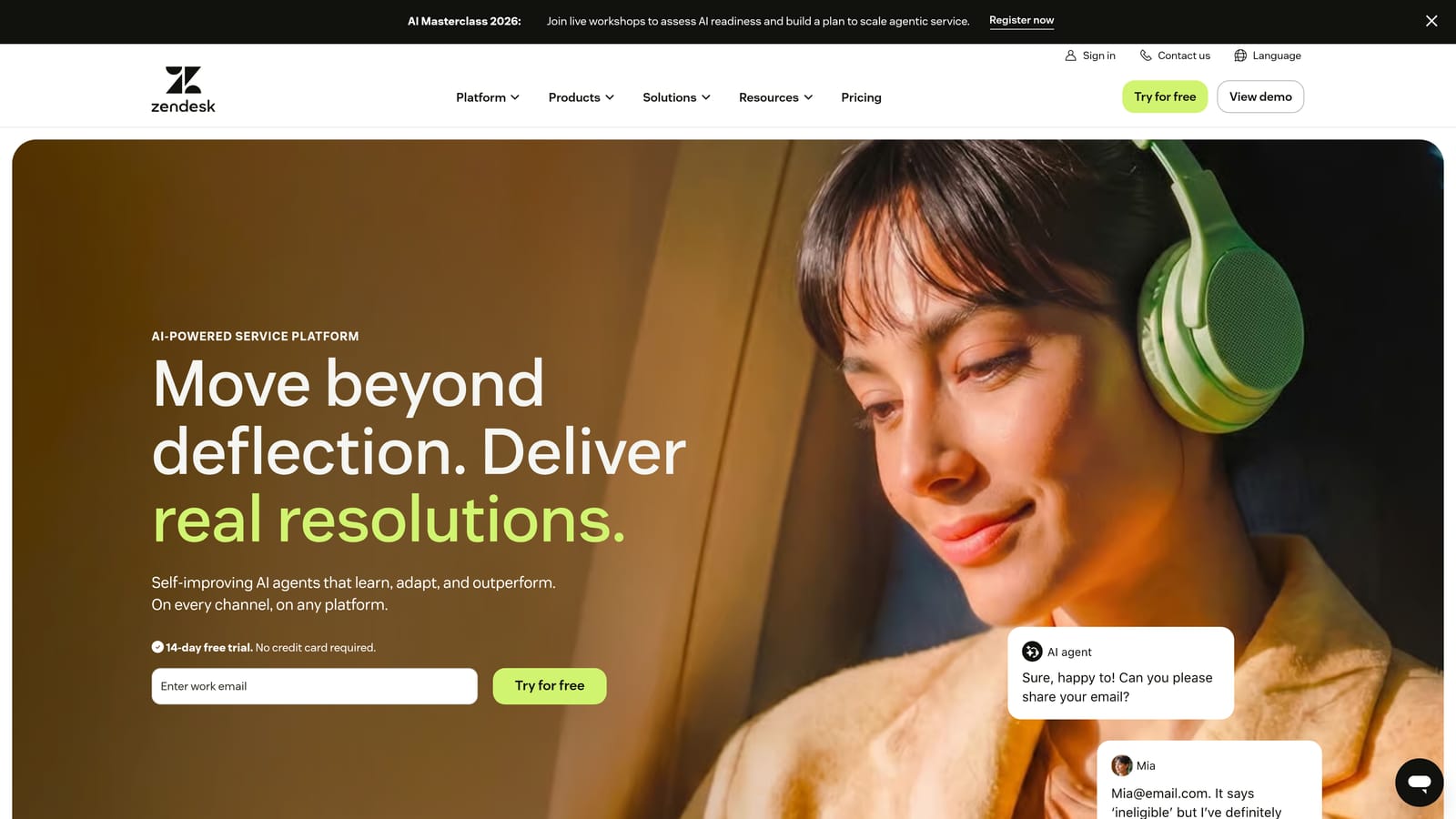
Zendesk is the market-leading enterprise helpdesk platform, with AI features layered on top of a mature ticketing and omnichannel system.
Where This Tool Shines
Zendesk's strength is breadth. It handles email, chat, voice, social, and messaging from a unified agent workspace, and its app marketplace offers hundreds of integrations for nearly any workflow. For organizations with dedicated support operations teams, the depth of configuration available is genuinely impressive.
The AI capabilities, powered by an OpenAI partnership, cover intelligent triage, suggested replies, and macro recommendations. These are useful features, but they're primarily agent-assist rather than autonomous resolution. If your support model centers on human agents handling every ticket with AI helping them go faster, Zendesk is a natural fit.
Key Features
Zendesk AI: Intelligent triage, suggested replies, and macro recommendations to accelerate agent workflows.
Omnichannel Support: Email, chat, voice, social, and messaging channels unified in the Agent Workspace.
App Marketplace: Hundreds of integrations covering CRM, analytics, e-commerce, and more.
Advanced Reporting and SLA Management: Detailed performance dashboards with configurable SLA tracking.
Agent Workspace: Unified view of all customer interactions across channels for individual agents.
Best For
Mid-to-large organizations with dedicated support ops staff, complex omnichannel needs, and the administrative resources to configure and maintain a sophisticated helpdesk environment.
Pricing
Suite plans start at approximately $55 per agent per month billed annually. Enterprise pricing is available for larger deployments. Costs can scale significantly with seat count and add-ons.
3. Intercom
Best for: SaaS teams combining customer support with in-app onboarding and lifecycle messaging
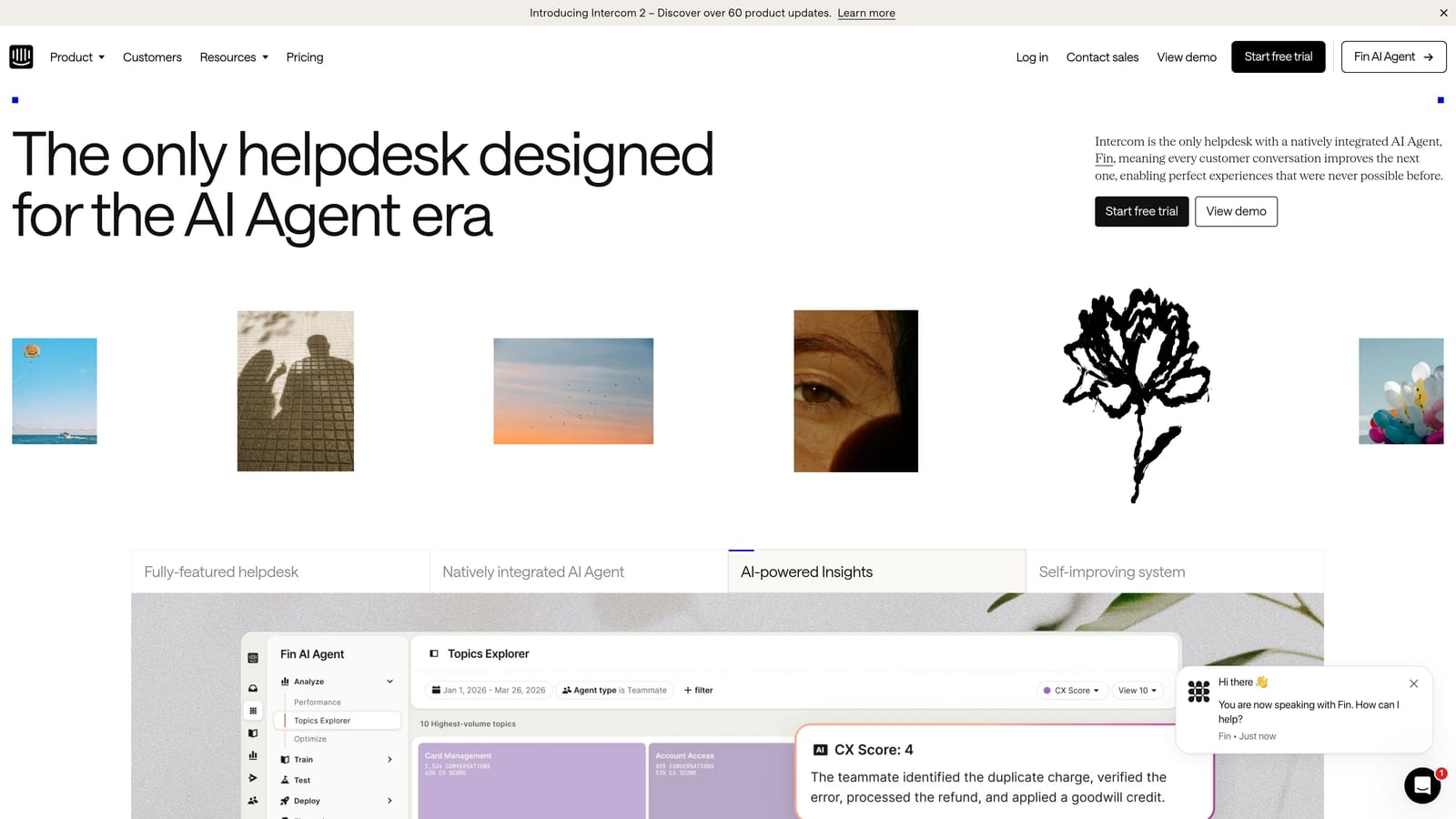
Intercom is a messaging-first customer platform that combines AI support through its Fin agent, product tours, and lifecycle messaging in a single tool.
Where This Tool Shines
Fin, Intercom's AI agent, resolves conversations autonomously using your existing help content. For teams that have invested in a solid knowledge base, Fin can deflect a meaningful portion of inbound volume without additional configuration. The messenger experience itself is polished and familiar to SaaS users.
Where Intercom stands out from pure support tools is the combination of support and onboarding in one platform. Product tours, checklists, and targeted in-app messages live alongside the support inbox. If your team wants to handle both onboarding flows and support conversations without stitching together separate tools, that's a real advantage.
Key Features
Fin AI Agent: Resolves support conversations autonomously using your help center content as its knowledge source.
In-App Messenger: Embeddable chat with product tours and onboarding flows built in.
Shared Inbox with AI Assist: AI-assisted reply drafting for human agents handling escalated conversations.
Customer Data Platform: Segmentation and targeted messaging based on user behavior and attributes.
Integrations: Connects with Salesforce, HubSpot, Stripe, and other common SaaS tools.
Best For
SaaS teams that want a single platform for in-app support and user onboarding, and are willing to invest in building out help content to maximize Fin's resolution rate. See also our Intercom alternatives comparison for more context.
Pricing
Essential plan starts at approximately $39 per seat per month. Fin AI usage is billed per resolution, so costs scale with conversation volume.
4. Freshdesk
Best for: Mid-market teams wanting competitive pricing within the Freshworks ecosystem
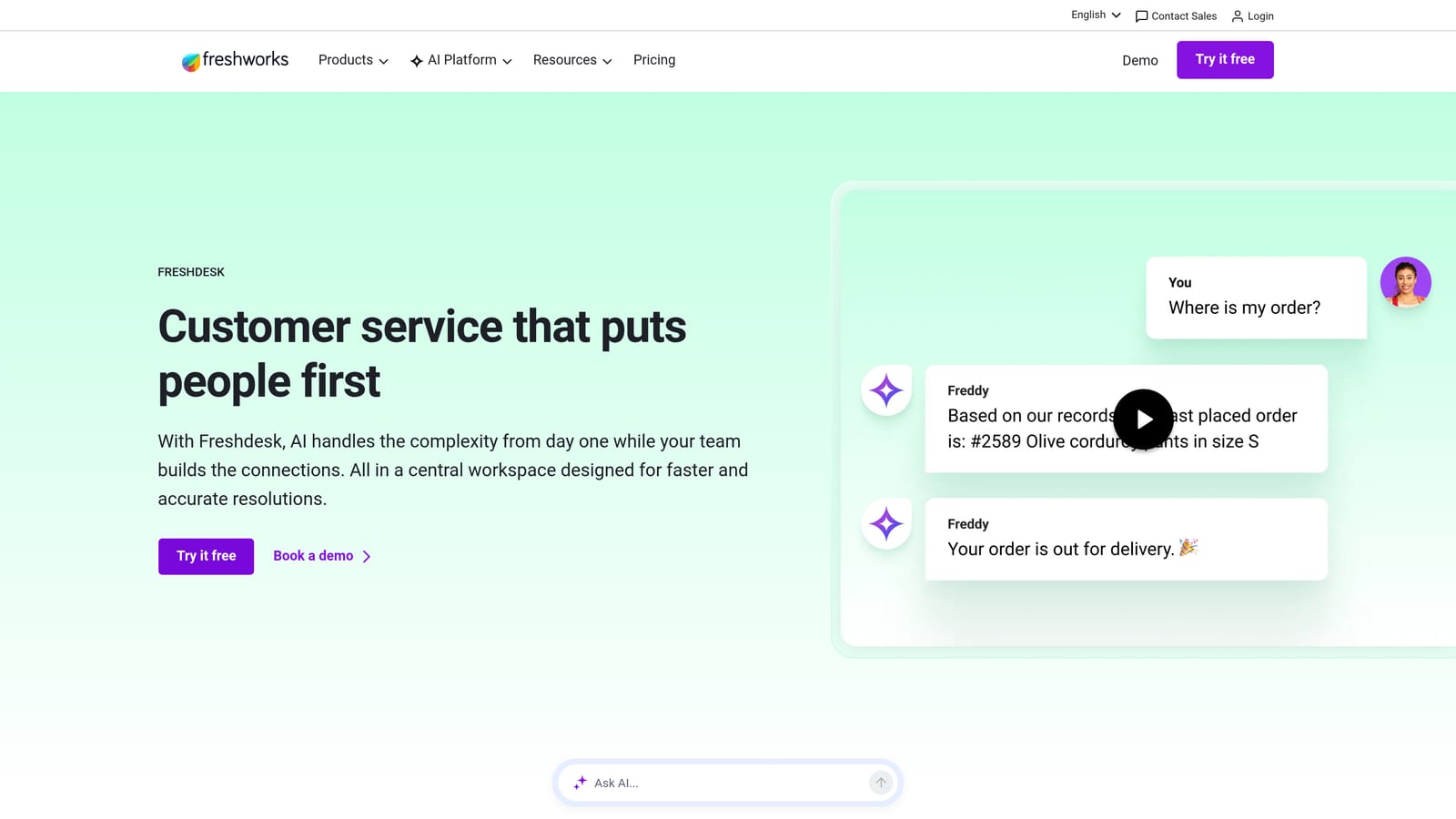
Freshdesk is a mid-market helpdesk platform with Freddy AI powering self-service, agent assist, and analytics across the support workflow.
Where This Tool Shines
Freshdesk's Freddy AI is actually three distinct capabilities rolled under one name: Freddy Self Service handles customer-facing chatbot deflection, Freddy Copilot assists agents with reply suggestions and summarization, and Freddy Insights delivers AI-powered analytics including anomaly detection. That's a reasonably complete AI layer for a platform at this price point.
The broader Freshworks ecosystem is a genuine advantage for teams already using Freshsales or Freshservice. Native data sharing across those products reduces integration complexity significantly. Compared to Zendesk, the administrative overhead is lighter and the pricing is more accessible for growing teams.
Key Features
Freddy Self Service: AI chatbot for customer-facing query deflection before tickets are created.
Freddy Copilot: Agent-side AI for reply suggestions, thread summarization, and tone adjustments.
Freddy Insights: AI-powered analytics with anomaly detection to surface support trends proactively.
Omnichannel Support: Email, chat, phone, and social channels on higher-tier plans.
Freshworks Ecosystem: Native integration with Freshsales and Freshservice for unified customer data.
Best For
Mid-market teams looking for a cost-effective Zendesk alternative, especially those already using other Freshworks products or wanting a solid AI-assisted helpdesk without enterprise-level complexity.
Pricing
Free plan available for small teams. Paid plans start at approximately $15 per agent per month. Freddy AI features are gated to higher tiers.
5. Tidio
Best for: SMBs and e-commerce teams needing fast deployment with live chat and AI deflection
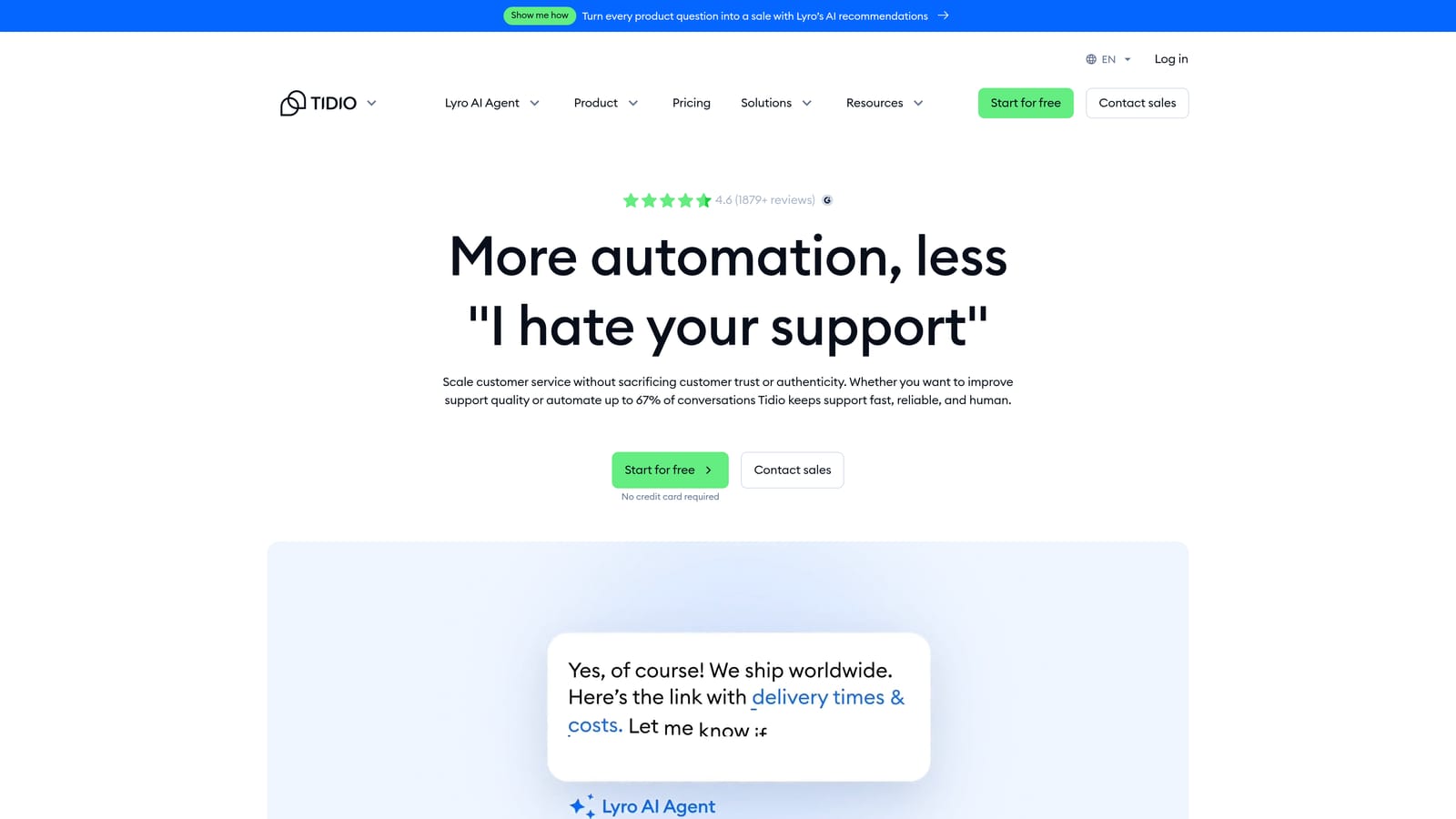
Tidio is an SMB-focused live chat and AI chatbot platform where Lyro AI handles common customer queries automatically.
Where This Tool Shines
Speed of deployment is Tidio's clearest advantage. Teams can be operational in minutes without engineering involvement, which matters a lot for small businesses that don't have dedicated support infrastructure. The Lyro AI chatbot is trained on your existing support content and handles conversational queries with a natural feel.
The AI-to-human handoff is smooth, and the visual flow builder lets non-technical users customize automation paths without writing code. That said, B2B SaaS teams with complex, multi-step product questions may find Lyro's depth limited compared to purpose-built AI agents.
Key Features
Lyro AI Chatbot: Trained on your support content to handle common queries autonomously with conversational responses.
Live Chat with Handoff: Seamless escalation from AI to human agents when conversations require a personal touch.
Visual Flow Builder: Drag-and-drop chatbot flow design for custom automation without code.
E-Commerce Integrations: Native connections to Shopify, WooCommerce, and BigCommerce.
Fast Deployment: Operational in minutes with no engineering support required.
Best For
SMBs, e-commerce businesses, and early-stage teams that need a fast, affordable way to add live chat and basic AI deflection without committing to a full helpdesk platform.
Pricing
Free plan available. Lyro AI plans start at approximately $29 per month, scaling with conversation volume.
6. Drift (Salesloft)
Best for: Revenue teams where pre-sales qualification and support conversations overlap
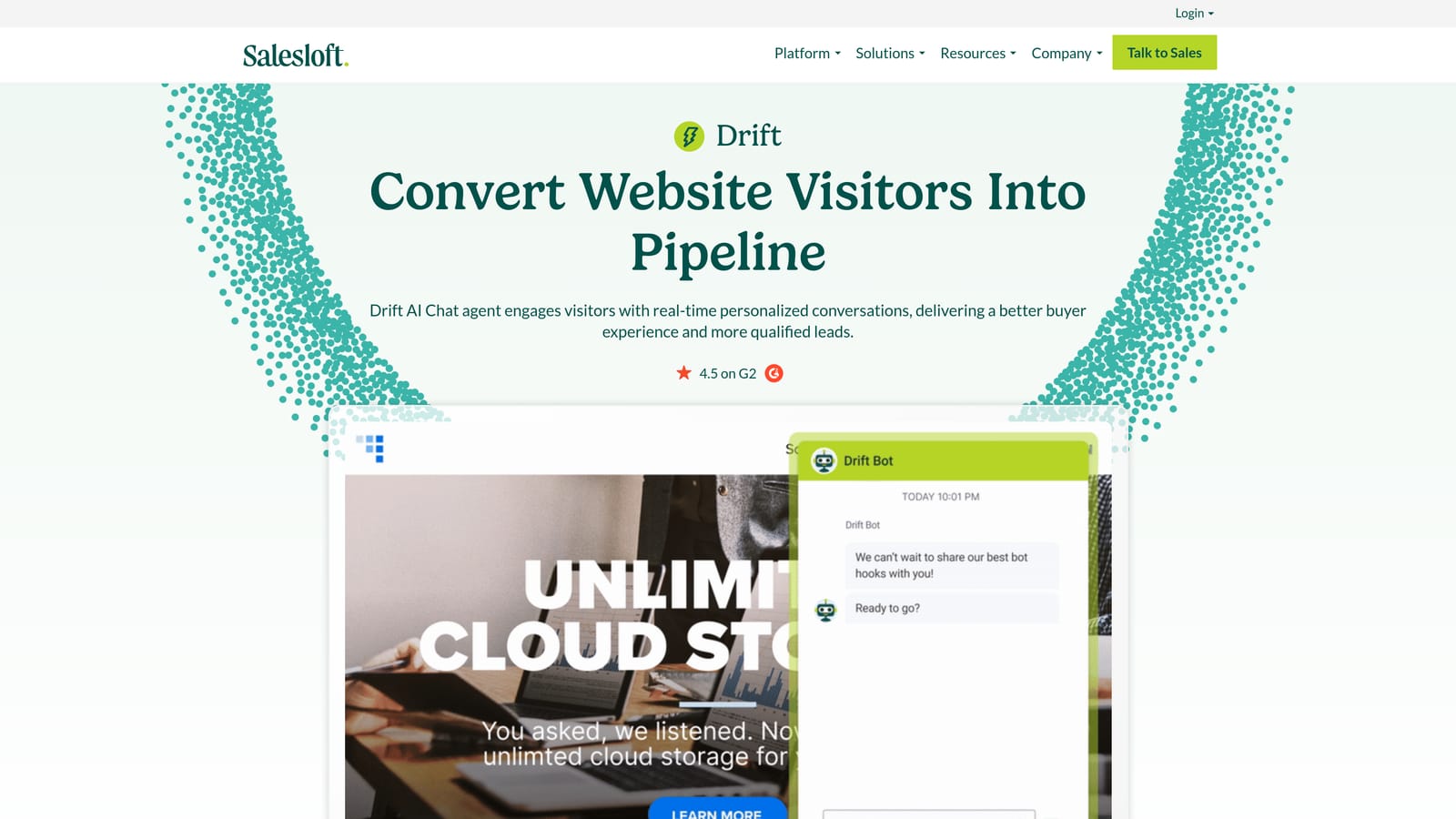
Drift, now part of Salesloft, is a conversational AI platform oriented around revenue acceleration, qualifying buyers, and routing support and sales conversations intelligently.
Where This Tool Shines
Drift's AI chatbot is genuinely strong at qualifying website visitors and routing them to the right team, whether that's sales, support, or a specific account owner. The Bionic Chatbots model, which combines AI with human-designed conversation flows, gives teams more control over how conversations progress than a fully autonomous agent would.
The revenue intelligence reporting ties conversation data back to pipeline impact, which is a differentiator for teams where support and sales are closely connected. That said, Drift is primarily a pre-sales and revenue tool. Post-sale support-heavy environments will likely find it underspecified for ticket management and resolution depth.
Key Features
AI Chatbot for Qualification: Engages website visitors, qualifies intent, and routes to the appropriate team or rep.
Bionic Chatbots: Combines AI with human-designed conversation flows for greater control over outcomes.
Revenue Intelligence Reporting: Ties conversation data to pipeline and revenue impact metrics.
CRM Integrations: Deep connections with Salesforce and HubSpot for syncing conversation data.
Prospector: Account-based targeting to identify and engage high-value accounts proactively.
Best For
B2B teams where the buyer journey and support journey overlap significantly, such as pre-sales technical questions or usage-based expansion motions. Less suited for teams focused primarily on post-sale ticket resolution.
Pricing
Custom pricing. Contact Drift or Salesloft directly for a quote based on your team size and use case.
7. Help Scout
Best for: Teams that value relationship-driven support with AI augmenting rather than replacing agents
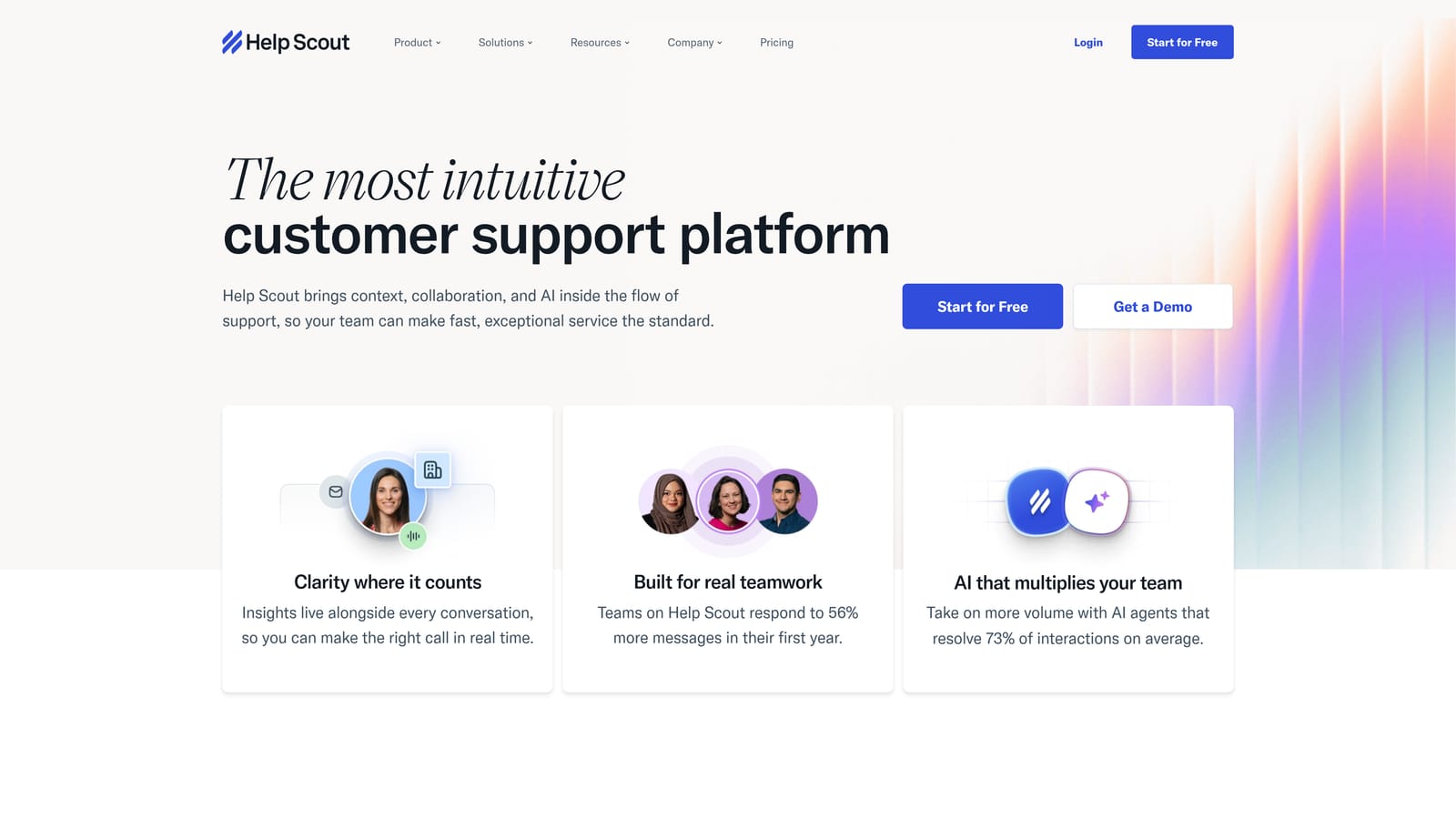
Help Scout is a human-centric shared inbox platform with AI features designed to make agents faster, not to replace them.
Where This Tool Shines
Help Scout's philosophy is deliberate: AI should augment human judgment, not automate it away. AI Summarize condenses long email threads so agents can get up to speed instantly, and AI Assist drafts replies in the agent's own voice. The result is a tool that feels like a productivity layer on top of thoughtful human support.
The Beacon in-app widget handles proactive messaging and self-service documentation, and the Docs knowledge base is included on all plans without extra cost. For teams that have built their support culture around personal, relationship-driven interactions, Help Scout preserves that feel while still reducing manual work.
Key Features
AI Summarize: Condenses long email threads into a quick summary so agents can respond faster with full context.
AI Assist: Drafts replies and suggests edits that match the individual agent's writing style.
Beacon Widget: In-app help widget with proactive messaging and self-service documentation access.
Docs Knowledge Base: Built-in knowledge base included across all plans at no additional cost.
Clean Interface: Low administrative overhead with a simple, intuitive design that teams adopt quickly.
Best For
Small to mid-sized teams that prioritize relationship-driven support, want AI to help agents work faster without removing the human element, and prefer transparent per-user pricing without complex tiers.
Pricing
Standard plan starts at approximately $22 per user per month. Plus and Pro tiers available with additional features and higher usage limits.
8. Kustomer
Best for: High-volume omnichannel operations with complex customer data and CRM-native support needs
Kustomer is a CRM-native omnichannel support platform with AI automation built around the full customer timeline.
Where This Tool Shines
Kustomer's core differentiator is the unified customer timeline. Every interaction, order, subscription event, and support conversation lives in one view, which gives agents and AI alike far richer context than a standard ticket queue provides. For businesses with complex customer histories, that context depth meaningfully improves resolution quality.
The KIQ AI agent handles self-service resolution across channels, and AI-powered routing ensures conversations reach the right team based on intent and customer data. Kustomer is particularly strong for high-volume B2C operations, though it's less commonly chosen by pure B2B SaaS teams unless customer data complexity is a primary concern.
Key Features
KIQ AI Agent: Self-service resolution across email, chat, SMS, and social channels.
Unified Customer Timeline: All interactions, orders, and events in a single chronological view per customer.
AI-Powered Routing: Intelligent conversation routing based on intent, customer segment, and team availability.
Omnichannel Coverage: Email, chat, SMS, social, and voice unified in one platform.
Deep CRM Data Model: Flexible data architecture for storing and querying complex customer histories.
Best For
High-volume operations with complex customer data needs, particularly businesses managing omnichannel B2C interactions or companies that need CRM-level customer context embedded directly in their support workflow.
Pricing
Enterprise plan starts at approximately $89 per user per month. Custom enterprise pricing available for larger deployments.
9. Chatbase
Best for: Teams needing a fast, lightweight AI chatbot trained on their own content
Chatbase is a lightweight AI chatbot builder that lets you train a GPT-powered bot on your own content and embed it anywhere.
Where This Tool Shines
Chatbase earns its place on this list through sheer simplicity. Upload documents, point it at URLs, or feed it a sitemap, and you have a functional AI chatbot in minutes. For teams that need basic self-service without the overhead of a full support platform, that speed-to-value is genuinely compelling.
The white-label option makes it popular with agencies building client-facing bots. API access allows custom integrations for teams with development resources. Where Chatbase falls short is depth: there's no ticketing system, no routing logic, no SLA management, and analytics are limited to basic conversation data. It's a starting point, not a complete support stack.
Key Features
Content Training: Train on documents, URLs, PDFs, or sitemaps in minutes with no technical setup required.
Embeddable Widget: Drop the chat widget onto any website with a simple code snippet.
API Access: Custom integrations for teams that want to connect Chatbase to other systems.
Basic Analytics: Conversation logs and common query reporting for understanding usage patterns.
White-Label Options: Rebrandable interface for agencies and resellers building client solutions.
Best For
Early-stage teams, agencies, or businesses that want a fast self-service chatbot without committing to a full platform. Not suited for teams that need ticket management, escalation workflows, or deep analytics. See also our Chatbase alternatives article for more options at this tier.
Pricing
Free plan available. Paid plans start at approximately $19 per month, scaling with message volume and chatbot count.
Which Tool Is Right for Your Team?
The right choice depends almost entirely on where you sit architecturally and what you're optimizing for.
For AI-first autonomous resolution with B2B SaaS context: Halo AI is built specifically for this. Page-aware guidance, continuous learning, and business intelligence signals make it the strongest fit for product teams who want AI that understands their product deeply, not just their FAQ docs.
For enterprise omnichannel with deep customization: Zendesk remains the default for large support operations with dedicated ops staff and complex channel requirements.
For SaaS onboarding plus support in one tool: Intercom's combination of Fin AI, product tours, and lifecycle messaging is hard to replicate without stitching tools together.
For mid-market value within the Freshworks ecosystem: Freshdesk offers competitive AI features at a price point that scales more predictably than enterprise alternatives.
For relationship-driven support with AI augmentation: Help Scout is the cleanest option for teams that want AI to help agents, not replace them.
For lightweight self-service without a full platform commitment: Chatbase gets you operational quickly, though you'll outgrow it as your support needs mature.
Your support team shouldn't scale linearly with your customer base. Let AI agents handle routine tickets, guide users through your product, and surface business intelligence while your team focuses on complex issues that need a human touch. See Halo in action and discover how continuous learning transforms every interaction into smarter, faster support.