9 Best Automated Customer Service Software Options by Cost in 2026
This guide compares automated customer service software cost across 9 leading platforms, breaking down pricing structures, automation depth, and total cost of ownership. Whether you're a lean startup or a scaling SaaS team, you'll find clear, data-driven recommendations to help you reduce support costs without sacrificing quality.
 Matt PattoliFounder13 min read
Automated customer service software pricing varies wildly. Some platforms charge per agent seat, others charge per resolution, and a growing number of AI-native tools use flat platform tiers that scale with usage rather than headcount. If you're a B2B team trying to reduce support costs without sacrificing quality, picking the wrong model can mean paying for features you'll never use or missing automation depth that would have meaningfully reduced your ticket load.
This guide breaks down the top automated customer service platforms with a clear-eyed look at pricing structure, automation depth, and total cost of ownership. We've evaluated each option on how well it automates, how it scales, and what the real cost looks like beyond the sticker price. Whether you're a lean startup automating your first batch of tickets or a scaling SaaS team replacing a legacy helpdesk, you'll find a clear recommendation here.
For a deeper look at how AI-native platforms compare to traditional helpdesks, see our breakdown of Zendesk vs. AI support platforms and modern support automation.
1. Halo AI
Best for: B2B SaaS teams wanting AI-native automation that learns, resolves, and surfaces business intelligence.
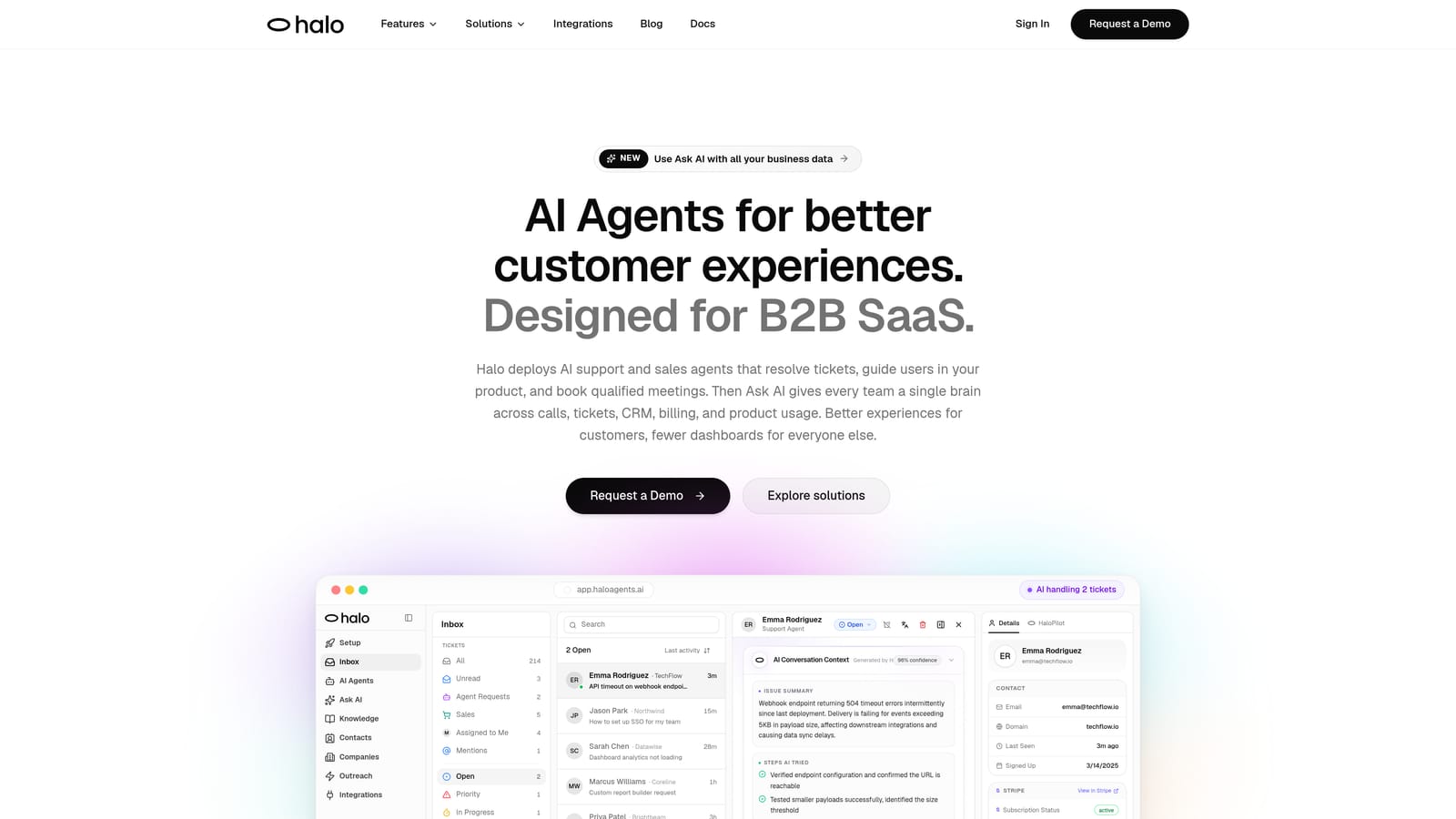
Halo AI is an AI-first customer support platform built from the ground up around intelligent agents, not a traditional helpdesk with AI bolted on.
Where This Tool Shines
The clearest differentiator is page-awareness. Halo's AI agent can see what page or screen a user is on and deliver contextual guidance based on that context, rather than generic FAQ responses. This matters enormously for SaaS products where a user's question is almost always tied to where they are in the product.
Beyond resolution, Halo surfaces business intelligence from support interactions: customer health signals, revenue anomalies, and product friction patterns that most helpdesks simply discard. If you want your support function to generate insight rather than just manage volume, this is a meaningful advantage over traditional tools.
Key Features
Page-Aware AI Agents: The AI sees the user's current page and provides contextual UI guidance rather than generic answers.
Continuous Learning: Every resolved ticket feeds back into the model, improving future response accuracy without manual retraining.
Auto Bug Ticket Creation: Support conversations that surface bugs automatically generate tickets routed to Linear or your engineering workflow.
Smart Inbox with Business Intelligence: Aggregates customer health signals, anomaly detection, and revenue intelligence across your support queue.
Live Agent Handoff: Complex or sensitive issues escalate seamlessly to human agents with full context preserved.
Native Integrations: Connects directly with Linear, Slack, HubSpot, Intercom, Stripe, Zoom, PandaDoc, and Fathom.
Best For
Product-led SaaS teams and B2B companies that want to automate the majority of their ticket volume while extracting intelligence from every interaction. Particularly well-suited for teams replacing a legacy helpdesk or looking to avoid the overhead of building AI automation on top of a traditional platform.
Pricing
Contact for pricing or book a demo at haloagents.ai/demo. Halo uses a demo-first model, which allows for pricing tailored to your support volume and team structure.
2. Intercom
Best for: Product-led SaaS companies wanting a mature messenger, inbox, and AI agent in one platform.
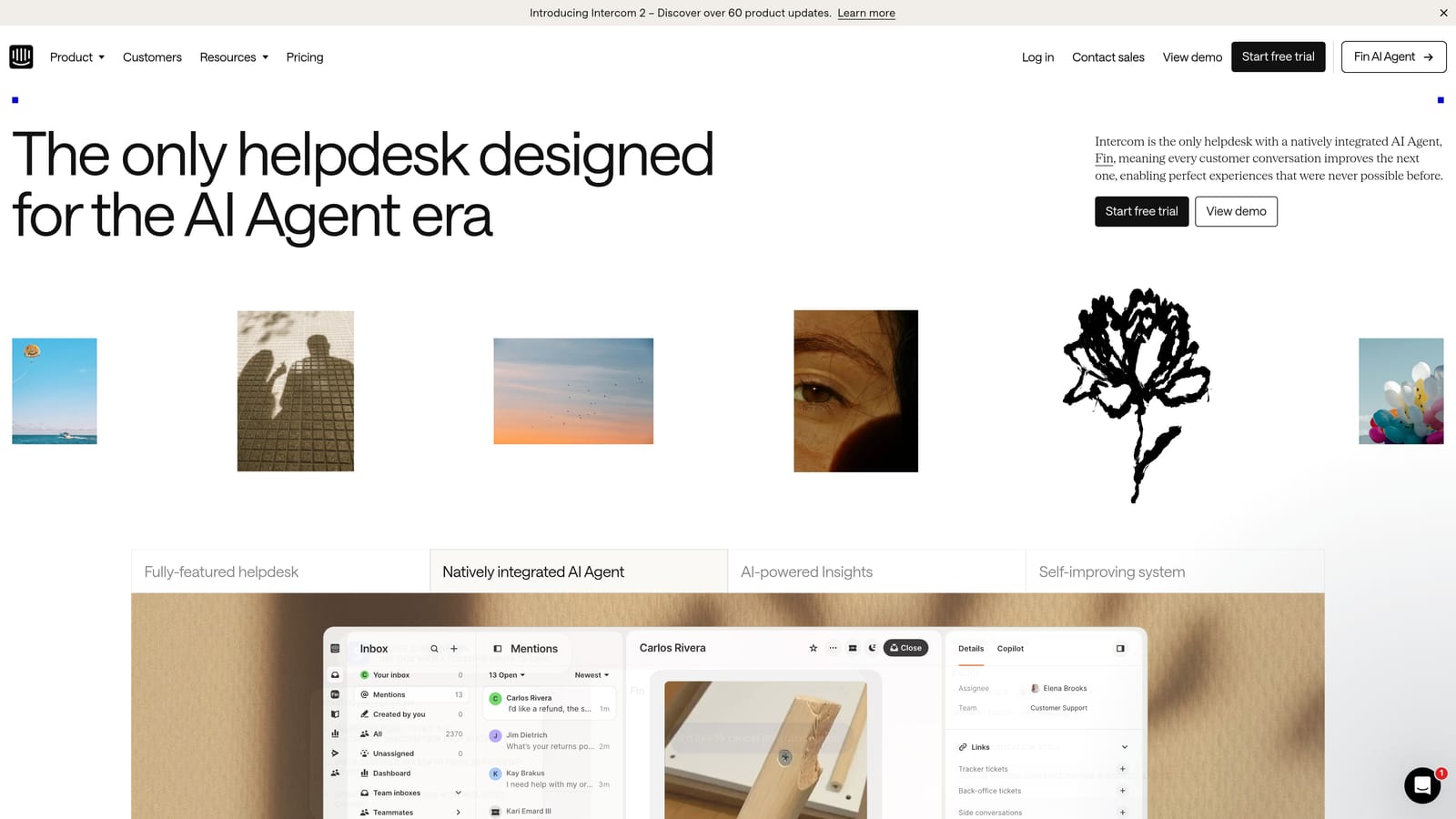
Intercom is a conversational support platform combining a customer messenger, shared inbox, and Fin AI agent for automated front-line resolution.
Where This Tool Shines
Intercom's strength is its maturity. The platform has been refined over many years, and the combination of in-app messenger, proactive messaging, and Fin AI creates a coherent experience for product-led companies. Fin handles a meaningful portion of repetitive queries, and the handoff to human agents is well-designed.
The app marketplace is extensive, and the developer ecosystem means most SaaS stacks can integrate without custom work. If your team already uses Intercom for onboarding or lifecycle messaging, adding support automation on top is a natural extension rather than a platform switch.
Key Features
Fin AI Agent: Handles automated front-line resolution using your knowledge base and product documentation.
Per-Resolution Pricing on Fin: Costs are tied to successful automations, which aligns incentives but can be unpredictable at volume.
Product Tours and Onboarding: Built-in tools for user activation alongside support, which is rare in this category.
App Marketplace: Hundreds of integrations covering CRM, analytics, billing, and engineering tools.
Best For
Product-led SaaS companies with established teams who want a unified platform for support, onboarding, and lifecycle messaging. Less suited for teams primarily focused on B2B support efficiency at the lowest cost per resolution.
Pricing
Fin AI charges per resolution on some plans, which can make total cost difficult to predict at scale. Verify current pricing and plan structure at intercom.com/pricing before committing.
3. Zendesk
Best for: Enterprise teams with complex compliance requirements, deep routing needs, and large agent organizations.
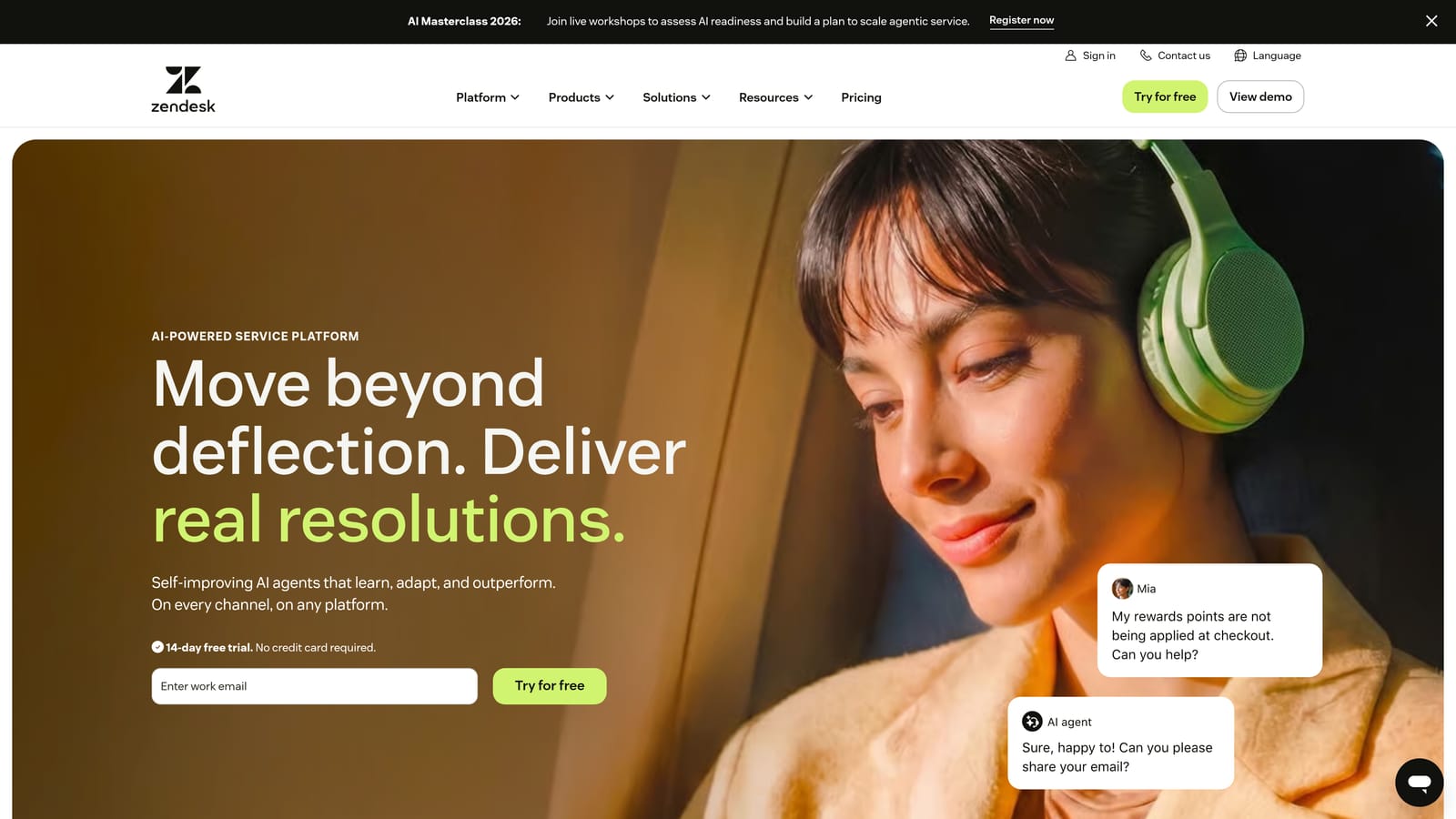
Zendesk is the enterprise helpdesk standard, offering mature ticketing, SLA management, and AI capabilities on higher-tier plans.
Where This Tool Shines
Zendesk's depth in enterprise workflows is unmatched in this list. If your support operation requires granular SLA management, multi-brand routing, or enterprise compliance certifications, Zendesk has built-in infrastructure for all of it. The platform has decades of refinement in ticketing workflows that newer tools simply haven't had time to replicate.
The partner ecosystem is also extensive. If you need a specialized integration or a certified implementation partner to manage a complex deployment, Zendesk's market position means those resources exist in abundance.
Key Features
Mature Ticketing and SLA Management: Robust routing rules, escalation paths, and SLA tracking built for large support organizations.
AI Features on Suite Tiers: Intelligent triage, macros, and bot capabilities are available on higher-tier plans rather than across all pricing levels.
Enterprise Compliance: SOC2 certified with HIPAA-eligible configuration options for regulated industries.
Large Integration Ecosystem: Hundreds of native integrations and a large partner marketplace for custom implementations.
Best For
Enterprise teams with 20+ agents, complex routing requirements, or strict compliance mandates. Smaller teams often find the platform's complexity and per-seat cost difficult to justify relative to lighter alternatives.
Pricing
Per-agent pricing across Suite plans. AI features are available on higher tiers. Verify current rates at zendesk.com/pricing before budgeting, as plan structures change regularly.
4. Freshdesk
Best for: SMBs and mid-market teams wanting competitive per-agent pricing with AI automation included.
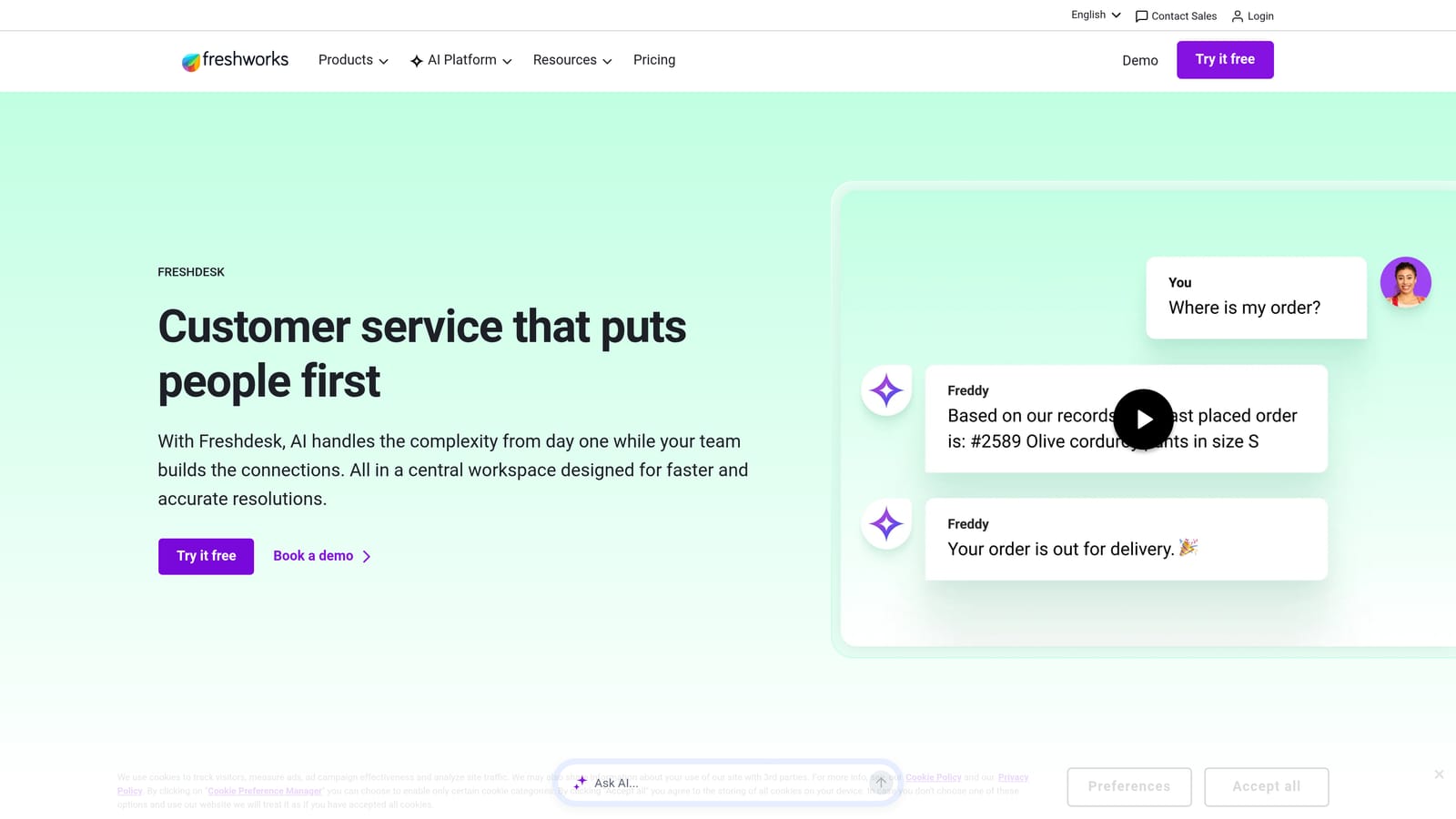
Freshdesk is a cost-competitive helpdesk from Freshworks with Freddy AI for automation, positioned as a more affordable alternative to Zendesk.
Where This Tool Shines
Freshdesk's pricing is its clearest advantage. For teams that need solid helpdesk functionality without enterprise-level spend, Freshdesk consistently undercuts Zendesk on per-agent cost while covering most of the same core workflows. The free plan is genuinely functional for small teams just getting started.
Freddy AI handles automated responses, ticket categorization, and agent assist features. It's not as deeply autonomous as AI-native platforms, but it meaningfully reduces manual work for teams that primarily need a well-priced, reliable helpdesk with some automation on top.
Key Features
Freddy AI: Automated responses, ticket categorization, and agent assist to reduce manual handling time.
Free Plan: A functional free tier for small teams with basic email and ticket management.
Omnichannel Support: Email, chat, phone, and social channels available on higher-tier plans.
Competitive Per-Agent Pricing: Consistently priced below Zendesk at comparable feature tiers, making it attractive for budget-conscious teams.
Best For
SMBs and growing mid-market teams that need a reliable helpdesk with AI assist features at a lower price point than enterprise alternatives. Also a strong choice for teams migrating away from email-based support for the first time.
Pricing
Free tier available. Growth, Pro, and Enterprise plans scale with features and agent count. Verify current rates at freshdesk.com/pricing.
5. Tidio
Best for: Small businesses and early-stage teams needing affordable live chat with basic AI automation.
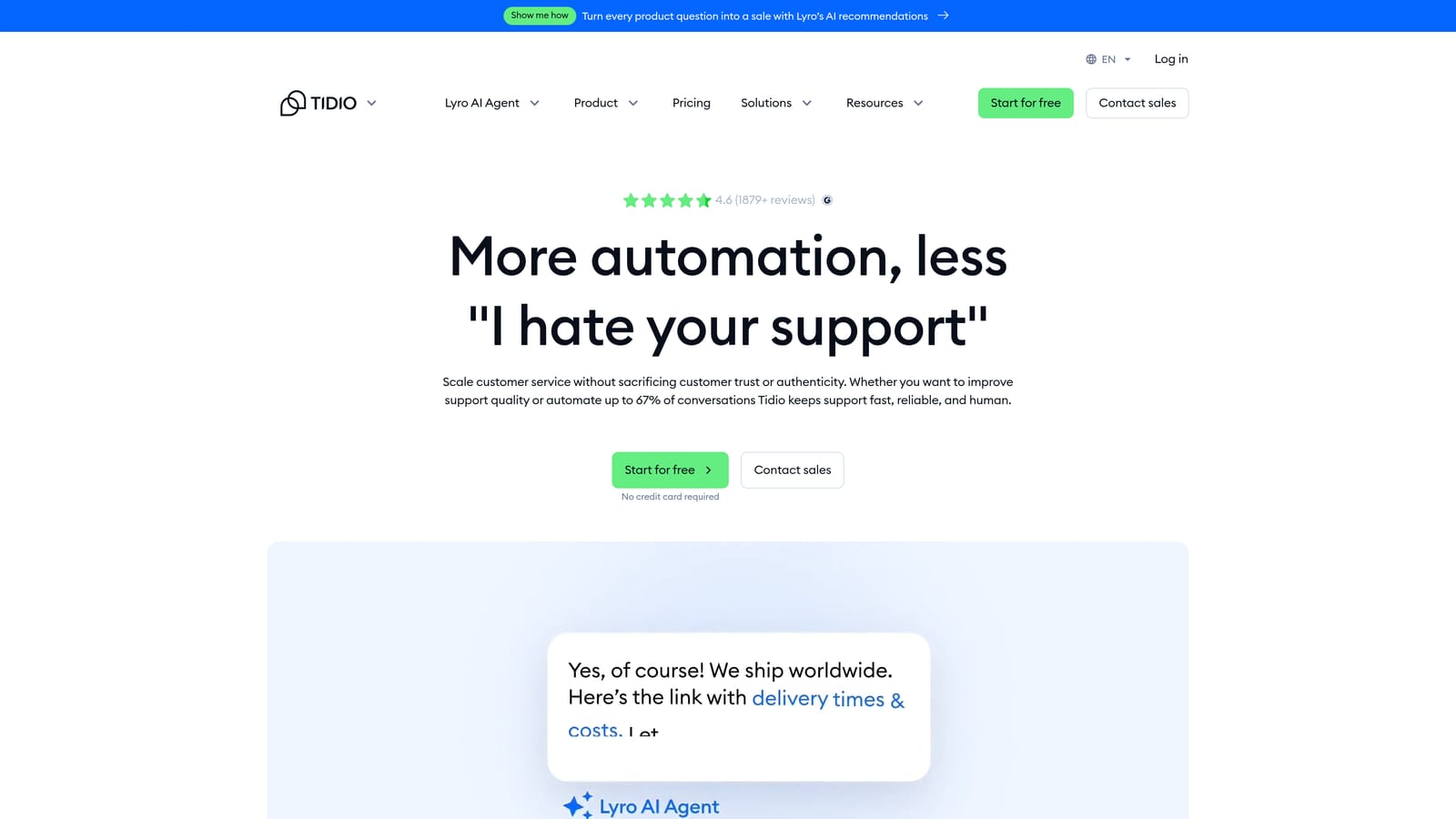
Tidio is a low-cost live chat and AI chatbot platform with Lyro AI designed for teams that need simple automation without enterprise complexity.
Where This Tool Shines
Tidio's entry point is genuinely accessible. The free plan covers basic live chat and a limited number of Lyro AI conversations, making it one of the few tools in this category where you can test real automation without a credit card. For small e-commerce brands or early-stage SaaS products handling a manageable ticket volume, that accessibility is valuable.
Lyro handles FAQ-style queries well and integrates with Shopify and WooCommerce for e-commerce workflows. The platform is not built for complex B2B support scenarios, but for straightforward use cases it delivers reasonable automation at a price point that larger platforms can't match.
Key Features
Lyro AI Chatbot: Automated responses for FAQ and common queries with a conversational interface.
Free Plan: Entry-level access with live chat and limited Lyro conversations at no cost.
Live Chat with Visitor Tracking: Real-time visitor monitoring and proactive chat triggering.
E-Commerce Integrations: Native connections to Shopify and WooCommerce for order-related automation.
Best For
Small businesses, early-stage startups, and e-commerce brands handling relatively simple support queries. Teams with complex B2B workflows, multi-channel requirements, or high ticket volume will quickly outgrow what Tidio offers.
Pricing
Free plan available. Paid plans unlock higher Lyro conversation limits and additional features. Verify current rates at tidio.com/pricing.
6. Drift (Salesloft)
Best for: B2B teams where support and sales qualification run through the same chat interface.
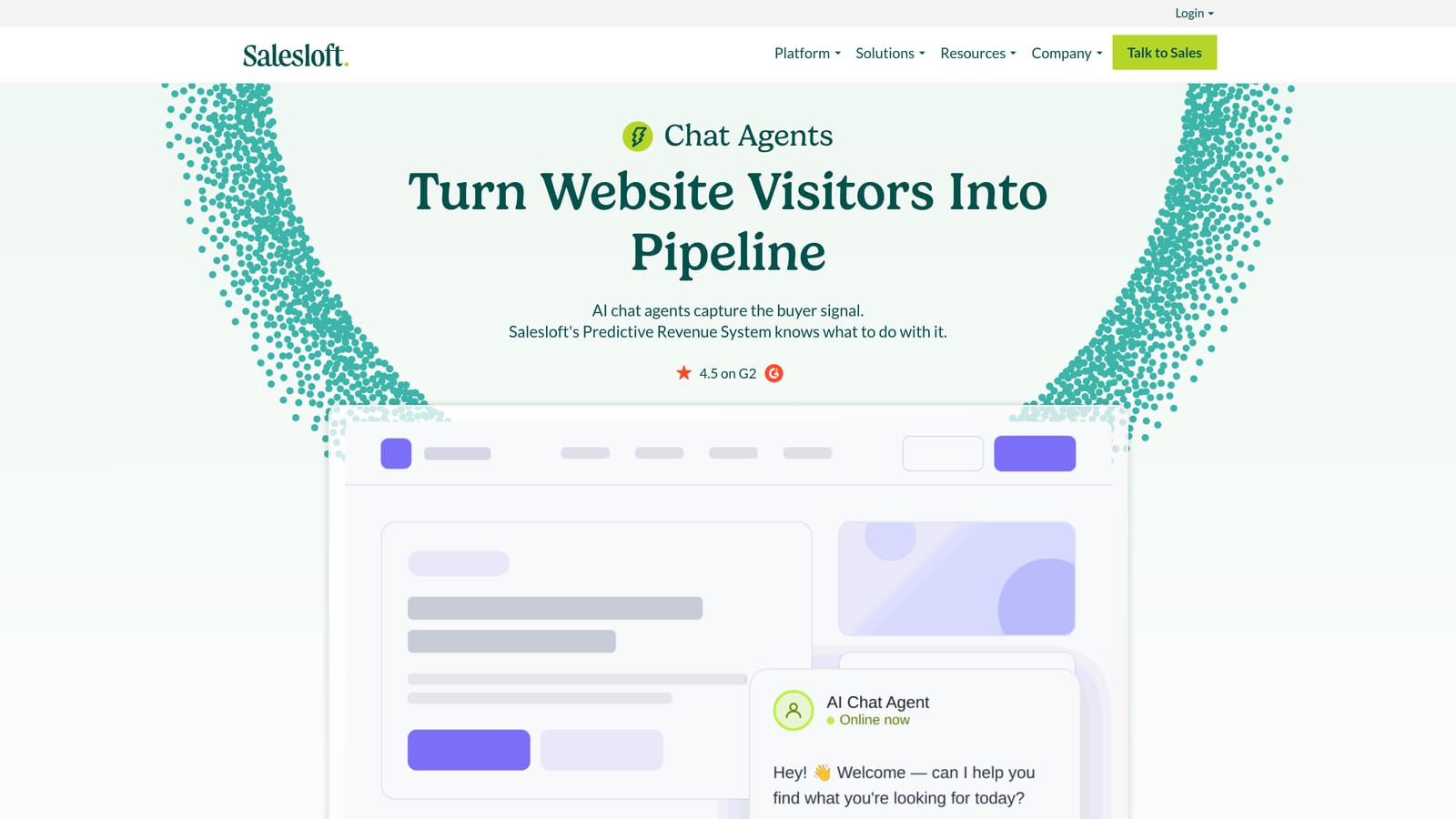
Drift, now part of Salesloft, is a conversational AI platform that blends support automation with sales qualification in a single interface.
Where This Tool Shines
Drift's core insight is that in B2B, the same chat window often handles both support questions and sales conversations. Its AI routing can distinguish between support intent and sales intent in real time, sending each conversation to the right team or playbook. For companies where revenue and support overlap significantly, this eliminates the awkward handoffs that happen when two separate tools are stitched together.
The Salesloft acquisition has added revenue intelligence capabilities alongside the core conversational platform. If your team is already in the Salesloft ecosystem for sales engagement, Drift becomes a natural extension rather than a standalone purchase.
Key Features
AI Intent Routing: Distinguishes support vs. sales intent in real time and routes accordingly.
Conversation Playbooks: Automated flows for common support and sales scenarios without manual agent involvement.
Revenue Acceleration Features: Pipeline and deal intelligence layered alongside support automation.
CRM Integration: Deep native connections to Salesforce and HubSpot for unified customer data.
Best For
B2B companies where support and sales conversations intersect frequently, particularly those already using Salesloft for sales engagement. Pure-play support teams without a sales motion will find the pricing hard to justify relative to dedicated support tools.
Pricing
Enterprise-oriented pricing. The Salesloft acquisition may have changed plan structures. Verify current rates at drift.com before budgeting.
7. Help Scout
Best for: Small to mid-sized teams wanting a clean, human-feeling inbox with transparent per-user pricing.
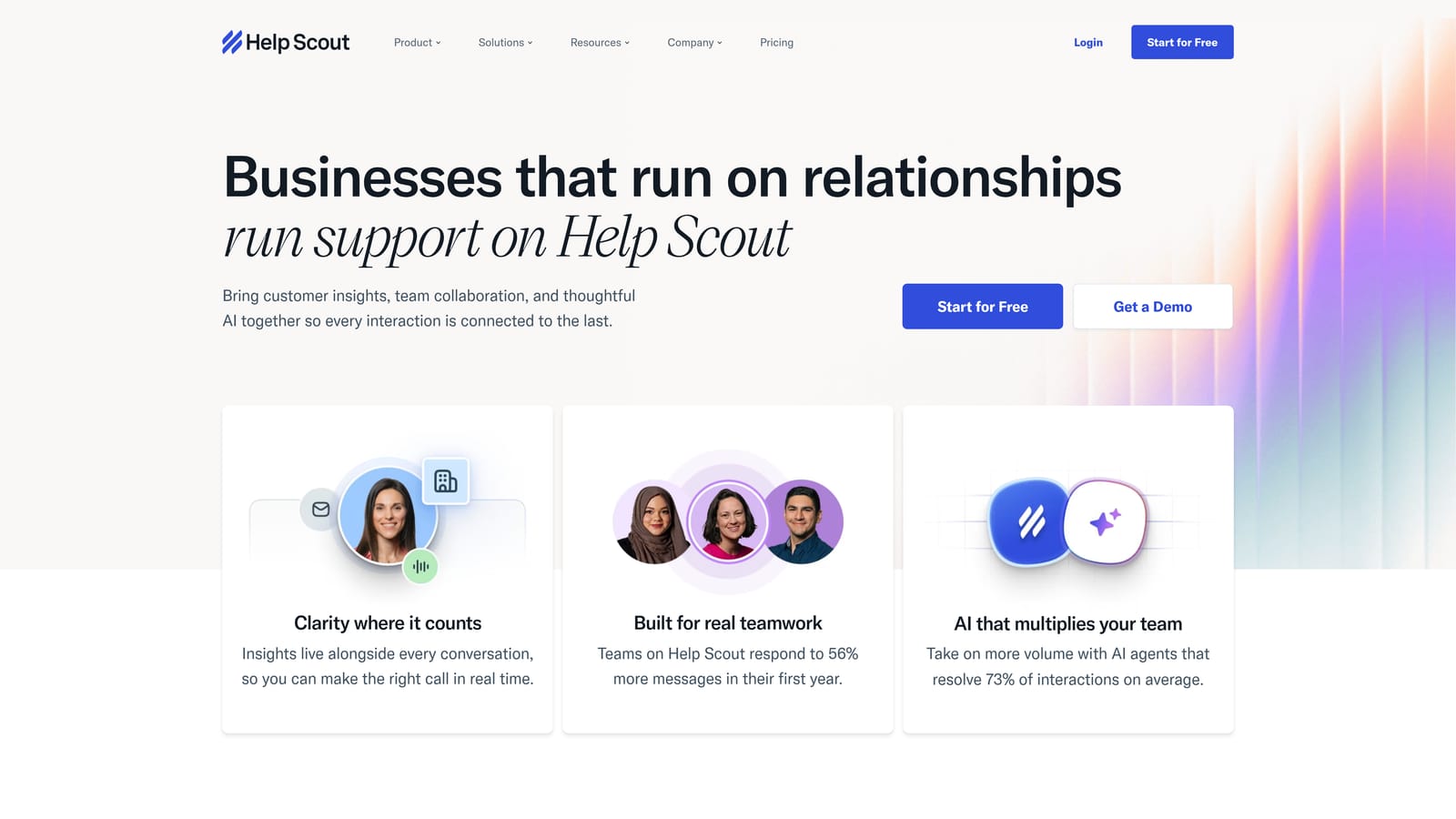
Help Scout is a shared inbox platform with AI assist features, a built-in knowledge base, and straightforward pricing that avoids the hidden add-ons common in this category.
Where This Tool Shines
Help Scout's philosophy is that support should feel human, and the product reflects that. The shared inbox is clean, fast to onboard, and designed around collaboration rather than ticket bureaucracy. Collision detection prevents two agents from responding to the same conversation, and private notes keep internal context organized without cluttering the customer-facing thread.
The AI features (Summarize and Drafts) are assistive rather than autonomous. They help agents move faster rather than replacing them entirely. For teams that want to preserve a personal support voice while reducing manual effort, this balance works well. Teams expecting full ticket deflection through AI will need to look elsewhere.
Key Features
AI Summarize and AI Drafts: Assistive AI that helps agents respond faster without fully automating the conversation.
Shared Inbox with Collision Detection: Prevents duplicate responses and keeps team coordination visible.
Docs Knowledge Base: Built-in self-service documentation included at no additional cost.
Transparent Per-User Pricing: Simple pricing with no hidden add-ons or feature-gated surprises.
Best For
Small to mid-sized teams prioritizing a clean agent experience and human-feeling support interactions. Less suited for teams that need deep automation or high deflection rates, where AI-native platforms will outperform it.
Pricing
Per-user monthly pricing with no major hidden add-ons. Verify current rates at helpscout.com/pricing.
8. Gorgias
Best for: E-commerce brands on Shopify, Magento, or BigCommerce needing order-centric automation.
Gorgias is a helpdesk built specifically for e-commerce, with deep platform integrations and a per-resolution pricing model that ties costs directly to automation success.
Where This Tool Shines
Gorgias does one thing better than anyone else in this list: e-commerce support automation. Order data, shipping status, refund history, and customer purchase records surface directly inside the ticket view, eliminating the tab-switching that slows down e-commerce support teams. Macros and rules handle the most common query types (order status, refund requests, shipping delays) automatically.
The per-resolution pricing model is worth understanding carefully. You pay based on how many tickets are automatically resolved rather than how many agents you have. For high-volume e-commerce brands with predictable query types, this can be very cost-efficient. For teams with more variable or complex queries, the costs can be harder to forecast.
Key Features
Native E-Commerce Integrations: Deep connections to Shopify, Magento, and BigCommerce pulling live order data into every ticket.
Per-Resolution Pricing: Costs tied to automated ticket resolutions rather than agent seats.
Macros and Automation Rules: Pre-built automations for order status, refunds, and shipping queries.
Social Media Support: Instagram and Facebook DM management built into the same inbox as email tickets.
Best For
E-commerce brands with high volumes of order-related queries on Shopify or similar platforms. Not a strong fit for B2B SaaS support teams whose queries don't map to order-centric workflows.
Pricing
Tiered by number of automated ticket resolutions per month rather than agent seats. Verify current tier structure at gorgias.com/pricing.
9. Kustomer
Best for: High-volume consumer support teams wanting a unified customer timeline with AI automation included in the per-user price.
Kustomer is a CRM-style customer support platform that aggregates every customer interaction into a single timeline view, with AI automation included rather than sold as a separate add-on.
Where This Tool Shines
Kustomer's timeline view is genuinely differentiated. Rather than treating each ticket as an isolated event, the platform shows every interaction a customer has ever had with your company in chronological order. For high-volume consumer support teams where context is everything, this eliminates the "can you explain your issue again?" problem that frustrates customers and slows agents.
The inclusion of AI automation (routing, sentiment analysis, suggested responses) in the per-user price rather than as a separate add-on is also worth noting. Many platforms charge separately for AI features; Kustomer bundles them. One important consideration: Kustomer is owned by Meta, which raises data and privacy questions that regulated industries or privacy-conscious teams should evaluate carefully before committing.
Key Features
Unified Customer Timeline: All interactions aggregated in a single chronological view per customer, regardless of channel.
AI Automation Included: Routing, sentiment analysis, and suggested responses bundled into the per-user price.
Omnichannel Coverage: Email, chat, phone, social, and SMS managed from a single interface.
Meta Ownership: Consider data handling and privacy implications carefully, particularly for regulated industries or privacy-sensitive use cases.
Best For
High-volume consumer support teams that need deep customer context across every interaction and want AI automation included without a separate line item. B2B teams with smaller customer counts may find the platform's consumer-support orientation less aligned with their workflows.
Pricing
Mid-market to enterprise per-user pricing. Verify current rates at kustomer.com before budgeting.
Matching the Right Tool to Your Budget and Use Case
The right automated customer service platform isn't the one with the lowest sticker price. It's the one where the pricing model, automation depth, and integration ecosystem align with how your team actually operates. Here's how to cut through the options quickly.
Lean startup on a tight budget: Start with Tidio for basic automation or Help Scout for a clean shared inbox experience. Both offer accessible entry points without long implementation timelines or enterprise contracts.
Mid-market SaaS replacing a legacy helpdesk: Halo AI is the strongest option if you want AI-native automation that learns from every interaction and surfaces business intelligence beyond ticket management. Freshdesk is the right call if you need a proven helpdesk with AI assist at a competitive per-agent price.
Enterprise with compliance requirements: Zendesk remains the standard for large support organizations that need SOC2 certification, HIPAA-eligible configuration, and deep routing infrastructure. The implementation overhead is real, but the compliance infrastructure is mature.
E-commerce brand: Gorgias is the clear choice. No other platform in this list matches its depth of Shopify integration and order-centric automation. The per-resolution pricing works in your favor if your query mix is predictable.
Revenue and support overlap: Drift is built for exactly this scenario. If the same chat window handles both inbound support and sales qualification, Drift's intent routing justifies the higher price point.
One final note on total cost of ownership: the cheapest per-seat price rarely reflects the true cost. Factor in implementation time, integration work, the headcount impact of automation depth, and how much the platform learns over time. A platform that resolves 70% of tickets autonomously and improves month over month has a very different TCO than one that requires agents to handle the same queries repeatedly.
Your support team shouldn't scale linearly with your customer base. See Halo in action and discover how continuous learning transforms every interaction into smarter, faster support that gets better the more it runs.