9 Best Automated Customer Success Platforms in 2026
Automated customer success platforms help B2B teams shift from reactive firefighting to proactive retention by monitoring customer behavior, triggering timely interventions, and predicting churn before it happens. This evaluation of the top nine platforms focuses on automation depth, integration capabilities, and analytics sophistication to help customer success teams scale efficiently without proportionally increasing headcount.
 Grant CooperFounder11 min read
Customer success teams are drowning in reactive work—chasing renewals, manually tracking health scores, and scrambling to prevent churn they didn't see coming. Automated customer success platforms change this equation by proactively monitoring customer behavior, triggering timely interventions, and freeing your team to focus on strategic relationship building.
The right platform doesn't just automate tasks. It transforms your CS operation from firefighting mode into a predictive, scalable engine for retention and expansion.
We evaluated dozens of platforms based on automation depth, integration capabilities, analytics sophistication, and real-world usability. Here are the top automated customer success platforms that stand out for B2B teams serious about scaling without proportionally scaling headcount.
1. Halo AI
Best for: Teams wanting AI-native support that learns from every customer interaction
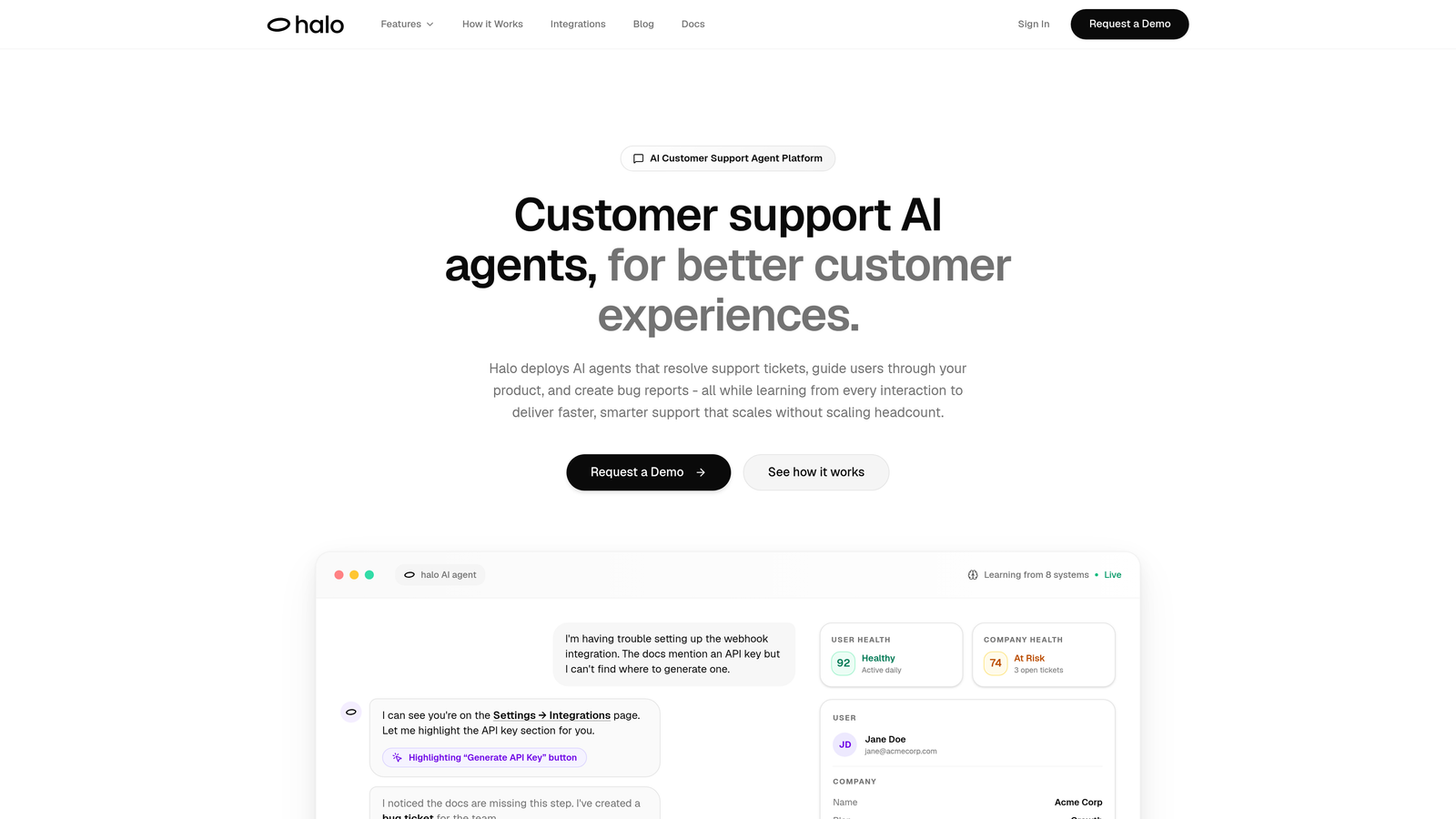
Halo AI takes a fundamentally different approach to customer success automation by deploying AI agents that don't just follow rules—they learn continuously from every interaction to deliver increasingly intelligent support.
Where This Tool Shines
Unlike platforms that bolt AI onto existing helpdesk infrastructure, Halo is built AI-first. Its agents autonomously resolve support tickets while gathering intelligence about customer health, product usage patterns, and potential expansion opportunities.
The page-aware chat widget sees what your customers see, providing visual UI guidance that reduces support volume while improving product adoption. This context awareness means customers get help exactly where they're stuck, without having to explain their entire situation.
Key Features
AI Agents with Continuous Learning: Autonomous ticket resolution that improves with every interaction, reducing manual CS workload while maintaining quality.
Page-Aware Context: Chat widget that understands user location and UI state, enabling precise guidance and faster resolution.
Smart Inbox with Business Intelligence: Goes beyond support metrics to surface customer health signals, revenue intelligence, and anomaly detection.
Auto Bug Ticket Creation: Automatically identifies and creates engineering tickets from support conversations, closing the feedback loop.
Multi-System Integrations: Connects to your entire business stack including HubSpot, Intercom, Stripe, Linear, Slack, and more for unified customer intelligence.
Best For
B2B SaaS companies that need support and success operations to scale without proportional headcount growth. Particularly strong for product-led growth companies where self-service support is critical but human escalation must be seamless.
Pricing
Contact for pricing. Scales with usage rather than fixed per-seat costs, making it flexible for growing teams.
2. Gainsight
Best for: Enterprise teams needing comprehensive journey orchestration and deep Salesforce integration
Gainsight is the enterprise standard for customer success platforms, offering extensive customization and sophisticated automation capabilities for large CS organizations.
Where This Tool Shines
Gainsight's Journey Orchestrator lets you build complex, multi-step customer engagement campaigns that trigger based on health score changes, lifecycle milestones, or product usage patterns. The platform excels at managing large customer portfolios where CSMs need automation to stay on top of hundreds of accounts.
The Timeline feature creates a unified view of every customer interaction across support, sales, product usage, and custom touchpoints. This comprehensive visibility helps CSMs understand context quickly when jumping into an account.
Key Features
Advanced Health Scoring: Customizable multi-dimensional health scores that incorporate product usage, support sentiment, engagement levels, and custom metrics.
Journey Orchestrator: Visual workflow builder for automated email campaigns, task creation, and multi-channel customer communications.
Renewal Center: Dedicated workspace for forecasting renewals, tracking expansion opportunities, and managing contract negotiations.
Success Plans: Collaborative goal-setting and tracking between CSMs and customers with automated progress monitoring.
Deep Salesforce Integration: Native integration that keeps customer success and sales data synchronized without manual updates.
Best For
Enterprise B2B companies with dedicated CS teams managing complex, high-value accounts. Works best when you have the resources to invest in proper configuration and ongoing platform management.
Pricing
Enterprise pricing typically starts at $2,500+ per month. Implementation costs and timeline can be significant for full deployment.
3. ChurnZero
Best for: Mid-market SaaS teams focused on real-time churn prevention and in-app engagement
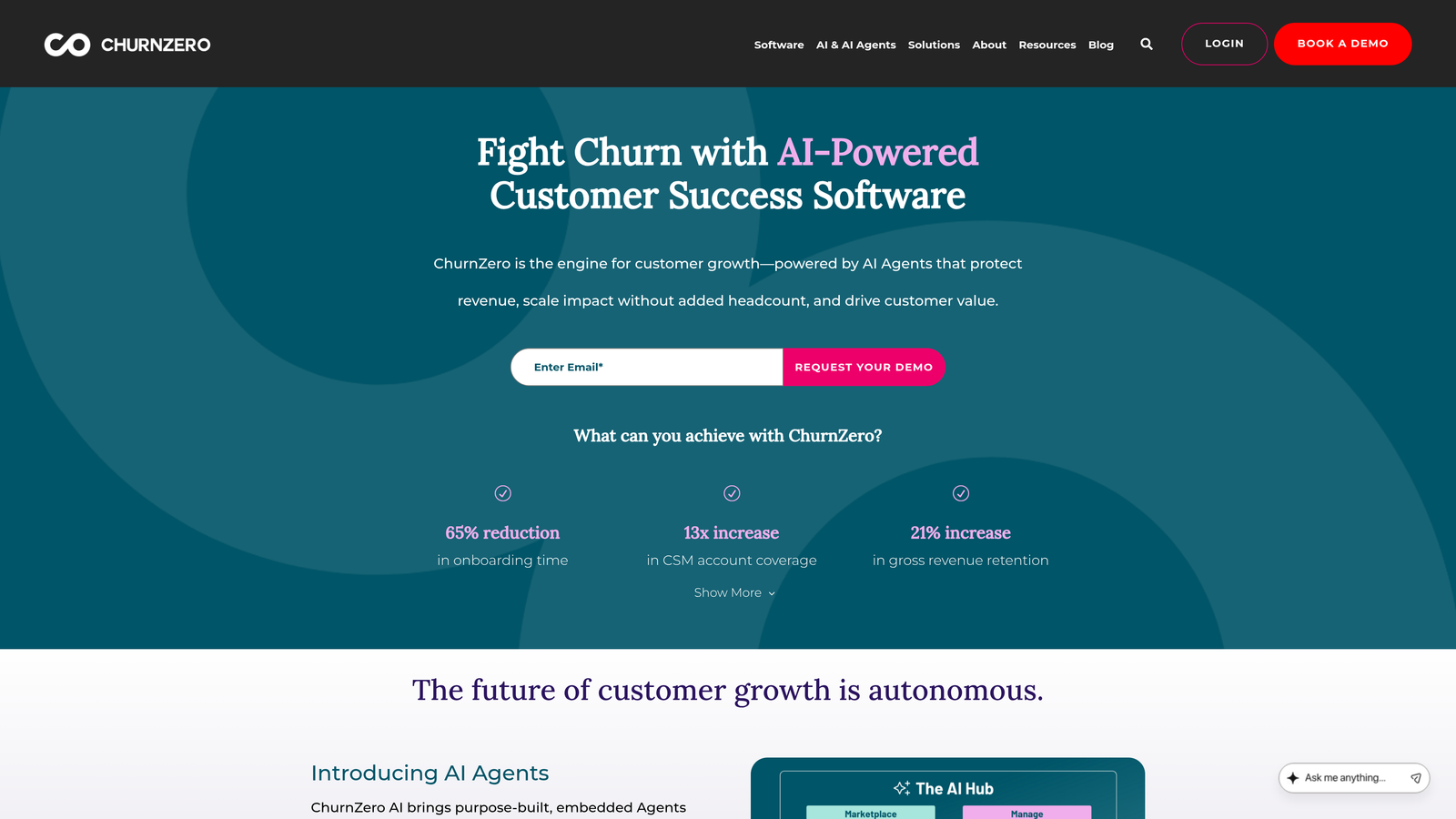
ChurnZero specializes in real-time customer success automation with a strong emphasis on identifying at-risk accounts before they churn.
Where This Tool Shines
ChurnZero's real-time alerting system monitors customer behavior continuously and notifies CSMs the moment concerning patterns emerge. A customer who suddenly stops logging in or abandons a key workflow triggers immediate intervention workflows.
The Plays feature automates repetitive CS workflows without requiring technical expertise. CSMs can build automated sequences that combine emails, in-app messages, task creation, and Slack notifications based on customer behavior triggers.
Key Features
Real-Time Alerts: Instant notifications when customer behavior indicates risk, enabling proactive intervention before churn occurs.
In-App Engagement: Deploy walkthroughs, announcements, and surveys directly inside your product without engineering resources.
ChurnScores: Predictive health scoring that identifies churn risk based on engagement patterns and historical data.
Plays Automation: Visual workflow builder for creating automated CS campaigns triggered by customer actions or milestones.
Integration Ecosystem: Strong connectors to major CRMs, billing systems, and product analytics platforms for unified data.
Best For
Mid-market B2B SaaS companies with product usage data that want to move from reactive to proactive customer success. Particularly effective for teams transitioning from manual CS processes to automated workflows.
Pricing
Mid-market pricing model. Contact for quote based on customer volume and feature requirements.
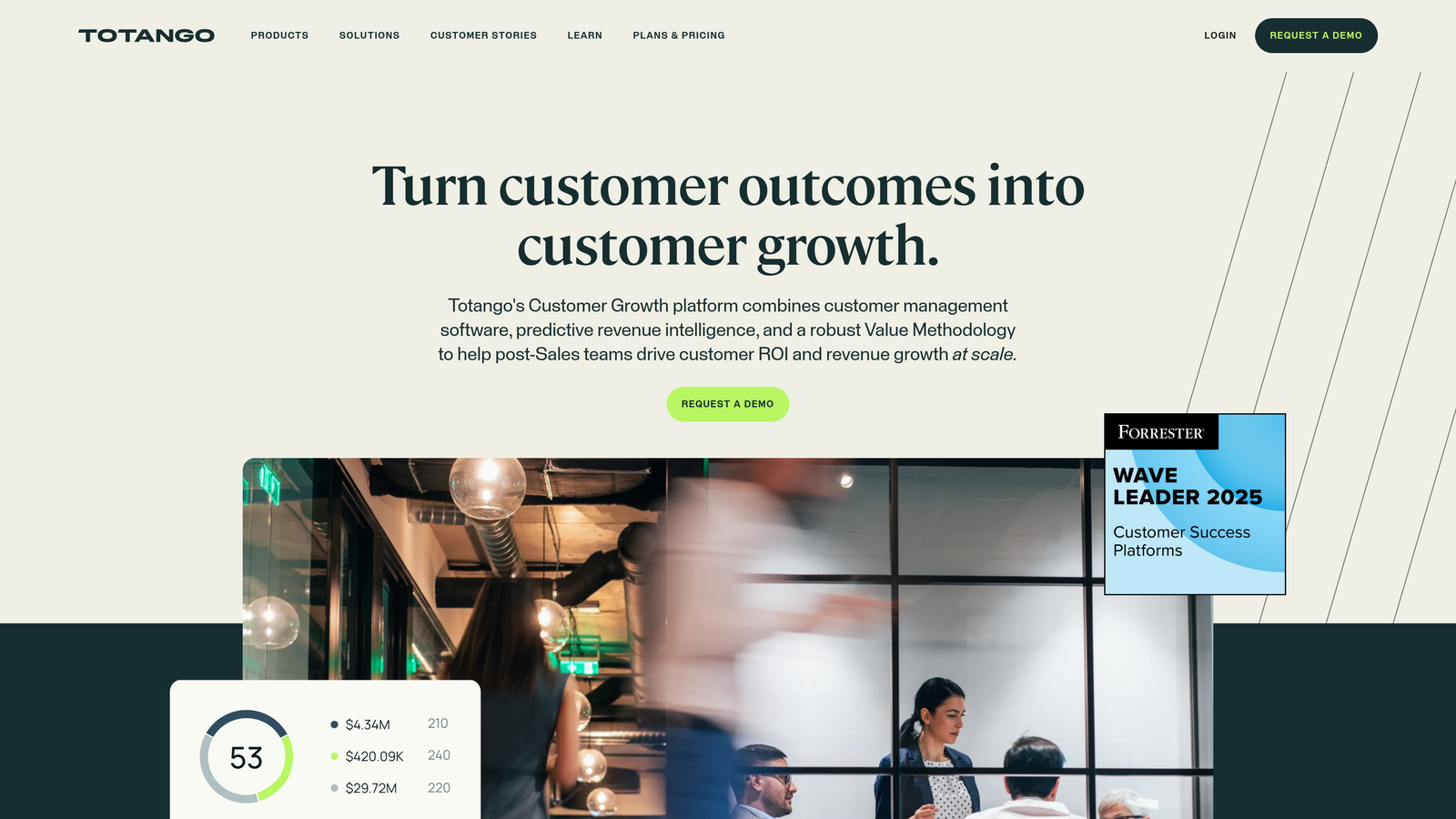
4. Totango
Best for: Teams wanting rapid deployment with pre-built automation templates across different customer segments
Totango offers a composable customer success platform built around SuccessBLOCs—pre-configured automation templates designed for common CS use cases.
Where This Tool Shines
Totango's SuccessBLOCs dramatically reduce time-to-value by providing ready-made automation for onboarding, adoption, renewal, and expansion campaigns. Instead of building workflows from scratch, teams can deploy proven templates and customize them for their specific needs.
The Spark platform unifies customer data from multiple sources into a single view, eliminating the data fragmentation that plagues many CS operations. Zoe, Totango's AI assistant, helps CSMs prioritize their day by surfacing the most important accounts and suggesting next actions.
Key Features
SuccessBLOCs: Pre-built automation templates for common CS workflows that can be deployed in days rather than weeks.
Spark Platform: Unified customer data layer that aggregates information from CRM, product analytics, support, and billing systems.
Zoe AI Assistant: Intelligent recommendations for CSM prioritization and next-best actions based on customer data patterns.
Flexible Health Scoring: Customizable scoring framework that adapts to different customer segments and business models.
Scalable Architecture: Designed to grow from startup to enterprise without requiring platform migration.
Best For
Growing SaaS companies that need quick wins from automation without extensive configuration. Works well for teams managing diverse customer segments requiring different CS approaches.
Pricing
Free tier available for small teams. Paid plans start at $249 per month, scaling with customer volume and feature access.
5. Vitally
Best for: Modern B2B SaaS teams prioritizing clean UX and deep product analytics integration
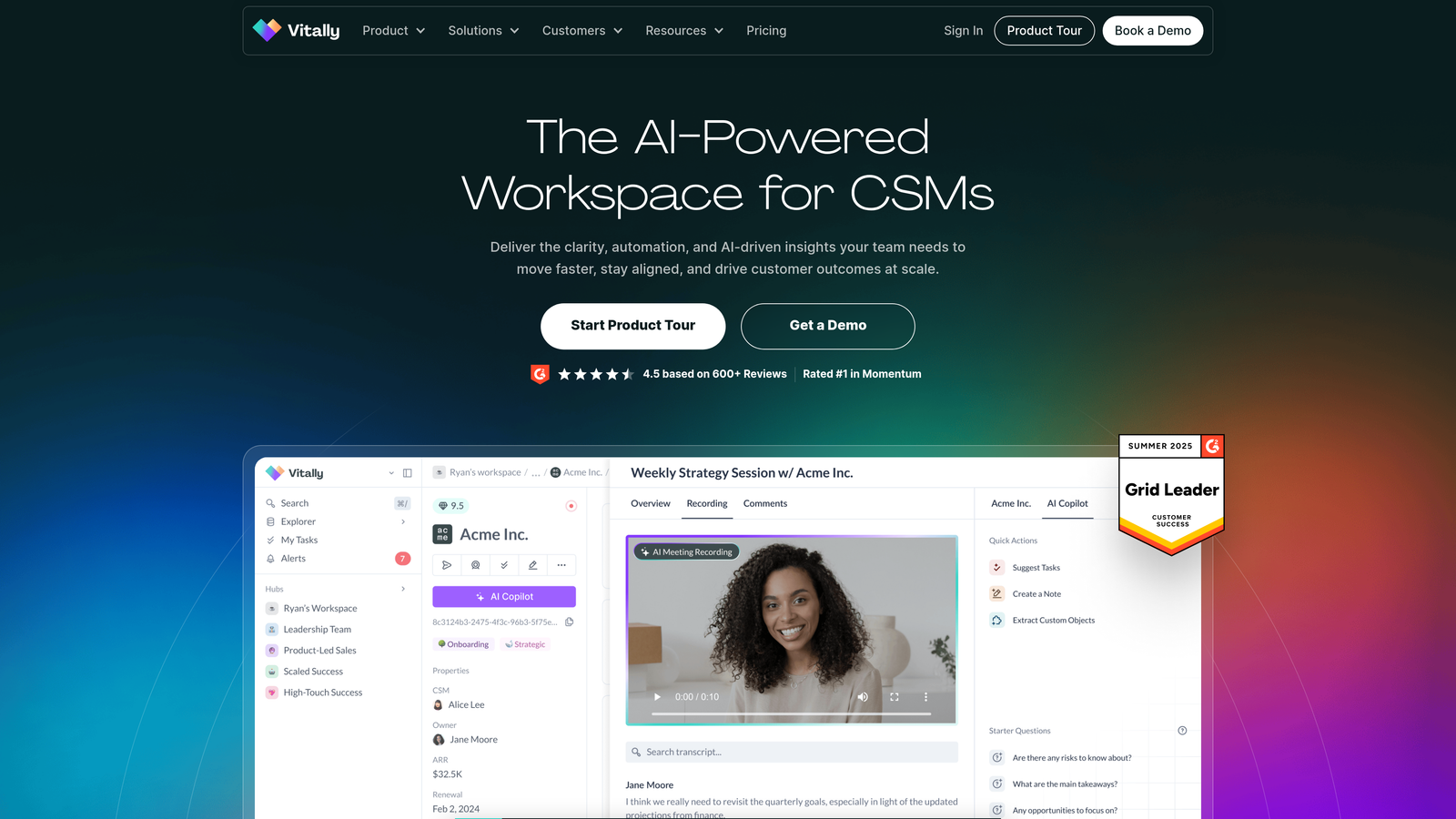
Vitally brings a refreshingly modern interface to customer success automation, with implementation timelines measured in days rather than months.
Where This Tool Shines
Vitally's visual automation builder makes creating complex workflows intuitive rather than intimidating. CSMs without technical backgrounds can build sophisticated automation sequences that trigger based on product usage, account changes, or custom events.
The platform's product analytics integration goes deeper than most competitors. You can trigger CS interventions based on specific feature adoption patterns, usage frequency changes, or abandoned workflows—turning product data into automated action.
Key Features
Intuitive Interface: Clean, modern design that reduces training time and increases CSM adoption across your team.
Visual Automation Builder: Drag-and-drop workflow creation that makes complex automation accessible to non-technical users.
Product Usage Analytics: Deep integration with product analytics tools for triggering interventions based on actual user behavior.
Docs Collaboration: Shared customer notes and documentation that keep entire teams aligned on account context.
Segment Integration: Strong connectivity with Segment and other analytics platforms for unified customer data.
Best For
Product-led growth companies where product usage data drives CS strategy. Ideal for teams that value fast implementation and intuitive tools over extensive customization options.
Pricing
Starts around $300 per month for small teams. Transparent pricing tiers based on customer volume and feature access.
6. Planhat
Best for: Teams needing highly customizable data models and revenue operations integration
Planhat positions itself as a unified customer platform that combines customer success, product analytics, and revenue operations in a single system.
Where This Tool Shines
Planhat's data model flexibility lets you structure customer information exactly how your business operates, rather than forcing your processes into predetermined fields. This customization extends to health scoring, lifecycle stages, and automation triggers.
The revenue analytics capabilities go beyond typical CS platforms to provide forecasting, expansion tracking, and revenue intelligence that connects customer success activities directly to financial outcomes. This makes it easier to demonstrate CS ROI to executive leadership.
Key Features
Customizable Data Models: Flexible schema that adapts to your specific customer structure, product hierarchy, and business processes.
Revenue Analytics: Built-in forecasting and revenue tracking that connects CS activities to financial performance.
Playbooks: Automated workflow engine for triggering communications, tasks, and interventions based on customer behavior.
Portfolio Management: Tools for managing large customer portfolios with automated segmentation and prioritization.
European Market Strength: Strong presence and support in European markets with GDPR compliance built in.
Best For
B2B companies with complex customer structures or unique business models that don't fit standard CS platform assumptions. Particularly strong for European companies or those with significant European customer bases.
Pricing
Contact for pricing. Modular pricing model allows teams to pay for only the capabilities they need.
7. CustomerSuccessBox
Best for: B2B SaaS companies with usage-based business models needing AI-driven health scoring
CustomerSuccessBox focuses on AI-powered customer success automation designed specifically for B2B SaaS companies operating on usage-based or consumption pricing models.
Where This Tool Shines
The platform's AI-driven health scoring adapts to usage-based business models where traditional engagement metrics don't tell the full story. It correlates consumption patterns with churn risk more effectively than rule-based scoring systems.
Automated onboarding workflows help scale customer activation without expanding your onboarding team. The system tracks onboarding milestones and triggers interventions when customers stall, ensuring consistent activation across your customer base.
Key Features
AI Health Scoring: Machine learning models that identify churn risk based on usage patterns specific to consumption-based businesses.
Onboarding Automation: Pre-built workflows for automating customer activation and time-to-value acceleration.
Product Adoption Tracking: Monitoring of feature adoption and usage depth to identify expansion opportunities and at-risk accounts.
Revenue Impact Analysis: Connection between CS activities and revenue outcomes for demonstrating team value.
Task Automation: Automated task creation and assignment based on customer behavior triggers and lifecycle milestones.
Best For
B2B SaaS companies with usage-based or consumption pricing models where traditional engagement metrics don't capture customer health accurately. Works well for teams needing SMB-friendly pricing without sacrificing automation capabilities.
Pricing
Contact for pricing. SMB-friendly options available for smaller teams and customer bases.
8. Custify
Best for: Growing SaaS teams needing straightforward automation without steep learning curves
Custify delivers essential customer success automation with an emphasis on simplicity and quick time-to-value for growing teams.
Where This Tool Shines
Custify strips away complexity to focus on the core automation that most CS teams actually need. The platform's straightforward approach means teams can get up and running in days rather than weeks, without extensive training or dedicated administrators.
The health scoring system uses configurable metrics without requiring data science expertise. Teams can define what matters for their business and start tracking customer health immediately, adjusting the model as they learn what predicts churn.
Key Features
Simple Automation: Workflow builder focused on essential CS automation without overwhelming complexity or feature bloat.
Configurable Health Scoring: Straightforward health metrics that teams can customize based on their specific churn indicators.
Task Management: Automated task creation and assignment that keeps CSMs focused on the right accounts at the right time.
Lifecycle Tracking: Customer journey monitoring that triggers interventions at critical milestones.
Competitive Pricing: Lower price point than enterprise platforms while maintaining essential automation capabilities.
Best For
Small to mid-sized SaaS companies building their first dedicated CS function. Ideal for teams that value simplicity and quick wins over extensive customization options.
Pricing
Starts at $199 per month, making it accessible for smaller teams with limited budgets.
9. Catalyst
Best for: Salesforce-native companies wanting seamless CRM and CS platform integration
Catalyst builds customer success automation directly on the Salesforce platform, eliminating the data synchronization challenges that plague many CS implementations.
Where This Tool Shines
For companies already invested in Salesforce, Catalyst provides native integration that keeps customer success and sales data perfectly synchronized without complex middleware or constant troubleshooting. Changes in Salesforce appear instantly in Catalyst and vice versa.
The platform's revenue intelligence capabilities connect CS activities directly to revenue outcomes, making it easier to demonstrate the financial impact of customer success investments. Health scoring incorporates revenue data alongside engagement metrics for a complete picture.
Key Features
Native Salesforce Integration: Built on Salesforce platform for seamless data synchronization and unified customer records.
Revenue Intelligence: Tracking of expansion opportunities, upsell potential, and revenue impact of CS activities.
Revenue-Tied Health Scoring: Health metrics that incorporate account value and expansion potential alongside traditional engagement signals.
Journey Builder: Automated workflow creation for customer communications, task assignment, and intervention triggers.
Enterprise Reporting: Comprehensive analytics and dashboards that connect CS metrics to business outcomes.
Best For
Enterprise B2B companies heavily invested in Salesforce who want customer success data living in the same system as sales data. Works best for organizations where sales and CS collaboration is critical.
Pricing
Contact for pricing. Enterprise-focused with pricing that reflects the Salesforce ecosystem positioning.
Matching Your Platform to Your CS Maturity
The right automated customer success platform depends less on feature checklists and more on where you are in your CS journey.
If you're building your first CS function, platforms like Custify or Totango offer quick wins without overwhelming complexity. You need automation that works out of the box while you're still figuring out what "good" looks like for your business.
Mid-market teams scaling from manual processes benefit most from platforms like ChurnZero or Vitally that balance sophistication with usability. You've learned what matters for your customers, and now you need automation that scales those insights across hundreds of accounts.
Enterprise organizations managing complex, high-value relationships need the depth of Gainsight or Catalyst. You're optimizing mature processes and need customization capabilities that adapt to your specific requirements.
The shift toward AI-native platforms represents a fundamental change in how customer success automation works. Traditional platforms automate what you tell them to do. AI-native platforms like Halo learn from every interaction, continuously improving their ability to predict customer needs and surface opportunities your team would otherwise miss.
Think about your integration ecosystem carefully. The best automation platform in isolation becomes frustrating if it can't pull data from your product analytics, CRM, and billing systems. Your customer success platform should unify data, not create another silo.
Consider your team's technical sophistication honestly. A platform with extensive customization options only helps if someone on your team has the time and expertise to configure it properly. Sometimes the simpler tool that your team actually uses beats the sophisticated platform that sits partially configured.
Your support team shouldn't scale linearly with your customer base. Let AI agents handle routine tickets, guide users through your product, and surface business intelligence while your team focuses on complex issues that need a human touch. See Halo in action and discover how continuous learning transforms every interaction into smarter, faster support.