9 Best Automated Customer Support Software Tools in 2026
Discover the 9 best automated customer support software tools for 2026, evaluated on AI capability, integration depth, and scalability to help B2B SaaS companies resolve tickets autonomously, reduce response times, and handle growing support volume without proportionally increasing headcount.
 Matt PattoliFounder13 min read
Customer support is one of the first things that breaks when a B2B SaaS company starts to scale. Ticket volume climbs, response times slip, and suddenly you're hiring support agents just to keep pace with growth. Automated customer support software changes that equation entirely by resolving tickets autonomously, routing intelligently, and surfacing insights your team would never have time to find manually.
But not all tools in this category are built the same. Some are legacy helpdesks with AI features bolted on. Others are purpose-built AI platforms that learn and improve with every interaction. The best tools for scaling B2B teams combine autonomous resolution, deep integrations with your existing stack, and the ability to handle growing volume without proportional headcount growth.
This list covers the top automated customer support software tools worth evaluating in 2026, assessed on AI capability, integration depth, deployment speed, and scalability. Whether you're a lean startup or a mid-market team managing thousands of tickets monthly, there's a right fit here for your stage and use case.
1. Halo AI
Best for: B2B SaaS teams that want AI-first support with continuous learning and business intelligence
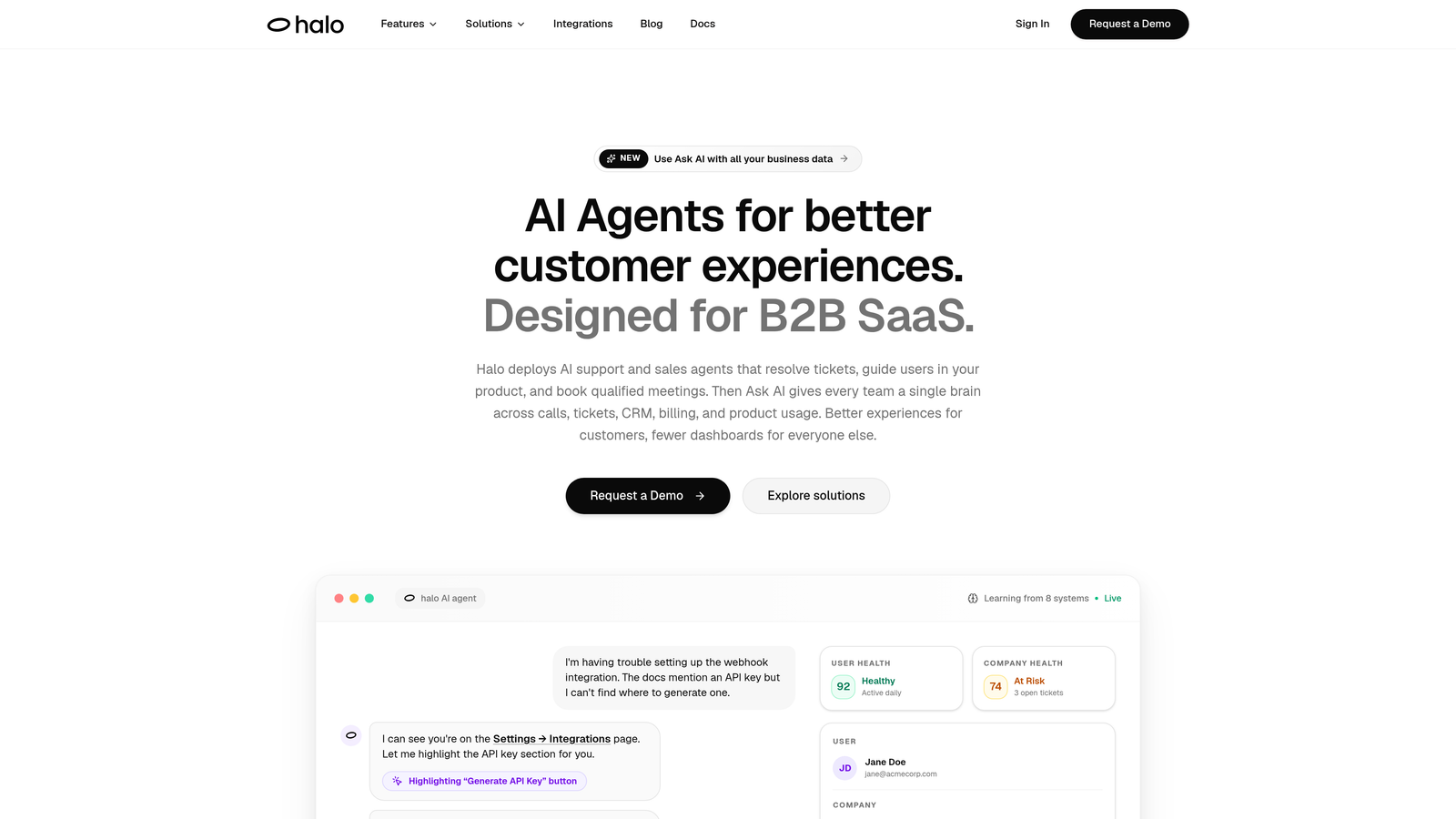
Halo AI is an AI-first customer support platform built to resolve tickets autonomously, guide users through your product in real time, and surface business intelligence from every support interaction.
Where This Tool Shines
What separates Halo from most tools on this list is that it wasn't built as a helpdesk with AI added later. It was designed AI-first from the ground up, which means the intelligence runs through every part of the platform rather than sitting as a layer on top of an existing ticketing system.
The page-aware chat widget is a standout feature: it sees what your user sees, allowing the AI agent to provide contextual guidance based on exactly where someone is in your product. Combined with continuous learning from every resolved interaction, Halo gets smarter over time without requiring manual retraining.
Key Features
Intelligent AI Agents: Autonomous ticket resolution that handles common support requests end-to-end without human involvement.
Page-Aware Chat Widget: The AI sees the user's current page context and delivers guidance that's specific to where they are in your product.
Smart Inbox with Business Intelligence: Goes beyond ticket management to surface customer health signals, revenue intelligence, and anomaly detection across your support data.
Auto Bug Ticket Creation: Automatically identifies and routes bug reports to Linear or your preferred development tool, closing the loop between support and engineering.
Live Agent Handoff: Seamlessly escalates complex issues to human agents when the situation requires judgment beyond what AI should handle.
Deep Integrations: Connects to Slack, HubSpot, Intercom, Stripe, Zoom, PandaDoc, Fathom, and Linear, so your support data flows across your entire business stack.
Best For
B2B SaaS product teams and customer success organizations that want AI to handle routine tickets autonomously while also gaining business intelligence from support interactions. Particularly strong for teams already using tools like Linear, HubSpot, or Stripe who want support data connected across their stack.
Pricing
Contact for pricing via a demo request at haloagents.ai. Pricing is customized based on team size and use case.
2. Zendesk
Best for: Enterprise and mid-market teams needing a proven, full-featured omnichannel helpdesk
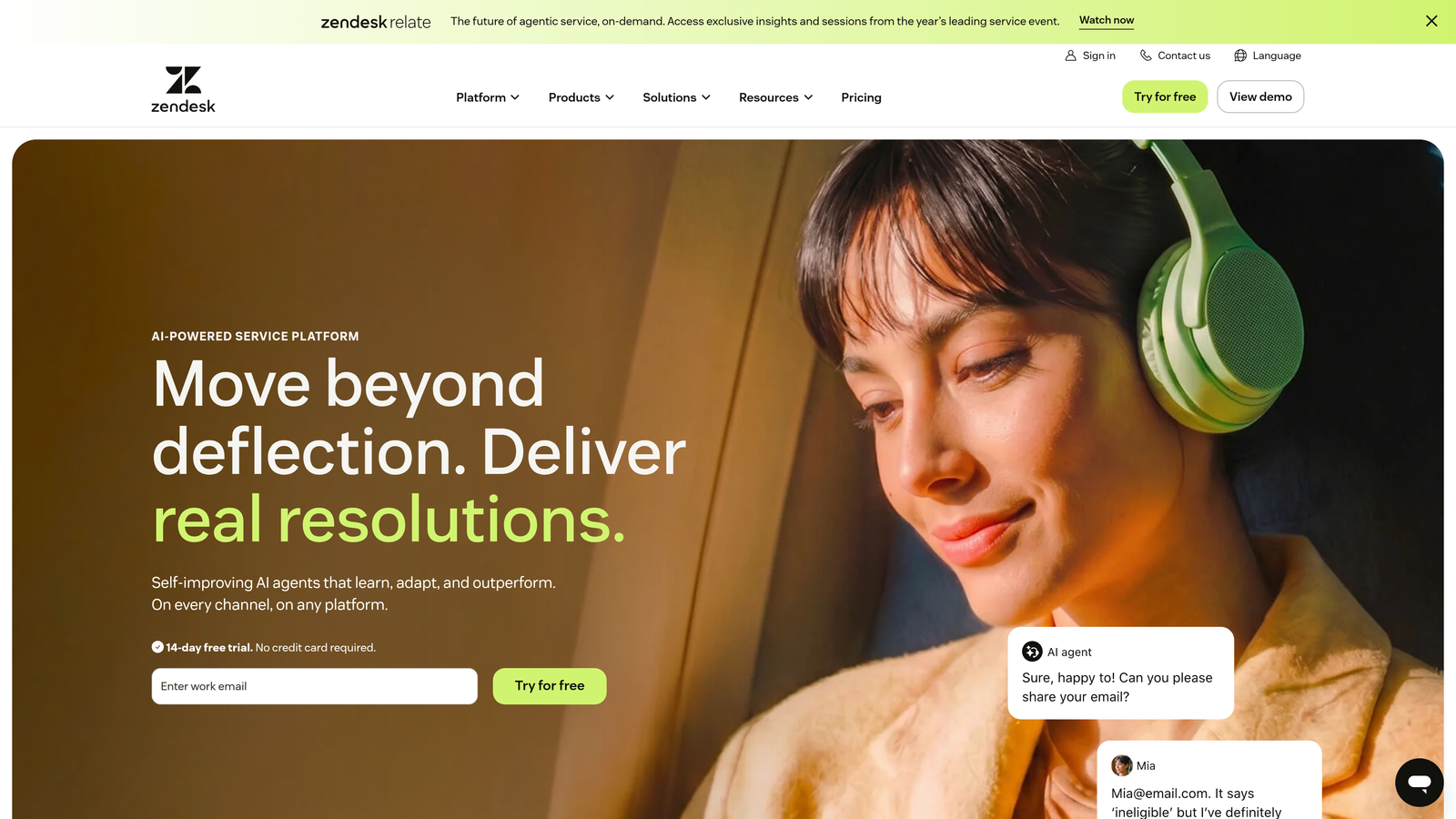
Zendesk is one of the most established helpdesk platforms available, now with AI capabilities layered across its Suite for ticket summarization, intent detection, and automated responses.
Where This Tool Shines
Zendesk's strength is breadth. Its marketplace of over 1,000 integrations, combined with robust workflow automation and enterprise-grade reporting, makes it a reliable choice for larger teams managing high ticket volumes across multiple channels.
Zendesk AI, powered by OpenAI, adds intent classification, ticket summarization, and auto-response capabilities to the core platform. For teams already embedded in the Zendesk ecosystem, these AI features extend existing workflows without requiring a platform change.
Key Features
Zendesk AI: Handles ticket summarization, intent classification, and automated responses across incoming support requests.
Omnichannel Support: Unified inbox covering email, chat, voice, social, and messaging channels.
1,000+ Integrations: Extensive marketplace connecting Zendesk to virtually any tool in your stack.
Advanced Workflow Automation: Routing rules, triggers, and automation that reduce manual triage work for agents.
Analytics and Reporting: Detailed dashboards for tracking resolution times, CSAT, agent performance, and ticket trends.
Best For
Mid-market and enterprise support teams that need a proven, scalable platform with broad channel coverage and a large integration ecosystem. Teams with dedicated administrators will get the most from Zendesk's depth of configuration options.
Pricing
Suite Team starts at approximately $55 per agent per month billed annually. Verify current pricing at zendesk.com as tiers and rates change regularly.
3. Intercom
Best for: SaaS companies that want to blend customer support with in-app engagement and onboarding
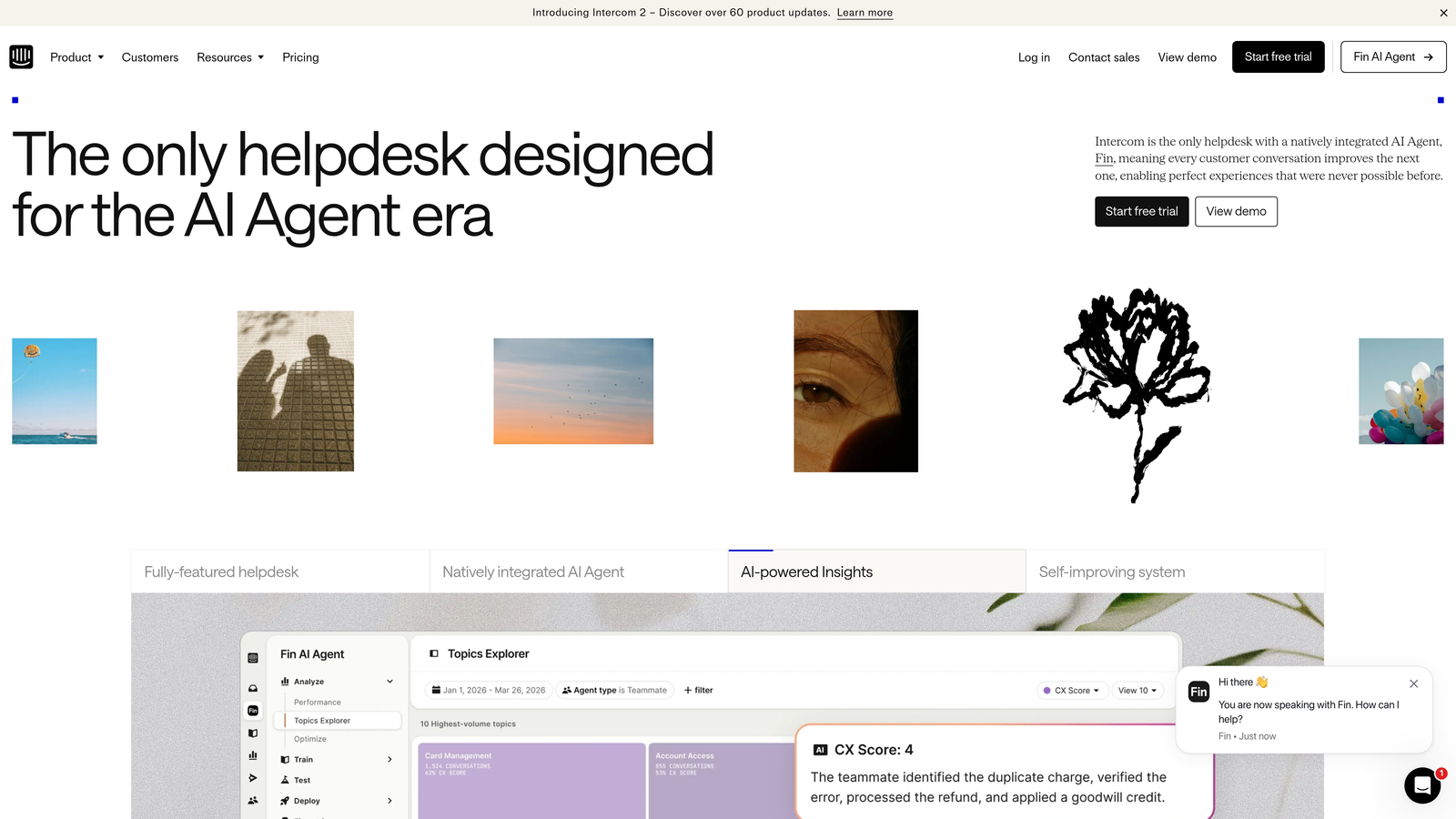
Intercom is a messenger-first support platform featuring Fin, an AI agent built to resolve customer questions autonomously using your existing knowledge base content.
Where This Tool Shines
Intercom occupies a unique space: it's as much a customer engagement platform as it is a support tool. Product tours, in-app messages, and onboarding flows sit alongside the shared inbox, making it a popular choice for SaaS teams that want support and product adoption handled in one place.
Fin, Intercom's AI agent built on GPT-4, can resolve common questions directly from knowledge base content without agent involvement. For teams with well-maintained documentation, this translates into meaningful deflection of repetitive tickets.
Key Features
Fin AI Agent: Autonomous question resolution powered by your existing knowledge base, with fallback to human agents for complex issues.
In-App Messaging and Product Tours: Proactive engagement flows that guide users through features and reduce support volume upstream.
Shared Inbox with AI Assist: Human agents get AI-suggested responses to speed up resolution for tickets Fin doesn't handle autonomously.
Customer Data Platform: Rich user data for personalized, context-aware support interactions.
SaaS and Mobile Integrations: Strong connectivity with the tools B2B product teams typically use.
Best For
SaaS companies that want a single platform for support, in-app messaging, and customer onboarding. Best suited for teams with a solid knowledge base already in place to maximize Fin's autonomous resolution capability.
Pricing
Starter plans begin at approximately $39 per seat per month, with AI features scaling with usage volume. Verify current pricing at intercom.com.
4. Freshdesk
Best for: Mid-market teams seeking competitive pricing with solid AI triage and multi-channel support
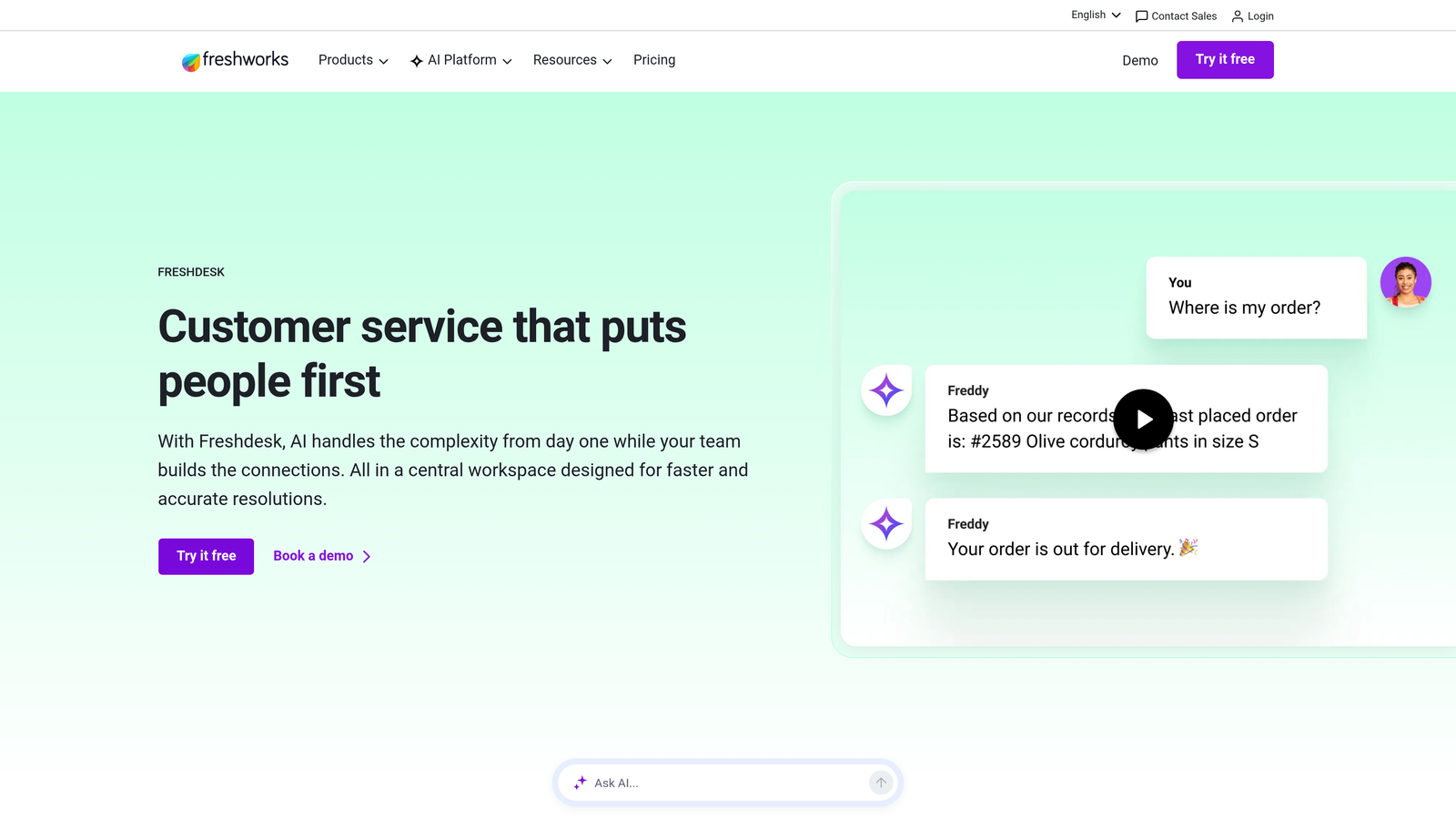
Freshdesk is a mid-market helpdesk platform where Freddy AI handles ticket categorization, suggested responses, and automated resolution across multiple support channels.
Where This Tool Shines
Freshdesk offers a compelling combination of price accessibility and feature depth that makes it a strong alternative to Zendesk for teams that don't need enterprise-tier complexity. Freddy AI reduces manual triage work meaningfully, and the free tier makes it approachable for smaller teams testing the waters with structured support tooling.
Collision detection is a practical feature that prevents two agents from working the same ticket simultaneously, which becomes a real problem in shared inboxes as team size grows.
Key Features
Freddy AI: Handles ticket triage, auto-tagging, and suggested replies to speed up agent workflows and deflect common requests.
Multi-Channel Inbox: Unified coverage across email, chat, phone, and social channels.
Collision Detection: Prevents duplicate agent responses on the same ticket.
SLA Management: Automated escalation rules to ensure response and resolution time commitments are met.
Free Tier Available: A no-cost entry point for small teams getting started with structured support operations.
Best For
Mid-market support teams looking for a cost-effective Zendesk alternative with solid AI triage capabilities. Also a good fit for growing startups that want to graduate from inbox-based support without a large upfront investment.
Pricing
Free tier available for small teams; Growth plan starts at approximately $15 per agent per month. Verify current pricing at freshdesk.com.
5. Tidio
Best for: SMBs and e-commerce teams that need fast AI chatbot deployment without technical resources
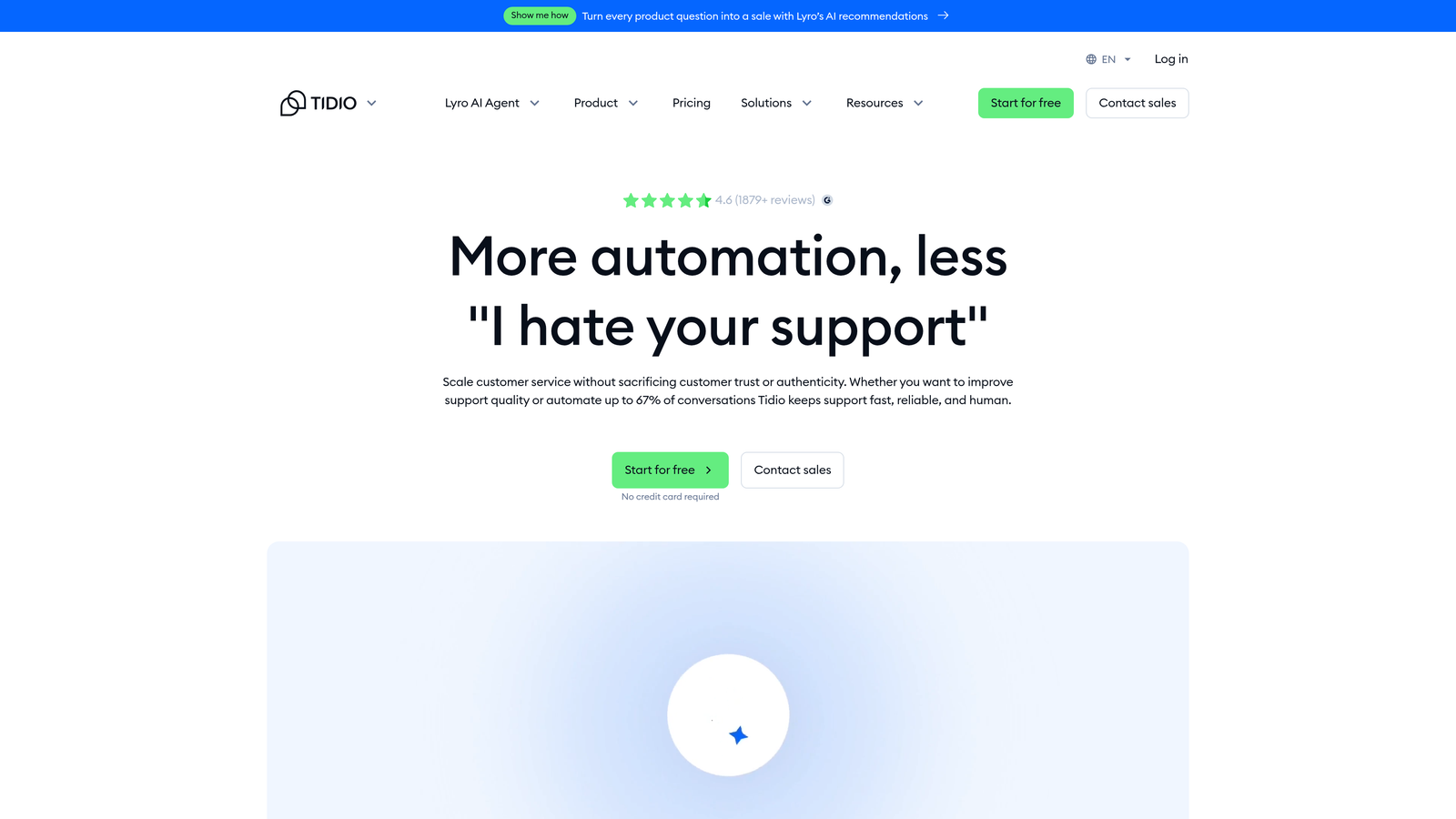
Tidio is an SMB-friendly customer support platform featuring Lyro, an AI chatbot built to handle common customer questions with minimal setup required.
Where This Tool Shines
Tidio's biggest advantage is speed to value. Teams can be live in minutes using the visual flow builder, without needing a developer or a lengthy implementation project. Lyro, built on Claude, handles common queries autonomously and hands off to a human agent when the conversation requires it.
For e-commerce businesses in particular, Tidio's native Shopify and WooCommerce integrations make it easy to connect support with order data, giving agents and the AI relevant context for customer questions.
Key Features
Lyro AI Chatbot: Autonomous query resolution built on Claude, designed to handle high-frequency questions without agent involvement.
Visual Flow Builder: Drag-and-drop conversation design for custom chatbot paths, no coding required.
Live Chat with Agent Takeover: Smooth handoff from AI to human agent when conversations escalate.
E-Commerce Integrations: Native connections to Shopify and WooCommerce for order-aware support.
Fast Deployment: Live in minutes with no technical resources required.
Best For
Small businesses and e-commerce teams that need an accessible AI chatbot without a complex implementation. Less suited for enterprise B2B teams with deep integration requirements or complex ticket workflows.
Pricing
Free tier available; Lyro AI plans start at approximately $29 per month. Verify current pricing at tidio.com.
6. Help Scout
Best for: Teams that prioritize a human, personal support experience with selective AI assistance
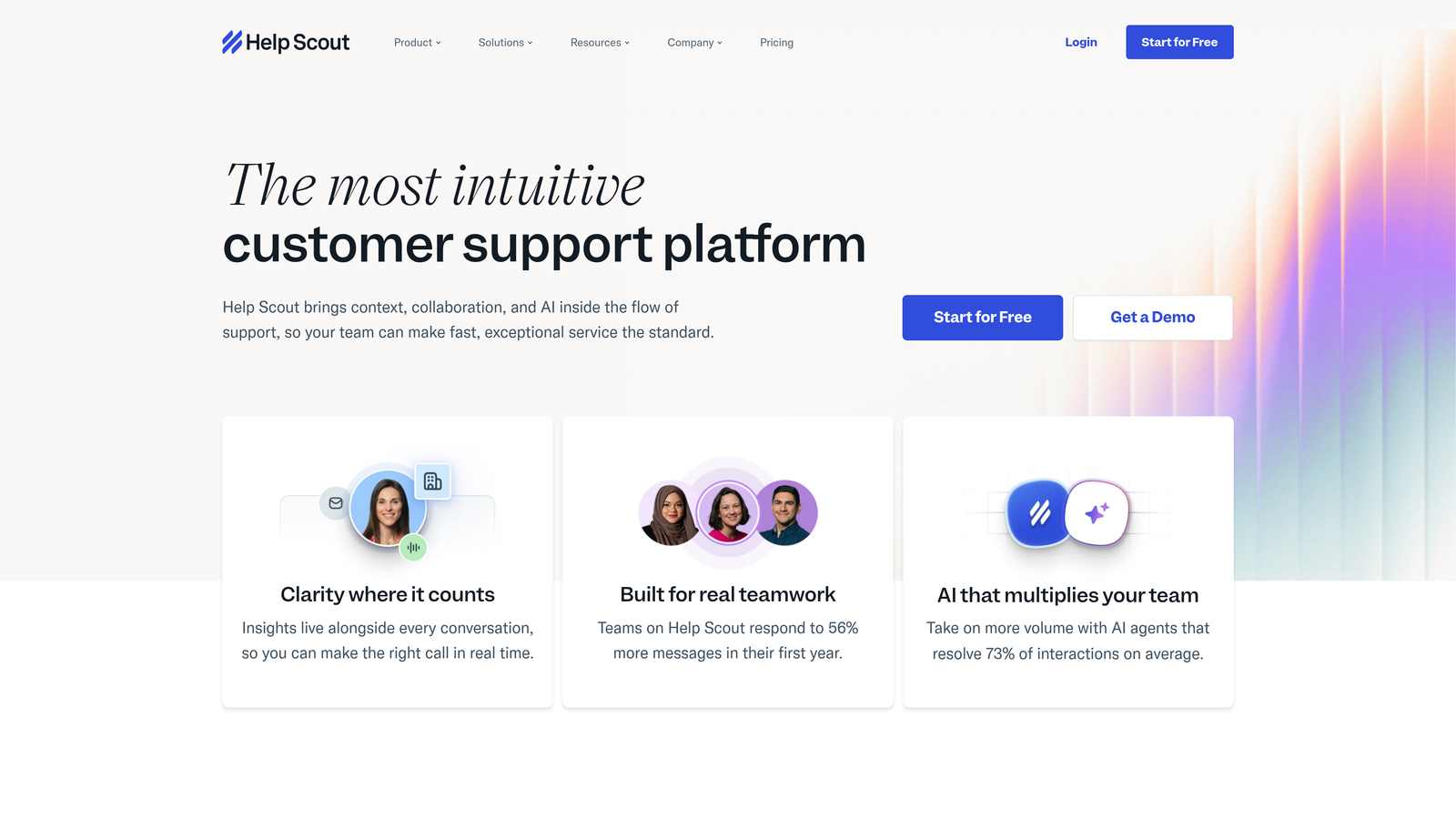
Help Scout is a human-first shared inbox platform with selective AI automation, designed for teams that want to maintain a personal support experience while reducing repetitive work.
Where This Tool Shines
Help Scout takes a deliberately restrained approach to AI. Rather than pushing autonomous resolution, it focuses on making human agents faster and more effective through AI Drafts, which suggest responses that agents review and send. This philosophy resonates with teams where the support relationship itself is a differentiator.
The Docs knowledge base with AI-powered search is a strong complement to the shared inbox, helping customers self-serve before they even reach an agent. Beacon, the in-app chat widget, surfaces relevant documentation proactively based on the page a user is viewing.
Key Features
AI Drafts: AI-generated response suggestions that agents review and send, maintaining quality and a personal tone.
Docs Knowledge Base: Structured self-service content with AI-powered search to improve findability.
Shared Inbox: Collision detection, private notes, and conversation history for clean team collaboration.
Customer Profiles: Full conversation history across channels for context-aware agent responses.
Beacon Chat Widget: In-app support widget that proactively surfaces relevant documentation.
Best For
Teams where support quality and relationship feel matter as much as efficiency. A strong fit for companies where customers expect a thoughtful, human response rather than an automated one, and where agent-assist AI is preferred over autonomous resolution.
Pricing
Starts at approximately $20 per user per month. Verify current pricing at helpscout.com.
7. Drift (Salesloft)
Best for: B2B revenue teams where support and sales conversations overlap significantly
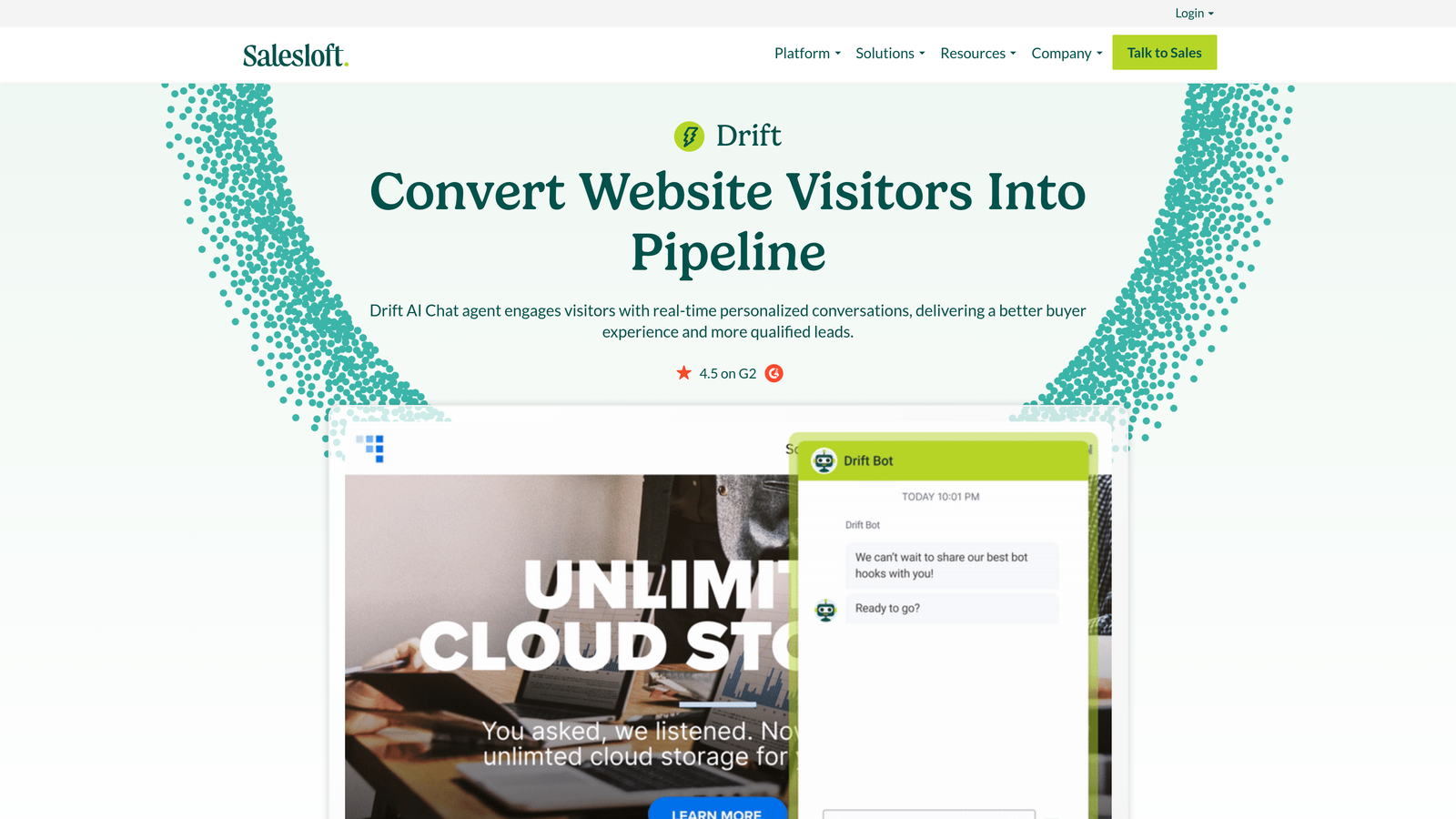
Drift, now part of Salesloft following its 2024 acquisition, is a conversational platform that uses AI chatbots to qualify leads, answer common questions, and route conversations to the right sales or support team.
Where This Tool Shines
Drift occupies a hybrid space between support and sales enablement. If your support team regularly handles conversations that could convert to upsells or renewals, Drift's intelligent routing and account-based targeting capabilities make it a genuinely useful tool rather than a pure support platform.
The native Salesloft integration creates a unified workflow for revenue teams, connecting chat conversations directly to sales sequences and CRM activity. For B2B companies where the line between support and sales is intentionally blurry, this is a meaningful differentiator.
Key Features
AI-Powered Chatbots: Lead qualification and support deflection through conversational AI on your website and in-app.
Intelligent Routing: Routes conversations to sales or support based on context, intent, and account data.
Meeting Scheduling Automation: Books meetings directly within the chat conversation without requiring a separate tool.
Account-Based Targeting: Personalizes chat experiences based on visitor company, account tier, or CRM data.
Native Salesloft Integration: Unified workflows connecting chat conversations to sales sequences and revenue operations.
Best For
B2B teams where support, sales, and customer success overlap and where chat conversations frequently have revenue implications. Less suited for teams focused purely on post-sale ticket management or deep technical support workflows.
Pricing
Enterprise pricing model. Contact Drift or Salesloft sales directly for current rates at drift.com.
8. Kustomer
Best for: High-volume teams that need a full customer timeline across every touchpoint
Kustomer is a CRM-native customer support platform that provides a unified customer timeline across all touchpoints, with AI automation layered on top of rich historical context.
Where This Tool Shines
Kustomer's core differentiator is the unified customer timeline. Rather than viewing support as a series of disconnected tickets, Kustomer shows every interaction a customer has ever had across every channel in a single chronological view. This context makes AI automation significantly more effective because the system has more signal to work with.
For teams handling complex B2B journeys or high-volume consumer support, the combination of CRM depth and AI-powered routing creates faster, more accurate resolutions without agents needing to dig through multiple systems to understand a customer's history.
Key Features
Unified Customer Timeline: Complete interaction history across all channels in a single view, eliminating context-switching for agents.
AI-Powered Automation: Routing, tagging, and resolution automation built on top of rich CRM data for higher accuracy.
Omnichannel Support: Email, chat, SMS, social, and voice in a single platform.
Deep CRM Data: Customer attributes, purchase history, and lifecycle stage available in every support interaction.
Workflow Automation: Conditional logic for complex routing and escalation scenarios.
Best For
High-volume support teams and complex B2B customer journeys where historical context is critical to resolution quality. Enterprise-focused, with pricing and implementation complexity to match.
Pricing
Enterprise pricing. Contact Kustomer sales for current rates at kustomer.com.
9. Forethought
Best for: Teams that want AI capabilities on top of their existing helpdesk without migrating platforms
Forethought is an AI layer that plugs into existing helpdesks like Zendesk and Salesforce Service Cloud, adding intelligent triage, auto-tagging, and autonomous resolution without requiring platform migration.
Where This Tool Shines
Forethought solves a specific and common problem: teams that are deeply invested in an existing helpdesk but want meaningfully better AI capabilities than their current platform provides. Rather than asking you to migrate, Forethought sits on top of your existing system and improves it.
Sentiment detection for priority escalation is a practical feature that ensures frustrated customers or high-value accounts get faster attention, without requiring agents to manually flag urgency. The analytics on deflection rates give support leaders clear data on what the AI is actually handling versus what still requires human attention.
Key Features
AI Triage and Auto-Tagging: Intelligent classification of incoming tickets on top of your existing helpdesk, reducing manual sorting work.
Suggested Responses and Autonomous Resolution: AI handles common tickets end-to-end while suggesting responses for more complex ones.
Sentiment Detection: Identifies frustrated or high-priority customers for faster escalation.
Native Helpdesk Integrations: Works directly with Zendesk, Salesforce Service Cloud, and ServiceNow without requiring platform changes.
Deflection Analytics: Clear reporting on AI performance, resolution rates, and where human agents are still needed.
Best For
Enterprise teams already committed to Zendesk, Salesforce, or ServiceNow who want to add AI capabilities without a disruptive platform migration. A practical bridge solution for organizations where switching costs are high.
Pricing
Contact Forethought for pricing at forethought.ai. Enterprise-focused with custom pricing based on volume and use case.
Which Tool Is Right for Your Team
The right automated customer support software depends almost entirely on where you are in your growth journey and what you're optimizing for.
For SMBs and early-stage teams: Tidio and Freshdesk offer accessible entry points with free tiers and fast deployment. You can be operational quickly without a large implementation investment.
For mid-market teams: Freshdesk, Help Scout, and Intercom each offer a different philosophy. Freshdesk prioritizes multi-channel coverage at competitive pricing. Help Scout is the right call if your team's human touch is a brand differentiator. Intercom fits SaaS teams that want support and product engagement in one platform.
For enterprise teams: Zendesk and Kustomer are the established players with the depth and scalability enterprise operations require. Forethought is worth evaluating if you're already on Zendesk or Salesforce and want better AI without a platform switch.
For B2B revenue teams: Drift makes sense where the support and sales boundary is intentionally blurred and chat conversations have direct revenue implications.
For B2B SaaS teams that want AI-first support: Halo AI is built for exactly this use case. The page-aware context, continuous learning, and business intelligence capabilities go well beyond ticket management. Your support team shouldn't scale linearly with your customer base. Let AI agents handle routine tickets, guide users through your product, and surface business intelligence while your team focuses on complex issues that need a human touch. See Halo in action and discover how continuous learning transforms every interaction into smarter, faster support.