9 Best Automated Customer Support Solutions in 2026
This guide reviews the 9 best automated customer support solutions in 2026, helping B2B SaaS teams evaluate AI-powered tools based on capability, integrations, scalability, and pricing. It's designed for teams using platforms like Zendesk, Freshdesk, and Intercom who need to scale support operations without increasing headcount.
 Grant CooperFounder13 min read
Customer support teams in 2026 face a familiar tension: ticket volumes keep climbing, customer expectations keep rising, and headcount budgets stay flat. Automated customer support solutions have become less of a "nice to have" and more of a structural necessity for B2B SaaS teams that want to scale without burning out their people.
This list was built for B2B SaaS teams, product teams, and companies evaluating or already using platforms like Zendesk, Freshdesk, and Intercom. Each tool was evaluated on AI capability, integration depth, scalability, ease of deployment, and pricing transparency. If you want deeper context before diving in, our posts on customer support automation strategy and automated customer support benefits are worth a read first.
One honest note upfront: Halo AI is our own product and it's listed first. We've tried to be direct about what it does well and who it's best suited for, so you can make the right call for your team.
1. Halo AI
Best for: B2B SaaS teams that want AI agents delivering intelligence, not just deflection.
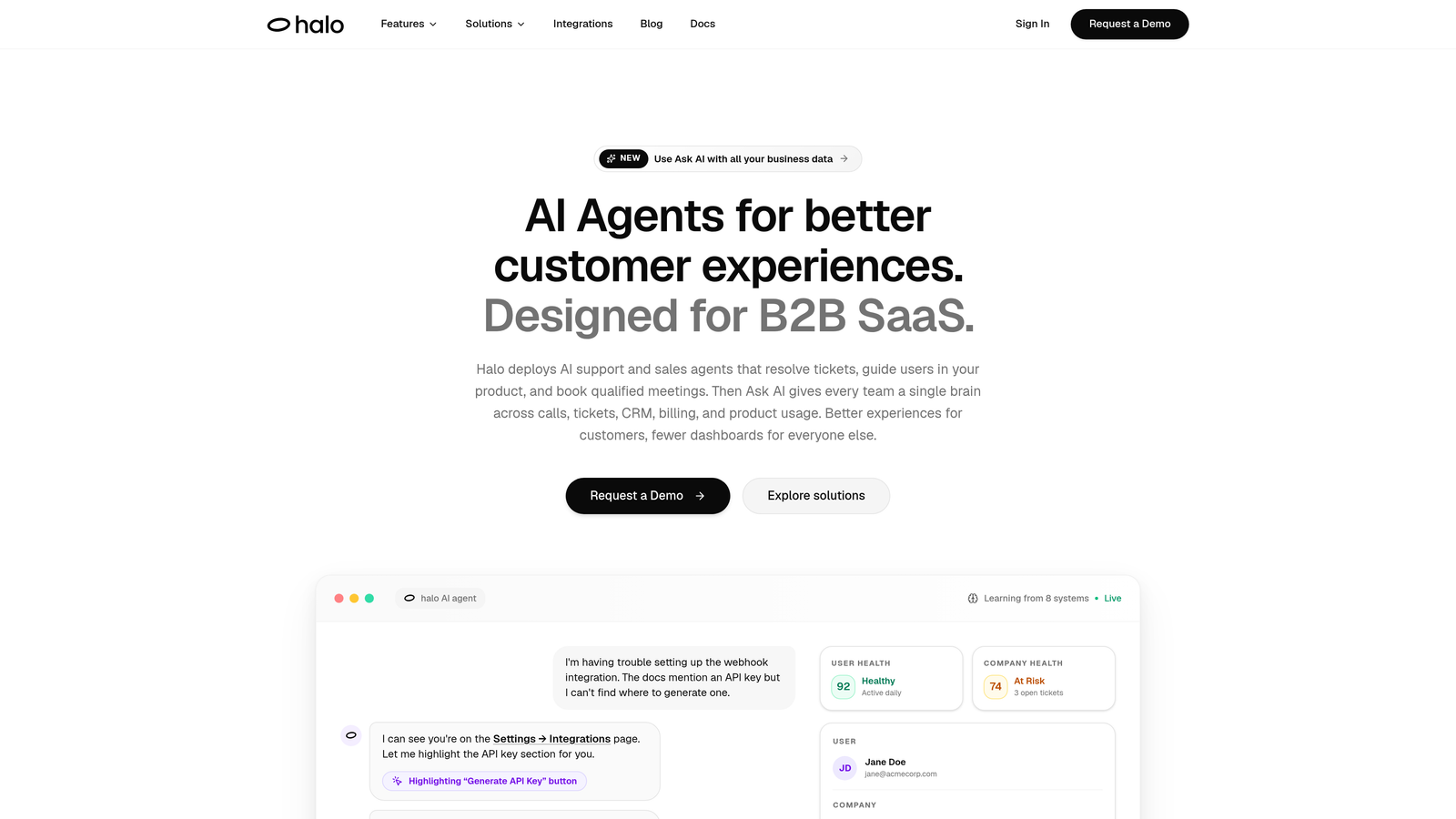
Halo AI is an AI-first customer support platform that resolves tickets, guides users through your product, and surfaces business intelligence signals from every interaction.
Where This Tool Shines
Most support tools bolt AI onto an existing helpdesk. Halo was built the other way around: AI is the architecture, not an add-on. The standout capability is page-aware context. Halo's agents understand what screen or workflow a user is currently on, which means guidance is specific and visual rather than generic. A user stuck on your billing settings gets help for that exact screen, not a link to a documentation page.
What separates Halo further is what it does with the data flowing through support. Beyond resolving tickets, it surfaces customer health signals, revenue anomalies, and churn indicators from support interactions. Your support team stops being a cost center and starts being an intelligence layer for the whole business.
Key Features
Page-Aware AI Agents: Understands exactly what screen or workflow the user is on, enabling precise visual UI guidance rather than generic answers.
Continuous Learning Architecture: Improves resolution quality with every interaction, getting smarter the more your team uses it.
Auto Bug Ticket Creation: Automatically creates and routes bug reports directly to engineering tools like Linear, closing the loop between support and product.
Smart Inbox with Business Intelligence: Surfaces customer health signals, revenue anomalies, and churn indicators from support data in real time.
Broad Integration Stack: Connects natively with Linear, Slack, HubSpot, Intercom, Stripe, Zoom, PandaDoc, and Fathom.
Graceful Live Agent Handoff: Escalates complex issues to human agents smoothly, with full context preserved.
Best For
SaaS product teams and B2B companies that want more from support than ticket deflection. If you're looking for a platform that learns continuously, integrates deeply with your existing stack, and turns support data into business intelligence, Halo is purpose-built for that use case. Less suited to teams that need a traditional helpdesk interface as their primary system of record.
Pricing
Visit haloagents.ai for current pricing. Plans scale with usage and team size.
2. Intercom
Best for: Teams wanting an all-in-one communications platform with a proven AI support agent.
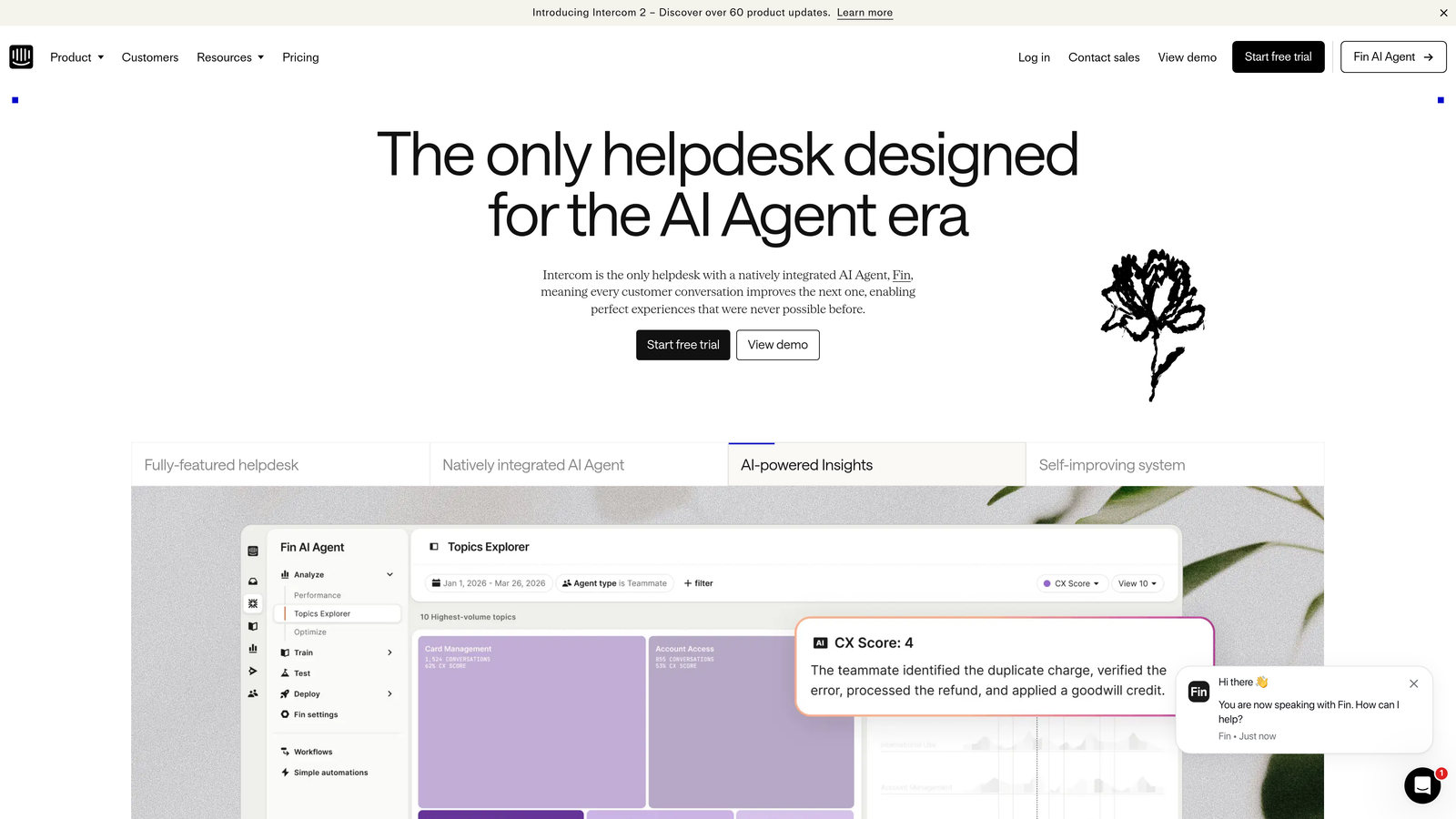
Intercom is a mature customer communications platform combining AI-powered support, onboarding automation, and proactive messaging in one ecosystem.
Where This Tool Shines
Intercom's Fin AI agent is one of the most widely deployed AI support agents in B2B SaaS. Built on large language models, Fin handles multi-turn conversations with solid resolution rates, and the surrounding platform adds genuine value: product tours, onboarding sequences, and proactive messaging mean you can automate the full customer journey, not just reactive support.
It's also worth noting that Halo AI integrates with Intercom, meaning these two tools can work together rather than forcing a binary choice. For teams already embedded in the Intercom ecosystem, this composability is a real advantage.
Key Features
Fin AI Agent: Handles multi-turn support conversations using large language models with strong resolution rates.
Proactive Messaging and Product Tours: Automates onboarding and in-app guidance beyond reactive support.
Large App Marketplace: Hundreds of integrations covering most business tool categories.
AI-Assisted Reply Suggestions: Helps human agents respond faster with contextual suggestions.
Built-In Reporting: Conversation analytics and resolution metrics included natively.
Best For
Teams that want a single platform for support, onboarding, and proactive customer engagement. Particularly strong for SaaS companies with a significant product-led growth motion where in-app messaging and tours matter as much as ticket resolution.
Pricing
Premium pricing tier; starts at several hundred dollars per month depending on seat count and usage volume. Verify current plans at intercom.com.
3. Zendesk AI
Best for: Enterprise support organizations needing compliance, scale, and AI layered into a proven helpdesk.
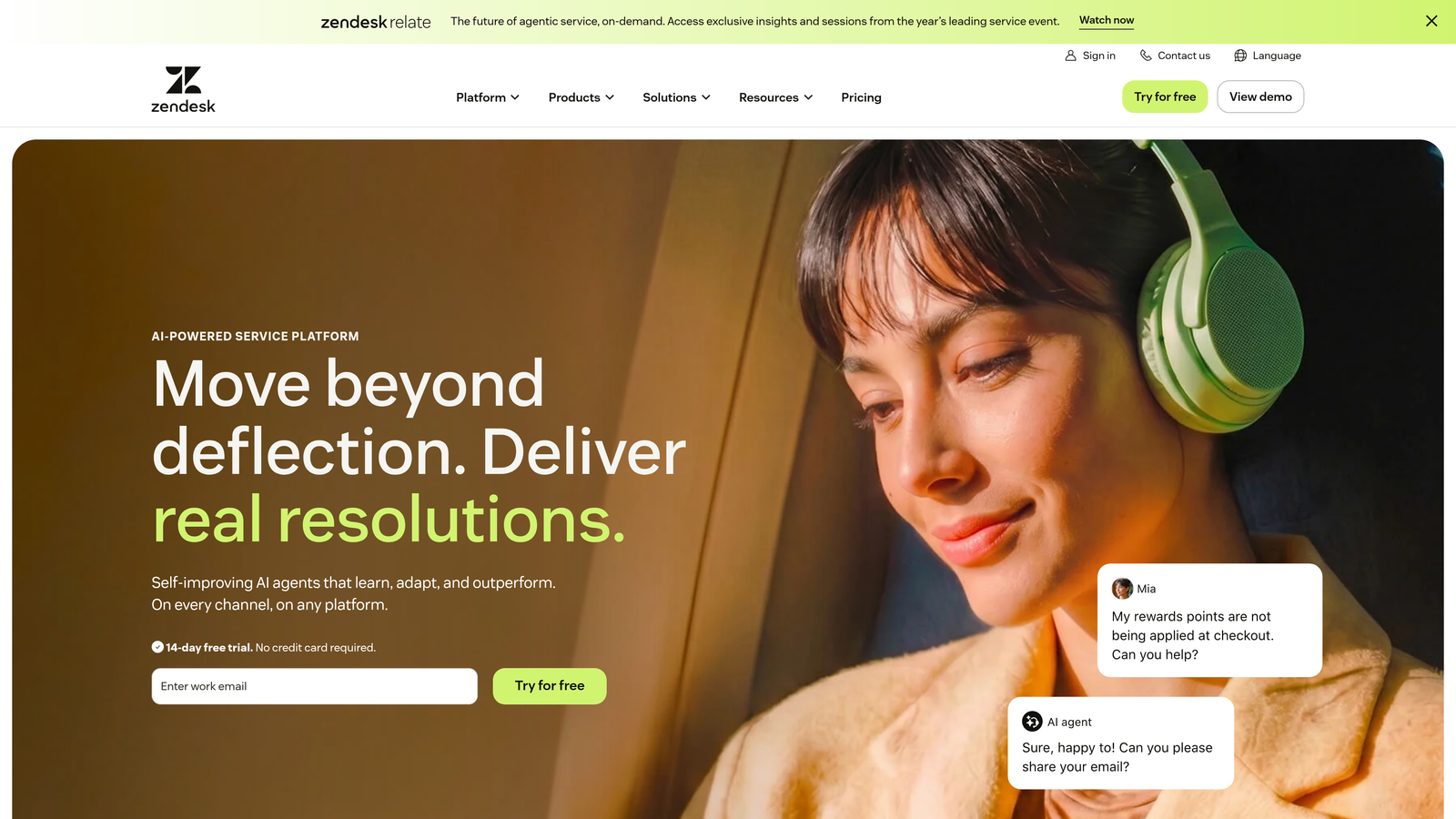
Zendesk is the enterprise standard for helpdesk software, now with AI triage, intelligent routing, generative agent assistance, and self-service bots built into the Zendesk Suite.
Where This Tool Shines
Zendesk's strength is institutional trust. Large support organizations choose it because it handles compliance, security, audit trails, and complex SLA management at a level most newer platforms haven't matched. The AI additions, including intelligent routing, generative reply drafting, and the Answer Bot for self-service deflection, are meaningful improvements to an already robust foundation.
The trade-off is complexity and cost. Zendesk's AI capabilities are strongest at the higher tiers, setup can be involved, and the total cost of ownership tends to be higher than alternatives. But for enterprises that need the compliance posture and integration ecosystem, those trade-offs are often worth it.
Key Features
AI-Powered Triage and Routing: Automatically classifies and routes incoming tickets to the right agent or queue.
Generative AI for Agents: Drafts replies and suggests knowledge base articles for human agents in real time.
Advanced Answer Bot: Deflects common queries before tickets are created through self-service flows.
Compliance and Security: Robust audit trails, data residency options, and enterprise security controls.
Extensive Integration Ecosystem: Connects with virtually every enterprise tool category.
Best For
Large enterprise support teams with compliance requirements, complex routing needs, and existing Zendesk investments. Less ideal for lean SaaS teams looking for fast deployment or AI-first architectures.
Pricing
Suite plans start around $55 per agent per month; AI features are available on higher tiers. Verify current pricing at zendesk.com.
4. Freshdesk (Freddy AI)
Best for: Growing SMB and mid-market teams that want AI-augmented helpdesk capabilities at accessible pricing.
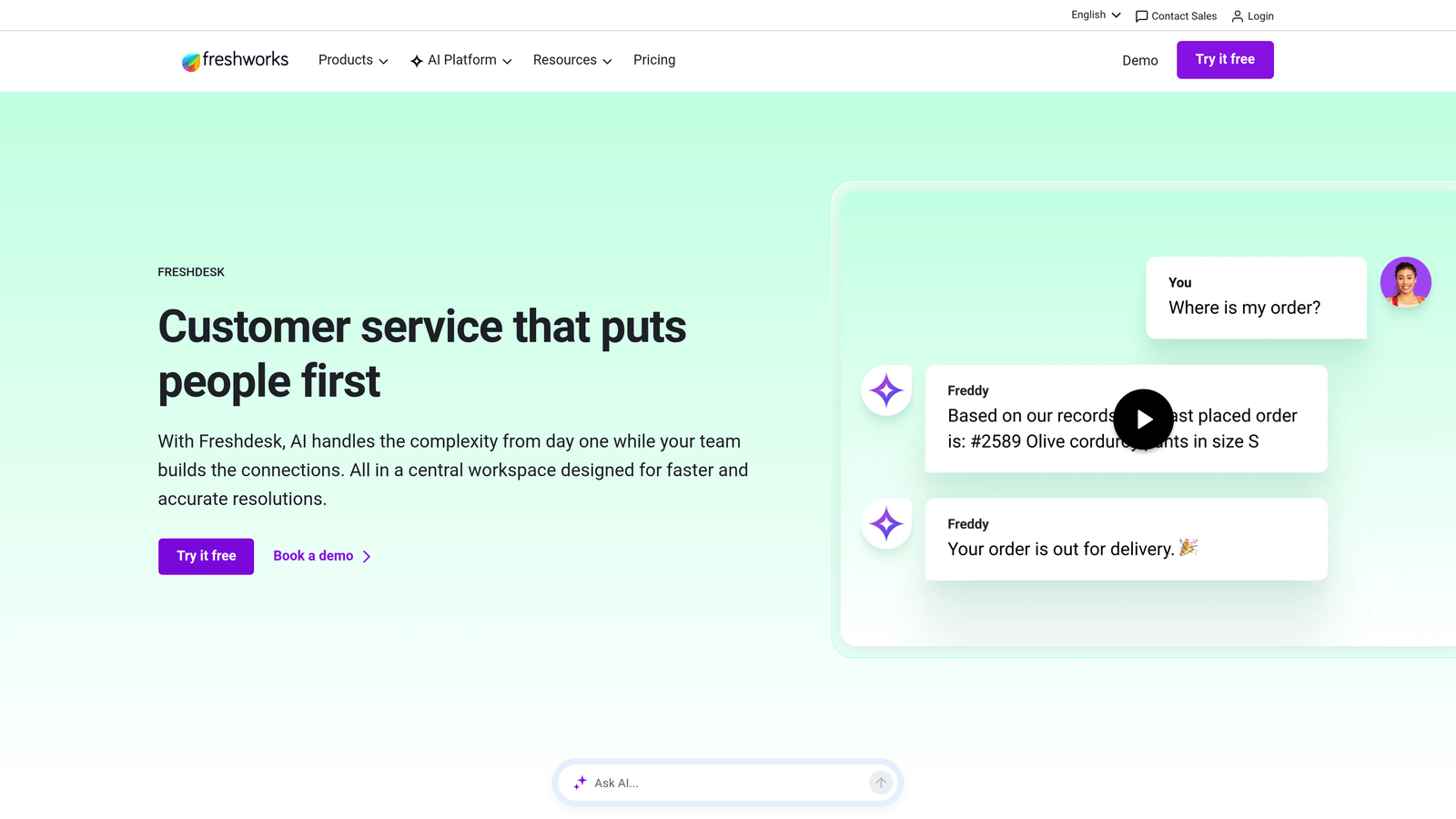
Freshdesk is a full-featured helpdesk platform with Freddy AI built in, covering self-service chatbots, agent copilot assistance, and analytics across a competitive pricing structure.
Where This Tool Shines
Freshdesk's value proposition is straightforward: you get a capable, omnichannel helpdesk with AI assistance at a price point that doesn't require an enterprise budget. Freddy AI covers the three layers most teams actually need: deflection before tickets are created, assistance while agents are working, and insights after the fact.
Freddy's resolution capabilities for complex, multi-step queries are generally considered less sophisticated than AI-first platforms, but for teams handling high volumes of repetitive, predictable queries, it performs well. The free tier also makes it an easy starting point for teams not ready to commit to paid AI tooling.
Key Features
Freddy Self Service: No-code AI chatbot that deflects common queries before they become tickets.
Freddy Copilot: Provides AI-suggested replies and next-best-action recommendations to human agents.
Freddy Insights: AI-driven analytics that surface ticket trends and CSAT patterns automatically.
Omnichannel Support: Handles email, chat, phone, and social from a single platform.
Competitive Pricing: Significantly more accessible than enterprise alternatives like Zendesk.
Best For
SMB and mid-market teams that need a reliable helpdesk with solid AI features and don't want to pay enterprise prices. Also a good fit for teams migrating off spreadsheets or email-based support for the first time.
Pricing
Free tier available; paid plans start around $15 per agent per month. Freddy AI features are available on higher tiers. Check current pricing at freshdesk.com.
5. Tidio
Best for: E-commerce and SMB teams that need a fast-deploy AI chatbot without developer involvement.
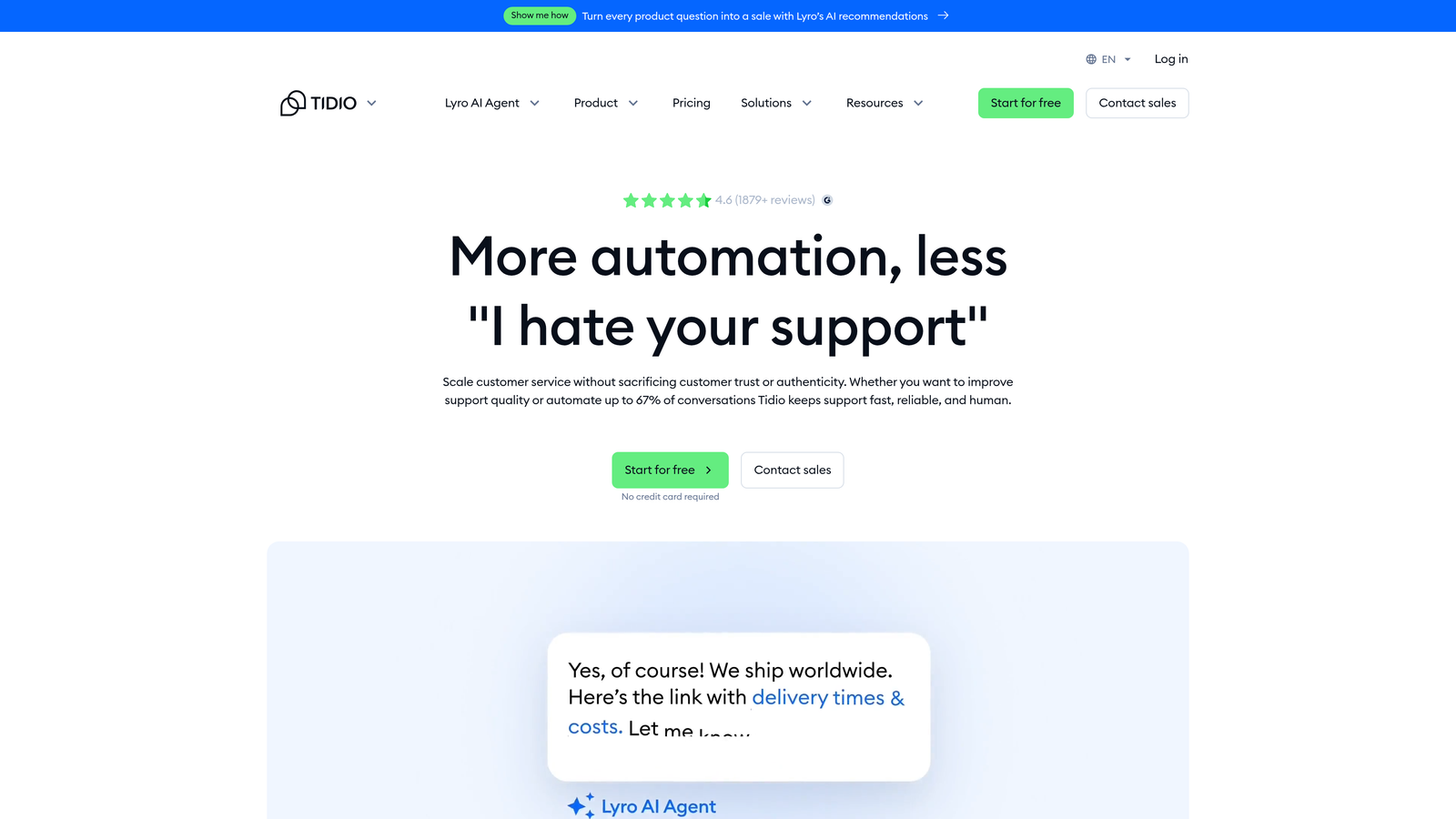
Tidio is a lightweight live chat and AI chatbot platform with a conversational AI agent called Lyro, known for its speed of deployment and strong e-commerce integrations.
Where This Tool Shines
If your team's priority is getting an AI support layer live quickly, Tidio is hard to beat on that dimension. Lyro trains automatically on your existing support content and can be deployed in hours without writing a single line of code. For e-commerce teams on Shopify or WooCommerce, the native integrations mean Lyro can handle order-related queries out of the box.
The honest limitation is that Tidio is best suited to simpler, repetitive query types. For complex B2B SaaS support with multi-step troubleshooting or deep product context, you'll likely hit the ceiling faster than with AI-first platforms built for that complexity.
Key Features
Lyro AI Chatbot: Trains automatically on your support content with no manual configuration required.
No-Code Setup: Deployable in hours without developer involvement.
Native E-Commerce Integrations: Direct Shopify and WooCommerce integrations for order-related workflows.
Live Chat with AI Handoff: Escalates to human agents for queries Lyro cannot resolve.
Visual Chatbot Flow Builder: Build custom conversation paths without code.
Best For
E-commerce brands, small businesses, and early-stage teams that need a working AI chatbot fast without a complex setup process. Less suited to SaaS teams with nuanced, multi-step support needs.
Pricing
Free plan available; Lyro AI starts around $29 per month. Visit tidio.com for current plans.
6. Drift (Salesloft)
Best for: Revenue-focused B2B teams where support and sales conversations overlap significantly.
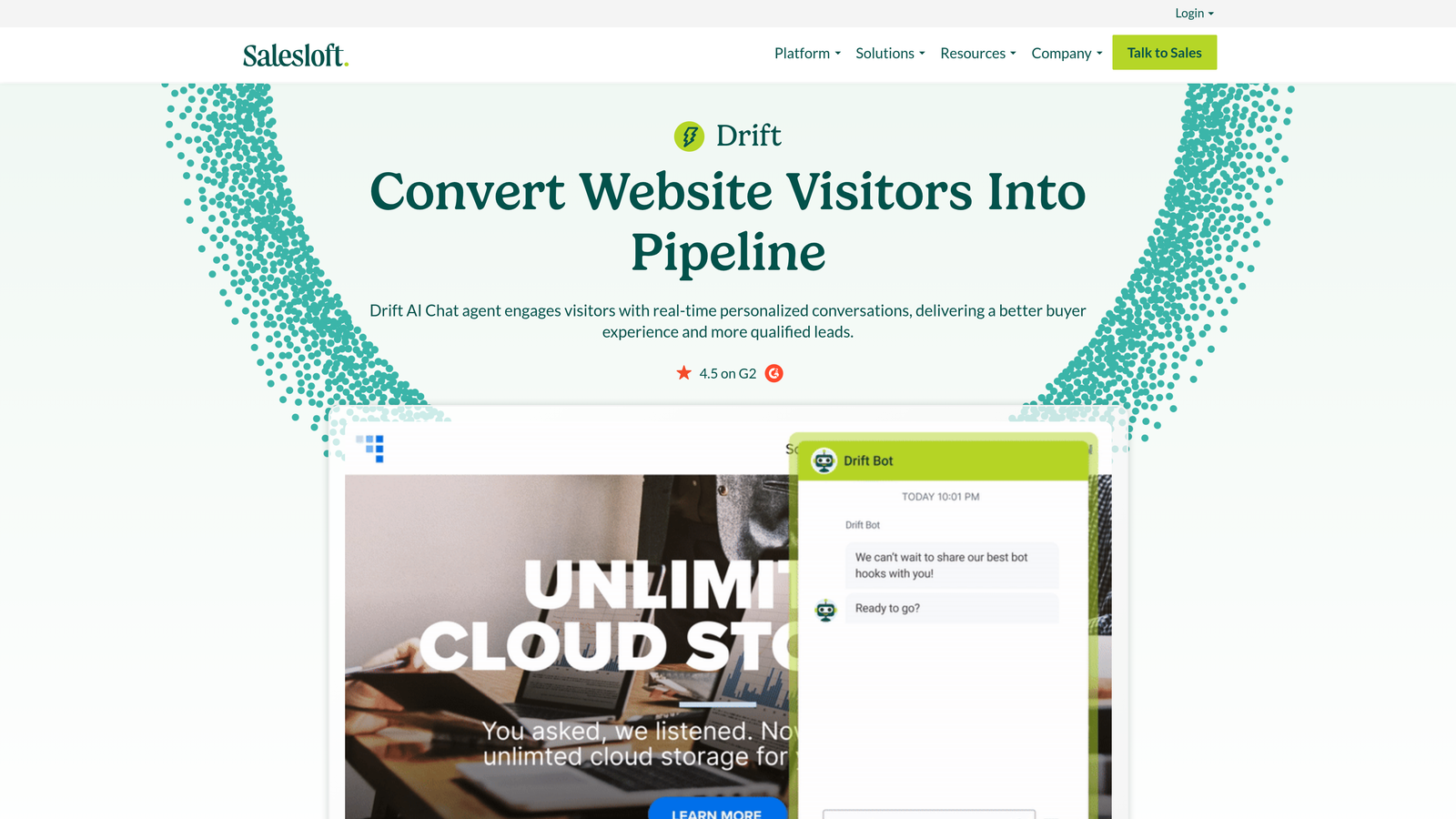
Drift, now part of Salesloft, is a conversational platform that blends AI-powered support automation with sales engagement, account-based routing, and pipeline context.
Where This Tool Shines
Drift's integration into Salesloft creates something genuinely different from a pure support tool: a platform where a conversation that starts as a support query can route intelligently based on account data, connect to sales context, and trigger a meeting booking without human intervention. For B2B teams where the line between customer success and sales is blurry, that continuity has real value.
The trade-off is focus. Drift is less optimized for pure ticket resolution volume than dedicated helpdesk or AI-first support platforms. Teams with a high-volume support operation as their primary concern will likely find more purpose-built options elsewhere on this list.
Key Features
AI Playbooks: Route conversations based on account data and buyer intent signals automatically.
Conversation Intelligence: Links support interactions to sales pipeline context for full-funnel visibility.
Account-Based Targeting: Serves different chat experiences to different customer segments based on firmographic data.
Salesloft Integration: Direct connection to broader sales engagement workflows and sequences.
Meeting Scheduling: Built-in calendar booking and sales handoff within the chat workflow.
Best For
B2B teams with a strong account-based go-to-market motion where support, success, and sales conversations need to share context. Less ideal for teams focused purely on support ticket resolution efficiency.
Pricing
Enterprise pricing; contact Drift or Salesloft for current quotes at drift.com.
7. Ada
Best for: Enterprise teams that need AI agents that execute transactions, not just answer questions.
Ada is an enterprise no-code AI agent platform focused on "action AI," where agents complete real transactions by connecting directly to backend systems.
Where This Tool Shines
Ada's core differentiator is the distinction between answering and doing. Most AI support tools provide information. Ada's agents can process a refund, update account details, change a subscription tier, or modify an order by connecting to the underlying systems where that data lives. For high-volume consumer-facing operations in telecom, fintech, or retail, that capability dramatically changes the ROI math on automation.
Ada is also genuinely no-code, meaning support and operations teams can build and modify agents without engineering involvement. For enterprises that want to move fast without creating a development backlog, that's a meaningful operational advantage.
Key Features
Action AI: Agents execute real transactions like refunds, account updates, and subscription changes, not just surface information.
No-Code Agent Builder: Accessible to non-technical support and operations teams without developer dependency.
Deep System Integrations: Connects to CRMs, billing platforms, and custom APIs to enable transactional actions.
Multilingual Support: Handles global enterprise deployments across multiple languages.
Enterprise Track Record: Strong deployment history in telecom, fintech, and large consumer brands.
Best For
Enterprise organizations with high volumes of transactional support requests, particularly in industries like telecom, fintech, insurance, or retail where agents need to do things, not just say things.
Pricing
Enterprise pricing; contact Ada for a custom quote at ada.cx.
8. Kustomer
Best for: DTC and retail brands that need CRM-native support with a unified customer timeline.
Kustomer is a CRM-native customer support platform that unifies every customer touchpoint into a single timeline, with AI automation for routing, workflows, and agent assistance.
Where This Tool Shines
Kustomer's defining feature is the unified customer timeline: every order, conversation, return, and interaction stitched together in one view for every agent. For brands where support conversations are inseparable from order history and purchase context, that single view eliminates the constant tab-switching that slows agents down and frustrates customers.
The built-in CRM also means you're not paying for and integrating a separate customer data system. For DTC and retail brands with complex customer histories, that consolidation has real operational value. Kustomer is less commonly adopted in pure SaaS contexts where order data isn't the central support driver.
Key Features
Unified Customer Timeline: Combines orders, conversations, and full history into a single agent view.
AI-Powered Routing: Workflow automation triggered by customer data and conversation context.
Omnichannel Coverage: Handles chat, email, SMS, voice, and social from one platform.
AI-Suggested Replies: Surfaces full customer context alongside reply suggestions for human agents.
Built-In CRM: Eliminates the need for a separate customer data system.
Best For
DTC brands, e-commerce companies, and retailers where order history and customer lifecycle data are central to every support interaction. Less suited to pure SaaS support teams without complex transaction histories.
Pricing
Starts around $89 per agent per month. Check current plans at kustomer.com.
9. Chatbase
Best for: Early-stage startups and lean teams deploying a first AI support layer on a tight budget.
Chatbase is a developer-friendly platform for building custom AI chatbots trained on your own documentation, PDFs, URLs, and knowledge bases.
Where This Tool Shines
Chatbase lowers the barrier to entry for AI support automation significantly. You connect your data sources, including docs, PDFs, Notion pages, and website URLs, and Chatbase builds an AI agent trained on that content. For teams that have solid documentation but no AI layer on top of it yet, this is a fast and affordable way to start deflecting repetitive questions.
The platform is also genuinely accessible to developers who want to customize behavior through the API without being locked into a rigid platform structure. The honest limitation is that Chatbase is a starting point, not a full-scale enterprise support platform. Complex multi-step workflows, deep integrations, and business intelligence capabilities are beyond its current scope.
Key Features
Custom Data Training: Train AI agents on your own docs, PDFs, URLs, and Notion pages directly.
Embeddable Chat Widget: Deploy on any website with minimal code.
API Access: Custom integrations with existing support workflows for developer teams.
Conversation Analytics: Identifies knowledge gaps in your documentation based on unanswered queries.
Accessible Pricing: One of the most affordable entry points for AI chatbot deployment.
Best For
Early-stage startups, lean teams, and developer-led organizations that want a cost-effective first layer of AI deflection without committing to a full enterprise platform. A natural stepping stone before graduating to a more comprehensive solution.
Pricing
Free tier available; paid plans start around $19 per month. Visit chatbase.co for current pricing.
Which Tool Is Right for Your Team?
The right automated customer support solution depends almost entirely on where you are and what you're optimizing for. Here's a quick way to think through the decision.
Choose Halo AI if you're a B2B SaaS team that wants more than ticket deflection. Page-aware context, continuous learning, auto bug reporting, and business intelligence signals make it purpose-built for product teams that want support to inform the whole business, not just close tickets.
Choose Intercom if you're already embedded in that ecosystem or need proactive messaging and onboarding automation alongside support. The Halo AI integration also means you don't have to choose between them.
Choose Zendesk AI if you're running a large enterprise support organization with compliance requirements and complex routing needs. The AI additions are meaningful, but the real value is the institutional maturity of the platform.
Choose Freshdesk if you're an SMB or mid-market team that needs a capable, omnichannel helpdesk with solid AI features at a price that doesn't require a VP's sign-off.
Choose Ada if your support operation is high-volume and transactional. If your agents spend their days processing refunds, updating accounts, and changing subscriptions, Ada's action AI capability changes the automation equation entirely.
Choose Chatbase if you're an early-stage team that wants to put your documentation to work immediately without a large investment. It's a smart first step.
Your support team shouldn't scale linearly with your customer base. Let AI agents handle routine tickets, guide users through your product, and surface business intelligence while your team focuses on the complex issues that actually need a human touch. See Halo in action and discover how continuous learning transforms every interaction into smarter, faster support.