9 Best Automated First Line Support Solutions in 2026
This roundup evaluates the 9 best automated first line support solutions available in 2026, comparing AI-powered tools that autonomously handle incoming customer inquiries, resolve common issues, and intelligently escalate complex cases—helping support teams reduce queue overload while improving response times and overall customer experience.
 Matt PattoliFounder13 min read
The front door of customer experience is getting a serious upgrade. Most incoming support tickets are repetitive, predictable, and perfectly suited for AI resolution — yet many teams still route every request through an overloaded human queue. Automated first line support solutions change that equation by handling initial inquiries, triaging complex cases, and resolving common issues autonomously before a human agent ever needs to get involved.
For this roundup, a "first line support solution" means any AI-powered tool that intercepts customer inquiries at the point of contact, resolves what it can autonomously, and escalates intelligently when it can't. If you want deeper background on the space before diving in, check out our guides on automated customer support and AI support agents.
Selection criteria for this list: AI resolution quality, integration depth, ease of setup, escalation handling, analytics capabilities, and pricing transparency. Here are the top automated first line support solutions worth evaluating in 2026.
1. Halo AI
Best for: Product-led SaaS teams wanting continuous learning, page-aware context, and deep business intelligence from support interactions.
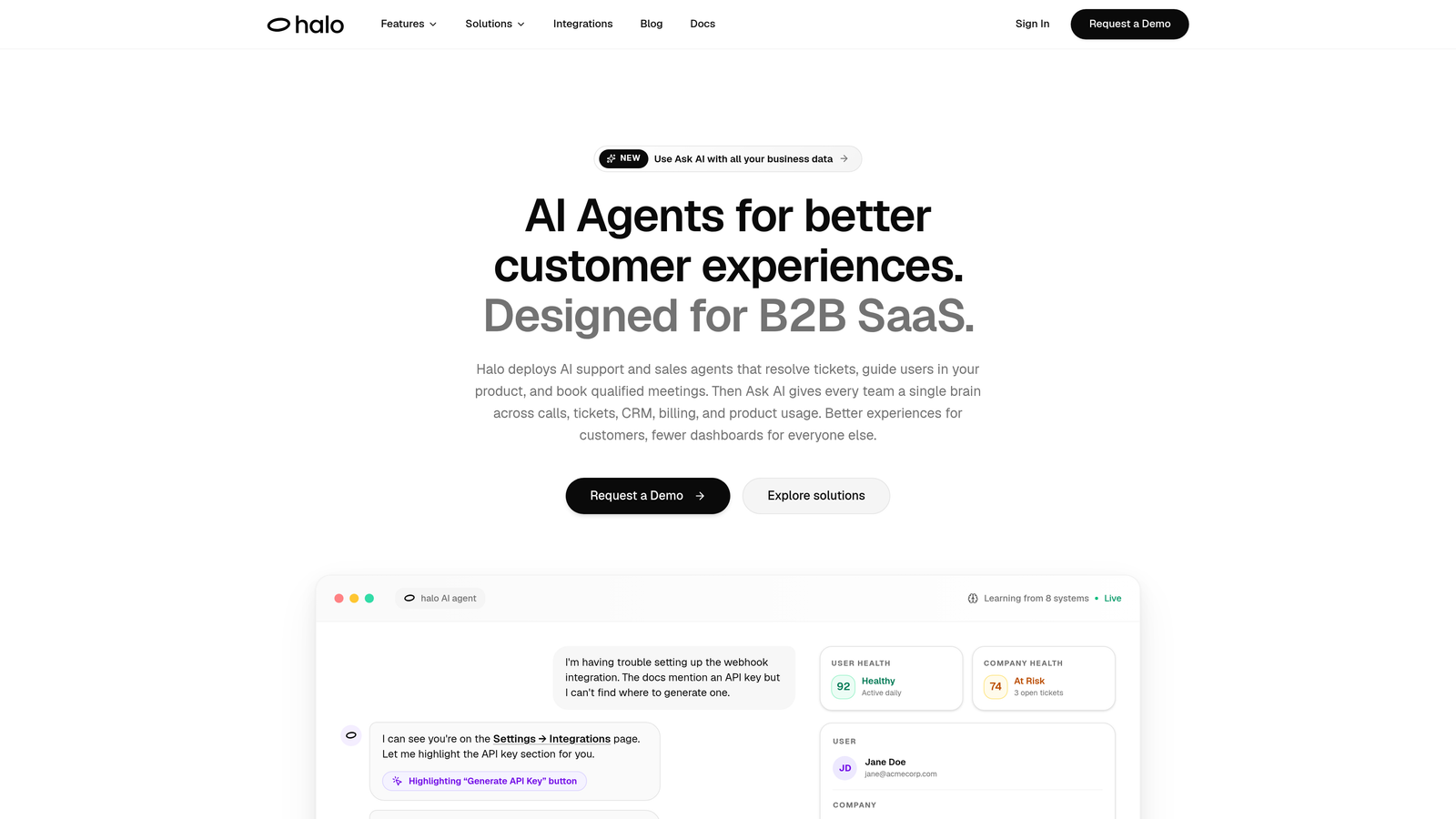
Halo AI is an AI-first customer support platform that deploys autonomous agents to resolve tickets, guide users with screen-aware context, and surface business intelligence — learning continuously from every interaction.
Where This Tool Shines
Most AI support tools answer questions. Halo AI actually sees what the user sees. Its page-aware context engine understands the user's current screen state, which means guidance is precise and situational rather than generic. Instead of pointing someone to a help article, Halo can walk them through the exact steps relevant to where they are in your product right now.
The continuous learning loop is another genuine differentiator. Every resolved ticket, every escalation, every interaction feeds back into the model — so the system gets measurably smarter over time rather than plateauing at initial training quality. Halo also connects support data to your broader business stack, surfacing customer health signals, revenue intelligence, and anomaly detection through its smart inbox rather than treating support as an isolated function.
Key Features
Page-Aware Chat Widget: Sees the user's actual screen state to deliver precise, contextual guidance rather than generic help content.
Continuous Learning Engine: Improves resolution quality with every interaction, building compounding intelligence over time.
Auto Bug Ticket Creation: Automatically routes issues to engineering tools like Linear, closing the loop between support and product teams.
Smart Inbox with Business Intelligence: Delivers customer health signals, revenue intelligence, and anomaly detection beyond standard support metrics.
Seamless Live Agent Handoff: Transfers complex conversations to human agents with full context preserved, so customers never have to repeat themselves.
Best For
SaaS companies and product-led growth teams that want support automation deeply connected to their product, engineering, and revenue workflows. Particularly strong for teams using tools like Linear, Slack, HubSpot, Intercom, Stripe, Zoom, and Fathom who want a single intelligence layer across their entire stack.
Pricing
Contact for pricing; a demo is available directly on the Halo AI website. Custom pricing reflects deployment complexity and integration scope.
2. Intercom Fin
Best for: Teams already running Intercom who want native AI resolution without switching platforms.
Intercom Fin is Intercom's native AI agent that resolves customer questions using your help center content and conversation history, with seamless handoff to human teammates within the Intercom platform.
Where This Tool Shines
Fin's biggest advantage is zero-friction adoption for existing Intercom customers. It trains directly on your help center articles and past conversations, meaning there's no separate knowledge base migration or parallel system to maintain. The quality of its responses is closely tied to the quality of your existing content, which incentivizes teams to keep their documentation sharp.
Multi-language support with automatic translation makes Fin a practical choice for companies serving international markets through a single Intercom workspace. The built-in reporting on resolution rate and customer satisfaction integrates naturally into Intercom's existing analytics layer.
Key Features
Help Center Training: Trained directly on your Intercom articles and historical conversations for context-aware responses.
Multi-Language Support: Automatic translation enables consistent first line resolution across global customer bases.
Custom Answers: Handles questions outside standard help content with configurable responses for edge cases.
Resolution Reporting: Built-in metrics for resolution rate and CSAT integrated into Intercom's dashboard.
Native Platform Integration: Works directly within Intercom's messenger, inbox, and workflow automation tools.
Best For
Companies already invested in the Intercom ecosystem who want to add AI resolution without introducing a new vendor. Less compelling for teams considering a platform switch or needing integrations outside Intercom's native toolset.
Pricing
Usage-based pricing per resolved conversation; requires an active Intercom subscription. Costs can scale significantly with high ticket volumes.
3. Zendesk AI Agents
Best for: Enterprise support teams running Zendesk Suite who want AI resolution and agent-assist built into their existing workflows.
Zendesk AI Agents are AI-powered agents built into the Zendesk platform that automate ticket resolution, intelligently triage incoming requests, and provide agent-assist features for complex issues.
Where This Tool Shines
Zendesk's AI benefits from training on a massive dataset of real customer service interactions, which gives its intent detection a head start that purpose-built tools often can't match out of the box. Ticket classification and routing happen automatically based on intent, language, and sentiment — reducing the manual triage burden that typically bogs down support ops teams.
The agent copilot feature is particularly useful for complex tickets that require human handling: it surfaces suggested responses and next actions so agents spend less time searching and more time resolving. For organizations with strict compliance requirements, Zendesk's enterprise-grade security posture is a meaningful factor.
Key Features
Pre-Trained Intent Detection: Built on billions of real support interactions for accurate classification from day one.
Automated Triage and Routing: Classifies tickets by intent, language, and sentiment without manual rules setup.
Generative AI Responses: Grounds responses in your knowledge base for accurate, on-brand answers.
Agent Copilot: Suggests responses and next-best actions for human agents handling escalated tickets.
Enterprise Security: SOC 2 compliance, data encryption, and role-based access controls built in.
Best For
Mid-market and enterprise teams deeply embedded in the Zendesk ecosystem. The AI capabilities are most powerful when layered on top of existing Zendesk workflows, ticket history, and knowledge base content.
Pricing
Core AI features are included in Zendesk Suite plans; advanced AI capabilities are available as a paid add-on. Pricing scales with agent seats and usage volume.
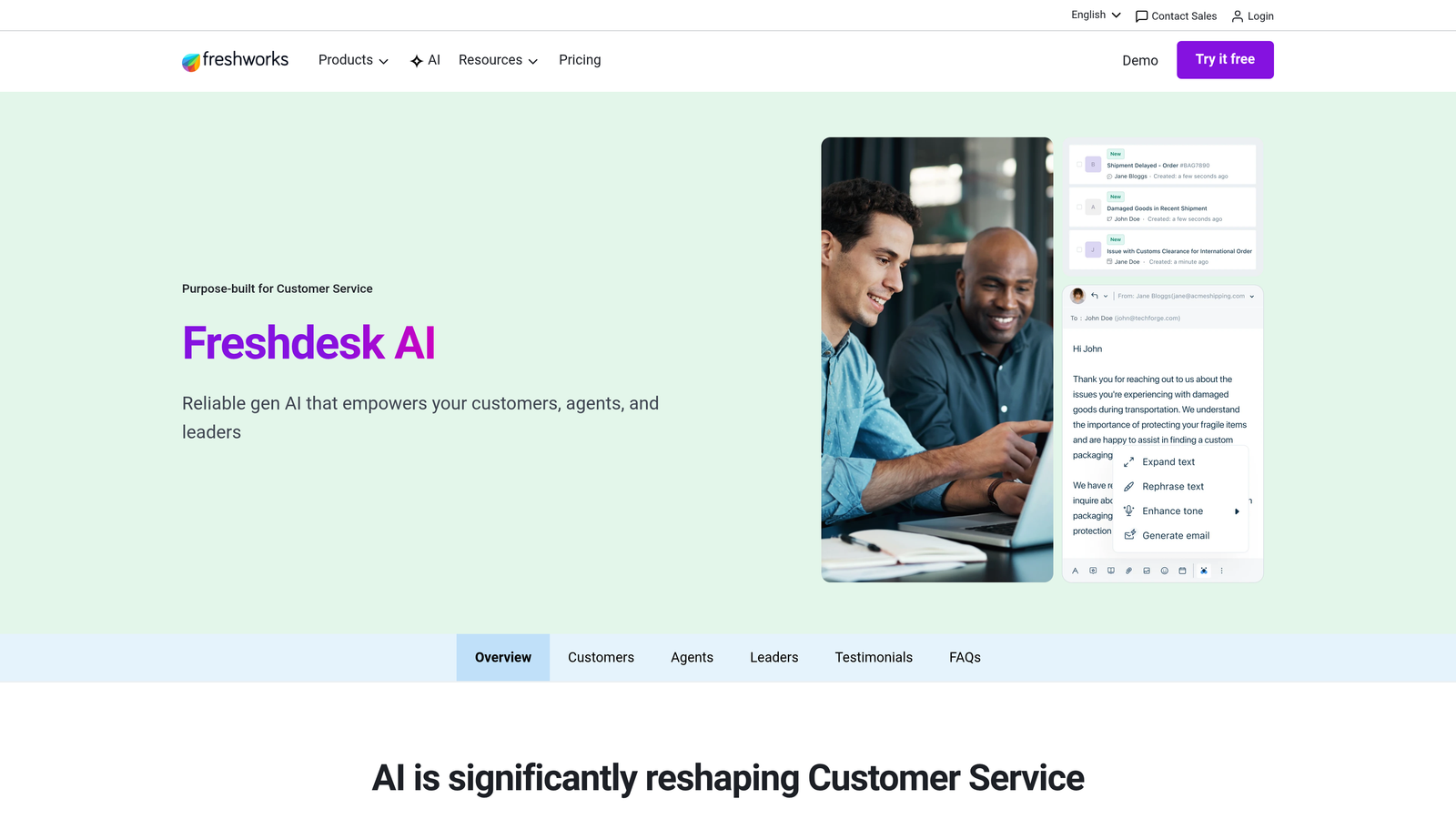
4. Freshdesk Freddy AI
Best for: Growing teams on the Freshworks platform looking for cost-effective AI automation across support, CRM, and marketing.
Freshdesk Freddy AI is Freshworks' AI engine that powers automated responses, ticket classification, and agent assistance across the Freshdesk support platform and broader Freshworks suite.
Where This Tool Shines
Freddy AI's cross-suite context is a genuine advantage for teams using multiple Freshworks products. When a support ticket arrives, Freddy can pull relevant context from Freshworks CRM and marketing tools — giving agents a unified customer view without switching tabs or querying separate systems. This is particularly useful for B2B support teams where account history and deal status are relevant to how a ticket should be handled.
Freddy Self Service, the chatbot component, handles first line resolution through automated conversations trained on your support content. The auto-triage feature predicts ticket fields and routes issues before agents are involved, reducing the administrative overhead that eats into resolution time.
Key Features
Freddy Self Service: AI chatbot for automated first line resolution trained on your support content.
Auto-Triage: Predicts ticket fields and routes issues automatically without manual rules configuration.
Unified Freshworks Context: Pulls customer data across CRM, marketing, and support for a complete picture.
Agent Assist: Canned response suggestions and knowledge base article recommendations surfaced during live tickets.
Competitive Pricing: Generally more affordable than Zendesk and Intercom at comparable feature tiers.
Best For
SMBs and mid-market teams already on Freshworks, or those evaluating it as a more budget-friendly alternative to Zendesk or Intercom. Strong fit for teams that want CRM and support AI in a single vendor relationship.
Pricing
AI features are included in Pro and Enterprise plans, starting at approximately $49 per agent per month. More accessible pricing than many enterprise alternatives.
5. Ada
Best for: Enterprise teams needing omnichannel AI deployment with strong compliance requirements and no-code configurability.
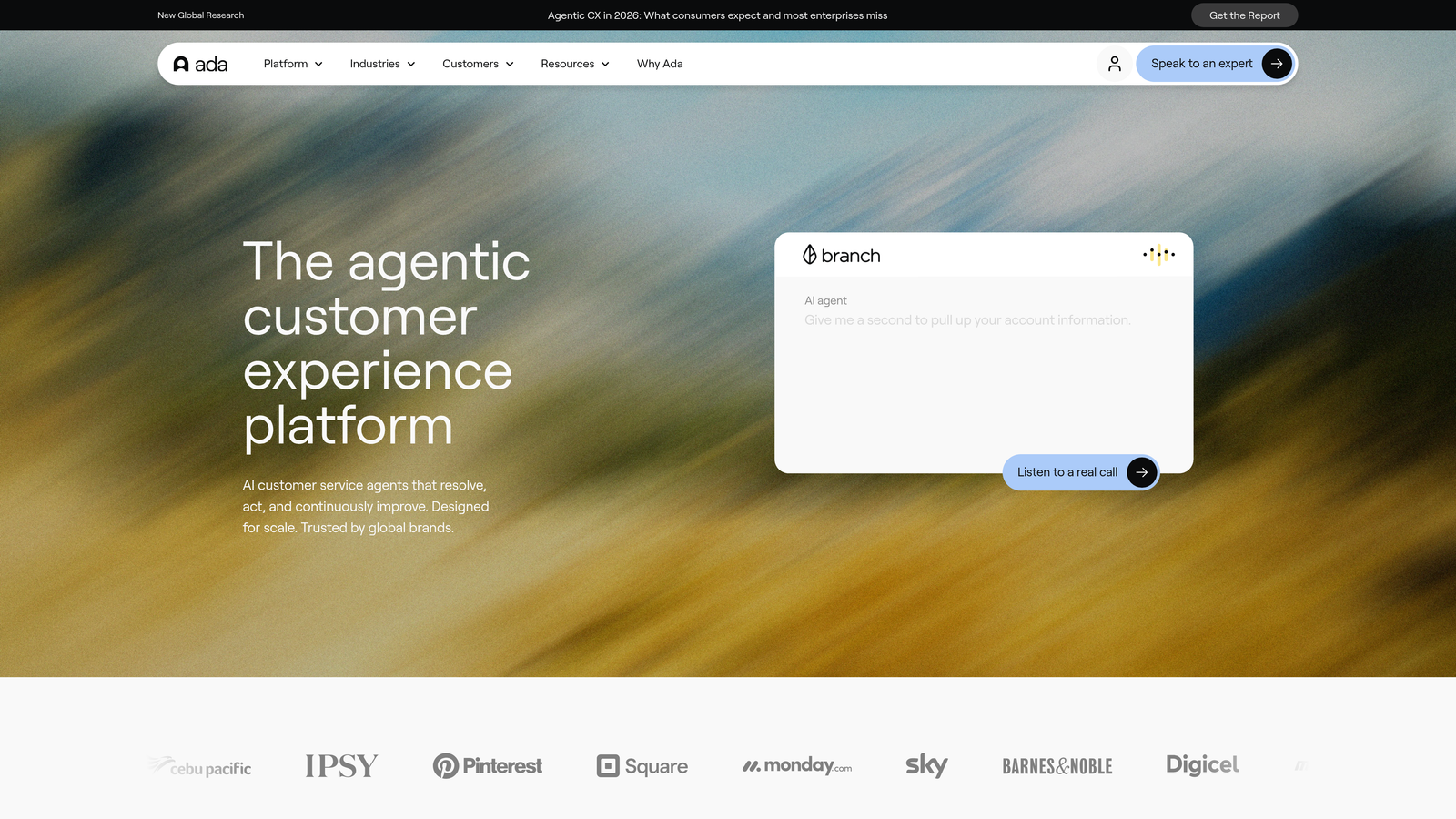
Ada is an enterprise-grade AI customer service platform that builds and deploys AI agents across web, mobile, social, and messaging channels with a no-code automation builder.
Where This Tool Shines
Ada's channel breadth is hard to match. Deploying the same AI agent across web chat, mobile app, SMS, WhatsApp, and social media from a single configuration layer removes the fragmentation that plagues multi-channel support operations. For enterprise teams managing customer contact across many surfaces, this consistency is operationally significant.
The reasoning engine goes beyond answering questions: it can take multi-step actions like checking order status, processing refunds, or updating account details. This moves Ada from "FAQ bot" territory into genuine agentic automation, which is where the real ticket deflection gains come from.
Key Features
No-Code AI Builder: Non-technical teams can build, configure, and iterate on AI agents without engineering involvement.
Omnichannel Deployment: Single agent configuration deploys across web, mobile, SMS, social media, and WhatsApp.
Multi-Step Action Reasoning: Can check orders, process refunds, and take backend actions — not just answer questions.
Containment Analytics: Robust dashboard tracking resolution, containment, and escalation metrics.
Enterprise Compliance: SOC 2 Type II certified with HIPAA compliance options for regulated industries.
Best For
Large enterprises with complex multi-channel support operations, strict compliance requirements, and the resources to invest in a premium AI platform. Less suited for small teams or those with limited automation budgets.
Pricing
Custom enterprise pricing; contact Ada's sales team for a quote. Pricing reflects deployment scale and channel complexity.
6. Forethought
Best for: Support teams wanting intelligent triage and generative AI responses that augment human agents rather than fully replacing first line coverage.
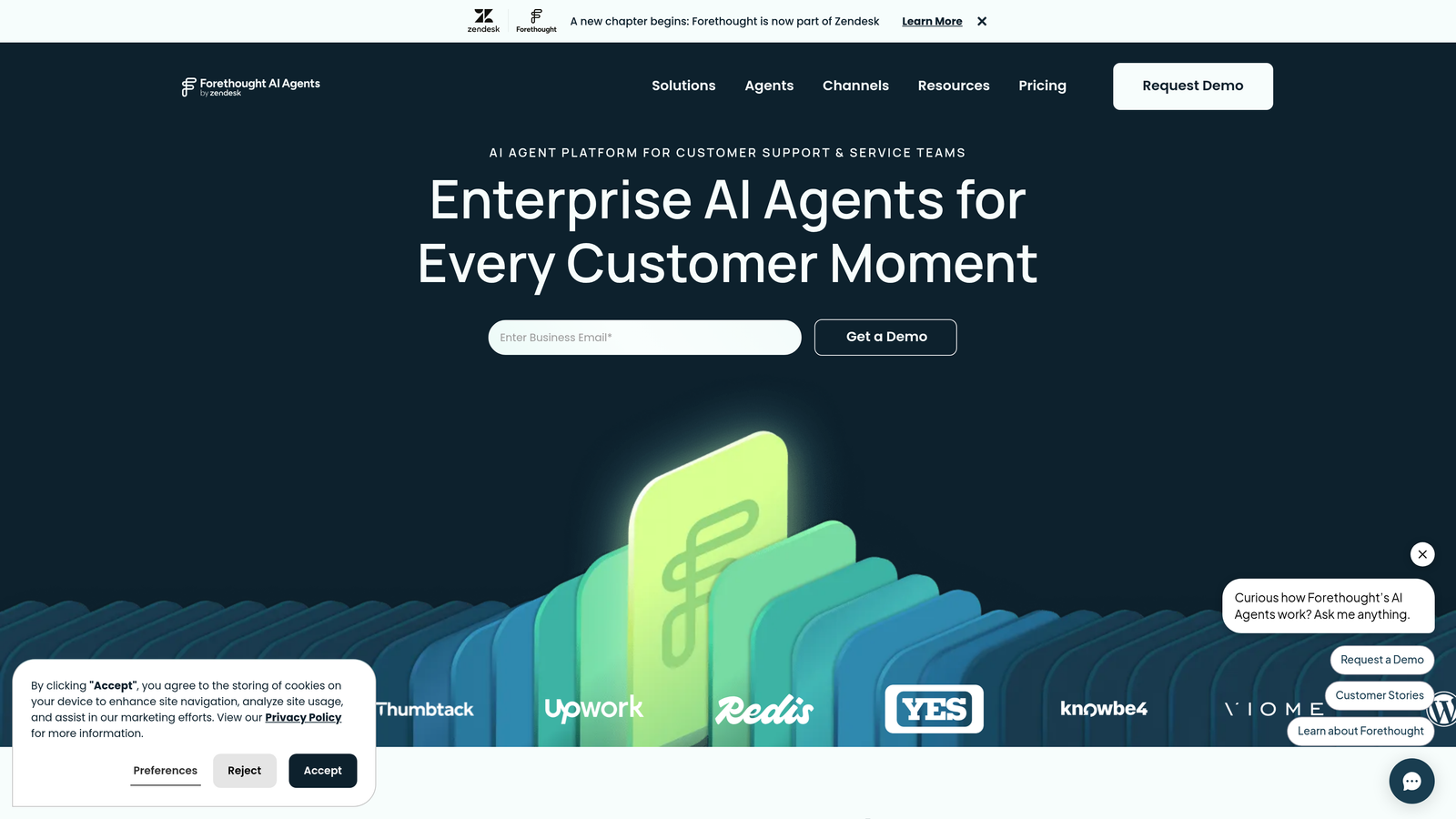
Forethought is an AI platform focused on intelligent ticket triage, generative AI responses, and agent assist — designed to work alongside support teams rather than operate as a fully autonomous front line.
Where This Tool Shines
Forethought's modular approach is its defining characteristic. Teams can deploy the Triage module for intelligent routing, the Solve module for autonomous resolution, and the Assist module for human agent augmentation — independently or in combination. This makes it easier to start with a specific pain point and expand rather than committing to a full platform overhaul upfront.
SupportGPT, Forethought's generative AI layer, grounds responses in your company's knowledge base to keep answers accurate and on-brand. The Assist module is particularly strong for support teams with high ticket complexity, surfacing relevant articles and macros at the moment agents need them most.
Key Features
Triage Module: Auto-classifies and routes tickets before human agents see them, based on intent and priority.
SupportGPT: Generative AI responses grounded in your company's knowledge base for accurate, contextual answers.
Solve Module: Autonomous resolution for common, repeatable inquiries without human involvement.
Assist Module: Surfaces relevant articles, macros, and suggested responses for agents handling escalated tickets.
Helpdesk Integrations: Connects with Zendesk, Salesforce Service Cloud, and other major helpdesk platforms.
Best For
Mid-market and enterprise support teams that want to enhance existing helpdesk workflows rather than replace them. Strong fit for organizations with a mix of simple and complex tickets where augmentation matters as much as automation.
Pricing
Custom pricing based on ticket volume and modules deployed; contact Forethought's sales team for a quote.
7. Tidio
Best for: Small businesses and e-commerce teams needing affordable AI chatbot functionality with a fast setup path.
Tidio is an affordable AI chatbot and live chat platform aimed at small businesses and e-commerce teams, featuring the Lyro AI assistant for automated customer conversations.
Where This Tool Shines
Tidio's free tier and accessible pricing make it the most approachable entry point on this list for teams with tight budgets. Lyro, its AI assistant, learns from your FAQ and support content to handle common questions automatically — and the visual drag-and-drop flow builder means non-technical teams can customize conversation paths without writing a single line of code.
The e-commerce integrations with Shopify, WordPress, and WooCommerce are native and well-maintained, making Tidio a natural fit for online retailers who need basic first line automation without the complexity or cost of enterprise platforms. Conversation handoff to human agents is built in for situations where Lyro reaches its limits.
Key Features
Lyro AI Chatbot: Learns from your FAQ and support content to handle common customer questions automatically.
Visual Flow Builder: Drag-and-drop chatbot builder for custom conversation paths without coding.
E-Commerce Integrations: Native connections to Shopify, WordPress, and WooCommerce for order and product context.
Free Tier: Basic chatbot and live chat functionality available at no cost for teams just getting started.
Human Handoff: Smooth escalation to live agents when the AI cannot resolve a conversation.
Best For
Small businesses, e-commerce stores, and early-stage teams that need functional first line automation without enterprise pricing. Not designed for complex B2B support operations or high-volume enterprise deployments.
Pricing
Free plan available; paid plans start at approximately $29 per month. Lyro AI is available as a separate add-on with its own pricing tier.
8. Ultimate (now part of Zendesk)
Best for: Multilingual enterprise support operations requiring strong GDPR compliance and EU data residency.
Ultimate is an AI-first support automation platform acquired by Zendesk, specializing in multilingual first line resolution with a strong European market presence and GDPR-compliant infrastructure.
Where This Tool Shines
Ultimate was purpose-built for multilingual support at scale, with coverage across more than 100 languages. For companies operating across European markets where language fragmentation creates support complexity, this depth of multilingual capability is a meaningful differentiator. The platform's GDPR compliance and EU data residency options address regulatory requirements that are non-negotiable for many European enterprises.
The dialogue builder allows teams to create custom conversation flows without code, and backend integrations enable the AI to take actions like updating orders or checking status — not just providing information. Now integrated into Zendesk's platform, Ultimate offers deeper ecosystem access for teams already running Zendesk infrastructure.
Key Features
100+ Language Support: Purpose-built for multilingual first line resolution across global markets.
No-Code Dialogue Builder: Custom conversation flow creation without engineering resources.
Backend Action Integrations: AI can update orders, check status, and take real actions beyond answering questions.
GDPR Compliance: EU data residency options and privacy-by-design architecture for regulated markets.
Zendesk Integration: Deep access to Zendesk's platform and ecosystem following the acquisition.
Best For
Enterprise teams with significant multilingual support volume, particularly those operating in European markets with strict data residency requirements. Now most relevant for organizations already evaluating or running Zendesk.
Pricing
Custom pricing, now sold through Zendesk's sales process following the acquisition. Contact Zendesk sales for current packaging details.
9. Drift (Salesloft)
Best for: Revenue-focused teams wanting first line support automation that simultaneously qualifies leads and identifies expansion opportunities.
Drift is a conversational AI platform now part of Salesloft that blends first line support automation with revenue intelligence, qualifying leads while resolving customer queries.
Where This Tool Shines
Drift occupies a unique position on this list: it treats support conversations as revenue opportunities. While other tools focus purely on deflection and resolution, Drift's AI identifies expansion signals and upsell opportunities embedded in support interactions. For teams where support and sales are closely aligned, this dual function can generate meaningful commercial value beyond ticket containment.
The integration with Salesforce and Salesloft's broader revenue engagement platform means that when a support conversation reveals a buying signal, it can flow directly into a sales workflow without manual handoff. Custom playbooks let teams configure different experiences for different visitor segments based on intent and account profile.
Key Features
Revenue-Aware AI: Identifies expansion and upsell opportunities within support conversations in real time.
Lead Qualification: Handles support questions while simultaneously qualifying visitors for sales follow-up.
CRM and Sales Integration: Native connections to Salesforce and Salesloft for seamless revenue workflow handoffs.
Custom Playbooks: Configurable conversation flows for different visitor segments and intent signals.
Meeting Scheduling: Built-in calendar integration for direct handoffs from support conversations to sales meetings.
Best For
B2B SaaS and technology companies where support and sales teams are closely aligned and support conversations frequently surface commercial signals. Less suited for pure support operations where revenue intelligence isn't a priority.
Pricing
Custom pricing through Salesloft; contact the sales team for a quote. Pricing reflects the combined support and revenue intelligence platform scope.
Which Tool Is Right for Your Team?
The right automated first line support solution depends on three things: where you're starting from, what you need the AI to do, and how much you want support intelligence to connect to the rest of your business.
If you're a product-led SaaS team that wants support, engineering, and revenue data flowing through a single intelligence layer, Halo AI is the strongest fit. Its page-aware context engine, continuous learning loop, and integrations across tools like Linear, Slack, HubSpot, and Stripe make it genuinely different from tools that treat support as an isolated function.
For teams locked into existing ecosystems, the platform-native options make sense: Intercom Fin for Intercom users, Zendesk AI Agents or Ultimate for Zendesk environments, and Freshdesk Freddy AI for Freshworks customers who want competitive pricing without a platform switch.
Ada and Forethought are the strongest choices for enterprise teams with complex multi-channel operations or a mix of simple and complex tickets requiring both automation and augmentation. Tidio remains the most accessible option for small businesses and e-commerce teams working with tighter budgets. And Drift is worth a serious look if your support function is expected to contribute directly to revenue outcomes.
Your support team shouldn't scale linearly with your customer base. Let AI agents handle routine tickets, guide users through your product, and surface business intelligence while your team focuses on complex issues that need a human touch. See Halo in action and discover how continuous learning transforms every interaction into smarter, faster support.