9 Best Automated Product Support Systems in 2026
Discover the 9 best automated product support systems of 2026, evaluated across AI capability, integration depth, scalability, and deployment ease. This guide helps B2B SaaS teams move beyond traditional ticket queues by comparing AI-native platforms and enhanced helpdesks, so you can resolve customer issues faster, surface actionable insights, and scale support without simply adding more agents.
 Matt PattoliFounder13 min read
Support teams used to scale the only way they knew how: hire more agents. But as B2B SaaS products grow in complexity and customer bases expand globally, that model breaks down fast. The shift toward automated product support systems isn't just about cutting costs. It's about resolving issues faster, surfacing smarter insights, and letting your team focus on the work that actually requires human judgment.
This list covers the top automated product support platforms evaluated across four criteria: AI capability, integration depth, scalability, and ease of deployment. Whether you're a product team outgrowing your current helpdesk or a B2B SaaS company ready to move beyond ticket queues, there's a tool here for you.
The landscape splits into two camps: AI-native platforms built for autonomous resolution from the ground up, and traditional helpdesks with AI layered on top. Both have their place, and this list includes strong options from each category. If you're still building out your support foundation, it's worth reading our guides on AI customer support agents and how modern teams are rethinking the support stack entirely.
1. Halo AI
Best for: B2B SaaS teams that want an AI-first platform built for autonomous ticket resolution and product intelligence.
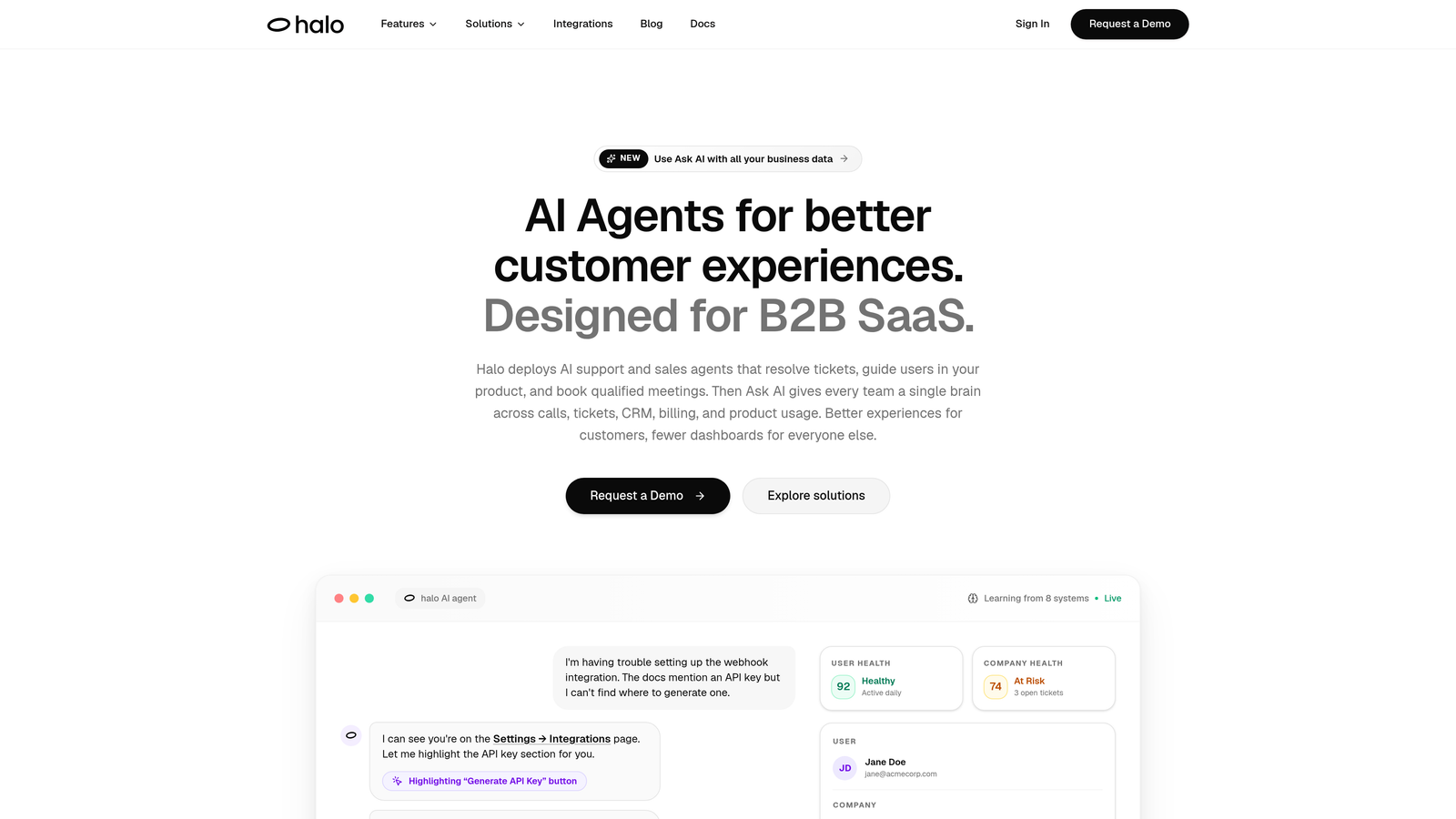
Halo AI is an AI-native customer support platform that deploys autonomous agents to resolve tickets, guide users visually through your product, and surface business intelligence — all while learning from every interaction.
Where This Tool Shines
What sets Halo apart from every helpdesk on this list is its architecture. It wasn't built as a ticketing system with AI bolted on. It was built around the idea that AI agents should be the primary resolution path, with humans stepping in only when genuinely needed. That distinction matters more than it might initially sound.
The page-aware context is a standout capability. Halo's agents can see what a user is looking at in your product, which means guidance is specific and visual rather than generic. Combine that with continuous learning from every resolved ticket and auto bug ticket creation routed directly to your engineering workflow, and you have a system that gets smarter and more useful over time rather than plateauing after initial setup.
Key Features
Page-Aware AI Agents: Agents see what users see on-screen and deliver visual UI guidance specific to the page and context.
Continuous Learning: Every resolved ticket feeds back into the model, improving accuracy and resolution rates with each interaction.
Auto Bug Ticket Creation: Automatically generates and routes bug reports to Linear or your existing engineering workflow without manual intervention.
Smart Inbox with Business Intelligence: Goes beyond support metrics to surface customer health signals, anomaly detection, and revenue insights directly from support interactions.
Live Agent Handoff: Seamlessly escalates complex issues to human agents with full context preserved, integrating with Slack, HubSpot, Intercom, Stripe, Zoom, PandaDoc, and Fathom.
Best For
Product-led B2B SaaS companies that want AI to handle routine resolution autonomously while extracting business intelligence from support data. Particularly strong for teams already using tools like Linear, HubSpot, or Intercom who want a connected, intelligent layer across their stack.
Pricing
Contact for pricing. Plans are tailored to team size and usage volume, making it worth a conversation if you're evaluating at scale.
2. Intercom
Best for: Teams already using Intercom for customer messaging who want AI-powered front-line resolution built into their existing setup.
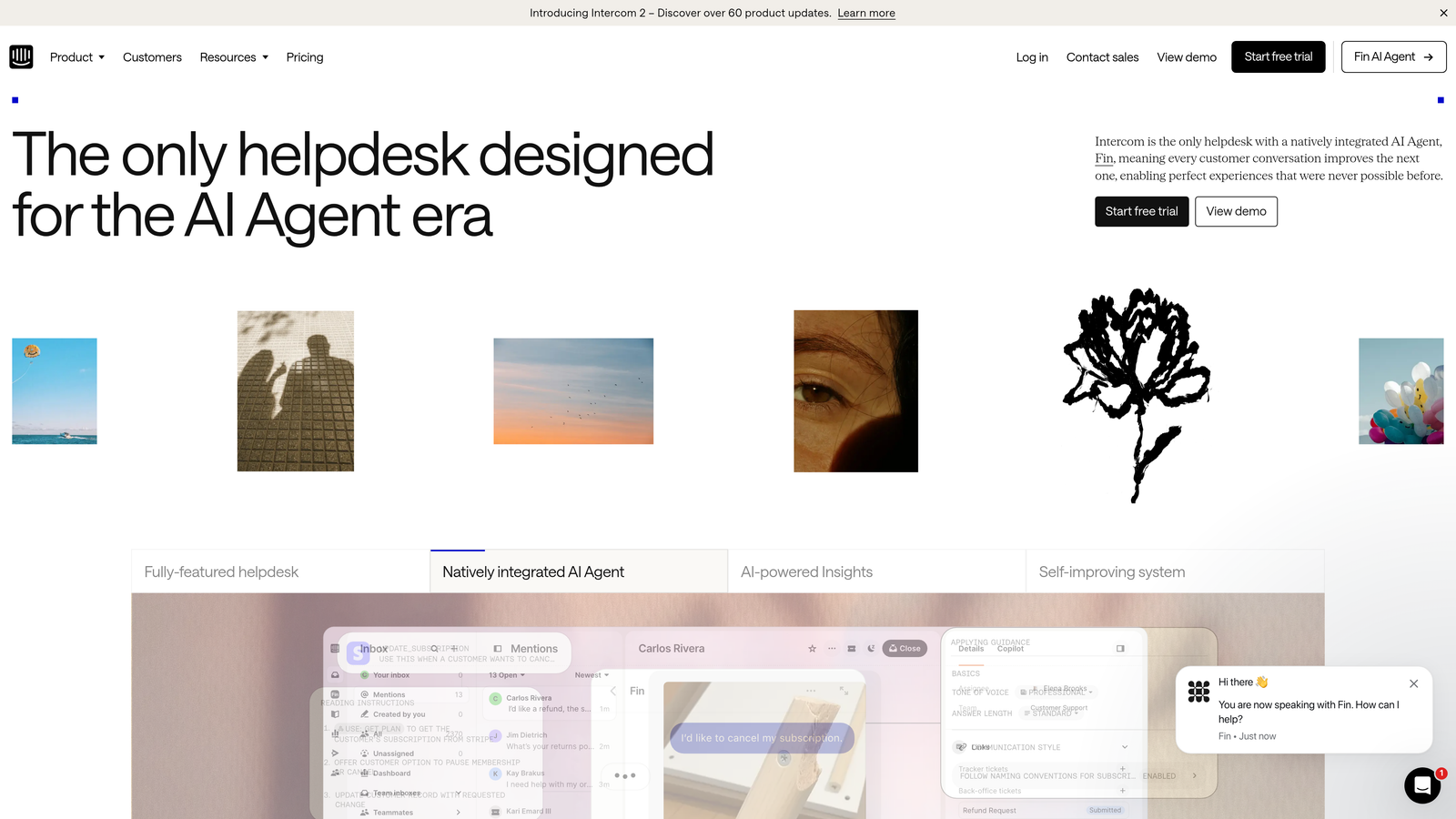
Intercom is a customer messaging platform with Fin, its AI agent, handling autonomous conversation resolution across chat, email, and in-app channels.
Where This Tool Shines
Fin is one of the more capable AI resolution layers in this category. For teams that have already built their customer communication workflows inside Intercom, adding Fin is a relatively natural extension rather than a platform migration. The unified inbox that combines support, onboarding, and proactive messaging is genuinely useful for teams managing the full customer lifecycle in one place.
The tradeoff is cost at scale. Fin's per-resolution billing model can become expensive as conversation volume grows, and teams should model that carefully before committing. Intercom was also acquired by a private equity firm in recent years, so product direction is worth monitoring for long-term platform decisions.
Key Features
Fin AI Agent: Handles front-line conversation resolution autonomously across chat, email, and in-app touchpoints.
Unified Inbox: Combines support, onboarding, and proactive messaging into a single workspace.
Workflow Builder: Visual automation for routing, escalation, and conversation handoff without code.
Integration Ecosystem: Connects with Salesforce, Stripe, Jira, and a broad range of SaaS tools.
Best For
Companies already invested in the Intercom platform that want to add AI resolution without switching tools. Less ideal as a standalone support system if you're starting fresh and comparing total cost of ownership.
Pricing
Starts around $39 per seat per month. Fin AI usage is billed per resolution, so costs scale with conversation volume.
3. Zendesk
Best for: Enterprise teams with complex routing requirements, SLA management, and compliance needs.
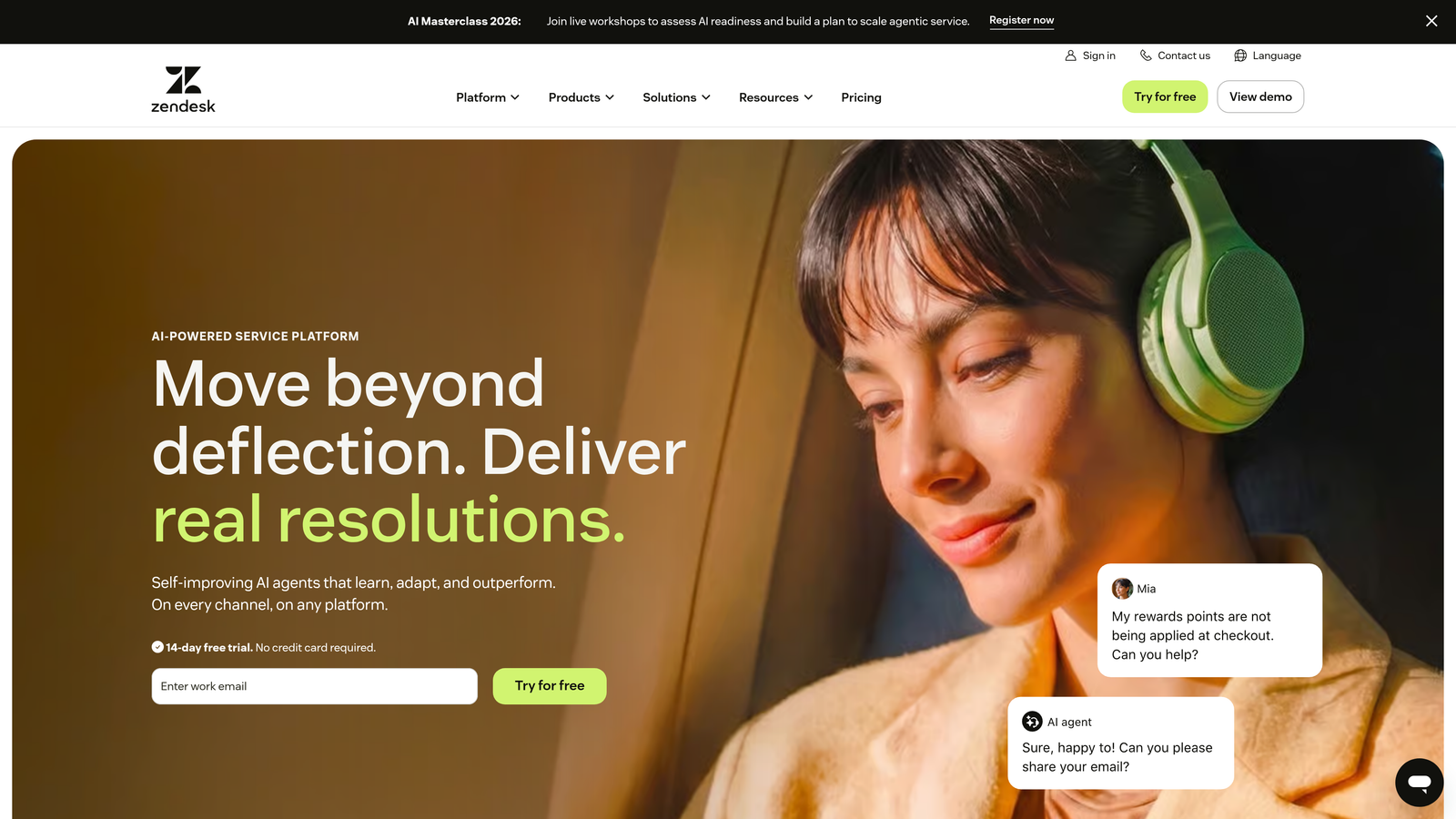
Zendesk is a mature enterprise helpdesk platform with AI-powered triage, macros, and agent assist capabilities built on top of robust ticketing infrastructure.
Where This Tool Shines
Zendesk's depth is its core advantage. The configurability of routing rules, SLA policies, and escalation paths is difficult to match, and the app marketplace with over a thousand integrations means it connects to nearly any tool in your stack. For organizations with strict compliance requirements or complex multi-tier support structures, Zendesk remains a strong choice.
The honest caveat is that Zendesk's AI features, while improving, still feel additive rather than foundational. Intelligent triage and auto-tagging are useful, but the platform was built around human agents first. If autonomous resolution is your primary goal, you'll be working against the grain of how Zendesk is architected.
Key Features
Intelligent Triage: AI-powered auto-tagging and intent detection to route tickets without manual sorting.
Configurable Routing: Highly flexible rules for SLAs, escalation paths, and team assignment logic.
App Marketplace: Over 1,000 integrations covering CRMs, engineering tools, billing systems, and more.
Workforce Management: Advanced reporting and staffing tools for larger support organizations.
Best For
Enterprise support organizations that need deep configurability, compliance features, and a proven platform with broad ecosystem support. Less ideal for teams prioritizing AI-native autonomous resolution over agent-assisted workflows.
Pricing
Suite plans start from approximately $55 per agent per month. AI features are available on higher tiers, which increases the total cost meaningfully for larger teams.
4. Freshdesk
Best for: Mid-market teams that need solid omnichannel support with AI assist at a competitive price point.
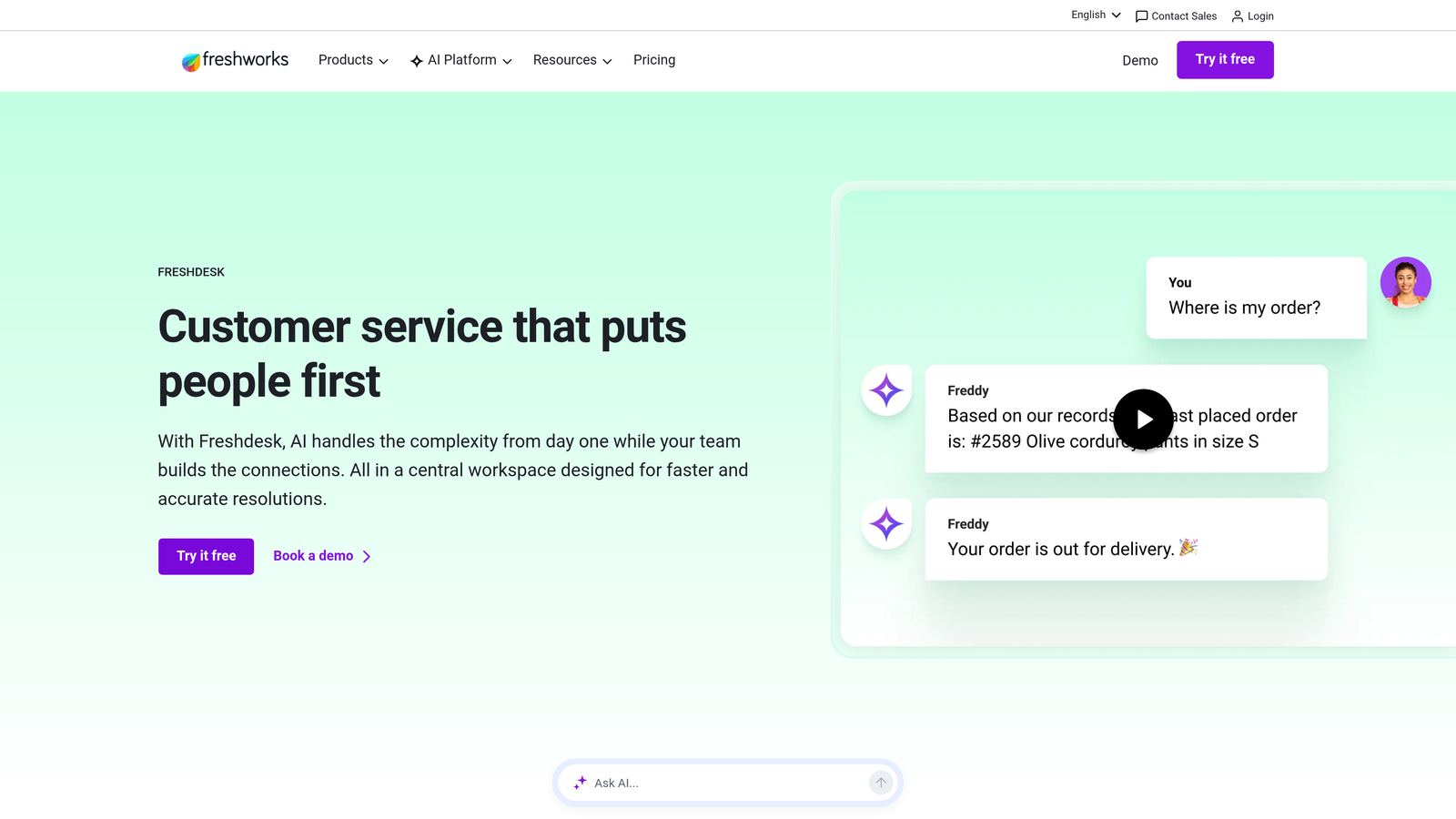
Freshdesk is a mid-market helpdesk platform where Freddy AI provides auto-resolution, agent assist, and omnichannel support across email, chat, phone, and social channels.
Where This Tool Shines
Freshdesk hits a strong value-to-capability ratio for growing teams. Freddy AI handles ticket auto-resolution and suggested responses with reasonable accuracy, and the omnichannel coverage — email, live chat, phone, WhatsApp, and social — is genuinely broad for the price. Teams that need to cover multiple channels without a large budget will find Freshdesk hard to beat on cost.
Where it falls short is AI depth. Freddy is a solid assistant, but it's not built for fully autonomous resolution the way AI-native platforms are. It's best understood as a productivity layer for human agents rather than a replacement for them.
Key Features
Freddy AI: Handles ticket auto-resolution and surfaces suggested responses to speed up agent workflows.
Omnichannel Coverage: Unified support across email, live chat, phone, WhatsApp, and social media.
Collision Detection: Prevents multiple agents from working the same ticket simultaneously.
Competitive Pricing Tiers: Accessible plans that scale without requiring enterprise-level commitment upfront.
Best For
Mid-market B2B teams that need broad channel coverage and AI-assisted workflows without the complexity or cost of enterprise platforms. A practical choice for teams that want to grow into automation gradually.
Pricing
Free plan available. Paid plans start from approximately $15 per agent per month, making it one of the more accessible options on this list.
5. Tidio
Best for: Smaller teams or early-stage companies looking for fast deployment and immediate ticket deflection without heavy configuration.
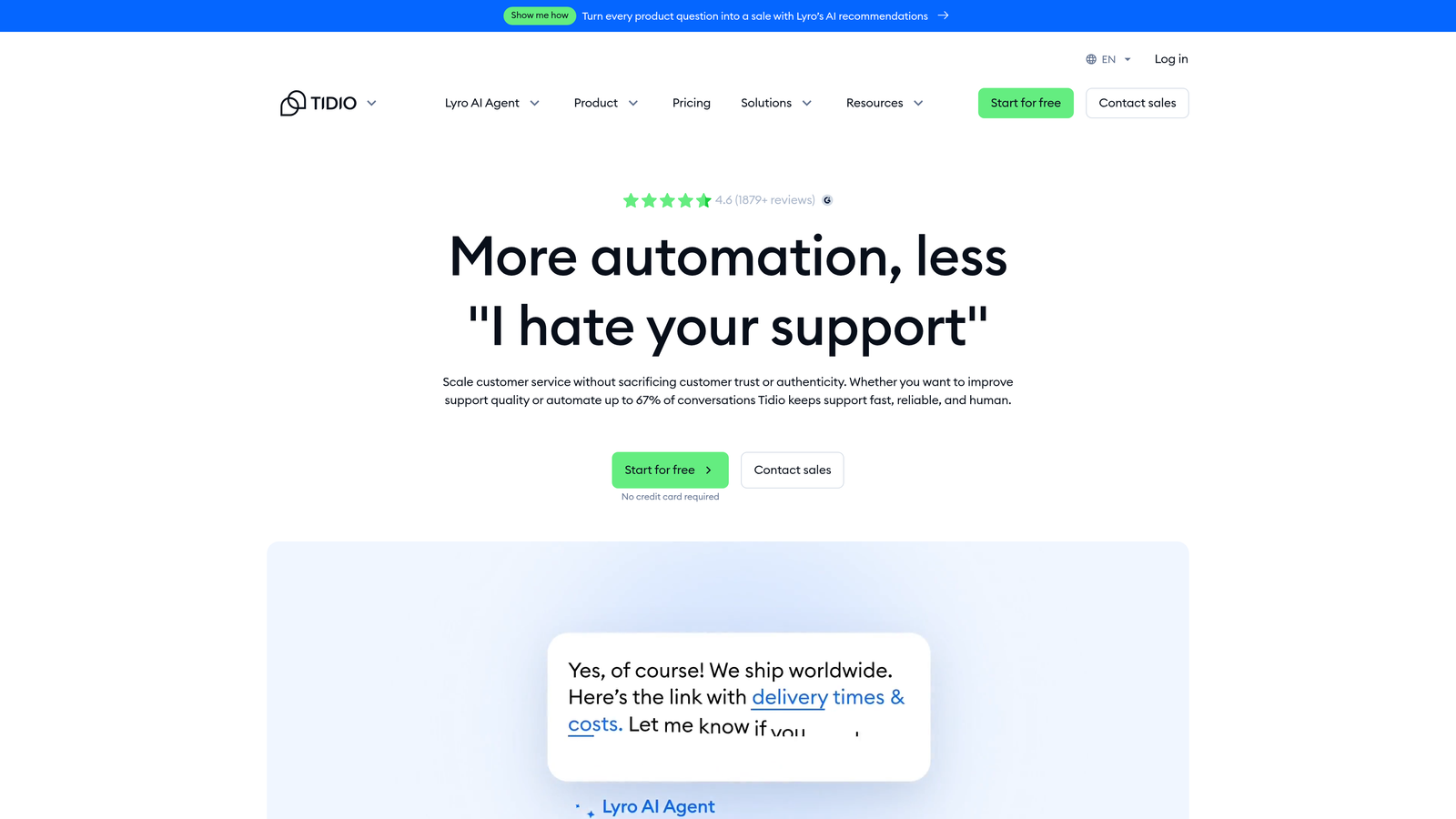
Tidio is a lightweight AI chat and support platform featuring Lyro, its AI chatbot, designed for quick setup and immediate reduction in incoming ticket volume.
Where This Tool Shines
Tidio's main appeal is speed and simplicity. Getting Lyro up and running requires minimal technical effort, and it handles common support queries with solid accuracy for straightforward use cases. For teams that are just beginning to automate support or want a low-risk starting point, Tidio removes most of the friction from getting started.
The limitations become clear in more complex B2B product support scenarios. Lyro is well-suited to FAQ-style resolution, but it lacks the depth needed for nuanced technical support or the business intelligence capabilities that more advanced platforms offer. Think of it as a strong entry point rather than a long-term enterprise solution.
Key Features
Lyro AI Chatbot: Automatically handles common support queries with conversational responses drawn from your knowledge base.
Live Chat Fallback: Escalates to a human agent when Lyro cannot confidently resolve the query.
No-Code Setup: Quick installation with minimal technical requirements for getting started.
Multichannel Integration: Connects with email and Facebook Messenger for broader coverage.
Best For
Small teams, early-stage SaaS products, or companies testing AI-driven deflection for the first time. Less suited to complex B2B product support environments with high ticket diversity.
Pricing
Free tier available. Lyro AI plans start from approximately $29 per month, making it one of the most accessible entry points on this list.
6. Drift (Salesloft)
Best for: B2B teams where support and sales conversation routing overlap and revenue context matters.
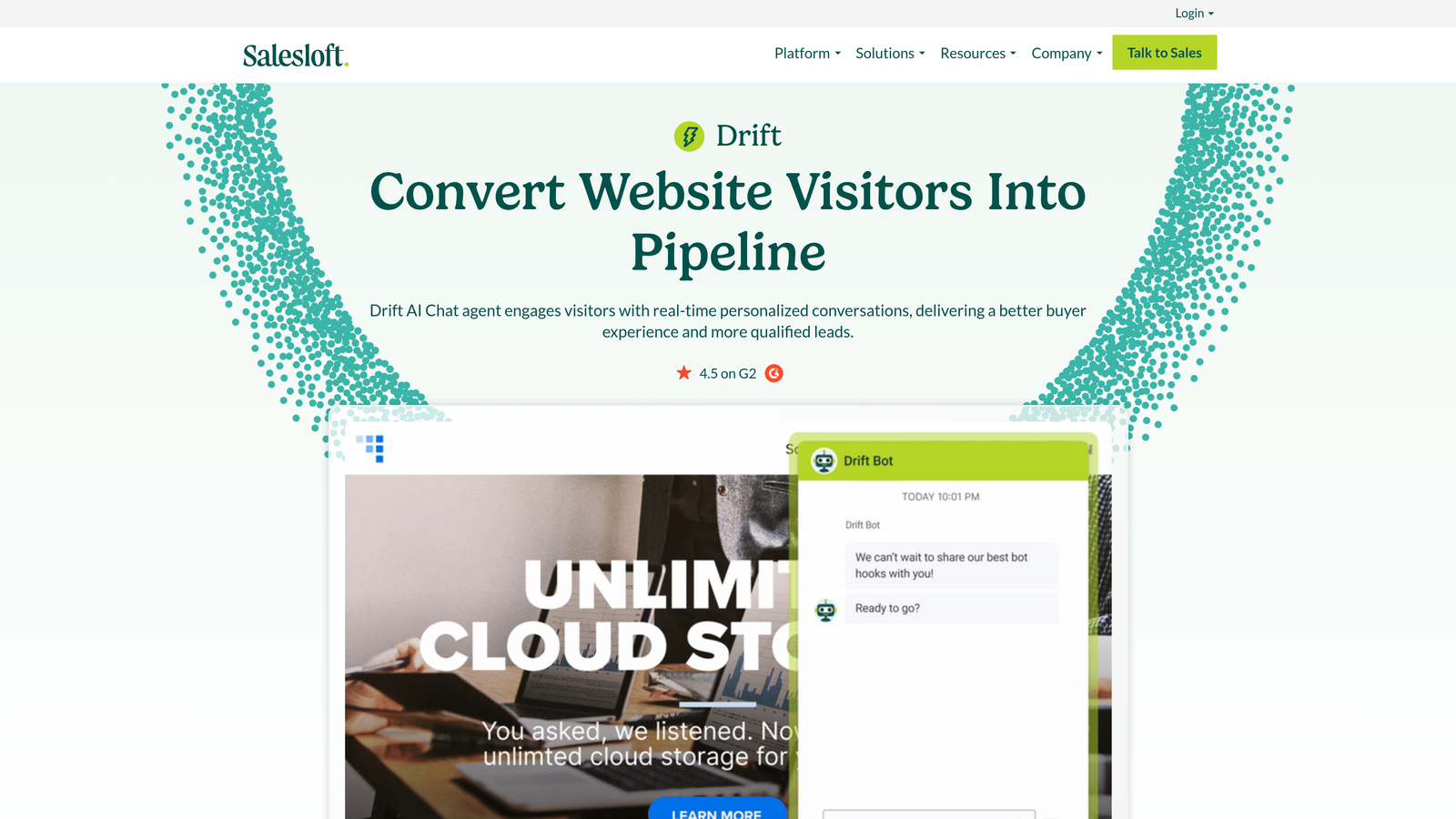
Drift is a conversational AI platform built for B2B teams, now part of the Salesloft revenue platform, where support workflows intersect with pipeline and qualification.
Where This Tool Shines
Drift occupies a unique position on this list because it was never purely a support tool. Its strength is in routing conversations intelligently across support and sales contexts, which matters a lot for B2B companies where the line between a product question and a sales opportunity is genuinely blurry. The Salesloft integration means conversation context flows directly into revenue workflows.
If your team is purely focused on support automation, Drift may feel like more than you need. But for revenue-focused teams where support interactions frequently convert into upsell or renewal conversations, the combination of AI routing, playbook automation, and CRM integration creates real leverage.
Key Features
AI Conversation Routing: Intelligently routes conversations between support and sales contexts based on intent signals.
Playbooks: Automates qualification and support workflows simultaneously within a single conversation flow.
Salesloft CRM Integration: Revenue-aware routing with full CRM context from the Salesloft platform.
Meeting Scheduling: Embeds calendar booking directly into chat flows for seamless handoff to sales or success teams.
Best For
B2B companies where support and revenue workflows intersect, particularly those already using Salesloft as their CRM. Less ideal for teams focused purely on support ticket resolution without a sales motion attached.
Pricing
Contact for pricing. Drift is enterprise-focused with custom quotes based on team size and usage requirements.
7. Help Scout
Best for: Teams that value the human relationship layer of support and want AI to assist agents rather than replace them.
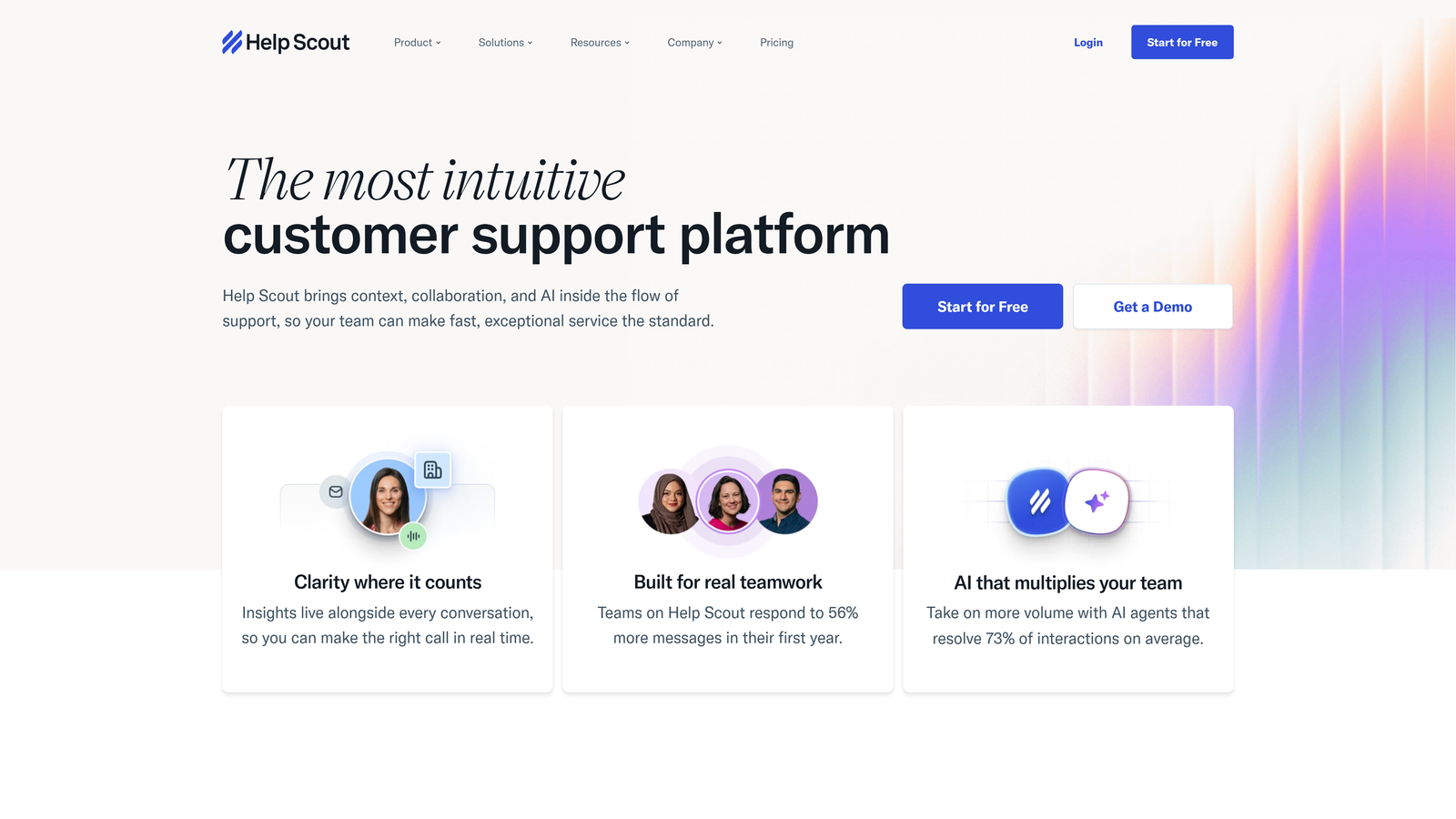
Help Scout is a human-centric support platform with AI Summarize and Assist features designed to make agents faster without removing them from the resolution loop.
Where This Tool Shines
Help Scout is deliberately positioned against the full-automation trend, and that's actually a strength for certain teams. AI Summarize gives agents instant context when picking up a mid-thread conversation, and AI Assist handles draft suggestions and tone adjustments that speed up response time without generating fully automated replies. For teams where support quality and relationship continuity matter, this approach reduces errors while preserving the human touch.
The Docs knowledge base builder with AI-powered search also adds meaningful self-service capability without requiring a separate platform. Help Scout is a clean, well-designed tool that does what it promises without unnecessary complexity.
Key Features
AI Summarize: Instantly surfaces thread context so agents can pick up conversations without re-reading entire histories.
AI Assist: Generates draft responses and adjusts tone to match your brand voice before agents send.
Docs Knowledge Base: Built-in knowledge base builder with AI-powered search for customer self-service.
Shared Inbox: Clean collaborative inbox with collision detection and internal notes for team coordination.
Best For
Support teams that prioritize relationship quality and aren't ready for full autonomous resolution. A strong fit for companies where personalized, human-reviewed responses are part of the brand promise.
Pricing
Starts from approximately $20 per user per month. AI features are included on the Standard plan and above.
8. Kustomer
Best for: High-volume support teams that need full customer context tied to every interaction and AI workflows built around that history.
Kustomer is a CRM-native support platform that ties every interaction to a complete customer timeline, with AI automation workflows built around that contextual history.
Where This Tool Shines
Kustomer's architecture is fundamentally different from a standard helpdesk. Because every support interaction is attached to a full customer record, AI routing and automation decisions are informed by context that most helpdesks simply don't have access to. A customer's purchase history, previous tickets, subscription status, and communication preferences all feed into how their next interaction is handled.
One important note for buyers: Kustomer is owned by Meta. For organizations with data privacy requirements or concerns about where customer data resides, that ownership structure warrants careful evaluation before committing to the platform.
Key Features
CRM-First Architecture: Every support interaction is tied to a complete customer timeline for full historical context.
Context-Aware AI Routing: Routes tickets based on customer history, intent signals, and relationship data rather than just ticket content.
Omnichannel Support: Unified coverage across email, chat, SMS, social, and voice channels.
Workflow Automation: Automates repetitive resolution paths using customer context as the decision layer.
Best For
High-volume support organizations with complex customer relationships where context-driven routing makes a meaningful difference. Teams with strict data residency requirements should evaluate Meta's ownership carefully.
Pricing
Starts from approximately $89 per user per month. Enterprise plans are available for larger organizations with custom requirements.
9. Forethought
Best for: Enterprise teams that want AI-powered resolution and triage without migrating away from their existing helpdesk.
Forethought is a modular AI layer designed to plug into existing helpdesks like Zendesk and Salesforce Service Cloud, adding autonomous resolution, intelligent triage, and agent assist without requiring platform migration.
Where This Tool Shines
Forethought's modular design is its primary differentiator. Rather than asking you to replace your helpdesk, it adds an AI intelligence layer on top of what you already have. The three modules — Solves for auto-resolution, Triage for predictive routing, and Assist for agent response suggestions — can be deployed independently, which reduces implementation risk and lets teams start with the capability that delivers the most immediate value.
This approach makes Forethought particularly attractive for large organizations that have significant investment in an existing helpdesk and can't justify a full migration. The tradeoff is that the ceiling on AI capability is partly constrained by the underlying platform it sits on.
Key Features
Solves Module: AI-driven autonomous ticket resolution for common support queries without agent involvement.
Triage Module: Predictive routing and priority scoring to ensure tickets reach the right team quickly.
Assist Module: Real-time response suggestions surfaced to agents as they work through tickets.
Native Integrations: Deep integration with Zendesk, Salesforce Service Cloud, and ServiceNow out of the box.
Best For
Enterprise teams with established helpdesk infrastructure that want meaningful AI uplift without the disruption of platform migration. Ideal for organizations where Zendesk or Salesforce Service Cloud is already deeply embedded.
Pricing
Contact for pricing. Forethought uses an enterprise-focused, usage-based model with custom quotes depending on volume and modules selected.
Which Tool Is Right for Your Team
The most important question isn't which tool has the best feature list. It's whether you want AI layered onto a helpdesk or an AI-native system built for autonomous resolution from the start. That single decision narrows the field significantly.
Here's a quick breakdown by use case to help you orient:
AI-first autonomous resolution: Halo AI is the strongest option here. It's the only platform on this list built from the ground up around autonomous agents with page-aware context, continuous learning, and business intelligence built in.
Enterprise helpdesk with AI features: Zendesk remains the standard for organizations with complex routing, SLA management, and compliance requirements. Forethought is worth considering if you're already on Zendesk and want AI uplift without migration.
Mid-market value: Freshdesk delivers solid omnichannel coverage and Freddy AI at a price point that's hard to argue with for growing teams.
Human-augmented support: Help Scout is the right call for teams where relationship quality matters and full automation isn't the goal yet.
Revenue-blended conversations: Drift makes the most sense when your support and sales motions genuinely overlap and you need AI routing that understands both contexts.
Your support team shouldn't scale linearly with your customer base. Let AI agents handle routine tickets, guide users through your product, and surface business intelligence while your team focuses on complex issues that need a human touch. See Halo in action and discover how continuous learning transforms every interaction into smarter, faster support.