9 Best Automated Support Tools for B2B Software Companies in 2026
B2B software teams can no longer rely on linear hiring or basic chatbots to manage growing support volume — modern automated support tools now deploy AI agents that resolve tickets autonomously, guide users through complex workflows, and surface business intelligence. This guide evaluates the 9 best automated support platforms for B2B software companies in 2026, ranked on AI depth, helpdesk integrations, technical question handling, and scalability.
 Matt PattoliFounder12 min read
B2B software teams face a genuine paradox: the more capable your product becomes, the more support volume it generates. Hiring agents linearly to keep up isn't sustainable, and basic chatbots that deflect FAQs don't cut it when your users are asking technical, product-specific questions.
Automated support tools have matured significantly. The best platforms in 2026 go well beyond scripted flows, offering AI agents that resolve tickets autonomously, guide users through complex workflows, detect bugs, and hand off intelligently to humans when the situation calls for it.
Here are the top automated support platforms built for B2B software companies, evaluated on AI depth, helpdesk integrations, technical question handling, business intelligence features, and scalability.
1. Halo AI
Best for: B2B software teams that want AI-first ticket resolution with business intelligence built in.
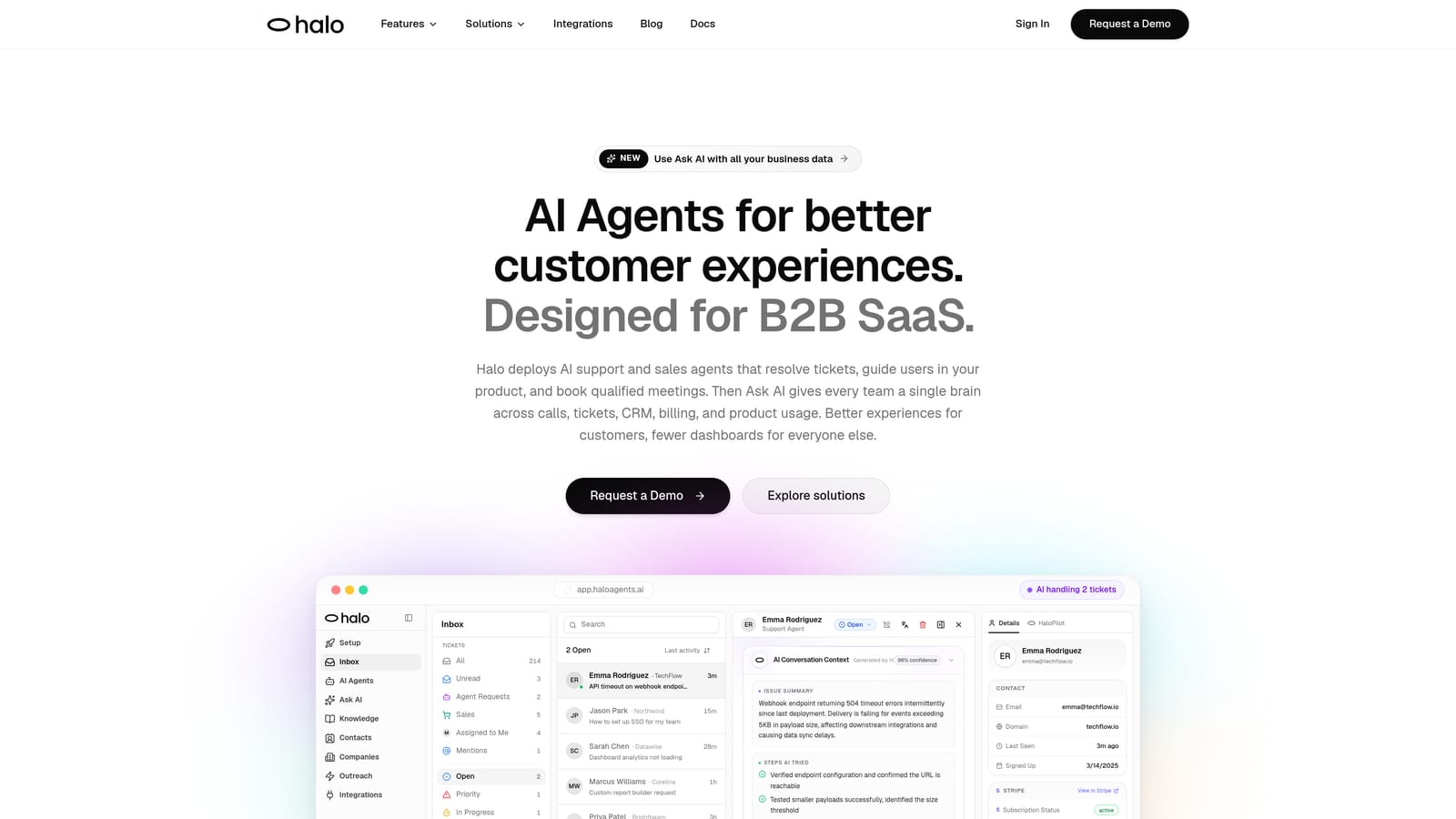
Halo AI is an AI-first customer support platform that deploys intelligent agents to resolve tickets, guide users visually through your product, auto-create bug reports, and surface business intelligence — all while learning from every interaction.
Where This Tool Shines
What separates Halo from most support tools is its page-aware architecture. The AI actually sees what the user sees, which means it can provide contextual, visual UI guidance rather than generic instructions. That's a meaningful difference when your users are stuck on a specific screen in a complex SaaS product.
Beyond ticket resolution, Halo's smart inbox surfaces business intelligence signals from support conversations: customer health indicators, revenue anomalies, and churn signals that most teams would never extract from a standard helpdesk. Support becomes a source of strategic insight, not just a cost center.
Key Features
Page-Aware AI Chat Widget: The AI understands which page the user is on and provides contextual visual guidance tailored to that exact moment in the product.
Autonomous Ticket Resolution: AI agents handle tickets end-to-end, continuously learning from past interactions to improve accuracy over time.
Auto Bug Ticket Creation: Product issues are automatically detected and routed to engineering tools like Linear, closing the loop between support and development.
Smart Inbox with Business Intelligence: Surfaces customer health signals, revenue intelligence, and anomaly detection directly within the support workflow.
Native Integrations: Connects to Linear, Slack, HubSpot, Intercom, Stripe, Zoom, PandaDoc, and Fathom out of the box.
Intelligent Live Agent Handoff: Complex issues are escalated to human agents with full context preserved, so nothing gets repeated or lost.
Best For
B2B SaaS companies that want AI to do the heavy lifting on ticket resolution while also extracting business intelligence from support conversations. Particularly strong for product-led teams where support data should inform product and revenue decisions.
Pricing
Contact for pricing; a demo is available at haloagents.ai. Halo operates on a demo-first model to match the right configuration to each team's needs.
2. Intercom
Best for: Product-led SaaS companies wanting a polished messenger experience with strong AI resolution.
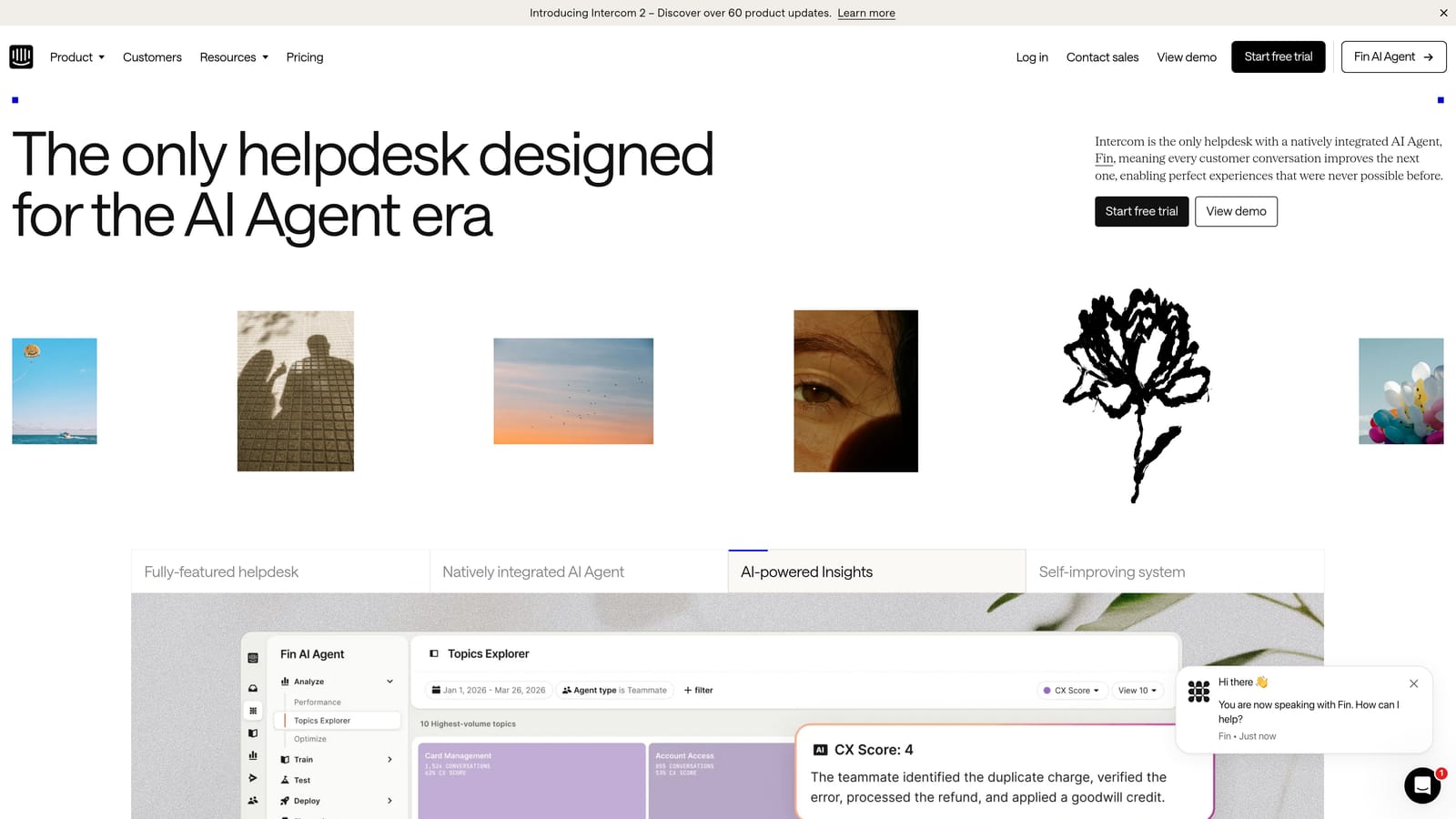
Intercom is a widely adopted customer messaging platform with Fin, an AI agent built to resolve support queries directly from your help content using large language models.
Where This Tool Shines
Intercom's Fin AI agent is one of the more capable AI resolution layers in the market. It draws on your existing help content to answer queries autonomously, and the in-app messenger experience is polished and well-suited to product-led growth motions.
The shared inbox is collaborative and well-designed for teams that blend support with onboarding and customer success conversations. Reporting on AI resolution rates gives teams visibility into how much Fin is actually deflecting.
Key Features
Fin AI Agent: Uses large language models to autonomously resolve support queries from your help documentation.
In-App Messenger: A highly customizable messenger experience built for product-led SaaS environments.
Shared Inbox: Team collaboration features including assignments, notes, and conversation routing.
Resolution Reporting: Tracks AI resolution rates and CSAT to measure the impact of automation.
Third-Party Integrations: Broad app marketplace covering CRM, analytics, and product tools.
Best For
Product-led SaaS teams that want a strong messenger-first experience with AI resolution layered on top. Works well for companies that use Intercom across support, onboarding, and customer success in a unified inbox.
Pricing
Tiered plans available; AI resolution with Fin is typically billed per resolved conversation, which can add up at higher volumes. Check Intercom's pricing page for current rates.
3. Zendesk
Best for: Enterprise B2B teams needing a mature, omnichannel helpdesk with AI layered across the workflow.
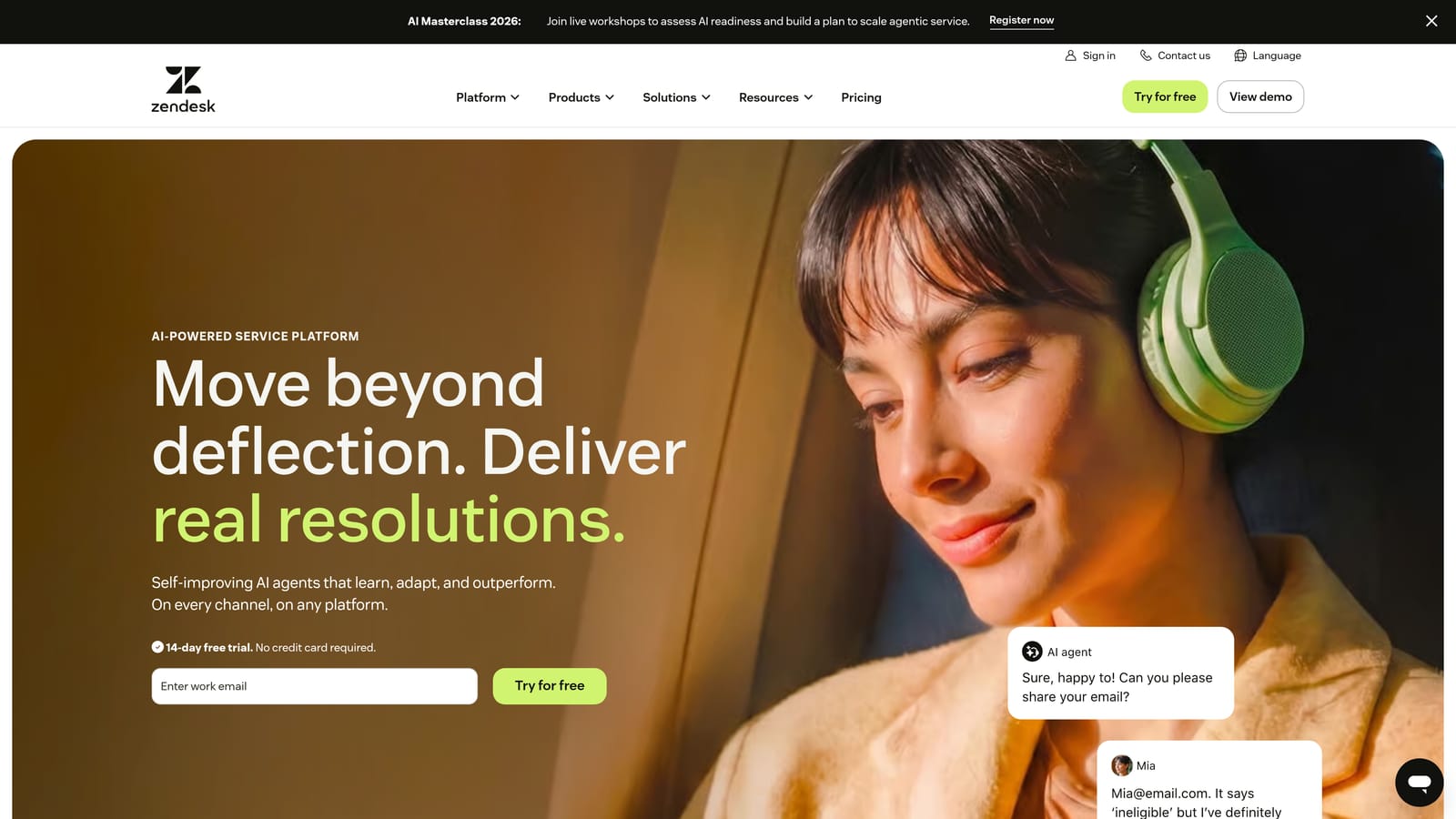
Zendesk is the enterprise-grade helpdesk platform with AI features spanning ticket triage, agent assist, and self-service across every support channel.
Where This Tool Shines
Zendesk's depth is hard to match when it comes to enterprise-grade ticketing. Its AI triage intelligently routes incoming tickets, while Agent Copilot provides suggested responses and next-best-action recommendations directly within the ticket view. For large teams managing high volumes across multiple channels, the operational controls are robust.
The app marketplace is one of the largest in the industry, making Zendesk a reasonable anchor for complex tech stacks. That said, smaller teams often find it heavyweight relative to their needs, and the AI features feel more like additions to a ticketing system than a native AI-first experience.
Key Features
AI-Powered Triage: Automatically categorizes, prioritizes, and routes incoming tickets based on content and intent.
Agent Copilot: Provides suggested responses and next-best-action guidance within the ticket view.
Omnichannel Support: Handles email, chat, voice, and social in a unified workspace.
App Marketplace: Thousands of third-party integrations across CRM, analytics, and engineering tools.
SLA Management: Advanced SLA tracking and reporting for teams with contractual response obligations.
Best For
Enterprise B2B teams with complex routing requirements, multi-channel support needs, and existing Zendesk investments they want to extend with AI. Less ideal for lean startups or teams starting fresh who want an AI-native experience from day one.
Pricing
Per agent per month; Suite plans start around $55 per agent per month, with enterprise pricing available for larger deployments. Verify current pricing at Zendesk's website.
4. Freshdesk
Best for: Growing B2B teams wanting Zendesk-comparable features at more accessible pricing.
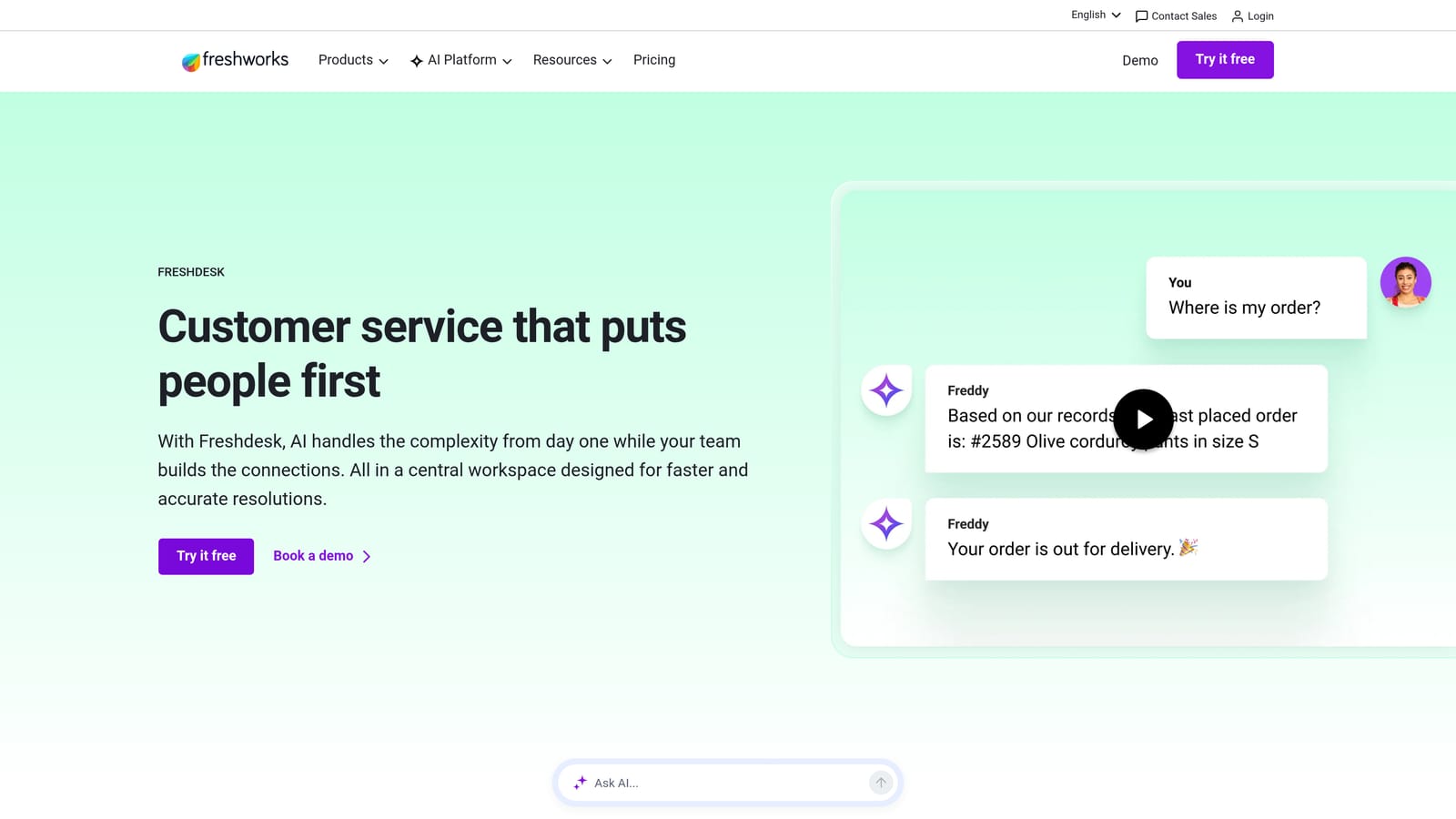
Freshdesk is a helpdesk platform with Freddy AI built in for ticket automation, deflection, and agent assistance at competitive price points.
Where This Tool Shines
Freshdesk's Freddy AI handles the core automation tasks you'd expect: ticket categorization, priority assignment, and suggested responses. The Freddy Self Service chatbot handles end-user query deflection before a ticket is ever created, which keeps volume manageable without requiring significant configuration effort.
The pricing structure is genuinely accessible, especially for teams that are scaling out of free tools but aren't ready for enterprise helpdesk costs. The free tier makes it easy to get started, and AI features unlock progressively on higher plans.
Key Features
Freddy AI Triage: Automatically categorizes tickets and assigns priority based on content analysis.
Freddy Self Service: Chatbot for end-user query deflection before ticket creation.
Agent Assist: Suggested responses and relevant knowledge surfaced within the ticket view.
Free Tier: A functional free plan for small teams getting started with structured support.
Integrations: Connects with Slack, Jira, Salesforce, and other common B2B tools.
Best For
Mid-market B2B software teams looking for a cost-effective alternative to Zendesk with solid AI automation built in. Also works well for teams that want to start free and scale into paid AI features as volume grows.
Pricing
Free plan available; paid plans start around $15 per agent per month. Freddy AI features are available on higher-tier plans. Confirm current tiers at Freshdesk's website.
5. Guru
Best for: Support teams where knowledge accuracy and fast information retrieval are the primary bottleneck.
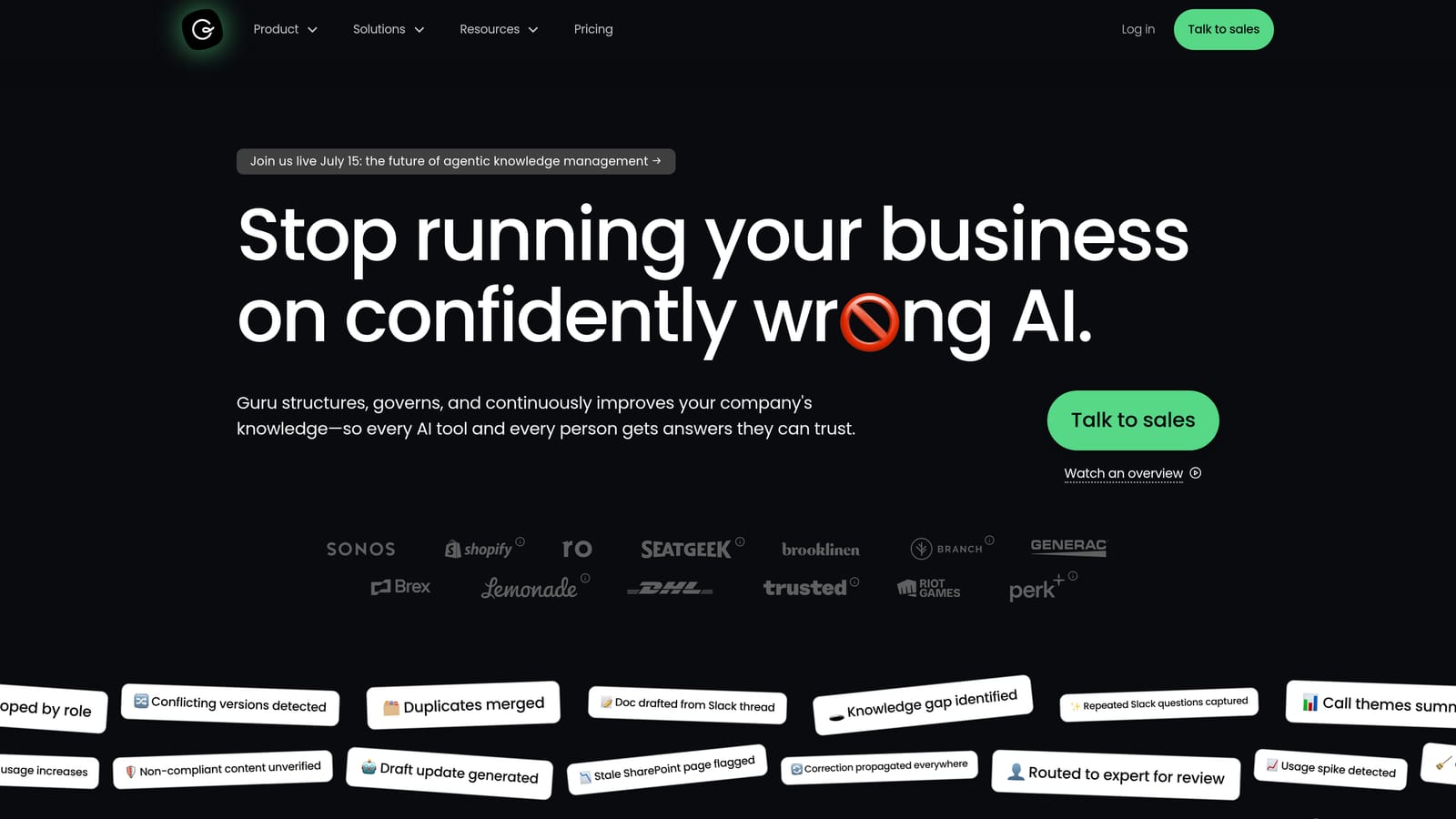
Guru is an AI-powered knowledge management platform that surfaces verified answers inside support agent workflows, reducing time spent hunting for information across scattered sources.
Where This Tool Shines
Guru solves a specific but critical problem: support agents in B2B software companies often spend a disproportionate amount of time searching for accurate answers across Confluence, Notion, Slack, and internal docs. Guru's AI search consolidates this into verified answer cards that surface in the right context.
The verification workflow is particularly valuable for technical products where outdated information creates real support problems. Content owners can set review schedules, and agents always know whether the information they're sharing has been recently verified.
Key Features
AI Search: Searches across your company's knowledge base and surfaces verified answer cards in real time.
Browser Extension and Slack Integration: Brings knowledge directly into the tools agents already use without switching context.
Knowledge Verification Workflows: Scheduled review cycles ensure content stays accurate as your product evolves.
Content Analytics: Shows which knowledge cards are used most and where gaps exist in your documentation.
Helpdesk Integrations: Works alongside Zendesk, Freshdesk, and other platforms as a knowledge layer.
Best For
B2B support teams with complex, frequently changing products where knowledge accuracy is critical. Guru works best as a complement to an existing helpdesk, not as a standalone support platform.
Pricing
Per user per month; a free trial is available. Contact Guru for team and enterprise pricing details.
6. Tidio
Best for: Early-stage B2B software teams that need accessible AI chat without a complex setup.
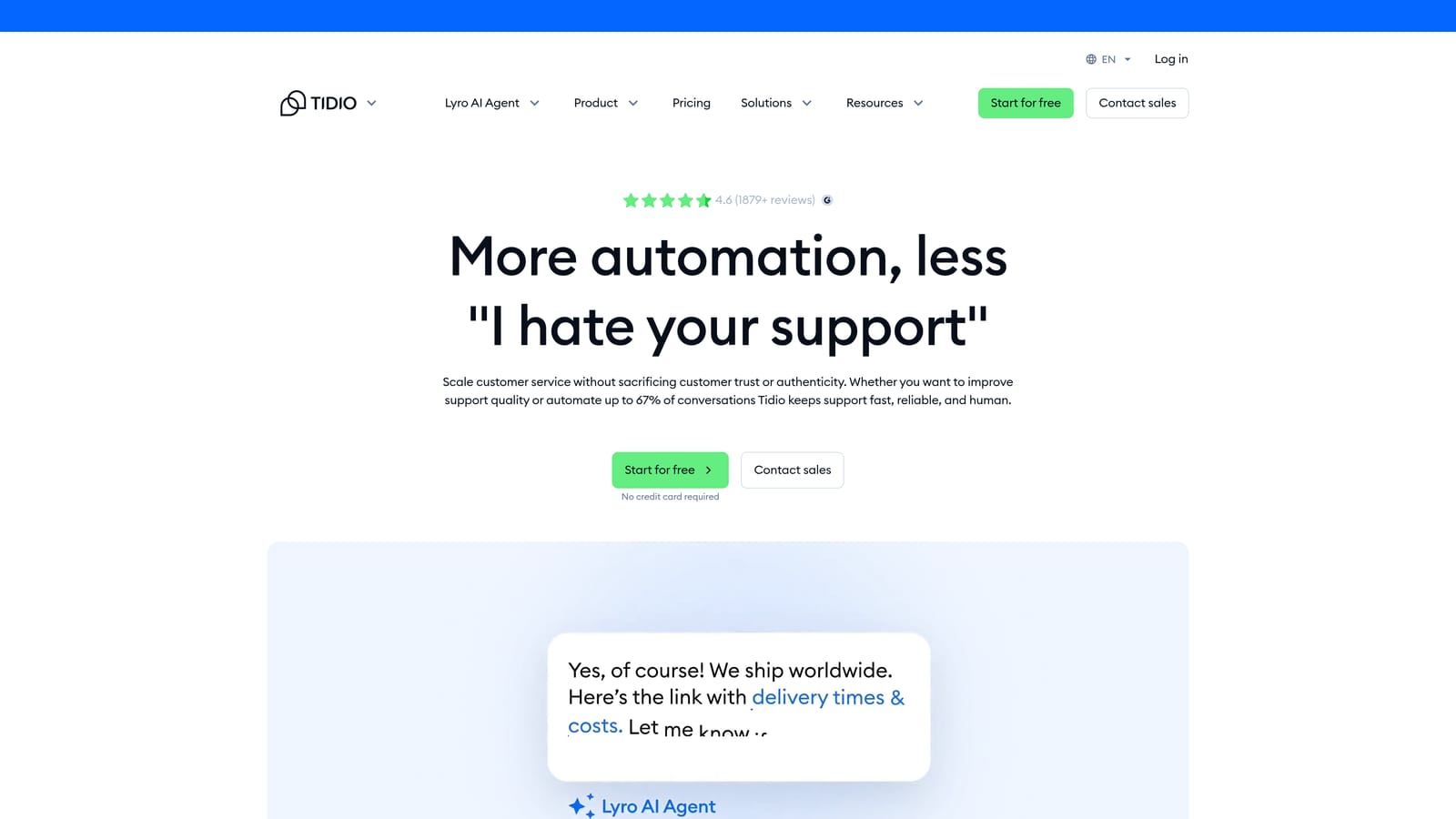
Tidio is a live chat and AI chatbot platform with Lyro AI for automated query handling, built to be approachable and affordable for smaller teams.
Where This Tool Shines
Tidio's biggest advantage is the combination of low friction and quick time-to-value. Lyro AI handles common support questions autonomously, and if it can't resolve something, live chat fallback connects the user to a human agent without a jarring handoff experience.
For early-stage companies that need something functional now without a lengthy implementation, Tidio gets you operational quickly. The trade-off is depth: it's less suited to complex technical B2B support scenarios where nuanced product knowledge is required.
Key Features
Lyro AI Chatbot: Autonomously handles common support questions without agent involvement.
Live Chat Fallback: Smooth agent takeover when Lyro reaches the limits of its knowledge.
Easy Setup: Website widget with straightforward integration and minimal configuration required.
Visitor Tracking: Basic analytics on visitor behavior and conversation patterns.
Email and Ticketing: Available on higher plans for teams that need more than chat.
Best For
Early-stage B2B software teams that need affordable AI chat with quick setup. Best for companies with relatively straightforward support queries; less suited to deeply technical products with complex troubleshooting needs.
Pricing
Free plan available; Lyro AI is available on paid tiers starting around $29 per month. Check Tidio's website for current plan details.
7. Forethought
Best for: Enterprise teams that need AI-powered support automation without migrating their existing helpdesk.
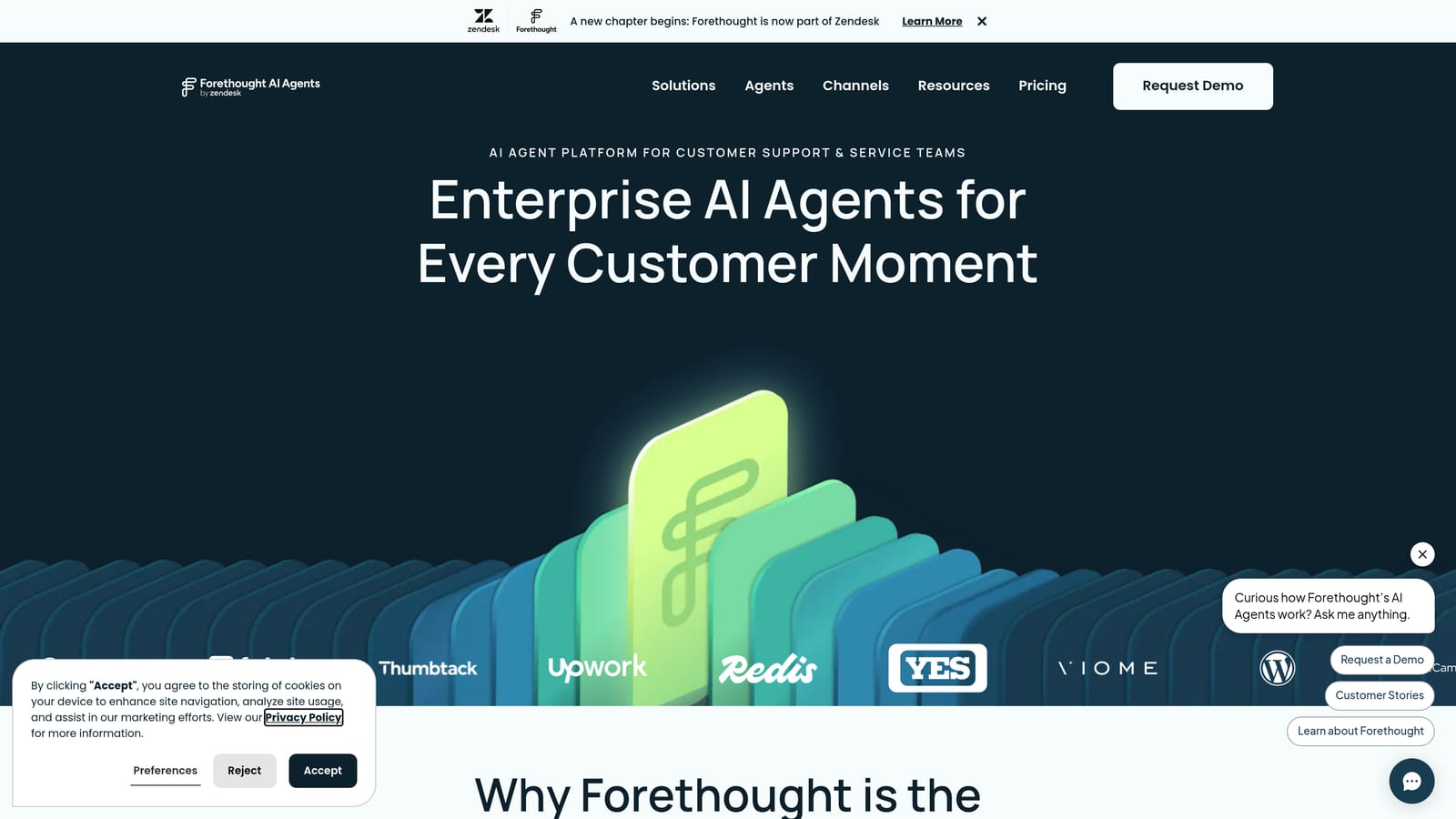
Forethought is an AI support platform that plugs into existing helpdesks to add intelligent triage, routing, deflection, and agent assist without requiring a platform migration.
Where This Tool Shines
Forethought's core value proposition is additive: if your team is deeply embedded in Zendesk, Freshdesk, or Salesforce Service Cloud and a full migration is off the table, Forethought layers AI capabilities on top of what you already have. Triage, routing, and deflection all improve without disrupting existing workflows.
The deflection workflows are particularly well-designed, resolving common queries before a ticket is ever created. For enterprise teams with high inbound volume, this can meaningfully reduce the load hitting the queue without requiring agents to change how they work.
Key Features
AI Triage and Routing: Intelligent classification and routing on top of Zendesk, Freshdesk, and Salesforce Service Cloud.
Deflection Workflows: Resolves common queries before ticket creation, reducing queue volume.
Agent Assist: Surfaces suggested responses and relevant knowledge within the existing helpdesk interface.
Deflection Analytics: Tracks deflection rates and resolution quality to demonstrate ROI.
Enterprise Security: Enterprise-grade security and compliance certifications for regulated industries.
Best For
Enterprise B2B teams with significant investment in an existing helpdesk that want to add AI capabilities without a disruptive migration. Strong fit for organizations with strict compliance requirements.
Pricing
Enterprise pricing; contact Forethought directly for a quote tailored to your team's volume and configuration needs.
8. Drift (Salesloft)
Best for: Revenue-focused B2B teams where support and sales conversations overlap significantly.
Drift, now part of Salesloft following its 2023 acquisition, is a conversational AI platform that blends support automation with sales qualification for teams where those two motions intersect.
Where This Tool Shines
Drift's strength is in the overlap between support and revenue. AI playbooks route conversations intelligently, qualifying leads and booking meetings while simultaneously handling support queries. For B2B teams where a chat conversation might be a prospect, a customer, or a churning account all at once, Drift's unified approach makes sense.
The Salesloft integration deepens the revenue-side capabilities, making it particularly useful for teams that want support conversations to feed directly into sales workflows. It's less suited to teams whose support and sales functions are clearly separated.
Key Features
AI Playbooks: Routes conversations across support and sales based on visitor identity and intent signals.
Meeting Booking Automation: Conversational landing pages that book meetings without human intervention.
Account-Based Routing: Real-time visitor identification routes known accounts to the right team or rep.
CRM Integrations: Connects with Salesforce, HubSpot, and Salesloft for full revenue workflow coverage.
Pipeline Analytics: Tracks how chat interactions influence pipeline and revenue outcomes.
Best For
B2B software companies where support and sales conversations happen in the same channel, particularly those using account-based marketing strategies and needing to qualify and route conversations in real time.
Pricing
Contact for pricing; Drift is enterprise-oriented and pricing reflects that. Reach out through Drift's website for a custom quote.
9. Help Scout
Best for: B2B teams that prioritize relationship quality and want AI to assist agents rather than replace them.
Help Scout is a human-first shared inbox platform with AI drafts and summarization, designed for B2B teams that treat support as a relationship-building function.
Where This Tool Shines
Help Scout takes a deliberately different philosophy from AI-first platforms. Rather than autonomous resolution, the AI assists agents: drafting replies, summarizing long conversation threads, and flagging context that helps agents respond faster and more thoughtfully. The result is a tool that improves agent quality without removing the human element.
The interface is genuinely clean and intuitive, which matters for teams that want high adoption without extensive training. Collision detection prevents two agents from drafting duplicate responses to the same ticket, a small feature that eliminates a surprisingly common problem in shared inboxes.
Key Features
AI Drafts: Generates suggested replies inside the inbox for agents to review, edit, and send.
AI Summarize: Condenses long conversation threads into quick context summaries for faster agent ramp-up.
Beacon Widget: In-app widget for self-service documentation and live chat without leaving the product.
Collision Detection: Alerts agents when someone else is already responding to the same conversation.
CSAT Tracking: Built-in customer satisfaction tracking tied to individual conversations and agents.
Best For
B2B software teams where relationship quality and thoughtful communication are core to the support experience. Particularly well-suited to companies with complex, high-value customer relationships where a fully automated response would feel impersonal.
Pricing
Per user per month; plans start around $22 per user per month. Accessible for growing teams without enterprise-level budgets.
Which Tool Is Right for Your Team?
The right choice depends heavily on where your team is today and where you need to be in twelve months.
If you're an early-stage B2B software company running lean and need AI-first support without a complex implementation, Halo AI and Tidio are strong starting points. Halo brings significantly more depth on the AI resolution and business intelligence side; Tidio is the faster, more affordable entry point for straightforward support needs.
If your team is already operating on Intercom or Zendesk, you don't necessarily need to migrate. Both platforms have meaningfully improved their AI capabilities, and layering Forethought on top of Zendesk or Freshdesk is a legitimate path for enterprise teams that can't afford a helpdesk migration.
For teams where support and sales conversations are genuinely blended, Drift is the clearest fit. For teams where knowledge accuracy is the primary bottleneck, Guru solves that specific problem better than any general-purpose helpdesk. And if relationship quality is your competitive differentiator, Help Scout's human-first approach is built for exactly that.
If your priority is resolving tickets autonomously while extracting business intelligence signals from support data, Halo AI is built for that combination specifically. Your support team shouldn't scale linearly with your customer base. Let AI agents handle routine tickets, guide users through your product, and surface business intelligence while your team focuses on complex issues that need a human touch. See Halo in action and discover how continuous learning transforms every interaction into smarter, faster support.