9 Best Automated Support Tools for Growing Companies in 2026
Automated support for growing companies becomes essential when customer volume outpaces hiring capacity, and this guide evaluates the 9 best tools of 2026 across deployment ease, automation depth, and scalability. From AI-native platforms to chatbot solutions, it helps scaling businesses identify which tools genuinely resolve customer issues rather than simply deflecting them.
 Matt PattoliFounder13 min read
Growing companies hit a painful inflection point somewhere between 50 and 500 customers: your base is expanding faster than your support team can hire. Tickets pile up, response times slip, and the customers you worked so hard to win start churning. Automated support tools exist to break that cycle, letting you scale coverage without scaling headcount at the same rate.
But not all automation is created equal. Some tools bolt AI onto legacy helpdesks. Others offer chatbots that deflect questions without actually resolving them. A few genuinely learn from every interaction and get smarter over time.
Here are the top automated support tools for growing companies in 2026, evaluated on ease of deployment, depth of automation, integration breadth, and how well they scale as your business grows.
1. Halo AI
Best for: B2B SaaS and product-led growth companies that want support to drive business intelligence
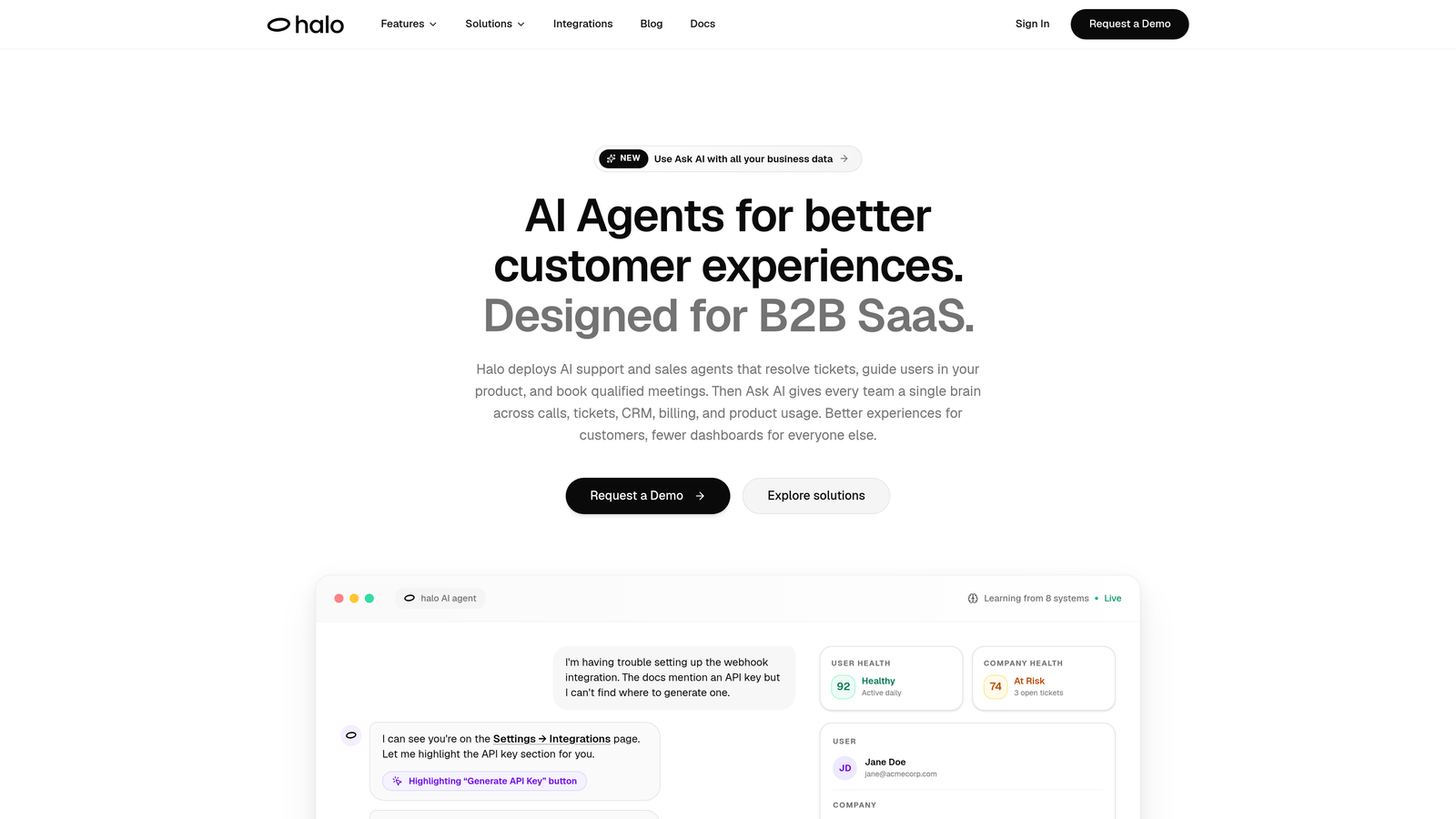
Halo AI is an AI-native customer support platform that deploys intelligent agents to resolve tickets, guide users through your product, and surface business intelligence while learning from every interaction.
Where This Tool Shines
What separates Halo from most tools on this list is its architecture. Automation isn't bolted onto an existing helpdesk infrastructure. It's the foundation. This means the AI has full context from the start rather than fighting against a legacy data model that wasn't designed with autonomy in mind.
The page-aware chat widget is a standout capability. The AI sees exactly what the user sees on screen, enabling contextual UI guidance that most support tools simply can't replicate. For B2B SaaS teams with complex products, this is the difference between a chatbot that says "check our docs" and one that walks a user through the exact screen they're stuck on.
Key Features
Page-Aware Chat Widget: The AI sees the user's current screen context, enabling step-by-step UI guidance rather than generic FAQ responses.
Autonomous Ticket Resolution with Live Agent Handoff: Tickets are resolved without human intervention where possible, with full context preserved when escalation is needed.
Smart Inbox with Business Intelligence: Goes beyond ticket metrics to surface customer health signals, revenue anomalies, and product usage patterns that inform decisions beyond the support team.
Auto Bug Ticket Creation: Support signals automatically generate bug tickets in Linear, closing the loop between customer issues and engineering workflows without manual triage.
Broad Integration Stack: Connects to Slack, HubSpot, Intercom, Stripe, Zoom, PandaDoc, and Fathom, making support data a first-class citizen across your entire business stack.
Best For
Halo is particularly well-suited for B2B SaaS companies and product-led growth teams where support context needs to flow into product, engineering, and revenue workflows. If you want your support layer to generate business intelligence, not just close tickets, this is the platform built for that job.
Pricing
Contact for pricing via haloagents.ai. Given the AI-native architecture and business intelligence capabilities, pricing is tailored to team size and usage.
2. Intercom
Best for: Mid-market SaaS teams already invested in the Intercom ecosystem
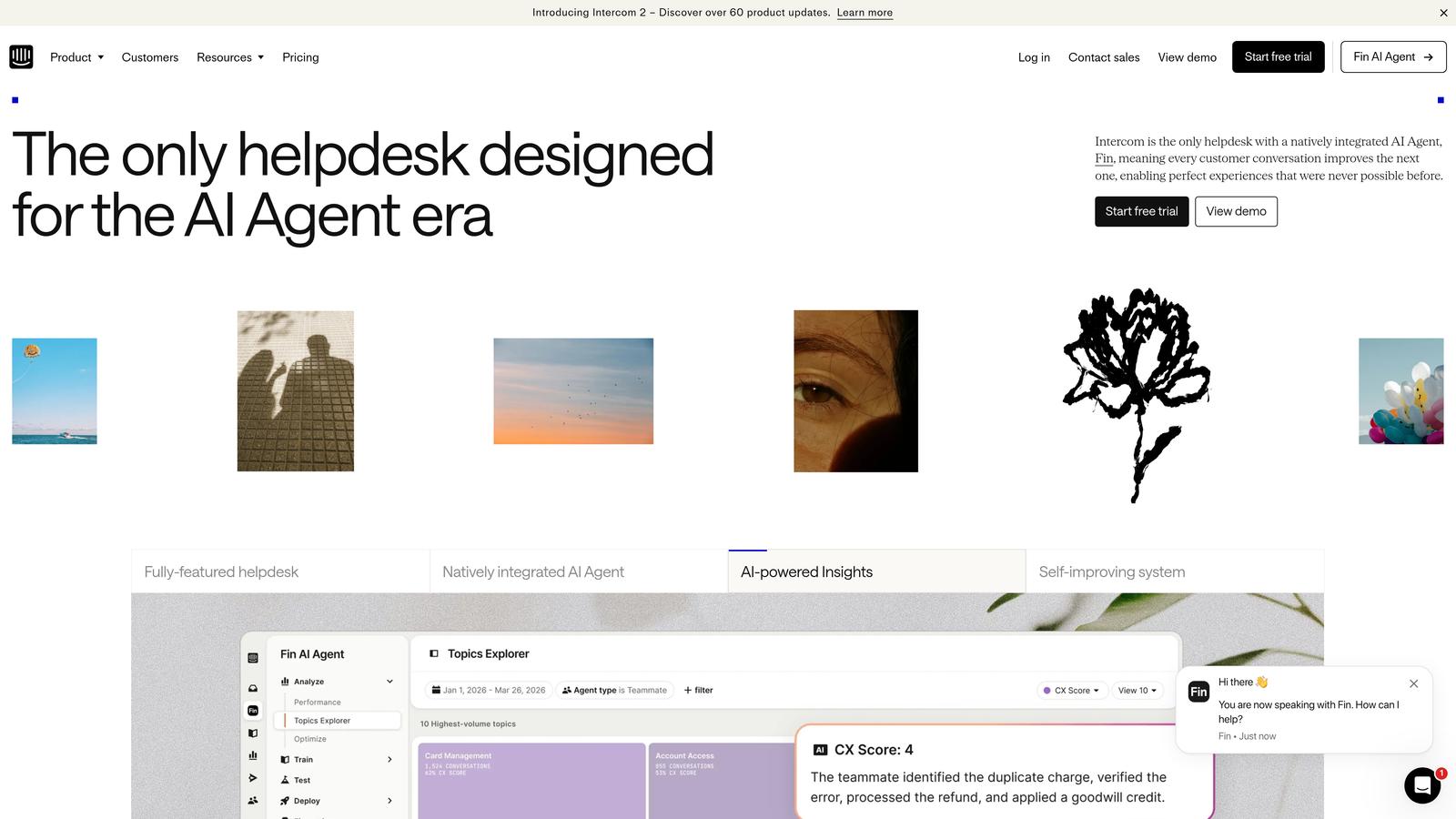
Intercom is a mature customer messaging platform with Fin, an AI agent built on large language models, layered on top of a unified inbox used by thousands of SaaS companies.
Where This Tool Shines
Intercom's strength is the depth of its messenger infrastructure. Decades of iteration on the chat and inbox experience show. Fin AI handles autonomous query resolution on the customer-facing side, while AI Copilot assists human agents with suggested replies and conversation summaries on the backend.
The unified inbox is genuinely useful for companies managing support, onboarding, and proactive messaging in one place. Where Intercom can feel limiting is pricing: costs scale quickly as usage grows, which can be a constraint for early-stage companies.
Key Features
Fin AI Agent: Handles autonomous customer query resolution using large language model reasoning against your knowledge base.
AI Copilot: Assists human agents in real time with suggested replies, ticket summaries, and relevant documentation surfacing.
Unified Inbox: Combines support, onboarding, and proactive messaging into a single agent workspace.
Customer Data Platform: Stores behavioral and attribute data that powers segmentation and personalized messaging alongside support.
Robust Reporting: Conversation analytics, resolution rates, and CSAT tracking across channels.
Best For
Mid-market SaaS companies already using Intercom for customer messaging will find the AI layer a natural extension. Less ideal for teams starting fresh who want a purpose-built AI-first platform without the messenger overhead.
Pricing
Starts at approximately $39/month for basic plans. Fin AI is priced on a usage basis on top of base plan costs, so total spend can climb with volume.
3. Zendesk
Best for: Larger support organizations with complex routing, SLA management, and compliance requirements
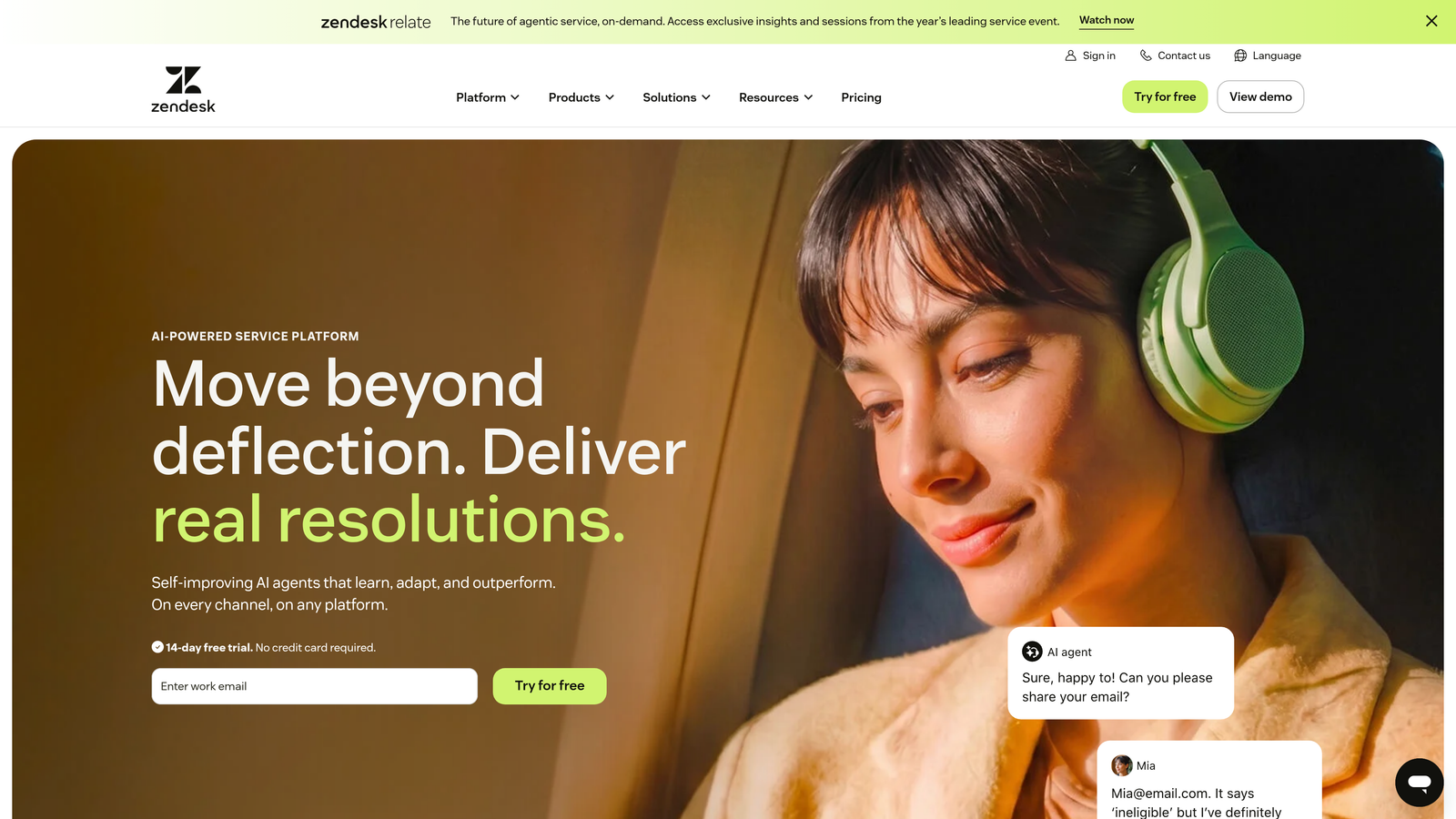
Zendesk is the enterprise-grade helpdesk standard, now with AI triage, intelligent routing, and generative AI features built into its Support Suite.
Where This Tool Shines
Zendesk's core advantage is breadth. The platform handles virtually any support workflow at scale, with sophisticated SLA management, reporting dashboards, and a marketplace of over 1,000 integrations. For large support organizations managing multiple channels, regions, and compliance requirements, Zendesk has the infrastructure depth to match.
The AI additions, including intelligent triage, intent detection, and generative reply drafting, are meaningful improvements. The honest caveat is that they're layered onto a ticket infrastructure that predates the AI era, which can create some friction compared to AI-native platforms.
Key Features
AI-Powered Triage and Intent Detection: Automatically categorizes and routes incoming tickets based on content and intent analysis.
Generative AI for Agents: Drafts replies and summarizes ticket threads to speed up agent response times.
Advanced SLA Management: Comprehensive service level agreement tracking with escalation rules and reporting.
Workflow Automation: Triggers, automations, and macros for handling repetitive support processes without manual intervention.
1,000+ Marketplace Integrations: Connects to virtually every tool in a modern support and business stack.
Best For
Enterprise and upper mid-market teams with dedicated support operations, complex routing needs, and established compliance requirements. Smaller teams often find it heavyweight for their actual needs.
Pricing
Suite Team starts at approximately $55 per agent per month. AI add-ons are priced separately, so total cost increases meaningfully for teams wanting full AI capability.
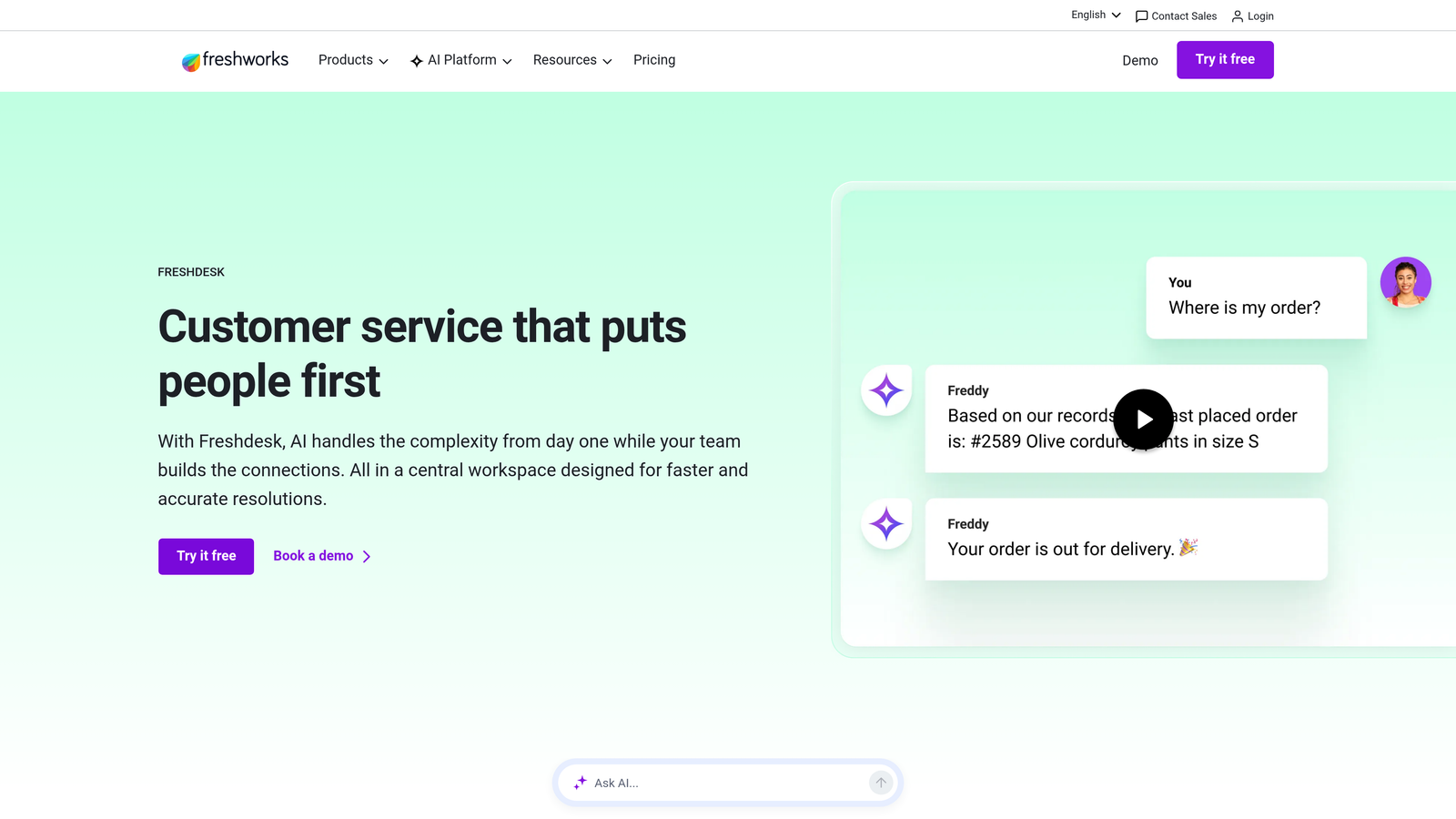
4. Freshdesk
Best for: Growing teams graduating from shared inboxes who need full helpdesk features at an accessible price
Freshdesk is a full-featured helpdesk with Freddy AI built in, offering a more accessible price point than enterprise alternatives without sacrificing core automation capabilities.
Where This Tool Shines
Freshdesk hits a practical sweet spot for companies that have outgrown a shared Gmail inbox but aren't ready for the complexity and cost of an enterprise platform. The Freddy AI suite covers customer-facing deflection, agent assistance, and analytics in distinct modules that teams can adopt incrementally.
Omnichannel coverage across email, chat, phone, and social is solid, and scenario automations handle repetitive workflow steps without requiring developer resources. It's a reliable, proven platform rather than a cutting-edge AI showcase.
Key Features
Freddy Self Service: AI-powered customer-facing deflection that resolves common queries before they reach an agent.
Freddy Copilot: Assists agents with reply suggestions, summarization, and relevant article recommendations.
Omnichannel Support: Unified inbox across email, live chat, phone, and social media channels.
Scenario Automations: Multi-step automation sequences for handling repetitive support workflows without manual effort.
Freddy Insights: Analytics and reporting module surfacing trends and team performance data.
Best For
Teams of 5 to 50 support agents moving from ad hoc tools to a proper helpdesk. Also well-suited for companies that want Zendesk-comparable features at a lower per-seat cost.
Pricing
Free plan available for small teams. Paid plans start at approximately $15 per agent per month, making it one of the more accessible options on this list.
5. Tidio
Best for: Small businesses and e-commerce teams that need automation live quickly without lengthy setup
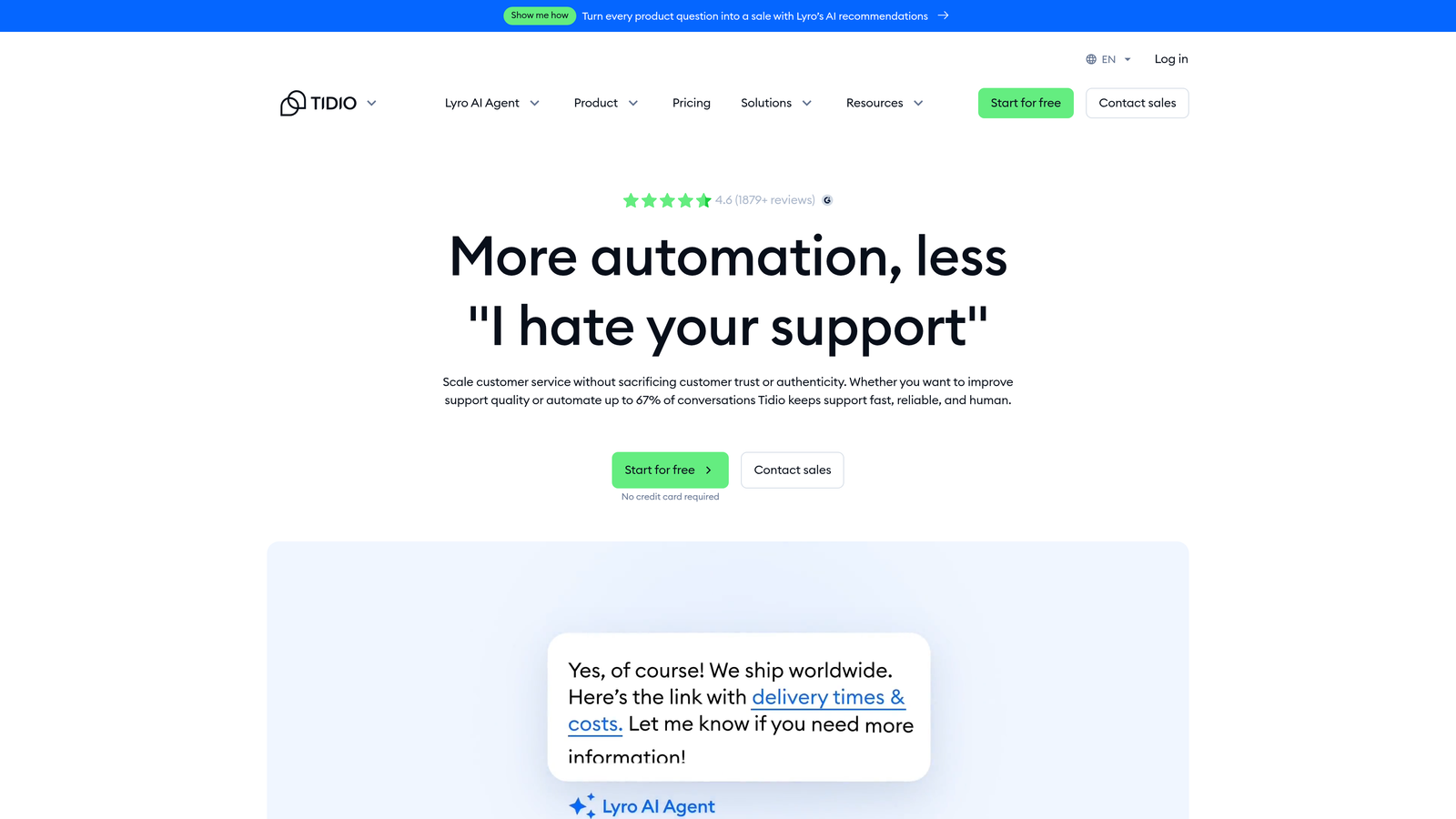
Tidio is a fast-to-deploy live chat and AI chatbot platform featuring Lyro, its conversational AI, designed for teams that need automation without a complex implementation process.
Where This Tool Shines
Tidio's reputation is built on speed to value. Teams regularly report being live within a day, which matters when you're a small team with limited implementation bandwidth. Lyro handles FAQ-style queries and common support questions autonomously, while the visual flow builder lets non-technical staff design automation logic without writing a line of code.
The platform is strongest in e-commerce and small business contexts. For B2B SaaS teams with complex, technical support scenarios, Lyro's capabilities can feel limited compared to more sophisticated AI agents.
Key Features
Lyro AI Chatbot: Conversational AI that handles FAQ and common support queries autonomously, learning from your existing content.
Visual Flow Builder: No-code automation designer for building custom conversation and routing logic.
Live Chat with Agent Takeover: Any automated conversation can be seamlessly handed to a human agent in real time.
CMS and E-commerce Integrations: Quick connections to Shopify, WordPress, and major content management platforms.
Multi-Channel Inbox: Manages live chat, email, and social messaging in a single workspace.
Best For
Small businesses, early-stage startups, and e-commerce brands that prioritize fast deployment and ease of use over deep customization or enterprise-grade analytics.
Pricing
Free plan available. Lyro AI starts at approximately $29/month, making it one of the most accessible entry points for AI-assisted support automation.
6. Drift (Salesloft)
Best for: B2B companies where chat serves as both a support channel and a sales pipeline driver
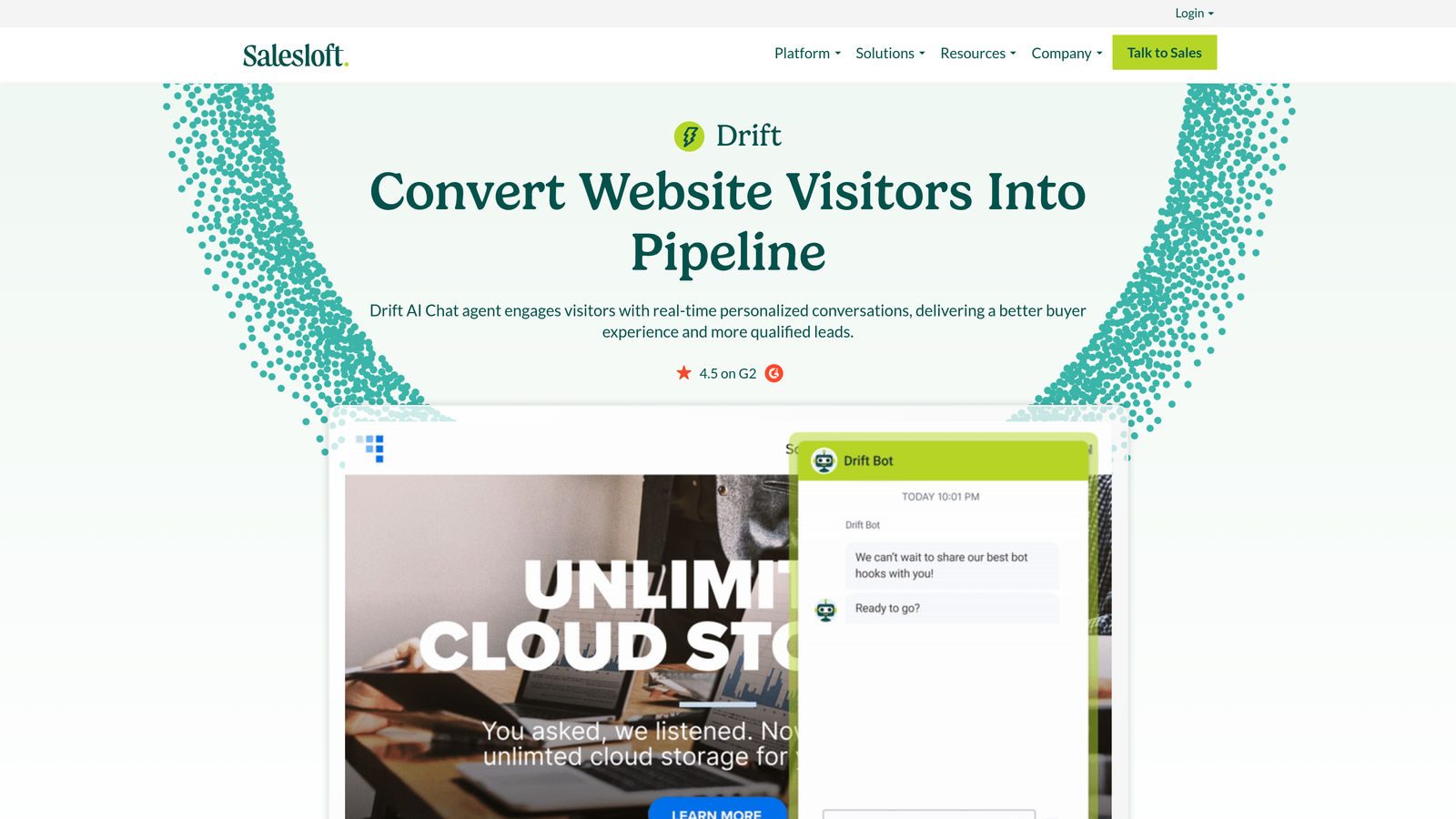
Drift, now part of Salesloft, is a conversational platform sitting at the intersection of support and revenue, using AI to route and respond to both buyer and customer conversations in real time.
Where This Tool Shines
Drift's differentiation is its revenue orientation. Where most support tools measure deflection rates and CSAT, Drift ties conversation outcomes to pipeline and revenue metrics. For B2B teams where the same chat widget handles both pre-sale qualification and post-sale support, that unified view has real value.
The AI-powered routing logic is sophisticated, directing inbound conversations to the right sales or support resource based on visitor attributes and intent signals. It's worth noting that Drift's primary identity is conversational marketing rather than pure support automation, so teams with support-only needs may find it over-engineered for their use case.
Key Features
AI-Powered Chatbot: Qualifies and routes inbound conversations based on visitor data, intent, and account attributes.
Revenue Intelligence: Ties support and sales chat interactions to pipeline metrics and account health data.
Meeting Scheduling: Embedded calendar booking within chat flows for seamless sales handoffs.
CRM Integrations: Deep connections to Salesforce, HubSpot, and major CRM platforms for bidirectional data sync.
Sales and Support Handoff: Unified routing logic that can escalate to either a support agent or an account executive depending on conversation context.
Best For
B2B companies with an account-based sales motion where support and sales conversations overlap. Less suited for teams that need a dedicated, pure-play support automation platform.
Pricing
Contact for pricing. Drift is enterprise-focused and pricing reflects that positioning.
7. Guru
Best for: Teams that need a knowledge layer on top of existing support tools to improve answer quality and consistency
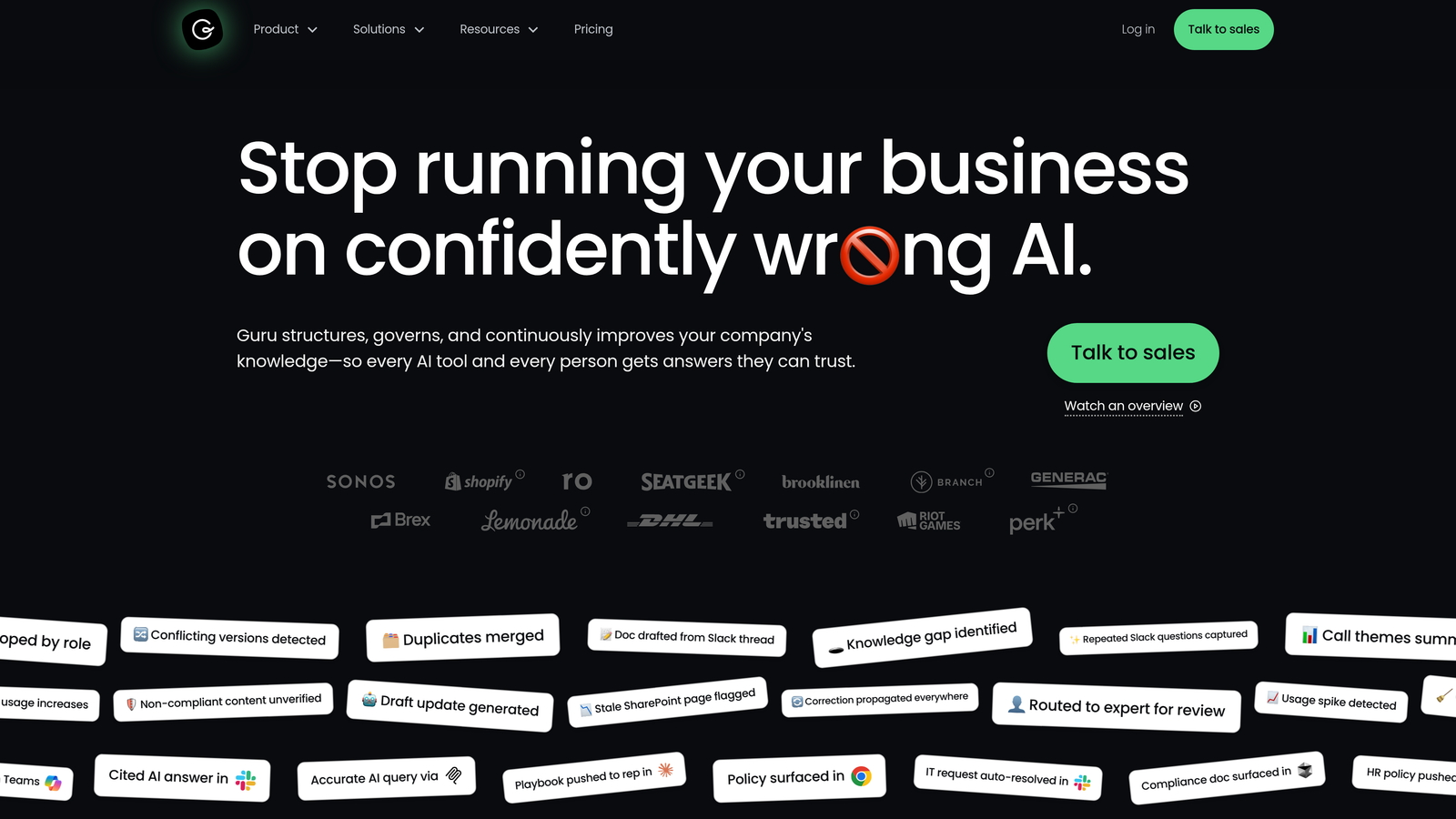
Guru is an AI-powered knowledge management platform that surfaces the right information to agents and customers in context, usable as a standalone knowledge base or layered on top of existing support infrastructure.
Where This Tool Shines
Guru solves a problem that pure helpdesk tools often leave unaddressed: knowledge quality. Even the best AI support agent is only as good as the documentation it draws from. Guru's browser extension delivers relevant knowledge cards directly inside Zendesk, Intercom, Slack, and other tools, so agents get answers in context without switching tabs.
The knowledge verification workflow is a particularly useful feature for growing companies where product documentation changes frequently. Cards have owners and expiration dates, which keeps the knowledge base accurate over time rather than becoming a graveyard of outdated articles.
Key Features
AI-Powered Contextual Search: Surfaces relevant knowledge cards in real time based on the conversation context an agent is working in.
Browser Extension: Delivers answers inside Zendesk, Intercom, Slack, and other tools without leaving the current workflow.
Knowledge Verification Workflows: Assigns ownership and expiration to documentation, keeping content accurate as products evolve.
Customer-Facing Help Center: Publishes the same internal knowledge base as a self-service portal for end users.
Analytics: Tracks which knowledge cards are used most, surfacing gaps in documentation coverage.
Best For
Support teams with complex or frequently changing product documentation, and companies that want to improve the quality of their existing support tools rather than replacing them entirely.
Pricing
Free for up to 3 users. Paid plans start at approximately $10 per user per month, making it a low-risk addition to an existing support stack.
8. Gorgias
Best for: E-commerce brands handling high volumes of transactional support queries
Gorgias is a helpdesk built specifically for e-commerce brands, with deep Shopify integrations and automation macros designed to handle transactional support at scale.
Where This Tool Shines
If your support queue is dominated by order status checks, return requests, and shipping questions, Gorgias was built for exactly that scenario. The native Shopify integration pulls order data directly into the ticket view, so agents and automations have full transaction context without switching tools.
The revenue statistics feature is a genuinely unique angle: Gorgias tracks the revenue influenced by support conversations, helping e-commerce teams make the case that support is a profit center rather than a cost center. This framing resonates with DTC and e-commerce leadership in a way that pure ticket metrics don't.
Key Features
Native E-commerce Integrations: Deep connections to Shopify, WooCommerce, and Magento with order data surfaced directly in ticket views.
Automation Macros: Pre-built and custom automation rules for order status, returns, cancellations, and shipping queries.
Revenue Statistics: Tracks the revenue impact of support conversations, tying ticket resolution to sales outcomes.
Omnichannel Inbox: Manages email, live chat, social media comments, and SMS in a single unified workspace.
Self-Service Flows: Customer-facing automation that resolves transactional queries without agent involvement.
Best For
E-commerce brands, particularly those on Shopify, with high ticket volumes driven by transactional queries. Not well-suited for B2B SaaS or technical support scenarios.
Pricing
Starts at approximately $10/month for 50 tickets, with pricing scaling by ticket volume rather than agent seat count.
9. Help Scout
Best for: Teams that want AI to enhance human agents rather than replace them
Help Scout is an email-native support platform that pairs a clean, human-feeling interface with AI features designed to assist agents rather than fully automate the support experience.
Where This Tool Shines
Help Scout occupies a deliberate position in this market: it's a company that believes great support is fundamentally human, with AI playing a supporting role. That philosophy shows in the product. The AI features, summarization, reply drafting, and self-service suggestions, are additive rather than replacing agent judgment.
For teams where support quality and relationship-building matter as much as resolution speed, Help Scout's interface feels right. It's clean, familiar, and doesn't try to automate away the human element entirely. The Beacon widget handles in-app self-service gracefully, and the shared inbox features like collision detection and private notes keep team coordination smooth.
Key Features
AI Summarize: Condenses long email threads into concise summaries so agents can get up to speed instantly on complex cases.
AI Assist: Drafts and improves agent replies based on conversation context and tone preferences.
Beacon Widget: In-app self-service widget with proactive messaging and instant answer suggestions before a ticket is submitted.
Shared Inbox with Collision Detection: Prevents two agents from responding to the same ticket simultaneously, with private notes for internal coordination.
Docs Knowledge Base: Integrated help center that powers both self-service search and AI answer suggestions.
Best For
Teams of 5 to 50 where support culture emphasizes quality and relationship over pure efficiency metrics. Also a strong fit for companies transitioning from email-based support who want a familiar interface with AI capabilities layered in.
Pricing
Starts at approximately $22 per user per month on the Standard plan.
Which Tool Fits Your Stage?
The right automated support tool depends less on feature lists and more on where your company is today and where it needs to be in 18 months.
Early-stage startups with small teams and limited budgets should look at Tidio for fast deployment or Help Scout for an email-native experience that doesn't require a steep learning curve. Both offer accessible entry points without locking you into enterprise contracts.
Mid-market SaaS companies scaling support operations will find the most value in Halo AI, Intercom, or Freshdesk. If you want AI to be the foundation rather than a feature, Halo's AI-native architecture and business intelligence capabilities are worth a close look. If you're already deep in the Intercom ecosystem, Fin AI extends what you have. Freshdesk is the practical choice for teams that want Zendesk-comparable capability at a lower cost.
Enterprise teams with complex routing, SLA requirements, and compliance needs will likely gravitate toward Zendesk for its infrastructure depth and integration breadth.
E-commerce brands running high volumes of transactional queries should evaluate Gorgias first. Its Shopify integration and revenue-tied metrics are purpose-built for that context in a way that general-purpose helpdesks aren't.
Before choosing, audit your current support stack: look at your ticket volume, your autonomous resolution rate, and where your team spends the most manual effort. The best tool is the one that eliminates the most friction at your specific bottleneck.
Your support team shouldn't scale linearly with your customer base. Let AI agents handle routine tickets, guide users through your product, and surface business intelligence while your team focuses on complex issues that need a human touch. See Halo in action and discover how continuous learning transforms every interaction into smarter, faster support.