9 Best Automated Support Platforms and What They Actually Cost in 2026
This guide cuts through the opacity of automated support platform pricing by breaking down nine leading tools—their actual costs, hidden fees, and what B2B SaaS teams can expect before signing a contract. From per-seat charges to add-on surprises, it covers what makes each platform distinct and who it's best suited for, helping decision-makers compare options confidently without wasting time on unnecessary sales calls.
 Grant CooperFounder14 min read
Automated support platform pricing is notoriously opaque. Most vendors bury costs behind "contact sales" buttons, per-agent seat fees, and add-on charges that only reveal themselves after you've signed a contract. Whether you're evaluating your first AI support tool or benchmarking your current stack, understanding what you'll actually pay and what you actually get is the real challenge.
This guide breaks down nine leading automated support platforms, their pricing models, and the hidden costs worth knowing before you commit. We've prioritized tools built for B2B SaaS teams and product-led companies, with a focus on platforms that go beyond basic ticket deflection to offer genuine automation, integrations, and intelligence. Each entry covers what makes the tool distinct, who it's best suited for, and what to expect on pricing — so you can make a confident decision without booking three discovery calls first.
1. Halo AI
Best for: B2B SaaS teams wanting an AI-first support platform with business intelligence built in.
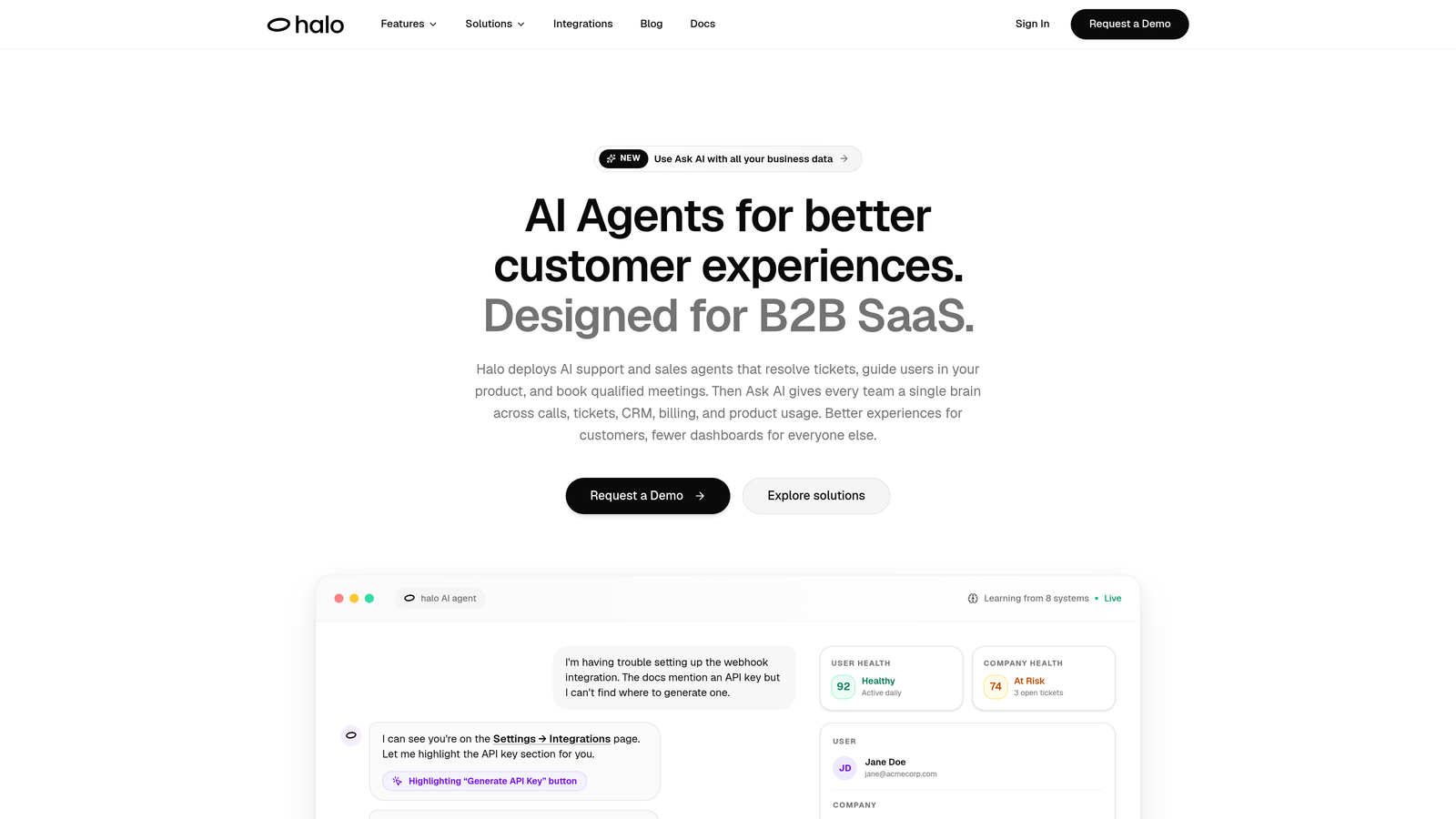
Halo AI is an AI-native customer support platform designed specifically for B2B SaaS companies that need more than ticket deflection.
Where This Tool Shines
Most support platforms started as helpdesks and bolted AI on later. Halo was built AI-first, which means the intelligence isn't a layer on top — it's the foundation. The standout capability is page-aware context: Halo's agents understand what a user is actually looking at inside your product UI, so responses are relevant to the specific screen or workflow, not just the text of the message.
Beyond resolving tickets, Halo surfaces business intelligence from support interactions. Customer health signals, revenue anomalies, and usage patterns emerge from conversations that would otherwise disappear into a closed ticket. That turns your support inbox into something closer to a strategic data source.
Key Features
Page-Aware AI Agents: Agents understand the user's current product context, enabling precise, UI-specific guidance without the user having to explain where they are.
Auto Bug Ticket Creation: Automatically generates and routes bug reports to engineering tools like Linear, closing the loop between support and product teams without manual handoffs.
Smart Inbox with Business Intelligence: Surfaces customer health signals, revenue intelligence, and anomaly detection directly from support data — a capability most platforms don't offer at all.
Live Agent Handoff: Escalates to human agents with full conversation context preserved, so customers never have to repeat themselves.
Broad Integration Stack: Connects with Slack, HubSpot, Stripe, Intercom, Zoom, PandaDoc, and Fathom, fitting into the workflows B2B teams already use.
Continuous Learning: Every resolved interaction improves the model, meaning the platform gets measurably smarter over time rather than staying static.
Best For
B2B SaaS companies and product-led growth teams that want AI-driven support resolution, automated bug reporting, and business intelligence from customer interactions — particularly teams scaling customer bases without proportionally scaling headcount.
Pricing
Custom pricing based on value delivered rather than seat count. Contact Halo for a demo at haloagents.ai. The model is positioned around outcomes rather than agent licenses, which is worth exploring if your current platform charges per seat.
2. Intercom
Best for: Teams wanting a mature messaging platform with a capable AI agent layered on top.
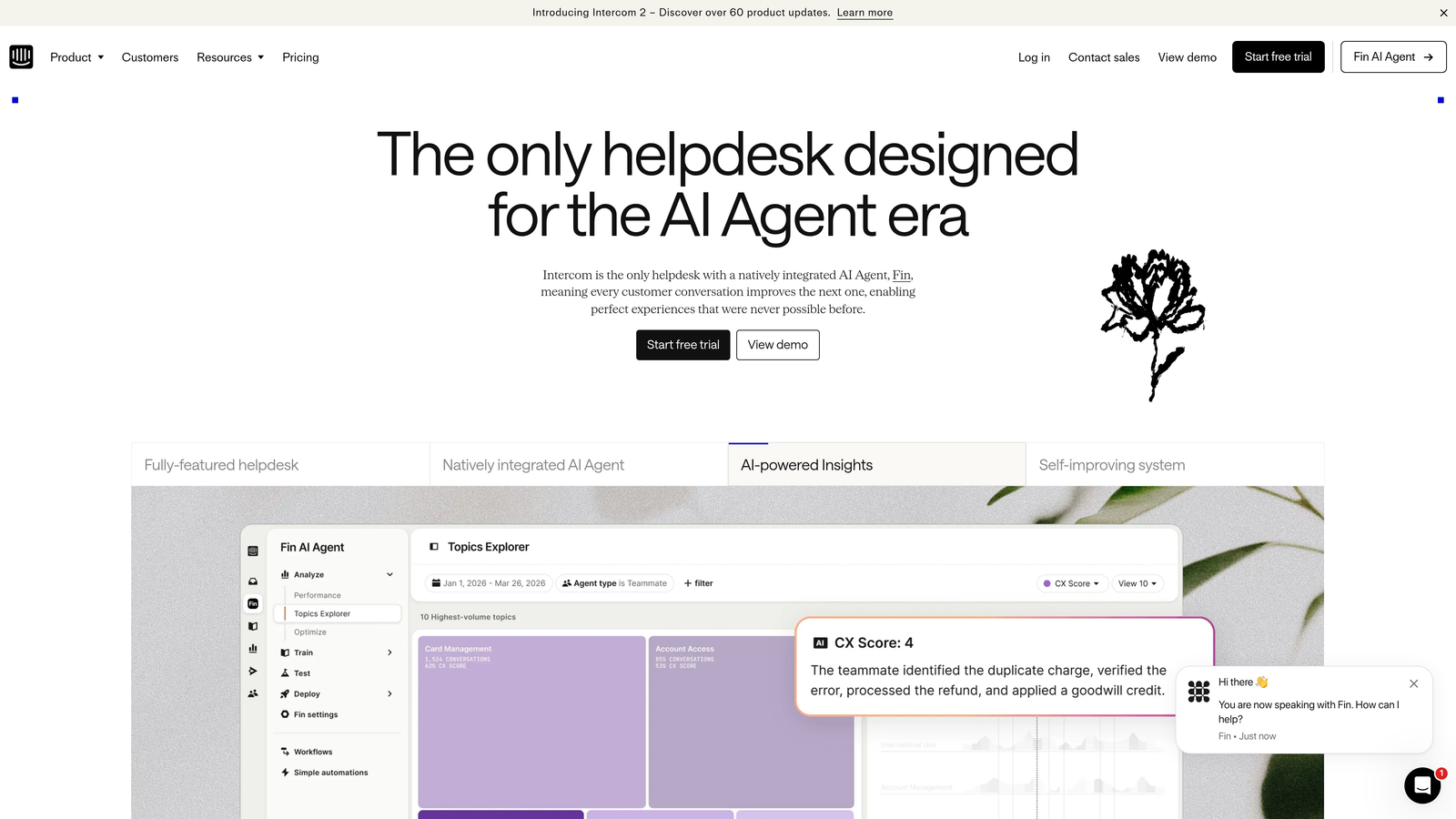
Intercom is one of the most widely adopted customer messaging platforms, with Fin — its GPT-4-powered AI agent — handling automated ticket resolution on top of a mature live chat and inbox suite.
Where This Tool Shines
Intercom's strength is its depth of customer data. Years of conversation history, rich user profiles, and behavioral data give Fin meaningful context to work with. For teams already using Intercom for sales and onboarding, extending it into AI-powered support feels like a natural evolution rather than a platform switch.
The unified inbox — combining chat, email, and in-app messages — is genuinely well-executed. Teams that manage multiple communication channels will appreciate having everything in one place with consistent routing logic.
Key Features
Fin AI Agent: GPT-4-powered agent that handles ticket resolution with a per-resolution pricing model rather than a flat fee.
Unified Inbox: Combines chat, email, and in-app messages into a single workspace with shared context.
Rich Customer Data: Deep conversation history and user profiles give AI and human agents strong context for every interaction.
Workflow Automation Builder: Visual builder for creating automated response flows, routing rules, and escalation logic.
Extensive App Marketplace: Large ecosystem of integrations and a robust API for custom connections.
Best For
Mid-market to enterprise SaaS companies already invested in the Intercom ecosystem, or teams that want a battle-tested platform with strong customer data infrastructure and a capable AI agent. Less ideal for teams on tight budgets where per-resolution fees could add up quickly at volume.
Pricing
Base plans start around $39/seat/month; Fin AI is charged per resolution on top of that base cost, which means total costs can escalate with volume. Verify current pricing at intercom.com before budgeting.
3. Zendesk
Best for: Enterprise teams needing a proven, omnichannel helpdesk with AI add-on capabilities.
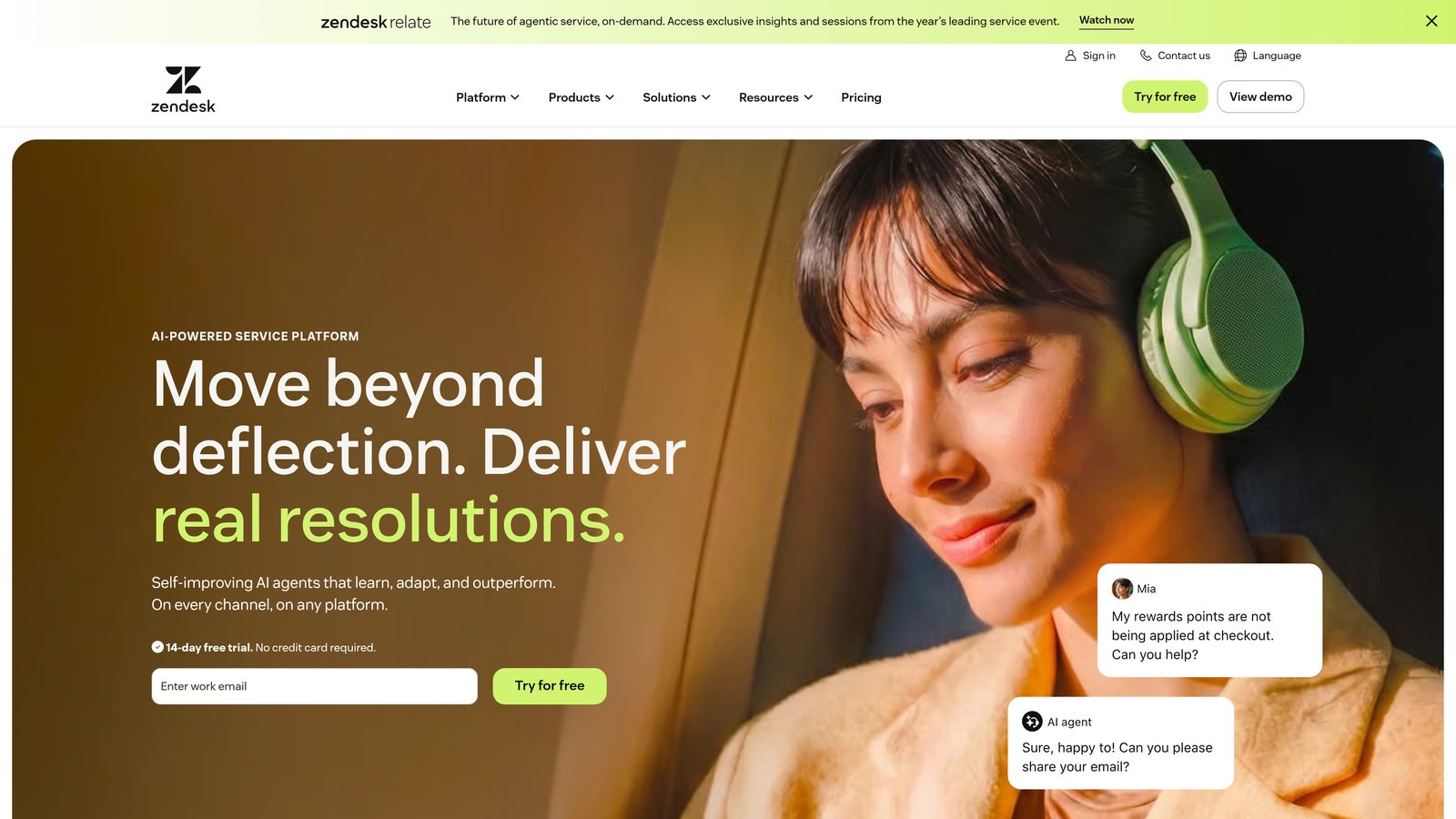
Zendesk is the enterprise-grade helpdesk standard, now with an AI add-on layer that brings automated triage, AI-assisted replies, and intelligent routing to its Suite of products.
Where This Tool Shines
Zendesk's core strength is reliability and breadth. It handles email, chat, voice, and social in a single platform, with SLA management and reporting that enterprise procurement teams expect. The sheer depth of its integration marketplace means it connects to almost anything in your stack.
The AI capabilities are genuinely useful for agent assistance — intelligent suggestions, automated triage, and routing — though they're positioned more as productivity tools for human agents than fully autonomous resolution engines. That distinction matters when evaluating total cost.
Key Features
AI-Powered Ticket Triage and Routing: Automatically categorizes and routes incoming tickets based on intent and priority.
Zendesk AI Add-On: Provides intelligent reply suggestions, summarization, and agent copilot features — sold separately from base plans.
Omnichannel Support: Covers email, chat, voice, and social channels within a unified agent workspace.
Advanced Reporting and SLA Management: Enterprise-grade analytics with customizable dashboards and service level tracking.
Large Integration Ecosystem: Hundreds of pre-built integrations and a mature API for custom development.
Best For
Enterprise companies and larger mid-market teams with complex support operations, multiple channels, and strict SLA requirements. Teams primarily looking for AI-first autonomous resolution may find Zendesk's AI layer less complete than newer platforms built around that capability from the start.
Pricing
Suite Team starts around $55/agent/month; AI features are sold as a separate add-on with additional per-agent fees. Total cost of ownership can be higher than initial quotes suggest. Verify current pricing at zendesk.com.
4. Freshdesk
Best for: Cost-conscious mid-market teams wanting solid helpdesk functionality with AI built in at accessible price points.
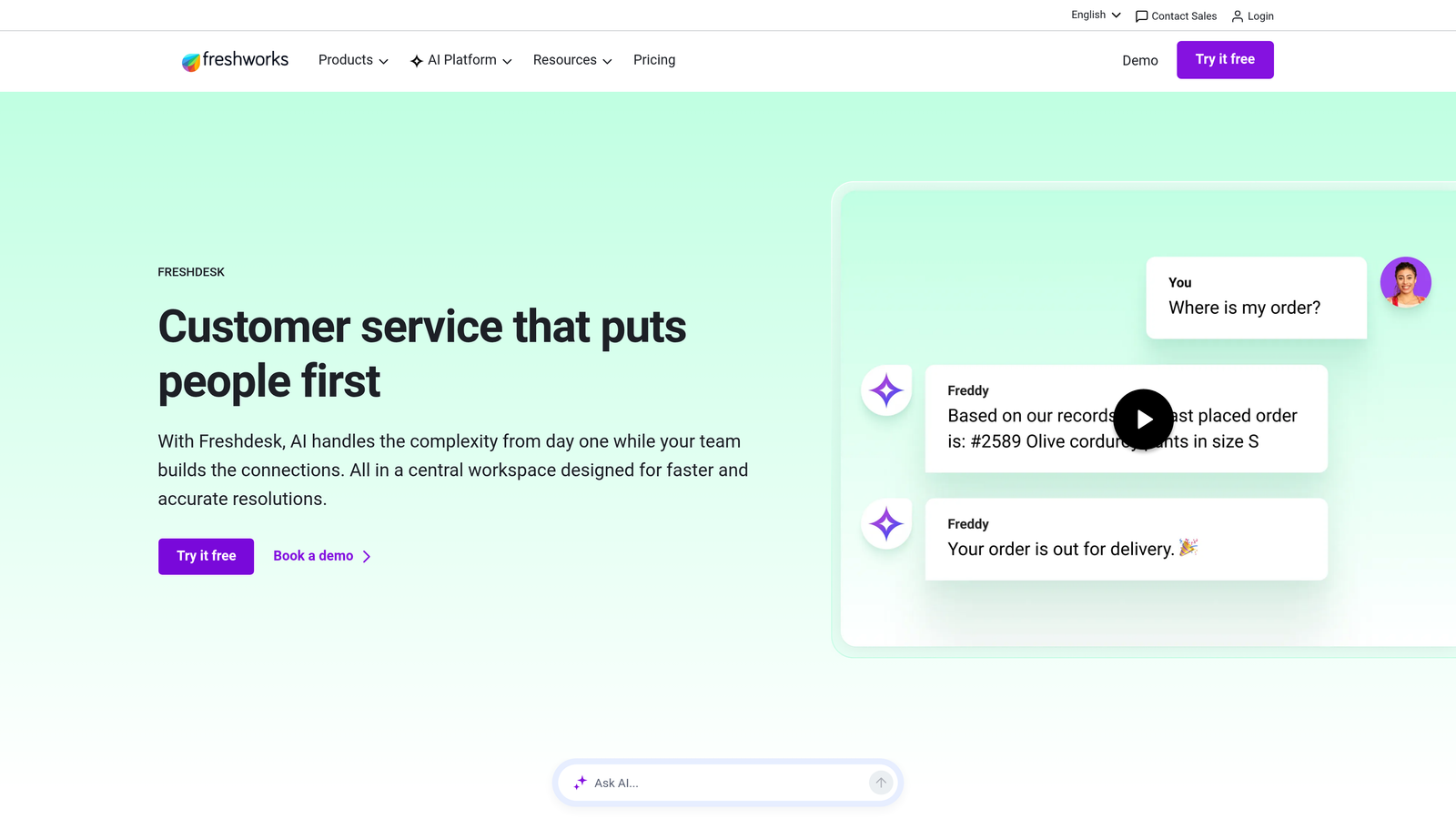
Freshdesk is a cost-competitive helpdesk platform with Freddy AI built in, offering automation for ticket deflection, agent assistance, and analytics — with a free tier that makes it accessible for smaller teams.
Where This Tool Shines
Freshdesk's value proposition is straightforward: solid helpdesk functionality at a price point that doesn't require enterprise budget approval. The free tier is genuinely functional for small teams, and the growth path is gradual enough that companies can scale without sudden cost cliffs.
Freddy AI handles ticket deflection and agent suggestions competently, and for teams already using other Freshworks products — particularly FreshCRM — the native integration creates a cohesive customer data environment without custom development.
Key Features
Freddy AI: Handles ticket deflection, agent reply suggestions, and analytics summarization across support workflows.
Free Tier: A functional free plan that allows small teams to get started without upfront commitment.
Multi-Channel Support: Covers email, chat, phone, and social channels with unified inbox management.
Automations and SLA Policies: Rule-based automation for routing, escalation, and SLA tracking.
Freshworks Ecosystem Integration: Native connections to FreshCRM, FreshSales, and other Freshworks products for teams using the broader suite.
Best For
SMBs and mid-market teams looking for a cost-effective helpdesk with built-in AI that doesn't require a separate add-on purchase. Also well-suited for teams already invested in the Freshworks product ecosystem.
Pricing
Free plan available for up to a limited number of agents; Growth plan starts around $15/agent/month. Freddy AI features are available at higher tiers. Verify current pricing at freshworks.com.
5. Tidio
Best for: Small to mid-size teams wanting fast deployment of AI chat automation without complex configuration.
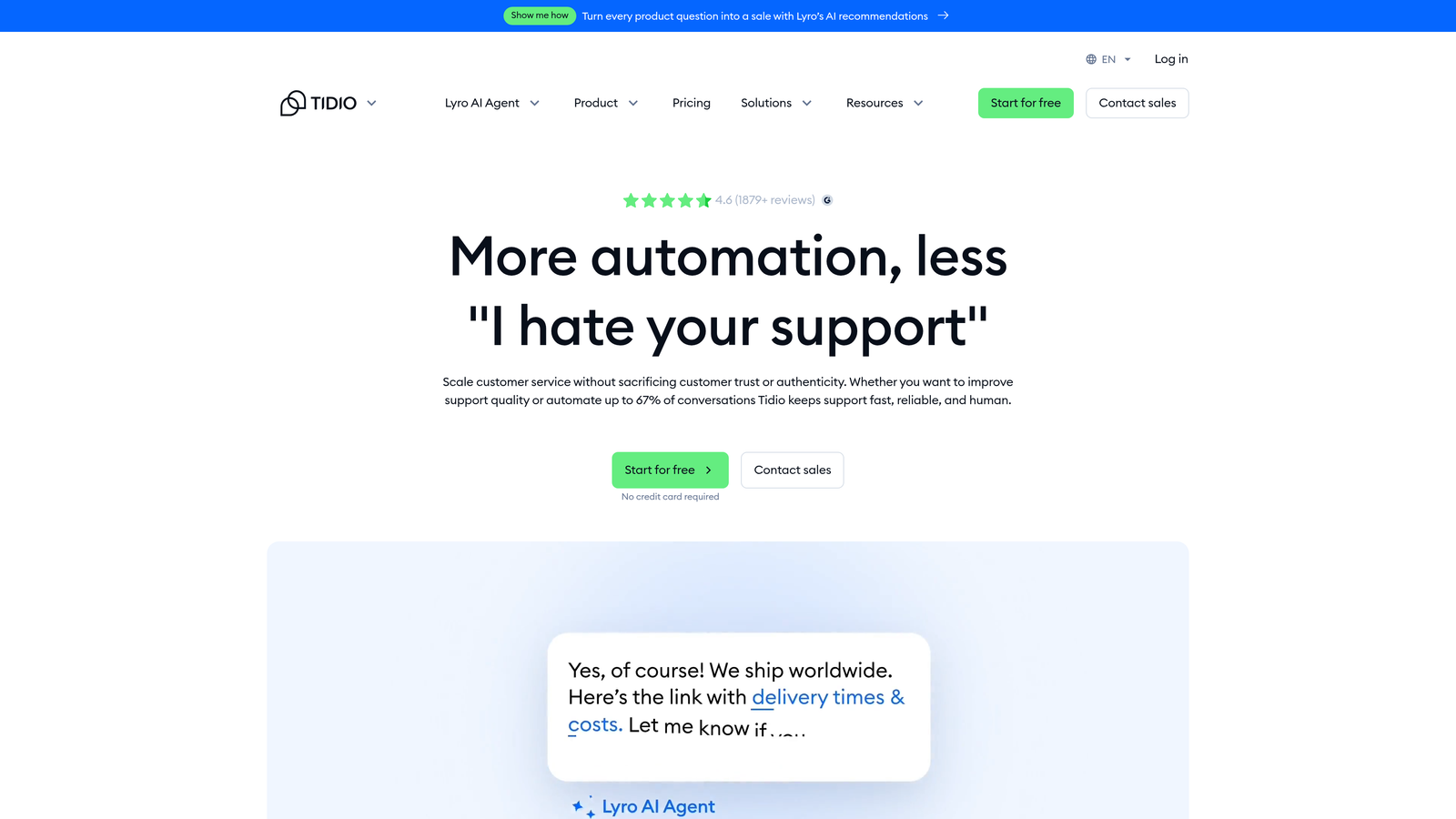
Tidio is a lightweight, fast-to-deploy live chat and AI chatbot platform with Lyro — its AI agent — designed for teams that want automation without technical overhead.
Where This Tool Shines
Tidio's setup speed is a genuine differentiator. Teams can go from signup to live AI chat in a matter of hours, not weeks. For companies that have been putting off automation because of implementation complexity, Tidio removes most of that friction.
Lyro handles a solid range of conversational support scenarios, and the visual chatbot flow builder makes it accessible to non-technical team members who want to customize behavior without writing code. The e-commerce integrations are particularly strong for Shopify and WooCommerce stores.
Key Features
Lyro AI Agent: Conversational AI agent with pricing based on the number of conversations handled rather than seats.
Quick Setup: Minimal technical overhead — designed for teams without dedicated implementation resources.
Combined Channels: Live chat, chatbot, and email in a single platform without complex configuration.
E-Commerce Integrations: Native integrations with Shopify and WooCommerce for order-aware support conversations.
Visual Flow Builder: Drag-and-drop chatbot builder for customizing conversation flows without code.
Best For
Small businesses, e-commerce brands, and mid-size teams that want AI chat automation deployed quickly and managed without technical complexity. Less suited to enterprise B2B teams needing deep CRM integration or complex workflow logic.
Pricing
Free tier available with limited Lyro conversations; paid plans start from approximately $29/month with Lyro conversation limits that increase at higher tiers. Verify current pricing at tidio.com.
6. Drift (Salesloft)
Best for: B2B revenue teams where support automation and sales pipeline overlap significantly.
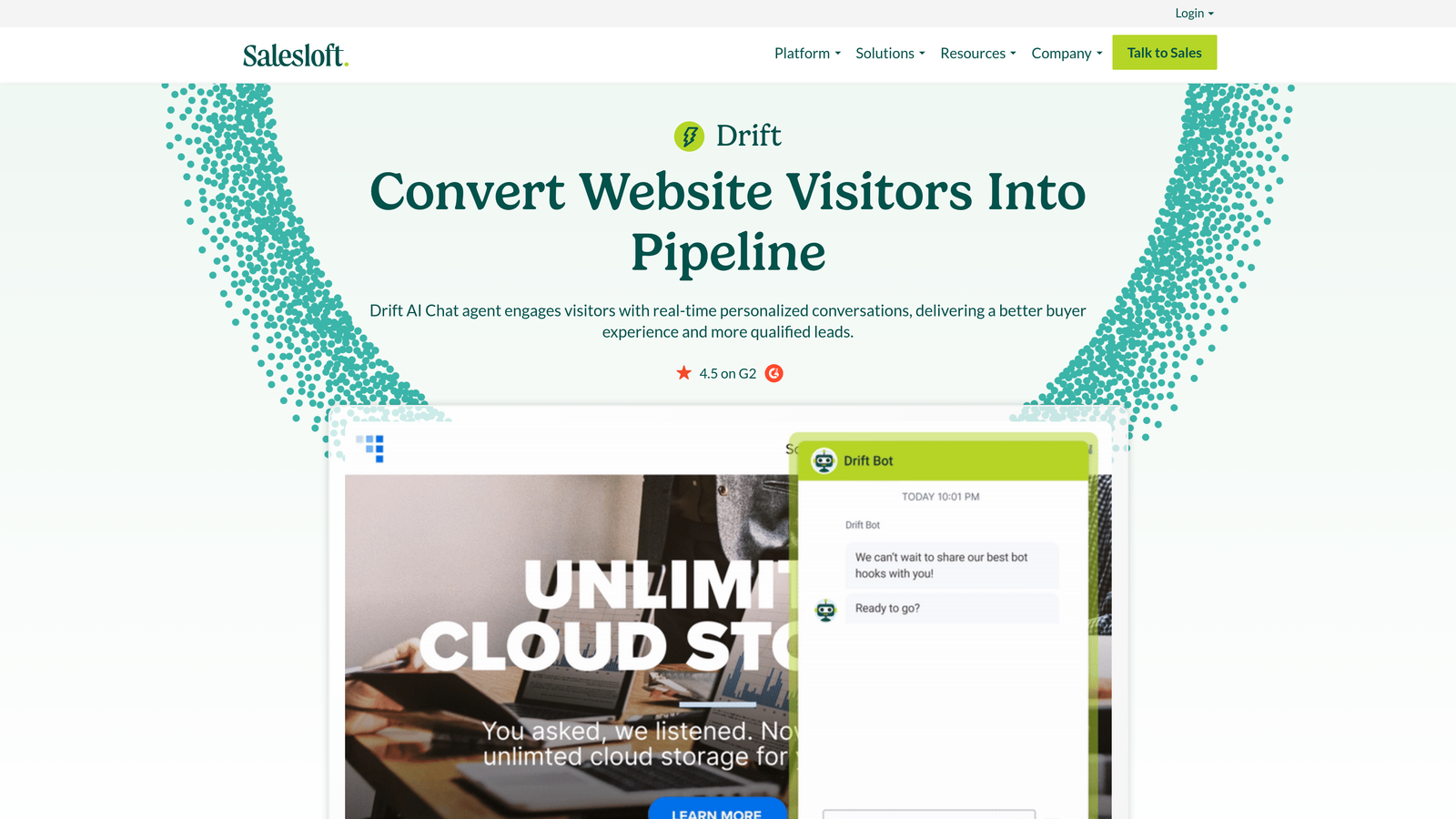
Drift is a conversational marketing and support platform now part of Salesloft, focused on blending AI-driven chat automation with revenue generation for B2B teams.
Where This Tool Shines
Drift occupies an interesting position: it's as much a revenue tool as a support tool. For B2B companies where the website chat widget needs to qualify leads, book meetings, and handle support questions simultaneously, Drift's account-based targeting and playbook system handles that complexity well.
The integration with Salesloft, Salesforce, and Marketo means that conversations flow naturally into sales workflows. If your support and sales teams share responsibility for customer conversations, that unified context is genuinely valuable.
Key Features
AI-Powered Playbooks: Automated conversation flows for both sales qualification and support resolution, configurable by account type or behavior.
Account-Based Targeting: Personalizes chat experiences based on company, industry, or account tier.
Meeting Scheduling Automation: Built-in calendar booking that converts conversations directly into sales meetings.
Revenue Intelligence Reporting: Analytics that connect chat interactions to pipeline and revenue outcomes.
CRM and Marketing Integrations: Native connections to Salesforce, Marketo, and the broader Salesloft platform.
Best For
Enterprise B2B companies where support and sales motions overlap, particularly those already using Salesloft for revenue operations. Teams looking for a pure support platform may find Drift's sales-first orientation more than they need.
Pricing
Enterprise and custom pricing — Drift has moved upmarket significantly since its acquisition by Salesloft. Contact Drift directly for current rates at drift.com.
7. Kustomer
Best for: High-volume consumer brands needing a CRM-native platform with full customer timeline visibility.
Kustomer is a CRM-native customer service platform owned by Meta that unifies the full customer timeline with AI-powered automation, designed for high-volume B2C brands.
Where This Tool Shines
Kustomer's defining feature is the 360-degree customer timeline. Every interaction — across every channel, across the entire customer relationship — is visible in a single view. For support agents handling complex, multi-touchpoint customer histories, that context dramatically reduces time spent reconstructing what's already happened.
The AI-powered deflection and routing works on top of that rich data layer, which means automation decisions are informed by full customer history rather than just the current conversation. That's a meaningful difference for brands where customer lifetime value varies significantly.
Key Features
360-Degree Customer Timeline: Full customer history across all channels and interactions in a single unified view.
AI-Powered Deflection and Routing: Automated ticket handling and intelligent routing informed by customer history and intent.
Omnichannel Inbox: Handles chat, email, SMS, social, and voice in a unified agent workspace.
Workflow Automation with Conditional Logic: Advanced automation builder for complex routing and escalation scenarios.
E-Commerce and CRM Integrations: Deep connections to e-commerce platforms and CRM data sources for consumer brands.
Best For
High-volume B2C brands and consumer-facing companies where customer history depth matters and agents handle complex, multi-channel relationships. Less optimized for B2B SaaS teams with smaller customer bases and more complex product-specific support needs.
Pricing
Enterprise pricing — contact Kustomer for current rates at kustomer.com. AI features are available at higher tiers.
8. Help Scout
Best for: Teams that value simplicity, transparent pricing, and a clean inbox-first support experience.
Help Scout is a clean, inbox-first support platform that has added AI Drafts and AI Summarize features while maintaining its reputation for simplicity and transparent pricing.
Where This Tool Shines
Help Scout's strongest selling point might be what it doesn't do: it doesn't surprise you with hidden AI add-on costs, complex configuration requirements, or enterprise-only features gated behind higher tiers. For teams that have been burned by pricing complexity elsewhere, that transparency is genuinely refreshing.
The AI features are practical rather than flashy. AI Drafts generates suggested replies that agents can review and send, while AI Summarize condenses long conversation threads — both save real time without requiring a separate AI platform purchase or per-resolution fee.
Key Features
AI Drafts: Automatically generates suggested reply drafts for agents to review, edit, and send — reducing time spent on routine responses.
AI Summarize: Condenses long conversation threads into concise summaries, helping agents get up to speed quickly on complex tickets.
Shared Inbox with Collision Detection: Prevents two agents from simultaneously responding to the same conversation.
Docs Knowledge Base Builder: Built-in tool for creating and maintaining a self-service knowledge base.
Transparent Per-User Pricing: Straightforward pricing with no hidden AI add-ons at most tiers — what you see is what you pay.
Best For
Small to mid-size teams that want a reliable, easy-to-use support inbox with practical AI assistance and no pricing surprises. Teams needing autonomous AI resolution or complex workflow automation may find Help Scout's feature set more limited than newer AI-first platforms.
Pricing
Starts around $20/user/month. Known for transparent, predictable pricing without separate AI add-on fees at standard tiers. Verify current pricing at helpscout.com.
9. Gorgias
Best for: E-commerce brands on Shopify or BigCommerce that want support tightly integrated with order data.
Gorgias is an e-commerce-native support platform with deep Shopify and BigCommerce integrations, using a ticket-volume pricing model that suits high-order-volume retailers.
Where This Tool Shines
Gorgias is built around a simple premise: e-commerce support agents should never have to leave their inbox to look up order information. Order data, shipping status, and purchase history surface directly inside every support conversation, which eliminates the tab-switching that slows down high-volume retail support teams.
The ticket-volume pricing model is worth understanding carefully. For brands with high order volume but relatively low support contact rates, Gorgias can be cost-efficient. For brands where a large percentage of orders generate support tickets, costs scale proportionally with that volume.
Key Features
Native E-Commerce Integrations: Deep connections with Shopify, BigCommerce, and Magento — order data surfaces directly inside the support inbox.
Order Data in Inbox: Agents see full order history, shipping status, and purchase details without leaving the conversation view.
E-Commerce Automation Rules: Automation triggers tied to order events like shipping delays, refund requests, or order cancellations.
AI-Powered Ticket Intent Detection: Automatically categorizes incoming tickets by intent to prioritize and route appropriately.
Revenue Statistics: Connects support interactions to revenue outcomes, showing which conversations convert or retain customers.
Best For
Direct-to-consumer e-commerce brands, particularly those on Shopify or BigCommerce, that handle high order volumes and want support deeply integrated with their commerce stack. Not designed for B2B SaaS teams with subscription-based products and complex product-specific support needs.
Pricing
Starts around $10/month for low ticket volumes, with costs scaling based on ticket count rather than agent seats. Verify current pricing at gorgias.com — the volume-based model means total cost depends heavily on your support contact rate.
Which Platform Is Right for Your Team?
The right automated support platform depends less on feature lists and more on where your team actually spends time and where your customers feel friction. Here's a quick-reference guide by buyer type.
B2B SaaS teams wanting AI-first architecture: Halo AI is built specifically for this use case. The combination of page-aware context, auto bug ticket creation, continuous learning, and business intelligence signals makes it uniquely suited to product-led SaaS companies. If you're scaling customer success without scaling headcount, it's worth a conversation.
Teams already invested in Intercom: Fin extends naturally from the existing platform. Just model out the per-resolution costs at your expected volume before committing.
Enterprise teams with complex omnichannel needs: Zendesk remains the benchmark for breadth and reliability, though the AI add-on costs deserve scrutiny in your budget planning.
Cost-conscious mid-market teams: Freshdesk offers the best entry-level value with a functional free tier and gradual pricing steps. Help Scout is the better choice if you prioritize simplicity and pricing transparency over feature depth.
E-commerce brands on Shopify or BigCommerce: Gorgias is purpose-built for this context. Tidio is a lighter alternative if you want fast deployment without platform lock-in.
B2B revenue teams blending support and sales: Drift (Salesloft) handles that overlap well, though the enterprise pricing reflects its upmarket positioning. Kustomer suits high-volume consumer brands where customer history depth matters most.
One pattern worth noting: platforms that charge per agent seat often feel affordable at first and expensive at scale. Platforms that charge per resolution or per conversation can feel affordable at low volume and expensive at high volume. Understanding your own support contact rate and expected automation rate is the most important input to any pricing comparison.
Your support team shouldn't scale linearly with your customer base. Let AI agents handle routine tickets, guide users through your product, and surface business intelligence while your team focuses on complex issues that need a human touch. See Halo in action and discover how continuous learning transforms every interaction into smarter, faster support.