9 Best Automated Support Platforms Reviewed for 2026
These automated support platform reviews cut through vendor hype to deliver honest assessments of nine leading tools evaluated across AI capability, integrations, scalability, deployment ease, and value—helping businesses identify whether their current platform truly delivers or simply layers AI onto outdated helpdesk infrastructure.
 Grant CooperFounder13 min read
Evaluating automated support platforms in 2026 feels a bit like shopping for enterprise software in the dark. Every vendor promises AI-powered resolution, seamless integrations, and effortless deployment. But the reality? Most platforms are legacy helpdesks with AI sprinkled on top, and the gap between marketing claims and actual capability can be significant.
This roundup cuts through that noise. We've assessed each platform against five criteria: AI capability depth, integration ecosystem, scalability, ease of deployment, and value for money. Whether you're building a support stack from scratch or evaluating whether your current platform is holding you back, this guide gives you an honest picture of what each tool actually delivers.
If you want deeper background before diving in, our guides on automated customer support and AI helpdesk software cover the foundational concepts worth understanding before committing to any platform.
Here are the top automated support platforms worth your attention in 2026.
1. Halo AI
Best for: B2B SaaS teams that want AI as the core architecture, not an afterthought.
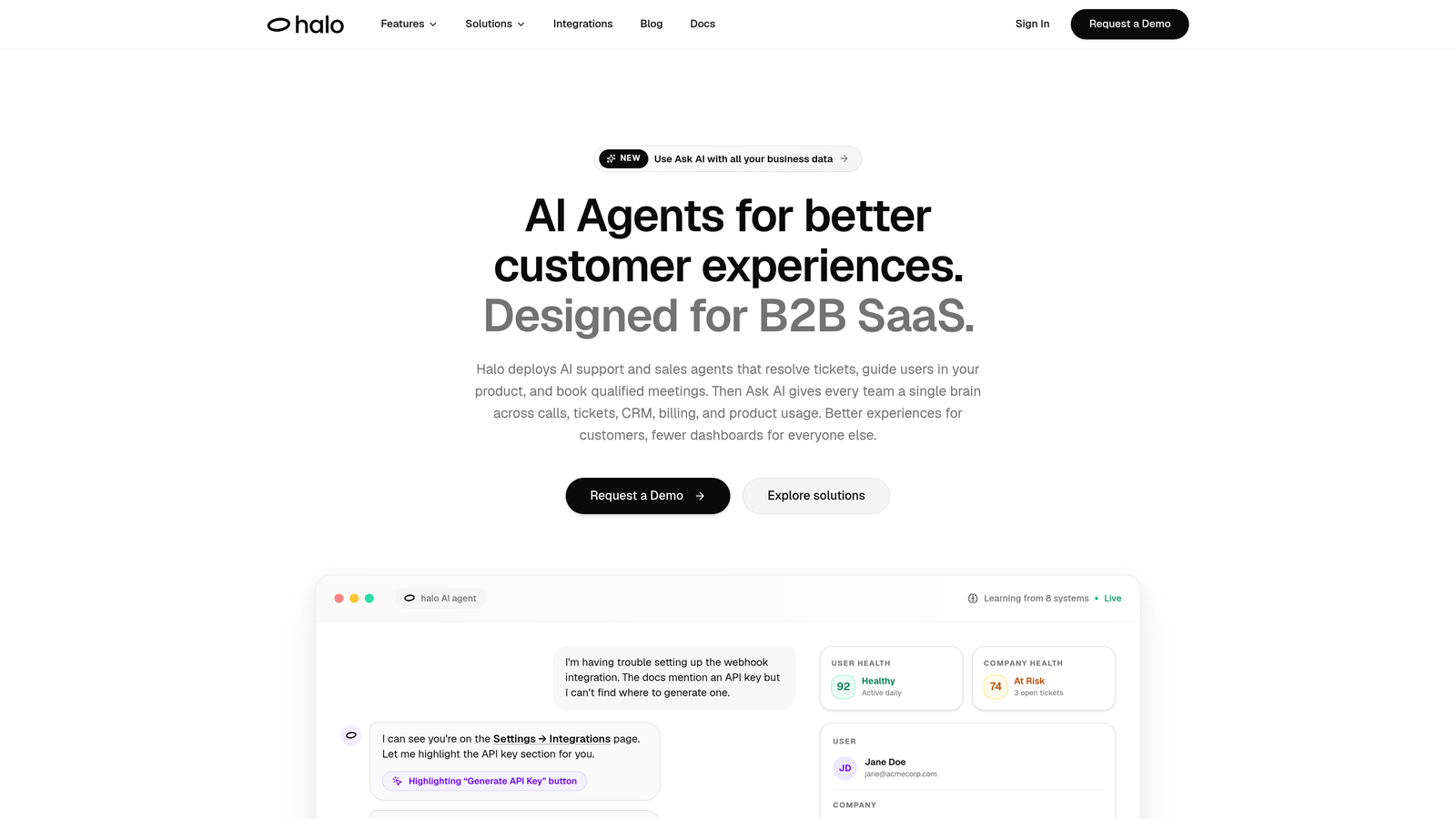
Halo AI is an AI-first customer support platform that deploys autonomous agents to resolve tickets, guide users visually, and surface business intelligence across your entire stack.
Where This Tool Shines
Most platforms in this space bolt AI onto an existing ticketing system. Halo was built the other way around: AI is the architecture, and every feature flows from that foundation. The result is a platform that doesn't just deflect tickets but genuinely resolves them, learns from every interaction, and gets measurably smarter over time.
What sets Halo apart from every other tool on this list is the combination of page-aware context and business intelligence. The chat widget doesn't just respond to text queries; it sees what the user is looking at and can provide visual UI guidance in real time. Meanwhile, the smart inbox surfaces customer health signals and revenue intelligence that most support platforms simply don't generate.
Key Features
Page-Aware Chat Widget: The widget understands what page a user is on and what they're seeing, enabling visual guidance rather than generic text responses.
Autonomous Bug Ticket Creation: Automatically creates and routes bug reports to Linear and other dev tools without requiring agent intervention.
Smart Inbox with Business Intelligence: Goes beyond support analytics to surface customer health signals, revenue intelligence, and anomaly detection directly in the inbox.
Continuous Learning Engine: Every resolved interaction feeds back into the model, improving resolution quality over time without manual retraining.
Deep Integration Ecosystem: Native connections to Slack, HubSpot, Intercom, Stripe, Zoom, PandaDoc, and Fathom, covering the full business stack rather than just the support layer.
Best For
Halo is the strongest fit for B2B SaaS companies and product teams that want AI to be a genuine architectural decision rather than a feature add-on. It's particularly well-suited for teams that need their support platform to connect across engineering, sales, and customer success workflows simultaneously.
Pricing
Contact for pricing. Plans are tailored based on ticket volume and feature requirements, which is typical for AI-native platforms at this capability level.
2. Zendesk AI
Best for: Established enterprise teams already invested in the Zendesk ecosystem.
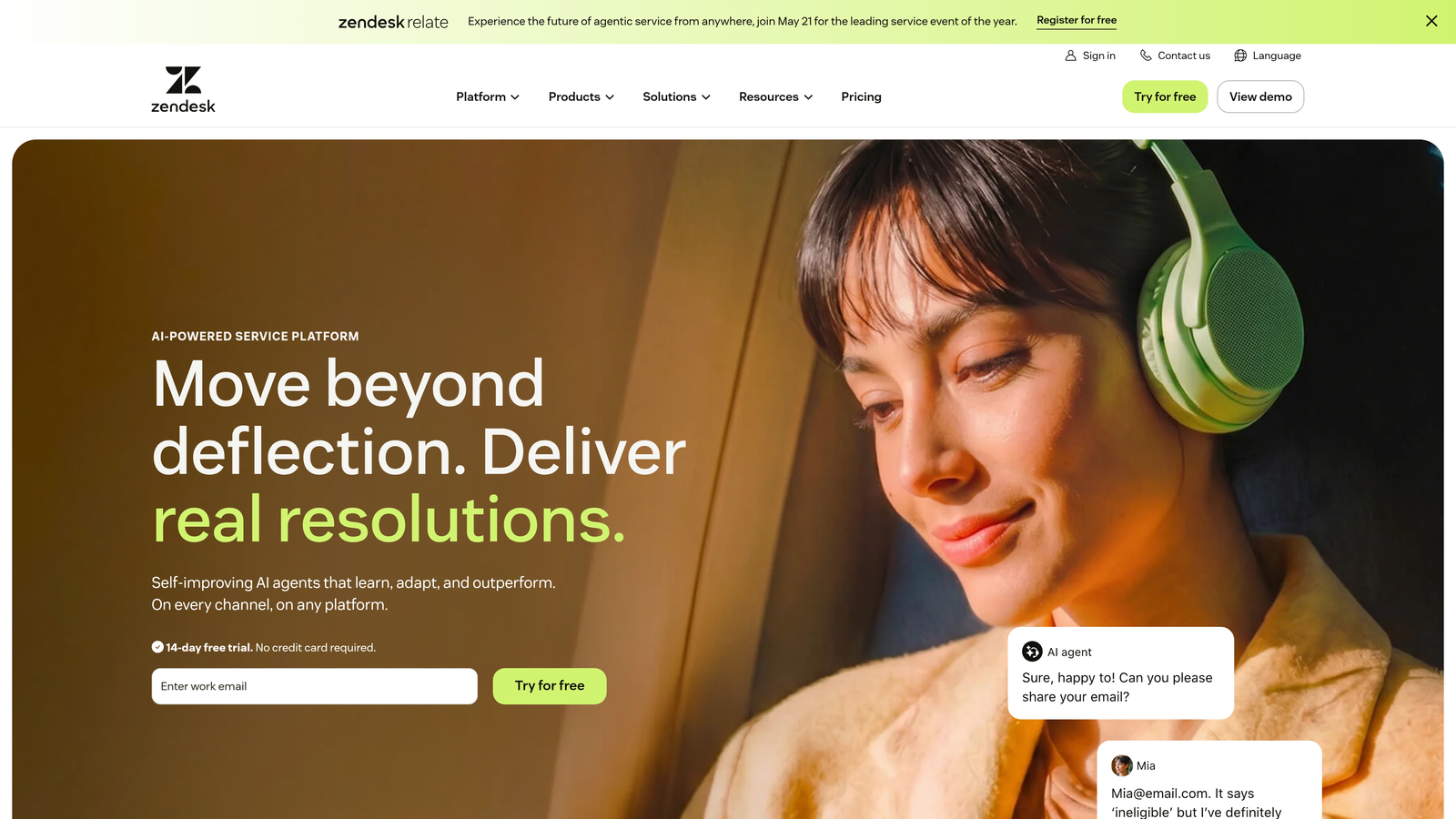
Zendesk AI is an enterprise helpdesk platform with AI capabilities layered on top of its mature ticketing, knowledge base, and omnichannel infrastructure.
Where This Tool Shines
Zendesk's greatest strength is its maturity. The platform has been refined over many years, and its ticketing system, reporting dashboards, and marketplace integrations are among the most robust available. For teams that have already built workflows around Zendesk, the AI additions provide meaningful efficiency gains without requiring a platform migration.
The tradeoff is that AI feels additive rather than foundational. Ticket routing suggestions and agent-assist features are genuinely useful, but they're enhancements to a human-first workflow rather than a reimagined one. Teams expecting autonomous resolution at scale may find the AI capabilities more limited than the marketing suggests.
Key Features
AI-Powered Routing and Suggested Replies: Automatically triages incoming tickets and surfaces response suggestions to speed up agent handling time.
Marketplace Ecosystem: Thousands of third-party integrations available, covering virtually every business tool category.
Omnichannel Support: Unified inbox for email, chat, phone, and social channels with consistent workflow management.
Advanced Reporting: Comprehensive analytics dashboards with customizable metrics and team performance tracking.
Best For
Enterprise teams with established Zendesk workflows, large agent teams that need robust reporting, and organizations where AI augmentation of human agents is the goal rather than autonomous resolution.
Pricing
Suite plans start around $55 per agent per month. Advanced AI capabilities typically require higher-tier plans or add-ons, which can increase total cost significantly at scale.
3. Intercom Fin
Best for: Product-led growth companies with strong help center content and in-app support needs.
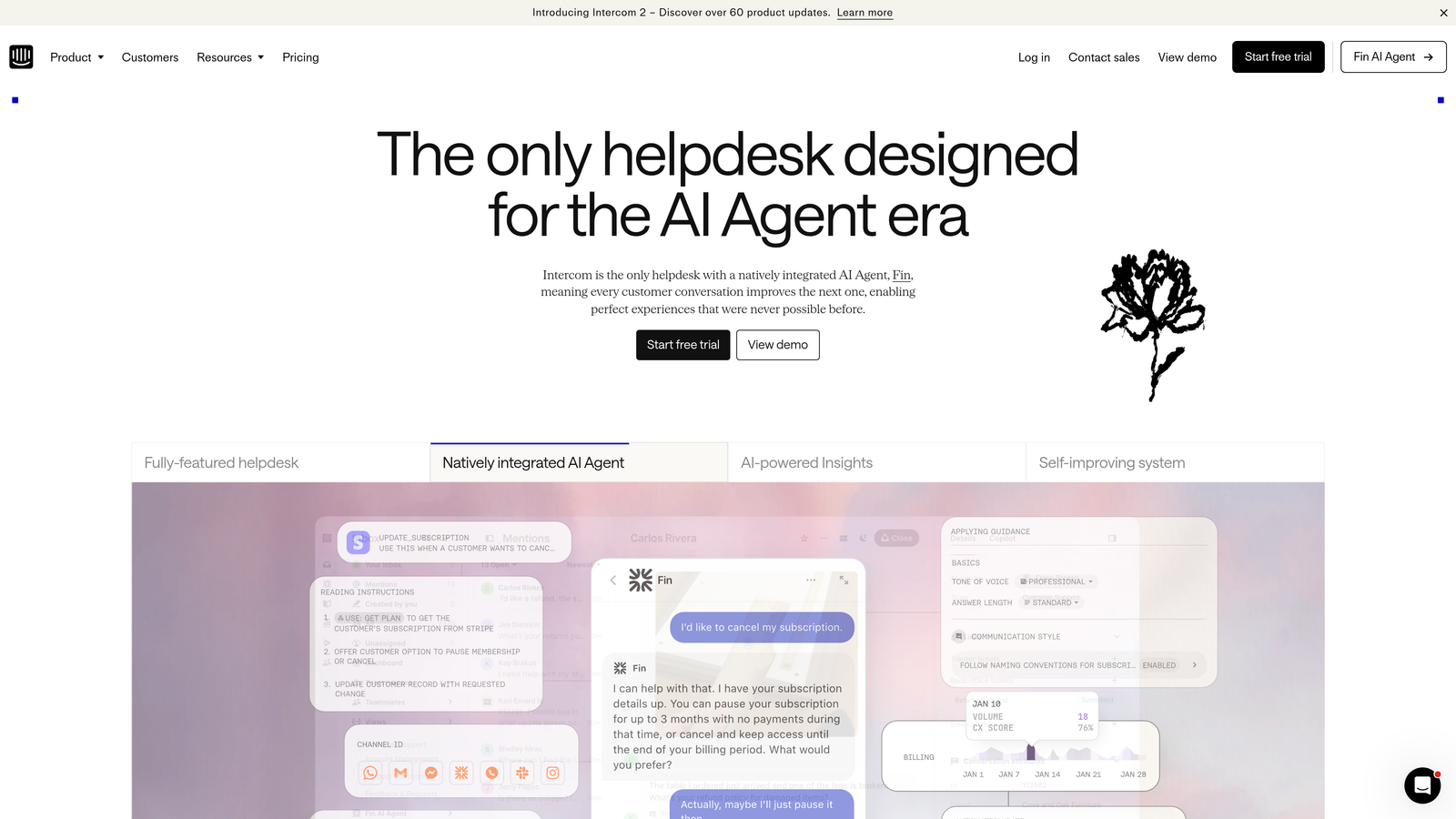
Intercom Fin is a conversational AI agent built into Intercom's messaging-first platform, designed to resolve support questions using existing help center content with minimal setup.
Where This Tool Shines
Fin's core value proposition is speed to value. If you have a well-maintained help center, Fin can start resolving common queries almost immediately after setup. The integration with Intercom's broader product, including in-app messaging and product tours, creates a coherent user experience from onboarding through ongoing support.
For PLG companies where the product itself is the primary growth engine, this tight coupling between product engagement and support is genuinely valuable. The visual conversation workflow builder also makes it accessible for teams without deep technical resources.
Key Features
Fin AI Agent: Auto-resolves queries by drawing on help center articles and custom content sources, with transparent escalation when confidence is low.
In-App Messaging and Product Tours: Tightly integrated support and onboarding flows within the product experience itself.
Visual Workflow Builder: Customizable conversation flows built without code, enabling non-technical teams to manage automation logic.
Resolution Analytics: Detailed reporting on AI resolution rates and conversation quality to track performance over time.
Best For
PLG SaaS companies, teams with existing Intercom deployments, and organizations where in-app messaging and product-led support are central to the customer experience strategy.
Pricing
Starts at $39 per seat per month. Fin AI usage is billed per resolution, so costs can scale significantly with volume. Worth modeling carefully before committing.
4. Freshdesk Freddy AI
Best for: Budget-conscious mid-market teams needing omnichannel support with accessible AI features.
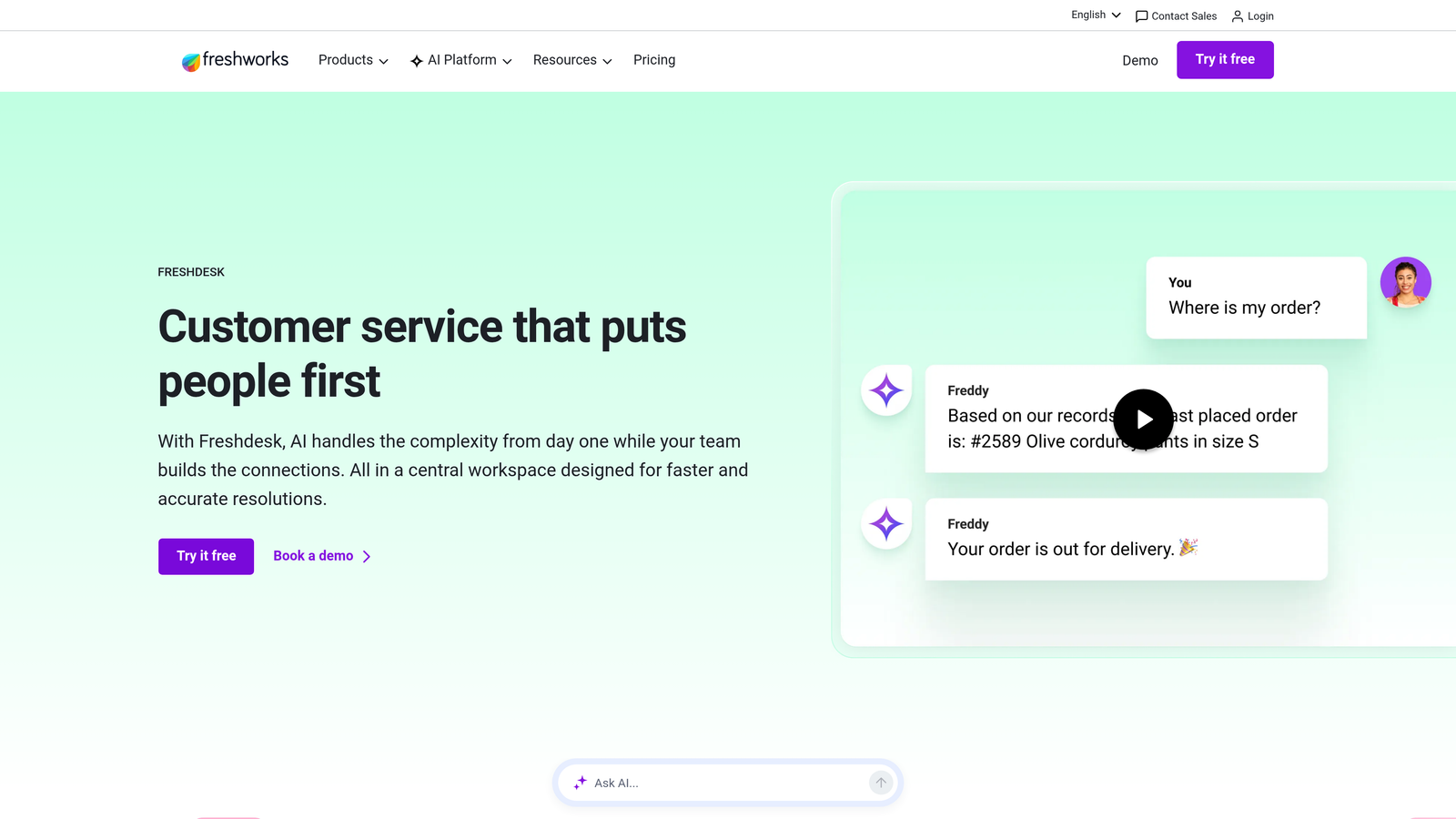
Freshdesk is Freshworks' AI-powered helpdesk offering omnichannel ticketing with Freddy AI for automation, agent assist, and self-service at competitive price points.
Where This Tool Shines
Freshdesk's pricing model is its most distinctive feature in a crowded market. With a functional free tier and paid plans that undercut most competitors, it opens enterprise-style helpdesk capabilities to teams that can't justify Zendesk-level spend. Freddy AI handles the core automation tasks well: triage, suggested responses, and canned reply recommendations that meaningfully reduce agent workload.
The platform is also notably accessible for teams without dedicated IT resources. Setup is straightforward, the interface is intuitive, and the built-in knowledge base and community forums give customers self-service options without additional tooling.
Key Features
Freddy AI Automation: Handles auto-triage, suggested responses, and canned reply recommendations to accelerate agent workflows.
Omnichannel Inbox: Unified management across email, chat, phone, and social channels within a single interface.
Built-In Knowledge Base: Native knowledge management with community forums, reducing the need for separate self-service tooling.
Accessible Pricing: Free tier available for small teams, with paid plans starting around $15 per agent per month.
Best For
Growing mid-market teams, companies moving off spreadsheets or basic email ticketing, and organizations where cost efficiency is a primary evaluation criterion alongside solid core functionality.
Pricing
Free tier available. Paid plans start around $15 per agent per month, making it one of the most affordable full-featured options on this list.
5. Ada
Best for: Enterprise teams with multilingual customer bases and complex automation requirements.
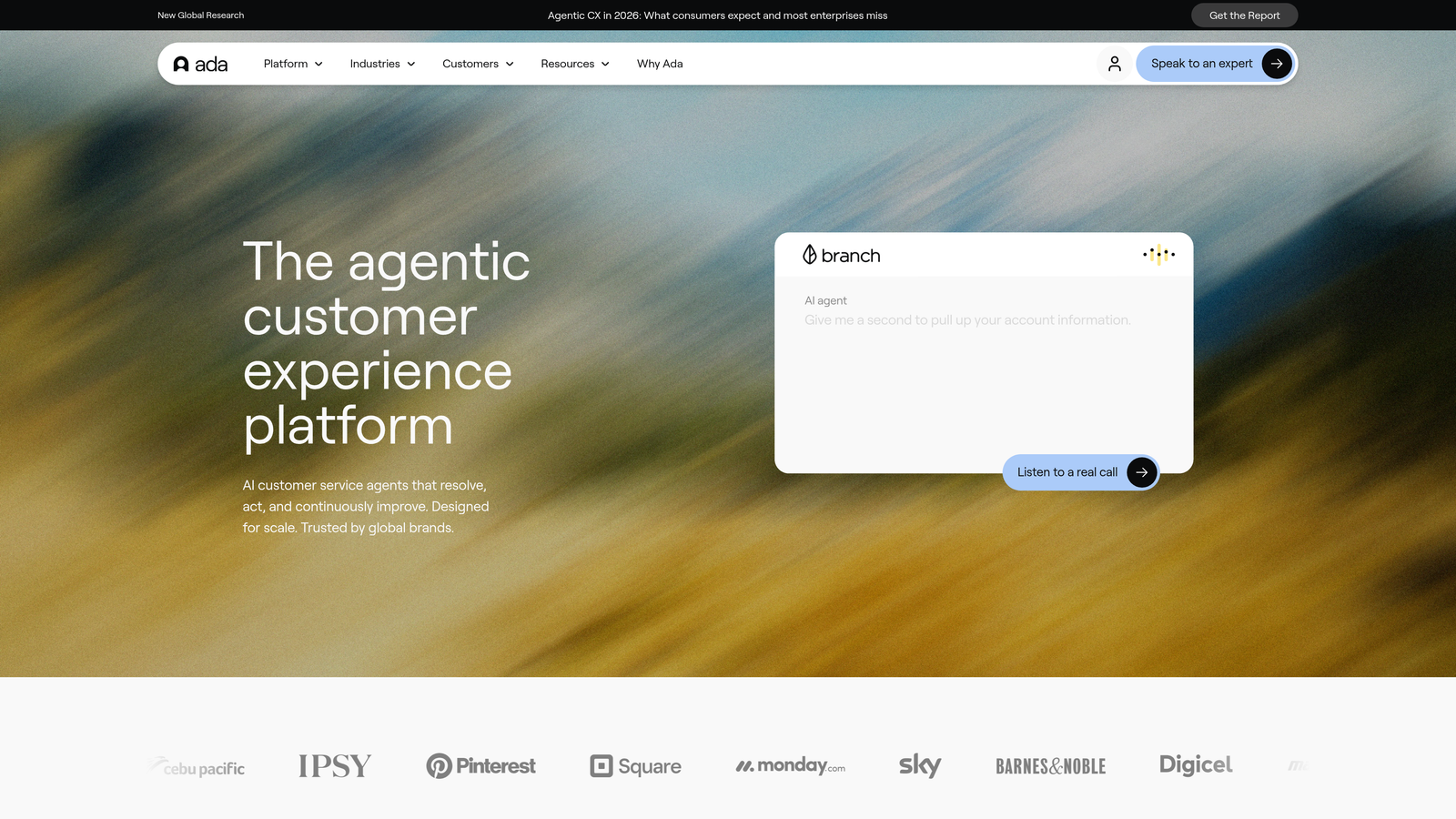
Ada is an enterprise-grade AI automation platform focused on delivering personalized, multilingual customer interactions across web, mobile, social, and messaging channels.
Where This Tool Shines
Ada's standout capability is multilingual support at scale. For enterprises serving customers across multiple regions and languages, Ada's breadth of language support and localization capabilities are difficult to match. The no-code automation builder also enables non-technical teams to create sophisticated conversation flows without engineering resources.
Proactive messaging is another area where Ada differentiates. Rather than waiting for customers to initiate contact, Ada can trigger personalized outreach based on user behavior, which shifts support from reactive to proactive. This is particularly valuable for reducing churn signals before they become cancellations.
Key Features
No-Code Automation Builder: Visual interface for creating complex, branching conversation flows without writing code.
Multilingual Support: Broad language coverage enabling consistent customer experiences across global markets.
Proactive Messaging: Behavior-triggered outreach that engages customers before they need to submit a support request.
CRM and Helpdesk Integrations: Connects with major CRMs, helpdesk platforms, and e-commerce systems for data continuity.
Best For
Global enterprises with multilingual support requirements, teams managing high-volume customer interactions across multiple channels, and organizations that want proactive engagement capabilities alongside reactive support.
Pricing
Custom enterprise pricing. Contact Ada directly for a quote. Expect pricing to reflect enterprise-tier capabilities and scale.
6. Tidio
Best for: Small businesses and e-commerce teams that need fast deployment with minimal technical overhead.
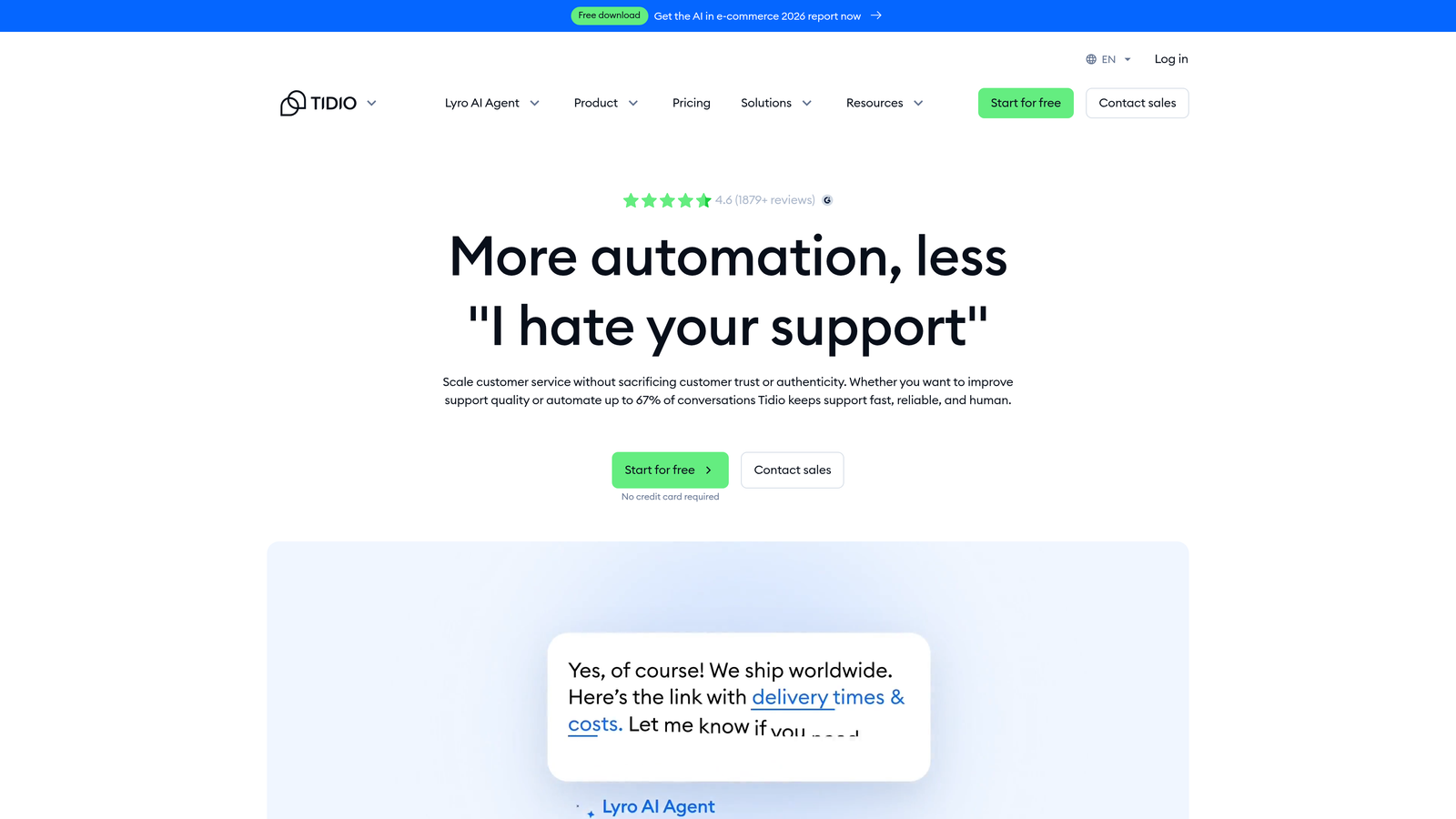
Tidio is a user-friendly chatbot and live chat platform designed for quick deployment, particularly popular with small businesses and e-commerce teams.
Where This Tool Shines
Tidio earns its place on this list through sheer accessibility. The drag-and-drop chatbot builder with pre-built templates means a small team can have a functional automated support flow running in hours rather than weeks. For e-commerce businesses in particular, the Shopify and WordPress integrations are tight and well-maintained.
The Lyro AI chatbot adds genuine conversational capability on top of the template-based flows, drawing from knowledge base content to handle questions that fall outside predefined paths. It's not the most sophisticated AI on this list, but it's well-matched to the needs of the teams Tidio serves.
Key Features
Visual Chatbot Builder: Drag-and-drop interface with pre-built templates for common support scenarios, requiring no technical expertise.
Lyro AI Chatbot: Conversational AI that answers questions from knowledge base content beyond the scope of template flows.
Real-Time Visitor Monitoring: Live chat with visibility into active visitors, enabling proactive engagement at the right moment.
E-Commerce Integrations: Native Shopify, WordPress, and WooCommerce integrations for seamless deployment on common e-commerce stacks.
Best For
Small businesses, e-commerce brands on Shopify or WordPress, and teams that prioritize speed of deployment and ease of management over advanced AI capabilities.
Pricing
Free plan available. Paid plans start around $29 per month, making it one of the most affordable options for small teams with straightforward automation needs.
7. Forethought
Best for: Teams that want to add intelligent AI capabilities to an existing Zendesk or Salesforce deployment.
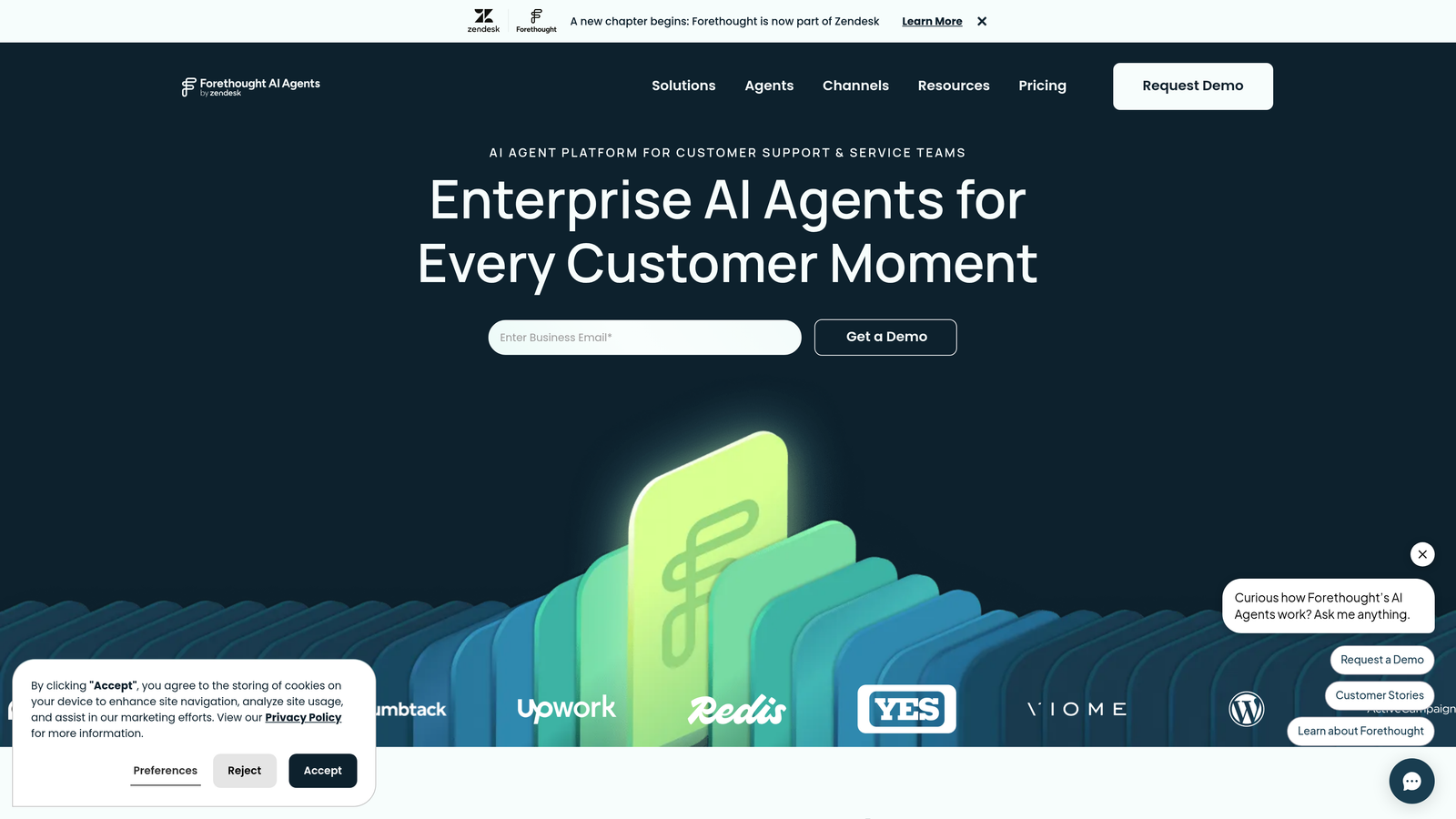
Forethought is an AI platform that layers intelligent triage, agent assist, and automated resolution on top of existing helpdesk systems rather than replacing them.
Where This Tool Shines
Forethought occupies a unique position in this market: it's explicitly designed to enhance rather than replace your current helpdesk. For teams that have significant workflow investment in Zendesk or Salesforce and aren't ready for a full migration, Forethought delivers meaningful AI capability without the switching cost.
The intent-based routing is particularly strong. Rather than routing on keywords or basic rules, Forethought analyzes the actual intent and priority of incoming tickets, which produces more accurate triage than most native helpdesk AI features. The agent assist layer also surfaces relevant knowledge in real time during live conversations, reducing handle time without requiring agents to search manually.
Key Features
Intent-Based Ticket Triage: AI routing based on actual customer intent and ticket priority rather than keyword matching.
Real-Time Agent Assist: Surfaces relevant knowledge base content and suggested responses during live agent conversations.
Solve Widget: Self-service resolution layer that deflects common queries before they reach the agent queue.
Helpdesk-Agnostic Architecture: Designed to sit on top of Zendesk, Salesforce, and other major helpdesk platforms without requiring migration.
Best For
Teams with established Zendesk or Salesforce workflows that want to add AI intelligence without platform migration, and organizations where agent augmentation is the primary goal.
Pricing
Custom pricing based on ticket volume. Contact Forethought for a quote. Pricing typically reflects the existing helpdesk tier and volume of AI-processed interactions.
8. Kustomer
Best for: Customer-obsessed teams that need deep CRM-level context within every support interaction.
Kustomer is a CRM-centric customer service platform, now part of Meta, that unifies customer data into a single timeline with AI-powered automation and agent suggestions.
Where This Tool Shines
Kustomer's defining feature is the unified customer timeline. Instead of agents toggling between a support ticket and a separate CRM record, Kustomer surfaces the full customer history, including orders, past interactions, and behavioral data, directly within the support conversation. This context depth enables more personalized, informed responses without manual research.
The AI-powered workflow automation is also mature, handling routing, escalation, and suggested actions based on conversation context. For high-volume teams where agent efficiency and personalization both matter, Kustomer strikes a balance that pure ticketing systems struggle to match.
Key Features
Unified Customer Timeline: Combines support history, order data, and interaction records in a single view accessible during every conversation.
AI-Powered Workflow Automation: Intelligent routing, escalation triggers, and agent suggestions based on conversation context and customer history.
Omnichannel Support: Unified management across email, chat, social, and SMS within a single agent interface.
CRM-Level Data Access: Full customer relationship data available in context without switching between systems.
Best For
High-growth e-commerce and D2C brands, customer-centric teams where personalization at scale is a priority, and organizations that want CRM and support unified rather than integrated.
Pricing
Enterprise plans start around $89 per user per month, positioning Kustomer at the premium end of the market. Best evaluated against the efficiency gains from reduced context-switching and improved resolution quality.
9. HubSpot Service Hub
Best for: Teams already using HubSpot CRM who want support tightly connected to marketing and sales data.
HubSpot Service Hub is HubSpot's customer service module offering ticketing, knowledge base, and AI-powered automation tightly integrated with HubSpot's CRM, marketing, and sales tools.
Where This Tool Shines
Service Hub's strongest argument is its native HubSpot integration. For teams already running HubSpot for CRM, marketing automation, or sales, adding Service Hub means support conversations are immediately connected to the full customer journey without any integration work. A support ticket can reference a contact's deal history, recent marketing interactions, and lifecycle stage in real time.
The AI chatbot builder and ticket automation are solid for a platform where support is one module among many rather than the core product. The built-in knowledge base with SEO recommendations is also a practical differentiator for teams that want their help content to drive organic traffic.
Key Features
Native HubSpot CRM Integration: Full customer journey visibility within every support interaction, with no separate integration required.
AI Chatbot and Ticket Automation: Automated routing, response suggestions, and chatbot flows built within the HubSpot ecosystem.
SEO-Optimized Knowledge Base: Built-in SEO recommendations help help center content rank in search, turning support documentation into a traffic asset.
Customer Feedback and NPS Tracking: Native survey tools and NPS tracking connected to contact records for closed-loop feedback management.
Best For
Teams already on HubSpot who want a unified platform rather than a best-of-breed support tool, and growing companies that want support, CRM, and marketing data in a single system without managing complex integrations.
Pricing
Free tools available. Starter plan at $20 per month. Professional plan at $100 per seat per month. The free tier is genuinely functional for small teams getting started.
Which Platform Is Right for Your Team?
The right choice here depends less on feature checklists and more on a few foundational questions: Is AI a core architectural decision for your support stack, or a feature you're adding to an existing system? What does your current tool ecosystem look like? And are you optimizing for agent efficiency, autonomous resolution, or something in between?
Here's how the recommendations break down by buyer profile.
AI-native teams building from scratch: Halo AI is the clear choice. It's the only platform on this list where AI is the foundation rather than a layer added on top, and the combination of page-aware context, continuous learning, and business intelligence goes well beyond what any legacy helpdesk offers.
Existing Zendesk shops: Zendesk AI makes the most sense if migration cost is a barrier. Alternatively, Forethought can add meaningful intelligence without touching your current workflows.
PLG and messaging-first companies: Intercom Fin is purpose-built for this motion, particularly if you're already using Intercom for in-app messaging and onboarding.
Budget-conscious mid-market teams: Freshdesk offers the best combination of capability and cost. The free tier alone is worth evaluating before committing to paid alternatives.
Enterprise with global, multilingual needs: Ada's language coverage and no-code automation depth make it the strongest fit for complex, international deployments.
One principle applies across all of these evaluations: a platform where AI is bolted on will always feel like it. The teams getting the most from automated support in 2026 are the ones that chose AI as a strategic foundation, not a feature upgrade.
Your support team shouldn't scale linearly with your customer base. Let AI agents handle routine tickets, guide users through your product, and surface business intelligence while your team focuses on complex issues that need a human touch. See Halo in action and discover how continuous learning transforms every interaction into smarter, faster support.
Want to go deeper before deciding? Our guides on chatbot software comparison and chatbot pricing cover the evaluation frameworks and cost models worth understanding before you commit.