9 Best Automated Support Platform Subscriptions for B2B Teams in 2026
Finding the right automated support platform subscription can transform how B2B teams handle tickets — resolving common issues instantly, routing complex ones intelligently, and freeing agents for high-value work. This guide evaluates the 9 best options available in 2026, comparing automation depth, AI quality, integration breadth, and total value to match every team's situation.
 Grant CooperFounder13 min read
Support teams are drowning in repetitive tickets while customers wait longer than ever. The right automated support platform subscription changes that equation: resolving common issues instantly, routing complex ones intelligently, and giving your team back the time to focus on work that actually requires a human.
But with dozens of platforms competing for your budget, choosing the wrong one means paying for features you don't need while missing the ones you do. This guide breaks down the best automated support platform subscriptions available in 2026, evaluated on automation depth, integration breadth, AI quality, and total value.
Whether you're migrating off a legacy helpdesk or building your support stack from scratch, you'll find a clear recommendation for your situation. We've prioritized platforms that go beyond basic ticket routing: tools that genuinely learn, adapt, and deliver measurable outcomes at scale.
1. Halo AI
Best for: B2B SaaS teams that want autonomous ticket resolution with product-aware context
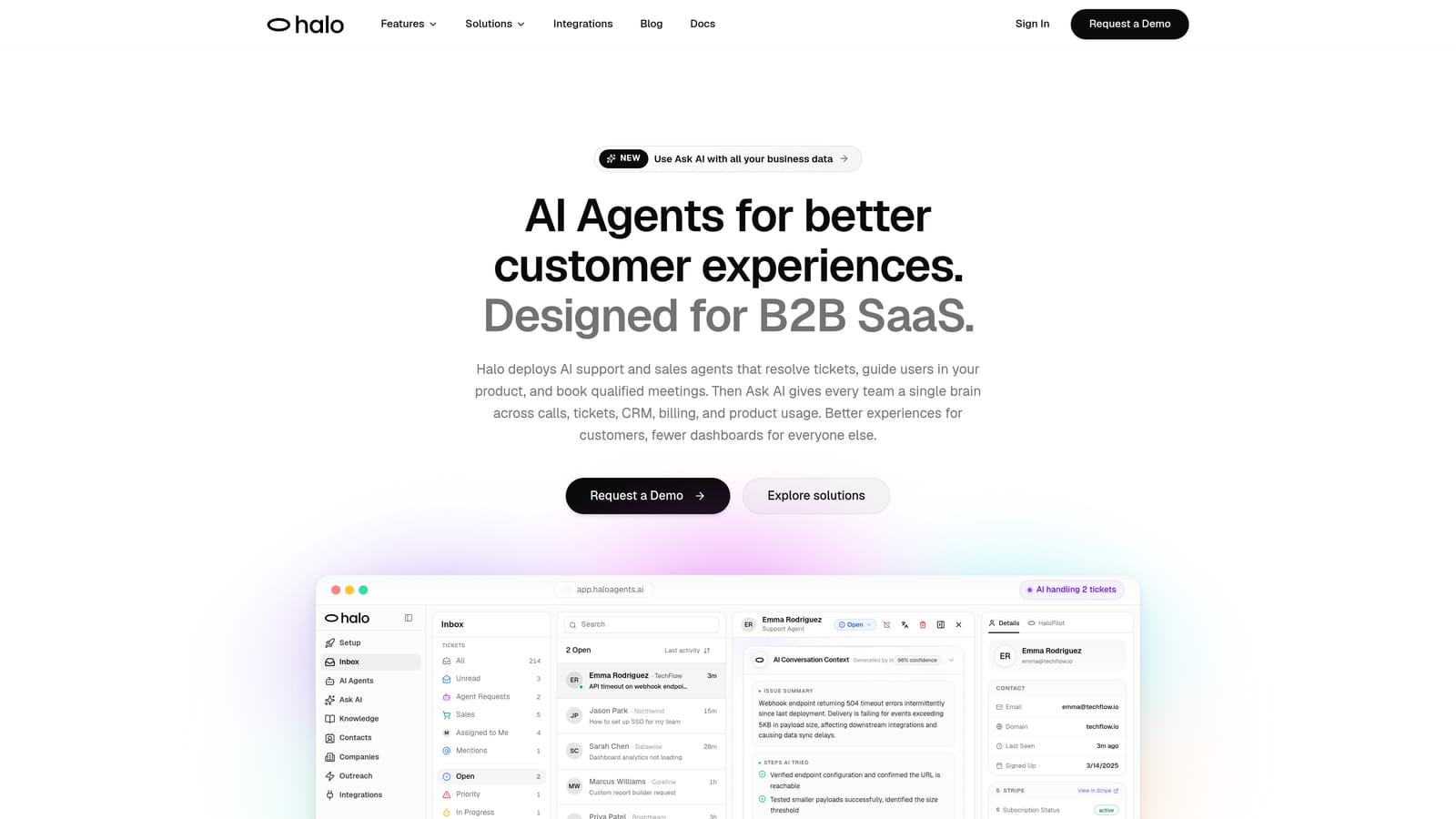
Halo AI is an AI-native customer support platform that deploys autonomous agents to resolve tickets, guide users through your product, and surface business intelligence from every interaction.
Where This Tool Shines
What separates Halo from most platforms on this list is the architecture underneath. This isn't a traditional helpdesk with an AI chatbot bolted on. It's built from the ground up around autonomous resolution, which means the AI isn't just suggesting replies for a human to approve — it's closing tickets end-to-end, learning from every interaction, and getting measurably better over time.
The page-aware chat widget is a standout capability. The agent understands what screen the user is currently on and can provide contextual UI guidance specific to that view. For SaaS products with complex interfaces, this is the difference between generic help documentation and genuinely useful, in-the-moment assistance. The smart inbox goes further still, surfacing customer health signals, revenue anomalies, and product feedback patterns that transform your support queue into a source of strategic intelligence.
Key Features
Page-Aware Chat Widget: Understands the user's current screen and delivers contextual UI guidance without requiring them to describe where they are.
Continuous Learning Engine: Improves resolution quality from every interaction automatically, without manual retraining cycles.
Smart Inbox with Business Intelligence: Surfaces customer health signals, revenue anomalies, and product feedback trends beyond standard support metrics.
Auto Bug Ticket Creation: Automatically generates structured bug reports in Linear and connected tools when users surface issues.
Live Agent Handoff: Seamless escalation path ensures complex or sensitive issues reach a human without friction.
Deep Integrations: Connects to Linear, Slack, HubSpot, Intercom, Stripe, Zoom, PandaDoc, and Fathom.
Best For
Halo is the strongest fit for B2B SaaS product teams that want genuine AI autonomy, not just AI assistance. It's particularly well-suited for companies evaluating whether their current Zendesk or Intercom setup is delivering the ROI an AI-first architecture could provide. Teams that care about support data informing product and revenue decisions will find the business intelligence layer especially valuable.
Pricing
Subscription model with custom pricing based on your team's needs. Contact Halo directly at haloagents.ai for a tailored quote.
2. Zendesk
Best for: Large enterprises needing a mature, fully configurable omnichannel helpdesk
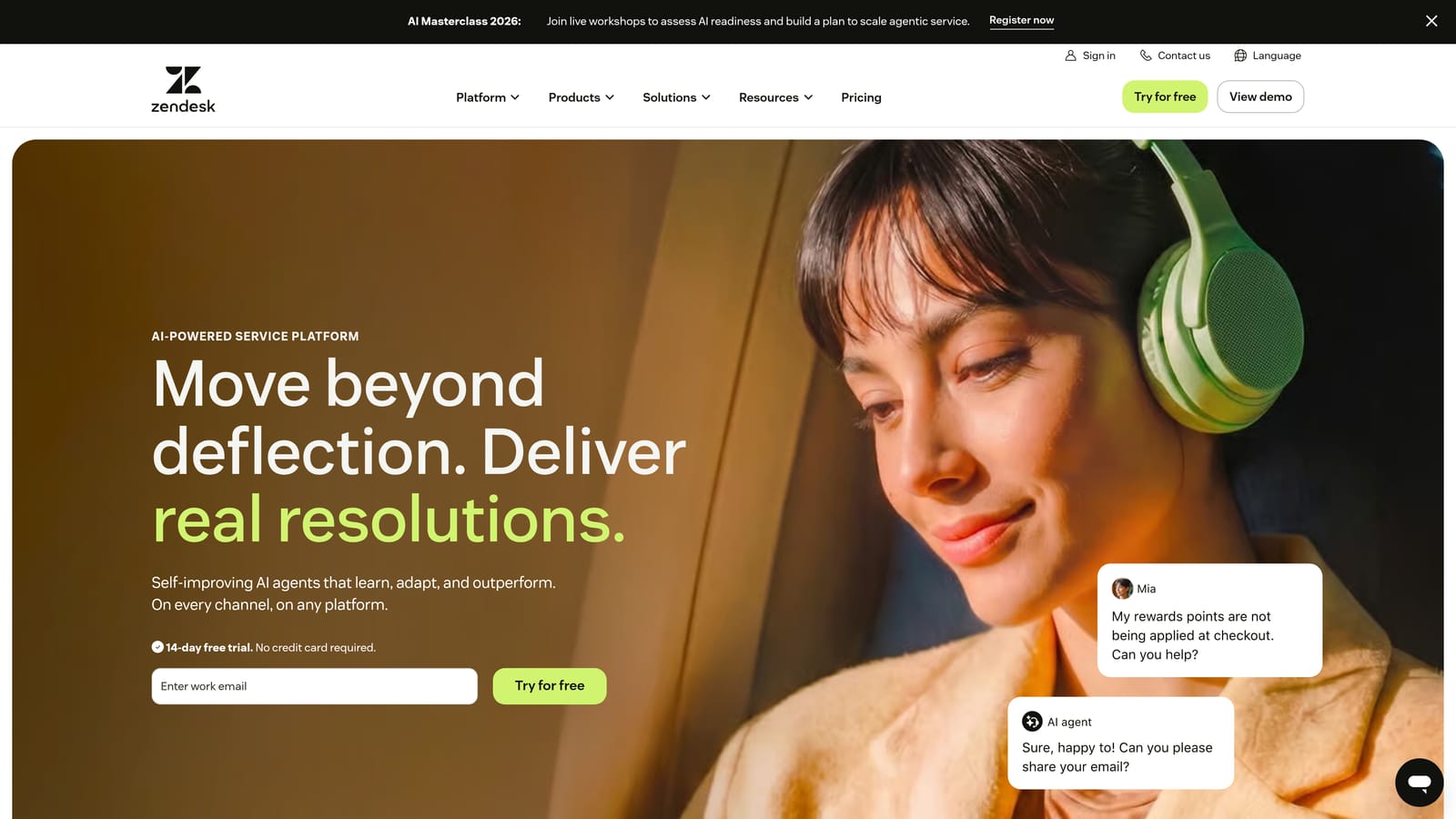
Zendesk is a market-leading enterprise helpdesk platform with broad channel support, a large integration marketplace, and AI features layered on top of its established ticketing foundation.
Where This Tool Shines
Zendesk's greatest strength is its maturity. Decades of development have produced a platform that handles virtually any support workflow at scale, with enterprise-grade compliance controls, deep customization options, and a marketplace of hundreds of integrations. For organizations with complex support operations, established processes, and dedicated admin resources, Zendesk delivers reliability that newer platforms are still building toward.
The AI capabilities, offered through the Zendesk AI add-on, cover triage, suggested replies, and intelligent routing. These are genuinely useful features, though it's worth noting they're additions to the core ticketing system rather than native to the architecture. Teams expecting AI-autonomous resolution comparable to newer platforms may find the experience more "AI-assisted" than "AI-autonomous."
Key Features
Omnichannel Support: Unified inbox across email, chat, voice, and social media channels.
Zendesk AI Add-On: Triage automation, suggested replies, and intelligent routing powered by AI.
App Marketplace: Hundreds of pre-built integrations covering CRM, billing, analytics, and more.
Advanced Reporting and SLA Management: Granular performance tracking with configurable service level agreement rules.
Enterprise Compliance Controls: SOC 2, HIPAA, GDPR, and other compliance frameworks supported.
Best For
Large enterprises with established support operations, dedicated Zendesk administrators, and complex multi-channel workflows. Less ideal for teams seeking AI-native autonomous resolution without significant configuration investment.
Pricing
Suite plans start at approximately $55 per agent per month. Verify current pricing at zendesk.com, as rates change frequently at the enterprise tier.
3. Intercom
Best for: SaaS teams blending customer support with onboarding and lifecycle communication
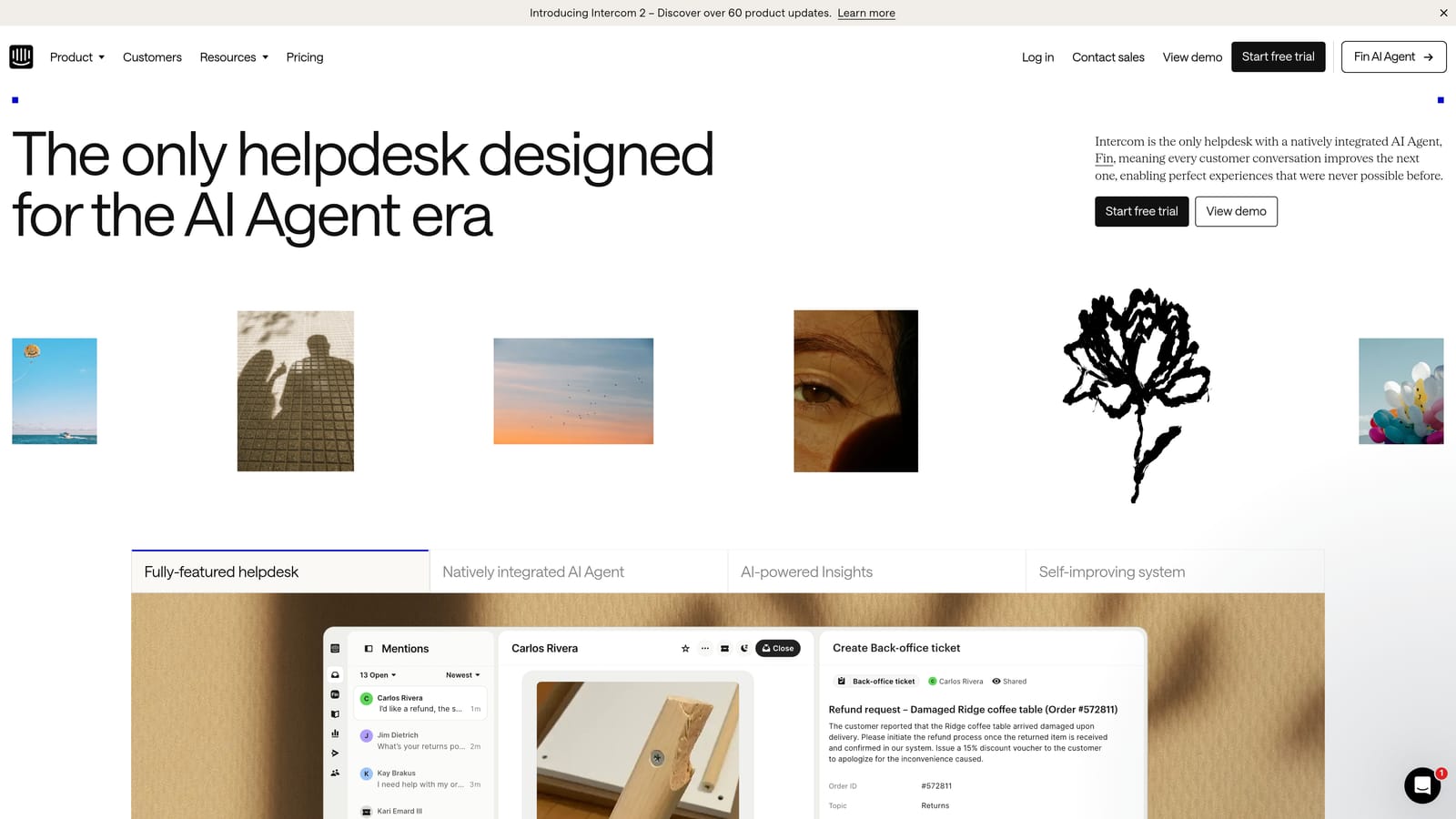
Intercom is a conversational support platform combining the Fin AI agent, in-app messaging, and proactive engagement tools in a single subscription.
Where This Tool Shines
Intercom occupies a unique position in this market: it's as much a customer engagement platform as it is a support tool. The Fin AI agent handles autonomous query resolution, while product tours, proactive messages, and lifecycle campaigns live in the same platform. For SaaS companies where support and customer success overlap significantly, this consolidation is a genuine advantage.
The customer data platform underneath Intercom enables personalized support experiences based on user attributes, behavior, and plan tier. When a user contacts support, agents have rich context about who they are and what they've done in the product, which meaningfully improves resolution quality for complex issues.
Key Features
Fin AI Agent: Autonomous query resolution that handles common support questions without human intervention.
In-App Messaging and Product Tours: Proactive engagement and onboarding flows built into the same platform.
Shared Inbox with Conversation Routing: Team inbox with assignment rules and workload management.
Help Center with AI-Assisted Suggestions: Knowledge base that surfaces relevant articles automatically during conversations.
Customer Data Platform: User attributes and behavior data available in every support conversation.
Best For
SaaS companies with high chat volume that want support, onboarding, and proactive messaging under one subscription. Pricing can escalate with usage volume, so teams with very high conversation counts should model costs carefully.
Pricing
Usage-based pricing model. Check intercom.com for current plan details, as pricing varies based on seat count and conversation volume.
4. Freshdesk
Best for: SMBs and growing teams needing solid omnichannel support at competitive pricing
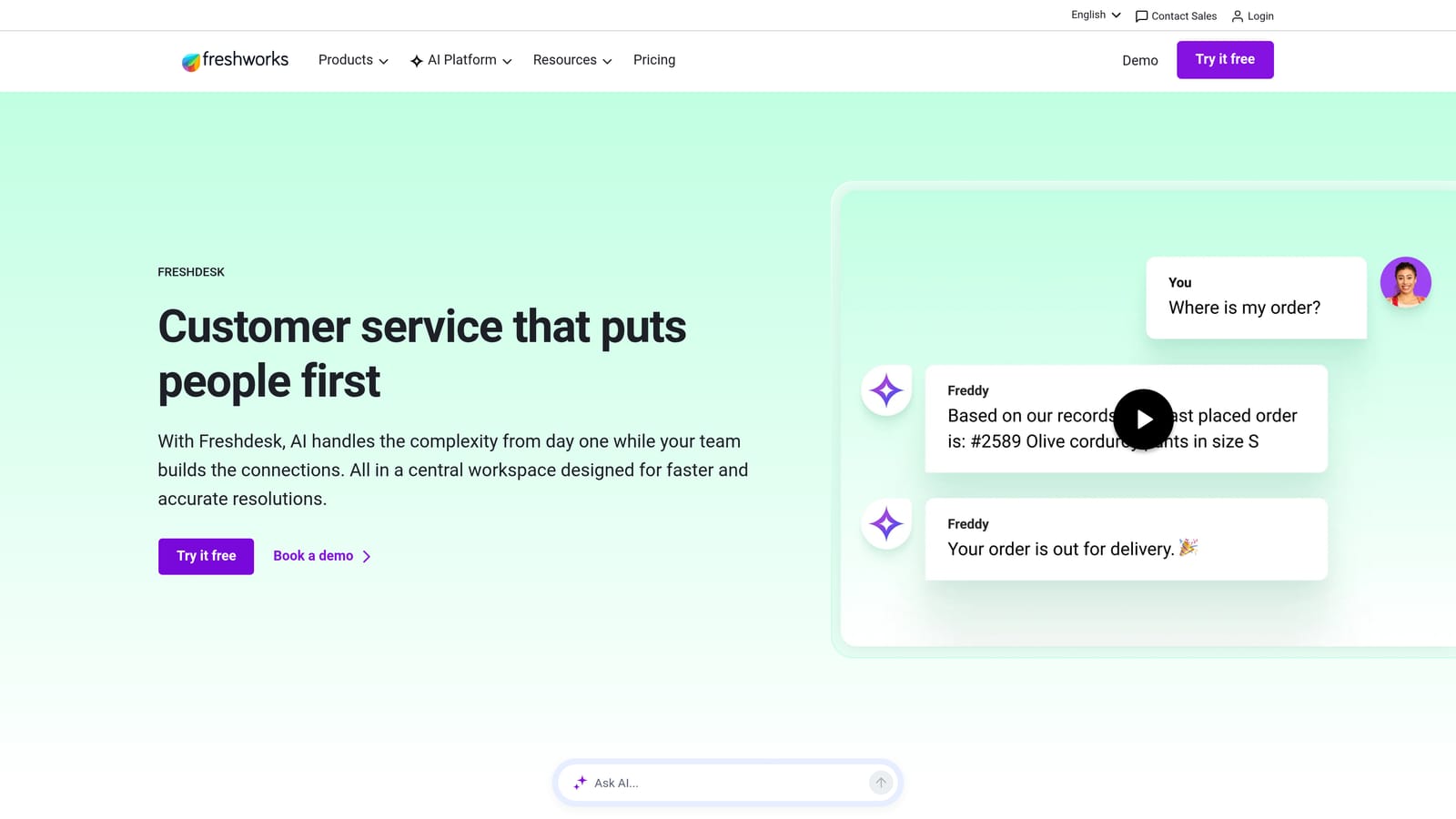
Freshdesk is a budget-friendly omnichannel helpdesk with Freddy AI for automation, offering a generous free tier and core features that scale with growing teams.
Where This Tool Shines
Freshdesk's value proposition is straightforward: you get a capable, full-featured helpdesk at pricing that doesn't require a procurement committee. The free plan is genuinely functional for small teams, and the paid tiers scale affordably as headcount and ticket volume grow. For teams coming from email-based support, Freshdesk represents a significant operational upgrade without a significant budget commitment.
Freddy AI handles ticket categorization, routing, and suggested responses, covering the automation basics that most teams need. It's not the deepest AI implementation on this list, but it handles the high-frequency, low-complexity tasks that consume disproportionate agent time.
Key Features
Freddy AI: Automated ticket categorization, routing, and suggested agent responses.
Omnichannel Support: Email, live chat, phone, and social media in a unified inbox.
Collision Detection: Prevents multiple agents from working the same ticket simultaneously.
Workflow Automation: Condition-based rules for routing, escalation, and status updates.
Free Plan: Available for small teams with no time limit on core features.
Best For
SMBs, startups, and growing teams that need a reliable helpdesk without enterprise pricing. Teams expecting AI-autonomous resolution at scale will eventually outgrow Freshdesk's AI depth, but it's an excellent starting point.
Pricing
Free plan available for small teams. Paid plans start at approximately $15 per agent per month. Verify current tiers at freshdesk.com.
5. Gorgias
Best for: DTC brands and e-commerce teams running on Shopify or BigCommerce
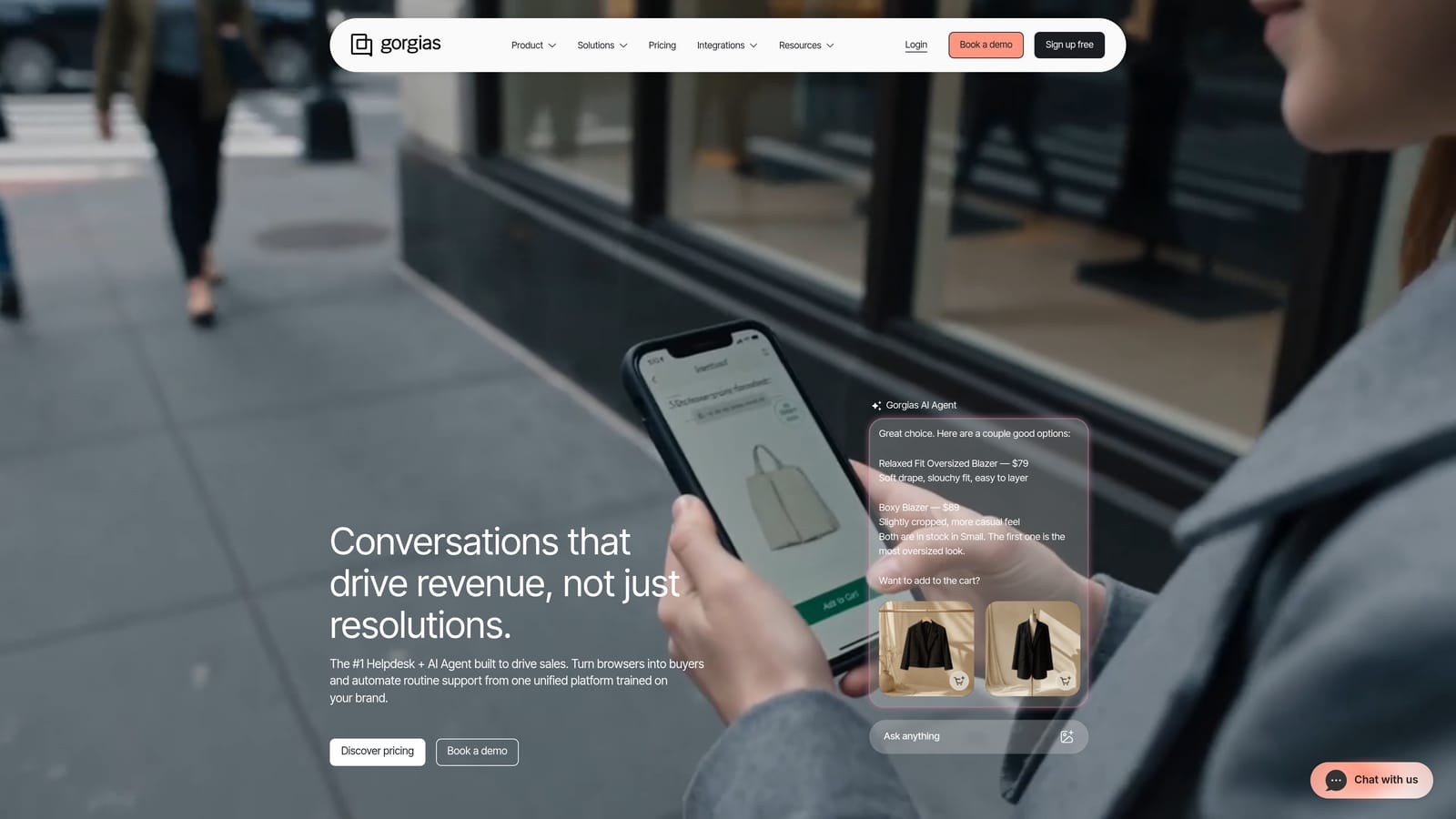
Gorgias is a support automation platform purpose-built for e-commerce, with deep order management integration that lets agents resolve issues without switching between systems.
Where This Tool Shines
If your support queue is dominated by "Where is my order?" queries, Gorgias was built for exactly that problem. The native Shopify integration surfaces order data directly inside the support ticket, and agents can issue refunds, modify orders, and trigger fulfillment actions without leaving the interface. This eliminates the tab-switching that slows down e-commerce support teams and creates resolution errors.
The revenue attribution feature is worth highlighting: Gorgias tracks which support interactions convert to sales, giving e-commerce teams a way to quantify the business value of their support operation. For brands where support is a customer retention and conversion lever, this data changes how teams think about staffing and investment.
Key Features
Native E-Commerce Integrations: Deep connections with Shopify, BigCommerce, and WooCommerce.
In-Ticket Order Management: View order status, issue refunds, and modify orders without leaving the support interface.
Revenue Attribution: Tracks the sales impact of support interactions.
Automated WISMO Responses: Handles "Where is my order?" queries automatically using live order data.
Macros and Rules: High-volume automation for repetitive ticket types.
Best For
DTC brands and e-commerce teams with high order inquiry volume. Gorgias is highly specialized: it's exceptional for its target use case and less relevant for B2B SaaS or service businesses.
Pricing
Ticket-based pricing model rather than per-seat. Check gorgias.com for current tier details, as pricing is structured differently from most helpdesks.
6. Help Scout
Best for: SMBs and startups prioritizing a clean, relationship-driven support experience
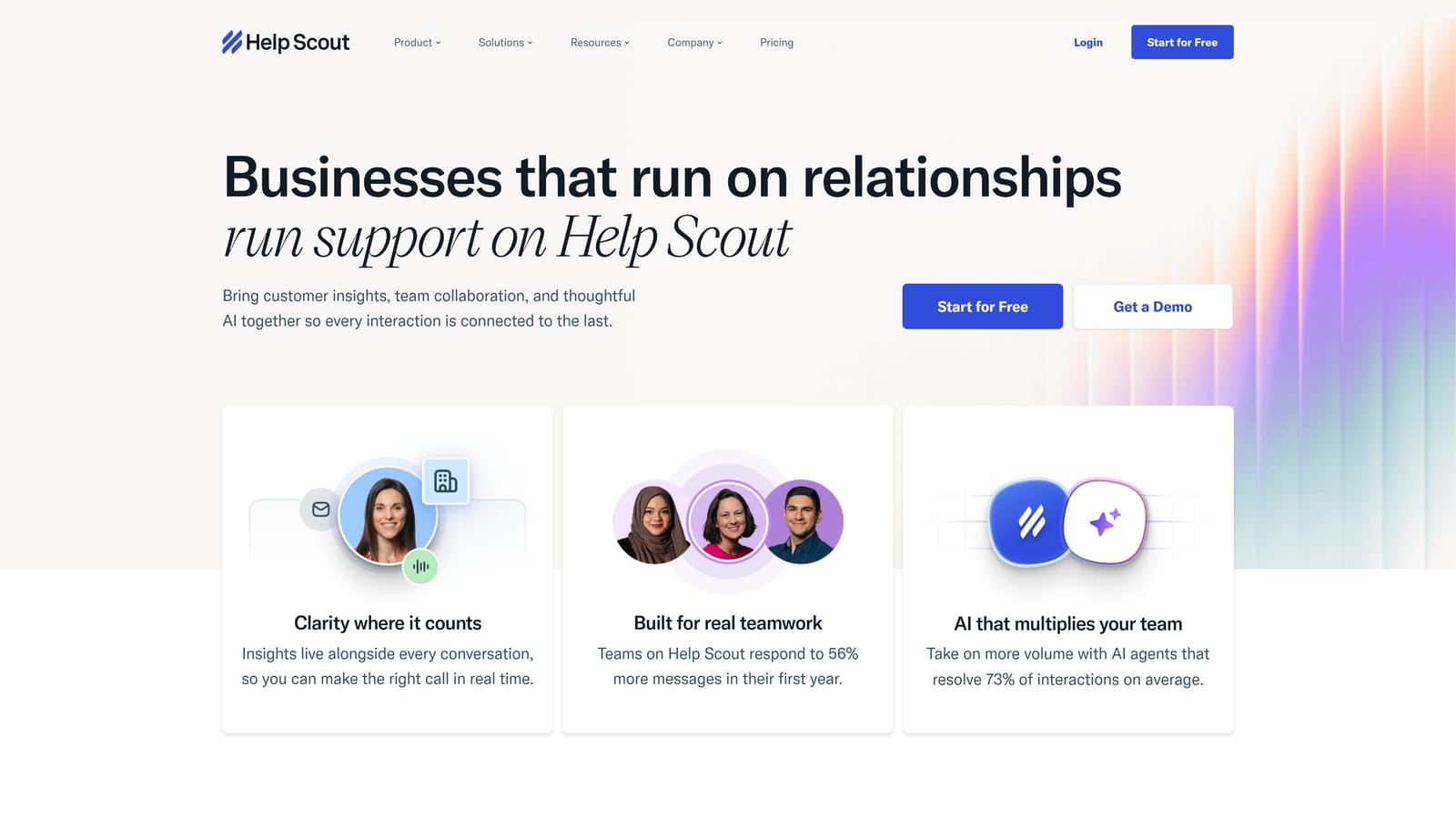
Help Scout is a shared inbox platform that prioritizes a human-feeling support experience, with AI Drafts to accelerate agent replies and a Docs knowledge base for self-service.
Where This Tool Shines
Help Scout's defining characteristic is restraint. Where other platforms pile on features and configuration options, Help Scout focuses on giving agents a clean, distraction-free environment to write good replies. The AI Drafts feature fits this philosophy well: it generates a suggested reply that the agent can review and send, keeping the human in the loop without requiring them to start from a blank page.
Team adoption is typically faster with Help Scout than with more complex platforms, which matters more than it might seem. A platform your team actually uses consistently outperforms a more powerful one that generates workarounds and shadow processes.
Key Features
AI Drafts: Generates reply suggestions for agents to review, edit, and send.
Shared Inbox with Collision Detection: Prevents duplicate responses with real-time agent visibility.
Docs Knowledge Base: Customer-facing self-service articles with search and analytics.
Saved Replies and Workflow Automation: Reusable templates and condition-based routing rules.
Customer Profiles: Full conversation history available in every ticket view.
Best For
SMBs, startups, and teams where relationship quality matters as much as ticket throughput. Teams that need deep AI autonomy or complex multi-channel workflows will find Help Scout's feature set limiting at scale.
Pricing
Plans start at approximately $20 per user per month. Verify current pricing at helpscout.com.
7. Tidio
Best for: Small businesses needing fast, affordable chat automation without technical resources
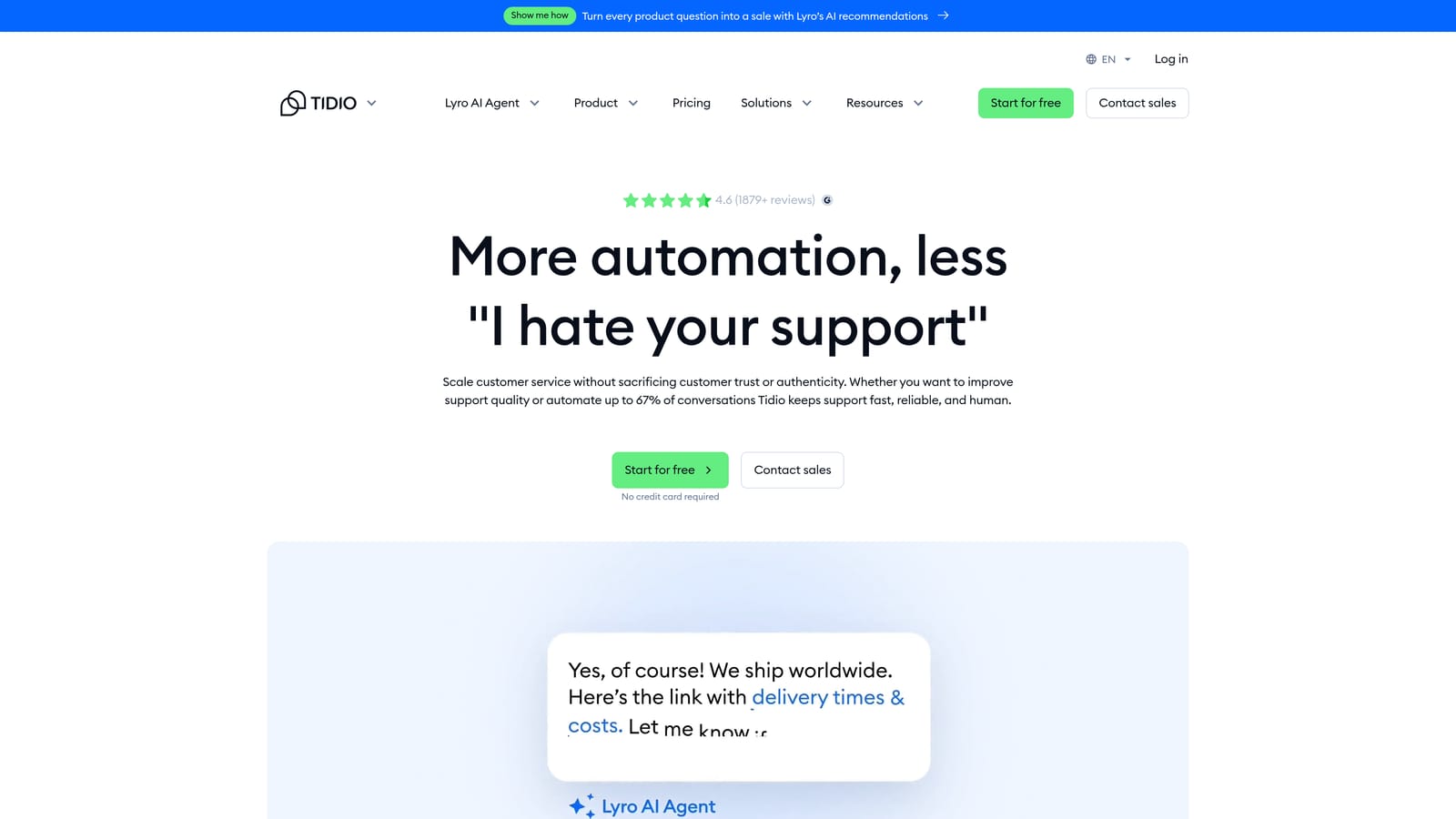
Tidio is a live chat and AI chatbot platform featuring the Lyro AI agent and pre-built automation flows designed to deploy quickly without developer involvement.
Where This Tool Shines
Tidio's strongest selling point is accessibility. The Lyro AI agent handles common queries autonomously, and the pre-built automation flows cover the most frequent small business support scenarios out of the box. For a solopreneur or small team that needs chat automation running this week, Tidio removes the friction that makes other platforms feel like a project.
The free plan is a genuine on-ramp, not a crippled demo. Small businesses can start capturing and responding to chat conversations immediately, then upgrade as volume and needs grow.
Key Features
Lyro AI Chatbot: Autonomous query handling for common customer questions.
Pre-Built Automation Flows: Ready-to-use automation for frequent support scenarios.
Live Chat with Agent Takeover: Human agents can step into any conversation seamlessly.
Email and Messenger Integration: Channels beyond website chat included in the platform.
Free Plan: Functional entry tier with no time limit.
Best For
Small businesses, solopreneurs, and early-stage teams that need chat automation without a significant budget or technical investment. Tidio scales less gracefully for complex enterprise workflows or high-volume B2B support operations.
Pricing
Free plan available. Paid plans start at affordable rates. Check tidio.com for current pricing tiers.
8. Kustomer
Best for: Mid-market and enterprise brands needing unified CRM and support in one platform
Kustomer is a CRM-native support platform that unifies every customer interaction in a timeline view, with AI automation layered on top of rich customer data for context-aware resolution.
Where This Tool Shines
Kustomer's timeline view is the feature that earns it a place on this list. Every interaction a customer has had across every channel, email, chat, SMS, social, and voice, appears in a single chronological view. Agents don't piece together context from multiple systems; it's all there before they type a single word. For high-volume consumer brands where context loss is a major source of customer frustration, this architecture is a meaningful differentiator.
The built-in CRM eliminates a common pain point: the need to maintain separate customer records in a CRM while also managing support tickets in a helpdesk. For teams that have experienced the data sync failures and context gaps that come with keeping two systems aligned, Kustomer's unified approach is worth serious consideration.
Key Features
Timeline-Based Customer View: Every interaction across all channels in a single chronological record.
AI-Powered Routing and Classification: Intelligent ticket assignment and suggested responses.
Omnichannel Coverage: Email, chat, SMS, social media, and voice in one platform.
Built-In CRM: Customer database integrated natively, eliminating the need for a separate tool.
Business Rule Engine: Flexible workflow automation for complex routing and escalation logic.
Best For
Mid-market and enterprise brands with high interaction volumes across multiple channels, particularly those frustrated by maintaining separate CRM and helpdesk systems. Pricing positions Kustomer above SMB budgets.
Pricing
Per-user pricing model. Check kustomer.com for current rates and plan details.
9. Zoho Desk
Best for: Teams already invested in the Zoho ecosystem seeking a tightly integrated helpdesk
Zoho Desk is a context-aware helpdesk that integrates tightly with Zoho CRM and the broader Zoho product suite, with Zia AI providing sentiment analysis, tagging, and response recommendations.
Where This Tool Shines
Zoho Desk's value proposition is strongest for teams already using Zoho CRM, Zoho Analytics, or other Zoho products. The integration depth within the ecosystem is genuine: CRM data surfaces directly in the agent view, ticket data flows back into analytics, and the entire stack operates under one vendor relationship. For teams that have standardized on Zoho, adding Desk is a natural extension rather than a new integration project.
Zia, Zoho's AI layer, brings useful capabilities including sentiment analysis on incoming tickets, anomaly detection for unusual volume patterns, and reply suggestions. These aren't the most advanced AI features on this list, but they address real operational needs at a price point that undercuts most competitors.
Key Features
Zia AI: Sentiment analysis, anomaly detection, ticket tagging, and reply suggestions.
CRM-Aware Ticketing: Zoho CRM data surfaced directly in the agent ticket view.
Multi-Department Support: Role-based access and department-specific workflows for complex organizations.
Blueprint Workflow Automation: Structured process automation for tickets requiring defined resolution steps.
Zoho Ecosystem Integration: Native connections to Zoho CRM, Analytics, SalesIQ, and other Zoho products.
Best For
Teams already using Zoho CRM or other Zoho products who want to add helpdesk functionality without introducing a new vendor. The value proposition is considerably weaker for teams not already in the Zoho ecosystem.
Pricing
Free plan available for small teams. Paid plans are competitively priced. Check zoho.com/desk for current tier details.
Which Platform Is Right for Your Team?
The right automated support platform subscription depends heavily on where you are, where you're going, and what kind of support experience you want to deliver.
For teams that want AI-autonomous resolution with genuine business intelligence built in, Halo AI is the strongest option on this list. It's the only platform here built from the ground up around autonomous agents rather than adding AI to an existing helpdesk architecture, and the page-aware context and continuous learning engine represent capabilities that AI-assisted platforms haven't replicated.
For large enterprises with established operations and dedicated admin resources, Zendesk remains a reliable choice. For SaaS teams blending support with onboarding and lifecycle messaging, Intercom offers the broadest feature set under one subscription. SMBs watching budget will find Freshdesk delivers strong value, while e-commerce teams on Shopify should look seriously at Gorgias. Teams already in the Zoho ecosystem will find Zoho Desk the most natural fit.
One question worth asking before you decide: do you want your support platform to assist your agents, or to resolve tickets autonomously while your agents focus on complex issues that genuinely need a human? The answer shapes everything else on this list.
Your support team shouldn't scale linearly with your customer base. Let AI agents handle routine tickets, guide users through your product, and surface business intelligence while your team focuses on complex issues that need a human touch. See Halo in action and discover how continuous learning transforms every interaction into smarter, faster support.