9 Best Automated Support Software Options and What They Actually Cost in 2026
This guide compares automated support software pricing across nine leading platforms, breaking down tier structures, hidden costs, and which tools suit different team sizes—helping B2B support teams make informed decisions before committing to a vendor demo.
 Matt PattoliFounder14 min read
Buying automated support software is harder than it looks. Most vendors bury their pricing behind demo requests, and the plans that appear affordable at first glance often exclude the AI features you actually need. This guide cuts through that noise.
We've broken down nine leading platforms, covering their pricing structures, what's included at each tier, and which types of teams they're built for. Whether you're a lean SaaS team looking to deflect tickets without hiring, or a scaling B2B operation that needs deep integrations and business intelligence, there are meaningful differences between these tools worth understanding before you book a single sales call.
A quick note on transparency: Halo AI is the product behind this site and is featured first. Every tool is evaluated on the same criteria: pricing clarity, depth of AI capabilities, integration flexibility, and real-world fit for B2B support teams.
Understanding the Pricing Models Before You Compare
Before diving into individual tools, it helps to understand that automated support software uses several distinct pricing models, and each has tradeoffs worth knowing upfront.
Per agent/seat: The most common model among traditional helpdesks. Predictable and easy to budget, but costs scale linearly with your team.
Per resolution/conversation: An emerging model favored by AI-native platforms. Costs align with value delivered, but can be unpredictable at high volume.
Per ticket: Popular in e-commerce. You pay based on tickets closed, not team size.
Hybrid: Some platforms combine a base platform fee with usage-based AI charges, which can make total cost harder to forecast.
Watch for hidden costs across all models: AI features locked behind higher tiers, integration add-ons, overage charges on conversation-based plans, onboarding fees at enterprise tier, and per-seat minimums that inflate entry costs. With that context in mind, here's how the top platforms stack up.
1. Halo AI
Best for: B2B SaaS teams that want autonomous ticket resolution with business intelligence built in.
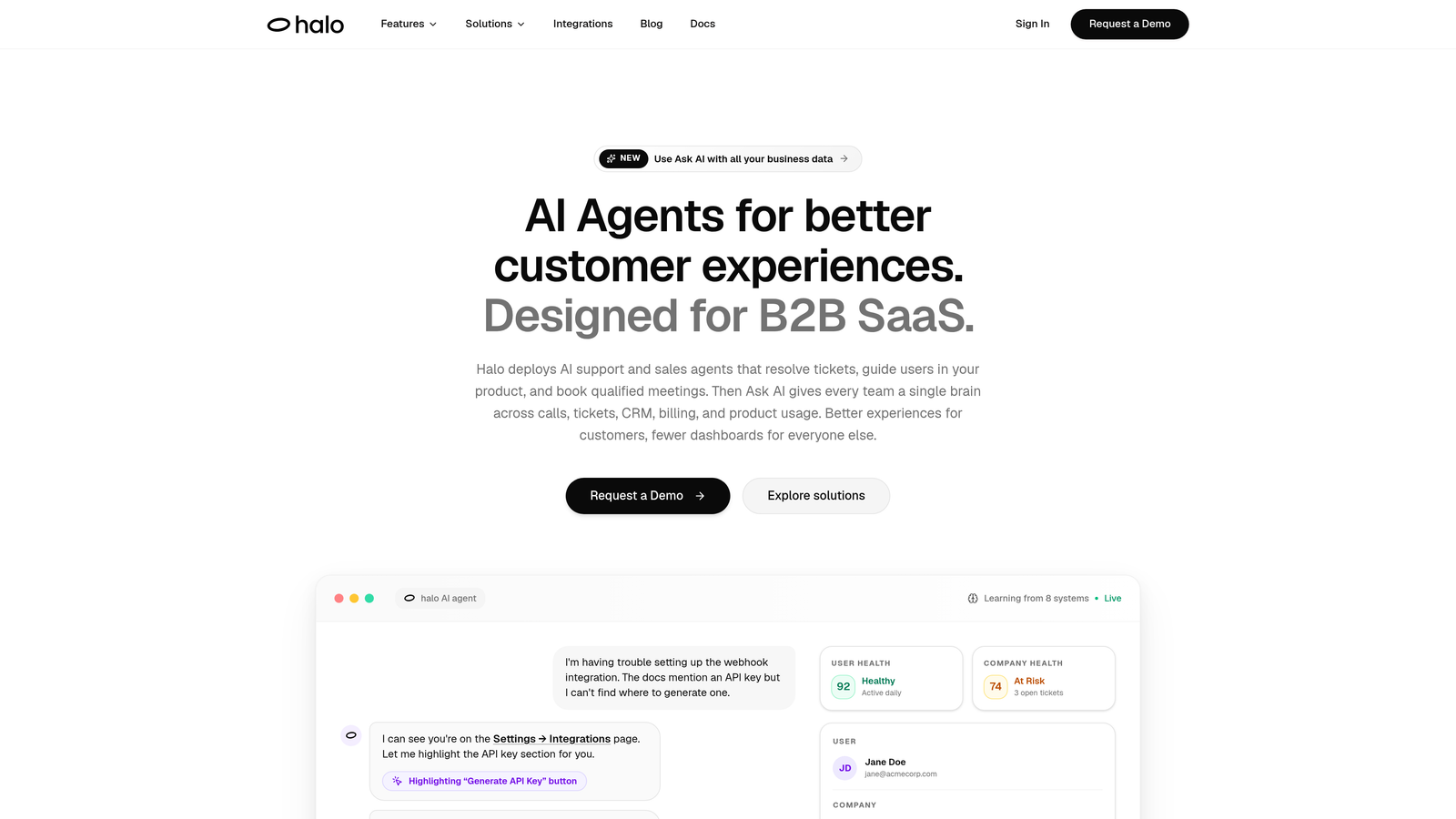
Halo AI is an AI-native customer support platform built specifically for B2B SaaS, deploying intelligent agents that resolve tickets end-to-end, guide users through your product, and surface business insights from every interaction.
Where This Tool Shines
What separates Halo from most tools on this list is its architecture. Rather than layering AI onto an existing helpdesk, Halo is built from the ground up with autonomous resolution as the core model. The AI doesn't just suggest replies; it handles tickets completely, escalating to human agents only when complexity warrants it.
The page-aware chat widget is a genuine differentiator for SaaS teams. It understands where a user is in your product and delivers contextual, visual guidance rather than generic answers. Combined with a smart inbox that surfaces customer health signals, revenue anomalies, and churn indicators, Halo functions more like a business intelligence layer than a traditional support tool.
Key Features
Autonomous AI Agents: Resolve tickets end-to-end with intelligent human escalation for complex or sensitive cases.
Page-Aware Chat Widget: Understands a user's location in your product and delivers contextual visual guidance tailored to that exact moment.
Smart Inbox with Business Intelligence: Surfaces customer health signals, revenue anomaly detection, and churn indicators directly from support interactions.
Auto Bug Ticket Creation: Automatically generates and routes bug reports to Linear or your project management tool, removing manual steps for your team.
Broad Integration Stack: Native connections to Slack, HubSpot, Intercom, Stripe, Zoom, PandaDoc, and Fathom.
Continuous Learning: The AI improves from every resolved interaction, becoming more accurate and efficient over time.
Best For
B2B SaaS companies that want AI to genuinely own ticket resolution rather than assist agents. Particularly strong for product-led growth teams where in-app guidance and bug reporting automation reduce friction across both support and engineering workflows.
Pricing
Pricing is available on request. Contact Halo AI for a demo and a custom quote based on your volume and integration needs.
2. Intercom
Best for: Teams that want AI-first resolution tightly integrated with in-app messaging.
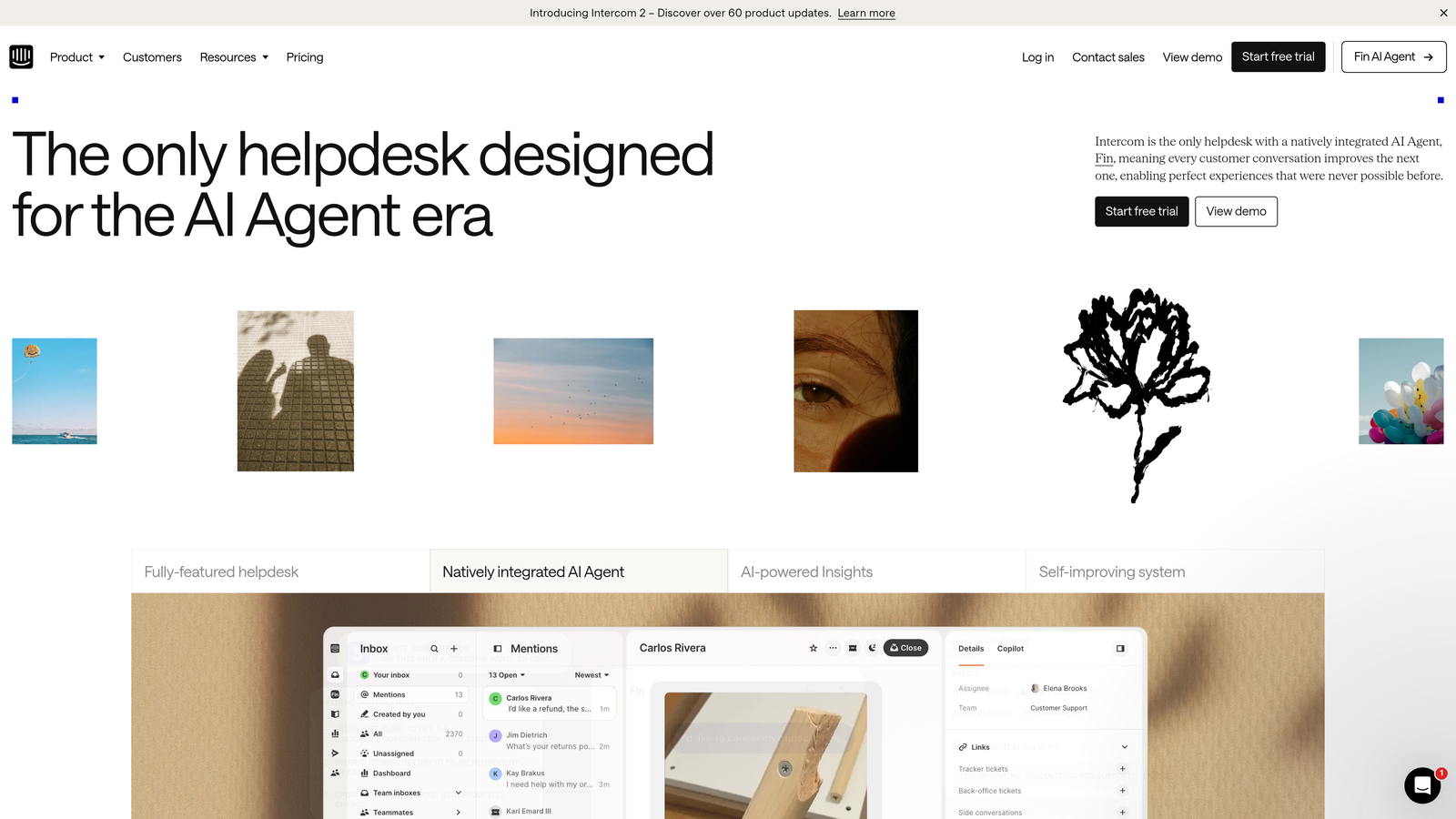
Intercom is a combined customer messaging and AI support platform, with its Fin AI Agent handling autonomous ticket resolution built on large language models.
Where This Tool Shines
Intercom's Fin AI Agent is one of the more mature AI resolution products on the market. It handles conversations autonomously across chat, email, and social, and the integration with Intercom's native messenger creates a seamless in-app experience that's hard to replicate with third-party chat widgets.
The AI Copilot feature, which helps human agents draft responses and retrieve knowledge, adds a useful layer for teams that handle complex queries requiring human judgment. Intercom's reporting and conversation analytics are also strong, giving support leaders clear visibility into resolution patterns.
Key Features
Fin AI Agent: Handles autonomous resolution across channels, charged per successful resolution rather than per seat.
AI Copilot: Assists human agents with drafting, knowledge retrieval, and suggested actions.
Omnichannel Support: Covers chat, email, and social from a single platform.
In-App Messenger: Deeply integrated chat experience designed for SaaS and digital products.
Conversation Analytics: Strong reporting on resolution rates, response times, and conversation trends.
Best For
SaaS and digital product teams that are already using Intercom for customer messaging and want to extend it with AI resolution without switching platforms. Teams with high chat volume will find Fin's per-resolution pricing model aligns costs with outcomes.
Pricing
Essential plan starts around $39/seat/month. Fin AI Agent is charged additionally per resolution on top of the base plan. Advanced and Expert tiers carry higher price points. The hybrid model means costs can escalate at high volume. Verify current pricing at intercom.com.
3. Zendesk
Best for: Enterprise teams that need mature workflow automation and compliance controls.
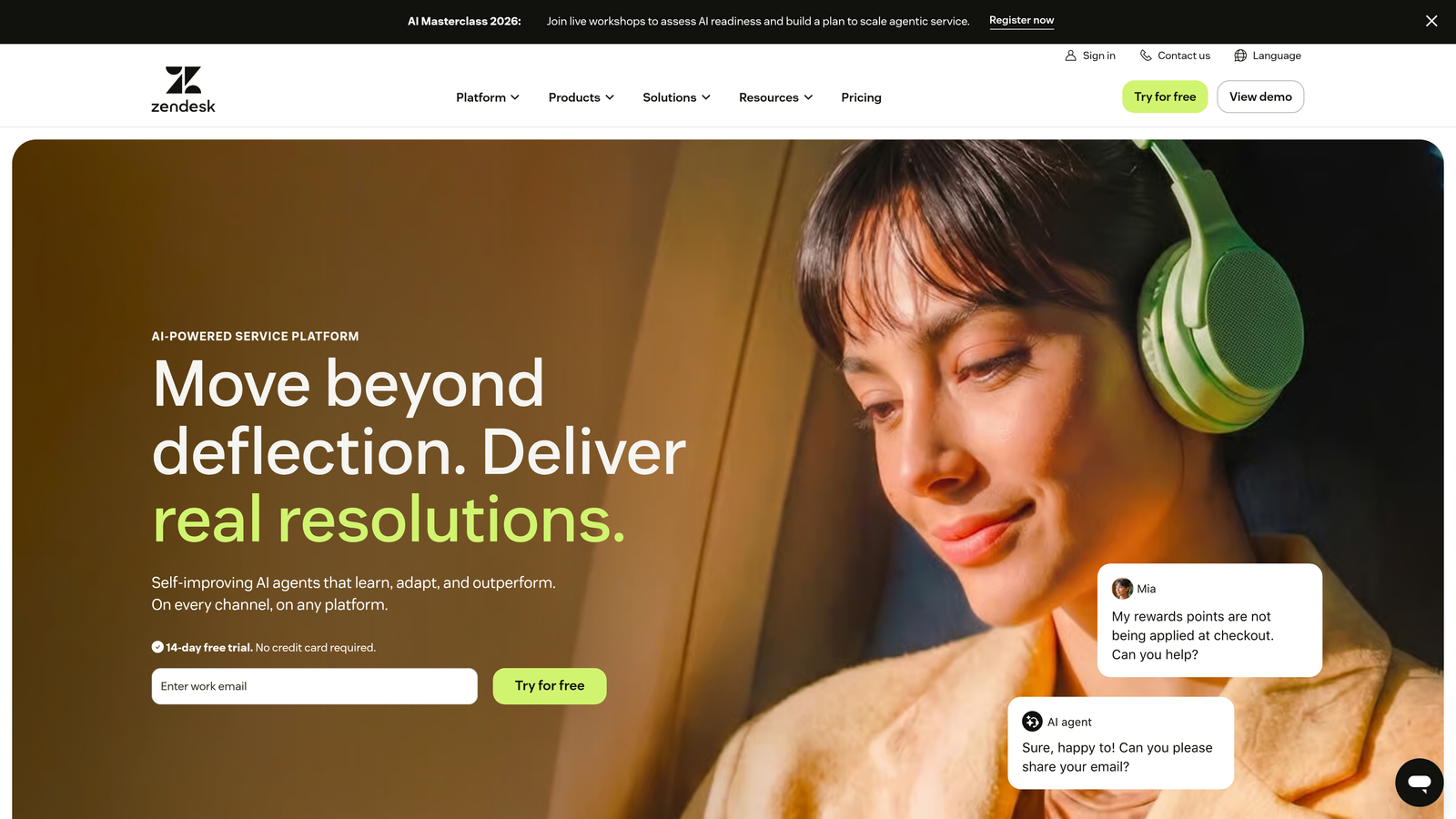
Zendesk is a mature enterprise helpdesk platform with AI capabilities layered across its ticketing, messaging, and self-service tools.
Where This Tool Shines
Zendesk's core strength is its depth of workflow automation. Triggers, macros, and business rules allow operations teams to build sophisticated routing and escalation logic without engineering involvement. The app marketplace, which includes hundreds of integrations, means most teams can connect Zendesk to their existing stack without custom development.
Zendesk AI handles triage, intent detection, and suggested replies, though it's worth noting that AI features are often available on higher tiers or as paid add-ons rather than included at the base level. For teams with complex compliance requirements, Zendesk's enterprise-grade security controls are a genuine asset.
Key Features
Zendesk AI: Automated triage, intent detection, and suggested replies for faster agent response.
Workflow Automation: Triggers, macros, and business rules for sophisticated ticket routing.
App Marketplace: Hundreds of integrations covering CRM, billing, project management, and more.
Advanced Reporting: SLA management, team performance dashboards, and custom reports.
Enterprise Security: Compliance controls including SOC 2, HIPAA, and data residency options.
Best For
Mid-market and enterprise support teams with complex workflows, large agent headcounts, and compliance requirements. Less suited for small teams where per-agent pricing and implementation complexity add overhead disproportionate to the benefit.
Pricing
Suite Team starts around $55/agent/month; Suite Professional around $115/agent/month, billed annually. AI features may require higher tiers or add-ons. Enterprise pricing is custom. Verify current pricing at zendesk.com.
4. Freshdesk
Best for: Growing teams that want AI-assisted support at an accessible price point.
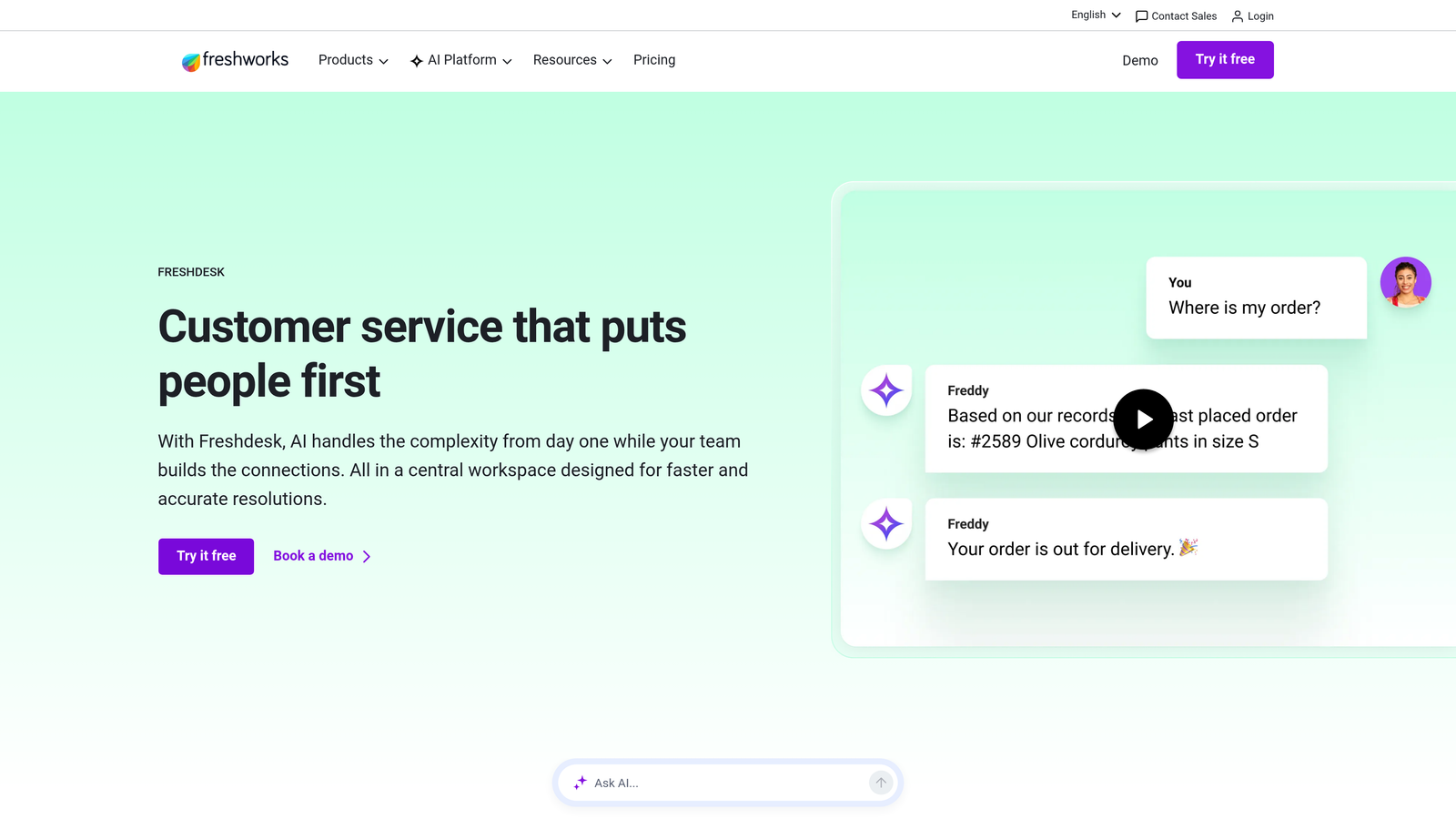
Freshdesk is a widely used helpdesk platform with Freddy AI built in, offering one of the more affordable entry points for teams adding support automation.
Where This Tool Shines
Freshdesk's pricing structure is among the most accessible on this list, and Freddy AI covers the core automation needs most teams start with: auto-triage, suggested responses, and self-service deflection. The free plan for up to two agents makes it genuinely low-risk to evaluate.
Freddy Copilot, available on higher tiers, assists agents with summarization and response drafting. Multi-channel coverage across email, chat, phone, and social means teams don't need to stitch together separate tools for different channels early in their growth.
Key Features
Freddy AI: Auto-triage, suggested responses, and self-service deflection built into the platform.
Freddy Copilot: Agent assistance with summarization and response drafting on higher tiers.
Multi-Channel Support: Email, chat, phone, and social managed from a single inbox.
Collision Detection: Prevents multiple agents from working the same ticket simultaneously.
Marketplace Integrations: CRM, e-commerce, and project management connections available.
Best For
Small to mid-sized teams looking for an affordable starting point with AI features included. A strong choice for teams coming from spreadsheets or basic email inboxes who want structured ticketing without a large upfront investment.
Pricing
Free plan available for up to two agents. Growth plan around $15/agent/month; Pro around $49/agent/month; Enterprise around $79/agent/month, billed annually. Verify current pricing at freshdesk.com.
5. Help Scout
Best for: Teams that prioritize human-feeling support with AI as an assist layer.
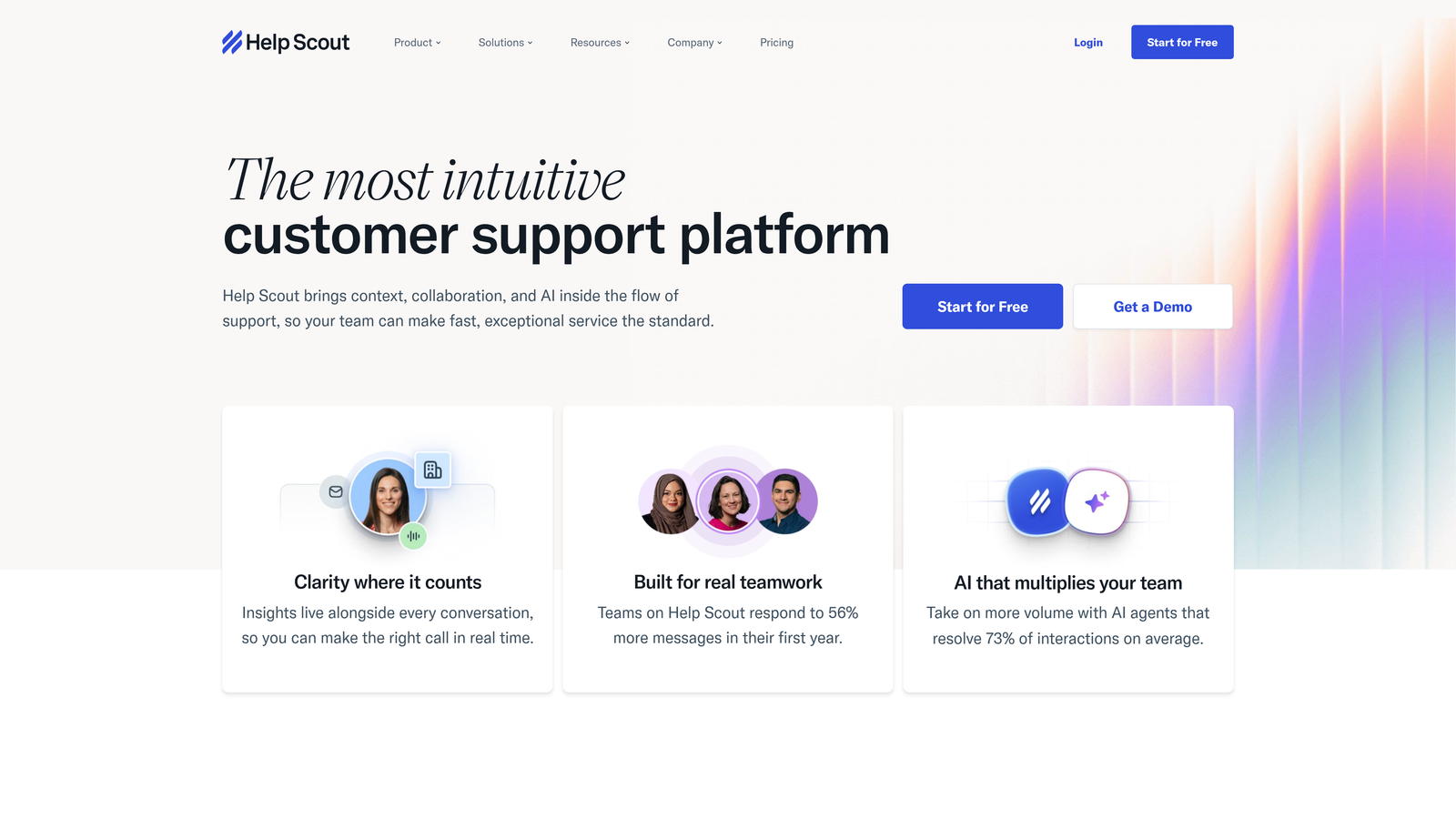
Help Scout is a customer support platform focused on clean, human-feeling interactions, with AI assist features that keep agents in control rather than replacing them.
Where This Tool Shines
Help Scout takes a deliberately agent-centric approach to AI. Rather than pursuing full autonomous resolution, its AI tools (Summarize, Assist, and Drafts) are designed to speed up what human agents are already doing: reading context quickly, drafting responses, and handling follow-ups. The result is a platform that feels clean and approachable rather than complex.
The Beacon chat widget handles in-app support well, and the built-in Docs knowledge base means teams can manage self-service content without a separate tool. For email-heavy support operations, Help Scout's shared inbox experience is polished and well-regarded.
Key Features
AI Summarize, Assist, and Drafts: Agent-facing AI tools that accelerate response without removing human judgment from the loop.
Shared Inbox: Clean team inbox with collision detection and assignment workflows.
Beacon Chat Widget: In-app chat support with a lightweight, customizable design.
Docs Knowledge Base: Built-in self-service content management included in plans.
Reporting: Focused on team performance and conversation metrics rather than complex analytics.
Best For
Teams where support quality and human tone matter deeply, such as those in professional services, early-stage SaaS, or industries where customers expect thoughtful, personalized replies. Less suited for teams looking for high-volume autonomous resolution.
Pricing
Standard plan around $20/user/month; Plus around $40/user/month; Pro around $65/user/month, billed annually. Verify current pricing at helpscout.com.
6. Tidio
Best for: Small teams testing support automation for the first time with a low financial commitment.
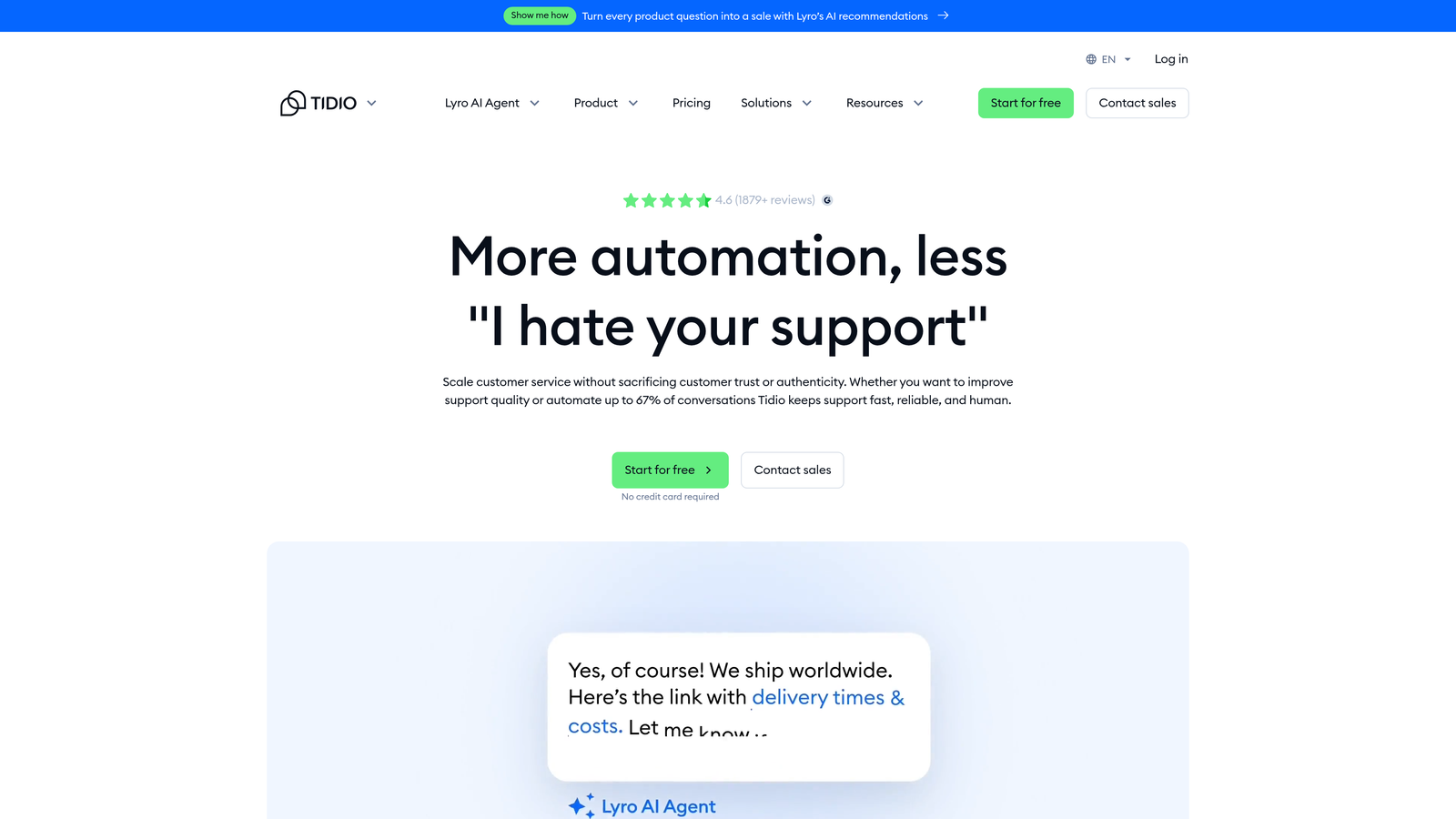
Tidio is a live chat and AI chatbot platform with a low entry price point, making it accessible for small teams exploring automation without a large initial investment.
Where This Tool Shines
Tidio's Lyro AI chatbot handles automated conversation flows and can manage a meaningful portion of common queries without agent involvement. The no-code visual chatbot builder means teams without technical resources can create and adjust flows independently. The free tier makes it genuinely low-risk to test before committing.
The live agent takeover feature ensures that when Lyro reaches the limits of its knowledge, a human can step in smoothly. For small e-commerce or early-stage SaaS teams, Tidio offers a practical on-ramp to automation that doesn't require a procurement process.
Key Features
Lyro AI Chatbot: Automated conversation handling for common queries, with configurable scope.
Visual Chatbot Builder: No-code flow creation for teams without engineering resources.
Live Agent Takeover: Smooth handoff from AI to human when conversations exceed automation scope.
E-Commerce Integrations: Native connections to Shopify and WooCommerce.
Free Tier: Available for low-volume teams with limited conversations.
Best For
Small businesses, early-stage startups, and e-commerce teams testing chatbot automation for the first time. The feature ceiling is lower than enterprise alternatives, so teams expecting to scale complex support workflows will likely outgrow it.
Pricing
Free plan available. Paid plans start around $29/month. Lyro AI conversations are priced separately or bundled in higher tiers. Verify current pricing at tidio.com.
7. Gorgias
Best for: E-commerce brands that want support automation tied directly to order management.
Gorgias is a helpdesk built specifically for e-commerce brands, with deep integrations into Shopify and a per-ticket pricing model that scales with support demand rather than team size.
Where This Tool Shines
Gorgias's per-ticket pricing model is unusual and worth understanding. You pay based on tickets closed, not agents using the platform. For e-commerce brands with seasonal volume spikes, this can be more predictable than per-seat pricing during quiet periods, though it can also escalate quickly during peak seasons.
The native Shopify, WooCommerce, and Magento integrations mean agents see order status, shipping details, and return history directly in the ticket view without switching tabs. Automated responses for order status queries and returns handle a large share of common e-commerce questions without agent involvement.
Key Features
Per-Ticket Pricing: Pay based on tickets closed rather than seats, with costs scaling to support demand.
Native E-Commerce Integrations: Deep connections to Shopify, WooCommerce, and Magento with order data visible in every ticket.
Automated Order Responses: Pre-built automations for order status, returns, and shipping queries.
Macro Automation: Rule-based responses for repetitive ticket types across any channel.
Revenue Statistics: Ties support interactions to revenue data for e-commerce performance tracking.
Best For
E-commerce brands of any size running on Shopify or WooCommerce. Not a strong fit for B2B SaaS teams, as its feature set and integrations are purpose-built for transactional retail support rather than product-led or subscription workflows.
Pricing
Starter plan around $10/month for 50 tickets. Higher tiers scale by ticket volume rather than agent count. Verify current pricing at gorgias.com.
8. Drift (Salesloft)
Best for: Revenue teams that want to unify sales engagement and support automation in a single conversational layer.
Drift is a conversational AI platform positioned at the intersection of sales engagement and support automation, now part of the Salesloft revenue platform.
Where This Tool Shines
Drift's strength is visitor engagement and pipeline routing rather than pure ticket resolution. Its AI-powered chat qualifies and routes website visitors, books meetings, and engages accounts based on firmographic and behavioral signals. For teams where the line between sales and support is blurry, Drift's playbook-driven conversation flows can handle both functions from a single interface.
The integration with Salesloft's broader revenue intelligence platform adds context that pure support tools don't offer, particularly for account-based teams tracking named accounts across the funnel. That said, its acquisition and integration into Salesloft has shifted its primary focus toward revenue workflows, which is worth factoring into your evaluation.
Key Features
AI-Powered Chat: Qualifies, routes, and engages website visitors based on behavior and account data.
Conversation Playbooks: Automated flows spanning both sales and support use cases.
Salesloft Integration: Access to broader revenue intelligence and pipeline context.
Meeting Scheduling: Built-in calendar routing and pipeline handoff within chat.
Account-Based Targeting: Personalized engagement for high-value named accounts.
Best For
B2B revenue teams where support and sales overlap significantly, particularly those already using Salesloft for sales engagement. Less suited for teams looking for a dedicated support ticketing platform with deep resolution automation.
Pricing
Pricing is not publicly listed and requires a demo. Positioned as a premium platform. Verify current pricing at drift.com or salesloft.com.
9. Kustomer
Best for: Support teams that want full customer context in every conversation with AI included at a flat per-agent rate.
Kustomer is a CRM-native helpdesk platform that unifies customer data with support workflows, offering flat per-agent pricing with AI features included rather than charged as add-ons.
Where This Tool Shines
Kustomer's CRM-first architecture is its defining characteristic. Every support conversation opens with a full customer timeline: past interactions, purchase history, subscription status, and prior tickets, all visible without switching tools. For teams handling complex customer relationships where context matters, this reduces the time agents spend reconstructing history before they can actually help.
The flat per-agent pricing model that includes AI is worth noting in a market where many platforms charge separately for AI features. Kustomer's omnichannel coverage across email, chat, SMS, voice, and social is broad, and the workflow automation engine handles sophisticated business rules without requiring engineering support.
Key Features
CRM-First Architecture: Full customer timeline visible in every support conversation without switching platforms.
AI-Powered Routing and Responses: Automated routing, suggested replies, and agent assistance included in plans.
Omnichannel Coverage: Email, chat, SMS, voice, and social managed from a unified interface.
Workflow Automation: Business rules and custom objects for complex operational workflows.
Flat Per-Agent Pricing: AI features included at each tier rather than charged as separate add-ons.
Best For
Mid-market and enterprise teams handling high-touch customer relationships where historical context significantly affects support quality. The per-agent pricing with AI included makes total cost more predictable than platforms that layer AI charges on top of base fees.
Pricing
Enterprise plan around $89/agent/month; Ultimate around $139/agent/month. AI included at both tiers. Verify current pricing at kustomer.com.
Which Tool Fits Your Team?
The right platform depends heavily on your team's size, technical needs, and where AI fits into your support model. Here's a quick orientation to help you narrow the field.
If you're a B2B SaaS team that wants AI to own ticket resolution: Halo AI is purpose-built for this. The combination of autonomous agents, page-aware context, bug ticket automation, and business intelligence makes it the strongest fit for product-led teams that want support and product insights from the same platform.
If you're already on Intercom and want to extend it with AI: Fin AI Agent is the natural next step. Just model out the per-resolution costs at your current ticket volume before committing, as the hybrid pricing model can escalate quickly.
If you need enterprise-grade workflow automation and compliance: Zendesk's depth of triggers, macros, and security controls is hard to match. Budget for the higher tiers where AI features are included rather than bolted on.
If you're a small team with a tight budget: Freshdesk's Growth plan and Tidio's free tier are both legitimate starting points. Expect to outgrow them as your support complexity increases.
If you run an e-commerce brand on Shopify: Gorgias's per-ticket model and native order management integrations are built for exactly that context.
If full customer context in every ticket matters most: Kustomer's CRM-native architecture and flat per-agent pricing with AI included make it a strong choice for teams handling complex, high-touch relationships.
Your support team shouldn't scale linearly with your customer base. AI agents can handle routine tickets, guide users through your product, and surface business intelligence while your team focuses on the complex issues that genuinely need a human touch. See Halo in action and discover how continuous learning transforms every interaction into smarter, faster support.