9 Best Automated Support Software Tools Reviewed for 2026
These automated support software reviews cover nine leading platforms evaluated for 2026 across AI capability, integration depth, deployment ease, and scalability, helping B2B SaaS teams identify which tools truly resolve tickets autonomously versus those that simply assist human agents with suggestions.
 Matt PattoliFounder14 min read
If you're evaluating automated support software, you've likely noticed that the market has exploded with options. From lightweight chatbots to full AI agent platforms that can resolve tickets, detect bugs, and hand off to humans seamlessly, the problem isn't finding a tool. It's knowing which one actually fits your team's workflow, tech stack, and support volume.
This review covers nine of the best automated support software platforms available in 2026, evaluated across key criteria: AI capability, integration depth, ease of deployment, scalability, and value for B2B SaaS teams. Each tool has been assessed based on publicly available feature documentation, pricing, and positioning, with a focus on what makes each one worth your attention.
Before diving in, here's a distinction worth keeping in mind: many tools automate responses or assist human agents with suggestions. Fewer tools actually resolve tickets autonomously, end-to-end. As you read, consider whether you want AI-assisted agents (humans still close tickets) or autonomous AI agents (AI closes tickets with escalation paths for complex issues). That single question will narrow your options significantly.
1. Halo AI
Best for: B2B SaaS teams wanting autonomous AI agents that resolve tickets, guide users visually, and surface business intelligence.
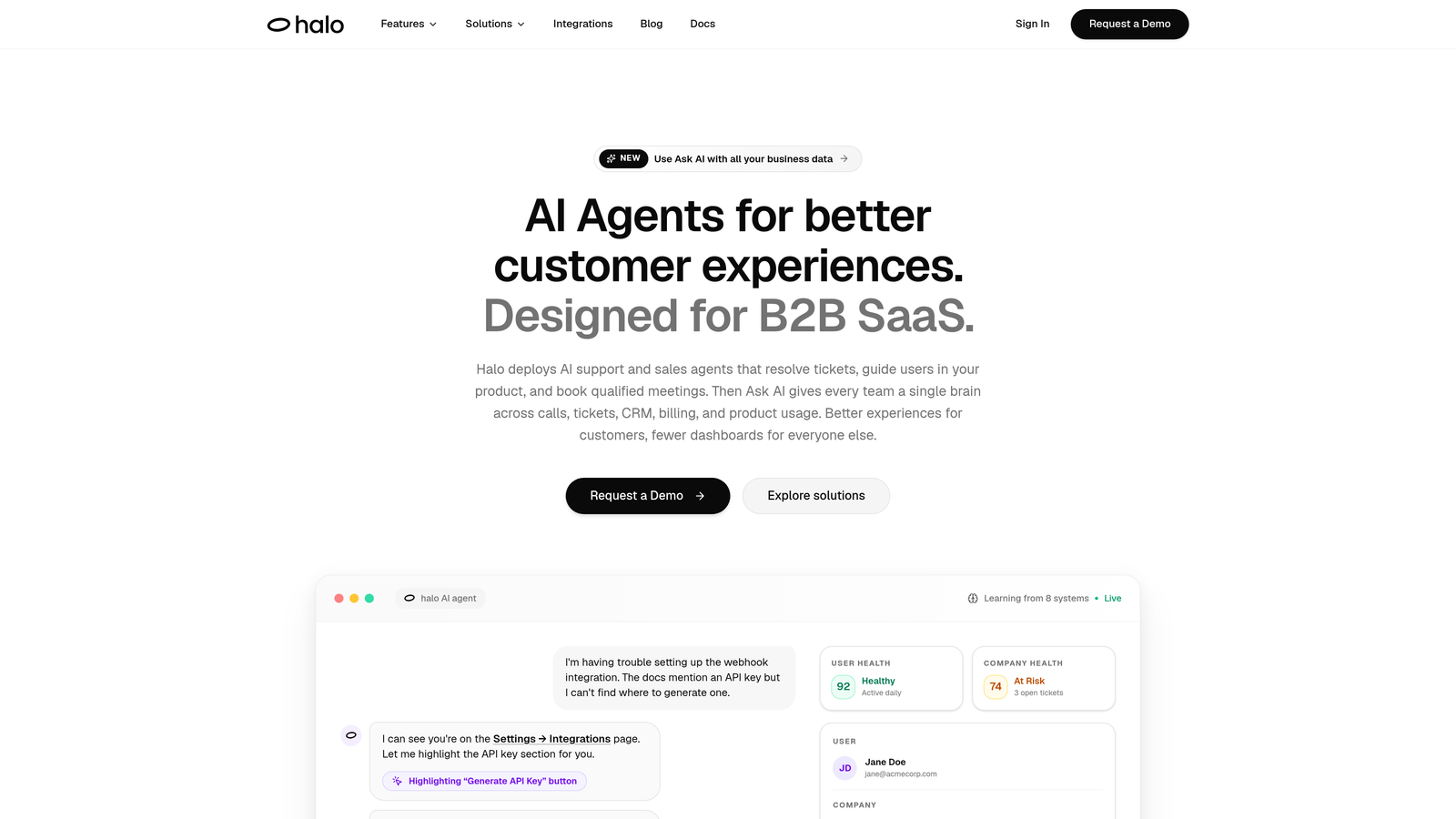
Halo AI is an AI-first customer support platform built specifically for B2B SaaS product teams, not a traditional helpdesk with AI features bolted on afterward.
Where This Tool Shines
Halo's most distinctive capability is page-awareness. The AI agent can see what a user sees on screen, enabling it to provide visual UI guidance rather than generic instructions. This matters enormously in SaaS support, where "click the settings icon" means different things depending on which page a user is on and what plan they're using.
Beyond resolution, Halo's smart inbox surfaces business intelligence that most support tools don't touch: customer health signals, revenue anomalies, and product usage patterns. Your support queue becomes a source of strategic insight, not just a task list to clear. The auto bug ticket creation feature, which detects recurring issues and creates tickets in Linear, is a particularly useful bridge between support and engineering teams.
Key Features
Page-Aware AI Agents: The AI sees what users see on screen, enabling contextual visual UI guidance rather than generic help text.
Autonomous Ticket Resolution: AI agents resolve tickets end-to-end with intelligent handoff to live agents when complexity warrants it.
Auto Bug Ticket Creation: Detects recurring issues and automatically creates bug tickets in Linear, closing the loop between support and engineering.
Smart Inbox with Business Intelligence: Surfaces customer health signals, revenue anomalies, and product usage patterns beyond standard support metrics.
Continuous Learning: The AI learns from every resolved interaction, improving accuracy and resolution rates over time with your specific product data.
Deep Integration Stack: Connects with Linear, Slack, HubSpot, Intercom, Stripe, Zoom, PandaDoc, and Fathom.
Best For
Halo is built for B2B SaaS product and support teams that want genuine autonomous resolution, not just agent assistance. If you're a growing SaaS company looking to scale support without scaling headcount, and you want your support data to feed back into product and revenue decisions, this is the platform designed with that use case in mind.
Pricing
Visit haloagents.ai for current pricing plans. Given the AI-native architecture and integration depth, pricing is positioned for SaaS teams rather than individual users or micro-businesses.
2. Intercom (Fin AI Agent)
Best for: Teams already using Intercom for lifecycle messaging who want AI-powered conversation resolution layered in.
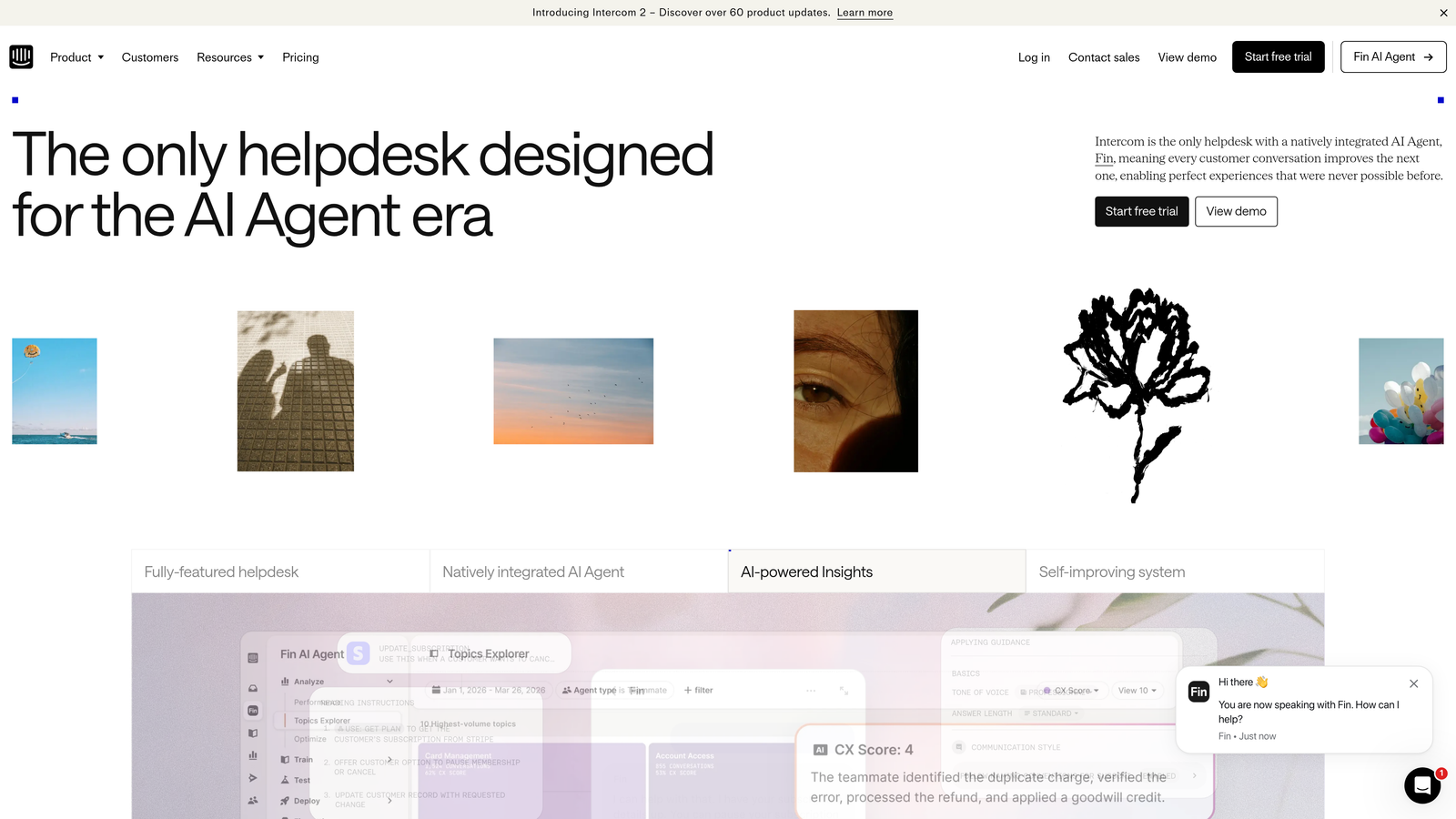
Intercom is a mature customer messaging platform with Fin, its AI agent layer, capable of handling a meaningful share of conversations autonomously before routing to human agents.
Where This Tool Shines
Fin's biggest advantage is its integration with Intercom's broader platform. If you're already using Intercom for onboarding sequences, product tours, and lifecycle messaging, adding Fin creates a unified experience where AI handles routine support within the same messenger your customers already use. The handoff between Fin and a human agent is seamless, which matters for customer experience.
The tradeoff is cost structure. Fin is priced per resolution on top of existing Intercom seat costs, which can compound quickly at higher support volumes. Teams should model their expected resolution rates carefully before committing.
Key Features
Fin AI Agent: Handles autonomous conversation resolution for common questions, drawing on your knowledge base and content.
Seamless Human Handoff: Routes complex conversations to human agents within the same messenger interface without friction.
Lifecycle Platform Integration: Works alongside Intercom's onboarding, engagement, and messaging tools for a unified customer experience.
Extensive App Marketplace: Large ecosystem of third-party integrations and a well-documented API.
Usage-Based AI Pricing: Pay per Fin resolution, giving teams flexibility to scale AI usage up or down.
Best For
Teams already invested in the Intercom ecosystem who want to add AI resolution without switching platforms. Less ideal for teams starting fresh who want a purpose-built AI support solution, or those with tight budgets where per-resolution costs could escalate.
Pricing
Intercom plans start at approximately $39/month; Fin AI agent is priced per resolution on top of seat costs. Check intercom.com for current rates, as pricing has evolved frequently.
3. Zendesk AI
Best for: Enterprise support teams needing AI-powered triage, workflow automation, and agent assistance at scale.
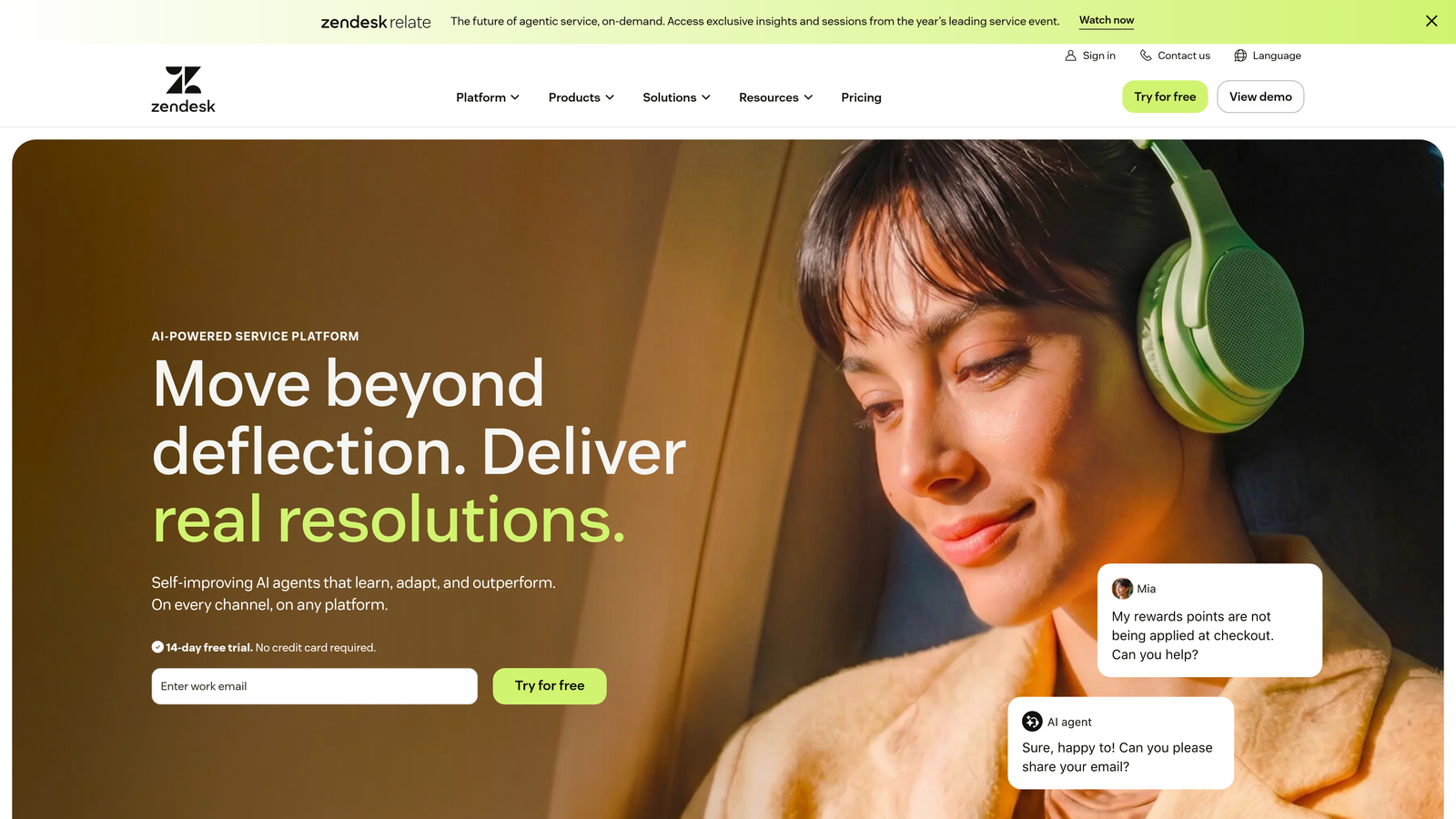
Zendesk is an enterprise-grade helpdesk with AI woven throughout: intelligent triage, intent detection, agent copilot suggestions, and automated workflows built for high-volume operations.
Where This Tool Shines
Zendesk's AI capabilities are strongest within its own ecosystem. Intelligent triage, ticket tagging, and intent detection reduce manual routing overhead significantly for teams handling large volumes. The Agent Copilot feature surfaces suggested responses and next-best-action guidance, making experienced agents faster and helping newer agents onboard more quickly.
The honest caveat: Zendesk can feel heavyweight for smaller teams. Implementation complexity is real, and the AI features that matter most live on higher-tier plans. If you're already a Zendesk customer at scale, the AI additions are compelling. If you're evaluating fresh, the setup investment is worth factoring in.
Key Features
AI-Powered Triage: Automatically tags, categorizes, and routes tickets based on intent detection and content analysis.
Agent Copilot: Provides human agents with suggested responses, next-best-action guidance, and contextual information during live interactions.
Advanced Workflow Automation: Sophisticated routing rules and trigger-based automation for complex support operations.
Robust Reporting Suite: Comprehensive analytics across ticket volume, resolution times, CSAT, and agent performance.
Third-Party Integration Ecosystem: One of the largest integration marketplaces in the category.
Best For
Enterprise teams with established Zendesk infrastructure who want to add AI capabilities to existing workflows. Also suitable for mid-market companies with high ticket volumes and complex routing requirements. Less suited for lean teams wanting fast deployment or autonomous resolution without heavy configuration.
Pricing
Suite plans start at approximately $55/agent/month, with AI features available on higher tiers. Check zendesk.com for current pricing and plan details.
4. Freshdesk (Freddy AI)
Best for: Growing teams wanting AI-assisted support across self-service, agent assist, and analytics at accessible price points.
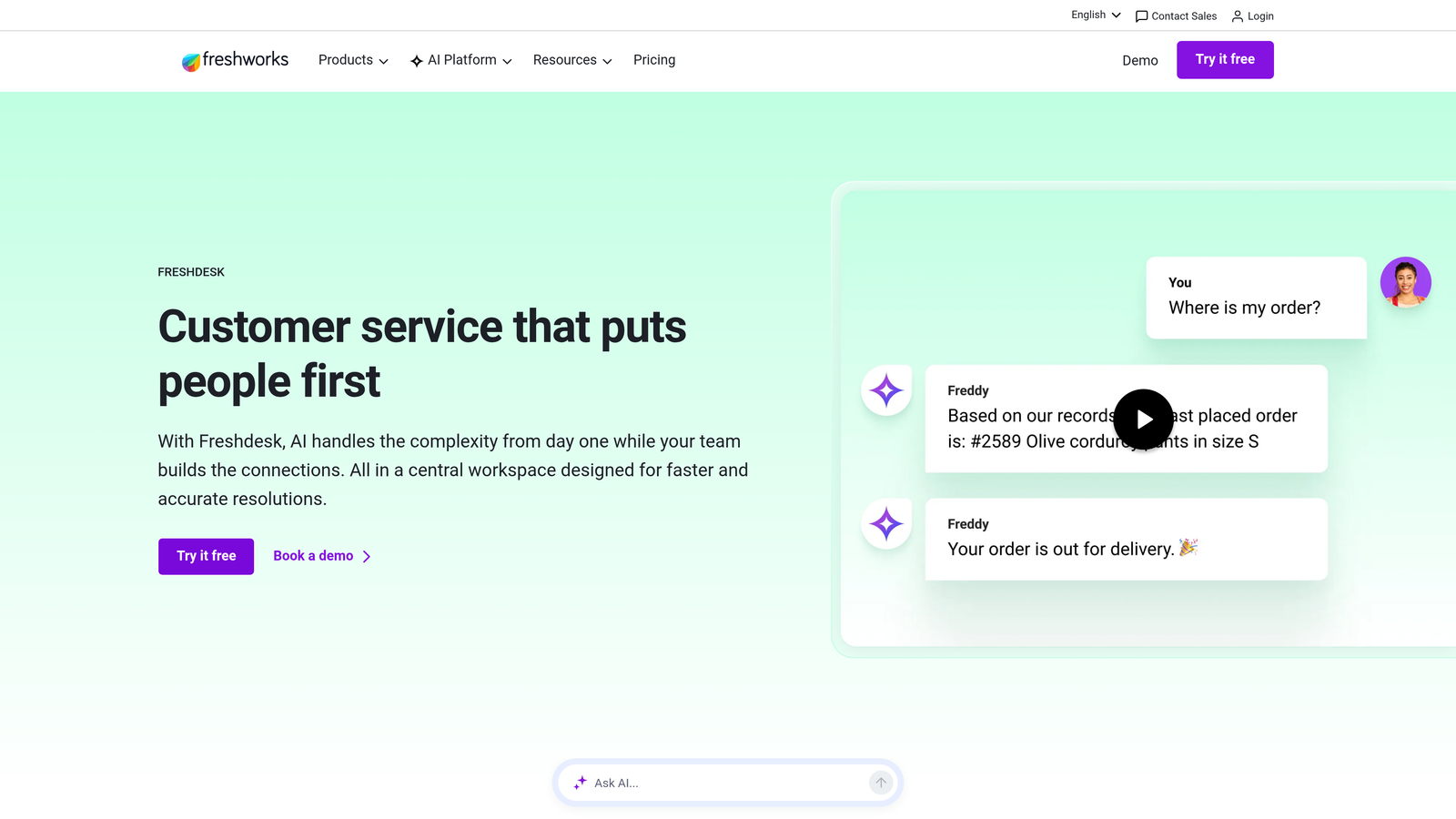
Freshdesk is a comprehensive helpdesk platform with Freddy AI spanning self-service bots, agent copilot assistance, and analytics, at price points accessible to teams that aren't ready for enterprise commitments.
Where This Tool Shines
Freshdesk's Freddy AI is thoughtfully segmented across three distinct capabilities: Freddy Self Service handles customer-facing deflection, Freddy Copilot assists human agents with drafts and suggestions, and Freddy Insights surfaces AI-driven analytics including anomaly detection. This modularity means teams can adopt the pieces that matter most to their current stage.
For teams in the Freshworks ecosystem, the value compounds. Freshdesk integrates natively with Freshsales and Freshservice, giving revenue and IT teams a shared data layer. The pricing accessibility compared to enterprise alternatives makes Freshdesk a strong option for companies scaling their support operations without a large budget.
Key Features
Freddy Self Service: AI bot for customer-facing deflection, handling common queries before they reach human agents.
Freddy Copilot: Provides human agents with AI-generated response drafts and contextual suggestions.
Freddy Insights: AI-driven analytics with anomaly detection to surface unusual patterns in support data.
Multi-Channel Support: Covers email, chat, phone, and social media within a single platform.
Freshworks Ecosystem Integration: Native connectivity with Freshsales CRM and Freshservice ITSM.
Best For
SMB and mid-market teams wanting AI capabilities without enterprise pricing or complexity. Particularly strong for companies already using other Freshworks products or those wanting a balanced mix of bot deflection and agent assistance.
Pricing
Free plan available; paid plans start at approximately $15/agent/month. Check freshdesk.com for current plan details and Freddy AI add-on pricing.
5. Tidio (Lyro AI)
Best for: Small businesses and e-commerce teams wanting fast, affordable AI chat deployment without complex setup.
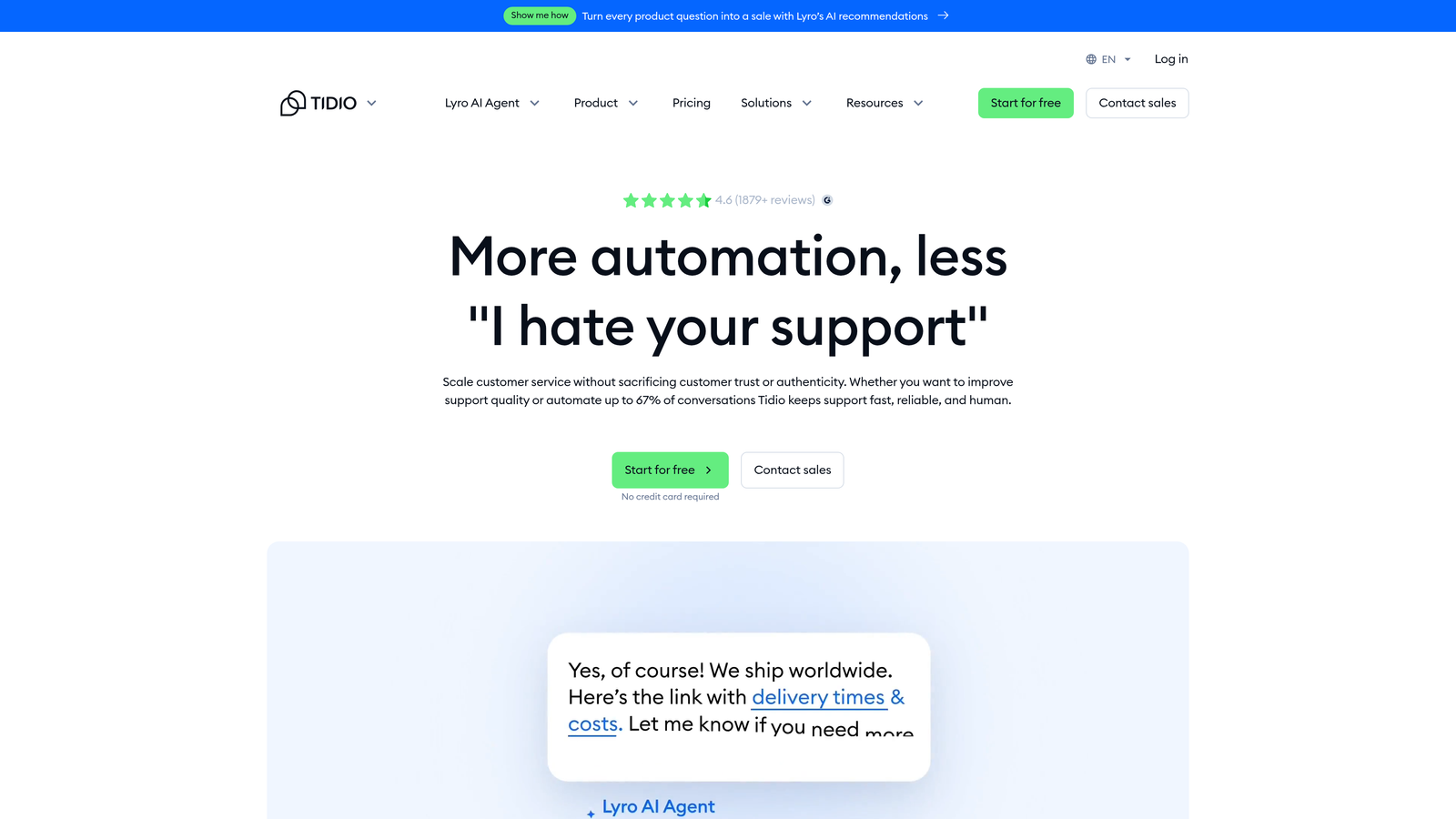
Tidio is a lightweight live chat and AI chatbot platform with Lyro, its conversational AI layer, designed for fast deployment and accessible pricing.
Where This Tool Shines
Tidio's primary strength is speed to value. The no-code configuration means teams can have Lyro handling conversations within hours, not weeks. For e-commerce businesses and small teams dealing with high volumes of repetitive questions, that fast deployment translates directly into time savings.
The platform's combined approach, bringing live chat, AI bot, and email ticketing into one interface, reduces the tool sprawl that smaller teams often struggle to manage. That said, Tidio's strength is in simplicity. Teams with complex B2B SaaS support needs, nuanced product questions, or requirements for deep CRM integration may find the capabilities limiting.
Key Features
Lyro AI Chatbot: Handles automated conversations using your existing knowledge base content.
Unified Platform: Combines live chat, AI bot, and email ticketing in a single interface.
No-Code Setup: Fast configuration without developer resources required.
E-Commerce Integrations: Native connections with Shopify, WordPress, and common e-commerce platforms.
Accessible Pricing: Among the most affordable entry points in the automated support category.
Best For
Small businesses, e-commerce brands, and teams with straightforward, high-volume support questions. Not the right fit for B2B SaaS companies with complex product support needs or requirements for deep business intelligence and autonomous resolution.
Pricing
Free plan available; Lyro AI starts at approximately $29/month. Check tidio.com for current pricing and conversation limits.
6. Drift (by Salesloft)
Best for: Revenue teams where sales qualification and support automation overlap in the same conversational interface.
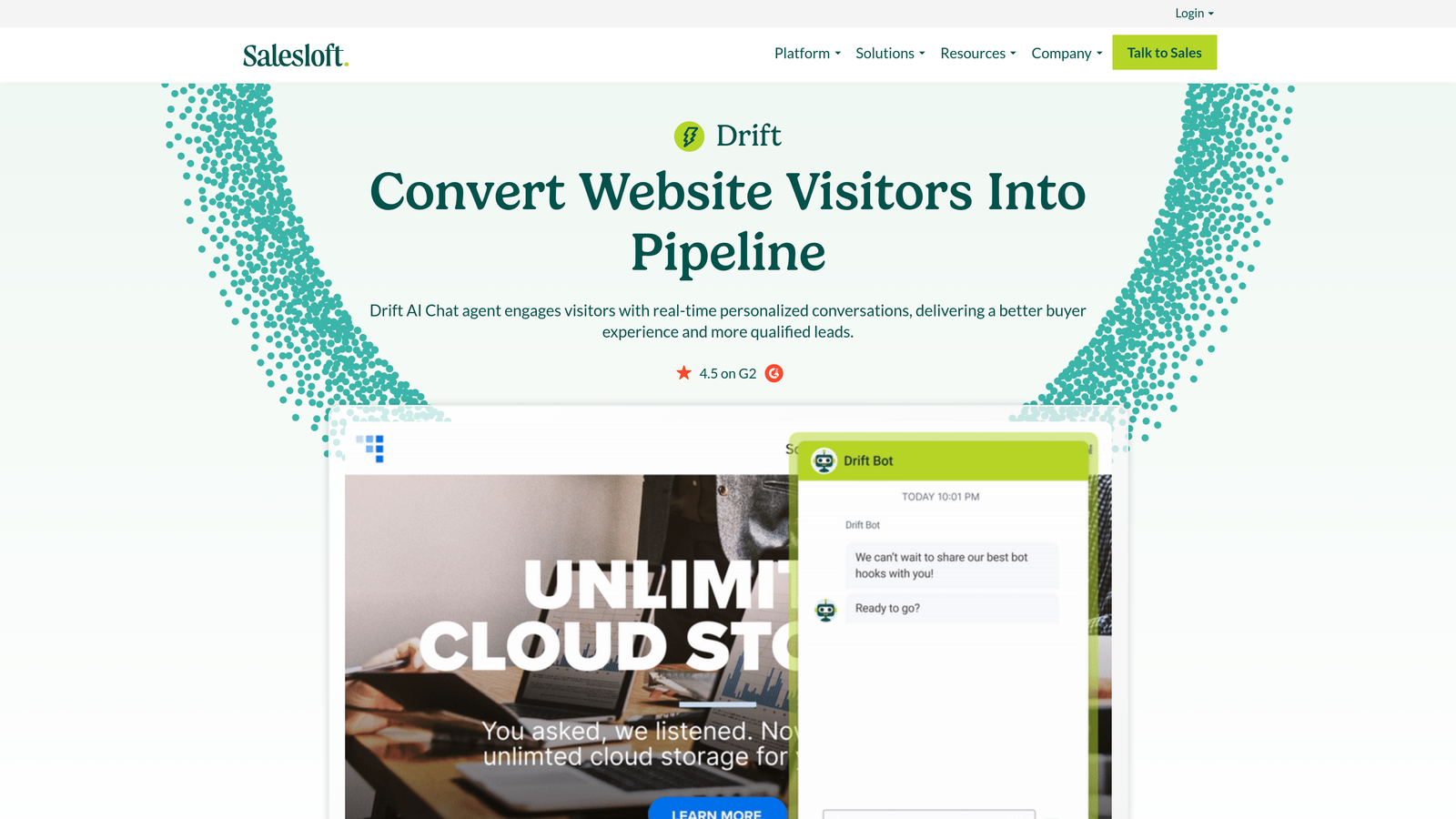
Drift is a conversational platform with AI-powered bots built primarily for revenue teams, with support automation as a secondary capability within a sales-first architecture.
Where This Tool Shines
Drift's AI bots are genuinely strong at what they were designed for: qualifying leads, booking meetings, and routing high-intent buyers to the right sales rep in real time. If your support team sits adjacent to your sales motion, and you frequently need to identify whether an inbound conversation is a support request or a sales opportunity, Drift handles that routing elegantly.
The important context: Drift was acquired by Salesloft and now operates within that ecosystem. Teams evaluating Drift purely for support automation should be clear-eyed that this is a revenue platform with support capabilities, not the reverse. If pure support automation is the goal, other tools on this list are better fits.
Key Features
Lead Qualification Bots: AI bots designed to qualify visitors and route high-intent conversations to sales reps.
Meeting Booking Automation: Schedules sales meetings directly from conversational flows without human involvement.
Conversational Landing Pages: Replaces static forms with interactive conversation experiences for ABM campaigns.
Buyer Intent Signals: Real-time routing based on account-level intent data.
CRM Integration: Deep integration with Salesloft and major CRM platforms including Salesforce and HubSpot.
Best For
B2B companies where the line between sales qualification and support is blurry, and where a single conversational interface needs to serve both functions. Not the right choice for teams wanting dedicated, autonomous support resolution as the primary use case.
Pricing
Pricing available on request. Check drift.com for current plan information and to request a quote.
7. Help Scout
Best for: Customer-centric teams that want AI to make human agents faster and more effective, not replace them.
Help Scout is a shared inbox platform with AI features designed to augment human agents, built around the philosophy that great support is fundamentally human.
Where This Tool Shines
Help Scout's AI features, Summarize, Drafts, and Assist, are well-integrated into a genuinely clean interface. AI Summarize gives agents instant context on long conversation threads. AI Drafts accelerates reply composition. AI Assist handles tone adjustment and translation. These aren't bolted-on features; they feel native to how the product works.
The platform has a strong reputation for thoughtful product design and a customer-centric culture that shows in the user experience. The tradeoff is intentional: Help Scout is not trying to autonomously resolve tickets at scale. If you need high-volume AI deflection or autonomous resolution, this isn't the tool for that job. If you want your human agents to be significantly more productive, it's worth serious consideration.
Key Features
AI Summarize: Instantly condenses long conversation threads so agents have context before they type a single word.
AI Drafts: Generates reply drafts that agents can review, edit, and send, reducing composition time.
AI Assist: Adjusts tone, fixes grammar, and handles translation within the reply interface.
Shared Inbox with Collision Detection: Prevents two agents from replying to the same conversation simultaneously.
Docs Knowledge Base: Built-in knowledge base with AI-powered search for customer self-service.
Best For
Teams that prioritize human-quality support and want AI to reduce agent workload rather than replace agents entirely. Excellent for companies where brand voice and relationship quality matter as much as resolution speed.
Pricing
Plans start at approximately $22/user/month. Check helpscout.com for current pricing and plan features.
8. Kustomer
Best for: Brands managing complex, multi-touchpoint customer relationships where full customer history informs every support interaction.
Kustomer is a CRM-native support platform with AI automation layered across a unified customer timeline, built for organizations where support and customer relationship management are inseparable.
Where This Tool Shines
Kustomer's core differentiator is its unified customer timeline. Every interaction, order, subscription event, and previous support conversation sits in a single view. AI automation in Kustomer operates across this full customer record, not just the individual ticket, which enables more contextually intelligent routing and responses than tools that treat each ticket in isolation.
This architecture is particularly valuable for brands with complex customer histories: subscription businesses, e-commerce companies with high repeat purchase rates, or any organization where understanding a customer's full journey changes how you handle their current issue. The enterprise pricing reflects the platform's depth and implementation requirements.
Key Features
Unified Customer Timeline: Consolidates all interactions, orders, and history into a single customer record visible during every support interaction.
AI Automation Across the Customer Record: Automation that draws on full customer history, not just the current ticket.
Omnichannel Support: Handles email, chat, social media, SMS, and voice within a single platform.
Intelligent Routing: Routes conversations based on customer attributes and history, not just ticket content.
No-Code Workflow Automation: Builds complex automation rules without developer involvement.
Best For
Mid-market and enterprise brands with complex customer relationships and high interaction frequency. Particularly strong for subscription businesses, retail, and any organization where customer lifetime context is essential to support quality.
Pricing
Enterprise pricing. Check kustomer.com for current plan details and to request a quote.
9. Zoho Desk
Best for: Teams in the Zoho ecosystem wanting feature-rich helpdesk capabilities with AI assistance at competitive pricing.
Zoho Desk is a feature-rich helpdesk with Zia, its AI assistant, handling sentiment analysis, ticket tagging, anomaly detection, and agent suggestions, with strong value for teams already using Zoho's broader suite.
Where This Tool Shines
Zia covers a broad range of AI assistance functions: sentiment analysis helps agents understand customer emotional state before responding, ticket tagging reduces manual categorization, and anomaly detection surfaces unusual patterns in support volume or resolution times. For teams in the Zoho ecosystem, the native integration with Zoho CRM creates a connected view of customer data across sales and support.
The pricing is genuinely competitive, particularly for Zoho suite customers who benefit from bundled pricing. Zia's capabilities are broad rather than deeply specialized, which suits teams wanting solid AI assistance across multiple functions rather than best-in-class performance on any single dimension.
Key Features
Zia AI Assistant: Handles sentiment analysis, ticket tagging, anomaly detection, and agent response suggestions.
Agent Assist: Surfaces AI-suggested responses to help agents reply faster and more consistently.
Multi-Channel Support: Covers email, chat, phone, and social media in a unified interface.
Zoho Ecosystem Integration: Deep native integration with Zoho CRM and the broader Zoho product suite.
Customizable Workflows and SLA Management: Flexible automation with SLA tracking and escalation rules.
Best For
Teams already using Zoho CRM or other Zoho products who want a helpdesk that integrates natively with their existing stack. Also a strong choice for budget-conscious teams wanting solid AI assistance without enterprise-level investment.
Pricing
Free plan for up to 3 agents; paid plans start at approximately $14/agent/month. Check zoho.com/desk for current pricing and Zia AI availability by plan.
Which Tool Is Right for Your Team?
The right automated support software depends on one foundational question: do you want AI that assists your agents, or AI that resolves tickets autonomously? Most tools in this list do the former well. Fewer do the latter.
If you want human agents to work faster with AI assistance, Help Scout, Freshdesk, and Zoho Desk are all strong options at accessible price points. If you're an enterprise team with complex workflows already built in Zendesk or Intercom, their AI layers are logical extensions of your existing investment.
For teams where support and sales qualification overlap, Drift fits a specific niche well. For brands managing complex, relationship-heavy customer histories, Kustomer's unified timeline approach is genuinely differentiated. And for small businesses or e-commerce teams wanting fast, affordable deployment, Tidio delivers speed to value.
For B2B SaaS teams that want autonomous resolution, not just assistance, the architecture matters. Halo AI was built from the ground up as an AI-first platform, with page-aware context, continuous learning, auto bug ticket creation, and business intelligence that goes well beyond support metrics. It's designed for teams that want their support system to get smarter with every interaction and connect meaningfully to the rest of their business stack.
Your support team shouldn't scale linearly with your customer base. Let AI agents handle routine tickets, guide users through your product, and surface business intelligence while your team focuses on complex issues that need a human touch. See Halo in action and discover how continuous learning transforms every interaction into smarter, faster support.