9 Best Automated Support Solutions Compared for B2B Teams in 2026
This automated support solutions comparison evaluates nine leading platforms for B2B and SaaS teams in 2026, assessing each on AI resolution quality, integration depth, scalability, and pricing transparency. Whether you're upgrading a legacy helpdesk or building a support stack from scratch, this guide helps you identify which tool best fits your team's complexity, budget, and growth stage.
 Matt PattoliFounder14 min read
B2B support teams are drowning in repetitive tickets while customers expect instant, accurate answers around the clock. The good news: automated support solutions have moved well beyond simple FAQ bots. Today's platforms resolve complex issues, guide users through products, escalate intelligently to humans, and surface business intelligence in the process.
But with dozens of tools competing for your stack, choosing the right one requires more than a feature checklist. This guide compares the best automated support solutions available in 2026, evaluated on AI capability, integration depth, scalability, and total value for B2B and SaaS teams.
Whether you're replacing a legacy helpdesk, layering AI onto an existing setup, or building a support stack from scratch, this comparison gives you a clear picture of what each platform does best — and who it's really built for. Selection criteria: AI resolution quality, integration ecosystem, ease of deployment, pricing transparency, and suitability for B2B/SaaS workflows.
1. Halo AI
Best for: B2B SaaS teams wanting an AI-first support platform with deep product context
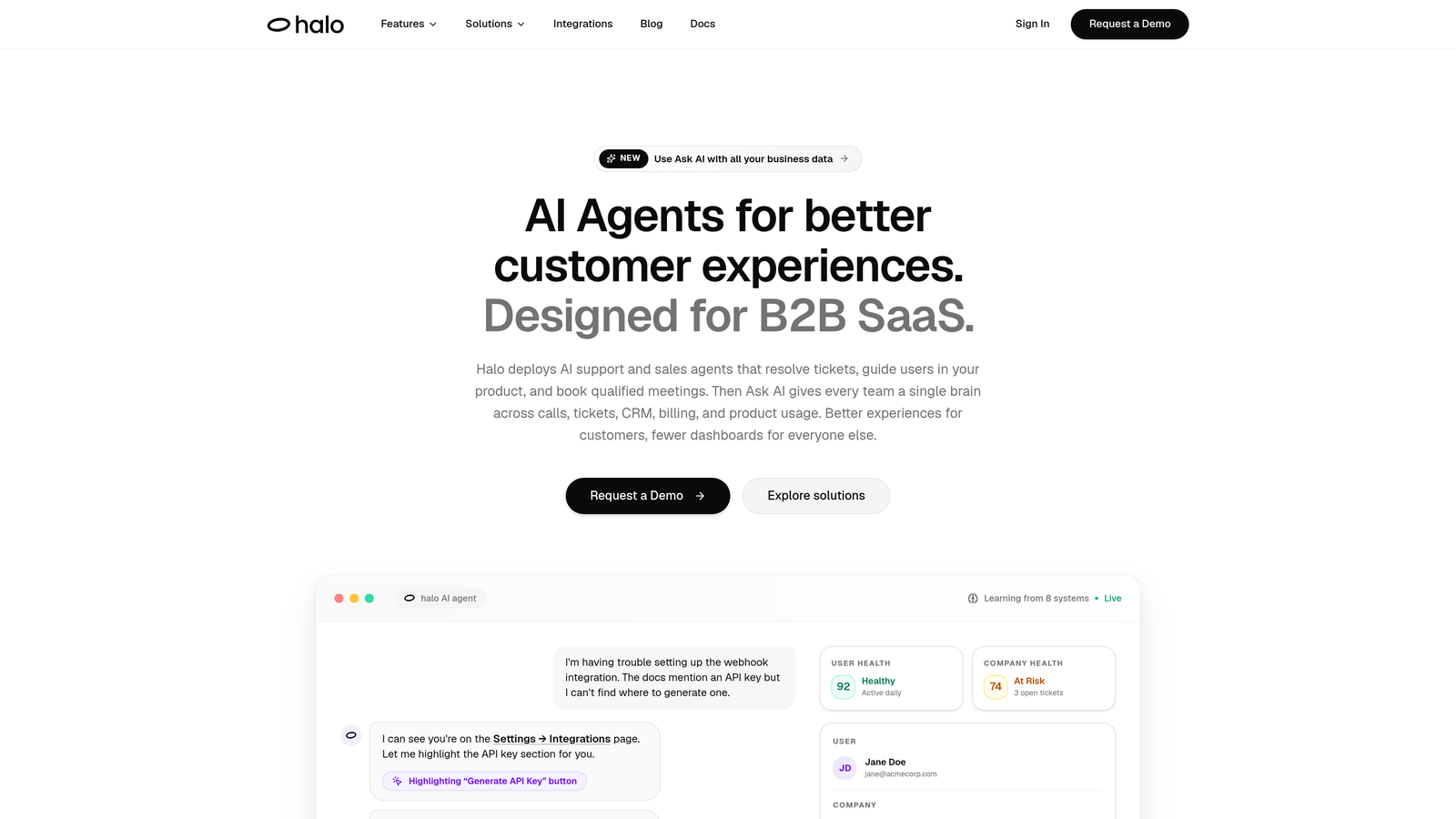
Halo AI is an AI-first customer support platform built specifically for B2B SaaS teams, deploying intelligent agents that resolve tickets, guide users through your product, and surface business intelligence signals.
Where This Tool Shines
What separates Halo AI from most platforms on this list is its architecture. Rather than bolting AI onto an existing helpdesk, Halo was built AI-first from the ground up. That distinction matters: the system learns from every resolved interaction, continuously improving resolution quality without manual retraining.
The page-aware context capability is particularly notable for SaaS teams. Halo's agents can see exactly what a user sees on screen, enabling guidance that's specific to where someone is in your product rather than generic help center responses. Pair that with automatic bug ticket creation and a smart inbox that flags customer health signals and churn indicators, and you have a platform that does more than deflect tickets.
Key Features
Page-Aware AI Agents: Agents understand the user's current screen context, delivering precise, in-product guidance rather than generic answers.
Auto Bug Ticket Creation: Automatically generates and routes bug reports to Linear or your engineering workflow when issues are detected in support conversations.
Smart Inbox with Business Intelligence: Surfaces customer health signals, revenue anomalies, and churn indicators directly from support data — turning your inbox into a strategic asset.
Live Agent Handoff: Seamlessly escalates complex conversations to human agents with full context preserved, so nothing gets repeated.
Broad Integration Ecosystem: Connects natively with Linear, Slack, HubSpot, Intercom, Stripe, Zoom, PandaDoc, and Fathom.
Continuous Learning: Every resolved interaction improves the model, so resolution quality compounds over time.
Best For
Halo AI is purpose-built for B2B SaaS product and support teams that want more than ticket deflection. It's particularly well-suited for teams that need AI to understand product context deeply, connect to an engineering workflow, and deliver intelligence beyond basic support metrics.
Pricing
Contact for pricing. Visit haloagents.ai to book a demo and get a quote tailored to your team's size and use case.
2. Intercom
Best for: Mid-market SaaS teams wanting support, onboarding, and messaging in one platform
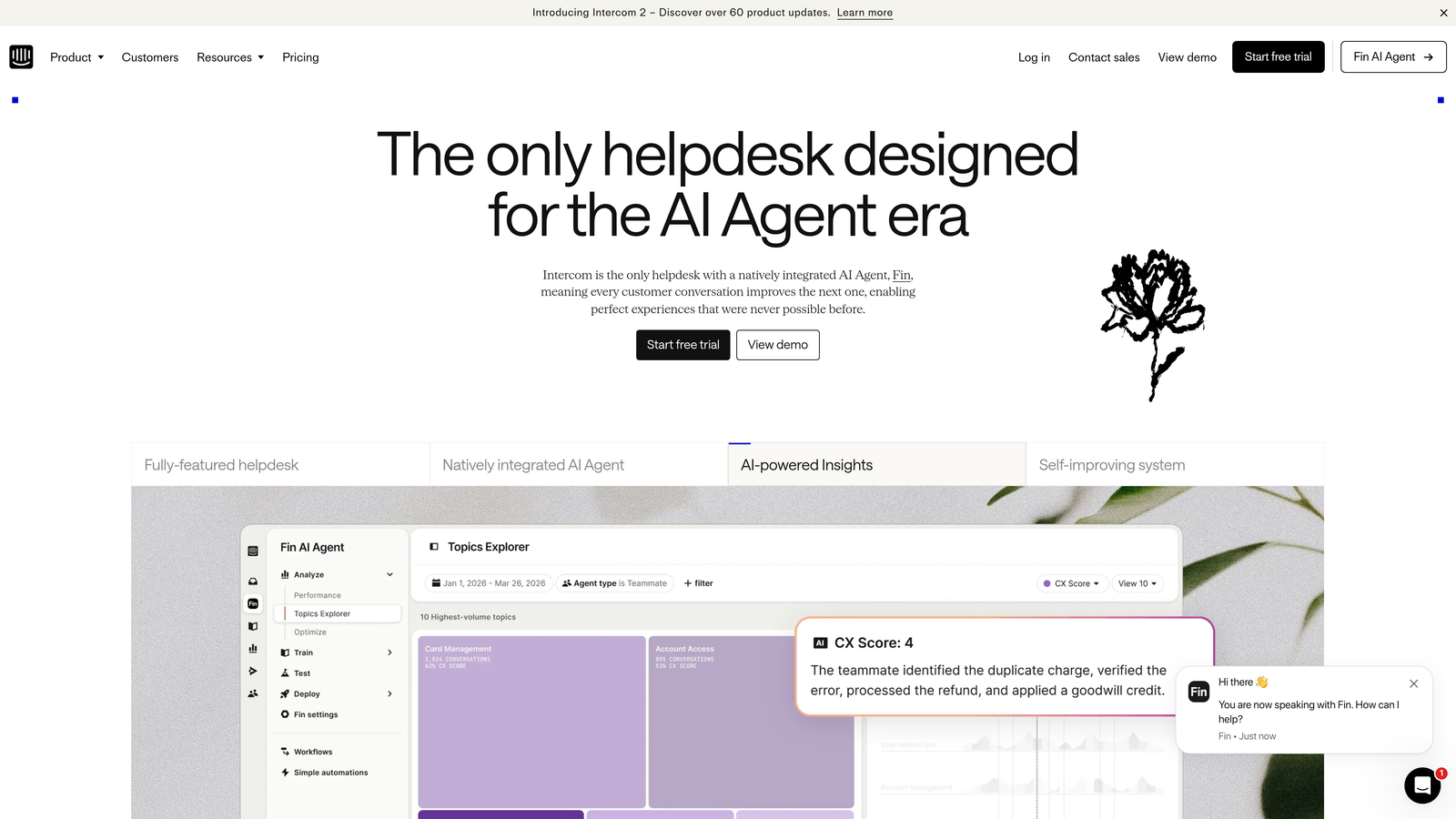
Intercom is an all-in-one customer messaging platform featuring Fin, an AI agent built on GPT-4 that resolves support queries directly from your existing help content.
Where This Tool Shines
Intercom's strength is breadth. It combines live chat, email, in-app messaging, product tours, and AI-powered support in a single platform. For teams that don't want to manage multiple point solutions for support and onboarding, that consolidation has real operational value.
Fin, Intercom's AI agent, is genuinely capable. It draws answers from your help center content and handles multi-turn conversations without requiring heavy configuration. The agent assist features also help human agents work faster during live interactions with AI-generated summaries and suggested responses.
Key Features
Fin AI Agent: Resolves customer queries using your existing help center content, handling common questions without human intervention.
Unified Inbox: Combines live chat, email, and in-app messaging into a single workspace for support teams.
Product Tours and Onboarding Flows: Enables in-product user guidance alongside reactive support, reducing onboarding friction.
300+ App Marketplace: Broad integration library covering CRMs, analytics tools, and productivity platforms.
AI Conversation Summaries: Automatically summarizes conversations for agents and provides real-time assistance during live interactions.
Best For
Mid-market SaaS companies that want a unified platform for support, onboarding, and customer messaging. Teams already using Intercom as their primary communication layer will find Fin a natural extension rather than a separate deployment.
Pricing
Starts at approximately $39 per seat per month. Fin AI resolution fees apply per resolved conversation, so costs can scale meaningfully with volume. Check Intercom's current pricing page for the latest structure.
3. Zendesk AI
Best for: High-volume enterprise support teams needing intelligent triage and agent assistance at scale
Zendesk AI is the AI capability layer built into the Zendesk Suite, adding intelligent triage, agent copilot functionality, and automated routing to one of the most established helpdesk platforms in the market.
Where This Tool Shines
Zendesk AI is most powerful for organizations that already run high-volume, multi-channel support operations. The intelligent triage automatically categorizes, prioritizes, and routes incoming tickets, reducing the manual overhead that slows large support teams. For enterprises dealing with thousands of tickets daily, that automation compounds quickly.
The Agent Copilot feature is worth highlighting. It provides real-time suggestions, macro recommendations, and next-best-action prompts during live interactions, helping agents resolve issues faster without sacrificing quality. Combined with enterprise-grade compliance and security certifications, Zendesk AI is a credible choice for regulated industries.
Key Features
Intelligent Triage: Automatically categorizes, prioritizes, and routes incoming tickets based on intent and urgency.
Agent Copilot: Delivers real-time suggestions, macro recommendations, and context during live agent interactions.
AI-Powered Self-Service Bots: Handles customer queries across web, mobile, and messaging channels before tickets are created.
Advanced Analytics: AI-driven reporting surfaces trends, bottlenecks, and performance insights across the support operation.
Enterprise Compliance: Meets enterprise security and compliance requirements, including certifications relevant to regulated industries.
Best For
Enterprise teams with existing Zendesk infrastructure, high ticket volumes, and complex multi-channel operations. Teams earlier in their support journey may find the platform's complexity and cost harder to justify.
Pricing
Suite plans start at approximately $55 per agent per month. The Advanced AI add-on is priced separately, which affects total cost for teams wanting the full AI feature set. Verify current pricing directly with Zendesk.
4. Freshdesk Freddy AI
Best for: Growing mid-market teams wanting affordable helpdesk AI within the Freshworks ecosystem
Freshdesk's Freddy AI is the built-in AI layer across the Freshworks platform, covering ticket deflection, agent assistance, and analytics insights in a more accessible package than many enterprise alternatives.
Where This Tool Shines
Freddy AI's three-layer approach covers the full support workflow. Freddy Self Service handles deflection before tickets are created. Freddy Copilot assists agents during live interactions with suggested replies and summaries. Freddy Insights surfaces trends and anomalies in support data automatically. Together, they address AI at each stage of the support lifecycle without requiring separate tools.
For teams already in the Freshworks ecosystem using Freshsales or Freshservice, the cross-product workflow integrations add meaningful efficiency. Freshdesk also tends to offer more accessible pricing than Zendesk for comparable feature sets, making it attractive for mid-market teams watching budget.
Key Features
Freddy Self Service: Deflects tickets with AI-powered answers before they reach the agent queue.
Freddy Copilot: Assists agents with suggested replies, conversation summaries, and next-best actions during live support.
Freddy Insights: Automatically surfaces trends, anomalies, and performance signals in support data.
Omnichannel Coverage: Handles email, chat, phone, and social channels from a unified workspace.
Freshworks Ecosystem Integration: Tight cross-product workflows with Freshsales and Freshservice for teams using multiple Freshworks products.
Best For
Growing mid-market teams that want AI-assisted support without enterprise-level pricing. Particularly strong for teams already invested in the Freshworks product suite.
Pricing
Free plan available. Paid plans start at approximately $15 per agent per month, with Freddy AI features available on higher tiers. Check Freshdesk's current pricing page for tier-by-tier feature breakdowns.
5. Tidio
Best for: SMBs and e-commerce businesses wanting fast deployment with live chat and AI in one tool
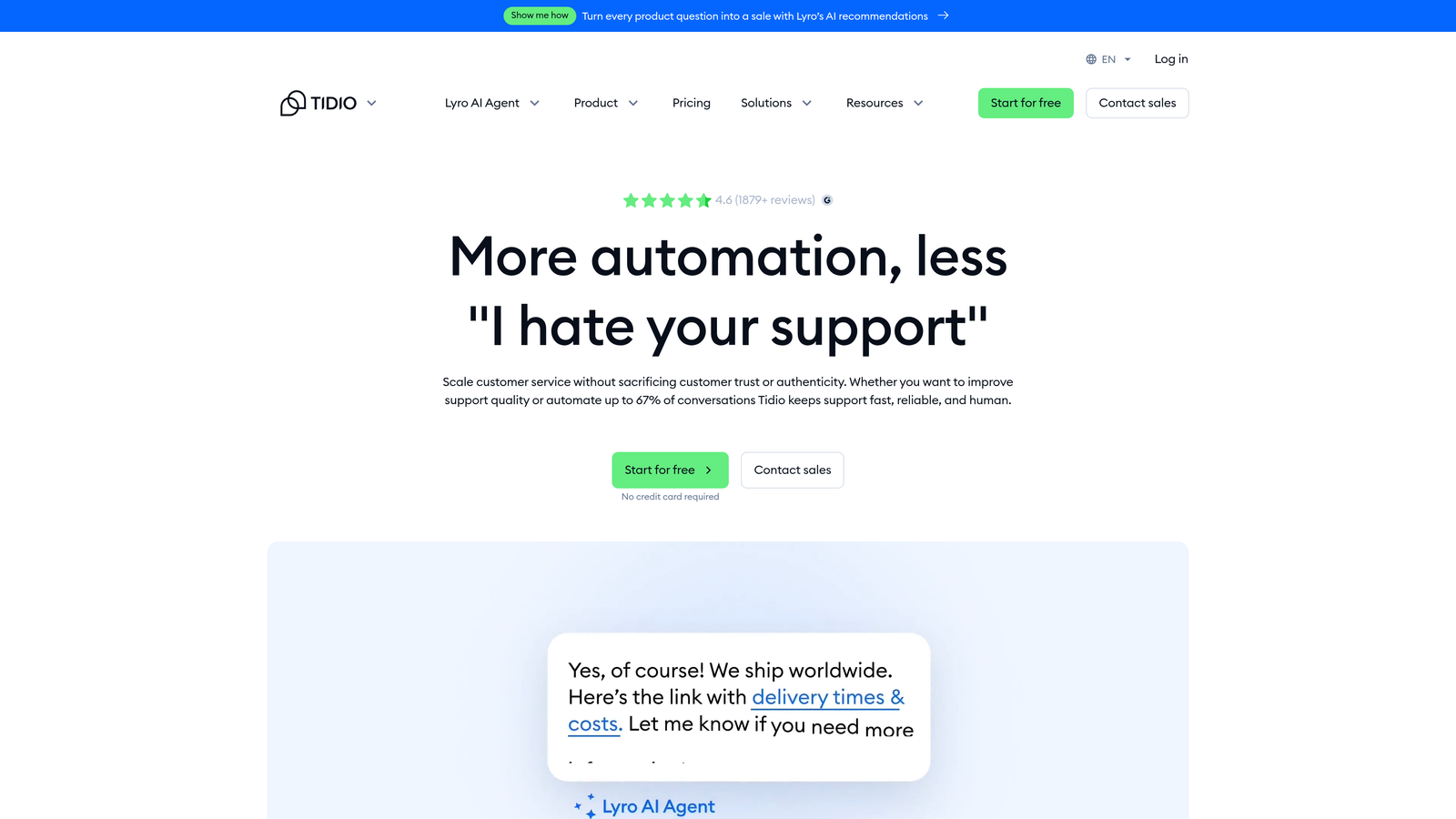
Tidio is a fast-to-deploy live chat and AI chatbot platform featuring Lyro, a conversational AI that handles common customer queries automatically with minimal setup time.
Where This Tool Shines
Tidio's primary advantage is speed. You can have a functional AI-powered chat widget live on your site in a matter of hours, not weeks. Lyro handles multi-turn conversations trained on your support content, and the live chat fallback ensures customers always have a path to a human if the AI reaches its limits.
For e-commerce teams specifically, the native Shopify and WooCommerce integrations make order-related queries a natural fit. Tidio handles the high-volume, repetitive questions that consume disproportionate time for small support teams: order status, return policies, shipping timelines.
Key Features
Lyro AI: Handles multi-turn conversations trained on your support content, resolving common queries without human intervention.
Live Chat Fallback: Ensures every conversation has a human option, preventing dead ends when AI reaches its resolution limits.
Shopify and WooCommerce Integration: Native integrations for order-related queries, making it especially useful for e-commerce teams.
Visual Flow Builder: Enables automation design without code, accessible for non-technical teams.
Multi-Channel Reach: Covers web chat, email, and Messenger from a single platform.
Best For
SMBs and e-commerce businesses that need a fast, affordable, and easy-to-deploy solution. Tidio is not designed for complex B2B enterprise workflows, but for its target audience it delivers strong value quickly.
Pricing
Free plan available. Lyro AI starts at approximately $29 per month, scaling with conversation volume. Among the most accessible entry points on this list.
6. Ada
Best for: Enterprise teams building action-oriented AI agents that complete transactions, not just answer questions
Ada is an enterprise-grade no-code AI agent platform that builds automated support agents capable of executing tasks autonomously, including account changes, lookups, and transactions.
Where This Tool Shines
Most AI support tools answer questions. Ada's agents can complete actions. That distinction matters significantly for industries like telecom, fintech, and retail, where customers need more than information: they need things done. An Ada agent can process an account change, look up a transaction, or update a subscription without transferring to a human.
The no-code builder combined with strong governance features gives enterprise teams control over brand voice, escalation logic, and agent behavior without requiring engineering resources for every update. Multilingual support across 50+ languages makes Ada a realistic choice for global operations.
Key Features
Action-Oriented AI Agents: Execute tasks autonomously, including account changes, data lookups, and transactions, not just answering questions.
No-Code Agent Builder: Build and update AI agents without engineering resources, with strong governance and brand control built in.
Multilingual Support: Handles conversations in 50+ languages, suitable for global customer bases.
Enterprise System Integrations: Deep connections with enterprise CRMs and backend systems to enable action execution.
Containment Analytics: Detailed reporting on deflection rates and containment, helping teams measure AI ROI accurately.
Best For
Enterprise organizations in telecom, fintech, or retail that need AI agents to complete transactions, not just provide answers. Ada typically requires more implementation time than lighter tools, but delivers highly customized automated workflows at scale.
Pricing
Enterprise pricing. Contact Ada directly for a custom quote based on your volume and use case.
7. Drift (Salesloft)
Best for: B2B companies where support conversations connect directly to sales pipeline and revenue workflows
Drift, now part of Salesloft, is a conversational AI platform that blends inbound support automation with B2B sales engagement and pipeline qualification.
Where This Tool Shines
Drift occupies a unique position: it treats support conversations as revenue opportunities. AI-powered chat playbooks can qualify visitors, route high-intent accounts to the right sales rep, and book meetings, all within the same conversation flow that handles support queries. For B2B teams where the line between support and sales is intentionally blurry, that capability is genuinely differentiated.
Since the Salesloft acquisition, Drift's roadmap has shifted further toward revenue intelligence, making it most valuable for teams that want their support infrastructure to contribute directly to pipeline visibility. If you're looking for a pure support automation tool, other options on this list may be a better fit.
Key Features
AI Chat Playbooks: Qualify, route, and book meetings from support conversations using automated playbook logic.
High-Intent Visitor Notifications: Real-time alerts when target accounts or high-value customers are active on your site.
Revenue Workflow Integrations: Connects with Salesforce, HubSpot, and Salesloft to sync conversation data directly into revenue workflows.
Conversational Landing Pages: Enables account-based marketing conversations triggered from campaigns.
AI Conversation Summaries: Automatically summarizes and syncs conversations to CRM records.
Best For
B2B companies where support and sales teams share the same customer conversations. Particularly strong for revenue-focused teams that want support automation to contribute to pipeline qualification and meeting booking.
Pricing
Premium and Enterprise plans available. Contact Salesloft for current pricing, as the post-acquisition structure has evolved.
8. Kustomer
Best for: Brands needing a unified customer timeline across all channels with AI automation built around complete history
Kustomer, owned by Meta, is a CRM-native customer service platform that builds a unified customer timeline across all channels and uses AI to automate workflows around complete customer history.
Where This Tool Shines
Kustomer's defining feature is context. Rather than treating each support interaction as an isolated ticket, Kustomer aggregates every interaction across every channel into a single customer timeline. When an agent or AI workflow engages with a customer, it has the full picture: purchase history, previous conversations, product usage, and sentiment signals.
The AI automation in Kustomer is built around that complete history, enabling workflows that respond intelligently to customer context rather than just the current message. For high-volume consumer brands managing complex customer relationships, that depth of context is a meaningful advantage over standard helpdesk tools.
Key Features
Unified Customer Timeline: Aggregates every interaction across all channels into a single view for agents and AI workflows.
History-Driven AI Automation: Triggers automated workflows based on complete customer data and interaction history, not just current ticket content.
Omnichannel Coverage: Handles email, chat, SMS, social, and voice from a single platform.
Custom Objects and Workflows: Enables complex business process automation tailored to your specific data model.
Meta Platform Integration: Native connections to Meta's ecosystem alongside broader CRM integrations.
Best For
D2C brands, marketplaces, and consumer companies managing high-volume, multi-channel customer relationships where historical context drives better support outcomes. Less common in pure B2B SaaS contexts, but powerful for the right use case.
Pricing
Starts at approximately $89 per agent per month for the Enterprise plan, placing it at the higher end of per-seat pricing on this list.
9. Chatbase
Best for: Developers and lean teams wanting a fast, lightweight GPT-powered chatbot trained on their own knowledge base
Chatbase is a developer-friendly tool for building GPT-powered AI chatbots trained on your own documents, URLs, or PDFs and deployed as an embeddable widget.
Where This Tool Shines
Chatbase wins on simplicity and speed. You can train a custom AI chatbot on your existing documentation, help articles, or product pages in minutes, then embed it on your site or integrate it via API. For startups or lean teams that need a deflection layer without a complex implementation project, that accessibility is the primary appeal.
The API access makes Chatbase genuinely useful for developers who want to integrate a custom AI layer into existing workflows without building a model from scratch. It's not built for complex escalation logic, business intelligence, or enterprise workflow automation, but as a focused deflection and FAQ tool, it delivers quickly.
Key Features
Custom Knowledge Base Training: Train a GPT-powered chatbot on your docs, URLs, or PDFs in minutes with no ML expertise required.
Embeddable Widget: Deploy as a customizable branded chat widget on any website with minimal technical setup.
API Access: Integrate the chatbot into custom workflows and applications for developers who need flexibility.
Multi-Source and Multilingual Support: Accepts multiple data source types and handles conversations in multiple languages.
Usage Analytics: Tracks chat volume, unanswered questions, and user satisfaction to identify knowledge gaps.
Best For
Startups, indie developers, and lean teams that need a fast, affordable AI deflection layer without enterprise complexity. Chatbase is not the right choice for teams needing sophisticated escalation design, workflow automation, or business intelligence from support data.
Pricing
Free plan available. Paid plans start at approximately $19 per month, scaling with message volume. Among the most affordable options on this list for basic AI chat functionality.
Which Tool Is Right for Your Team?
The right automated support solution depends less on which platform has the longest feature list and more on where your team is today, where you're headed, and what your customers actually need.
Here's a quick orientation by use case to help you narrow the field:
AI-first B2B SaaS teams: Halo AI is purpose-built for this context. Page-aware agents, auto bug ticket creation, business intelligence signals, and deep integrations with the tools SaaS teams already use make it the strongest fit for product-led growth companies that want support to do more than deflect.
Enterprise helpdesk with AI: Zendesk AI is the natural choice for organizations with existing Zendesk infrastructure, high ticket volumes, and enterprise compliance requirements.
All-in-one messaging and support: Intercom remains a strong option for mid-market SaaS teams that want support, onboarding, and customer messaging consolidated in one platform.
Budget-conscious growing teams: Freshdesk Freddy AI offers solid AI coverage at accessible price points, especially for teams already in the Freshworks ecosystem. Tidio is the right call for SMBs and e-commerce businesses that need something live fast.
No-code enterprise agents that take action: Ada stands apart for organizations that need AI to complete transactions, not just answer questions, particularly in telecom, fintech, and retail.
B2B revenue and support blend: Drift is uniquely positioned for teams where support conversations feed directly into sales pipeline and revenue workflows.
Developer or lean startup teams: Chatbase offers the fastest path to a functional AI deflection layer with minimal overhead and cost.
One final thought: the best tool is the one that fits your existing workflow, integrations, and growth trajectory. A platform that checks every feature box but requires a six-month implementation and a dedicated admin is rarely the right answer for a growing SaaS team.
Your support team shouldn't scale linearly with your customer base. Let AI agents handle routine tickets, guide users through your product, and surface business intelligence while your team focuses on complex issues that need a human touch. See Halo in action and discover how continuous learning transforms every interaction into smarter, faster support.